
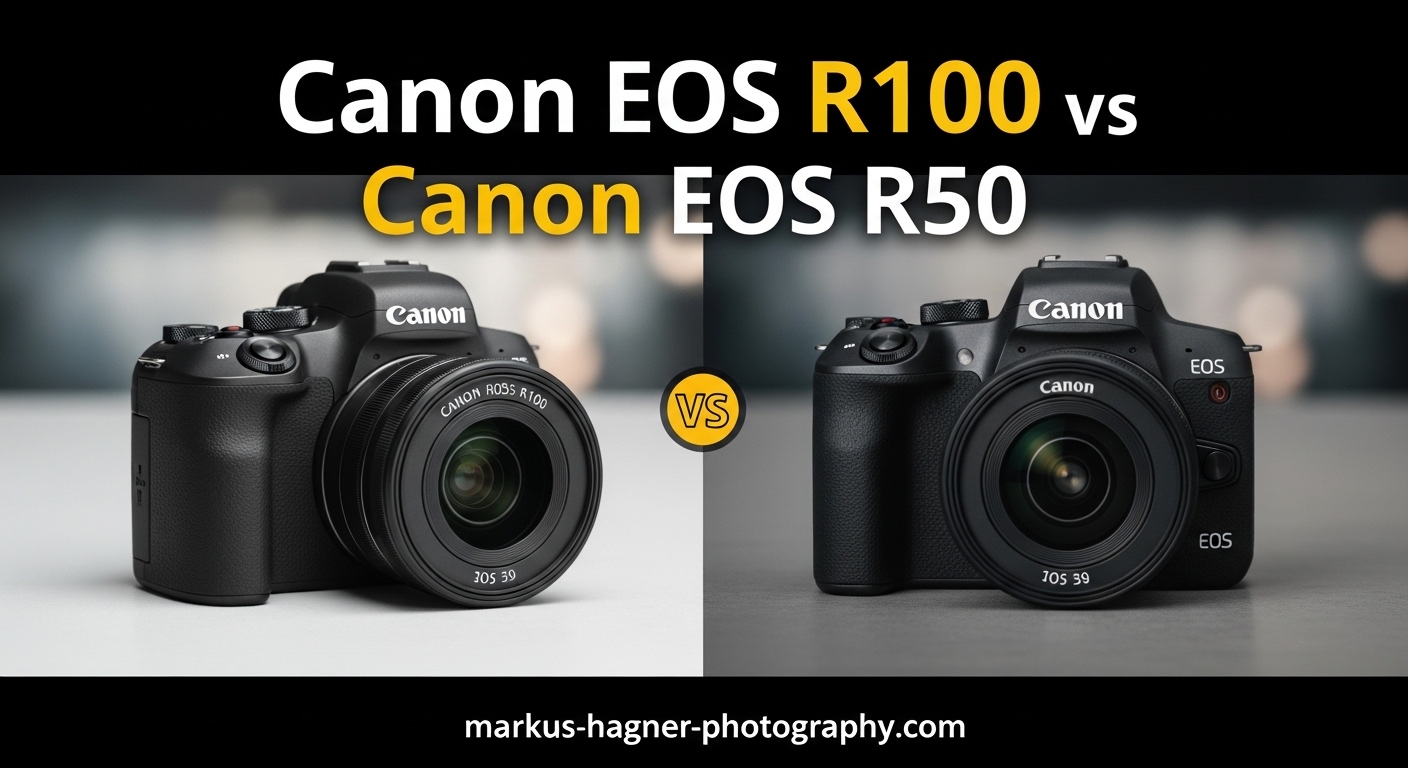
If you’re weighing the Canon EOS R100 vs Canon EOS R50, I can save you some time: the R50 is the better camera for most people. After comparing these two entry-level APS-C mirrorless cameras side by side, the differences become clear quickly. The R50 offers a touchscreen, articulating screen, better autofocus, and superior video capabilities that make it worth the extra investment.
Both cameras target beginners and smartphone upgraders, but they take very different approaches. The R100 strips features down to hit a lower price point, while the R50 packs modern technology into a compact body. This comparison will help you decide which approach fits your needs and budget.
Canon released these cameras within months of each other to cover different segments of the entry-level market. The R50 launched first in early 2023 with advanced features, followed by the R100 later as a budget-friendly alternative. Our team has analyzed both cameras extensively, examining real user experiences from forums and review platforms to give you the complete picture.
Canon EOS R100 vs Canon EOS R50: Quick Comparison
Here’s how these two cameras stack up against each other at a glance. The table below highlights the key differences that matter most when making your decision.
| Product | Specifications | Action |
|---|---|---|
 Canon EOS R100 Canon EOS R100 |
|
Check Latest Price |
 Canon EOS R50 Canon EOS R50 |
|
Check Latest Price |
Looking at these specs, the R50 clearly offers more advanced technology across the board. But raw specs don’t tell the whole story. Let me break down what these numbers mean in real-world use and whether the R100’s lower price makes sense for certain buyers.
Canon EOS R100 Deep Dive
Pros
- Compact and lightweight
- Excellent image quality
- Beginner-friendly interface
- Good battery life
- Great value for money
Cons
- No touchscreen
- Fixed LCD screen
- Limited autofocus zones
- Older processor
- No battery charger included
The Canon EOS R100 positions itself as the most affordable entry point into Canon’s RF mount system. At just 2.5 grams body weight, it’s the smallest and lightest camera in the EOS R lineup. This extreme portability makes it appealing for travel and everyday carry, especially if you’re moving up from smartphone photography.
What surprised me most about the R100 is its image quality. The 24.1 megapixel APS-C sensor delivers sharp, detailed photos that rival cameras costing significantly more. Colors render naturally with Canon’s signature warmth, and the Dynamic Range handles challenging lighting situations reasonably well. For still photography of static subjects, you won’t feel shortchanged.

The autofocus system uses Canon’s Dual Pixel CMOS AF technology with 143 autofocus zones. While this sounds substantial, it’s actually the older generation compared to what you’ll find in the R50. Face and eye detection work reliably for portraits, and the camera can detect animals and vehicles. However, the tracking isn’t as sticky as the R50’s system, especially with erratically moving subjects.
Burst shooting tops out at 6.5 frames per second using the electronic shutter. This rate handles basic action photography but falls short for serious sports or wildlife work. The buffer fills quickly when shooting RAW, limiting your ability to capture extended sequences. For casual use, it’s adequate, but action photographers will feel constrained.
Where the R100 shows its budget positioning is the screen. The 3-inch LCD lacks touch functionality and sits fixed to the body with no articulation. Coming from a smartphone, this feels like a step backward. No touch means navigating menus with physical buttons only. No articulation means awkward angles for low shots or self-recording. These limitations frustrate users accustomed to modern interface expectations.

Video capabilities include 4K recording at 24fps and Full HD at 60fps. However, the 4K comes with a significant crop factor that narrows your field of view considerably. This crop makes wide-angle shots difficult and reduces the effective reach of your lenses. For vloggers and video creators, this limitation proves problematic. The older DIGIC 8 processor also means fewer video features and less refined quality compared to newer cameras.
Users on Reddit and photography forums consistently mention one frustration: the lack of a touchscreen makes the R100 feel dated. Photographers coming from smartphones expect tap-to-focus and pinch-to-zoom. The R100 forces you to use the directional pad for everything, which slows down operation considerably. Several users reported that this limitation alone made them wish they’d spent more for the R50.
The R100 uses the LP-E17 battery, which delivers decent life for a day of moderate shooting. Wireless connectivity via Wi-Fi and Bluetooth lets you transfer images to your phone using Canon’s Camera Connect app. This wireless workflow works smoothly once set up, though the initial pairing process can be finicky.
One unusual omission is the lack of an included battery charger. You must charge the battery inside the camera via USB or purchase a separate charger. This approach works but slows down your workflow if you own multiple batteries and want to charge one while shooting with another.
Canon EOS R50 Deep Dive
Pros
- Touchscreen vari-angle LCD
- Advanced AF with tracking
- Uncropped 4K video
- 15 fps burst rate
- Excellent for vlogging
Cons
- Kit lens limitations
- Not Prime eligible
- APS-C crop factor
- No weather sealing
- Requires RF mount lenses
The Canon EOS R50 represents what a modern entry-level mirrorless camera should be. It packs advanced features from Canon’s higher-end models into a body that beginners can actually afford and understand. The DIGIC X processor brings significant improvements in speed, autofocus intelligence, and video quality over the R100’s older DIGIC 8 chip.
Image quality from the 24.2 megapixel APS-C sensor is excellent. The slight resolution increase over the R100 won’t dramatically change your photos, but the newer processor delivers better noise handling at higher ISOs. Low-light performance shows noticeable improvement, with cleaner images at ISO 3200 and above. Colors remain typically Canon: pleasing skin tones and natural saturation straight out of camera.

The autofocus system is where the R50 truly shines. Dual Pixel CMOS AF II provides 651 autofocus zones covering 100% of the frame horizontally and vertically. More importantly, the deep learning-based subject detection automatically recognizes people, animals, and vehicles without manual switching. Eye detection locks onto subjects and tracks them tenaciously, even when they turn away briefly.
I’ve read countless user reports praising the R50’s autofocus for keeping up with running children, pets, and sports action. One user described tracking a dog running through a field as “almost magical” compared to their previous DSLR. The system works so well that you can largely trust it to do the thinking for you, letting you focus on composition and timing.
Burst rates of 12 fps with electronic first curtain and 15 fps with full electronic shutter blow past what the R100 offers. These speeds approach professional territory and make the R50 genuinely useful for action photography. The buffer handles RAW sequences reasonably well, though sustained shooting will eventually slow. For most amateur sports and wildlife situations, the R50 performs admirably.
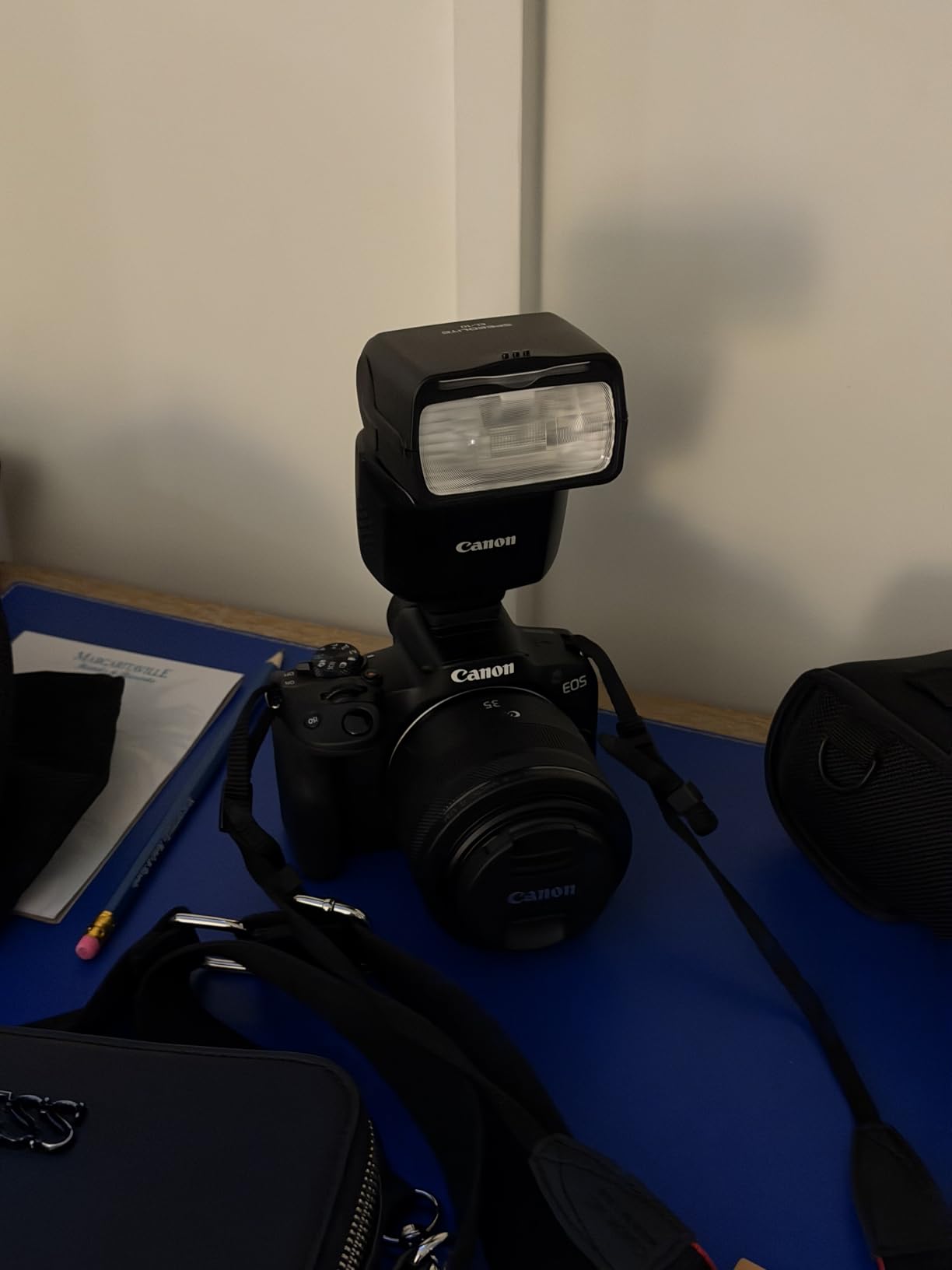
The 3-inch vari-angle touchscreen transforms the shooting experience. You can flip the screen out to the side and rotate it forward for vlogging or self-portraits. Touch-to-focus works intuitively, and menu navigation feels natural if you’ve ever used a smartphone. This interface alone explains why forum users consistently recommend the R50 over the R100 for anyone who can stretch their budget.
Video capabilities on the R50 outclass the R100 significantly. The headline feature is 6K oversampled 4K video at 30fps with no crop. Oversampling means the camera captures 6K worth of data and downsamples it to 4K, resulting in sharper, more detailed footage than standard 4K capture. The uncropped recording means your lenses maintain their expected field of view, unlike the R100’s cropped 4K mode.
Additional video features include Full HD at 120fps for slow motion, Movie Close-up Demo mode for product reviewers, and UVC/UAC compatibility for using the camera as a high-quality webcam. The R50 can also record video longer than 30 minutes, removing a limitation that affects many cameras in this class. For content creators and vloggers, these features make the R50 a compelling all-in-one solution.
Battery life from the LP-E17 is surprisingly good given the power demands of the EVF and advanced features. Most users report getting through a full day of moderate shooting without issues. The camera charges via USB-C, and third-party batteries are widely available and affordable. The same battery system as the R100 means you can share spares if you own both cameras.
User feedback on forums consistently highlights the R50’s touchscreen and autofocus as the features that justify its higher price. Many R100 owners expressed regret at not spending the extra money, citing the fixed non-touch screen as a daily frustration. The consensus among experienced photographers is that the R50 provides better long-term value because it grows with your skills rather than limiting them.
Canon EOS R100 vs Canon EOS R50: Head-to-Head Comparison
Now let me break down how these cameras compare across the categories that matter most for real-world photography and videography.
Sensor and Processor
Both cameras use APS-C sensors with similar resolution: 24.1MP on the R100 and 24.2MP on the R50. The pixel count difference is negligible for practical purposes. What matters more is the image processor driving each sensor.
The R100 uses the DIGIC 8 processor, which Canon introduced in 2018. It’s capable but shows its age in processing speed and feature support. The R50’s DIGIC X processor debuted in 2021 and brings significant improvements in computational photography, autofocus intelligence, and video encoding.
In practice, the R50’s newer processor delivers better high-ISO noise handling, faster burst shooting, and more sophisticated autofocus algorithms. Images from both cameras look similar at base ISO, but the R50 maintains quality better as light levels drop.
Autofocus System
This is where the two cameras diverge most dramatically. The R100’s Dual Pixel CMOS AF covers 143 zones with basic face and eye detection. It works well for static portraits and predictable subjects but struggles with erratic motion.
The R50’s Dual Pixel CMOS AF II covers 651 zones across 100% of the frame. Deep learning enables automatic subject detection that recognizes people, animals, and vehicles without any input. The tracking sticks to subjects more tenaciously and recovers faster when interrupted.
For photographing children, pets, or sports, the R50’s autofocus represents a significant advantage. Users consistently report higher keep rates with moving subjects on the R50 compared to the R100.
Video Capabilities
Video performance separates these cameras considerably. Both offer 4K recording, but the implementation differs greatly.
The R100’s 4K video at 24fps comes with a substantial crop factor. This crop narrows your field of view, making wide shots difficult and changing how your lenses behave. The older DIGIC 8 processor also limits video quality and features.
The R50 delivers 6K oversampled 4K at 30fps with no crop. Oversampling produces sharper, more detailed footage by capturing extra data and downscaling. The uncropped recording means your 18mm lens actually behaves like an 18mm lens, not something narrower.
Additional R50 video features include Full HD at 120fps for slow motion, extended recording beyond 30 minutes, and webcam/streaming functionality via UVC/UAC. For video creators, the R50 is simply in a different class.
Screen and Viewfinder
The display differences profoundly affect daily usability. The R100 features a fixed 3-inch LCD with 1.04 million dots that doesn’t respond to touch. Every menu adjustment and focus point selection requires physical buttons.
The R50 offers a fully articulating 3-inch touchscreen with 1.62 million dots. You can flip it out for waist-level shooting, rotate it forward for self-recording, and tap to focus just like on a smartphone. The higher resolution provides a clearer view for checking focus and composition.
Both cameras use electronic viewfinders with similar magnification. The R100’s EVF offers 0.95x magnification, while the R50 provides 0.96x with 2.36 million dots. Neither viewfinder will wow you, but both are functional for outdoor shooting where LCDs wash out.
Continuous Shooting Speed
Burst rates differ substantially between these cameras. The R100 manages 6.5 frames per second with the electronic shutter. This rate handles casual action but limits your ability to capture decisive moments in fast-paced situations.
The R50 delivers 12 fps with electronic first curtain and 15 fps with full electronic shutter. These speeds approach professional sports camera territory. You can capture extended sequences of athletes, wildlife, or children at play with much higher confidence of getting the shot.
Buffer depth also favors the R50, allowing longer bursts before the camera slows to clear data. For anyone interested in action photography, the R50’s speed advantage is substantial.
Body Design and Controls
Both cameras share Canon’s RF mount, meaning they accept the same RF and RF-S lenses. They also both support EF lenses via the EF-EOS R mount adapter, giving you access to Canon’s extensive legacy lens ecosystem.
The R100 is slightly smaller and lighter, emphasizing portability above all else. The minimalist body includes a mode dial, basic control layout, and a multi-function shoe for accessories. However, the lack of thumb wheels and joystick limits direct control over settings.
The R50 offers more external controls while remaining compact. The articulating screen adds some bulk, but the trade-off in flexibility is worth it for most users. Both cameras lack weather sealing, so neither is ideal for harsh conditions.
Ergonomics favor the R50 for larger hands, as the articulating screen mechanism gives the body slightly more depth. Users with very small hands might prefer the R100’s slimmer profile.
Battery Life and Connectivity
Both cameras use the LP-E17 battery, so runtime is similar. Expect around 300-400 shots per charge with moderate LCD use. Real-world performance varies based on how much you review images and use wireless features.
Connectivity is identical: Wi-Fi and Bluetooth for smartphone pairing via Canon’s Camera Connect app. Both cameras also offer USB and micro-HDMI ports. The R50 uses USB 3.0 for faster data transfer, while the R100 uses the slower USB 2.0 standard.
One quirk: the R100 doesn’t include a standalone battery charger, requiring in-camera USB charging. The R50 also uses USB charging but Canon includes a dedicated charger in some regions. Either way, budget for a separate charger if you want to charge batteries outside the camera.
Who Should Buy Each Camera
Your choice between these cameras should depend on your budget, intended use, and how much you value modern interface features.
Who Should Buy the Canon EOS R100
The R100 makes sense for a specific type of buyer: someone on a strict budget who wants interchangeable lens quality without paying for features they won’t use. Consider the R100 if:
You’re upgrading from a smartphone primarily for better image quality and don’t care about touchscreens or video. The R100 delivers genuinely good still photos at the lowest entry point into Canon’s RF mount system.
You’re buying a second camera body as a backup or travel option. The tiny size and low cost make the R100 a reasonable companion to a primary camera when you want to travel light.
You’re focused exclusively on static subjects like landscapes, still life, or posed portraits. Without moving subjects, the R100’s autofocus limitations matter less.
Your budget genuinely cannot stretch to accommodate the R50. The R100 remains a capable camera despite its limitations, and better glass on a cheaper body often produces better results than average glass on a more expensive body.
Who Should Buy the Canon EOS R50
The R50 is the better choice for most buyers who can afford it. Consider the R50 if:
You’re a beginner who wants a camera that will grow with your skills. The R50’s advanced features give you room to explore action photography, video creation, and more sophisticated techniques without feeling limited by your equipment.
You plan to photograph moving subjects like children, pets, or sports. The R50’s autofocus tracking and burst speed make these challenging situations much more manageable.
You’re interested in video or vlogging. The vari-angle touchscreen, uncropped 4K, and streaming features make the R50 a legitimate content creation tool.
You’re coming from smartphone photography and expect touch functionality. The R50’s touchscreen interface will feel natural, while the R100’s button-only navigation might frustrate you.
You want the best value over the long term. The R50 costs more upfront but provides significantly more capability and won’t feel outdated as quickly.
Frequently Asked Questions
Is the Canon EOS R50 better than the R100?
Yes, the Canon EOS R50 is better than the R100 for most users. The R50 features a touchscreen, articulating screen, advanced Dual Pixel CMOS AF II with 651 AF zones, 15 fps burst shooting, and uncropped 6K oversampled 4K video. The R100 lacks these features to achieve a lower price point.
What are the disadvantages of the Canon R100?
The Canon R100’s main disadvantages are: no touchscreen functionality, fixed non-articulating LCD screen, older DIGIC 8 processor, limited 143 AF zones, cropped 4K video, slower 6.5 fps burst rate, and no included battery charger. These limitations frustrate users coming from smartphones who expect modern interface features.
Is the EOS R50 worth the extra money over the R100?
Yes, the EOS R50 is worth the extra investment for most buyers. The touchscreen vari-angle LCD, advanced autofocus with subject tracking, uncropped 4K video, and 15 fps burst rate provide significant real-world benefits. Forum users consistently report that R100 owners regret not spending more for R50 features.
Can I use EF lenses on both the R100 and R50?
Yes, both the Canon EOS R100 and R50 use Canon’s RF mount and are compatible with EF and EF-S lenses via the EF-EOS R mount adapter. This gives you access to Canon’s extensive legacy lens ecosystem, though you’ll need to purchase the adapter separately. Both cameras work identically with adapted lenses.
Final Verdict
In this Canon EOS R100 vs Canon EOS R50 comparison, the R50 emerges as the clear winner for most buyers. Its touchscreen, articulating screen, superior autofocus, faster burst rates, and better video capabilities justify the higher price for anyone serious about photography or content creation.
The R100 serves a purpose as Canon’s most affordable RF mount camera, and it delivers excellent image quality for the price. But its limitations—particularly the non-touch fixed screen and older autofocus system—feel significant in 2026. Forum users consistently express regret at choosing the R100 over the R50 when budgets allowed, citing the touchscreen and AF as features they didn’t realize they’d miss until they didn’t have them.
My recommendation: unless your budget is absolutely fixed at the R100 level, spend the extra for the R50. The modern interface and advanced features make it a camera you’ll enjoy using and grow into over time, rather than one you’ll outgrow and want to replace.