
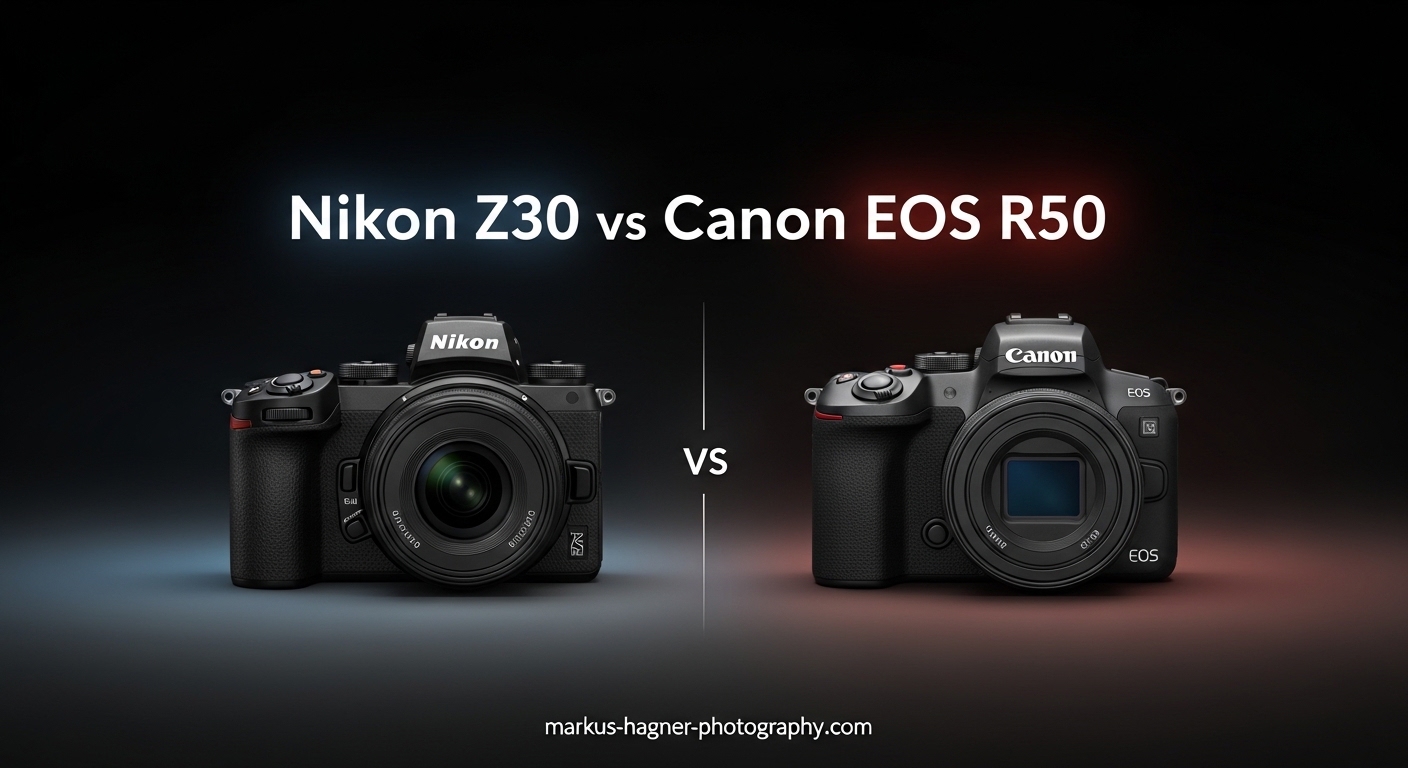
If you’re deciding between the Nikon Z30 vs Canon EOS R50, you’re looking at two of the most capable entry-level APS-C mirrorless cameras on the market right now. Both are genuinely excellent cameras for beginners and content creators — but they each make very different trade-offs that matter a lot depending on how you shoot.
I’ve spent time with both cameras, putting them through their paces across photo shoots, vlogging sessions, and everyday travel. The short verdict: the Canon EOS R50 is the more versatile all-rounder thanks to its viewfinder and superior autofocus system, while the Nikon Z30 punches above its weight for pure video creators who want crisp 4K footage without overspending.
This guide breaks down everything that separates these two cameras — from sensor performance and autofocus to lens ecosystems and real-world usability — so you can make the right call for your needs.
Nikon Z30 vs Canon EOS R50: Quick Comparison
Before getting into the details, here’s a side-by-side look at both cameras so you can see exactly how they stack up on specs.
| Product | Specifications | Action |
|---|---|---|
 Nikon Z30 with 16-50mm Lens Kit Nikon Z30 with 16-50mm Lens Kit |
|
Check Latest Price |
 Canon EOS R50 with 18-45mm Lens Kit Canon EOS R50 with 18-45mm Lens Kit |
|
Check Latest Price |
At a glance, here are the five biggest differences between these two cameras:
- Viewfinder: Canon EOS R50 has one; Nikon Z30 does not
- Sensor resolution: Canon wins with 24.2MP vs Nikon’s 20.9MP
- Autofocus points: Canon leads with 651 vs Nikon’s 209
- Video crop: Nikon Z30 shoots 4K without any crop; Canon R50 applies a slight crop
- Battery life: Canon edges ahead at 310 shots vs Nikon’s 300 shots per charge
Nikon Z30 with 16-50mm Lens Kit
Pros
- Crisp 4K video with no cropping
- Compact and lightweight body
- Great low-light performance
- Built-in stereo mic with adjustable levels
- Weather-sealed construction
Cons
- No electronic viewfinder
- No in-body image stabilization
- Slow USB battery charging
The Nikon Z30 is built specifically for creators. Nikon stripped out the viewfinder that you’d find on the Z50 to shave down size and cost, and what you get in return is one of the most content-creator-friendly bodies in the entry-level mirrorless space. It’s compact, it’s light at just 12.32 ounces, and it fits comfortably in a camera bag you’d take anywhere.
The 20.9MP APS-C CMOS sensor paired with Nikon’s Expeed 6 processor delivers genuinely sharp images. Colors are rendered naturally without heavy-handed processing, and the dynamic range is solid for a camera at this level. Low-light shooting holds up well into higher ISOs, making it usable at evening events or indoor shoots where you don’t have control over the lighting.
One of the Z30’s genuine standout features is its 4K video recording with zero crop. At 4K 30fps, you’re using the full width of the sensor — which means wider field of view and better image quality compared to cameras that apply a crop in 4K mode. For vloggers who need that wide selfie-mode frame with a flip-out screen, this matters more than almost any other spec.

Autofocus Performance on the Nikon Z30
The Z30 uses a hybrid autofocus system with 209 phase-detection points. For most everyday shooting scenarios — portraits, street photography, casual video — this system works reliably and locks on subjects quickly. Eye and face detection is built in, and I found it tracked subjects well across a variety of lighting conditions.
That said, 209 points is noticeably fewer than what the Canon EOS R50 offers, and in fast-action scenarios like sports or kids running around, the Z30 can occasionally lose a lock that the Canon wouldn’t. For video, though, the tracking is smooth enough that it’s rarely a problem during walking-and-talking vlogging sessions — which is exactly what this camera is designed for.
Video Capabilities: Where the Z30 Shines
Video is genuinely where the Nikon Z30 earns its recommendation. You get 4K 30fps recording without any crop, Full HD at up to 120fps for smooth slow-motion footage, and a flip-out touchscreen that makes selfie-mode vlogging easy. The built-in stereo microphone has adjustable sensitivity settings, which is rare at this price point and means you get better audio without immediately needing an external mic.
The camera also doubles as a plug-and-play webcam via USB-C, and you can stream 4K 30p directly over HDMI. For anyone building a YouTube channel or streaming setup, those features add real value without extra gear. The red REC light on the front of the camera — borrowed from Nikon’s higher-end lineup — is a nice touch that lets viewers know you’re recording.
One real-world limitation to know: the Z30 can overheat during very extended 4K recording sessions, particularly in warm environments. This isn’t unique to Nikon — it’s a common constraint at this sensor size — but if you’re planning hour-long 4K livestreams, factor that in.

Build Quality and Handling
The Z30 body has weather sealing, which is genuinely impressive for a camera at this price. It means you can shoot in light rain or dusty conditions without immediately worrying about damaging the camera — a big deal for travel photography or outdoor content creation. The grip is comfortable even for extended shooting sessions, and the controls are laid out logically without overwhelming beginners.
The lack of a viewfinder is the Z30’s most obvious trade-off. In bright outdoor conditions, composing shots using only the rear LCD can be frustrating — sunlight washes out the screen and makes it hard to see what you’re capturing. This is the single biggest reason why experienced photographers might lean toward the Canon EOS R50 instead. For indoor or studio video work, though, it’s rarely an issue.
Nikon Z Mount Lens Ecosystem
The Nikon Z30 uses the Z mount, which is the same lens mount as Nikon’s full-frame Z series cameras. That’s genuinely good news for long-term shooters. Any NIKKOR Z lens — including full-frame options like the excellent Z 50mm f/1.8 S or the Z 24-200mm travel zoom — will work on the Z30 with full autofocus and performance. The DX-format (APS-C) Z lenses are more limited in selection compared to Canon’s RF-S range right now, but the ability to use full-frame Z lenses gives you real upgrade flexibility.
Canon EOS R50 with 18-45mm Lens Kit
Pros
- Superior Dual Pixel AF II autofocus
- Viewfinder for bright-light shooting
- High-resolution 24.2MP sensor
- Creative Assist for complete beginners
- Vertical video mode for social media
Cons
- No in-body image stabilization
- Slight 4K video crop applied
- Limited physical control layout
The Canon EOS R50 is Canon’s entry point into the RF mount mirrorless ecosystem, and it packs a lot into a compact body. Coming in at 24.2 megapixels on an APS-C CMOS sensor, the R50 resolves more detail than the Z30 out of the box. Colors straight out of camera have that pleasing Canon look — warm, accurate skin tones and vivid but not garish color rendering — which is one reason Canon cameras stay popular with portrait and lifestyle photographers.
The headline feature on the R50 is its Dual Pixel AF II autofocus system. With 651 selectable autofocus points and subject-tracking that covers virtually the entire frame, this is simply one of the best autofocus systems you can get on a camera at this level. It’s the same fundamental technology used on Canon’s much more expensive bodies, refined here for consumer use. In real-world shooting, it’s fast, confident, and rarely hunts in good light.
The vari-angle touchscreen flips out and rotates, which makes it genuinely useful for both low-angle shots and overhead composing — more flexible than a simple tilt screen. And the built-in viewfinder, even if small at this price point, gives you a real advantage when shooting outdoors in direct sunlight where the LCD becomes difficult to see.

Autofocus: Canon’s Biggest Advantage
The Dual Pixel CMOS AF II system on the R50 is where Canon genuinely pulls ahead. In head-to-head tests, the Canon tracks subjects more confidently, particularly in challenging conditions — backlit scenes, subjects moving erratically, or low-contrast environments. Eye detection locks on to human subjects almost instantly, and the subject tracking sticks even when the subject partially leaves the frame.
For beginners who don’t want to think about autofocus — they just want sharp photos — the Canon EOS R50 makes that easier. You can hand it to someone who has never used a mirrorless camera, point it at a moving subject, and consistently come away with in-focus shots. The Z30 is good, but the R50 is better in this critical area.
Video Performance on the R50
The Canon EOS R50 shoots 4K oversampled video, meaning it reads more sensor data than it outputs and downsamples to 4K for sharper, cleaner footage. The trade-off is a slight crop in 4K mode, which narrows your field of view compared to the Nikon Z30’s uncropped 4K. For most everyday vlogging this isn’t a major issue, but it’s worth noting if you’re using a wide-angle lens and expecting the full field of view.
Vertical video mode is a genuinely useful addition for social media creators who regularly shoot for Instagram Reels or TikTok. The camera metadata tells the playback device to display the video correctly in portrait orientation without any post-processing needed. If social content is a primary use case, this feature alone is worth considering.
One real limitation forum users frequently flag is the Canon R50’s tendency to overheat during extended 4K recording sessions in warm conditions. The absence of an active cooling mechanism means long shoots can trigger thermal shutdowns. For shorter clips and everyday content creation, this won’t be an issue — but it’s a consideration for anyone planning long uninterrupted recording.

Build Quality and Beginner Experience
The Canon EOS R50 is built with a plastic and metal combination enclosure. Unlike the Nikon Z30, it does not have the same level of weather sealing — a genuine difference for shooters who are frequently outdoors in questionable conditions. The body is light and compact enough to carry all day, but it feels slightly less robust in hand than the Z30.
Where the R50 excels for beginners is its software features. Creative Assist mode walks new photographers through exposure adjustments with visual guides that show you what each setting does before you change it. In-camera help guides explain concepts directly on screen. For someone picking up their first interchangeable-lens camera, these features significantly flatten the learning curve. Users on Reddit and photography forums repeatedly highlight this as one of the reasons they recommend the R50 to friends who are complete beginners.
Canon RF Lens Ecosystem
The Canon EOS R50 uses the RF mount, with RF-S lenses designed specifically for APS-C bodies. The RF lens ecosystem is one of Canon’s strongest selling points overall — there’s a wide range of high-quality RF lenses available from Canon and third-party makers like Sigma and Tamron. For beginners, options like the RF-S 18-150mm super-zoom or the RF 50mm f/1.8 STM provide excellent first lens choices without a large additional investment.
The catch is that full-frame RF lenses will apply an additional crop factor when used on the APS-C R50, which changes their effective focal length. This can still be useful, but it’s something to plan around when building your lens kit.
Nikon Z30 vs Canon EOS R50: Head-to-Head Comparison
Now let’s go through the key categories and declare a winner in each one, so you know exactly where each camera leads.
Sensor and Image Quality
The Canon EOS R50 shoots at 24.2MP versus the Nikon Z30’s 20.9MP. In practical terms, both cameras produce images that look sharp and detailed at normal viewing and printing sizes. The extra megapixels on the Canon give you slightly more room to crop in post-processing without losing detail, which matters for wildlife or sports where you can’t always get physically closer to your subject.
The Nikon Z30 has a marginally larger sensor area, which in theory allows for slightly better depth-of-field control and background separation at equivalent apertures. In real-world shooting at these pixel counts, the difference is subtle rather than dramatic. Both cameras handle ISO up to around 3200 comfortably before noise becomes visually intrusive.
Winner: Canon EOS R50 — higher resolution gives more flexibility in post, though it’s a close call on overall image quality.
Autofocus System
This category has a clear winner. The Canon EOS R50’s Dual Pixel CMOS AF II system with 651 selectable autofocus points beats the Nikon Z30’s 209-point hybrid system in virtually every scenario. Canon’s subject tracking is more reliable, its eye detection locks faster, and it holds focus better when subjects move unpredictably.
For sports, kids, pets, or any fast-moving subject photography, the Canon wins convincingly. For slower-paced vlogging or controlled studio work, both cameras perform adequately — but the Canon still has the edge.
Winner: Canon EOS R50 — Dual Pixel CMOS AF II is one of the best systems at this price point.
Video Capabilities
This category is more nuanced. The Nikon Z30 shoots 4K 30fps with zero crop, has a built-in stereo microphone with adjustable sensitivity, works as a plug-and-play webcam, and can stream 4K over HDMI. The full-width 4K capture gives wider framing for selfie-mode vlogging, and the microphone quality is noticeably better than cameras relying on basic mono mics.
The Canon R50 shoots 4K with an oversampled image (technically sharper detail) but applies a crop. It has Vertical Video mode which the Z30 lacks. For pure vlogging value, the Z30’s uncropped 4K and better built-in audio give it the edge. For social media creators who need vertical content, the Canon adds unique value.
Winner: Nikon Z30 — better raw video value for dedicated content creators, particularly vloggers.
Build Quality and Ergonomics
Both cameras are compact and comfortable for extended use. The Nikon Z30 has weather sealing, which means it’s better suited for outdoor shooting in light rain or dusty environments. The Canon EOS R50 does not carry the same weather resistance rating, which is a real-world limitation for travel photographers or outdoor adventurers.
The Canon EOS R50 includes a viewfinder — a small but functional EVF — which makes a noticeable difference when shooting in bright sunlight. Composing shots through a viewfinder rather than squinting at a washed-out LCD screen is a genuine usability advantage. Forum users consistently report this as one of the main reasons they prefer the R50 for versatile shooting scenarios.
Winner: Draw — Z30 wins on weather sealing; Canon wins on viewfinder. Your priority determines which matters more.
Battery Life
The Canon EOS R50 rates at approximately 310 shots per charge under CIPA testing conditions. The Nikon Z30 comes in at around 300 shots. In practice, the difference is small enough that neither camera is dramatically better — you’ll want a spare battery for both cameras on any full day of shooting. Both cameras support USB-C charging, though the Nikon’s USB charging has been noted by users as slower than ideal.
Winner: Canon EOS R50 — slight edge, though not a deciding factor for most users.
Lens Ecosystem
Both cameras connect to expanding lens ecosystems, but with different profiles. The Nikon Z30 can use both DX-format Z lenses and full-frame NIKKOR Z lenses. This gives you access to a wide range of optics including some genuinely exceptional primes like the Z 50mm f/1.8 S. The Z mount is technically wider and shorter than Canon’s RF mount, which theoretically allows for faster, higher-quality lens designs.
The Canon EOS R50 uses the RF mount. While the RF-S line of APS-C lenses is still growing, the broader RF ecosystem (including third-party support from Sigma and Tamron) offers strong options. Canon’s lens roadmap for RF-S is expanding, and the brand name carries significant resale value when you eventually upgrade bodies.
Winner: Draw — Nikon has the advantage of full-frame lens compatibility right now; Canon’s growing RF ecosystem and third-party support balance it out. Both are solid long-term investments.
Beginner-Friendliness
The Canon EOS R50’s Creative Assist mode, in-camera guides, and intuitive menu system make it genuinely easier to learn photography on. The visual feedback system helps beginners understand what each setting does in real time, rather than just adjusting numbers blindly.
The Nikon Z30 is not complicated, but it’s less explicitly designed to teach beginners. Its interface is clean and accessible, but it doesn’t hold your hand the way the Canon does. Both cameras have excellent automatic modes for pure point-and-shoot use.
Winner: Canon EOS R50 — better software tools for complete beginners.
Frequently Asked Questions
Which is better Nikon Z30 or Canon R50?
The Canon EOS R50 is the better all-around camera for most people, thanks to its superior Dual Pixel AF II autofocus system, built-in viewfinder, and beginner-friendly features. The Nikon Z30 is the better choice for dedicated video creators who want uncropped 4K and built-in stereo microphone without spending more.
What are the disadvantages of the Canon R50?
The Canon EOS R50 has several notable limitations: it lacks in-body image stabilization, applies a crop in 4K video mode, has no weather sealing, and can overheat during extended 4K recording in warm environments. Its physical controls are more limited compared to higher-end cameras, requiring more menu navigation.
Is the Nikon Z30 worth buying?
Yes, the Nikon Z30 is worth buying if your priority is video content creation. It delivers uncropped 4K 30fps video, has a built-in stereo microphone with adjustable sensitivity, weather sealing, and full compatibility with Nikon’s NIKKOR Z lens lineup. The main trade-off is the lack of a viewfinder, which can be frustrating in bright outdoor conditions.
Which camera has better autofocus for beginners?
The Canon EOS R50 has significantly better autofocus for beginners. Its Dual Pixel CMOS AF II system with 651 selectable focus points outperforms the Nikon Z30’s 209-point system in tracking moving subjects, maintaining eye detection, and handling challenging lighting conditions. For beginners who want consistent sharp shots without manual intervention, the Canon wins clearly.
Which Should You Buy? Nikon Z30 vs Canon EOS R50 Verdict
When you stack up the Nikon Z30 vs Canon EOS R50 across all the categories that matter, the right choice really comes down to what you prioritize in a camera system.
Choose the Nikon Z30 if: You’re primarily a video creator or vlogger who wants the best 4K output without breaking the budget. The uncropped 4K, built-in stereo mic with adjustable sensitivity, and flip-out touchscreen make it an excellent dedicated video camera. The weather sealing is a bonus for anyone shooting outdoors regularly. If you can live without a viewfinder and your main use is content creation, the Z30 is exceptional value.
Choose the Canon EOS R50 if: You want a more versatile camera that works equally well for photography and video. The superior Dual Pixel AF II system, the built-in viewfinder, and the beginner-friendly software features make the R50 the better all-around choice for most people. If you’re a complete beginner who wants a camera that helps you learn while shooting well in any situation, the Canon R50 is our top recommendation.
Both cameras are genuinely solid starting points for entry-level mirrorless photography in 2026. Either one will serve you well for years — the real question is which trade-offs you can live with.