
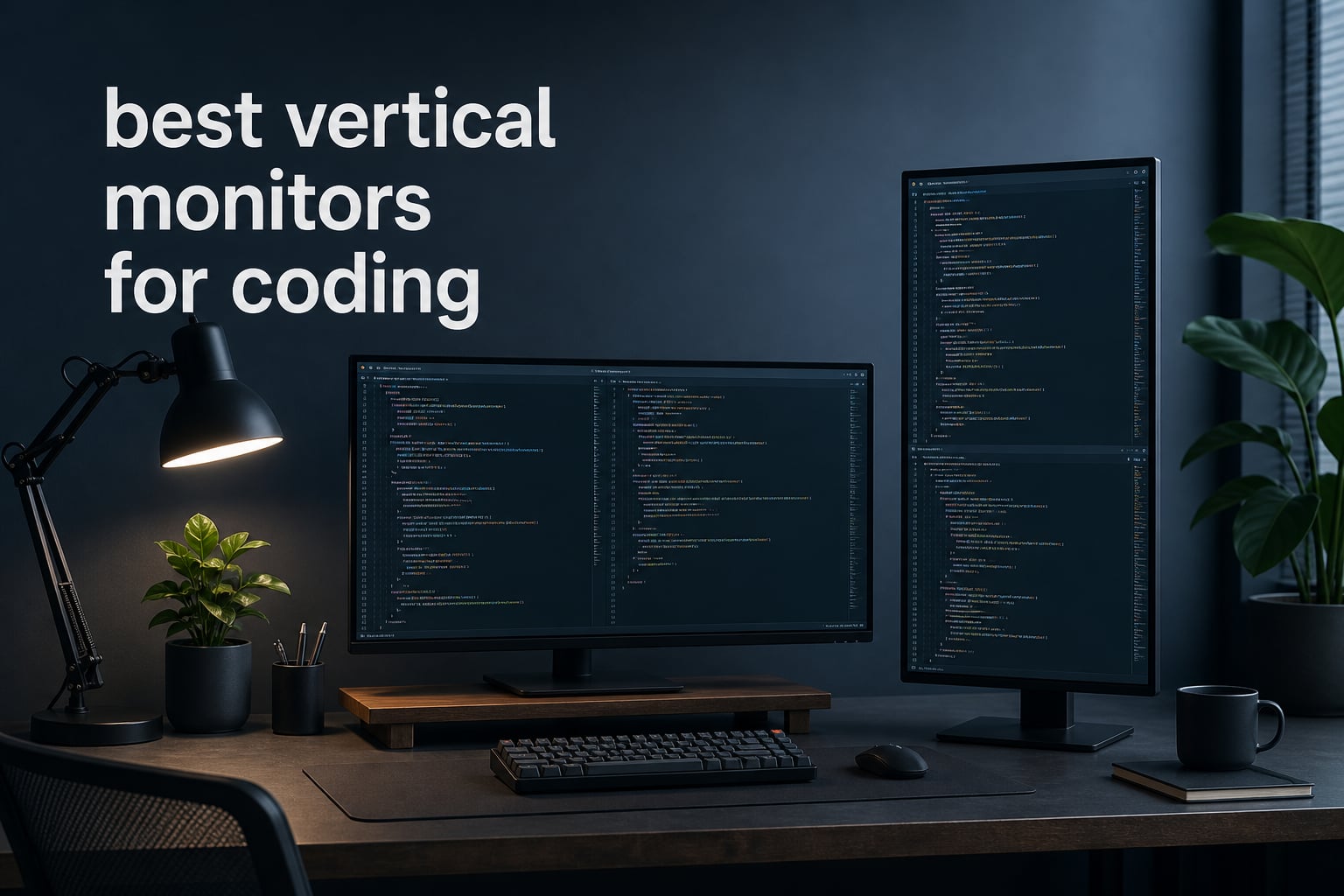
A vertical monitor is good for coding because portrait mode makes the screen taller than it is wide, so one display can hold a longer stretch of source code, logs, PDFs, or documentation before you scroll. Developers in the forum research often reported 50–70% more code visibility, although the gain depends on your editor, font size, and scaling.
For the best vertical monitors for coding, I would start with a 24- to 27-inch display that has a real pivot adjustment and enough height range to lower the panel after rotation. This guide compares eight verified monitors with those basics in mind: text resolution, stand movement, laptop connectivity, refresh rate, and the limits that matter at a desk.
My practical take is that portrait mode works best beside a landscape primary monitor, not as a rule that every screen must follow. Use the vertical display for the long material that interrupts focus—Git diffs, terminal output, API references, large pull requests, and source files—then keep the wide display for side-by-side work.
The Top Three Vertical Coding Picks Are Dell, Samsung, and CRUA
The Dell S2725DC is my first pick because its 27-inch QHD IPS panel, 144Hz refresh rate, USB-C with 65W power delivery, and four-way stand cover the most coding desks without giving up smooth scrolling. It also has a 4.8 rating from 70 listed reviews, the highest rating in this set.
The Samsung is the smaller, faster alternative when a 24-inch portrait panel feels more natural beside a main screen. The CRUA is the direct compact portrait option, with stated 90-degree rotation, 120mm height adjustment, and a 200Hz refresh rate.
The Best Vertical Monitors for Coding in 2026 Are These Eight
| Product | Specifications | Action |
|---|---|---|
 Dell S2725DC Dell S2725DC |
|
View on Amazon |
 Samsung Odyssey G3 G30D Samsung Odyssey G3 G30D |
|
View on Amazon |
 LG 27UP650K-W LG 27UP650K-W |
|
View on Amazon |
 Dell S2722DC Dell S2722DC |
|
View on Amazon |
 LG 27UP850K-W LG 27UP850K-W |
|
View on Amazon |
 SANSUI ES-G27F6Q SANSUI ES-G27F6Q |
|
View on Amazon |
 CRUA CR245ZB CRUA CR245ZB |
|
View on Amazon |
 Acer CB272K Acer CB272K |
|
View on Amazon |
There is no single best monitor for software developers because resolution and desk geometry change the decision. QHD at 27 inches is a balanced text-size choice, while 4K at 27 inches gives much denser text but may ask for scaling; the 24- and 24.5-inch FHD models take less side-to-side desk space in portrait.
Every monitor here has listed pivot capability or explicit vertical rotation, so the shortlist avoids a common frustration: buying a panel that looks suitable on paper but cannot rotate on its supplied stand. I would still measure the desktop-to-eye-line distance before committing, since rotating a 16:9 panel makes its long edge the height.
1. Dell S2725DC Is the Best All-Round Vertical Coding Monitor
Pros
- QHD 144Hz IPS panel
- USB-C with 65W power
- Full stand adjustment
Cons
- One HDMI port
- 8ms stated response time
I would put the Dell S2725DC at the top of a vertical monitor setup for developers because its 2560×1440 resolution and 27-inch size offer a sensible middle ground. It is denser than FHD without making the display as demanding to scale as 4K can be on some systems.
The stand lists height, tilt, pivot, and swivel adjustment, which is the feature set I want before turning a monitor upright. USB-C with 65W power delivery can also connect and power a compatible laptop through one cable, while DisplayPort and HDMI leave room for a desktop or another source.
Its 144Hz refresh rate is not only for games; it can make scrolling through code and documentation feel less jumpy. AMD FreeSync and the listed 1ms MPRT are useful extras if the same screen also handles casual gaming.
The trade-off is port count rather than panel flexibility: Dell lists one HDMI port. The specifications also list an 8ms response time, so I would treat the 1ms MPRT figure as a motion-performance mode rather than assume every response measurement is 1ms.
A QHD 27-inch panel gives code a balanced text scale
For long files, QHD gives more vertical and horizontal workspace than 1080p without forcing tiny interface elements by default. The 1500:1 contrast ratio and 99% color gamut are useful listed specifications for people who split time between coding and visual work.
A one-cable laptop desk benefits most from the S2725DC
I would choose this Dell when the vertical screen also needs to charge a compatible notebook through USB-C. Its two 3W speakers are convenient for system audio, though I would not make speaker quality the reason to select a coding monitor.
2. Samsung Odyssey G3 G30D Is the Compact High-Refresh Pick
Pros
- 180Hz refresh rate
- 1ms MPRT
- Full ergonomic adjustment
Cons
- One HDMI port
- Glossy finish can reflect
The Samsung Odyssey G3 G30D makes sense when a 24-inch vertical display is all the desk can absorb. In portrait, that smaller physical height can be easier to position next to a landscape monitor than a rotated 27-inch panel.
Its 1920×1080 resolution is less dense than QHD or 4K, but that can make text and interface controls easy to read at normal scaling. The stand has height, swivel, and tilt adjustments, and the listed features include pivot adjustment, so it is built to change orientation rather than merely sit in one position.
Samsung specifies a 180Hz refresh rate, 1ms response time, and FreeSync. I see that combination as a good fit for a developer who wants a portrait monitor for code during the day and a responsive screen for games afterward.
The glossy screen finish deserves a desk check before buying. A window, bright wall, or lamp behind you can produce reflections that are more distracting when you are reading light text on a dark editor background.
A 24-inch FHD panel keeps portrait height under control
This is a practical size for a secondary portrait monitor, particularly where the main display already dominates the desk. It gives a tall column for code without asking you to turn your head as far toward the outer edge of the setup.
A fast refresh rate suits scrolling and mixed-use desks
People using Windows often prioritize 120Hz or higher for smoother scrolling, and this Samsung reaches 180Hz. Its gaming extras, Black Equalizer and Virtual Aim Point, are available but do not change the monitor’s core coding value.
3. LG 27UP650K-W Is the Straightforward 4K Text-Detail Choice
Pros
- 4K IPS resolution
- 95% DCI-P3 color
- Pivot-capable stand
Cons
- 60Hz refresh rate
- No USB-C
The LG 27UP650K-W is the pick I would consider when text density ranks ahead of high refresh and one-cable laptop charging. Its 3840×2160 IPS panel places far more pixels into the same 27-inch diagonal than a QHD alternative.
That extra density can make small fonts, code punctuation, and documentation screenshots look sharply defined. The monitor pairs that resolution with a matte anti-glare surface, Reader Mode, Flicker Safe, and a stand with height, tilt, and pivot adjustment.
There are two HDMI ports and DisplayPort, which is more flexible for fixed desktop connections than a single-input screen. DisplayHDR 400, Dynamic Action Sync, and Black Stabilizer add multimedia and gaming functions without taking away from the portrait-friendly stand.
The limitation is simple: this is a 60Hz display with no USB-C port listed. If your workstation depends on charging a laptop from the monitor, I would move to the LG 27UP850K-W or Acer CB272K instead.
A 4K portrait screen favors close reading and fine text
A 27-inch 4K monitor is well suited to developers who want a dense vertical column for code review, terminal output, and PDFs. Check your operating system’s scaling before deciding, because the smallest native text can be uncomfortable at a normal viewing distance.
A desktop with HDMI and DisplayPort fits the 27UP650K-W best
I would use this LG with a desktop that already has the right video output or a dock that supplies it. The listed 95% DCI-P3 gamut also gives it a secondary role for color-aware creative work.
4. Dell S2722DC Is the Dependable QHD USB-C Programming Choice
Pros
- WQHD resolution
- USB-C with 65W power
- Four-way stand adjustment
Cons
- 75Hz refresh rate
- No Prime eligibility listed
The Dell S2722DC remains a clean choice for a portrait monitor for code when the goal is business-focused connectivity rather than a very high refresh rate. Dell explicitly lists programming among its specific uses, along with business and education.
Its WQHD 2560×1440 panel, 99% color gamut, and matte anti-glare finish cover the text-first requirements well. Height, pivot, swivel, and tilt adjustments allow the stand to adapt as you rotate the screen and place it beside a main display.
USB-C with 65W power delivery is the main convenience feature here. The monitor also has HDMI, USB 3.2 Gen 1 connectivity, a quick-access Type-A port, and built-in speakers, giving a compatible laptop workspace fewer separate cables.
The 75Hz refresh rate is a step down from the newer Dell S2725DC at 144Hz. I would choose the S2722DC when its port layout and established productivity focus matter more than the extra refresh headroom.
A 75Hz QHD display favors focused office and code work
For writing, compiling, debugging, and reading documentation, 75Hz is a reasonable listed refresh rate. It is less suited to someone who expects the portrait display to double as a high-speed gaming screen.
A full-adjustment stand protects portrait placement options
Rotated monitors can sit too high when the stand base and neck lack range. The S2722DC’s listed height and pivot movement gives you more control, but I would still set the top edge within a comfortable eye-line range before a long session.
5. LG 27UP850K-W Is the Best 4K Laptop-Dock Alternative
Pros
- 4K IPS panel
- USB-C with 90W power
- Thunderbolt connectivity
Cons
- 60Hz refresh rate
- Limited stock listed
The LG 27UP850K-W combines the high-density text of a 27-inch 4K IPS screen with stronger laptop power delivery. Its USB-C connection provides up to 90W according to the listed specifications, a meaningful difference for compatible notebooks that need more than 65W.
Like the other LG 4K model, it has a matte finish, 95% DCI-P3 color gamut, DisplayHDR 400, height adjustment, tilt, and pivot. It also includes built-in speakers with Waves MaxxAudio, plus two HDMI ports, DisplayPort, and two USB 3.0 ports.
Thunderbolt connectivity is listed as well, giving this model a broader connection story than the 27UP650K-W. I would put it on a desk where the vertical screen handles code while one cable also connects a work laptop and helps reduce cable clutter.
For pure text work, HDR is not the deciding feature, and the refresh rate remains 60Hz. Developers who alternate between long coding sessions and fast-moving games may prefer the Dell S2725DC or SANSUI instead.
A 90W USB-C connection suits power-hungry compatible laptops
This LG is the direct pick for a MacBook or Windows notebook that benefits from 90W USB-C charging and a 4K vertical panel. Confirm the laptop’s USB-C video and charging support before relying on a single cable.
A 4K screen benefits documentation and color-aware side work
I would use the vertical orientation for long reading and code, then turn to the 95% DCI-P3 coverage for photo or media tasks when needed. DisplayHDR 400 is available for supported content, but standard desktop SDR remains the normal coding mode.
6. SANSUI ES-G27F6Q Is the Fast QHD Pivot and VESA Choice
Pros
- Fast IPS QHD panel
- Up to 200Hz via DisplayPort
- 100x100 VESA support
Cons
- No Prime eligibility listed
- No USB-C listed
The SANSUI ES-G27F6Q is a strong option when a developer wants a 27-inch QHD portrait monitor that also emphasizes motion performance. It uses a Fast IPS panel, has a listed 2560×1440 resolution, and supports up to 200Hz through its DisplayPort 1.4 connections.
The monitor’s ergonomic stand supports pivot, swivel, height adjustment, and tilt, with rotation from negative 90 to positive 90 degrees. It also lists 100x100mm VESA compatibility, which matters if the supplied stand cannot place a portrait display low enough.
Two DisplayPort 1.4 ports can reach the stated 200Hz level, while the two HDMI 2.0 ports are listed up to 144Hz. A 400-nit brightness figure, FreeSync, low motion blur, and a 1ms response time round out the fast-screen focus.
The missing laptop-friendly port is USB-C, so this is not the one-cable dock option. I would pair it with a desktop or with a separate laptop dock, then use the VESA route if arm placement matters more than the included stand.
A 100×100 VESA mount solves many portrait-height problems
Forum users repeatedly point to a VESA arm when a rotated monitor feels too high or the base consumes too much desk depth. This SANSUI lists the 100x100mm standard, so check the arm’s weight rating and reach before buying the arm.
Up to 200Hz fits developers who also play fast games
The high refresh rate is not required for compiling code, but it can make scrolling and mixed gaming use feel smoother. For the full stated 200Hz figure, use a DisplayPort 1.4 connection rather than assume every port behaves the same way.
7. CRUA CR245ZB Is the Direct Compact Portrait-Monitor Choice
Pros
- Explicit 90-degree rotation
- 200Hz refresh rate
- 75x75mm wall mount
Cons
- FHD resolution
- One HDMI port
The CRUA CR245ZB is the most direct vertical monitor for programming in this list because its product description explicitly calls out 90-degree portrait rotation. At 24.5 inches, it takes a more compact physical footprint than the 27-inch choices when turned upright.
Its 1920×1080 panel has a 200Hz refresh rate, 3ms response time, FreeSync, 120% sRGB color coverage, and 300cd/m² brightness. The matte finish, low blue light mode, and three-sided narrow bezels make it a practical secondary screen on paper.
The stand provides a 120mm height adjustment, tilt from negative 5 to positive 15 degrees, and swivel from negative 15 to positive 15 degrees. It also supports a 75x75mm wall mount, giving small-desk users a mounting alternative.
The FHD resolution is the main compromise at this size, particularly if you prefer very small fonts or keep dense panels beside it. I would set editor text deliberately rather than expect portrait orientation by itself to make every extra line comfortable.
A 24.5-inch screen fits narrow desks and secondary-screen roles
This CRUA works best where the vertical panel is a reading and reference column, not the only screen for every task. Its smaller diagonal can also reduce the neck turn needed when it sits to the side of a large landscape display.
Its 75×75 mount support broadens compact installation options
A small VESA pattern does not fit every arm, so verify the arm supports 75x75mm before ordering accessories. If the supplied stand is used, take advantage of the stated height range before deciding the viewing position is fixed.
8. Acer CB272K Is the 4K 90W USB-C Ergonomic Alternative
Pros
- 4K UHD resolution
- USB-C with 90W power
- Wide ErgoStand adjustment
Cons
- 60Hz refresh rate
- 4.0 rating from 108 reviews
The Acer CB272K is another 27-inch 4K option for a coder who wants dense text and a USB-C charging connection. Its USB 3.1 Type-C port supports display, data transfer, and 90W device charging according to the product details.
Acer lists 99% sRGB color coverage, 350 nits brightness, a matte finish, and a 2000:1 contrast ratio. The 3840×2160 panel is paired with FreeSync and an Eyesafe Display feature intended to reduce harmful blue light exposure.
The ErgoStand has unusually broad listed adjustment: negative 5 to positive 35 degrees of tilt, plus or minus 178 degrees of swivel, plus or minus 90 degrees of pivot, and 6.5 inches of height adjustment. That range gives this monitor a credible case for portrait mode without adding an arm first.
This is a 60Hz screen, and its 4.0 rating from 108 listed reviews is lower than the other options in this roundup. I would choose it for the combined 4K, 90W USB-C, and stand range, while weighing that rating and review count appropriately.
A broad pivot and height range supports portrait fine-tuning
The Acer’s plus-or-minus 90-degree pivot specification makes vertical rotation explicit, while the 6.5-inch height adjustment gives room to lower or raise the panel. Set the monitor after rotating it, since its effective height changes sharply in portrait.
A 4K 90W USB-C monitor favors a dock-like laptop workspace
I would select this Acer for a compatible laptop that needs display, data, and charging over USB-C. The 99% sRGB specification also suits developers who work on interface assets or photographs alongside code.
A 24- to 27-Inch IPS Monitor Is the Right Starting Point
For most developers, start with a 24- to 27-inch display that pivots on its own stand. The 24- and 24.5-inch FHD options are easier to fit beside a primary screen, while 27-inch QHD is a balanced middle point for a vertical display for developers.
Choose 4K at 27 inches when text density and screenshot detail matter more than the simplicity of native-sized interface elements. A 4K panel has noticeably denser pixels than QHD at the same diagonal, but macOS and Windows scaling preferences can change whether that density feels helpful or too small.
A pivot stand matters before a refresh-rate number
Portrait mode depends on actual rotation, height range, and desk clearance. A monitor can have an excellent panel and still be uncomfortable if its stand leaves the top edge too high after the long side is vertical.
If you use an arm, match its mounting pattern and weight capacity to the monitor. The SANSUI specifies 100x100mm VESA support and the CRUA specifies 75x75mm support; for the other models, confirm the exact mounting information from the seller or manufacturer before ordering an arm.
QHD is the comfortable middle path, while 4K is the detail path
QHD at 27 inches provides a useful amount of code width and height without the high pixel density of 4K. It is why the two Dell QHD models and the SANSUI are sensible all-purpose choices for a vertical monitor setup.
4K gives sharper small type, but the real decision is whether your operating system and chosen font size make that type pleasant to read. Mac users concerned about fractional scaling should try the target resolution and scaling mode when possible, rather than buy on resolution alone.
Windows and Linux need a quick rotation check after setup
On Windows, rotate the display in the operating-system display settings and revisit ClearType or font smoothing if text edges look colored or blurry. Also verify that your code editor is using its intended font rendering after the orientation change.
On Linux, confirm the desktop environment and graphics driver support the intended rotation and that sleep, wake, and docking do not reset the panel. These checks take a few minutes and can prevent a frustrating portrait monitor setup for developers.
A portrait secondary screen works better when it sits close to the main panel
Place the vertical monitor on the side that matches where you naturally turn, with the near edges of the two screens close together. This reduces the empty gap that forces a larger head turn when moving between an editor and a browser.
Keep the top third of the portrait display near eye level rather than raising it to match a landscape monitor’s top edge. Take regular visual and posture breaks as well; no panel feature can offset a fixed, uncomfortable position through a long workday.
Mini-LED and HDR are not default coding requirements
HDR can be useful for video and games, but SDR desktop work is the normal mode for code, terminals, and documentation. Some forum users dislike blooming from Mini-LED backlights in desktop use and the repeated switching between HDR and SDR, so an IPS panel with good text handling remains a straightforward choice.
Do not let a gaming label rule out a monitor, but do not let it override rotation, resolution, connection needs, and ergonomics either. The best monitor to use vertically is the one that stays comfortable at your font size and connects cleanly to the computer you actually use.
Vertical Monitor FAQs Answer the Setup Questions That Matter
Is a vertical monitor good for coding?
Yes. A portrait display is good for coding because it shows a taller column of source code, logs, documentation, and PDFs before you need to scroll. Developers in the forum research commonly report seeing 50–70% more code vertically, though the practical gain depends on editor layout, font size, display scaling, and how the screen is positioned. It works especially well as a secondary display next to a landscape primary monitor.
What is the best monitor to use vertically?
The Dell S2725DC is the most balanced monitor to use vertically in this group. It has a 27-inch QHD IPS panel, a 144Hz refresh rate, USB-C with 65W power delivery, and a stand with height, tilt, pivot, and swivel adjustment. Choose a 4K alternative such as the LG 27UP850K-W or Acer CB272K if denser text and 90W USB-C power delivery matter more than high refresh.
Which monitor is best for coders?
For many coders, the Dell S2725DC is the best all-round option because QHD at 27 inches, 144Hz, USB-C with 65W power delivery, and full stand adjustment address common programming needs. The LG 27UP650K-W suits text-density-first 4K desks, the SANSUI ES-G27F6Q suits fast QHD and VESA mounting, and the CRUA CR245ZB suits compact portrait setups.
Are vertical monitors worth it?
Vertical monitors are worth it when you regularly read long code files, code reviews, logs, technical documentation, or PDFs. They reduce repetitive scrolling and can keep more related context visible. They are less useful for wide design canvases, side-by-side spreadsheet work, or simple tasks. Start with a pivot-capable 24- to 27-inch screen, set its height after rotation, and use it as a secondary display if a landscape panel remains better for your main work.
Dell S2725DC Is the Best Starting Point for Most Coding Desks
The Dell S2725DC has the most balanced blend of QHD resolution, 144Hz smoothness, USB-C with 65W power delivery, and a fully adjustable stand. If you want 4K text density and 90W USB-C, move to the LG 27UP850K-W or Acer CB272K; if you need a smaller screen, look at the Samsung or CRUA.
The best vertical monitors for coding in 2026 are the models that match your font size, computer connection, desk depth, and posture—not merely the longest feature list. Measure the portrait height, set the screen after rotating it, and choose the model whose verified connections and adjustment range fit your daily workflow.