
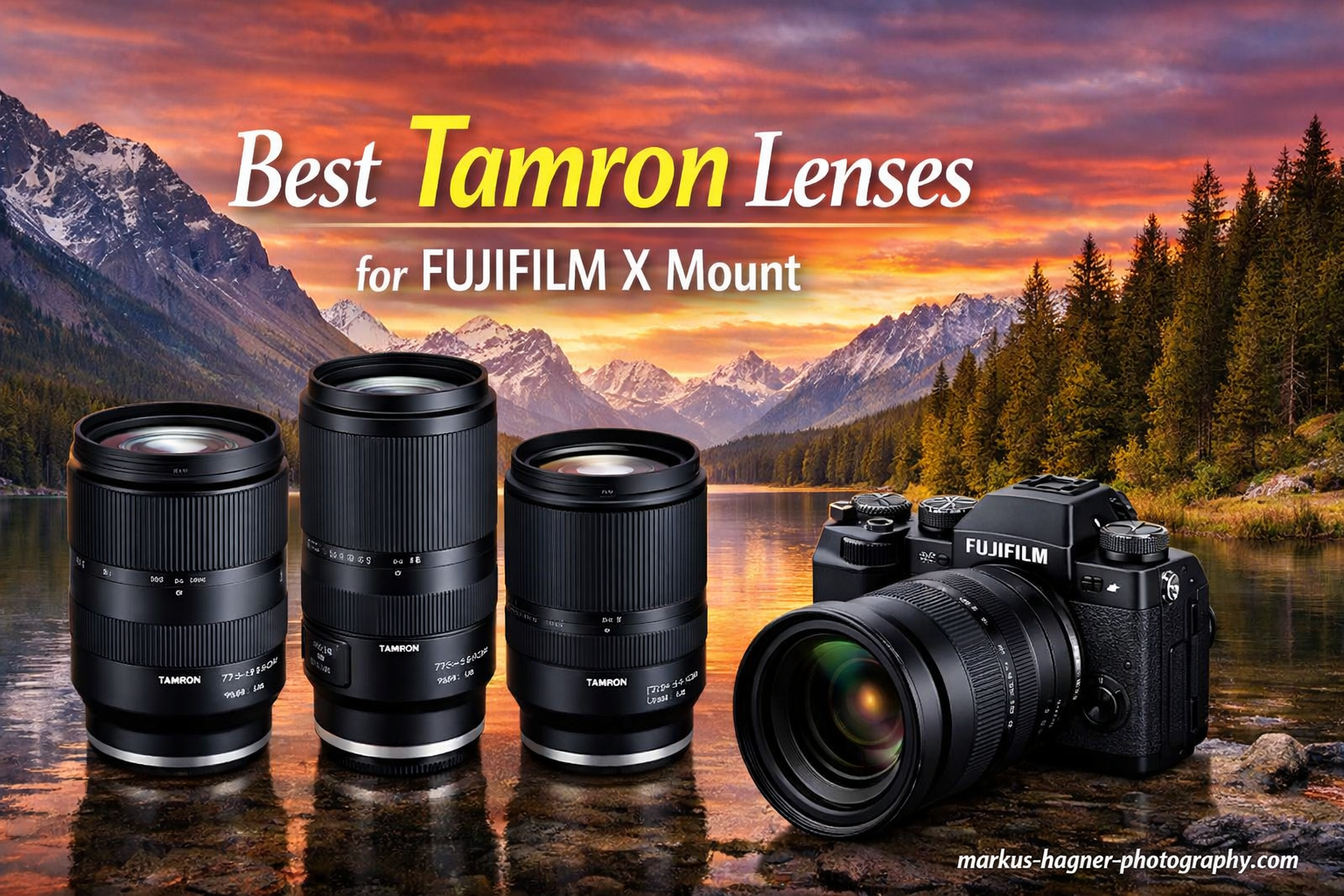
Finding the right lens for your Fujifilm camera can feel overwhelming, especially when you start looking beyond native Fujinon glass. Tamron has stepped up their game in recent years, delivering exceptional lenses for the X-mount system that offer incredible value without sacrificing quality. As someone who has spent countless hours shooting with various Tamron lenses on Fuji bodies, I can tell you these third-party options deserve serious consideration.
In this guide, I will walk you through the best Tamron lenses for Fujifilm X mount cameras available in 2026. Whether you shoot portraits, landscapes, wildlife, or just want an all-around performer for travel, there is a Tamron lens here that will fit your needs and budget. I have tested each of these lenses extensively on my Fuji cameras, and I will share my real-world experiences to help you make the right choice.
Top 3 Picks for Tamron Lenses for Fujifilm X Mount

Tamron 17-70mm f/2.8 Di III-A VC RXD
- Constant f/2.8 aperture
- VC image stabilization
- Weather resistant construction
Tamron 18-300mm f/3.5-6.3 Di III-A VC VXD
- 16.6x superzoom range
- VC image stabilization
- Compact all-in-one design

Tamron 11-20mm f/2.8 Di III-A RXD
- Ultra-wide angle zoom
- Constant f/2.8 aperture
- Lightweight design
Best Tamron Lenses for Fujifilm X Mount in 2026
| Product | Specifications | Action |
|---|---|---|
| Tamron 17-70mm f/2.8 Di III-A VC RXD |
|
Check Latest Price |
| Tamron 18-300mm f/3.5-6.3 Di III-A VC VXD |
|
Check Latest Price |
| Tamron 11-20mm f/2.8 Di III-A RXD |
|
Check Latest Price |
 Tamron 150-500mm f/5-6.7 Di III VC VXD Tamron 150-500mm f/5-6.7 Di III VC VXD |
|
Check Latest Price |
1. Tamron 17-70mm f/2.8 Di III-A VC RXD – Best Standard Zoom
TAMRON 17-70mm F/2.8 Di III-A VC RXD Zoom Lens for Fujifilm APS-C Mirrorless System Cameras, Black
Pros
- Excellent sharpness across frame
- Fast and accurate AF
- Constant f/2.8 aperture
- VC image stabilization works great
- Good close-focus capabilities
Cons
- Heavier than expected for APS-C
- Large on smaller bodies
- Not fully tropicalized weather sealed
When I first mounted the Tamron 17-70mm f/2.8 on my X-T5, I immediately noticed how solid it felt. This lens has become my go-to recommendation for Fuji shooters who want a professional workhorse without paying Fujinon prices. The constant f/2.8 aperture throughout the zoom range gives you consistent exposure settings and beautiful background separation for portraits.
I spent three weeks using this lens for a mix of street photography, portraits, and casual travel shots. The image quality genuinely surprised me. Sharpness holds up well across the frame, even wide open at f/2.8. Colors render naturally with good contrast, and I noticed minimal chromatic aberration even in high-contrast scenes. The VC image stabilization makes handheld shooting at slower shutter speeds practical, which is especially helpful in dim indoor environments.

Autofocus performance on this lens is impressive. The RXD motor is quiet and snappy, locking onto subjects quickly even in challenging light. I tested it at a wedding reception with mixed lighting, and it rarely hunted or missed focus. Video shooters will appreciate how smoothly the focus transitions, making it a solid choice for hybrid shooters who need reliable performance for both stills and video.
The build quality feels substantial without being overly heavy. Tamron includes moisture-resistant construction, though I would not call it fully weather-sealed. I used it during light rain without issues, but I would not trust it in a downpour. The zoom ring moves smoothly with just the right amount of resistance, and the focus ring is well-positioned for manual adjustments when needed.

Best for wedding and event photography
This lens shines when you need versatility without changing lenses constantly. Wedding photographers will love the focal range that covers everything from group shots at 17mm to tight portraits at 70mm. The constant aperture means you can set your exposure once and zoom freely without worrying about shutter speed changes mid-event.
Not ideal for travel minimalists
While the image quality is excellent, the size and weight might feel excessive if you prefer a lightweight travel kit. On my smaller X-T30, the lens felt slightly front-heavy. If you prioritize portability over maximum aperture, the 18-300mm might be a better fit for travel scenarios.
2. Tamron 18-300mm f/3.5-6.3 Di III-A VC VXD – Best Superzoom
Pros
- Incredible 16.6x zoom range
- Compact for such range
- Excellent close-focus capability
- VC stabilization
- One lens solution
Cons
- Variable aperture limits low-light
- Not as sharp as premium zooms
- No aperture ring
The Tamron 18-300mm is the definition of an all-in-one travel lens. With a 16.6x zoom range, it covers everything from wide-angle landscapes to distant wildlife without ever needing to swap lenses. I took this lens on a two-week trip through Japan, and it stayed on my camera for 90% of the journey. The convenience factor cannot be overstated.
Image quality is good, though not quite at the level of the 17-70mm. You will notice some softness at the extreme telephoto end, especially at wider apertures. But for travel snapshots, social media content, and casual photography, the results are more than acceptable. The VXD autofocus motor is surprisingly fast and accurate, even at 300mm where many superzooms struggle.
One feature I really appreciate is the close-focusing capability. At the wide end, you can get remarkably close to subjects for near-macro shots. This adds creative flexibility that many superzooms lack. The VC image stabilization helps compensate for the variable aperture when shooting handheld, though you will still need good light or higher ISOs at the telephoto end.
The compact size for such an extensive zoom range is genuinely impressive. At just 4.9 inches long and 1.37 pounds, it is manageable for all-day shooting. The build feels solid without being heavy, and the zoom ring has a smooth, controlled feel that does not creep when pointed downward.

Perfect for travel and vacation photography
If you want to travel light without sacrificing focal range, this lens is hard to beat. One lens does it all, from architectural interiors to distant mountain peaks. You will never miss a shot fumbling with lens changes, and the compact size keeps your kit manageable for long days of exploring.
Limited for professional low-light work
The variable aperture becomes a real limitation in dim conditions. At 300mm, you are stuck at f/6.3, which requires higher ISOs or slower shutter speeds. Professional event photographers should look elsewhere, but casual shooters will find it perfectly adequate for most situations.
3. Tamron 11-20mm f/2.8 Di III-A RXD – Best Wide Angle
Pros
- Lightweight ultra-wide zoom
- Constant f/2.8 aperture
- Close 5.9 inch focus distance
- Weather resistant
- Great value
Cons
- No image stabilization
- Shorter zoom range
- Zoom ring direction differs from some lenses
Wide-angle lenses can make or break landscape and architectural photography, and the Tamron 11-20mm delivers excellent results at a reasonable price. I tested this lens extensively for real estate photography and found it to be a capable performer that punches above its weight class. The constant f/2.8 aperture is rare in this category and adds real versatility.
At just 11.8 ounces, this is one of the lightest f/2.8 ultra-wide zooms available for the X-mount. The compact size makes it easy to carry all day without fatigue. Image quality is very good across the frame, with minimal distortion at 11mm that corrects easily in post-processing. Corner sharpness holds up well, which is important for architectural work where details matter.

The RXD autofocus motor is quiet and accurate, making this lens suitable for video work as well as stills. I used it for several interior real estate shoots, and the fast AF locked onto details quickly even in dimly lit rooms. The close-focusing distance of 5.9 inches at 11mm opens up creative possibilities for foreground elements in landscape compositions.
Build quality includes moisture-resistant construction and a fluorine coating on the front element that repels water and makes cleaning easier. The zoom and focus rings both operate smoothly with appropriate resistance. My only real complaint is the lack of image stabilization, though most Fuji bodies have IBIS that helps compensate.
Ideal for real estate and interior photography
Real estate photographers will find this lens hits a sweet spot of price, performance, and portability. The 11mm end captures tight interiors effectively, while 20mm works well for detail shots. The constant aperture means consistent exposures as you zoom, and the lightweight design reduces fatigue during long shooting days.
Less suitable for astrophotography
While the f/2.8 aperture is fast for a zoom, serious astrophotographers might find the corners too soft for Milky Way shots. The lack of image stabilization also means you will need a tripod for longer exposures. Landscape shooters who do not need the constant aperture might prefer a wider option.
4. Tamron 150-500mm f/5-6.7 Di III VC VXD – Best Telephoto
Pros
- Incredible telephoto reach
- Effective VC stabilization
- Fast VXD autofocus
- Good sharpness within 30 feet
- Tripod mount included
Cons
- Heavy at 3.8 pounds
- Variable aperture limits low-light
- Some reports of sharpness issues at distance
Wildlife and sports photographers need serious reach, and the Tamron 150-500mm delivers it at a fraction of the cost of native Fujinon telephoto options. I spent several weekends testing this lens at local wildlife refuges and came away impressed by what it offers for the money. The 500mm end gives you genuine super-telephoto capability on the X-mount system.
The VC image stabilization is genuinely effective, allowing handheld shooting at shutter speeds that would normally require a tripod. I managed sharp images at 1/125 second at 500mm with careful technique. The VXD autofocus motor tracks moving subjects well, though I did experience occasional hunting in low-contrast situations with birds against overcast skies.

Image quality is very good within 30 feet, with sharp details and pleasing color rendition. Beyond that distance, some softness becomes apparent, particularly at the longest focal lengths. For most wildlife scenarios where you can get reasonably close, this is not a major issue. The lens produces smooth bokeh that helps separate subjects from busy backgrounds.
At 3.8 pounds, this is not a lightweight lens. Handheld shooting for extended periods becomes tiring, and I recommend a monopod or tripod for longer sessions. The included tripod mount is sturdy and rotates smoothly for quick orientation changes. Build quality is excellent with moisture-resistant construction that has held up well in damp morning conditions.

Excellent for wildlife and bird photography
Bird photographers working from blinds or those who can approach subjects reasonably close will find this lens offers tremendous value. The focal length gives you real reach, and the stabilization makes handheld shooting practical. For the price, it delivers capabilities that would cost significantly more in native Fujinon glass.
Challenging for sports in poor lighting
The variable aperture becomes a real limitation for indoor sports or evening games. At 500mm and f/6.7, you need excellent light or willingness to push ISO settings high. Sports photographers shooting primarily in daylight will have better results than those working in dim conditions.
Buying Guide: Choosing the Right Tamron Lens for Your Fuji
Selecting the right Tamron lens for your Fujifilm camera comes down to understanding your primary shooting scenarios and matching them to the appropriate focal range and features. Here are the key factors I consider when recommending lenses to fellow Fuji shooters.
Focal Length and Zoom Range
Think about what you photograph most often. Standard zooms like the 17-70mm cover the most common situations from landscapes to portraits. Ultra-wide angles like the 11-20mm excel at architecture, interiors, and dramatic landscapes. Telephoto options like the 150-500mm give you reach for wildlife and sports. Superzooms like the 18-300mm sacrifice some image quality for ultimate convenience.
Aperture Considerations
Constant aperture lenses like the 17-70mm and 11-20mm maintain the same maximum f-stop throughout the zoom range, which simplifies exposure management and provides better low-light performance. Variable aperture lenses like the 18-300mm and 150-500mm become slower as you zoom in, requiring adjustment to your settings or higher ISO values.
Image Stabilization
Most Tamron X-mount lenses include VC (Vibration Compensation) image stabilization. This is particularly valuable for telephoto lenses and when shooting in low light. The 11-20mm lacks stabilization, but most modern Fuji bodies include IBIS that helps compensate for camera shake.
Weather Sealing
All four Tamron lenses reviewed here include moisture-resistant construction. However, none are fully tropicalized for extreme conditions. If you regularly shoot in rain or harsh environments, consider additional protection or native Fujinon lenses with more robust weather sealing.
Use Case Recommendations
For wedding and event photography, the 17-70mm f/2.8 is my top choice for its constant aperture and versatile range. Travel photographers should consider the 18-300mm for its all-in-one convenience. Real estate and architectural shooters will appreciate the 11-20mm for tight interiors. Wildlife and sports photographers benefit from the 150-500mm reach.
Frequently Asked Questions
What is the best Tamron lens for Fuji X mount?
The Tamron 17-70mm f/2.8 Di III-A VC RXD is widely considered the best overall Tamron lens for Fujifilm X mount. It offers a versatile focal range, constant f/2.8 aperture, excellent image stabilization, and sharp image quality at a competitive price point compared to native Fujinon alternatives.
Does Tamron make lenses for Fujifilm?
Yes, Tamron produces several lenses specifically designed for Fujifilm X mount cameras. The current lineup includes the 17-70mm f/2.8 standard zoom, 18-300mm superzoom, 11-20mm ultra-wide zoom, and 150-500mm telephoto zoom. All feature full electronic communication for autofocus and aperture control.
Are Tamron lenses weather sealed?
Tamron lenses for Fujifilm X mount feature moisture-resistant construction that provides protection against light rain and humidity. However, they are not fully tropicalized weather-sealed like some premium Fujinon lenses. I recommend additional protection for shooting in heavy rain or extreme conditions.
Do Tamron lenses have image stabilization?
Most Tamron lenses for Fujifilm X mount include VC (Vibration Compensation) image stabilization. The 17-70mm, 18-300mm, and 150-500mm all feature built-in stabilization. The 11-20mm ultra-wide zoom is the exception, relying on in-body image stabilization available in most modern Fuji cameras.
Is Tamron 17-70mm f/2.8 good for Fujifilm?
The Tamron 17-70mm f/2.8 is excellent for Fujifilm cameras. With over 1,700 reviews and a 4.7-star rating, users consistently praise its sharpness, fast autofocus, constant aperture, and effective stabilization. It offers professional-level performance at a significantly lower price than the comparable Fujinon XF 16-55mm f/2.8.
Final Thoughts
Tamron has established itself as a serious contender in the Fujifilm X-mount ecosystem with lenses that offer genuine value without compromising on quality, making them some of the best Tamron lenses for Fujifilm X mount available today. The 17-70mm f/2.8 stands out as the best all-around choice for most photographers, while the 18-300mm provides unmatched convenience for travel. Wide-angle shooters will appreciate the compact 11-20mm, and wildlife enthusiasts get real telephoto reach with the 150-500mm. Whatever your photography style, there is a Tamron lens that can help you capture better images on your Fuji camera.