
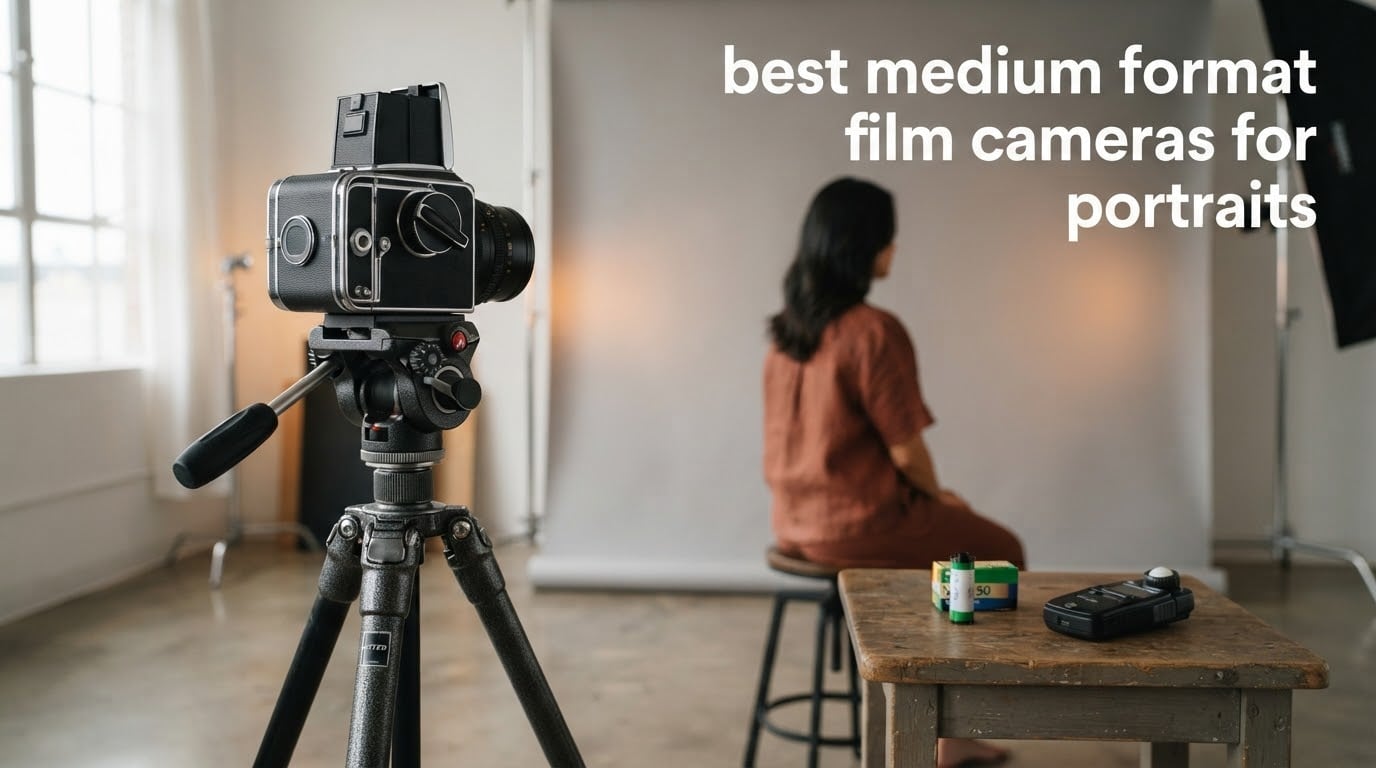
Short answer: for a first medium format film camera for portraits, the Holga 120N is the cheapest and least intimidating way to start shooting 120, and the Hasselblad 501C bundled with the 80mm f/2.8 Zeiss Planar C is the body I would put on a tripod for a paid studio portrait session. The Planar is the portrait lens in this group, and the 6×6 square gives a head-and-shoulders crop with plenty of room to breathe.
I have shot film bodies for years, and the thing nobody tells you about medium format portraiture is that the negative size does less work than the lens does. A 6×6 negative gives you roughly four times the area of a 35mm frame, which buys the tonal roll-off that makes skin look like skin rather than like plastic. But the shallow-background look that people actually buy a Hasselblad for comes from the aperture, and most lenses in this format top out well short of what a 105mm f/1.4 gives you on full frame.
That is the axis this roundup is built on. Every camera below is judged on four things: the negative size and the depth-of-field payoff it unlocks, the fastest portrait lens available for that body, the shutter type and its flash sync ceiling, and how the camera behaves when a person is standing in front of it. I have not ranked these on general-purpose usefulness, because a body that is superb for landscapes can be hopeless for a sitting.
If you are moving up from 35mm and want the wider context first, read our medium format film camera guide for enthusiasts and our medium format portrait camera overview first. If you already know the format and want the full body list, we also cover medium format cameras for general photography and our expert medium format picks.
Top 3 Best Medium Format Film Cameras for Portraits in 2026

Hasselblad 501C with 80mm f/2.8 Planar
- 80mm f/2.8 Zeiss Planar C
- Optical finder
- Manual exposure
Those three cover three completely different jobs. The Holga 120N is a learning tool that happens to be a real 120 body, the Hasselblad 501C is a studio instrument, and the Mamiya M645 M is the one you can actually carry around a location without a technician accompanying you.
All 10 Best Medium Format Film Cameras for Portraits in October
Everything in the list, with the specification that actually decides a portrait sitting: negative size, the fastest portrait aperture available, shutter type, and where the body sits on the tripod-to-handheld spectrum.
| Product | Specifications | Action |
|---|---|---|
| Holga 120N |
|
Check Latest Price |
| Hasselblad 501C with 80mm f/2.8 Zeiss Planar C |
|
Check Latest Price |
 Mamiya M645 M Mamiya M645 M |
|
Check Latest Price |
 Bronica ETR body with 120 film magazine Bronica ETR body with 120 film magazine |
|
Check Latest Price |
 Lubitel 166 Universal Lubitel 166 Universal |
|
Check Latest Price |
 Rollei 6008 Integral Rollei 6008 Integral |
|
Check Latest Price |
 Rolleiflex 3.5 TLR Rolleiflex 3.5 TLR |
|
Check Latest Price |
 Kiev 88CM Kiev 88CM |
|
Check Latest Price |
 Holga 120N Pan 6×12 Holga 120N Pan 6×12 |
|
Check Latest Price |
 Pentax 645Z Pentax 645Z |
|
Check Latest Price |
One warning before the individual entries. The Pentax 645Z at position 10 is a digital medium format body, not a film camera. It is on this list because portrait photographers keep asking whether used film is still the smarter spend, and it is a legitimate answer for a different kind of workflow. Everything above it shoots film.
1. Holga 120N: The Cheapest Real 120 Body for Learning Portraits
Pros
- Lowest cost of entry to real 120 film
- Two film masks switch between 6x6 and 6x4.5
- Self timer and tripod mount for self portraits
- Distinctive soft focus and vignetting
Cons
- Fixed plastic lens limited to f/8 and f/11
- Unpredictable light leaks and heavy vignetting
- No automatic exposure
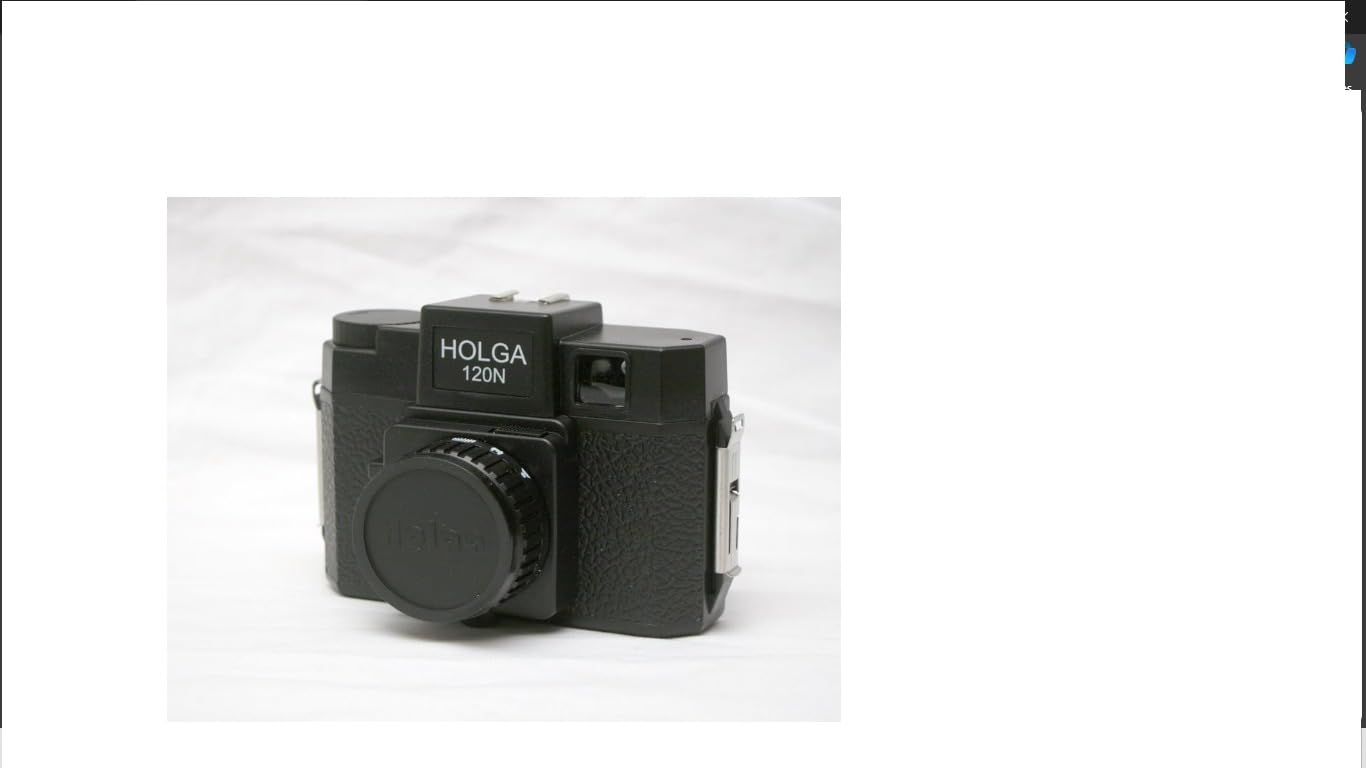
I started three people on medium format with this camera and all three are still shooting film. That is the honest headline: across 343 owner reviews it averages 4.3 out of 5, and the complaints are about the look, not about the camera failing. Owners describe soft focus, intense vignetting and unpredictable light leaks as features rather than faults, and that is the correct read for what this body is for.
For portraits, the 10 second self timer is the detail that matters. It lets you set the camera at head height, step into frame, and get a real portrait without a second person behind the camera, which is exactly the situation a lot of portrait practice happens in. The 1/4-20 tripod mount means it also slots straight onto a proper tripod for a sitting.
The negative is 6×6 with the supplied mask, or 6×4.5 when you swap to the second one. A 120 roll gives you 12 frames on 6×6 and 16 on 6×4.5, so you plan the session rather than shooting freely, and that constraint is good practice for anyone learning to direct a sitter.
Exposure is manual with two aperture zones, sunny at f/11 and shade or flash at f/8, plus a bulb setting. You set shutter and aperture by eye, which sounds primitive but forces you to watch your light meter instead of trusting it, and that habit transfers directly to the Hasselblad and Mamiya later.
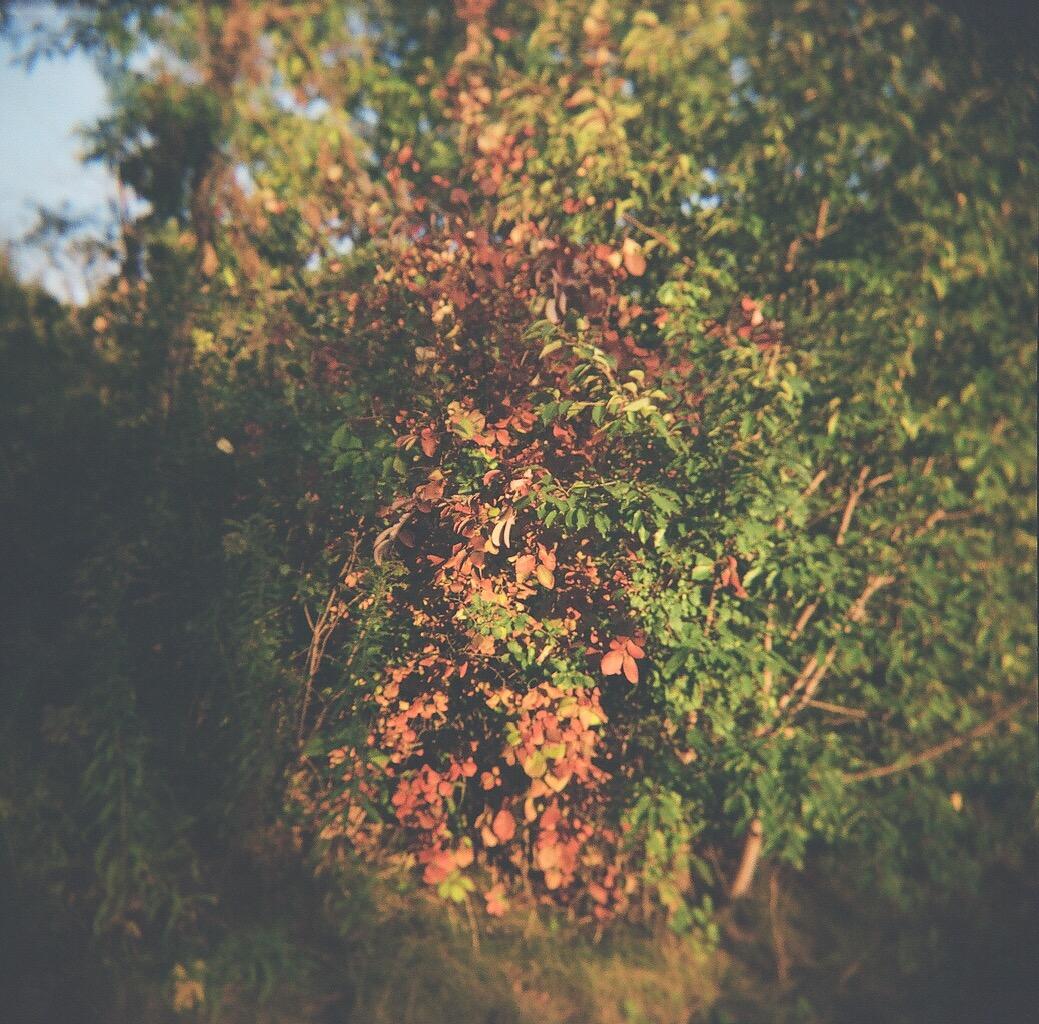
Is the fixed plastic lens a problem for portraits?
It is a limit, not a dealbreaker, as long as you know what you are buying. You cannot open the aperture to blur a background, because the choice is f/8 or f/11 and nothing in between. What you get instead is a uniform softness across the frame, which some portrait styles use deliberately and most clients will not.
The practical use is a tight environmental portrait at middle distance where the whole frame is acceptable focus, or a set of moody frames where the vignette does the framing for you. For headshots with a clean background and a sharp eye, look at the Hasselblad instead.
What should you check before buying one?
Check the back locking mechanism first, because it is the part that actually gets dropped and it is the single most common failure. Owners specifically praise the improved back locking device on later versions, so confirm the one you are buying is not a very early run. Then check the film mask sits flat and that the frame lines are crisp when the light seal is dark.
Light leaking is expected rather than exceptional on this body, so do not treat it as a bargaining chip. If you want predictable frames, meter the scene and shoot a test roll, and read our film handling notes in the enthusiast 120 guide before your first real sitting.
2. Hasselblad 501C with 80mm f/2.8 Zeiss Planar C: The Studio Portrait Body
Pros
- Portrait lens supplied in the kit
- Zeiss Planar rendering with excellent skin tones
- Simple mechanical operation
- Compact square negative ideal for headshots
Cons
- This listing has no owner review history
- Body only available with a fixed lens to service
- Manual metering requires practice
When someone asks me for one medium format film camera for portraits and one only, this is the kit I point at. The Hasselblad V-system bodies are still the most-copied shape in studio photography, and the reason is not nostalgia. The square 6×6 frame is a portrait shape, the lenses mount close to the film plane which lets them stay fast, and the whole thing is mechanically simple enough to service decades from now.
The 80mm f/2.8 Zeiss Planar C is the reason to buy this particular listing rather than a bare body. On 6×6 that focal length frames a head-and-shoulders comfortably at roughly a metre and a half of working distance, which is close enough to talk to your sitter, and f/2.8 gives you the background separation that medium format portraits are usually after. That combination of a real aperture and a workable distance is the whole game, and most entry-level 120 kits do not offer it.
You focus manually on a ground glass screen, and the optical viewfinder is bright and clear for a waist-level hold. Exposure is fully manual, which sounds like a downgrade until you remember that a photographer working with a sitter and a strobe is making three or four exposures per setup anyway, and manual control is faster than menu diving.
How close does the Planar let you work?
Close enough that you can shoot a head and shoulders without a long lens, which is the single biggest reason the Planar still works. The frame lines up with the plane of the subject at a conversational distance, so your sitter is not being pushed back across a studio to accommodate the lens.
The trade is that you have no wide aperture wider than f/2.8 in this kit. For a single subject against a clean background, that is enough. For a busy background or a group of three, f/2.8 starts to look tight, and you would want the 150mm Sonnar, which is a separate purchase and a separate cost.
What does owning a Hasselblad ask of you?
It asks for patience with a manual body and for a service plan. The V-system is well supported and parts interchange across the range, so a clean, lubricate and adjust is a normal and sensible purchase rather than an emergency. Budget for it at the start and the camera will run for a very long time.
This particular listing has no recorded owner reviews, so treat the condition claims as unverified and ask for shutter speed accuracy and a recent service date before you commit. If you want a wider view of what else carries a fast portrait lens, our medium format portrait camera overview compares the fast-lens options across body types.
3. Mamiya M645 M: The Leaf Shutter Body You Can Actually Carry
Pros
- Leaf shutter syncs far above typical medium format speeds
- Compact body suits location portrait sessions
- 645 negative is the most portable of the large formats
- Optical finder with manual control
Cons
- Body only
- no lens or film back
- Only a single review on record
This is the entry point into the Mamiya system that most of the serious 645 work grew out of, and the reason it is interesting for portraits is the leaf shutter. A leaf shutter sits inside the lens body, so a fast lens in front of it can still sync at a usable speed. On the bodies in this list that use focal plane shutters, the sync ceiling is so low that studio strobe work becomes awkward.
Compact is not a marketing word here, it is the difference between a camera you carry and a camera you have a assistant carry. The 645 negative is smaller than 6×6 and 6×7, which means fewer frames per roll but a body you can actually walk around a location with. For a portrait photographer doing on-location work rather than studio sittings, that trade is usually worth making.
The optical viewfinder and fully manual exposure are a deliberate simplicity. You compose on the finder, set the shutter, set the aperture, and shoot. There is no battery dependency to fail mid-sitting, which matters more in this format than in small formats because a dead body ends the session.
Why does the leaf shutter matter so much?
Because flash sync and aperture speed are usually the same dial. On a focal plane shutter body, the fastest speed you can sync is often somewhere around 1/30s, so f/2.8 means f/16 in the studio unless you buy a special sync shutter. With a leaf shutter, the fast lens stays usable at its wide aperture, so your background separation survives the switch on the strobes.
That is the single largest practical advantage medium format offers over full frame for flash portraiture, and it is why lens-shutter bodies remain in demand decades after production stopped.
What does buying a body only actually cost you?
More than the listing suggests. This is a body without a lens and without a film back, and both are required before you can take a photograph. A 645 film back and a 80mm lens are both required purchases, so budget for the complete kit rather than the body figure, and confirm what is included in the box in writing.
Film is rated across ISO 100 to 6400, so you are not limited to one speed of colour negative. For portraits I would run it at ISO 160 or 400 and push to 800 when the light drops, since the larger negative tolerates push processing better than 35mm does.
4. Bronica ETR Body with 120 Film Magazine: Modular on a Budget
Pros
- 120 magazine included in the kit
- Interchangeable viewfinders let you change finder type
- Modular body accepts 6x4.5
- 6x6 and 6x7 backs
Cons
- Listing metadata inconsistently declares the film format
- No owner reviews on record
- Manual SLR operation with no metering mentioned
The Bronica ETR is a lesson in why modular design lasts. The body, the film magazine and the viewfinder are separate pieces, so you can shoot 6×4.5 on one day and 6×7 on the next with the same camera. For portraiture that flexibility is unusually valuable, because the negative size you choose changes the working distance and the background separation more than the lens does.
The supplied 120 film magazine is the piece that makes the kit usable immediately, since a bare ETR body is just a mechanical box without a way to hold film. Interchangeable viewfinders mean you can move between a waist-level finder for direct eye contact with the sitter and a prism for vertical work without changing bodies.
Operation is manual, and the kit ships as body plus magazine, so confirm what else is in the box before you order. The listing metadata is inconsistent about film format, which is worth flagging to yourself before purchase rather than discovering after the film arrives.
Why does the negative size choice matter this much?
Because it determines the frame count and the aperture you can hold. A 6×7 negative gives you 10 to 12 frames on a 120 roll, so a sitting that would take 40 exposures on 35mm becomes a plan you have to stick to. A 6×4.5 gives you 16 and moves the whole body down in size and weight.
The payoff for the larger negative is depth of field at the same framing. Bigger format, same lens, same distance, more total light-gathering area per frame, and the background falls away more at the same aperture. The ETR is the body in this list that lets you test that effect for yourself rather than taking my word for it.
What should you inspect on this kit?
Check the magazine: wind it on, make sure the frame spacing is consistent and the back latches firmly, and confirm the take-up spool turns freely. A magazine with a slipping frame advance will ruin a sitting, and it is the part most often dropped on a floor.
Then check the shutter sounds across the full speed range and the firing pin fires consistently. No owner reviews exist for this listing, so condition claims are unverified. Ask for a test roll or a shutter timing check, and read our servicing notes in the expert medium format guide before you commit.
5. Lubitel 166 Universal: Dual Format for Learning Two Shapes
Pros
- All five owner reviews give it 5 out of 5
- Switches between 6x6 and 6x4.5 framing
- Light for a medium format TLR
- Automatic exposure
Cons
- Body only
- lens and film not included
- Not water resistant
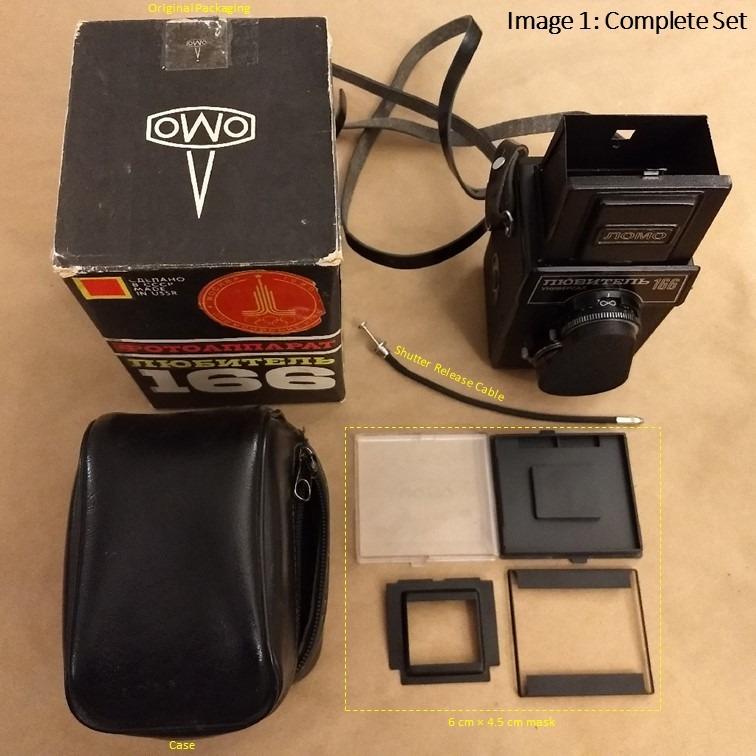
The Lubitel 166 Universal is the camera I hand to people who want to understand why negative size changes a portrait before they spend real money. The dual format ability is the whole point. Shoot 6×6 and 6×4.5 from the same sitting and the shape difference teaches framing faster than any tutorial.
Across five owner reviews it holds a perfect 5 out of 5, and the descriptions are consistent: fun, lightweight for a medium format twin-lens reflex, and capable of a distinctive look. The improved back locking device is specifically called out, which is the part I would otherwise worry about on a body of this age.
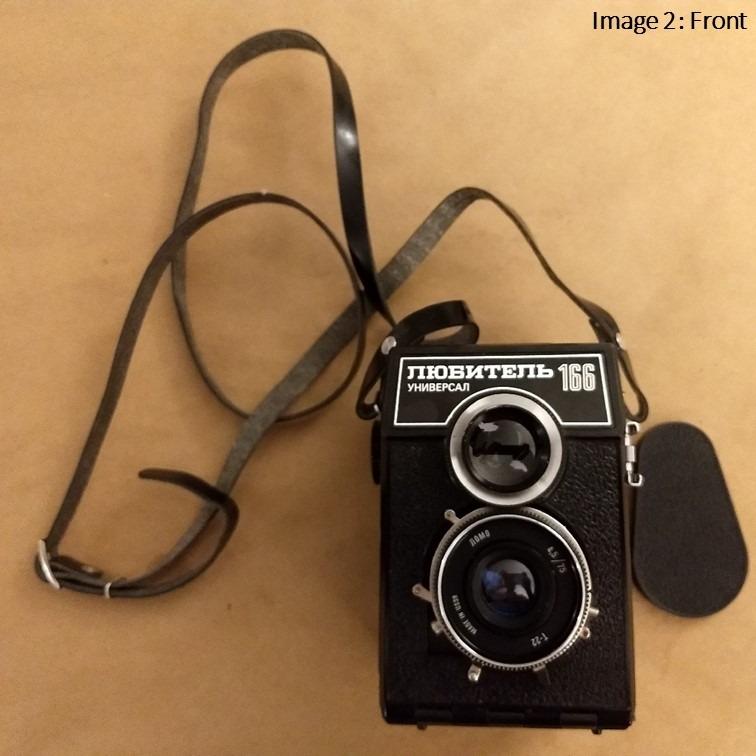
Lightweight matters more than it sounds. A twin-lens reflex held at waist level is already an unusual posture, and carrying one of these across a location for a whole afternoon is a genuinely different experience from hauling a 6×7 SLR. If your portrait work is outdoors and informal, that is the feature that decides it.
Exposure is automatic and the finder is optical, so this is the most forgiving camera in the list. A beginner can get a usable frame without understanding a single exposure triangle value, which makes it a good teaching body and a poor final answer for a paid sitting.
Is a twin-lens reflex good for portraits?
Yes, and the reason is the finder. A TLR composes on a ground glass screen at waist level, so you look down into the camera rather than up through it. Your sitter is not watching you peer at them through a prism, and the angle often produces a more direct, less guarded expression. Owners reach for bodies like this precisely because the shooting posture is socially easier.
The limitation is the fixed taking lens. You cannot swap to a fast telephoto, so your framing options are set by what came with the body, and the 6×4.5 mask crops the same lens rather than giving you a different one.
What is missing from the box?
Lens and film. This listing is body only, and a TLR body without a taking lens cannot make an exposure, so the lens is a required purchase rather than an optional upgrade. Confirm the lens is included with the specific listing you purchase, because bodies are frequently listed with and without one.
The camera is not water resistant, which matters if you plan to use it outdoors. I keep mine in a dry bag whenever there is any chance of rain, and I would do the same with yours. Exposure is automatic but there is no manual override mentioned, so if you want deliberate control you are looking at a different body.
6. Rollei 6008 Integral: Built-In Metering and a Folding Finder
Rollei 6008 Integral Medium Format SLR Camera Kit Body with 120 Film Back and Folding Waist Level Viewfinder – USA (requires charger)
Pros
- Metered auto exposure with program and manual modes
- 120 film back and folding finder included
- Leaf-shutter class 6x6 system
- Manual mode available when you want control
Cons
- Weighs 10.6 pounds
- Requires a charger
- No owner reviews on record
The 6008 Integral is the camera for a portrait photographer who wants the Hasselblad idea with a meter built in. It ships with a 120 film back and a folding waist-level finder, so unlike a lot of kits at this level you are not immediately hunting for the two parts that make it a camera at all.
Metering is the headline. Advanced metering with auto exposure plus program and manual shooting modes means you can meter a setup and shoot, then switch to manual and stay on your settings as the sitter moves through the light. On a manual-only body, changing a background light means re-metering every single frame.
The 10.6 pound weight is the thing to plan around. That is a full studio session of carrying, and it is why I would mount this on a stand for a sitting rather than hand-hold it for a moving subject.
Is the folding waist-level finder an advantage?
For portraiture, genuinely yes, and most roundups list it as a gimmick. Shooting from below your own eye line changes the relationship entirely. Your sitter sees a photographer looking down into the camera rather than a face peering at them, and in my experience that produces a more relaxed expression in the first ten frames of a sitting.
It also means you can hold the camera at any angle without losing the horizon, because the ground glass stays level. For a standing sitter, the camera can go to chest height and still frame accurately.
What is the focal plane shutter trade-off?
This body uses a focal plane shutter, which is the one specification that determines whether the 6008 suits your studio. A focal plane shutter can run fast, but its flash sync is very low, commonly around 1/30s to 1/60s. That means aperture and strobe power are effectively locked together, and you are working with a strobe whether you intended to or not.
If your portrait work is available light or natural window light, this is a non-issue. If you are running a full strobe setup and want a fast lens wide open, look at a leaf-shutter body instead, such as the Mamiya M645 M.
The listing notes a charger is required, so confirm the battery type before you order. There is no owner review history on this listing either, so the metering accuracy claim is a specification rather than an observation from owners, and I would test it against a handheld meter before a paid session.
7. Rolleiflex 3.5 TLR: The One That Gets Grabbed First
Pros
- Waist-level composition encourages direct eye contact with the sitter
- Leaf shutter keeps aperture usable with flash
- 75mm is a workable portrait focal length
- Original leather case and lens cap included
Cons
- Listing declares 35mm film format rather than 120
- Slow shutter for modern flash strobes
- No owner reviews on record
Twin-lens reflex bodies have a reputation in portraiture that no specification explains. The mechanism is simple. You look down into the waist-level finder, the sitter is at or below your eye line, and the first thing they register is a photographer who is not staring at them. That posture is why people who own a shelf of medium format bodies still reach for a TLR first.
This listing pairs a 75mm lens with a leaf shutter, which is a good combination for the format. The leaf shutter keeps the aperture usable at the shutter speeds the camera needs, and 75mm on a square negative gives a natural head-and-shoulders framing that most people find flattering.
Auto exposure and a sensitivity range of ISO 25 to 400 cover most portrait situations without manual fiddling. The original leather case and lens cap are a nice touch, and on a vintage body the case is what stops the camera taking the punishment that leads to slow shutter speeds.
Does the film format declaration matter?
It does, and I would resolve it before ordering. The listing metadata declares 35mm film format, which conflicts with a twin-lens reflex body of this design and with a 75mm taking lens of this type. Ask the seller directly which film the camera takes, because guessing wrong on a vintage mechanical body is an expensive lesson.
Ask the same question about the film back and whether it is included, since twin-lens bodies of this era take interchangeable backs and a bare body is not a working camera.
What are the leaf-shutter limits on a TLR?
The maximum aperture, mostly. Leaf-shutter portrait glass in this class typically stops around f/3.5 to f/4.5, which is slower than the Planar on the Hasselblad, so you are separating subject from background with focal length and distance rather than with a very wide aperture. That is an older way of working and it produces a slightly more formal look, with more of the frame in focus.
Shutter speed is the other limit. A body of this vintage tops out far below modern strobe sync, so flash on a Rolleiflex is a deliberate, low-power affair or not at all. I use one for daylight and window light portraits, which is where it is genuinely excellent.
No owner reviews exist for this listing, so there is no community feedback on the condition of this specific body. Budget for a service, because a shutter that is slow by a fraction of a stop is the most common fault on a vintage leaf shutter and it affects exposure accuracy more than anything else.
8. Kiev 88CM: A Complete 6×6 Kit, With Caveats
Pros
- Complete body
- lens
- back and finder set
- 6x6 leaf shutter system
- Waist level finder included
- Manual control with no electronics to fail
Cons
- Weighs 6 pounds
- Single review on record and it is negative
- Manual leaf shutter body needs servicing attention
The appeal of the Kiev 88CM kit is that everything is in one box. Body, lens, accessories and a 6×6 film back means you can load it and shoot without hunting for parts, which is the most common reason a first medium format kit gets abandoned in a cupboard.
It is a leaf-shutter 6×6 body with a waist-level finder and fully manual exposure. Mechanically that is a good foundation for portrait work, since a leaf shutter keeps the aperture usable with flash and a waist-level finder keeps your sitter relaxed. The 6 pounds is manageable for a sitting and awkward for a long location day.
The single review on record gives it 1 out of 5, and the complaint is about a return process rather than the camera itself. There is therefore no reliable owner feedback on this listing at all, and I would treat the condition as entirely unverified.
Why is a complete kit still the right pick here?
Because the parts are what cost you, not the body. A modular medium format system sold as a body is not a camera until you add a lens and a film back, and both are real costs on top of the figure you see. A kit that arrives complete lets you shoot a test roll this weekend, and a test roll tells you more than any specification.
For a portrait shooter, that first test roll can be a portrait session with a friend, which is a genuinely good way to find out whether the waist-level viewfinder and the manual exposure suit the way you work.
What should you test on a Kiev 88CM?
Test the shutter across the full speed range and time it against a meter, because leaf shutters drift and this body has no electronic shutter to self-correct. Check the mirror return and the film advance, and run a roll through to confirm the back spacing is even, since an inconsistent frame advance shows up as a soft roll of focus.
Check the lens for haze and fungus and confirm the shutter fires on every speed without hesitation. At 6 pounds this is not a lightweight body, so any play in the back or the focusing rails is worth knowing about before you commit, and a service plan is part of owning one of these.
Given the review situation, I would only buy this from a seller who will let you inspect it or send a current test roll, and I would factor servicing into the decision rather than treating it as a future possibility.
9. Holga 120N Pan 6×12: Panoramic Frames for Group Portraits
Pros
- 6x12 panoramic format on standard 120 film
- Very light at 400g
- Portrait scene setting built in
- Optical finder and strap included
Cons
- Fixed plastic lens limits aperture and focus
- Film not included
- Only two reviews on record
A 6×12 panoramic frame is roughly square but twice as wide, and for portraiture that shape is genuinely useful. A family group, a couple with a wide landscape behind them, or a row of people at an event all fit into a single exposure where a 6×6 frame would force you to either crop or step back until the perspective flattens.
Both reviews on record give it 5 out of 5, and both point at the same thing: the wide format is creative value at a low entry point. Owners are buying the format idea, not a precision instrument, and on those terms it delivers.
At 400g this is by far the lightest body in the list. It is roughly a third of the weight of the Rollei 6008, which means it is the one here you can genuinely hand-hold for an extended session without the weight becoming the limiting factor.
When does 6×12 beat 6×6 for a portrait?
When the subject is wider than tall. A head-and-shoulders crop in 6×12 leaves a great deal of empty frame on both sides unless you fill it with something, so this format rewards environmental portraiture and group work rather than tight headshots. If the brief is a single face against a plain background, a square negative serves you better.
The aspect ratio also changes how you approach composition. You are placing a very long subject across the frame, so the usual rule of thirds becomes a rule of fifths, and a centred symmetrical composition often works better than an off-centre one.
What are the controls like on this one?
Manual and automatic exposure with four scene settings, including a dedicated portrait setting and separate cloudy, sunny and landscape modes. That is genuinely convenient for someone who does not want to meter each frame, and the portrait mode does most of the work for a basic sitting.
The fixed plastic lens limits both aperture and focus control, so this is not a camera for deliberate shallow depth of field. The framing is the point, not the separation. Film is not included with the kit, and with only two reviews on record the sample is very small, so treat owner feedback as encouraging but thin.
10. Pentax 645Z: The Digital Answer to the Same Question
Pros
- Owners rate it 4.9 out of 5 for image quality and dynamic range
- Fast and accurate autofocus and metering
- Tilting LCD with versatile live view
- Dual SD card slots and 27-point AF
Cons
- No in-body image stabilization
- Sensor sits deep in the body so cleaning needs a service centre
- Digital body only
- no film
I am including a digital body in a film roundup deliberately, because the question underneath almost every medium format purchase right now is whether used film still makes sense for portrait work. If you shoot more than a handful of portraits a month, this is the honest answer for many working photographers, and pretending otherwise would not help you.
Owners rate it 4.9 out of 5 across seven reviews, and the descriptions cluster around two things: image quality and dynamic range that they call unmatched for the price, and fast, accurate autofocus and metering. The 51.4MP medium format CMOS sensor is the largest negative-equivalent surface in this list by a wide margin, and it is backed by 27-point phase-detection autofocus with 25 cross-type points.
The tilting 3.2 inch LCD with live view changes how a portrait session runs. You can shoot from low or high angles without losing the sitter, show a frame to direct someone, and work in light a waist-level finder would struggle with. A 3FPS frame rate is modest by digital standards but irrelevant for a sitter who is not moving fast.
What do you give up compared with film?
The workflow, mostly. There is no film cost per frame, no reload in the dark between rolls, and no 10 frame limit on a 6×7 negative. You also lose the specific rendering that a pushed colour negative gives you, and if that tonal behaviour is the reason you are here, a digital medium format body will not reproduce it.
There is no image stabilization, which matters more on this body than the spec suggests because the sensor is large and the system is not built for panning at slow speeds. Stabilization is the one omission owners notice on bodies where the lens options are limited.
What should a buyer know about servicing?
The sensor sits deep in the body, so cleaning it yourself is not a realistic option. Owners report that it has to go to a central service centre, which adds shipping and service cost to something you might otherwise treat as a ten-minute job. That is worth knowing before you buy, not after.
On the flip side, the Pentax 645 lens system is long-lived and there is a large second-hand market for the glass, so a body purchase here is an entry into an existing ecosystem rather than a dead end. The weather-sealed large SLR body and dual card slots suggest this was built to be carried and used.
If your decision comes down to cost per frame and how many frames you need, read our broader medium format camera guide before committing, and weigh the film bodies on this list against a session schedule rather than a single sitting.
How to Choose a Medium Format Film Camera for Portraits
Four decisions decide this purchase, and only one of them is the brand name. Work through them in order and the model will usually choose itself.
Decide the shutter type first
Leaf shutter or focal plane shutter is the single most consequential specification in the whole format for portraiture, and it is the one most roundups bury. A leaf shutter sits inside the lens, so the fast aperture of a fast lens remains available at the speeds the camera needs. A focal plane shutter runs much faster, but its flash sync is low, commonly around 1/30s, which means you either stop down hard and lose your background separation, or you work with a continuous strobe whether you wanted to or not.
For natural light and window light portraits, the distinction barely matters. For studio work with strobes, it decides the camera. Bodies in this list with leaf shutters include the Mamiya M645 M, the Rolleiflex 3.5 and the Kiev 88CM, and the Rollei 6008 is the focal plane example where you will feel the difference immediately.
Then pick the negative size against your session length
6×4.5, 6×6 and 6×7 behave very differently in a sitting. A 6×4.5 negative gives you 16 frames on a 120 roll and 6×6 gives you 12, while 6×7 drops to 10 or 12. That is the number you plan against, and a portrait session on 6×7 is a short session with a director, not a long one.
The larger negative buys depth of field at the same framing. Same subject, same distance, same aperture, more light-gathering area, and the background falls further away. It also gives you the resolution to make a large print, which is where the format earns its cost on a gallery print. If your work is headshots delivered small online, the smallest format in the list will serve you and the body will weigh less.
Many 120 bodies also take 220 film, which yields roughly twice the frames at a lower per-frame resolution. Forum shooters use it exactly as you would expect, to stretch a budget across a series, and the trade is a real loss of detail that matters most on the largest format.
Work out the working distance before the lens
Choose the distance you want from the sitter, then pick the focal length that fills the frame from there. The reason this matters is that the negative size changes the equivalent focal length for the same framing, so a 150mm on 6×7 and a 150mm on 6×4.5 do not give the same picture. Nobody in the roundup format translates this, and it is the number you actually think in when you are framing a head.
The practical version is simple. For a head-and-shoulders with room to talk, you want to be roughly a metre and a half to two metres away. The 80mm f/2.8 Planar on the Hasselblad kit does this on 6×6 without pushing anyone back. For a full-length where the sitter’s whole body is in frame, you move back and you want a longer lens, and that is where bodies like the Bronica ETR earn their keep through their lens catalogue.
Set a lens budget before you look at bodies
This is where the assumption that medium format film is cheap falls apart. The body is often the inexpensive part, and a decent portrait lens is a separate purchase on every system. A kit sold as body only needs a lens and a film back before it takes a photograph, and the Mamiya M645 M and the Bronica ETR are both in that position.
Add a servicing figure before you commit. A clean, lubricate and adjust is a normal purchase on a mechanical body, not an emergency, and a camera that has just been serviced is worth more than an identical one that has not. Factor the lens, the film back and the service into one number, because that is what the camera actually costs you.
Inspect a used body in this order
Check the shutter accuracy first, because it is the fault that changes every photograph you take and the one most often ignored. Fire it against a sound meter or a light meter and confirm the speeds are within tolerance across the range. On leaf shutters, check whether the speeds have drifted slower, which is the normal age-related failure.
Then check frame advance spacing, run the film back locking mechanism hard, and inspect the light seals. On a body with interchangeable finders, confirm the finder is bright and the diopter is adjustable. Finally, look for mirror slap and mirror return on an SLR, run a full roll of film, and treat any gear that shows uneven spacing as unfinished business.
Do not skip the test roll. I have seen bodies described as working that immediately produced uneven frame spacing on film, and the roll costs almost nothing compared to discovering it after a paid session. If you are buying remotely, insist on one.
Finally, think about whether you want film at all. A digital medium format body at position 10 costs more and gives you the same large sensor with no per-frame cost and no reload, which changes the arithmetic completely if you shoot many portraits a month. Our film scanner guide for large negatives covers the other side of that decision, since a digital body changes nothing about what you do with your scans.
Frequently Asked Questions
What is the best medium format film camera for portraits?
The Hasselblad 501C with the 80mm f/2.8 Zeiss Planar C is the strongest single answer, because it pairs a fast portrait lens with a square 6×6 negative and a body that is still straightforward to service. The Holga 120N is the best starting point if you want to learn the format cheaply, and the Mamiya M645 M is the best choice for hand-held work because of its leaf shutter.
Is 120 film considered medium format?
Yes. 120 is the name of the film spool and the paper backing, and it covers several negative sizes including 6×4.5, 6×6 and 6×7. Because those negatives are several times the area of a 35mm frame, 120 is the film most people mean when they say medium format.
Does anyone still make medium format film cameras?
New medium format film bodies are rare and mostly limited to small fixed-lens 120 cameras. The real market is used, and it is active, because systems like the Hasselblad V, the Bronica ETR and the Mamiya 645 are modular, mechanically simple and still serviceable by specialists.
Is the Hasselblad 500C/M worth it?
It is worth it if you are buying a body with a fast lens attached, such as the 80mm f/2.8 Planar, because that combination covers the majority of portrait situations out of the box. A body on its own is less convincing, since the lens is where the money and the image quality both are.
What are the disadvantages of using 120 film?
A 6×7 roll gives you only 10 to 12 exposures and 6×6 gives you 12, so a sitting has to be planned rather than shot freely. Reloading happens in the dark unless the body takes a removable film back, there is no per-frame preview, and processing and scanning are slower and more expensive than digital.
Which is better for portraits, 6×6 or 6×7?
Choose 6×6 for headshots, studio work and any session where you want a lighter body and more frames on a roll. Choose 6×7 when you need more negative for large prints and the deepest background separation, and when you can accept roughly 10 frames and a body that works best on a tripod.
Conclusion: The Best Medium Format Film Camera for Portraits
For a first medium format film camera for portraits, the Holga 120N is where I would start, because it costs little, it teaches you the negative sizes, and 343 owners have already proven it works. The Hasselblad 501C with the 80mm f/2.8 Planar C is the answer for anyone shooting a paid sitting, since a fast lens and a square negative cover most portrait briefs without adjustment.
Reach for the Mamiya M645 M when the work is hand-held or flash-lit, the Bronica ETR when you want to change negative sizes with one body, and a twin-lens reflex such as the Rolleiflex 3.5 or the Kiev 88CM when the waist-level finder and the direct eye contact matter more to you than aperture control. Check the shutter accuracy, run a test roll, and budget for servicing before you buy any of them.
Whichever you choose, film the sitting you already have planned and compare it against what your digital body gives you. That comparison, made on your own portraits, settles the question faster than any roundup can.