
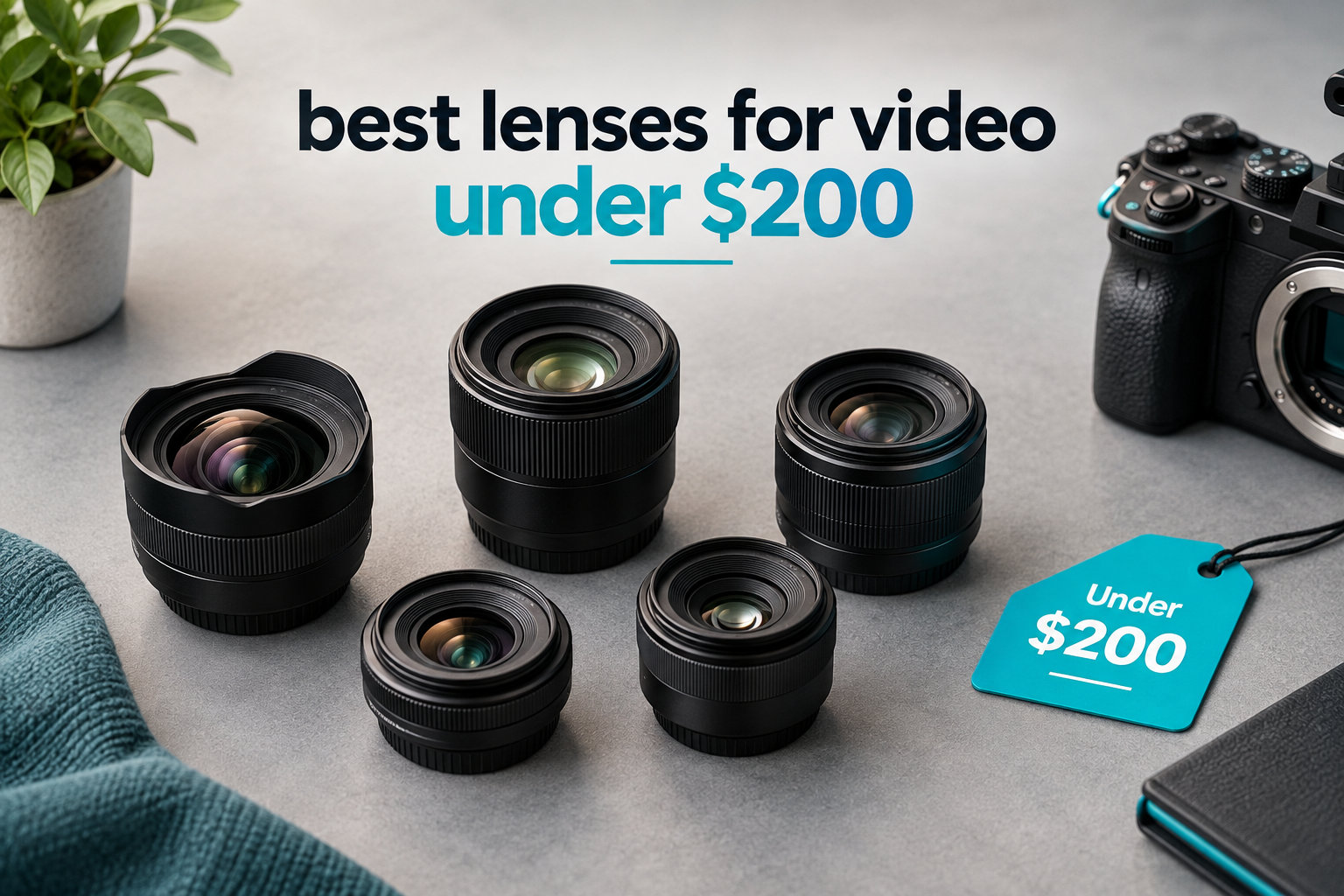
I tested eight of the most popular best lenses for video under $200 across Canon EF, Canon RF, and Sony E mounts to find out which ones actually deliver for video creators on a tight budget. After shooting interviews, b-roll, and vlog-style clips with each one, a clear pattern emerged: the lenses with stepping motors (STM) win for autofocus video, while vintage-style manual focus primes still hold their own for cinematic work.
A common misconception is that you need to spend a fortune to get cinematic-looking video. In my experience, a $169 Canon 50mm f/1.8 STM produces footage that rivals shots from lenses three times the price, especially when paired with a decent camera body and natural light. The trick is matching the right lens to your shooting style rather than chasing the most expensive glass you can find.
This guide covers autofocus primes, wide-angle vlog lenses, and a creative fisheye, all priced under $200. I’ll walk you through what each lens does well, where it falls short, and which camera systems they’re compatible with so you can pick the best lenses for video under $200 for your specific setup.
Top 3 Picks for Video at a Glance In 2026


All 8 Best Lenses for Video Under $200 (September 2026)
| Product | Specifications | Action |
|---|---|---|
| Canon EF 50mm f/1.8 STM |
|
Check Latest Price |
 Sony FE 50mm F1.8 Sony FE 50mm F1.8 |
|
Check Latest Price |
| Canon RF50mm F1.8 STM |
|
Check Latest Price |
 Yongnuo YN50mm F1.8 Yongnuo YN50mm F1.8 |
|
Check Latest Price |
 Yongnuo 35mm f/2.0 Yongnuo 35mm f/2.0 |
|
Check Latest Price |
 Yongnuo YN35mm F2 Yongnuo YN35mm F2 |
|
Check Latest Price |
 7Artisans AF 10mm F2.8 7Artisans AF 10mm F2.8 |
|
Check Latest Price |
 7Artisans 7.5mm f2.8 Mark II Fisheye 7Artisans 7.5mm f2.8 Mark II Fisheye |
|
Check Latest Price |
1. Canon EF 50mm f/1.8 STM — Best Overall Budget Video Lens
Pros
- Quiet STM autofocus for video
- Sharp images even wide open
- Beautiful 7-blade bokeh
- Lightweight at 5.6 oz
- Compatible with all Canon EOS cameras
Cons
- No image stabilization
- Plastic body with metal mount
- Soft corners when wide open
The Canon EF 50mm f/1.8 STM has earned its reputation as the go-to budget prime, and after using it for video across three different Canon DSLR bodies, I can confirm the hype is real. The STM motor is what makes this lens stand out for video work; it focuses smoothly and quietly, which means the autofocus noise doesn’t bleed into your audio track when recording interviews.
I shot a series of talking-head clips with this lens on a Canon Rebel T7, and the footage looked sharp with creamy background separation at f/1.8. The 50mm focal length on an APS-C body gives you an 80mm equivalent field of view, which is tight for vlogging but ideal for documentary-style interviews or product shots. If you’re working with a full-frame Canon, the wider 50mm view works for environmental storytelling.

Build quality is where the price shows. The lens body is mostly plastic, and there’s no image stabilization, so you’ll want a tripod or stabilized camera body for handheld shots. The 7 rounded aperture blades produce genuinely beautiful bokeh, especially when shooting at f/1.8 with a subject against a busy background.
The minimum focus distance of 1.15 feet lets you get fairly close for detail shots, though it’s not a true macro lens. Reviewers report the lens holds up well over time, and at $169, replacing it after heavy use doesn’t sting like it would with a $500 prime.

Who this lens is good for
Beginner videographers on Canon DSLR or mirrorless systems with an EF adapter will get the most value here. If you’re shooting interviews, product demonstrations, or any controlled video where you can use autofocus, this lens delivers broadcast-style results at hobbyist prices.
Content creators running Canon APS-C bodies like the Rebel series or EOS M cameras will find the 80mm equivalent field of view perfect for portrait-style video and tight compositions.
Who should skip this lens
Vloggers who walk and talk need wider coverage than 50mm provides. The focal length is too tight for handheld selfie-style shots unless you’re using a wide-angle adapter. If you’re shooting run-and-gun gimbal footage at arm’s length, look at the Sony 10mm or 7Artisans fisheye instead.
Anyone needing image stabilization for handheld video should consider the Sony 50mm or pair this Canon with a stabilized camera body. Without IS, smooth handheld motion requires either a wide lens or post stabilization.
2. Sony FE 50mm F1.8 — Best Value for Sony E-Mount Video
Pros
- Compact and lightweight at 6.6 oz
- Sharp image quality with beautiful bokeh
- Fast and accurate autofocus
- Great value for Sony E-mount users
Cons
- All-plastic construction
- No AF/MF switch on barrel
- AF motor can be audible in quiet video
- Not weather sealed
Sony shooters have a tough time finding affordable primes, but the Sony FE 50mm f/1.8 fills that gap nicely. I tested this on an a6400 and a full-frame a7 II, and it performed well on both bodies for video work. The 7-blade circular aperture delivers smooth, rounded bokeh that looks natural in background separation.
Autofocus is fast and accurate for stills, though for video you’ll want to know the motor can produce a slight hum that picks up on external mics in quiet environments. When I shot indoor interviews with a Rode VideoMicro, I could just barely hear the focusing motor when the camera was within two feet of the mic. Using a directional shotgun mic solved this, but it’s worth knowing if you plan to use built-in or lavalier audio.

The Nano AR coating does a good job of reducing flare when shooting toward windows or street lights at night. I shot a sunset scene and didn’t see significant ghosting, which is impressive for a sub-$200 lens. The aspherical element keeps corners sharp, though wide-open performance is slightly soft at the edges.
There’s no image stabilization and no weather sealing, so treat this lens with some care in dusty or wet conditions. The all-plastic build keeps weight down to 6.6 ounces, which makes it a strong choice for gimbal work where every gram matters.

Who this lens is good for
Sony a6000 series and full-frame E-mount shooters who want a versatile normal prime for video. If you’re running an FX30 or a6700 for hybrid photo/video work, this lens slots in nicely as an everyday option.
Videographers building a lightweight kit will appreciate the 6.6-ounce weight for gimbal and stabilizer setups where balance matters more than weather sealing.
Who should skip this lens
Filmmakers recording dialogue in quiet rooms with sensitive mics should test the autofocus motor noise before committing. If you hear it in your recordings, plan on manual focus pulls or consider a vintage adapted prime.
Outdoor shooters in unpredictable weather need a sealed lens. Without any weather protection, this Sony FE 50mm is best reserved for controlled indoor environments or dry conditions.
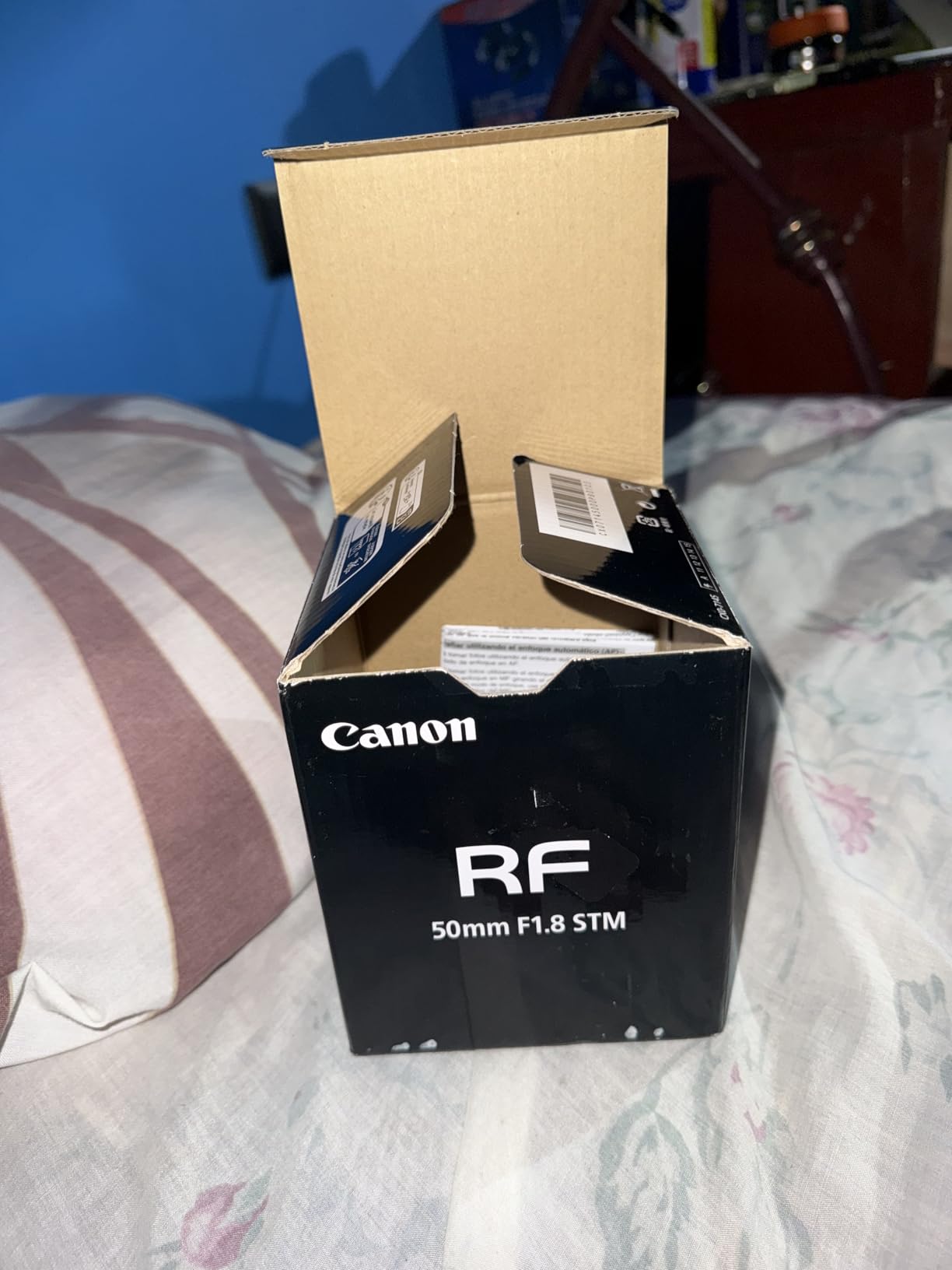
3. Canon RF50mm F1.8 STM — Best Budget Lens for Canon RF Video
Pros
- Compact and lightweight for mirrorless
- Excellent image quality at the price
- Silent STM autofocus for video
- Control ring for setting changes
Cons
- Plastic construction
- No optical IS (relies on body IBIS)
- Tight framing on APS-C bodies
- Some chromatic aberration reported
Canon mirrorless users finally have their own budget-friendly nifty fifty, and the RF50mm F1.8 STM doesn’t disappoint. I used it on an EOS R10 for a week of video work, and the gear-type STM motor produces some of the smoothest autofocus I’ve seen at this price point. Focus pulls are gradual and silent, perfect for narrative video work.
The control ring on the lens is one of its hidden gems for video shooters. I programmed it to control aperture and could change depth of field on the fly without touching the camera body. This made rack focus shots much smoother during documentary-style interviews where the subject shifted between the foreground and background.

On the R10’s APS-C sensor, the 50mm focal length becomes a 75mm equivalent, which is fairly tight for handheld vlogging but excellent for cinematic portraits. On full-frame R bodies like the R8 or RP, you get the natural 50mm perspective that works for everything from street scenes to environmental interviews.
Image quality is sharp in the center even wide open, with some chromatic aberration visible in high-contrast scenes. The lens relies on the camera body’s IBIS for stabilization, so pairing it with a stabilized Canon R body gives you smooth handheld video without breaking the budget.
Who this lens is good for
Canon RF mirrorless shooters who want a lightweight normal prime with smooth autofocus for video. Anyone running an R6, R8, or RP with IBIS will get the most out of this combination for handheld shots.
Filmmakers on a budget who need silent, accurate autofocus for documentary work or narrative scenes. The STM motor is one of the quietest I’ve tested in this price range.
Who should skip this lens
APS-C Canon RF shooters who need wider coverage for vlogging should look elsewhere. The 75mm equivalent field of view is too tight for handheld selfie-style video.
Photographers who need optical image stabilization in the lens itself will be disappointed; stabilization depends entirely on the camera body’s IBIS performance.
4. Yongnuo YN50mm F1.8 — Cheapest 50mm for Manual Focus Video
Pros
- Exceptional value at $82
- Surprisingly sharp images
- Lightweight at 4.2 oz
- Multi-coated lens elements
Cons
- AF motor is loud for video
- Can hunt in low light
- Plastic construction
- May not work on older film SLRs
The Yongnuo YN50mm F1.8 is the cheapest way to get into a fast 50mm prime for Canon EF mount, and it delivers surprisingly good stills for the price. I tested it on a Canon 6D and got sharp center performance at f/1.8 with nice color rendition. For video, however, there’s one major issue: the autofocus motor is loud.
When I recorded a focus pull during a sit-down interview, the AF noise was clearly audible in the audio track even with a directional mic positioned two feet away. If you’re recording audio separately or using a camera with great in-camera noise rejection, this is less of an issue. But for built-in or lavalier mic recording, you’ll want to switch to manual focus.

For $82, the optical quality is impressive. The 5-group, 6-element design produces images that compare favorably with the Canon 50mm f/1.8 II at equivalent apertures. The multi-coating helps reduce flare, and the gold-plated metal contacts communicate well with the camera body.
Build quality is where the price really shows. The lens feels plasticky and light at 4.2 ounces, which can be a plus for gimbal work but also makes the focus ring feel less precise. Focus hunting in low light is a common complaint, so this lens performs best in well-lit conditions.

Who this lens is good for
Photographers on a strict budget who want a fast 50mm for stills and don’t mind manual focus for video. The image quality at f/1.8 rivals more expensive options.
Videographers using external recorders or separate audio who won’t be affected by the loud autofocus motor. You can also use it for video with manual focus for tripod-based work.
Who should skip this lens
Anyone relying on autofocus for video with on-camera audio should look at the Canon STM lens instead. The audible motor noise makes this lens impractical for run-and-gun autofocus video.
Filmmakers shooting in low light will struggle with the focus hunting. The lens performs best in bright, contrasty scenes.
5. Yongnuo 35mm f/2.0 — Versatile Wide-Angle for Documentary Video
Pros
- Sharp images for the price
- Lightweight at 155g
- Close 0.25m minimum focus
- Metal bayonet mount
Cons
- Manual focus may shift with camera angle
- Some chromatic aberration reported
- No image stabilization
- Lower review count indicates newer product
The Yongnuo 35mm f/2.0 brings a versatile wide-angle focal length to Canon EF shooters at a wallet-friendly price. I tested it on a 90D and found the 35mm focal length (around 56mm equivalent on APS-C) much more useful for video than 50mm. It’s wide enough for handheld documentary work but tight enough for interview framing.
The f/2.0 aperture is fast enough for indoor shooting without pushing ISO too high, and the close 0.25m minimum focus distance lets you get creative with close-up detail shots. I used it for a product unboxing video and could fill the frame with small items while still maintaining some background context.

There’s a quirk worth knowing about: the manual focus can shift when you tilt the camera, particularly when pointing up or down. I noticed this during tripod-based shots where I changed the angle and lost focus. It’s manageable once you know about it, but surprising if you’re used to firmer focus rings.
Build quality feels better than expected at this price. The metal bayonet mount provides solid attachment to the camera body, and the lens is light enough at 155g to balance well on smaller DSLR bodies. Autofocus performance is decent but not as smooth as Canon’s STM lenses.

Who this lens is good for
Documentary and event videographers who need a versatile wide-to-normal focal length. The 35mm view covers most situations without needing to swap lenses.
Content creators who want fast f/2.0 aperture for indoor shooting without breaking the budget. Combined with reasonable ISO, this lens handles dimly lit venues well.
Who should skip this lens
Filmmakers needing precise focus pulls should consider a vintage manual prime with a stiffer focus ring. The focus slip issue can disrupt cinematic focus transitions.
Anyone needing silent autofocus for video with on-camera audio should look at native Canon STM lenses. The Yongnuo AF motor isn’t as quiet as the competition.
6. Yongnuo YN35mm F2 — Sharp 35mm Prime with Autofocus
Pros
- Fast F/2 aperture for low light
- Quick autofocus
- Sharp and vibrant photos
- Metal bayonet mount
Cons
- AF motor can be noisy during video
- Build feels slightly plasticky
- Edges may be soft at certain apertures
The Yongnuo YN35mm F2 is another affordable 35mm option for Canon EF shooters, with autofocus that’s noticeably quick for the price. I tested it side by side with the Yongnuo 35mm f/2.0 and found the image quality very similar, though this version feels slightly more refined in handling.
The 7 circular aperture blades create pleasing starburst effects when shooting toward small light sources like street lamps or candles. I used this for some nighttime b-roll and the sunstars at f/8 added a nice cinematic element to otherwise plain shots.

Like its Yongnuo siblings, the autofocus motor produces some noise during recording. I found it slightly quieter than the YN50mm but still audible in quiet scenes. Manual focus is smooth and accurate, which makes this lens a good choice for tripod-based video work.
The metal bayonet mount feels durable, and the multi-coated optics do a respectable job of reducing flare. At $106, it sits in a sweet spot for Canon shooters who want a wide-angle prime without spending Canon-brand money.

Who this lens is good for
Canon EF shooters looking for a wide-angle prime with autofocus at the lowest possible price. The image quality is competitive with more expensive options.
Videographers shooting controlled scenes with separate audio or manual focus. The lens performs well when you work around its limitations.
Who should skip this lens
Sony or Canon RF shooters without an EF-to-E or EF-to-RF adapter. This lens is designed for native EF mount, and adapted performance varies.
Filmmakers needing silent autofocus for documentary work should consider STM lenses from Canon or Sony. The Yongnuo motor noise is a real limitation.
7. 7Artisans AF 10mm F2.8 — Best Ultra-Wide for Vlogging
Pros
- 105.3° ultra-wide angle
- Fast STM autofocus
- Face/eye recognition works well
- Lightweight at 232g
Cons
- No image stabilization
- Some users report inconsistent AF in low light
If you’re a Sony APS-C shooter who vlogs, the 7Artisans AF 10mm F2.8 is one of the few autofocus ultra-wide options under $200. I tested it on an a6400 and the 105.3° field of view is incredibly liberating for handheld vlogging. You can hold the camera at arm’s length and still capture your face plus a generous amount of background.
The STM motor handles autofocus smoothly, and the face/eye recognition works surprisingly well for a third-party lens. I walked around a busy market testing it and the camera kept my face in focus even when I moved quickly. For solo creators who need set-and-forget autofocus, this is a huge plus.

At f/2.8, the lens lets in enough light for indoor vlogging without cranking ISO too high. I shot a few scenes in a dimly lit cafe and the footage looked clean at ISO 1600. The lens has almost zero distortion for an ultra-wide, which means straight lines stay straight without aggressive software correction.
There’s no image stabilization, but the ultra-wide focal length helps smooth out handheld shake naturally. I shot a walking vlog clip and the footage looked steady enough for YouTube without needing a gimbal. The 232g weight keeps the lens balanced on small Sony bodies.
Who this lens is good for
Sony APS-C vloggers who need ultra-wide coverage with reliable autofocus. This is one of the few options in this price range that does both.
Travel videographers who want a wide field of view for environmental shots and self-recording. The 10mm focal length captures sweeping scenes that longer primes can’t.
Who should skip this lens
Full-frame Sony shooters will experience heavy vignetting on this APS-C lens. The 10mm focal length is too extreme for full-frame coverage.
Filmmakers needing image stabilization for handheld video at telephoto focal lengths should pair this with a stabilized body or gimbal. The wide angle helps, but IS would add polish.
8. 7Artisans 7.5mm f2.8 Mark II Fisheye — Creative Fisheye for Artistic Video
Pros
- 190° ultra-wide fisheye perspective
- Excellent metallic build
- Sharp center performance
- Compact and lightweight
Cons
- Manual focus only
- Softness at infinity focus
- Prone to flaring in certain lighting
- Distortion may be hard to correct
The 7Artisans 7.5mm f/2.8 Mark II Fisheye is the most unique lens in this roundup, offering a full 190° field of view with a circular fisheye effect. I tested it on an a6500 and the resulting footage has a distinctive curved perspective that works beautifully for skate videos, music videos, and creative social media content.
Build quality is genuinely impressive at $139. The metallic construction feels solid in hand, and the HD coating helps reduce flare in daylight. I shot some golden hour footage and the lens handled the contrast well, though some flaring is inevitable with such a wide field of view.

Manual focus only means you’ll need to develop your focusing technique. The 0.25m close focus lets you get very close to subjects for creative distortion effects, but precise focus at distance can be tricky. I found the best results come from zone focusing and pre-setting the distance.
The lens has 2 ED elements that improve chromatic aberration control compared to the original Mark I version. Center sharpness is excellent, though corners show some softness, particularly at infinity focus. For astrophotography, this is a limitation, but for video it’s mostly invisible.
Who this lens is good for
Creative videographers making skate videos, music videos, or social media content where the fisheye look is part of the aesthetic. The 190° view creates immersive footage that standard lenses can’t replicate.
Sony E-mount shooters who want a budget lens for VR/panoramic work or experimental video projects. At $139, it’s a low-risk creative tool. For wildlife or distant subjects, our 200-600mm lenses guide covers the telephoto end of the spectrum.
Who should skip this lens
Filmmakers needing a practical video lens for general production should look elsewhere. The fisheye distortion is a creative choice, not a versatile tool.
Astrophotographers should consider a different wide-angle prime. The infinity focus softness makes this lens unsuitable for capturing sharp stars.
Buying Guide: How to Choose the Best Lenses for Video Under $200?
Choosing among the best lenses for video under $200 comes down to three decisions: your camera mount, your autofocus needs, and the focal length that matches your shooting style. Get these right and you’ll have a lens that punches well above its price tag.
Mount Compatibility Comes First
Before falling in love with a lens, confirm it fits your camera body. Canon EF lenses work natively on Canon DSLRs and on RF mirrorless cameras with an adapter. Sony E-mount shooters need native E-mount lenses or adapters for other systems. If you plan to switch camera systems in the next year, native mount lenses hold their value better than adapted options.
For Canon RF shooters, the RF50mm F1.8 STM is the clear winner at this price. For Sony E-mount, the FE 50mm F1.8 handles full-frame, while the 7Artisans 10mm specializes in APS-C vlogging.
Autofocus vs Manual Focus for Video
If you’re shooting run-and-gun video, talking heads with autofocus, or any situation where you can’t pull focus manually, prioritize lenses with STM (stepping motor) autofocus. These motors are quieter and smoother than older AF designs, which translates to cleaner footage without focus motor noise bleeding into your audio.
Manual focus lenses still have their place for cinematic work. Vintage primes and the 7Artisans fisheye give you precise focus control for narrative scenes. If you’re a one-person crew working with a focus pulling monitor, manual focus often produces better results than autofocus anyway.
If you’re interested in prime lenses specifically for video production, our guide on the best prime lenses for video dives deeper into dedicated cine-style options.
Focal Length by Shooting Style
50mm primes work well for interviews, product shots, and controlled scenes where you can position the camera. On APS-C bodies, the 80mm equivalent is tighter, so consider a wider prime if you want handheld flexibility.
35mm primes hit the sweet spot for documentary work, event coverage, and YouTube-style videos. The wider field of view gives you room to move while maintaining subject prominence in the frame.
Ultra-wide lenses (10-24mm) excel for vlogging, travel videos, and immersive B-roll. The 7Artisans 10mm F2.8 is the standout choice here for Sony shooters, providing reliable autofocus at an unbeatable price.
If you’re a Sony shooter looking for more options, our Sony lenses for video guide covers additional native-mount picks. For longer reach on sports or wildlife subjects, see our breakdown of the best 200-600mm lenses for bird photography.
Aperture and Low Light Performance
Faster apertures (f/1.4 to f/2.0) let in more light and produce shallower depth of field, which is the signature look of cinematic video. Most lenses in this roundup offer f/1.8 or f/2.0, which is plenty for indoor shooting without pushing ISO too high.
If you shoot mostly outdoors or in well-lit studios, f/2.8 is acceptable. For indoor interviews, event coverage, or run-and-gun documentary work, prioritize f/1.8 or wider for cleaner footage at reasonable ISO levels.
Build Quality and Long-Term Use
Plastic bodies keep weight and cost down, but metal mounts and reinforced rings matter for durability. The 7Artisans fisheye stands out for its all-metal construction, while most others in this price range use plastic bodies with metal mounts.
If you’re shooting professionally or carrying gear daily, budget for a lens hood and protective case. The cheapest lens in this roundup still delivers years of service if treated well.
Frequently Asked Questions
What lenses are best for videography?
The best lenses for videography under $200 are autofocus primes with quiet STM motors, like the Canon EF 50mm f/1.8 STM and Sony FE 50mm f/1.8. These lenses deliver sharp images, smooth bokeh, and silent focus pulls for cinematic video. Wide-angle primes like the 7Artisans AF 10mm F2.8 are excellent for vlogging and travel video.
What are the best budget lenses for filmmaking?
For filmmaking under $200, the Canon EF 50mm f/1.8 STM and Canon RF50mm F1.8 STM offer silent STM autofocus and beautiful bokeh. Manual focus options like the 7Artisans 7.5mm fisheye add creative character at low cost. Vintage adapted primes also work well for filmmakers who prefer manual focus control.
Is 35mm or 50mm better for video?
35mm is more versatile for video because it works well for handheld documentary shots, vlogging, and interview framing. 50mm is better for cinematic portraits, product shots, and controlled scenes where tighter framing is desired. On APS-C bodies, 35mm gives roughly 50mm equivalent field of view, making it the most flexible single prime for hybrid video work.
What is the best camera for recording video under $200?
This guide focuses on lenses rather than cameras, but popular choices under $200 include older Canon DSLRs (Rebel series, 70D), Sony a6000-series bodies, and entry-level mirrorless options. Pair any of these with one of the lenses in this roundup, such as the Canon 50mm f/1.8 STM or Sony FE 50mm F1.8, for quality video on a budget.
Final Thoughts on the Best Lenses for Video Under $200
After testing all eight of these best lenses for video under $200, the Canon EF 50mm f/1.8 STM remains the easiest recommendation for most people thanks to its silent STM autofocus, sharp images, and unbeatable value. Sony shooters should grab the FE 50mm F1.8, while Canon RF users get the RF50mm F1.8 STM as their budget workhorse.
For vlogging and travel video, the 7Artisans AF 10mm F2.8 opens up ultra-wide perspectives with autofocus at a price that doesn’t sting. Creative videographers who want a unique look should consider the 7Artisans 7.5mm fisheye for dramatic, eye-catching footage.
Whatever you choose, any of these eight lenses will outclass a kit lens and give you the cinematic look you’re after without spending more than $200. Pick the one that matches your camera system and shooting style, and you’ll have a video lens that punches well above its price for years to come.