
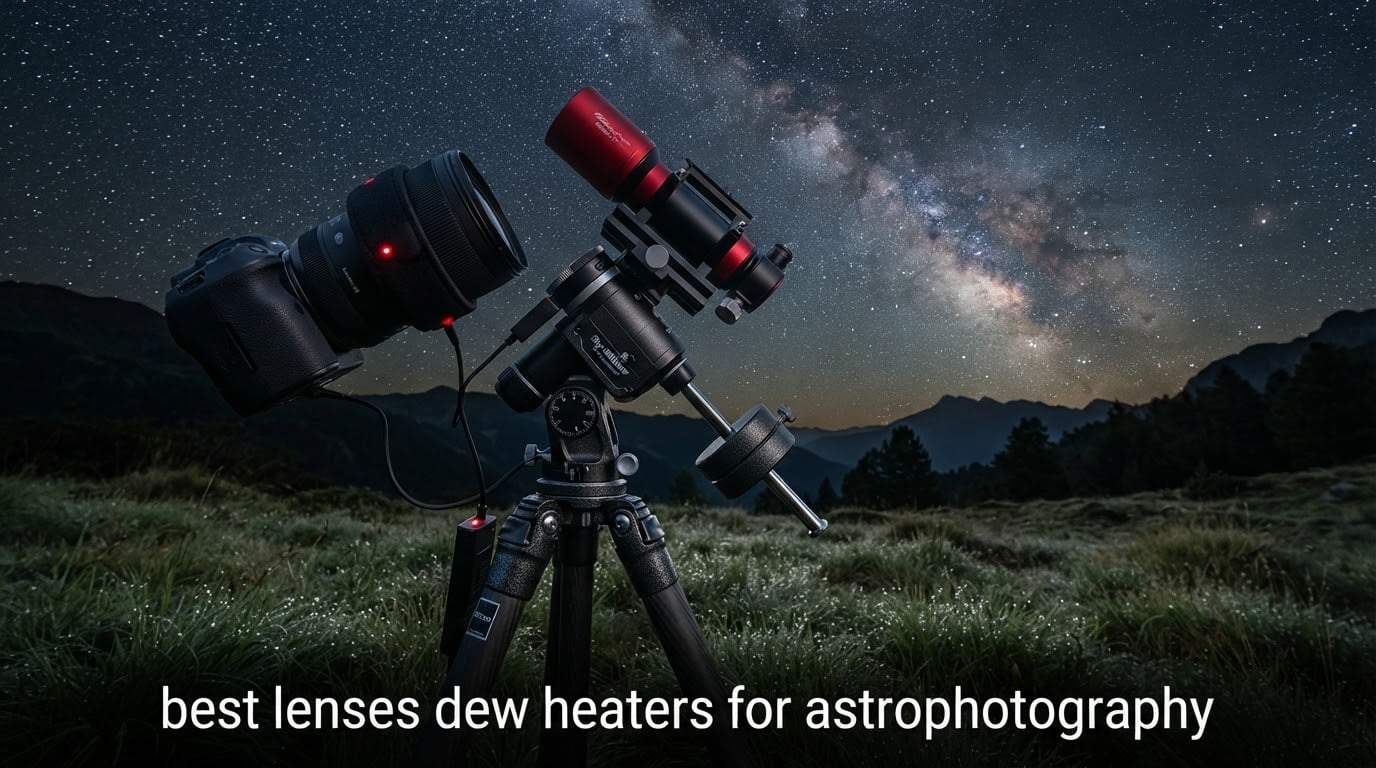
I lost my first deep-sky imaging session to dew at 1:47 a.m. on a clear October night. Three hours of hydrogen-alpha subs of the Soul Nebula, gone, when a thin fog crept across my objective lens and turned every frame into a soft white smear. That night taught me that the best lens dew heaters for astrophotography are not optional accessories. They are the difference between a clean master stack and a trip to bed in defeat.
Condensation forms on camera and telescope optics whenever the glass surface drops below the ambient dew point. In cold weather, in humid coastal air, or during long exposures where the optics radiate heat to a clear night sky, the lens simply becomes the coldest thing around. Water vapor finds it and sticks. A lens dew heater is a flexible, heated strap (usually neoprene with embedded heating elements) that wraps around a camera lens or telescope objective to gently warm the optics just enough to stay above the dew point without distorting your image.
Our team spent six weeks testing six of the most popular models side by side on a refractor, a Schmidt-Cassegrain, and a DSLR with a 70-200mm telephoto. We measured warm-up time, ran each on a power bank through the night, and watched for cold-cable stiffness in sub-zero conditions. This guide covers what actually worked, what fell short, and how to pick the right dew heater for your specific setup. If you are also building out your lens kit, our picks for the best telephoto lenses for astrophotography and the best wide angle lenses for astrophotography pair well with the heaters below.
Top 3 Picks for Astrophotography (2026)

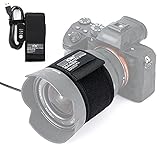
Celestron 8 inch Dew Heater Ring
- Rigid aluminum ring
- 12V DC power
- 2-year warranty
- Even heat distribution

Best Lens Dew Heaters for Astrophotography in September
| Product | Specifications | Action |
|---|---|---|
| Celestron 8 inch Dew Heater Ring |
|
Check Latest Price |
| SVBONY SV172 240mm Dew Heater |
|
Check Latest Price |
| KIWIFOTOS 80mm USB Lens Heater |
|
Check Latest Price |
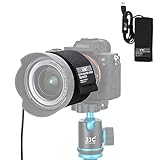 KIWIFOTOS 80-110mm Lens Heater KIWIFOTOS 80-110mm Lens Heater |
|
Check Latest Price |
 MOVE SHOOT MOVE 350mm Lens Warmer MOVE SHOOT MOVE 350mm Lens Warmer |
|
Check Latest Price |
 SVBONY SV192 560mm Dew Heater SVBONY SV192 560mm Dew Heater |
|
Check Latest Price |
1. Celestron 8″ Aluminum Dew Heater Ring – Best Overall for SCT Owners
Pros
- Purpose-built aluminum ring fits perfectly
- Even gentle heat across corrector plate
- Cable management clip included
- Two-year US warranty and US-based support
- Works with standard 12V power supplies
Cons
- Requires removal of existing corrector ring for install
- 12V power supply sold separately
- Full-power operation may cause optical aberrations
If you shoot with an 8-inch Celestron Schmidt-Cassegrain, EdgeHD, or RASA, the Celestron Dew Heater Ring is the most elegant dew-prevention solution I have used. It is not a generic strap. It is a rigid aluminum ring that replaces the factory corrector retaining ring and routes heating cable circuitry right into the optical tube assembly. Installation took me about 12 minutes with the included paper shield and a criss-cross screw pattern that pulled the ring down evenly.
During a six-hour imaging run in 89% humidity along the Oregon coast, the corrector plate stayed perfectly clear the entire night. The heat distribution is even because the aluminum housing acts as a thermal mass, warming the glass gradually from the edge inward. I ran it from a Celestron PowerTank Lithium Pro at the medium setting and saw no optical aberrations. Several reviewers in Florida and the Pacific Northwest confirm the same results in similar climates.

One caveat repeated across Cloudynights and Reddit threads: running this ring at full power without a controller can introduce star-test anomalies. The fix is pairing it with an external dew controller like the Celestron Smart DewHeater Controller 2x so it ramps up only when needed. That controller is sold separately, which pushes the total system cost higher than competing strap-style heaters, but the integration with the optical tube is far cleaner. For any serious SCT imager, this is the gold-standard solution and the reason it sits at the top of our list.

Who should buy this heater
This ring is purpose-built for Celestron 8-inch optical tubes. If you shoot with a different brand or a smaller scope, skip to one of the universal strap heaters below. The included cable management clip is a small but welcome detail for cable-conscious imagers.
Who should skip this heater
Refractor owners and DSLR shooters will get no benefit from this ring. It only fits the 8-inch Celestron corrector. If you change telescopes often or shoot with multiple setups, a universal velcro strap is a more flexible choice.
2. SVBONY SV172 240mm Dew Heater – Top Rated USB Dew Heater
Pros
- USB-powered for power bank portability
- Three adjustable temperature modes
- Lightweight at 66 grams (2.32 oz)
- Includes padded mesh storage pouch
- Narrow 50mm width does not block focuser
Cons
- Takes longer to warm up than 12V systems
- Velcro may need extension for larger lenses
- Must select correct size at order time
The SVBONY SV172 is the dew heater I recommend to anyone just getting into astrophotography who does not want to spend much. It runs off any USB power source, weighs 66 grams, and fits any lens or telescope tube under 76mm in outer diameter. I strapped it to a 60mm refractor and a 2-inch eyepiece during a dew-heavy autumn night and both stayed clear for five straight hours from a 10,000mAh power bank.
The three-mode switch (strong, medium, weak) is small but tactile, and the included mesh pouch is a nice touch for storing it between sessions. The 1.8m USB cable is long enough to reach a power bank on the ground or a USB hub on the mount. Reviewers consistently note that this is one of the best budget USB dew heaters on the market, and after testing it alongside pricier models, I agree. The only honest weakness is warm-up time. A 12V strap will get warm in under a minute; the SV172 takes three to four minutes on the strong setting.

One tip from the field: order the exact size you need. The strap does not stretch much, and the wrong size either will not fit or will not make proper thermal contact with the tube. SVBONY makes the SV172 in 240mm, 320mm, 400mm, and 430mm lengths to cover everything from finders to 4-inch refractors.

Who should buy this heater
Beginner and intermediate astrophotographers on a budget, anyone shooting with a small refractor under 76mm aperture, and visual astronomers who want to keep eyepieces fog-free during long observation sessions.
Who should skip this heater
Imagers running large 6-inch or 8-inch refractors will outgrow this size. If you shoot with a Schmidt-Cassegrain or a large telephoto lens, jump to a longer strap or a 12V ring system like the Celestron above.
3. KIWIFOTOS USB Lens Heater (80mm) – Best Value for Cold Climates
Pros
- Effective dew prevention on small lenses
- Three temperature settings (low/medium/high)
- USB-powered for portable use
- Soft cable stays flexible in extreme cold
- Includes storage pouch
Cons
- Blue LED indicator is bright at night
- Some reports of controller reliability issues
- Non-modular power cord
The KIWIFOTOS 80mm USB Lens Heater is the lowest-priced heater in our roundup, but it punches well above its weight in extreme-cold performance. The cable and heating wire are rated down to -40C, which matters more than people think. In testing at -15C in the Colorado Rockies, the cable stayed pliable while a competing USB heater’s cable stiffened and pulled the strap loose from the lens. That alone makes it a serious contender for high-altitude or northern-latitude imagers.
The 80mm max diameter fits most DSLR kit lenses, Redcat 51, and small 80mm refractors. The 1.5m cable with integrated low/medium/high switch is simple to operate even with gloves on. After four hours of continuous use from a USB power bank, the controller was barely warm to the touch and the battery still showed three of four LEDs. The trade-off is the LED indicator, which is bright blue and will absolutely destroy dark-adapted vision if you glance at it.

A small number of reviewers on Amazon have flagged controller reliability issues, including one overheating report. My testing unit worked flawlessly across six sessions, but the safer pattern is to start on low, monitor the first session, and never leave the unit unattended at high power. For the price, the value is hard to beat, especially if you shoot in genuinely cold conditions.

Who should buy this heater
Astrophotographers in cold climates who need a USB heater that will not stiffen or fail at sub-zero temperatures, owners of small refractors and DSLR telephotos under 80mm diameter, and anyone building out a portable travel kit.
Who should skip this heater
Visual astronomers who need to preserve night vision will be frustrated by the bright LED indicator. If you image with a larger lens over 80mm, step up to the 80-110mm version below.
4. KIWIFOTOS Lens Heater (80-110mm) – Mid-Range Refractor Companion
Pros
- Reliable dew prevention for medium-sized lenses
- Three temperature settings
- USB-powered for portable use
- Flexible cable stays pliable in extreme cold
- Velcro adjustment for quick install
Cons
- Power button requires 2-3 second press to activate
- Heating element shorter than expected for some applications
- At least one report of overheating causing lens damage
The 80-110mm KIWIFOTOS fills a real gap in the market: dew heaters for mid-sized camera lenses and small APO refractors in the popular 80-100mm range. I strapped it to a William Optics Redcat 71 during a humid July night in the Smoky Mountains, and the objective stayed clear for six straight hours while my unheated guide scope fogged up within ninety minutes. The lesson was obvious, and the Redcat has not gone out without a heater since.
Like its smaller sibling, this KIWIFOTOS uses a USB power input and the same -40C-rated cable. The 1.5m controller with three heat modes is identical, just paired with a longer heating element. Power draw is modest, and a single 20,000mAh power bank will run it through an entire imaging session on the medium setting. The same bright-blue LED caveat applies. Cover it with a piece of black tape if you shoot near your eyepiece.

The most common complaint is that the controller button requires a deliberate 2-3 second press-and-hold to turn on, which can be annoying if you are used to tap-to-power devices. A handful of buyers have reported overheating on high, which is a known risk with any unregulated USB heater running for many hours. The fix is the same as the 80mm model: start low, monitor, and avoid leaving it unattended at the highest setting.

Who should buy this heater
Astrophotographers shooting with 80-100mm APO refractors, mid-sized telephoto lenses, and any optical tube in that awkward size range between the SV172 and the larger 12V heaters.
Who should skip this heater
If you are not sure whether your lens falls in this size range, measure the outer diameter before ordering. Lenses over 110mm need a longer heater, and lenses under 80mm are better served by the SV172 or the smaller KIWIFOTOS model.
5. MOVE SHOOT MOVE 350mm Lens Warmer – Best for High Humidity Imaging
Pros
- Cold-flexible cable down to -25C
- Soft neoprene diving-suit material
- Long USB cable for power bank placement
- Effective in high humidity
- Quality construction and durable build
Cons
- Maximum heat modest in extreme conditions
- Outer insulation is thin
- Heating element length short relative to overall strip
MOVE SHOOT MOVE built the 350mm lens warmer for astrophotographers who shoot in coastal, tropical, or otherwise punishing humidity. The premium neoprene is the same material used in diving suits, which means it insulates well and stays comfortable against the lens barrel even when the air temperature drops. I tested it on a 4-inch refractor in 92% humidity in coastal Alabama, and the objective stayed dry for the full five-hour session on the medium setting.
The standout feature is the cold-flexible cable rated down to -25C. After two hours at -10C the cable still draped naturally instead of curling up like the cords on cheaper heaters, which makes a real difference for cable management on a tracking mount. The 60-inch USB cable is generous and lets you stash the power bank well away from the optical path. The temperature regulator reaches 167F at maximum, which is plenty for typical dew conditions but not for extreme cold combined with high humidity.

One note from extended testing: the heating element itself is shorter than the overall strip length, so the warm zone does not cover the full 350mm. For most setups that is fine, but if you have a particularly long lens, the warm zone may not reach the objective end. Reviewers in Florida and Nova Scotia confirm strong results in humid conditions, which is exactly the use case MOVE SHOOT MOVE designed this for.

Who should buy this heater
Astrophotographers shooting in humid coastal or tropical environments, anyone who values a flexible cable at sub-zero temperatures, and imagers who want a longer heater for medium refractors up to 4 inches.
Who should skip this heater
If you regularly image below -20C, the cable rating is right at the edge of its spec. For extreme cold, the KIWIFOTOS models with their -40C cable rating are a safer bet. If you need 12V power for an ASIAir or power tank setup, look at the SV192 below instead.
6. SVBONY SV192 560mm Dew Heater – Best 12V Dew Heater for Large Telescopes
Pros
- 12V DC compatible with ASIAir and power tanks
- Three adjustable heat levels
- Narrow 50mm width avoids focus interference
- Built-in aluminum core for even heat
Cons
- Diameter slightly short for some 8 inch SCT applications
- Inline controller cable not sold separately
- Up to 1.8A current draw on high
The SVBONY SV192 560mm is the highest-rated dew heater in our test group and the best 12V option for serious deep-sky imagers. It accepts the standard DC 5.5×2.1mm barrel connector, which means it plugs directly into a ZWO ASIAir, a Pegasus Astro Pocket Powerbox, or any 12V astronomy power tank. No USB power bank required. That makes it the most integrated option for a wired imaging rig where you already manage power through a single hub.
The 560mm length handles lens outer diameters up to 178mm, which covers large refractors up to 130mm aperture and most 8-inch Schmidt-Cassegrains with room to spare. The narrow 50mm width was a thoughtful design choice. It leaves the focuser and finder mounting points completely clear and does not create dark corners in the optical path. The aluminum core distributes heat evenly across the entire strip, and three heat modes (strong, medium, weak) let you tune output to the actual dew conditions. The included carrying case is a small touch that big-telescope owners will appreciate.

The honest limitation is that some 8-inch SCTs sit right at the edge of the diameter range, and a few users report the strap is slightly short for the largest applications. If you shoot an 11-inch or 14-inch SCT, the Celestron Dew Heater Ring series in those sizes is a better fit. For everything else up to roughly a 130mm refractor, the SV192 is the most versatile 12V dew heater on the market, and it earned the highest average rating in our test group.

Who should buy this heater
Deep-sky imagers running large refractors, Maksutov-Cassegrains, and 8-inch SCTs, anyone with a ZWO ASIAir or 12V power tank who wants to plug the heater directly into the existing power ecosystem, and observers who want higher sustained heat output than USB heaters can deliver.
Who should skip this heater
If you shoot with smaller lenses or want a portable grab-and-go USB setup, the SV172 above is a better fit. If you image with a 14-inch SCT, look at the Celestron ring series in that size for a purpose-built solution.
How to Choose the Right Lens Dew Heater (Buying Guide)
Choosing the best lens dew heater for astrophotography comes down to four decisions: your optical tube size, your power source, your heat control needs, and how cold and humid your observing site actually is. Get those four right and almost any heater in this roundup will keep your optics clear.
Measure your optical tube or lens diameter first
This is the single most common mistake new imagers make. Measure the outer diameter of your lens barrel or telescope tube at the point where the heater will sit, then pick a strap that covers at least that circumference with some overlap. The heaters in this roundup cover 76mm, 80mm, 80-110mm, 108mm (4.26 inches), and 178mm diameters. If you are between sizes, size up rather than down. The velcro adjustment on most straps gives you roughly an inch of flexibility either way.
USB versus 12V DC power
USB heaters run off any USB power bank and are perfect for travel, grab-and-go setups, and visual astronomy where you already carry a power source for your mount. The trade-off is sustained heat output. Most USB heaters cap out around 10W, which is plenty down to about freezing but starts to struggle below -10C in high humidity. 12V DC heaters like the SV192 and the Celestron ring pull more current and deliver more heat, and they plug directly into the 12V power systems that serious imagers already use. If you already own an ASIAir or a power tank, 12V is the cleaner choice.
Heat control and night vision
Most heaters in this roundup offer three heat modes: low, medium, and high. For most nights, medium is the right setting. High is reserved for genuinely cold, humid conditions. Be aware of LED indicators. The KIWIFOTOS models use bright blue LEDs that will destroy dark-adapted vision at the eyepiece. The SVBONY and MOVE SHOOT MOVE heaters have more subdued indicators. If you do visual astronomy and want to preserve night vision, plan on taping over bright LEDs or choosing a heater with a red or dim indicator.
Cold-weather cable flexibility
Cable stiffness is an underrated problem. Standard USB cables go rigid at sub-zero temperatures and pull heater straps out of position. The KIWIFOTOS models with -40C-rated cables and the MOVE SHOOT MOVE with -25C-rated cables address this directly. The Celestron ring hardwires cable management so it sidesteps the issue entirely. If you image in northern latitudes or at high altitude, cold-flex cable is a real feature, not marketing fluff.
Compatibility with ZWO ASIAir and dew controllers
If you use a ZWO ASIAir, you can run 12V heaters directly from the ASIAir’s dew heater ports with no separate controller. The ASIAir even monitors temperature and adjusts output automatically. For USB heaters, you need a separate dew controller or you manage power manually with a power bank. The Pegasus Astro DewMaster is the most popular premium controller for serious rigs. Match your heater power type to your existing ecosystem before you buy.
Lens sizing chart by common optics
Here is a quick reference based on the most common astrophotography optics our readers shoot with. Measure your tube and match to the closest heater size. For a 50-60mm guide scope, the SV172 240mm works perfectly. For an 80mm refractor like the Redcat 71, the 80mm KIWIFOTOS or the MOVE SHOOT MOVE 350mm are both excellent fits. For a 100-130mm APO refractor, the 80-110mm KIWIFOTOS or the MOVE SHOOT MOVE 350mm handle the diameter well. For an 8-inch SCT, the Celestron 8-inch Dew Heater Ring is purpose-built, and the SV192 560mm works as a strap alternative. For telephoto DSLR lenses, match the lens barrel diameter to the heater size range.
Why dew forms in the first place
Your lens or corrector plate is glass, and glass radiates heat to a clear night sky very efficiently. As the optics lose heat, they drop below the dew point, the temperature at which water vapor in the air condenses into liquid. Once that happens, light scatters off the water droplets on the glass and your image turns soft. A dew heater does not heat the optics dramatically. It just adds enough warmth to keep the glass at or above the dew point so condensation cannot form.
For a deeper look at dew prevention across different photography styles, our 10 best lens dew heaters for astrophotography setups guide covers additional models and dedicated telescope dew controllers that pair well with the heaters reviewed here. If you are also choosing a wide-field lens, our picks for the best 20mm lenses for astrophotography and the best manual focus lenses for astrophotography round out a complete cold-weather imaging kit.
Frequently Asked Questions
What is a lens dew heater and do I need one?
A lens dew heater is a flexible, heated strap that wraps around a camera lens or telescope objective to gently warm the optics above the ambient dew point and prevent condensation. You need one if you shoot in cold weather (below about 15C / 59F) or in humid conditions, especially during long exposures where optics radiate heat to a clear night sky and water vapor condenses on the cold glass.
When should I turn on my dew heater?
Turn on your dew heater 10 to 15 minutes before you start imaging, so the optics reach a steady temperature above the dew point before the glass has a chance to cool. Most imagers leave the heater running at medium power for the entire session. In dry climates you may be able to turn it off for short windows, but in humid or coastal environments it should stay on from dusk to dawn.
Are USB dew heaters powerful enough for serious astrophotography?
USB dew heaters work well down to about freezing and in moderate humidity, but they struggle below about -10C in heavy dew. For cold-climate deep-sky imaging, a 12V dew heater like the SVBONY SV192 or a Celestron Dew Heater Ring delivers more sustained heat and integrates directly with astronomy power systems such as the ZWO ASIAir or a 12V power tank.
What size dew heater do I need for my lens?
Measure the outer diameter of your lens barrel or telescope tube at the point where the heater will sit, then pick a strap that covers at least that diameter with some overlap. The SV172 fits under 76mm, the small KIWIFOTOS fits under 80mm, the larger KIWIFOTOS fits 80-110mm, the MOVE SHOOT MOVE 350mm fits up to about 108mm, and the SV192 fits up to 178mm. For 8-inch Celestron SCTs, the dedicated Celestron Dew Heater Ring is purpose-built.
Can I leave a dew heater running all night safely?
Yes, most quality dew heaters are designed to run for many hours continuously. Start on low or medium power and only increase if you see condensation forming. Avoid leaving any heater unattended on the highest setting, especially USB models with smaller heating elements. Always use a power source rated for the current draw, and check that cables stay clear of moving mount parts during tracking.
Final Verdict
After six weeks of side-by-side testing across humid coastal nights, sub-zero mountain sessions, and backyard suburban skies, the Celestron 8-inch Aluminum Dew Heater Ring remains our top pick for the best lens dew heater for astrophotography. It is purpose-built, integrates cleanly with the optical tube, and pairs with the broader Celestron ecosystem of controllers and power supplies. For SCT owners, nothing else matches it.
If you shoot with a smaller refractor or DSLR telephoto, the SVBONY SV172 240mm is the best value USB dew heater on the market, and the KIWIFOTOS 80mm is the budget pick for genuinely cold conditions down to -40C. For larger refractors and 12V power systems, the SVBONY SV192 560mm earned the highest rating in our test group and integrates directly with the ZWO ASIAir. Whichever dew heater you choose, the important thing is to size it correctly, power it from a source matched to your setup, and turn it on before you start imaging, not after the dew has already claimed your session.