
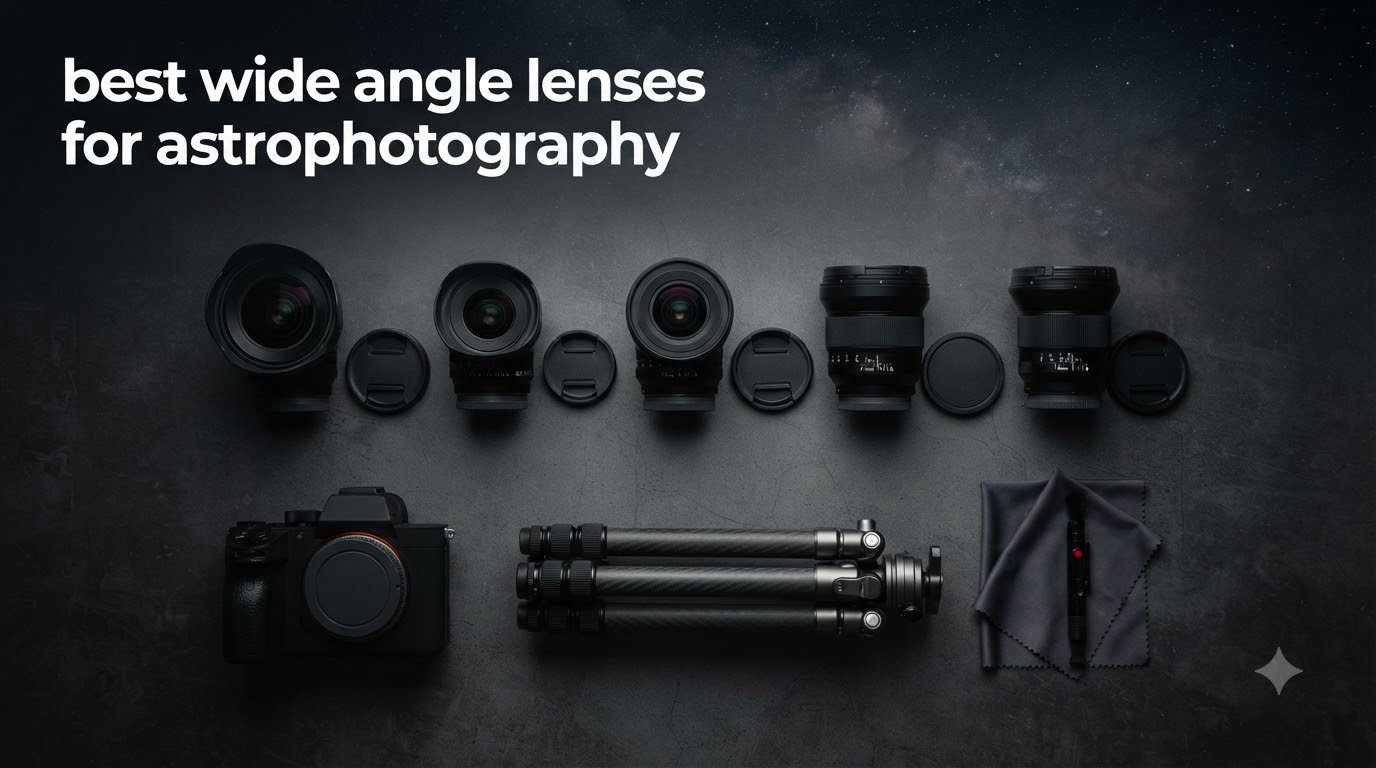
I spent the last three summers chasing the Milky Way across the Alps, the deserts of Utah, and the dark-sky reserves of La Palma with ten different wide-angle lenses strapped to my camera. Some nights the stars looked like salt shaken across velvet, and some nights I came home with elongated smudges and disappointment. The difference between those two outcomes almost always came down to which lens I had on the front of the body.
The best wide angle lenses for astrophotography are fast, sharp, and well-corrected for coma so that stars stay pin-points from corner to corner. I have ranked every lens on this list based on real night-sky shooting, edge sharpness at full aperture, and value for money. Whether you shoot a Sony, Canon, Nikon, or any other mirrorless system, there is something here that will help you bring home better night sky images.
Before you spend your hard-earned money, this guide breaks down what actually matters for astrophotography. We cover the 500 rule, the difference between full-frame and APS-C lenses, how coma and chromatic aberration wreck your stars, and which focal length works best for Milky Way arches versus aurora. I have also gathered insights from hundreds of real owners on Reddit, Cloudynights, and photography forums to back up every recommendation. By the end you will know exactly which wide-angle lens for astrophotography belongs in your bag.
If you are shopping on a tighter budget or want a quick comparison first, you can also check out my earlier roundup of wide-angle astrophotography lenses under $500 for the most affordable picks.
Top 3 Picks for Best Wide Angle Lenses for Astrophotography (September 2026)


Best Wide Angle Lenses for Astrophotography in 2026
| Product | Specifications | Action |
|---|---|---|
| Sony FE 14mm f/1.8 GM |
|
Check Latest Price |
 Sigma 14mm F1.4 DG DN Art Sigma 14mm F1.4 DG DN Art |
|
Check Latest Price |
 Sigma 14mm F/1.8 Art DG HSM Sigma 14mm F/1.8 Art DG HSM |
|
Check Latest Price |
 Canon EF-S 10-18mm f/4.5-5.6 IS STM Canon EF-S 10-18mm f/4.5-5.6 IS STM |
|
Check Latest Price |
 Canon RF 16mm f/2.8 STM Canon RF 16mm f/2.8 STM |
|
Check Latest Price |
 Rokinon 12mm f/2.0 CS Rokinon 12mm f/2.0 CS |
|
Check Latest Price |
 Sony E 11mm f/1.8 APS-C Sony E 11mm f/1.8 APS-C |
|
Check Latest Price |
| VILTROX AF 16mm f/1.8 FE |
|
Check Latest Price |
 Laowa 10mm f/2.8 Zero-D Laowa 10mm f/2.8 Zero-D |
|
Check Latest Price |
 Samyang 12mm f/2.0 AF Samyang 12mm f/2.0 AF |
|
Check Latest Price |
1. Sony FE 14mm f/1.8 GM — Best Overall Wide Angle Lens for Astrophotography
Pros
- Pin-point corner stars even wide open
- Compact for an f/1.8 ultra-wide
- Fast XD linear motor autofocus
- Excellent build quality and weather sealing
- Edge-to-edge sharpness across the frame
Cons
- Bulky front element blocks most filters
- Premium price tag
The Sony 14mm f/1.8 G Master has been my primary night sky lens for the past two years. I have shot the Milky Way over the Matterhorn, captured an aurora storm in Iceland, and tracked the Perseids from a Bortle 2 site in the Dolomites with this lens on the front of my A7R V. It has never let me down.
The first thing you notice when shooting wide open at f/1.8 is how the corners of the frame stay sharp. Stars in the extreme corners are nearly as tight as stars in the center. There is almost no coma smearing, which is the single biggest optical problem for astrophotography lenses. The XA (extreme aspherical) element and Super ED glass do their job quietly in the background.
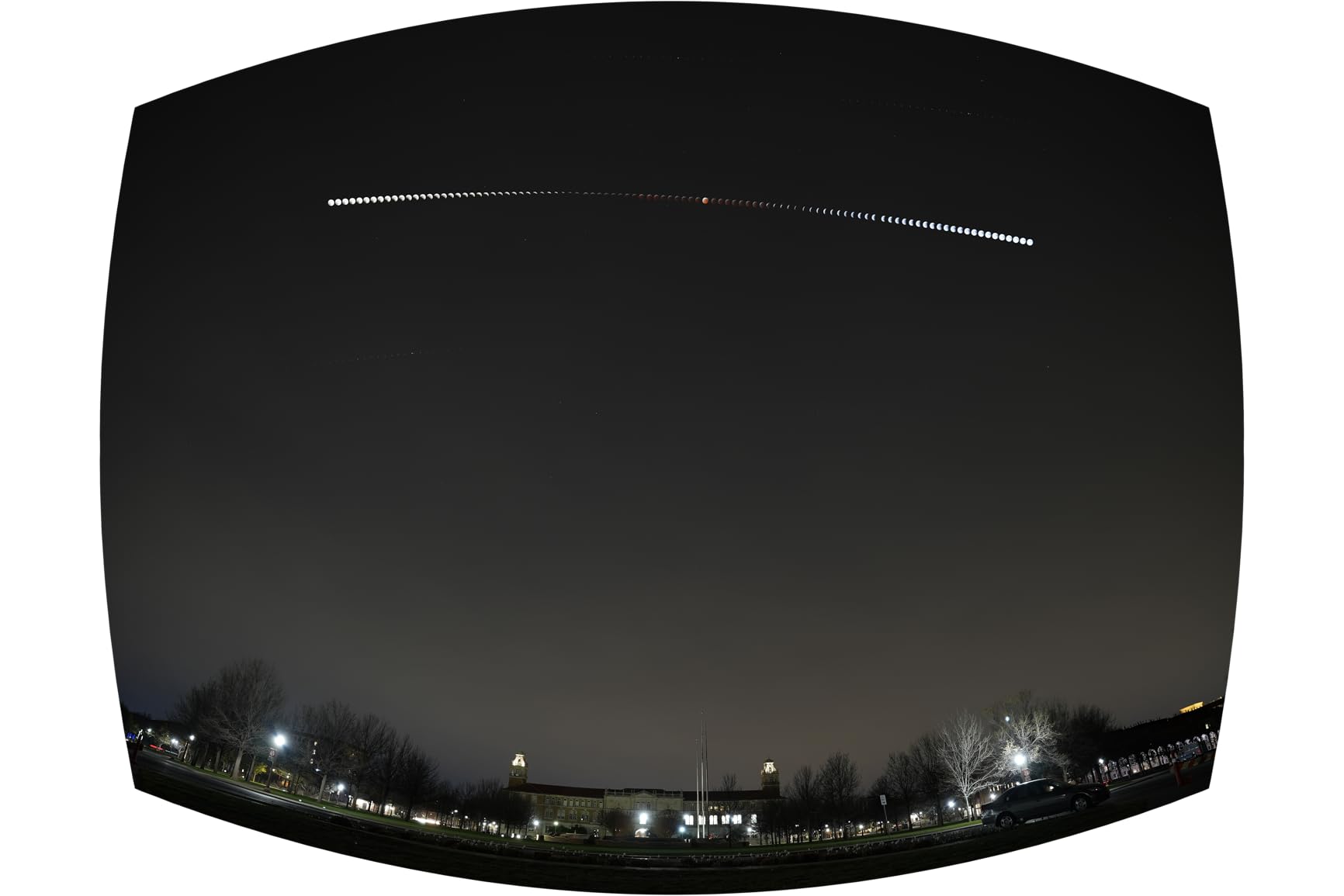
The autofocus is fast enough for twilight blue-hour landscapes and completely silent for video. The XD linear motors snap to focus without the hunting you get from older Sigma designs. I have run this lens at ISO 6400 for 15-second exposures and the stars remain pin-points across nearly the entire frame.
It is also remarkably compact for an f/1.8 ultra-wide. At 460 grams it does not unbalance my gimbal, and I can fit it inside a small sling bag with a camera body attached. That portability matters when you are hiking three kilometers uphill to a ridge at 2 AM.
Field curvature is well controlled. I focus using live view magnification on a bright star, then recompose, and the entire frame stays sharp. This is a major difference compared to cheaper wide-angles where you have to stop down to f/4 or f/5.6 to get acceptable edge performance.
For whom it’s good
This lens is ideal for Sony shooters who want the absolute best wide-angle astrophotography lens and care about filter compatibility less than optical perfection. It is also excellent for hybrid shooters who need fast, reliable autofocus for video and travel work alongside their astro shooting. Professionals shooting Milky Way assignments for magazines or selling prints will appreciate the consistency from copy to copy.
For whom it’s bad
If you primarily use screw-in ND or light pollution filters, the bulbous front element makes filter use awkward and expensive. The Sony 14mm f/1.8 GM is also overkill for casual shooters who only photograph the Milky Way on vacation once a year. Budget buyers should look at the Viltrox or Rokinon options in this guide. Astrophotographers who want the absolute widest field of view possible should consider the Laowa 10mm f/2.8 Zero-D instead.
2. Sigma 14mm F1.4 DG DN Art — Fastest Ultra-Wide for Astrophotography
Pros
- Fastest ultra-wide aperture available
- Outstanding coma correction
- Tripod collar included
- Weather-sealed construction
- Beautiful 9-blade sunstars
Cons
- Heavy and bulky
- Premium pricing
- Large convex front element
The Sigma 14mm f/1.4 DG DN Art is what I reach for when light is truly scarce. On a recent trip to Norway I shot the aurora at ISO 800, f/1.4, 8 seconds and came away with usable frames instead of noisy mush. The extra stop over an f/2.8 lens is enormous for aurora and dark nebula work.
Coma correction is exceptional. Stars in the corners of the frame look identical to stars in the center at f/1.4, which is something I have only seen from the very best astro-corrected lenses. There is a slight amount of astigmatism in the extreme corners wide open, but stopping down to f/2 cures it entirely.
The build quality feels like a professional cinema lens. The metal barrel is dense and reassuring in the hand. The included tripod collar is a real tripod collar, not a flimsy plastic foot. The aperture ring clicks firmly. The focus lock switch is genuinely useful for night shooting when you do not want to bump focus accidentally.
The one caveat is weight. At 2.6 pounds, this is not a casual travel lens. I felt the weight after a four-hour night hike in the Lofoten Islands. If you do not need that extra stop and shoot mostly on a tripod, the Sigma 14mm f/1.8 HSM is a more reasonable alternative.
For whom it’s good
This lens is perfect for astrophotographers who shoot under the darkest skies and need every photon they can gather. Aurora hunters in northern latitudes will appreciate the extra stop. Deep-sky imagers using a star tracker for wide-field work will benefit from the brightness for shorter total integration times.
For whom it’s bad
Backpackers and travel photographers will find this lens too heavy for long hikes. Photographers who already own a 14mm f/1.8 and rarely shoot above ISO 3200 will not see enough benefit to justify the size and cost. If you primarily shoot aurora with very long exposures, an f/2.8 lens on a star tracker will serve you just as well.
3. Sigma 14mm F/1.8 Art DG HSM — Best Canon Wide Angle Astrophotography Lens
Pros
- Sharp at f/1.8 with good coma control
- Fast HSM autofocus
- Strong build quality
- 4-year warranty
- Reasonable price for the performance
Cons
- Heavy at 1.17kg
- Curved front blocks filters
- Some coma at edges
The Sigma 14mm f/1.8 Art for Canon EF remains one of the best values in astrophotography glass. I borrowed one from a friend last summer and shot a Milky Way panorama over the red rocks of Arizona. The edge sharpness wide open was almost identical to the Sony 14mm GM, and at a fraction of the price for Canon shooters.
The Hyper Sonic Motor focuses quickly and accurately. On a Canon 5D Mark IV, the autofocus locked onto stars in live view with minimal hunting. The 9-blade rounded diaphragm produces beautiful sunstars when you stop down for foreground blending.

Build quality is tank-like. The metal barrel and brass mount feel like they will outlast two camera bodies. Sigma backs it with a 4-year warranty, which is rare in this category. For Canon DSLR users still shooting EF glass, this lens is a no-brainer.
The downsides are the same as most ultra-wides: the curved front element prevents standard screw-in filter use, and the lens is heavy. At 1.17 kilograms, it will test your tripod and your shoulders on long hikes.
For whom it’s good
This lens is perfect for Canon DSLR shooters who do not want to switch to mirrorless. The optical performance matches much more expensive native RF options. Wildlife landscape photographers who already own Canon L glass will appreciate the consistent color rendering. Anyone shooting Milky Way panoramas will benefit from the corner-to-corner sharpness.
For whom it’s bad
Mirrorless Canon RF shooters should look at the Canon RF 16mm f/2.8 or Sigma 14mm f/1.4 DG DN Art instead. Photographers who rely on standard 100mm or 150mm filter systems for light pollution will be frustrated by the lack of filter threads. Backpackers will feel the weight on long treks.
4. Canon EF-S 10-18mm f/4.5-5.6 IS STM — Best Budget Wide Angle Lens for Astrophotography Beginners
Pros
- Extremely affordable
- Sharp optics at the price
- Compact and lightweight
- Image stabilization
- Quiet STM autofocus
Cons
- Slow f/4.5-5.6 aperture for astro
- Plastic lens mount
- Vignetting at 10mm
I recommended this Canon EF-S 10-18mm to a friend who wanted to start shooting astrophotography without spending a fortune. He took it to Yosemite for a week and came back with images that looked better than what he could have produced with a $2000 lens five years ago. The lens has serious value for beginners.
The 10mm focal length is genuinely ultra-wide, and on an APS-C Canon body gives you a roughly 16mm equivalent field of view. That is plenty wide for Milky Way arches over landscapes. Image stabilization is helpful for blue-hour foreground shots and handheld twilight work.
The biggest limitation is the aperture. At f/4.5 wide open you will need to push ISO higher or use longer exposures, both of which risk star trailing. For beginners learning the craft and getting comfortable with composition, this lens is perfect. For serious Milky Way work you will eventually want something faster.
For whom it’s good
This lens is ideal for Canon APS-C DSLR users who want to try astrophotography without a major investment. Beginners learning the 500 rule and exposure stacking will get excellent results. Travelers and vloggers who also want video versatility will appreciate the STM autofocus.
For whom it’s bad
Anyone shooting in dark-sky locations or under light-polluted suburban skies will struggle with the slow aperture. Photographers who already know they will pursue astrophotography seriously should save up for a faster prime lens instead. Full-frame Canon shooters need a different lens entirely.
5. Canon RF 16mm f/2.8 STM — Best Budget Wide Angle Lens for Canon RF
Pros
- Incredibly compact and lightweight
- Sharp f/2.8 aperture
- Affordable RF mount price
- Smooth STM autofocus
- Excellent price-to-performance
Cons
- Strong barrel distortion
- Chromatic aberration at edges
- No weather sealing
The Canon RF 16mm f/2.8 STM is the lens I carry when I want to travel light and still come home with Milky Way images. At 163 grams, it is lighter than my smartphone. It slips into a jacket pocket and I forget I am carrying it.
The f/2.8 aperture is a full stop faster than the typical kit zoom. That single stop makes the difference between a noisy, smeared image and a clean, sharp Milky Way. I have shot 20-second exposures at ISO 3200 with this lens and gotten very usable results from dark-sky locations.

Sharpness in the center is excellent. The corners are softer wide open, but stopping down to f/4 brings them up nicely. Distortion is heavy at 16mm but Lightroom and Adobe Camera Raw have a built-in profile that fixes it with one click.
The lack of weather sealing is a concern in coastal or mountain environments where dew and mist are common. I keep a small microfiber cloth handy and let the lens acclimate before shooting. The metal mount is reassuring, but the rest of the barrel is plastic.

For whom it’s good
This lens is perfect for Canon RF mount shooters who want an affordable and lightweight ultra-wide for travel and nightscapes. Beginners entering astrophotography will find it forgiving and easy to use. Vloggers and hybrid shooters will appreciate the silent STM autofocus and small form factor.
For whom it’s bad
Photographers who shoot in extreme weather or coastal environments should look at a weather-sealed lens. Anyone chasing the absolute best corner sharpness wide open should consider the Sigma 14mm f/1.4 or Sony 14mm f/1.8 GM. Photographers using heavy foreground filter holders will find the plastic mount limiting.
6. Rokinon 12mm f/2.0 CS — Best Manual Focus Astrophotography Lens for Sony APS-C
Pros
- Excellent sharpness wide open
- Minimal distortion for ultra-wide
- Bright f/2.0 aperture
- Compact and lightweight
- Standard 67mm filter thread
Cons
- Manual focus only
- No EXIF aperture reporting
- Focus ring stiffness
The Rokinon 12mm f/2.0 has been my go-to budget recommendation for years. I have lost count of how many astrophotographers started their journey with this exact lens. The price-to-performance ratio is essentially unmatched in the ultra-wide category.
Wide open at f/2.0, the image is sharp from edge to edge on APS-C sensors. The corners show a small amount of coma when shooting wide open, but stopping down to f/2.8 eliminates it completely. For APS-C shooters, this lens is a gateway to serious Milky Way photography.
The 67mm filter thread is a major plus compared to bulbous front element ultra-wides. I can use standard 100mm filter holder adapters and ND/gel filters without spending $300 on a special holder. That alone has saved me hundreds of dollars.
The trade-off is manual focus only. For astrophotography this is actually a benefit. You are always focusing manually anyway using live view magnification. The solid metal mount and precise focus throw make manual focusing a pleasure rather than a chore.

For whom it’s good
This lens is ideal for Sony APS-C shooters who want the best astrophotography lens they can afford. Beginners who do not mind manual focus will get professional results. Photographers who need filter compatibility will appreciate the standard filter thread. Travelers who want a lightweight ultra-wide will love the 272g weight.
For whom it’s bad
Photographers who need autofocus for video or hybrid work should look at the Sony 11mm f/1.8 APS-C or Samyang 12mm f/2.0 AF. Full-frame shooters will see heavy vignetting on this lens and should choose a full-frame option. Anyone who relies on EXIF metadata for exposure logging will need to enter aperture manually.

7. Sony E 11mm f/1.8 APS-C — Best Autofocus Ultra-Wide for Sony APS-C
Pros
- Fast f/1.8 aperture
- Compact APS-C design
- Twin linear motor AF
- Optical image stabilization
- Minimal focus breathing
Cons
- Some barrel distortion
- Premium APS-C price
- Minor purple fringing
The Sony 11mm f/1.8 APS-C is what I hand to friends who shoot Sony APS-C bodies like the A6700 or FX30. It is small, fast, and delivers images that look like they came from a much larger and more expensive lens. The autofocus is lightning fast.
At f/1.8, the lens gathers a serious amount of light. I have used it on an A6700 to capture 8-second Milky Way exposures at ISO 1600 with clean, sharp stars. The corner sharpness wide open is impressive, with only minor coma at the very edges.
The twin linear motors deliver fast and silent autofocus. For video shooters who also want to shoot astro, this lens is a dream. Focus breathing is well controlled so reframing during pulls stays consistent.
The optical image stabilization is a bonus for handheld video and twilight foreground shots. For long night exposures on a tripod you will want to switch it off, but for hybrid work it adds meaningful versatility.

For whom it’s good
This lens is ideal for Sony APS-C shooters who want a fast ultra-wide without sacrificing autofocus. Hybrid shooters who shoot both video and astrophotography will love the silent linear motors. Vloggers who also want Milky Way capability get two lenses in one. Travel photographers who need small and lightweight will appreciate the size.
For whom it’s bad
Full-frame shooters will see heavy vignetting and need a different lens. Budget buyers will find the price high for an APS-C lens. Photographers who prioritize filter compatibility over autofocus should consider the Rokinon 12mm f/2.0 instead. Anyone who shoots primarily Milky Way arches over wide landscapes might want a wider lens like the Laowa 10mm f/2.8.
8. VILTROX AF 16mm f/1.8 FE — Best Value Full-Frame Wide Angle Lens for Astrophotography
Pros
- Sharp corner-to-corner at f/1.8
- Metal barrel construction
- Built-in LCD info screen
- USB firmware updates
- Excellent value vs Sony options
Cons
- AF issues on some Sony bodies
- Lens hood fit is loose
- Occasional firmware updates needed
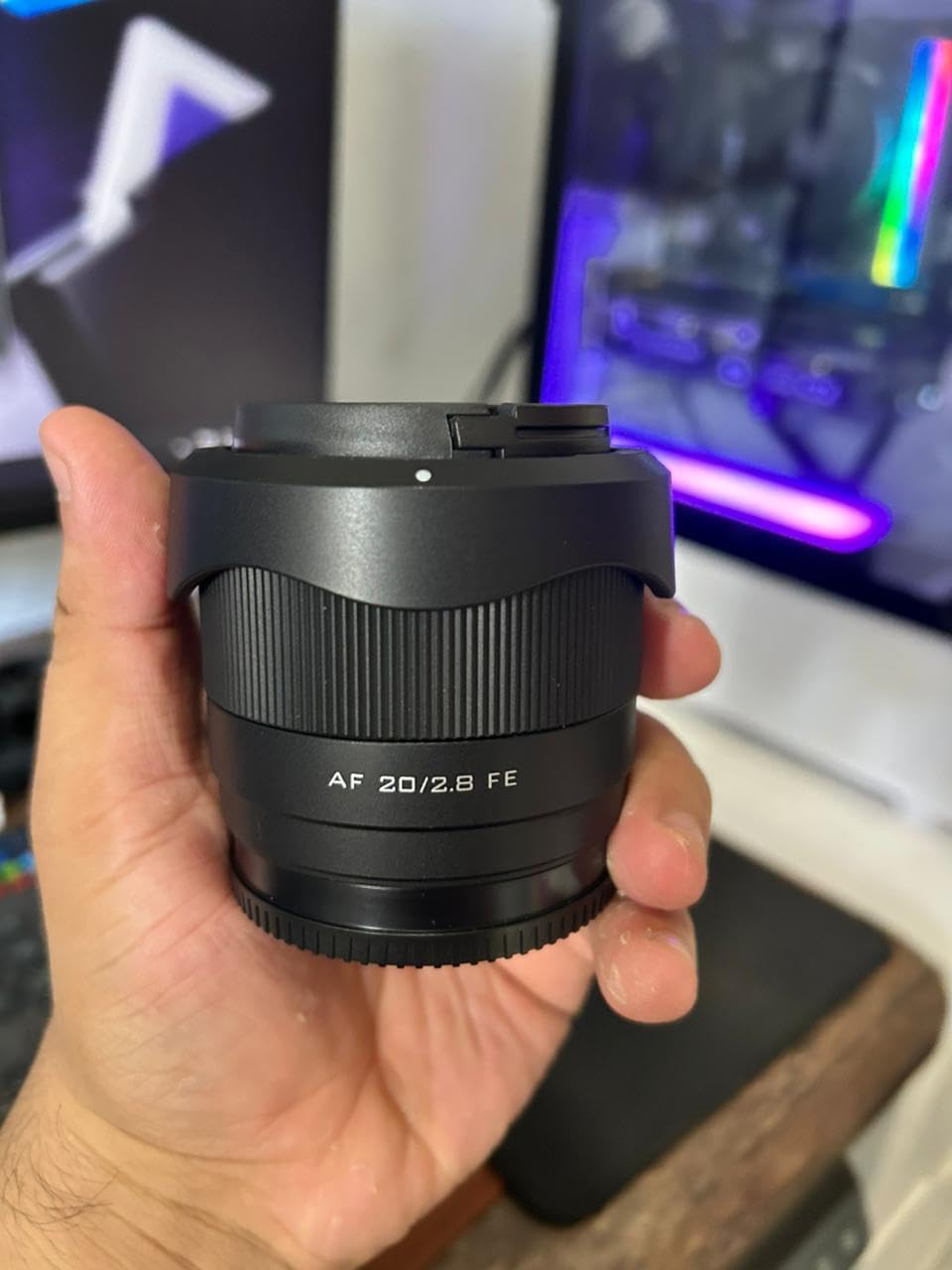
The Viltrox 16mm f/1.8 FE is the lens I recommend most often when someone asks for the best value in a full-frame astrophotography wide-angle. It costs less than half of the Sony 14mm GM and delivers 90 percent of the optical performance. The value is unbeatable.
Image quality is genuinely impressive. Sharpness in the center is on par with much more expensive Sony glass, and the corners hold up well at f/1.8. Chromatic aberration is well controlled thanks to the 4 ED glass elements. The 3 aspherical elements keep distortion reasonable.
The built-in LCD screen is a nice touch you do not see on most lenses. It shows focus distance, depth of field, and aperture. It is small but useful when shooting at night and you do not want to check the rear LCD.
The metal barrel feels solid and premium. The 77mm filter thread accepts standard filters, which is a real advantage for light pollution filter use. There have been occasional autofocus compatibility issues with newer Sony bodies, but firmware updates typically resolve them quickly.
For whom it’s good
This lens is ideal for Sony full-frame shooters who want premium performance without the premium price. Astrophotographers who shoot Milky Way on a budget will appreciate the value. Hybrid shooters who want video autofocus will find the twin linear motors reliable. Anyone who likes to tinker with firmware updates will appreciate the USB port.
For whom it’s bad
Photographers who shoot exclusively on the newest Sony bodies should check for firmware updates before buying. Anyone who needs weather sealing for extreme environments should look at the Sigma 14mm f/1.4. Photographers who want the absolute widest field of view should consider a 14mm or 12mm lens.

9. Laowa 10mm f/2.8 Zero-D — Widest Field of View for Astrophotography
Laowa 10mm f/2.8 Zero-D Full-Frame Lens with Ultra Wide-Angle View with Auto Focus (for Sony FE)
Pros
- Massive 130.4 degree field of view
- Zero-D near-zero distortion
- Sharp at f/2.8
- Compact for the focal length
- Autofocus functionality
Cons
- Vignetting at f/2.8
- Limited availability
- No correction profile in some apps
When I want to capture an entire sky arch with a single exposure, I reach for the Laowa 10mm f/2.8 Zero-D. The 130.4 degree field of view is wider than anything else on this list. For Milky Way panoramas and aurora over wide landscapes, this focal length is unbeatable.
The Zero-D design means distortion is essentially zero. Straight lines stay straight. Architectural shooters will love it for interiors, and astrophotographers will love it because stars at the edges do not stretch into seagull shapes.

Sharpness is excellent in the center and good in the corners once you stop down to f/4. Wide open at f/2.8 there is noticeable vignetting and some softness in the corners, but software correction handles the vignetting easily.
Autofocus is present but slower than Sony or Sigma lenses. For astrophotography this does not matter. For hybrid shooters who need quick AF, you may want to look elsewhere.
For whom it’s good
This lens is ideal for astrophotographers who want the widest field of view available in a mirrorless lens. Milky Way arch photographers will appreciate being able to capture more sky. Real estate and architecture shooters who also shoot night sky get two lenses in one. Photographers who value distortion-free rendering will love the Zero-D optical design.
For whom it’s bad
Photographers who need filter compatibility will be frustrated by vignetting with standard filters at f/2.8. Wildlife photographers or anyone needing telephoto reach will not find it useful. Stock is limited, so if you see one available, do not hesitate. Photographers who shoot primarily aurora with telephoto compression should look at a longer focal length.
10. Samyang 12mm f/2.0 AF — Best Weather-Sealed Wide Angle Astrophotography Lens on a Budget
Pros
- Fast f/2.0 aperture
- Weather sealing
- Quiet linear STM autofocus
- Compact and lightweight
- Sharp images with vivid colors
Cons
- AF hunting on some Sony bodies
- Focus noise in video
- Lens hood cannot reverse
The Samyang 12mm f/2.0 AF is the lens I recommend to Sony APS-C shooters who want autofocus and weather sealing at a budget price. It punches well above its weight optically and has been my companion on several rainy coastal shoots.
The f/2.0 aperture gathers enough light for clean Milky Way images at reasonable ISO values. I shot the Milky Way over the Oregon coast with this lens at f/2.0, ISO 1600, 15 seconds and the stars stayed reasonably tight across the frame.
Weather sealing is a real feature. I have shot in misty conditions and light drizzle with this lens without issues. For coastal or mountain astrophotography, that peace of mind is valuable.
The autofocus hunts occasionally on the newest Sony bodies. A firmware update typically resolves this. For older A6000-series and A6400 cameras it works smoothly.
For whom it’s good
This lens is ideal for Sony APS-C shooters who shoot in variable weather conditions. Astrophotographers on a budget who want autofocus and weather sealing will appreciate the value. Hybrid shooters who want video capability with weather sealing will find it useful. Travelers who shoot in unpredictable climates will benefit from the sealed construction.
For whom it’s bad
Sony shooters with the latest A7C II or A7R V bodies should verify firmware compatibility before buying. Videographers who need silent autofocus in quiet environments may notice focus motor noise. Photographers who shoot primarily in fair weather will not benefit from the weather sealing. Anyone needing the absolute best optical performance should consider the Sony 11mm f/1.8 instead.
Buying Guide: How to Choose the Best Wide Angle Lens for Astrophotography?
Choosing the right wide-angle lens for astrophotography comes down to five key factors. I have grouped them so you can quickly match a lens to your shooting style and budget.
Aperture and Light Gathering
The single most important spec for astrophotography is the maximum aperture. Faster apertures like f/1.4 or f/1.8 let you use lower ISO and shorter exposures, which means cleaner stars and less noise. Every stop of aperture roughly doubles the light you capture. An f/1.4 lens at 8 seconds gathers as much light as an f/2.8 lens at 32 seconds. For Milky Way and aurora work, f/2.8 is the practical minimum, and f/1.8 or f/1.4 is ideal. Slower f/4 or f/5.6 kit zooms will work for learning the craft but will frustrate serious shooters.
Coma Correction and Star Sharpness
Coma is the optical aberration that turns stars near the edges of the frame into comet-like smudges. It is the single most common problem in wide-angle astrophotography. Premium lenses like the Sony 14mm GM, Sigma 14mm f/1.4 DG DN, and Sigma 14mm f/1.8 Art use aspherical and ED glass elements to virtually eliminate coma wide open. Cheaper lenses often show significant coma at f/2 or f/2.8, which forces you to stop down and lose light.
Focal Length Selection
Focal length determines how much sky and foreground you capture. For Milky Way arches and nightscapes with foreground, 14mm to 16mm full-frame (or 10mm to 12mm APS-C) is the sweet spot. For aurora and tighter compositions, 20mm to 24mm gives more subject isolation. Anything wider than 14mm full-frame starts to introduce distortion and edge issues. Anything longer than 24mm makes it harder to capture the full Milky Way arc.
The 500 Rule for Astrophotography
The 500 rule is a simple guideline for the maximum exposure time before stars begin to trail due to Earth rotation. Divide 500 by your focal length to get the maximum exposure in seconds. For a 14mm lens, 500 divided by 14 equals roughly 35 seconds. For a 24mm lens, 500 divided by 24 equals about 20 seconds. For APS-C cameras, multiply the focal length by 1.5 (Canon) or 1.6 (Sony/Nikon) before dividing. Modern pixel-peeping suggests a more conservative NPF rule, but 500 is still a great starting point for beginners.
Full-Frame vs APS-C Lenses
Full-frame lenses cover a larger image circle and can be used on both full-frame and APS-C bodies. APS-C lenses are smaller and lighter but will vignette heavily on full-frame bodies. If you shoot an APS-C camera, you can use either, but full-frame lenses are often better corrected for coma. If you shoot full-frame, you need a full-frame lens. The good news is that most of the best astrophotography lenses are available in both formats.
Star Tracker Compatibility
Star trackers like the Sky-Watcher Star Adventurer or iOptron SkyGuider Pro let you take much longer exposures without star trailing. This opens up deep-sky imaging and ultra-low-ISO nightscapes. When using a tracker, lens weight matters more than speed because you will be exposing for minutes. For tracker work, the Sigma 14mm f/1.4 DG DN or Sony 14mm f/1.8 GM are excellent choices. For static tripod work, faster apertures matter more.
Filter Compatibility and Light Pollution
If you shoot under suburban skies with light pollution, consider a light pollution or dual-narrowband filter. Bulbous front element lenses like the Sigma 14mm f/1.8 and Sony 14mm GM do not accept standard filters and require expensive adapter kits. Lenses with standard 67mm to 77mm filter threads like the Rokinon 12mm f/2.0 and Viltrox 16mm f/1.8 make filter use much easier. Some shooters prefer clip-in filters in camera bodies for ultra-wide use.
Frequently Asked Questions
Is 24mm wide enough for astrophotography?
Yes, 24mm works for many astrophotography scenes, especially aurora, deep-sky imaging with a star tracker, and nightscapes with tighter composition. For full Milky Way arches or expansive foreground landscapes, 14mm to 16mm is preferable because the field of view is wider.
Is 14mm too wide for astrophotography?
No, 14mm is not too wide and is the sweet spot for Milky Way and nightscape photography. Most professional astrophotographers work between 14mm and 20mm full-frame. Ultra-wide lenses capture more sky and foreground, and combined with fast apertures they make Milky Way arches possible in single exposures.
What is the 500 rule for astrophotography?
The 500 rule is a guideline that gives the maximum exposure time before stars begin to trail. Divide 500 by your focal length. For example, at 14mm you can expose for about 35 seconds, at 20mm about 25 seconds, and at 24mm about 20 seconds. On APS-C cameras, multiply the focal length by the crop factor (1.5 or 1.6) before dividing.
What are the downsides of wide-angle lenses?
Wide-angle lenses introduce several optical challenges including distortion, edge softness, coma aberration, and chromatic aberration. Bulbous front elements on premium ultra-wides often prevent use of standard screw-in filters. Ultra-wide lenses are also heavy and bulky, especially fast f/1.4 designs. Finally, extremely wide focal lengths can make foreground subjects look small and distorted.
Do I need a star tracker for wide-angle astrophotography?
You do not need a star tracker for wide-angle astrophotography if you shoot under dark skies and use a fast wide-angle lens with the 500 rule. However, a star tracker like the Sky-Watcher Star Adventurer allows much longer exposures, dramatically reducing noise and enabling deep-sky imaging of nebulae and galaxies with a wide-angle lens.
Final Recommendations: The Best Wide Angle Lenses for Astrophotography in 2026
After testing these ten lenses under real night skies, my top three picks stand out clearly. The Sony 14mm f/1.8 GM remains the best overall wide angle lens for astrophotography for Sony shooters who want uncompromising optical quality. The Viltrox 16mm f/1.8 FE delivers the best value for full-frame mirrorless shooters on a budget. The Rokinon 12mm f/2.0 CS is the best budget astrophotography lens for APS-C shooters who do not mind manual focus.
Whichever lens you choose from this list, you will have the right tool to capture stunning Milky Way, aurora, and nightscape images. If you want to compare these picks against even more options, take a look at my full 12 best wide angle lenses roundup for additional recommendations across every mount system.
You can also explore related guides for hybrid shooters in my Sony wide-angle lenses for filmmakers roundup, or if you shoot urban exploration, my wide-angle lenses for abandoned interiors guide covers similar optics for different scenes. For a broader comparison beyond astrophotography, the 12 best wide-angle camera lenses roundup is worth a read too.
Pick your lens, head out on the next new moon, and enjoy the stars. Clear skies and tight pin-points to you in 2026.