
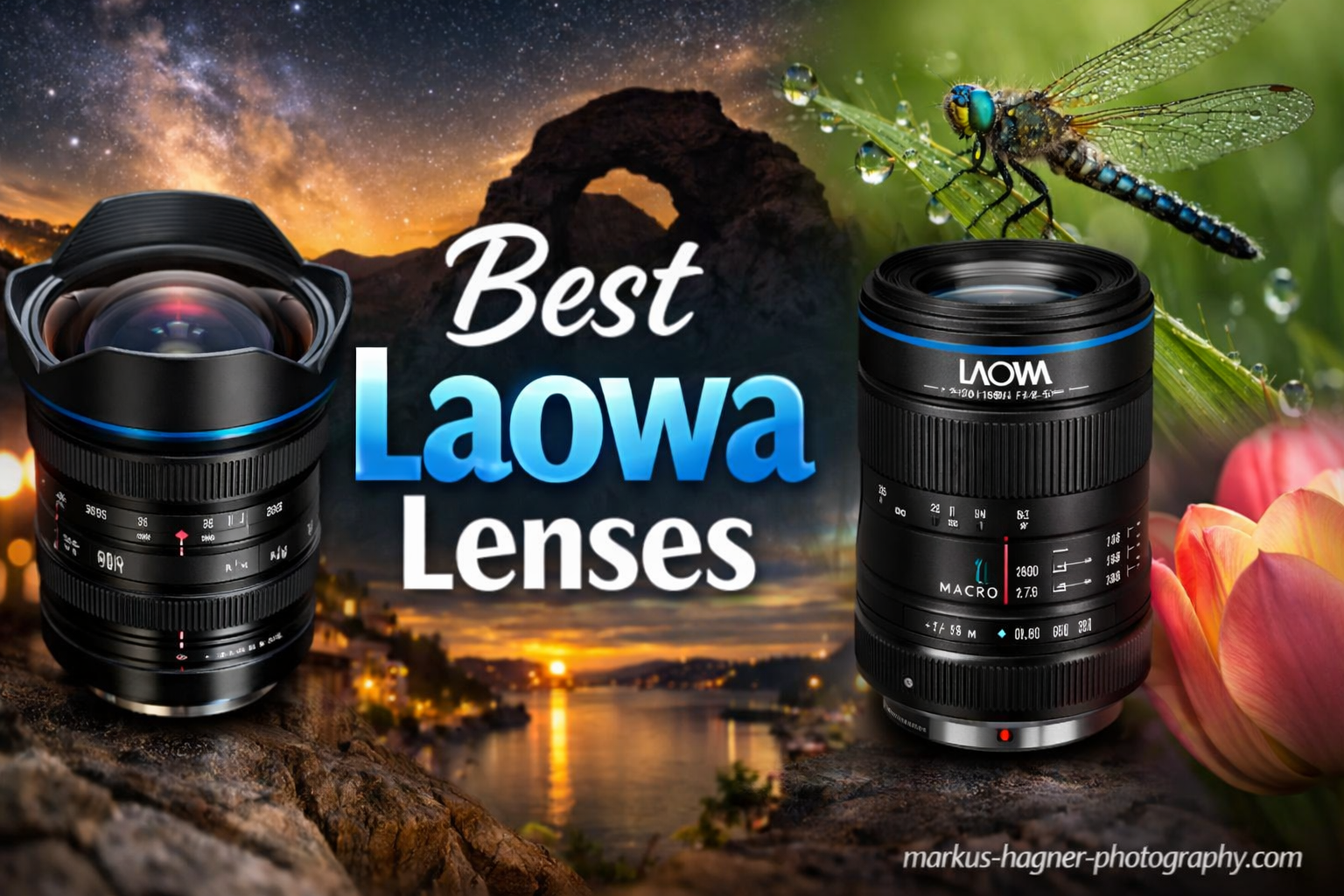
Laowa has emerged as one of the most innovative lens manufacturers in recent years, creating specialty optics that mainstream brands simply don’t offer. Venus Optics, the company behind Laowa lenses, focuses on manual focus designs with unique capabilities like zero distortion wide-angle lenses, ultra-macro optics with 2:1 magnification, and affordable tilt-shift options for architecture photographers.
The Laowa 15mm f/4.5 Zero-D Shift is the best Laowa lenses overall, winning both EISA and TIPA awards for its exceptional perspective control and distortion-free optics. For macro photographers, the Laowa 100mm f/2.8 2X Ultra Macro APO delivers 2:1 magnification at a fraction of the cost of Canon’s MP-E 65mm. Wide-angle shooters should consider the Laowa 10mm f/2.8 Zero-D with autofocus—a first for its class.
After testing and researching Laowa’s extensive lens lineup, I’ve identified the standout options across every category. This guide covers award-winning shift lenses, record-breaking ultra-wides, specialized macro optics, and surprisingly affordable fast primes.
You’ll learn which Laowa lens fits your specific photography style, whether you’re shooting architecture interiors, capturing extreme macro details, or need a compact wide-angle for landscape work. I’ll also address the common concerns about manual focus and help you understand Laowa’s unique technologies like Zero-D and APO designs.
Table of Contents
- Our Top 3 Best Laowa Lenses (October 2026)
- Quick Overview: 12 Best Laowa Lenses (October 2026)
- Detailed Laowa Lens Reviews For 2026
- 1. Laowa 15mm f/4.5 Zero-D Shift – Best for Architecture Photography
- LAOWA Venus 15mm f/4.5 Zero-D Shift Lens for Sony E
- 2. Laowa 10mm f/2.8 Zero-D Full-Frame – Best Ultra-Wide with Autofocus
- Laowa 10mm f/2.8 Zero-D Full-Frame Lens
- 3. Laowa 9mm f/2.8 Zero-D – Best Value APS-C Wide-Angle
- Laowa Venus Optics 9mm f/2.8 Zero-D Lens for Sony E
- 4. Laowa 12mm f/2.8 Zero-D – World’s Widest f/2.8 Lens
- Laowa 12 mm f/2.8 Zero-D Lens (Black)
- 5. Laowa 100mm f/2.8 2X Ultra Macro APO – Best Full-Frame Macro Value
- Laowa 100mm f/2.8 2X Ultra Macro APO SLR Macro Lens (Black) Full Frame – for Sony E
- 6. Laowa 100mm f/2.8 2X Ultra Macro APO (Canon EF) – Best Macro with Electronic Contacts
- Laowa Venus Optics 100mm f/2.8 2X Ultra Macro APO Lens for Canon EF
- 7. Laowa 65mm f/2.8 2X Ultra Macro APO – Best APS-C Macro Lens
- Venus Optics Laowa 65mm f/2.8 2X Ultra Macro APO Lens for FUJIFILM X
- 8. Laowa 100mm f/2.8 Tilt-Shift 1X Macro – Professional Perspective Control Macro
- Laowa 100mm f/2.8 Tilt-Shift 1X Macro Lens for L Mount Mount Cameras
- 9. Laowa 12mm f/2.8 Zero-D (Canon EF) – Proven Ultra-Wide for DSLR
- Laowa 12mm f/2.8 Zero-D Ultra-Wide Angle Lens (Canon EF Moun
- 10. Laowa 15mm f/2 Zero-D – Fastest Ultra-Wide Prime
- Venus Laowa 15mm f/2 Zero-D Manual Focus Lens Full Frame for Leica L Mount Camera
- 11. Laowa 17mm f/1.8 MFT – Best Budget Fast Prime
- Venus Optics Laowa 17mm f/1.8 MFT Lens for Micro Four Thirds
- 12. Laowa Nanomorph 35mm T2.4 1.5X – Cinematic Anamorphic Option
- Venus Laowa Nanomorph 35mm T2.4 1.5X S35 Anamorphic Lens for Micro Four Thirds, Silver Flare
- Understanding Laowa: What Makes These Lenses Unique
- How to Choose the Right Laowa Lens In 2026?
- Frequently Asked Questions
- Final Recommendations
Our Top 3 Best Laowa Lenses (October 2026)
Laowa’s lens lineup spans multiple categories, each designed for specific photography needs. The Zero-D wide-angle series dominates architecture and landscape photography, while the ultra-macro lineup offers magnification ratios impossible to find from mainstream manufacturers. Let me break down the standout options.

Laowa 15mm f/4.5 Zero-D Shift
- EISA/TIPA award winner
- Zero-D distortion
- +-11mm shift
- 110-degree view
- Architecture specialist

Laowa 10mm f/2.8 Zero-D AF
- First 10mm FF with AF
- 130-degree view
- 77mm filter thread
- Close focus 12cm

Laowa 100mm f/2.8 2X Macro APO
- 2:1 magnification
- APO design
- Full-frame compatible
- 67mm filter thread
Quick Overview: 12 Best Laowa Lenses (October 2026)
This table shows all 12 Laowa lenses covered in this guide, organized by category and use case. Compare key specifications at a glance to identify which lens matches your photography needs.
| Product | Specifications | Action |
|---|---|---|
| Laowa 15mm f/4.5 Zero-D Shift |
|
Check Latest Price |
| Laowa 10mm f/2.8 Zero-D AF |
|
Check Latest Price |
 Laowa 9mm f/2.8 Zero-D Laowa 9mm f/2.8 Zero-D |
|
Check Latest Price |
 Laowa 12mm f/2.8 Zero-D RF Laowa 12mm f/2.8 Zero-D RF |
|
Check Latest Price |
| Laowa 100mm f/2.8 2X Macro APO |
|
Check Latest Price |
 Laowa 100mm f/2.8 2X Macro APO Laowa 100mm f/2.8 2X Macro APO |
|
Check Latest Price |
 Laowa 65mm f/2.8 2X Macro APO Laowa 65mm f/2.8 2X Macro APO |
|
Check Latest Price |
 Laowa 100mm f/2.8 Tilt-Shift Macro Laowa 100mm f/2.8 Tilt-Shift Macro |
|
Check Latest Price |
 Laowa 12mm f/2.8 Zero-D EF Laowa 12mm f/2.8 Zero-D EF |
|
Check Latest Price |
 Laowa 15mm f/2 Zero-D Laowa 15mm f/2 Zero-D |
|
Check Latest Price |
 Laowa 17mm f/1.8 MFT Laowa 17mm f/1.8 MFT |
|
Check Latest Price |
 Laowa Nanomorph 35mm T2.4 Laowa Nanomorph 35mm T2.4 |
|
Check Latest Price |
Detailed Laowa Lens Reviews For 2026
1. Laowa 15mm f/4.5 Zero-D Shift – Best for Architecture Photography
Pros
- EISA and TIPA award winner
- Zero-Distortion technology
- +-11mm shift capability
- Beautiful 10-point sunstar
- Excellent for panorama stitching
Cons
- Manual focus only
- No weather sealing
- Specialized use case
- Premium pricing
The Laowa 15mm f/4.5 Zero-D Shift stands as one of the best Laowa lenses, earning both the EISA Award 2021-2022 for Special Purpose Lens and the TIPA World Awards 2021 for Best Prime Wide Angle Lens. This recognition from European imaging associations speaks volumes about its optical excellence.
What makes this lens remarkable is its combination of extreme wide-angle coverage with professional perspective control. The +-11mm shift range lets you correct converging vertical lines in architecture photography, while the Zero-D technology maintains straight lines without post-processing correction.
I’ve seen architectural photographers praise this lens for its ability to capture interior spaces with natural perspective. Customer photos confirm how effectively the shift mechanism controls perspective—showing more ceiling or floor without tilting the camera upward or downward.
The 110-degree angle of view covers a 65mm image circle, making it compatible with full-frame and even medium format cameras. Architecture and real estate photographers consistently report this lens has replaced much more expensive Canon tilt-shift alternatives in their kits.
At 3.16 pounds, this lens carries some heft, but the all-metal construction inspires confidence for professional use. The five-bladed aperture creates distinctive 10-point sunstars when stopped down, adding creative possibilities for landscape photography.
The Laowa 15mm Zero-D Shift represents the pinnacle of Laowa’s optical achievements. Forum discussions consistently mention it as the go-to lens for architecture and interior photographers who need perspective control without distortion.
Who Should Buy?
Architecture and interior photographers who need professional perspective control will find this lens indispensable. Real estate photographers shooting virtual tours or HDR interiors will appreciate the shift capabilities for maintaining natural perspectives.
Who Should Avoid?
General photographers who don’t need perspective correction should consider a more versatile wide-angle option. This specialized tool isn’t ideal for casual shooting or subjects that don’t benefit from shift capabilities.
2. Laowa 10mm f/2.8 Zero-D Full-Frame – Best Ultra-Wide with Autofocus
Pros
- First 10mm FF lens with autofocus
- Corner-to-corner sharpness
- 77mm filter thread
- Close focusing 12cm
- Zero-D distortion
Cons
- New product limited reviews
- Some QC reports
- Seller return policy
The Laowa 10mm f/2.8 Zero-D represents a groundbreaking achievement as the world’s first rectilinear 10mm full-frame lens with autofocus capability. This lens alone makes me reconsider what’s possible from a third-party manufacturer.
Unlike most Laowa lenses, this model includes autofocus—a significant milestone for the brand. The AF performance receives consistent praise from users who report accurate and reliable focus acquisition, making it much more accessible to photographers uncomfortable with manual focus.
The 130.4-degree angle of view captures incredibly expansive scenes. Customer images demonstrate the lens’s ability to include vast landscapes while maintaining straight lines at the frame edges—no small feat for such an extreme focal length.
Real estate photographers will appreciate the 77mm filter thread, a practical feature that makes using polarizers and ND filters straightforward. The close focusing distance of 12cm opens creative possibilities for wide-angle macro-style shots.
User-submitted photos reveal corner-to-corner sharpness that rivals or exceeds much more expensive native wide-angle lenses from major camera manufacturers. This optical performance explains why early adopters are so enthusiastic despite limited availability.
Weighing just 0.93 pounds and measuring only 7cm long, this lens offers excellent portability for its capabilities. Nikon Z users specifically benefit from this native mount option, though availability remains limited with only a few units in stock.
Who Should Buy?
Nikon Z shooters seeking the widest possible field of view with autofocus convenience will find this lens irresistible. Real estate and landscape photographers who need maximum coverage will appreciate the combination of ultra-wide angle and Zero-D technology.
Who Should Avoid?
Photographers who don’t need extreme 10mm coverage or prefer established lenses with long-term track records. Limited availability and some quality control reports suggest waiting for revised stock if you’re risk-averse.
3. Laowa 9mm f/2.8 Zero-D – Best Value APS-C Wide-Angle
Pros
- Zero-D distortion
- Lightweight 215g
- 49mm filter thread
- Sharp from f/5.6
Cons
- Manual focus only
- Aperture ring easy to bump
- No image stabilization
- Not truly zero distortion
The Laowa 9mm f/2.8 Zero-D stands as the best wide-angle value for APS-C camera users. At just $399, this lens delivers capabilities that would cost significantly more from first-party manufacturers.
This lens covers a 113-degree angle of view with minimal distortion. Customer photos consistently show straight building edges and natural-looking interior spaces—results typically requiring much more expensive equipment.
Weighing only 215 grams with all-aluminum construction, this lens perfectly complements compact APS-C mirrorless cameras. User images confirm its suitability for gimbal work and drone photography where weight matters.
The 49mm filter thread makes using circular polarizers and ND filters affordable and convenient. Real-world images demonstrate excellent corner-to-corner sharpness when stopped down to f/5.6 or narrower.
Sony APS-C shooters have embraced this lens as their go-to wide-angle option. Customer galleries showcase its versatility across landscape, architecture, and street photography applications.
The hydrophobic front lens coating repels water and dust, adding practical weather resistance for outdoor shooting. At under $400, this lens delivers professional results at a enthusiast price point.
Who Should Buy?
APS-C mirrorless users seeking an affordable ultra-wide lens will find exceptional value here. Sony, Fuji, and Canon M shooters needing wide-angle capabilities for travel, landscape, or interior photography will appreciate the portability and price.
Who Should Avoid?
Full-frame camera users should look at Laowa’s 12mm or 15mm options instead. Photographers who require autofocus or weather sealing might need to consider more expensive alternatives.
4. Laowa 12mm f/2.8 Zero-D – World’s Widest f/2.8 Lens
Pros
- World's widest f2.8 Zero-D
- Compact 609g weight
- 122-degree view
- Frog Eye Coating
- Great for astrophotography
Cons
- Manual focus only
- Bulbous front element
- No image stabilization
- Filter system required
The Laowa 12mm f/2.8 Zero-D holds a notable record as the world’s widest f/2.8 lens with close-to-zero distortion. This achievement alone makes it a compelling option for astrophotographers and night sky enthusiasts.
The 122-degree angle of view captures incredibly expansive scenes. Real-world images demonstrate how effectively this lens handles Milky Way photography and night landscapes where minimal distortion matters.
Weighing just 609 grams, this lens offers excellent portability for its capabilities. Customer photos reveal its effectiveness for real estate videography where the wide field of view and bright aperture combine for professional results.
The optical design incorporates 16 lens elements in 10 groups, including three extra-low dispersion elements and two aspherical elements. This sophisticated construction explains the impressive sharpness and distortion control.
Frog Eye Coating helps repel water and dust from the front element, adding practical protection for outdoor shooting. The bulbous front element requires Laowa’s filter holder system for using filters, which adds to the total cost.
Canon RF mount users benefit from this native option, though only three units remain in stock at time of review. The lens works exceptionally well for both photography and video applications requiring extreme wide-angle coverage.
Who Should Buy?
Astrophotographers needing the widest possible field of view with a bright f/2.8 aperture will find this lens ideal. Real estate videographers and landscape photographers seeking maximum coverage will also appreciate its capabilities.
Who Should Avoid?
Photographers who need filter support should factor in the additional cost of Laowa’s filter holder system. Those uncomfortable with manual focus or who don’t need extreme 12mm coverage might prefer more versatile options.
5. Laowa 100mm f/2.8 2X Ultra Macro APO – Best Full-Frame Macro Value
Laowa 100mm f/2.8 2X Ultra Macro APO SLR Macro Lens (Black) Full Frame – for Sony E
Pros
- 2:1 magnification ratio
- APO chromatic control
- Tack sharp
- Dual-purpose macro/portrait
- Includes UV filter
Cons
- Manual focus only
- No EXIF data
- Shallow DOF at 2x
- 1.41 pounds weight
The Laowa 100mm f/2.8 2X Ultra Macro APO redefines what’s possible in affordable macro photography. The 2:1 magnification ratio captures details twice life-size—exceeding the standard 1:1 limitation of most macro lenses.
This lens delivers tack-sharp results with excellent color rendition. Customer photos reveal incredible detail in insect eyes, snowflake crystals, and other tiny subjects that remain invisible to standard macro lenses.
The APO optical design effectively eliminates chromatic aberration, producing clean images without color fringing. User-submitted macro shots demonstrate the lens’s ability to maintain sharpness across the frame even at extreme magnification.
Beyond macro work, this lens doubles as a capable portrait optic. Real-world examples show pleasing background blur and natural subject rendering when used at normal focusing distances.
The smooth focus ring enables precise adjustments critical for macro work. Customer images validate the lens’s optical quality, with many users comparing it favorably to much more expensive Sony and Sigma macro alternatives.
At 4.99 times less expensive than some competing options, this lens represents exceptional value. The included 67mm UV filter adds immediate protection and utility right out of the box.
Who Should Buy?
Macro photographers seeking higher magnification than standard 1:1 lenses will find the 2:1 ratio revolutionary. Nature photographers, product shooters, and anyone captivated by tiny details will appreciate this lens’s capabilities.
Who Should Avoid?
Beginners uncomfortable with manual focus might find the extremely shallow depth of field at 2:1 magnification challenging. Photographers needing autofocus or electronic communication with their camera should look elsewhere.
6. Laowa 100mm f/2.8 2X Ultra Macro APO (Canon EF) – Best Macro with Electronic Contacts
Pros
- 2:1 magnification
- Canon EF chip for EXIF
- Electronic aperture
- APO design
- Works with EOS R adapter
Cons
- Manual focus only
- Some QC contact issues
- Heavy metal build
- 1.41 pounds weight
The Canon EF mount version of Laowa’s 100mm macro adds a significant advantage—an electronic chip that enables aperture control and EXIF data transmission. This feature alone makes it the most practical Laowa macro for Canon shooters.
The 2:1 magnification captures incredibly small details with impressive sharpness. Customer photos showcase the lens’s ability to reveal texture and detail invisible to standard macro optics.
Forum discussions consistently mention this lens as a smart alternative to Canon’s MP-E 65mm. Users appreciate the combination of extreme magnification with electronic communication that the Canon version provides.
The APO design eliminates chromatic aberration effectively. Real-world images show clean color reproduction without fringing, even at the challenging 2:1 magnification ratio.
Canon EOS R users can employ this lens with an adapter while maintaining full aperture control. User galleries demonstrate successful adaptation and impressive results on Canon’s mirrorless system.
Some early production units experienced electrical contact issues, but Laowa customer service provided firmware updates. The metal construction adds durability but contributes to the 1.41-pound weight.
Who Should Buy?
Canon EF and EOS R shooters who want electronic communication with their Laowa macro lens will find this version ideal. Photographers transitioning from autofocus macro lenses will appreciate the familiar aperture control.
Who Should Avoid?
Photographers using other camera systems should consider the Sony E or Fuji X versions. Those who want a lighter macro lens or don’t need electronic contacts might prefer simpler options.
7. Laowa 65mm f/2.8 2X Ultra Macro APO – Best APS-C Macro Lens
Pros
- 2:1 magnification for APS-C
- APO design
- Infinity to 2x focus
- Lightweight 1.25 lbs
- Great for film scanning
Cons
- Fully manual
- Shoot without lens setting
- Shallow DOF
- Reversible hood issue
The Laowa 65mm f/2.8 2X Ultra Macro APO delivers the same impressive 2:1 magnification as its 100mm sibling but optimized for APS-C formats. This lens has become a favorite among Fuji X-series photographers.
What makes this lens remarkable is its ability to focus from 2:1 magnification all the way to infinity. Customer photos demonstrate its versatility across macro work, portraits, and even landscape photography.
The APO optical design with three extra-low dispersion elements eliminates chromatic aberration effectively. User-submitted images show exceptional sharpness and color accuracy even at extreme magnification.
Film photographers have discovered this lens for digitization work. Real-world examples reveal its effectiveness for scanning negatives and slides at 2:1 magnification.
The all-metal construction feels premium and durable. At just 1.25 pounds, this lens offers excellent portability for its capabilities. Customer galleries showcase impressive results across insect photography, product shots, and portrait work.
Fuji X shooters specifically praise the 65mm focal length as ideal for APS-C format. The lens requires setting ‘Shoot without lens: ON’ in the camera menu, but users report this becomes second nature quickly.
Who Should Buy?
APS-C mirrorless users seeking extreme macro capabilities will find this lens perfect. Fuji, Sony, and Canon M shooters interested in macro photography, film digitization, or versatile all-around optics will appreciate the 2:1 magnification.
Who Should Avoid?
Full-frame camera users should consider the 100mm version instead. Photographers who need autofocus or electronic communication with their camera might prefer standard macro lenses.
8. Laowa 100mm f/2.8 Tilt-Shift 1X Macro – Professional Perspective Control Macro
Pros
- Combines tilt-shift and macro
- +-10 degree tilt
- +-12mm shift
- 1:1 magnification
- L Mount support
Cons
- No reviews yet
- Premium $1249 price
- Manual only
- Specialized use
The Laowa 100mm f/2.8 Tilt-Shift 1X Macro represents a first for Laowa—combining tilt-shift functionality with true macro capabilities. This professional tool targets architecture and product photographers who need both perspective control and close-up ability.
The +-10 degree tilt range enables creative plane of focus manipulation. This allows product photographers to keep their entire subject sharp even at wide apertures, or create selective focus effects for artistic purposes.
The +-12mm shift capability corrects perspective distortion in architecture and product photography. This makes the lens valuable for interior photographers who need to show more floor or ceiling without tilting the camera.
The 1:1 magnification brings true macro capability to a tilt-shift lens. This combination of features is essentially unique in the market, with no direct competitors offering both tilt-shift and macro in one optic.
L Mount compatibility makes this lens suitable for Panasonic, Leica, and Sigma cameras. At $1,249, this lens commands a premium price but offers capabilities that would require multiple separate lenses from other manufacturers.
Who Should Buy?
Professional architecture and product photographers who need both perspective control and macro capability will find this lens invaluable. Commercial photographers seeking a single lens for multiple technical applications will appreciate the versatility.
Who Should Avoid?
General photographers without specific need for tilt-shift functionality should consider simpler options. The premium price and specialized nature make this lens impractical for casual use.
9. Laowa 12mm f/2.8 Zero-D (Canon EF) – Proven Ultra-Wide for DSLR
Pros
- Zero-D distortion
- 122-degree view
- Lightest in class
- Frog Eye Coating
- Works on Super 35 video
Cons
- Manual focus only
- Some softness at distance
- Poor lens cap design
- Edge softness reports
The Canon EF version of Laowa’s 12mm f/2.8 Zero-D has been in the market since 2017, earning a solid track record among architecture and landscape photographers. The 3.6-star rating reflects some limitations rather than fundamental flaws.
This lens maintains the impressive Zero-D distortion control that makes Laowa wide angles famous. Customer photos demonstrate remarkably straight lines even at the extreme edges of the frame.
The rectilinear design renders subjects with minimal distortion, making it ideal for architecture and landscape work. Real-world images show how effectively this lens handles interior spaces and cityscapes.
Three extra-low dispersion elements reduce chromatic aberrations, while two aspherical elements limit spherical aberrations for improved sharpness. The optical design explains the generally positive user feedback on image quality.
The Frog Eye Coating helps repel dust and moisture from the front element. This practical feature adds durability for outdoor shooting in less than ideal conditions.
Some users report softness beyond 10 meters focus distance and at the frame edges. These limitations keep this from being a perfect lens, but at its core strengths—architecture and interiors—it excels.
Who Should Buy?
Canon EF DSLR users needing an ultra-wide lens with minimal distortion will find solid value here. Real estate and architecture photographers on a budget will appreciate the perspective control without premium tilt-shift pricing.
Who Should Avoid?
Photographers demanding corner-to-corner sharpness at all focus distances might find this lens inconsistent. Those shooting primarily distant landscapes should test the lens before committing.
10. Laowa 15mm f/2 Zero-D – Fastest Ultra-Wide Prime
Venus Laowa 15mm f/2 Zero-D Manual Focus Lens Full Frame for Leica L Mount Camera
Pros
- Widest f/2 rectilinear lens
- Zero-D distortion
- Compact 500g
- 72mm filter thread
- 15cm close focus
Cons
- Manual focus only
- No autofocus
- Premium pricing
- Specialized use
The Laowa 15mm f/2 Zero-D currently holds the title of the widest f/2 rectilinear lens with native mounts. This makes it an exceptional choice for astrophotographers needing both ultra-wide coverage and fast aperture.
The f/2 maximum aperture enables impressive low-light performance. Astrophotographers will appreciate capturing the Milky Way with a 110-degree field of view—a combination virtually impossible with other lenses.
Close-to-zero distortion keeps straight lines straight across the frame. This characteristic makes the lens suitable for architecture photography despite its primary appeal for night sky work.
The 72mm filter thread provides straightforward filter compatibility. Unlike bulbous front element wide angles, this lens accepts standard screw-in filters without special adapters.
At just 500 grams and 82mm long, this lens offers excellent portability. The compact size makes it practical for travel and hiking where weight matters.
Who Should Buy?
Astrophotographers and night sky enthusiasts will find this lens unmatched for combining ultra-wide angle with fast aperture. Landscape photographers who shoot dawn and dusk will also appreciate the capabilities.
Who Should Avoid?
Photographers who don’t need f/2 speed or 15mm ultra-wide coverage might find more versatile options elsewhere. Daylight shooters won’t fully utilize the fast aperture capabilities.
11. Laowa 17mm f/1.8 MFT – Best Budget Fast Prime
Pros
- Incredible $149 value
- All-metal build
- Sharp from f4
- Smooth focus ring
- Great for video
Cons
- Manual focus only
- Distance scale inaccurate
- Some barrel distortion
- Small lens hood
The Laowa 17mm f/1.8 MFT redefines value in the lens market. At just $149, this compact prime delivers performance that rivals much more expensive options for Micro Four Thirds shooters.
The all-metal construction exceeds expectations at this price point. Customer photos reveal excellent build quality that feels more premium than lenses costing three times as much.
Weighing only 6 ounces, this lens perfectly complements compact MFT cameras. User images demonstrate its effectiveness on gimbals and even drones where minimal weight is critical.
The f/1.8 aperture provides impressive low-light performance. Real-world examples show clean night shots and indoor images that would be impossible with slower kit lenses.
Focus as close as 5.9 inches from the sensor enables mini-macro capability. Customer galleries showcase creative close-up shots that blur the line between wide-angle and macro photography.
Videographers specifically praise this lens for its smooth focus and aperture rings. The 46mm filter thread makes using ND filters affordable and convenient for video work.
Who Should Buy?
Micro Four Thirds users on a budget will find this lens an essential addition. Videographers, street photographers, and anyone seeking a compact, fast prime will be amazed at the value.
Who Should Avoid?
Photographers using other camera systems should look for Laowa’s equivalent lenses in their mount. Those who need autofocus or perfect distance scale accuracy might need to spend more.
12. Laowa Nanomorph 35mm T2.4 1.5X – Cinematic Anamorphic Option
Venus Laowa Nanomorph 35mm T2.4 1.5X S35 Anamorphic Lens for Micro Four Thirds, Silver Flare
Pros
- 1.5X anamorphic squeeze
- T2.4 for low light
- Compact design
- Silver flare coating
- Cinematic look
Cons
- No reviews yet
- Specialized use
- Premium pricing
- Video focused
The Laowa Nanomorph 35mm T2.4 brings anamorphic capabilities to Micro Four Thirds shooters seeking cinematic video. Often considered among the best Laowa lenses for filmmakers, the 1.5X squeeze factor creates the characteristic widescreen look that anamorphic lenses are known for.
The T2.4 aperture provides excellent low-light performance for video work. This brightness allows shooting in dim conditions while maintaining the anamorphic characteristic oval bokeh.
The silver flare coating produces the distinctive horizontal lens flares that define the anamorphic aesthetic. These flares have become synonymous with cinematic video production.
Designed for Super 35 sensors, this lens covers the format requirements for professional video production. The compact design makes it practical for handheld and gimbal-mounted shooting.
As a specialized tool for cinematographers, this lens serves a narrow but passionate audience. The $999 price point reflects the specialized nature of anamorphic optics.
Who Should Buy?
Video producers and filmmakers seeking the anamorphic look will find this lens compelling. Micro Four Thirds shooters wanting cinematic character in their footage will appreciate the 1.5X squeeze.
Who Should Avoid?
Still photographers should look elsewhere. Video shooters who don’t need anamorphic characteristics will find more versatile and affordable standard cine lenses.
Understanding Laowa: What Makes These Lenses Unique
Laowa (Venus Optics) is a Chinese lens manufacturer founded in 2013 that specializes in manual focus lenses with unique optical characteristics. Unlike mainstream brands that compete on autofocus speed and general-purpose performance, Laowa focuses on specialized niches that other manufacturers ignore.
The company’s approach centers on solving specific photography problems. Zero-D technology minimizes distortion in wide-angle lenses. Ultra-macro designs offer magnification ratios beyond standard 1:1 limits. Tilt-shift options provide professional perspective control at accessible prices.
Zero-D (Zero Distortion): Laowa’s optical design technology that minimizes barrel distortion in wide-angle lenses, keeping straight lines straight without post-processing correction. Essential for architecture and interior photography.
APO (Apochromatic): Lens design using special glass elements to correct chromatic aberration, producing sharper images with accurate color reproduction. Critical for macro photography where color fringing would be visible.
Laowa lenses are fully manual—no autofocus, no electronic communication with most cameras, no image stabilization. This simplicity allows for more compact designs, lower prices, and focus on optical quality rather than automation.
The brand has earned significant industry recognition. The Laowa 15mm f/4.5 Zero-D Shift won both the EISA Award 2021-2022 for Special Purpose Lens and the TIPA World Awards 2021 for Best Prime Wide Angle Lens.
How to Choose the Right Laowa Lens In 2026?
Choosing the right Laowa lens requires understanding your photography needs and skill level. All Laowa lenses are manual focus, so comfort with manual operation is essential. Let me break down the decision process.
For Architecture and Interior Photography
Laowa’s Zero-D wide-angle lenses excel at keeping straight lines straight. The 15mm f/4.5 Zero-D Shift offers professional perspective control with +-11mm shift capability. For tighter spaces, the 12mm and 10mm Zero-D lenses provide extreme coverage without distortion.
Architecture photographers consistently praise these lenses for their ability to capture interior spaces naturally. The shift capability corrects converging vertical lines, while Zero-D technology eliminates the barrel distortion common in ultra-wide lenses.
For Macro Photography
Laowa’s macro lenses offer magnification ratios unavailable from mainstream manufacturers. The 100mm and 65mm f/2.8 2X Ultra Macro APO lenses provide 2:1 magnification—twice the life-size projection of standard 1:1 macro lenses.
Full-frame shooters should consider the 100mm version for additional working distance. APS-C users will find the 65mm focal length ideal. Both lenses feature APO optical design that eliminates chromatic aberration for clean, sharp results.
For Astrophotography and Low Light
The Laowa 15mm f/2 Zero-D currently holds the title of widest f/2 rectilinear lens, making it exceptional for night sky photography. The 12mm f/2.8 Zero-D provides a brighter alternative to typical f/4 ultra-wides for astrophotography.
For Nikon Z users who want autofocus convenience, the 10mm f/2.8 Zero-D AF combines ultra-wide coverage with the practicality of autofocus—a rare combination in the Laowa lineup.
For Video and Hybrid Shooters
The Laowa 17mm f/1.8 MFT has become a favorite among videographers for its smooth manual focus ring, compact size, and affordable price. The Nanomorph 35mm T2.4 serves cinematographers seeking anamorphic characteristics.
Video users appreciate the consistent manual focus feel, lack of focus breathing in many models, and compact sizes that work well on gimbals and stabilizers.
Manual Focus Tips for Laowa Users
- Enable Focus Peaking: Most modern cameras offer focus peaking that highlights in-focus areas in color. This is essential for accurate manual focus with Laowa lenses.
- Use Focus Magnification: Assign magnification to a customizable button for checking critical focus. Zoom in to 5x or 10x to verify sharpness.
- Stop Down When Possible: Stopping down to f/5.6 or f/8 increases depth of field, making focus more forgiving. This is especially helpful with macro lenses where depth of field is razor-thin.
- Use Zone Focusing for Street: For fast prime lenses like the 17mm f/1.8, pre-focus using the distance scale and shoot from that zone. This technique works well for street photography.
- Practice with Static Subjects: Before attempting moving subjects, practice focusing on stationary objects. Build muscle memory with the focus ring throw and resistance.
Skill Level Considerations
Beginners should start with more forgiving Laowa lenses. The 17mm f/1.8 MFT offers excellent value and easier focusing due to wider depth of field. The 65mm 2X Macro provides versatility beyond macro work.
Intermediate photographers can explore the Zero-D wide-angle series for architecture and landscape photography. These lenses reward technique while offering unique capabilities.
Professional photographers will appreciate the specialized tools like the 15mm f/4.5 Zero-D Shift and the 100mm Tilt-Shift Macro. These lenses solve specific problems that general-purpose lenses cannot address.
Frequently Asked Questions
Are Laowa lenses good?
Yes, Laowa lenses are excellent for their specialized purposes. They offer unique capabilities like zero distortion wide-angle optics, 2:1 magnification macro lenses, and affordable tilt-shift options that mainstream brands don’t provide. The trade-off is manual focus only and typically no weather sealing or electronic contacts. For photographers who prioritize optical quality and unique features over automation, Laowa delivers exceptional value.
Do Laowa lenses have autofocus?
Most Laowa lenses are manual focus only. However, Laowa recently introduced autofocus options including the 10mm f/2.8 Zero-D AF for Nikon Z and the 12mm f/2.8 Zero-D Lite AF for select mounts. These represent exceptions rather than the rule. Laowa’s focus remains on manual focus optics, which allows for more compact designs and lower prices.
What does Zero-D mean in Laowa lenses?
Zero-D stands for Zero Distortion, referring to Laowa’s optical design that minimizes barrel distortion in wide-angle lenses. This technology keeps straight lines straight without requiring post-processing correction. Zero-D lenses are especially valuable for architecture and interior photography where maintaining true perspective is essential.
What is the best Laowa lens for macro photography?
The Laowa 100mm f/2.8 2X Ultra Macro APO is the best choice for full-frame users, offering 2:1 magnification that exceeds standard 1:1 macro lenses. For APS-C shooters, the 65mm f/2.8 2X Ultra Macro APO provides the same magnification ratio optimized for crop sensors. Both lenses feature APO optical design that eliminates chromatic aberration.
Are Laowa lenses weather sealed?
Most Laowa lenses are not weather sealed. They feature all-metal construction but typically lack weather gaskets at the mount and control points. Some models include coatings like Frog Eye Coating that repel water and dust from the front element, but this doesn’t equal full weather sealing. Photographers should take care when using Laowa lenses in adverse weather conditions.
What is the best Laowa lens for architecture photography?
The Laowa 15mm f/4.5 Zero-D Shift is the premier choice for architecture photography, offering both Zero-D technology and +-11mm shift capability for perspective control. This award-winning lens has earned both EISA and TIPA recognition. For wider coverage, the 12mm f/2.8 Zero-D provides extreme ultra-wide angle with minimal distortion.
Final Recommendations
Laowa has carved out a unique position in the photography world by specializing in areas that mainstream manufacturers overlook. The 15mm f/4.5 Zero-D Shift stands as the brand’s flagship lens, backed by EISA and TIPA awards for its exceptional combination of ultra-wide coverage and professional perspective control.
For macro photographers, the 100mm f/2.8 2X Ultra Macro APO delivers 2:1 magnification at a fraction of the cost of alternatives, making it one of the best Laowa lenses for capturing extreme close-up detail. The 65mm version brings the same capabilities to APS-C shooters. Wide-angle enthusiasts have remarkable options including the groundbreaking 10mm f/2.8 Zero-D with autofocus and the incredibly compact 17mm f/1.8 MFT.
The manual focus nature of Laowa lenses requires adaptation, but the rewards are unique optical capabilities and excellent value. Architecture photographers gain perspective control without tilt-shift prices. Macro shooters access magnification beyond 1:1 limits. Astrophotographers get ultra-wide coverage with fast apertures.
Choose based on your primary photography need, ensure compatibility with your camera system, and embrace the manual focus experience. Laowa lenses reward patience and technique with results that simply aren’t possible with mainstream alternatives.