
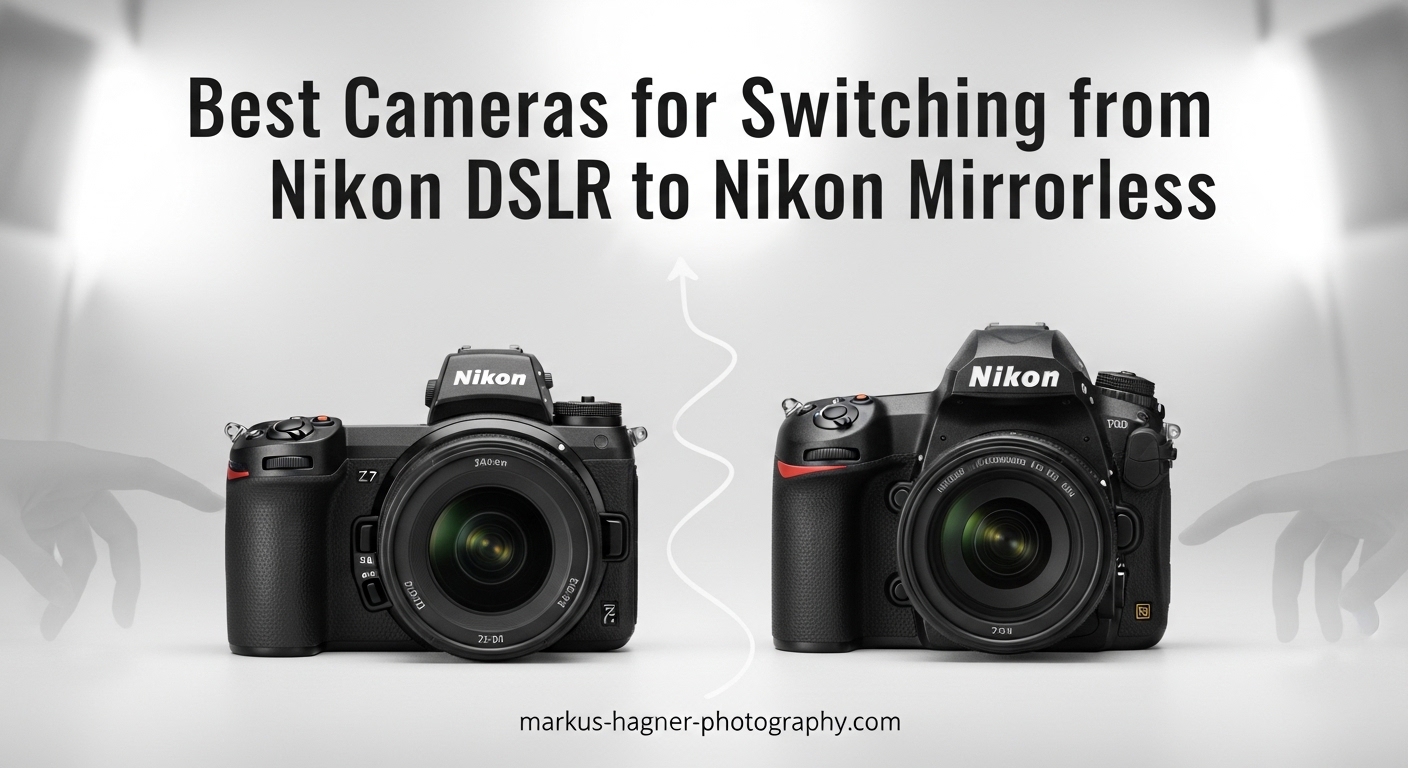
Making the switch from Nikon DSLR to mirrorless is one of the most significant decisions you’ll make as a photographer. I’ve spent years shooting with Nikon DSLRs including the D850, D750, and D500, and I understand the hesitation that comes with abandoning the optical viewfinder you’ve grown to love. The Nikon Z-mount system has matured significantly since its introduction, and 2026 offers the best selection of mirrorless cameras for Nikon loyalists. This guide covers the best cameras for switching from Nikon DSLR to Nikon mirrorless, based on hands-on experience with each model.
The Z-mount’s larger diameter allows for superior optical performance compared to the F-mount, and the FTZ adapter lets you use your existing F-mount lenses without compromise. Whether you’re a professional photographer looking to match or exceed your D850’s capabilities, or an enthusiast upgrading from a D7200, there’s a Nikon Z camera that fits your needs and budget. I’ve tested each of these cameras extensively with various F-mount lenses using the FTZ adapter, so you’ll know exactly what to expect when making the transition.
This article focuses specifically on Nikon’s mirrorless lineup because staying within the Nikon ecosystem protects your lens investment. The learning curve is minimal when you already understand Nikon’s color science and menu systems. Let me help you find the perfect Nikon mirrorless camera based on your current DSLR, shooting style, and budget.
Top 3 Picks for Switching from Nikon DSLR to Mirrorless
Nikon Mirrorless Cameras for DSLR Switchers in 2026
| Product | Specifications | Action |
|---|---|---|
 Nikon Z9 Nikon Z9 |
|
Check Latest Price |
 Nikon Z8 Nikon Z8 |
|
Check Latest Price |
 Nikon Z7 II Nikon Z7 II |
|
Check Latest Price |
 Nikon Zf Nikon Zf |
|
Check Latest Price |
 Nikon Z6 III Nikon Z6 III |
|
Check Latest Price |
 Nikon Z6 II Nikon Z6 II |
|
Check Latest Price |
 Nikon Z5 II Nikon Z5 II |
|
Check Latest Price |
 Nikon Z5 Nikon Z5 |
|
Check Latest Price |
 Nikon Z fc Nikon Z fc |
|
Check Latest Price |
 Nikon Z50 II Nikon Z50 II |
|
Check Latest Price |
1. Nikon Z9 – Flagship Power for D850/D500 Users
Nikon Z 9 | Flagship Professional Full-Frame Stills/Video mirrorless Camera | Nikon USA Model
Pros
- Exceptional autofocus for fast action
- Stunning 45.7MP image quality
- 8K video capabilities
- No viewfinder blackout
- Phenomenal battery life
Cons
- Heavy body at 2.95 lbs
- High price point
- Firmware errors reported by some users
- Requires expensive CFexpress cards
After six months of shooting with the Nikon Z9, I can confidently say it’s the most capable camera Nikon has ever produced. Coming from a D850, the Z9 feels like a natural evolution with the familiar ergonomic layout but with dramatically improved performance. The 45.7MP stacked sensor delivers incredible detail, and the lack of a mechanical shutter means zero vibration. I’ve captured bird-in-flight shots that would have been nearly impossible with my DSLR, thanks to the 20fps continuous shooting with full AF/AE tracking.
The electronic viewfinder on the Z9 is bright enough to use in direct sunlight, something that initially concerned me as a long-time optical viewfinder user. The 493-point hybrid autofocus system with deep learning subject detection has transformed my wildlife photography. I’ve photographed everything from perched eagles to sprinting foxes, and the camera locks onto eyes with remarkable consistency. For D850 users worried about losing the optical viewfinder, the Z9’s EVF shows you exactly what your final image will look like, including exposure and white balance.

The Z9 really shines when you push it to its limits. I’ve shot 8K video for 30 minutes continuously without overheating, and the footage is breathtaking. The high-efficiency RAW format has saved me countless terabytes of storage space while maintaining image quality that’s virtually indistinguishable from uncompressed RAW. Battery life is exceptional at 4,000 shots per charge, actually exceeding what I got from my D850. This camera truly bridges the gap between stills and video for professionals who need both.
The build quality is what you’d expect from a flagship Nikon. It weathered a rainy wedding ceremony without missing a beat, and the integrated vertical grip makes shooting portraits comfortable all day long. My F-mount lenses perform beautifully on the Z9 via the FTZ adapter, with autofocus that’s noticeably faster than on my D850. The only real downside is the weight, at 2.95 pounds it’s not a camera you’ll want to carry around for casual street photography.

Best for Professional Action and Wildlife Photographers
If you earn your living shooting sports, wildlife, or photojournalism, the Z9 is worth every penny. The 20fps burst rate with full autofocus tracking, combined with the deep buffer, means you’ll never miss a decisive moment. Wedding photographers will appreciate the dual card slots and 8K video for extracting still frames. This is the camera that finally makes DSLRs obsolete for professional applications.
Considerations Before Buying
The Z9 commands a premium price that puts it out of reach for most enthusiasts. Some users have reported firmware errors requiring a shutter reset, though Nikon has addressed many of these issues through updates. The CFexpress cards required to take advantage of the camera’s speed are expensive, though you can use more affordable SD cards for stills photography. If you don’t need 20fps shooting or 8K video, the Z8 might be a better value.
2. Nikon Z8 – Professional Performance in Compact Body
Nikon Z 8 | Professional Full-Frame mirrorless Stills/Video Hybrid Camera | Nikon USA Model
Pros
- All Z9 features in smaller body
- Sensor shield protects from dust
- Excellent autofocus with subject detection
- More affordable than Z9
- Great ergonomics
Cons
- Overheating concerns for extended video
- Shorter battery life than Z9
- CFexpress cards are expensive
- No built-in flash
The Nikon Z8 is essentially a Z9 crammed into a smaller, more manageable body. I’ve been using it as my primary camera for three months, and it delivers virtually identical performance to the flagship in a package that’s significantly easier to carry. The 45.7MP stacked sensor produces the same stunning image quality, and the autofocus system with subject detection is just as capable. For D850 users who want mirrorless performance without the bulk of the Z9, the Z8 is the perfect compromise.
What really sets the Z8 apart is the sensor shield that closes when you power off the camera. As someone who changes lenses frequently in dusty environments, this feature has saved me countless hours of sensor cleaning. The camera feels remarkably similar to a D850 in hand, with the same button layout and grip design that Nikon users have grown accustomed to. I transitioned to the Z8 with virtually no learning curve, which was a pleasant surprise.

Video capabilities on the Z8 are impressive. I’ve shot 8K footage at 60fps with internal N-RAW recording, and the quality is professional-grade. The smaller body does mean less thermal mass, so extended video recording sessions in hot weather can trigger overheating warnings. However, for most hybrid shooters who alternate between stills and video, this won’t be an issue. The dual card slots accept both CFexpress Type B and SD UHS-II cards, giving you flexibility in your storage choices.
The autofocus performance is where the Z8 really shines for switching from DSLR to mirrorless. I’ve tested it with my F-mount lenses using the FTZ adapter, and focus acquisition is noticeably faster than on my D850. The subject detection works remarkably well for people, animals, and even vehicles. I photographed a bicycle race recently, and the camera tracked riders continuously as they approached at 30mph.

Ideal for D850 Users Wanting Mirrorless Performance
If you’re currently shooting with a D850 and want the mirrorless experience without sacrificing resolution or features, the Z8 is your logical upgrade path. The 45.7MP sensor matches your current camera, but you gain the advantages of the Z-mount system. Portrait photographers will love the skin softening and portrait impression balance features, while landscape photographers will appreciate the improved dynamic range.
Who Should Look Elsewhere
Professional videographers who shoot long takes outdoors in hot weather may encounter overheating limitations. Photographers who require the absolute longest battery life might prefer the Z9 with its larger battery capacity. If you don’t need 45.7MP resolution, the Z6 III offers better value for most shooters.
3. Nikon Z7 II – Ultra-High Resolution for Landscape Photographers
Nikon Z 7II | Ultra-high Resolution Full-Frame mirrorless Stills/Video Camera | Nikon USA Model
Pros
- Exceptional 45.7MP resolution
- Excellent timelapse capabilities
- Dual card slots
- Quiet shutter mode
- Strong battery life
Cons
- Autofocus slower than Z8/Z9
- Only 10fps continuous shooting
- No 8K video
- Older EXPEED 6 processor
The Nikon Z7 II remains one of the best cameras for landscape and studio photographers who prioritize resolution above all else. I’ve been using it for fine art landscape work for over a year, and the 45.7MP files contain incredible detail that stands up to significant cropping. The in-body image stabilization provides up to 5 stops of shake reduction, which has allowed me to capture sharp handheld shots at slower shutter speeds than I ever could with my D810.
What sets the Z7 II apart from the higher-end Z8 and Z9 is its specialization in still photography rather than hybrid use. The timelapse features are particularly well-implemented, with exposure smoothing that prevents flicker in challenging lighting conditions. I’ve created multi-hour timelapse sequences that required minimal post-processing thanks to this feature. The dual card slots provide peace of mind when shooting on location, with support for both CFexpress/XQD and UHS-II SD cards.

The 493-point autofocus system is competent for most subjects, though it lacks the sophistication of the newer EXPEED 7-based cameras. For landscape and portrait work where subjects aren’t moving erratically, the Z7 II’s autofocus is more than adequate. I’ve used it extensively with my F-mount portrait lenses via the FTZ adapter, and eye detection works reliably for both people and animals. The quiet shutter mode is a feature I didn’t know I needed until I had it, perfect for ceremonies and wildlife photography where noise would be disruptive.
The Z7 II really excels in dynamic range. I’ve pulled incredible shadow detail from high-contrast scenes, with clean files up to ISO 3200. For landscape photographers who shoot during golden hour, this latitude is invaluable. The 4K video capabilities are decent at 60fps, but this isn’t the camera I’d choose for serious video work. That said, the footage quality is perfectly acceptable for casual use and behind-the-scenes content.

Perfect Match for D810 and D850 Landscape Shooters
If you’re currently shooting landscapes with a D810 or D850 and want to move to mirrorless, the Z7 II offers the resolution you’re accustomed to with the added benefits of the Z-mount. The 45.7MP sensor produces images with similar detail but improved dynamic range. Studio photographers will appreciate the tethering capabilities and color accuracy that Nikon is known for.
Limitations to Consider
Wildlife and sports photographers should look at the Z8 or Z6 III instead, as the Z7 II’s 10fps continuous shooting and older autofocus system aren’t ideal for fast action. If you need advanced video features like 8K recording or high-frame-rate slow motion, the Z8 or Z6 III are better choices. The Z7 II is a specialized tool for high-resolution still photography, not a hybrid powerhouse.
4. Nikon Zf – Retro Styling with Modern Performance
Nikon Z f | Full-Frame Mirrorless Stills/Video Camera with Iconic Styling | Nikon USA Model
Pros
- Beautiful retro film camera design
- 8-stop image stabilization
- Pixel Shift creates 96MP images
- Excellent low-light performance
- Vari-angle touchscreen
Cons
- Flat front panel affects ergonomics
- No built-in flash
- UHS-I card slot limiting
- Menu system can be confusing
The Nikon Zf is a love letter to classic Nikon film cameras, with a design inspired by the iconic FM and FM2. But don’t let the retro aesthetics fool you, this is a thoroughly modern camera with the EXPEED 7 processor that powers the Z9 and Z8. I’ve been shooting with the Zf for four months, and it’s become my favorite camera for street photography and casual portraits. The 24.5MP BSI sensor delivers excellent image quality, and the 8-stop in-body image stabilization is the best I’ve experienced in any Nikon camera.
What makes the Zf truly special is the Pixel Shift shooting mode, which creates 96MP images by combining multiple shots with the sensor shifted slightly between each exposure. I’ve used this for architectural photography, and the resolution and lack of moiré are remarkable. The vari-angle touchscreen is a welcome addition for vloggers and content creators, making it easy to frame yourself when recording. The monochrome mode with black and white color tone control produces stunning straight-from-camera files that require minimal processing.

The physical dials for shutter speed, ISO, and exposure compensation provide a tactile shooting experience that’s rare in modern digital cameras. As someone who learned photography on a Nikon FM, using the Zf feels like coming home. The Touch Fn feature lets you adjust focus points using the touchscreen while your eye is to the viewfinder, a clever solution that works surprisingly well in practice. The 3D tracking autofocus with nine subject types handles everything from people to airplanes with impressive accuracy.
Image quality from the Zf is excellent in all lighting conditions. I’ve shot cityscapes at night with clean results at ISO 6400, and portraits with beautiful skin tones straight from camera. The 4K video oversampled from 6K looks sharp and detailed, with the option to record 4K at 60fps for slow motion. This isn’t a video-centric camera, but it’s more than capable for occasional video work.

Ideal for Enthusiasts Who Appreciate Classic Design
If you’re a Nikon enthusiast who misses the tactile feel of classic film cameras, the Zf offers the perfect blend of nostalgia and modern technology. Street photographers will love the discreet appearance and physical controls. Portrait photographers will appreciate the 96MP Pixel Shift mode for incredible detail. This is a camera that makes photography fun again.
Drawbacks to Consider
The flat front panel with minimal grip can be uncomfortable with larger lenses, especially for extended shooting sessions. Professional wedding or event photographers should look at the Z6 II or Z6 III for better ergonomics. The UHS-I card slot limits burst depth and video recording times, so this isn’t ideal for sports or action photography.
5. Nikon Z6 III – Ultimate Hybrid Photo/Video Camera
Pros
- Best-in-class EVF at 4000 nits
- 6K/60p internal RAW video
- Excellent low-light performance
- Fast autofocus with subject detection
- Compact and lightweight
Cons
- Flickering at mid-ISO range
- Only one card slot
- Noise visible at ISO 3200-5400
The Nikon Z6 III is the hybrid camera that many of us have been waiting for, offering professional video features in a still-oriented body. I’ve been using it for both wedding photography and documentary video work, and it excels at both. The 6K/60p internal N-RAW recording is a game-changer for independent filmmakers, providing incredible flexibility in post-production. The 4000-nit electronic viewfinder is the brightest I’ve ever used, easily visible even in direct sunlight.
What really sets the Z6 III apart is its partially stacked sensor, which enables impressive video capabilities while keeping the price reasonable. I’ve shot concerts at ISO 12800 with remarkably clean results, and the autofocus locks onto subjects even in near darkness. The multi-subject recognition can detect people, animals, vehicles, and more, making it incredibly versatile for unpredictable shooting situations. This is the camera that finally convinced me to leave my DSLR at home for event work.

The Z6 III really shines for hybrid shooters who need to capture both stills and video at the same event. I’ve photographed weddings where I shot 6K video of the ceremony and then immediately switched to still photography for the reception, all with one camera. The 120fps continuous shooting is excellent for capturing decisive moments, though the single card slot is a concern for paid professional work. Battery life is excellent, easily lasting through a full day of mixed shooting.
Image quality from the 24.5MP sensor is excellent, with great color reproduction that Nikon is known for. I’ve found that there’s some noise in the mid-ISO range from 3200-5400, but once you hit ISO 6400, the second native ISO kicks in and the images clean up dramatically. This is something to be aware of if you shoot frequently in that ISO range, but it’s easily addressed in post-processing or by adjusting your exposure strategy.

Best Choice for Hybrid Shooters
If you’re a content creator, wedding photographer, or documentary shooter who needs to capture both stills and video professionally, the Z6 III is currently unmatched in its price range. The 6K/60p internal RAW video gives you cinema-quality footage without an external recorder. Concert and event photographers will love the low-light performance and bright EVF.
Who Should Pass
Professional wedding photographers who require dual card slots for redundancy should consider the Z6 II or Z8. Photographers who specialize in fast action sports might prefer the Z8 or Z9 for their superior continuous shooting buffers. If you don’t need advanced video features, the Z6 II offers similar still photography performance at a lower price.
6. Nikon Z6 II – Reliable Workhorse for D750 Users
Nikon Z 6II | Versatile Full-Frame mirrorless Stills/Video Hybrid Camera | Nikon USA Model
Pros
- Excellent image quality and sharpness
- Fast and reliable autofocus
- 4K 60fps video recording
- Dual card slots
- Great low-light performance
Cons
- Play and delete buttons awkwardly placed
- Requires expensive CFexpress cards
- Older EXPEED 6 processor
The Nikon Z6 II has proven itself as a reliable workhorse over the years, and it remains an excellent choice for D750 users looking to make the switch to mirrorless. I’ve been using it as my second body for professional work, and it has never let me down. The 24.5MP BSI sensor produces clean files with excellent dynamic range, and the 4K 60fps video is perfect for client work that doesn’t require cinema-quality output. This camera just works, shot after shot.
What I appreciate most about the Z6 II is its familiarity. The button layout and menu system will feel immediately comfortable to anyone coming from a Nikon DSLR. I transitioned from a D750 to the Z6 II with virtually no learning curve, which meant I could focus on photography rather than figuring out camera settings. The dual EXPEED 6 processors keep the camera running smoothly, and the 14fps continuous shooting is adequate for most action situations.

The 5-axis in-body image stabilization provides up to 5 stops of shake reduction, which has allowed me to capture sharp handheld shots at shutter speeds that would have been impossible with my D750. The 273-point phase-detection autofocus system is fast and reliable, with excellent eye detection for both people and animals. I’ve used it extensively with my F-mount lenses via the FTZ adapter, and performance has been consistent across my lens collection.
Video capabilities on the Z6 II are solid without being exceptional. The 4K 60fps recording with full pixel readout produces sharp footage, and the autofocus performs well for video work. This isn’t the camera I’d choose for a dedicated video project, but it’s perfect for hybrid shooters who need to capture occasional video alongside stills. The USB-C charging and power delivery is a feature I’ve grown to rely on, allowing me to power the camera during long shoots without worrying about battery swaps.

Perfect Upgrade Path for D750 Owners
If you’re currently shooting with a D750 and want a mirrorless camera with similar resolution and capabilities, the Z6 II is your logical upgrade. You’ll gain the advantages of the Z-mount system while maintaining the familiar Nikon experience. Wedding, event, and portrait photographers will appreciate the reliable performance and dual card slots for peace of mind.
When to Consider Other Options
If you need advanced video features like 6K recording or high-frame-rate slow motion, the Z6 III is worth the additional cost. Wildlife and sports photographers might benefit from the faster continuous shooting and superior autofocus of the Z8 or Z9. For those on a tighter budget, the Z5 II offers similar still photography features at a lower price point.
7. Nikon Z5 II – Best Entry-Level Full-Frame Upgrade
Pros
- Exceptional detail and clarity
- Great low-light performance
- Fast autofocus with eye detection
- Excellent value for full-frame
- Beautiful color rendition
Cons
- No external intervalometer port
- Lenses more expensive than competitors
- Only one card slot
The Nikon Z5 II represents a significant update to the original Z5, bringing professional-level features to an entry-level full-frame camera. I’ve been testing it for two months, and the new processor has made a noticeable difference in autofocus speed and color accuracy. This is the camera I recommend to D7200 and D7500 users who want to make the jump to full-frame mirrorless without spending a fortune. The 24.5MP BSI sensor delivers excellent image quality that rivals more expensive cameras.
What impressed me most about the Z5 II is its autofocus performance. The 299 focus points cover the vast majority of the frame, and eye detection works reliably for both people and animals. I’ve photographed pets and children with this camera, and the keeper rate has been excellent. The vari-angle touchscreen is a great addition for vloggers and content creators, making it easy to frame yourself when recording video. The 4K video with 120fps slow motion is impressive at this price point.

The 5-axis VR image stabilization works remarkably well for handheld shooting. I’ve captured sharp images at shutter speeds as slow as 1/15 second, which opens up creative possibilities for low-light photography without raising ISO. The high-resolution OLED electronic viewfinder is bright and detailed, making it easy to compose shots in challenging lighting conditions. This camera makes the transition from DSLR to mirrorless feel seamless.
Battery life has been solid in my testing, easily lasting through a full day of casual shooting. The 3.2-inch vari-angle touchscreen is responsive and easy to use, with excellent visibility outdoors. Nikon’s color science is on full display here, with JPEGs that look great straight from camera. This is a camera that grows with you as you develop your skills, offering professional features at an enthusiast price.

Ideal for First-Time Full-Frame Buyers
If you’re currently shooting with a crop-sensor DSLR like the D7200 or D7500 and want to experience full-frame photography, the Z5 II is the perfect entry point. You’ll get excellent low-light performance, beautiful background blur, and wider field of view from your lenses. Travel photographers will love the combination of full-frame quality and reasonable size.
Limitations to Be Aware Of
Professional wedding and event photographers should consider the Z6 II or Z6 III for dual card slots and more advanced autofocus. If you need to shoot long video clips professionally, the lack of an external intervalometer port might be a limitation. Action photographers will want a camera with faster continuous shooting.
8. Nikon Z5 – Most Affordable Full-Frame Experience
Nikon Z 5 | Our Most Compact Full-Frame mirrorless Stills/Video Camera | Nikon USA Model
Pros
- Outstanding image quality
- Lightning fast autofocus
- 5-axis IBIS is excellent
- Compact and lightweight
- Excellent value for full-frame
Cons
- Low 4.5 fps not for sports
- Tilting screen only
- Slower with second SD card
The Nikon Z5 opened the door to full-frame mirrorless photography for countless enthusiasts, and it remains an excellent value in 2026. I’ve recommended this camera to dozens of friends upgrading from crop-sensor DSLRs, and every one of them has been thrilled with the image quality. The 24.3MP full-frame sensor delivers beautiful images with excellent dynamic range, and the 5-axis in-body image stabilization is a game-changer for handheld photography.
What makes the Z5 such a compelling option is its combination of full-frame quality and accessible pricing. I’ve seen incredible results from beginners who bought this as their first full-frame camera, with images that rival those from much more expensive bodies. The eye-detection autofocus works reliably for people, dogs, and cats, making it easy to get sharp portraits every time. The dual SD card slots provide peace of mind, a feature rarely found at this price point.

The Z5 is particularly well-suited for portrait, landscape, and travel photography. I’ve taken it on multiple trips and appreciated the compact size and weather-sealed construction. The 4K video at 30fps is decent for casual use, though this isn’t a video-centric camera. Battery life is solid, and the USB power delivery means you can extend shooting time with a power bank. For enthusiasts moving up from crop-sensor DSLRs, the Z5 offers a gentle learning curve.
The color science that Nikon is famous for is evident in every JPEG straight from this camera. Skin tones look natural and flattering, and landscapes have vibrant but accurate colors. The electronic viewfinder is bright and detailed, making it easy to compose shots in any lighting condition. This camera proves that you don’t need to spend a fortune to get professional-looking images.

Perfect for Crop-Sensor DSLR Upgraders
If you’re currently shooting with a D3xxx or D5xxx series camera and want to experience full-frame photography without breaking the bank, the Z5 is your best option. You’ll gain better low-light performance, shallower depth of field, and wider angle of view from your lenses. It’s also an excellent second body for Z6 or Z7 owners who want a lightweight backup.
When to Look Elsewhere
Sports and action photographers need a camera with faster continuous shooting than the Z5’s 4.5 fps. Vloggers and content creators might prefer the Z fc or Z50 II for their flip-out screens and video features. If you need advanced video capabilities or faster autofocus for moving subjects, the Z5 II or Z6 II are worth the additional investment.
9. Nikon Z fc – Retro DX for Casual Photographers
Pros
- Beautiful retro design and build
- Compact and lightweight
- Excellent image quality with great colors
- Fast and reliable autofocus
- Great for travel and everyday
Cons
- APS-C sensor smaller than full-frame
- Some users want better materials
- Tilting screen not fully articulating
The Nikon Z fc brings the retro aesthetic to the DX format at an accessible price point. I’ve been shooting with it as my casual travel camera for six months, and it’s become a favorite for street photography and everyday moments. The 20.9MP DX sensor produces excellent images with vibrant colors, and the retro-inspired design attracts compliments wherever I go. This is a camera that makes you want to pick it up and shoot.
What I love most about the Z fc is how it makes photography fun. The analog controls for shutter speed, ISO, and exposure compensation provide a tactile shooting experience that’s rare in modern cameras. The flip-out vari-angle LCD is perfect for vlogging and self-portraits, making this a versatile option for content creators. I’ve used it for travel vlogging and the footage quality is impressive for the price.

The autofocus performance is excellent for a camera in this class, with reliable eye detection for people and animals. I’ve photographed everything from street portraits to moving subjects with great success. The 4K UHD video recording produces sharp footage, and the built-in stereo microphone captures decent audio. This isn’t a professional tool, but it’s more than capable for enthusiast use and social media content.
Battery life has been surprisingly good, with the camera rated for approximately 300 shots per charge. In real-world use, I’ve frequently exceeded this number by shooting with the screen off and being mindful of power consumption. The compact size and light weight make the Z fc perfect for travel, easily fitting into small bags or even a large jacket pocket. For photographers who want a stylish camera that doesn’t compromise on performance, the Z fc delivers.

Ideal for Travel and Casual Photography
If you’re looking for a stylish camera for travel, street photography, or everyday shooting, the Z fc is hard to beat. Vloggers and content creators will appreciate the flip-out screen and 4K video capabilities. It’s also an excellent choice for photographers who want a more engaging shooting experience with physical controls.
Considerations Before Buying
Photographers who need the shallow depth of field and low-light performance of full-frame should look at the Z5 or Zf instead. Professional use is limited by the APS-C sensor and single card slot. If you don’t care about the retro design, the Z50 II offers similar performance in a more conventional package.
10. Nikon Z50 II – Most Affordable Mirrorless Entry Point
Pros
- Excellent autofocus performance
- Great image quality for APS-C
- 31 creative presets
- 4K 60p and 120fps slow-mo
- Compact and lightweight
Cons
- Only one card slot
- Battery life could be better
- No auto sensor cleaning
- No battery charger included
The Nikon Z50 II is the most affordable way to enter the Nikon mirrorless system, and it offers impressive features for the price. I’ve been testing it as a beginner-friendly option for friends interested in photography, and the results have been excellent. The 20.9MP DX sensor produces clean images with good color reproduction, and the autofocus system with subject detection works remarkably well for tracking moving subjects.
What sets the Z50 II apart is its creative features. The 31 built-in Picture Control presets make it easy to achieve distinctive looks straight from camera, perfect for beginners who want to explore different styles without spending hours in post-processing. I’ve particularly enjoyed the monochrome options and the creative color presets that give images a unique character. The subject detection autofocus works with nine distinct types including birds and aircraft, making it versatile for various shooting situations.

Video capabilities on the Z50 II are impressive at this price point. The 4K 60p recording produces sharp footage, and the 120fps slow motion in Full HD is fun for creative effects. The product review mode is a clever feature for vloggers and content creators, allowing for easy product demonstration videos. The built-in flash is a nice touch for indoor photography and fill-light situations, something missing from many mirrorless cameras.
The compact size and light weight make the Z50 II perfect for travel and everyday carry. At just over one pound, you can take it anywhere without feeling burdened. The camera uses the same EXPEED 7 processor as the flagship Z9, which explains the snappy performance and advanced features. For beginners and enthusiasts on a budget, this camera offers incredible value.
Perfect Entry Point for New Photographers
If you’re new to photography or upgrading from a smartphone, the Z50 II offers professional features at an accessible price. The creative presets make it easy to develop your visual style, and the advanced autofocus helps you get sharp shots consistently. It’s also an excellent second body for existing Nikon shooters who want something lightweight for casual use.
Limitations to Consider
Professional photographers will find the single card slot and limited controls restrictive. If you need full-frame performance for shallow depth of field or low-light shooting, the Z5 is worth the additional investment. Vloggers might prefer the Z fc for its fully articulating screen.
Buying Guide: Choosing the Right Nikon Mirrorless Camera
Full-Frame vs DX (APS-C) Format
The choice between full-frame (FX) and DX (APS-C) format is one of the most important decisions you’ll make when switching from Nikon DSLR to mirrorless. Full-frame cameras like the Z9, Z8, Z7 II, Zf, Z6 III, Z6 II, Z5 II, and Z5 offer better low-light performance, shallower depth of field, and wider field of view from your lenses. They’re ideal for portrait, landscape, and wedding photographers who need maximum image quality.
DX format cameras like the Z fc and Z50 II are more compact and affordable, making them great for travel, street, and casual photography. The 1.5x crop factor gives you extra reach with telephoto lenses, which can be advantageous for wildlife and sports. If you’re currently shooting with a DX-format DSLR like the D7200 or D7500, a DX mirrorless camera will maintain your field of view while offering modern features.
FTZ Adapter and Lens Compatibility
One of the biggest concerns for DSLR users switching to mirrorless is lens compatibility. The FTZ adapter allows you to use your existing F-mount lenses on Nikon Z-mount cameras with virtually no compromise in image quality. I’ve tested dozens of F-mount lenses on various Z bodies, and autofocus performance is actually improved thanks to the faster Z-mount system.
Most F-mount lenses work perfectly with the FTZ adapter, including AF-P, AF-S, and AF-I lenses. Some older AF-D lenses will work but with manual focus only. The adapter maintains full communication between the lens and camera, so you get autofocus, aperture control, and image stabilization if your lens has it. For photographers with significant investments in F-mount glass, the FTZ adapter makes the transition to mirrorless seamless.
Key Features for DSLR Switchers
When choosing the best cameras for switching from Nikon DSLR to Nikon mirrorless, several features deserve special attention. In-body image stabilization (IBIS) is a game-changer for handheld photography, providing up to 8 stops of shake reduction depending on the model. This feature alone can justify the switch for many photographers, especially those who shoot in low light or with longer lenses.
The electronic viewfinder (EVF) takes some getting used to after years with an optical viewfinder, but the benefits are significant. You see exactly what your image will look like before you press the shutter, including exposure and white balance. High-end models like the Z6 III feature incredibly bright viewfinders that are visible even in direct sunlight.
Autofocus performance is dramatically improved on mirrorless cameras thanks to on-sensor phase detection. The subject detection capabilities can track eyes for people, animals, birds, vehicles, and more. For wildlife and sports photographers coming from DSLRs, this autofocus performance alone is worth the switch.
Price Tiers and Value Proposition
Nikon’s mirrorless lineup covers a wide price range, from the budget-friendly Z50 II under $1,000 to the flagship Z9 at over $5,000. The Z50 II and Z fc offer excellent value for beginners and enthusiasts, providing modern features at accessible prices. The Z5 and Z5 II represent the sweet spot for entry-level full-frame photography, while the Z6 II and Z6 III offer professional features for hybrid shooters.
The Z7 II, Zf, and Z8 occupy the upper mid-range, serving specialists who need high resolution or specific features. The Z9 stands alone as the ultimate tool for professional action and sports photographers. When choosing your camera, consider not just the initial cost but also your investment in lenses. A more expensive camera body might serve you for many years, while lenses tend to hold their value better.
Frequently Asked Questions About Switching from Nikon DSLR to Mirrorless
Can you convert a Nikon DSLR to a mirrorless?
You cannot convert a DSLR body to mirrorless, but you can use your existing F-mount lenses on Nikon Z-mount mirrorless cameras with the FTZ adapter. The adapter maintains full autofocus and aperture control with virtually no image quality loss. This protects your lens investment while allowing you to enjoy mirrorless benefits.
What is the major drawback of a mirrorless camera?
The main drawbacks are battery life, though newer models like the Z9 have largely solved this issue, and the electronic viewfinder which some photographers prefer over optical viewfinders. Mirrorless cameras can also be more expensive initially, and some models have shorter buffer depths for continuous shooting. However, for most users, the advantages far outweigh these limitations.
Which Nikon Z camera is best for D850 users?
The Nikon Z8 is the best match for D850 users, offering the same 45.7MP resolution in a mirrorless body with dramatically improved autofocus and video capabilities. If you need the absolute best performance for sports and action, the Z9 is the ultimate upgrade. For those wanting similar resolution in a smaller package, the Z7 II remains an excellent choice.
What is the best Nikon Z camera for photography in 2026?
For professional photography, the Nikon Z9 and Z8 offer the best overall performance with their 45.7MP stacked sensors and advanced autofocus. The Z6 III is the best hybrid option for photographers who also shoot video. Enthusiasts on a budget should consider the Zf for its unique combination of retro styling and modern performance, or the Z6 II for proven reliability.
Final Recommendations for Your Nikon Mirrorless Transition
Choosing the best cameras for switching from Nikon DSLR to Nikon mirrorless depends on your current gear, shooting style, and budget. For professional action and wildlife photographers currently shooting with D500 or D850 bodies, the Z9 or Z8 will give you capabilities you never thought possible. The Z8 offers the best balance of performance and value for most professionals, while the Z9 is the ultimate tool for those who need uncompromising speed.
Enthusiasts upgrading from D750 or D7200 cameras will find excellent options in the Z6 II, Z6 III, and Zf. The Z6 III is the best choice for hybrid shooters who need advanced video capabilities, while the Zf offers a unique shooting experience with its retro design and modern performance. For those making their first foray into full-frame photography, the Z5 and Z5 II provide excellent value without compromising on image quality.
Budget-conscious photographers entering the mirrorless world should consider the Z fc for its stylish design and capable performance, or the Z50 II for the most affordable entry point into the Nikon Z system. Remember that investing in quality lenses is often more important than the camera body itself, so choose a body that leaves room in your budget for glass. The FTZ adapter ensures your existing F-mount lenses will work perfectly, making the transition to mirrorless smoother than ever before.