
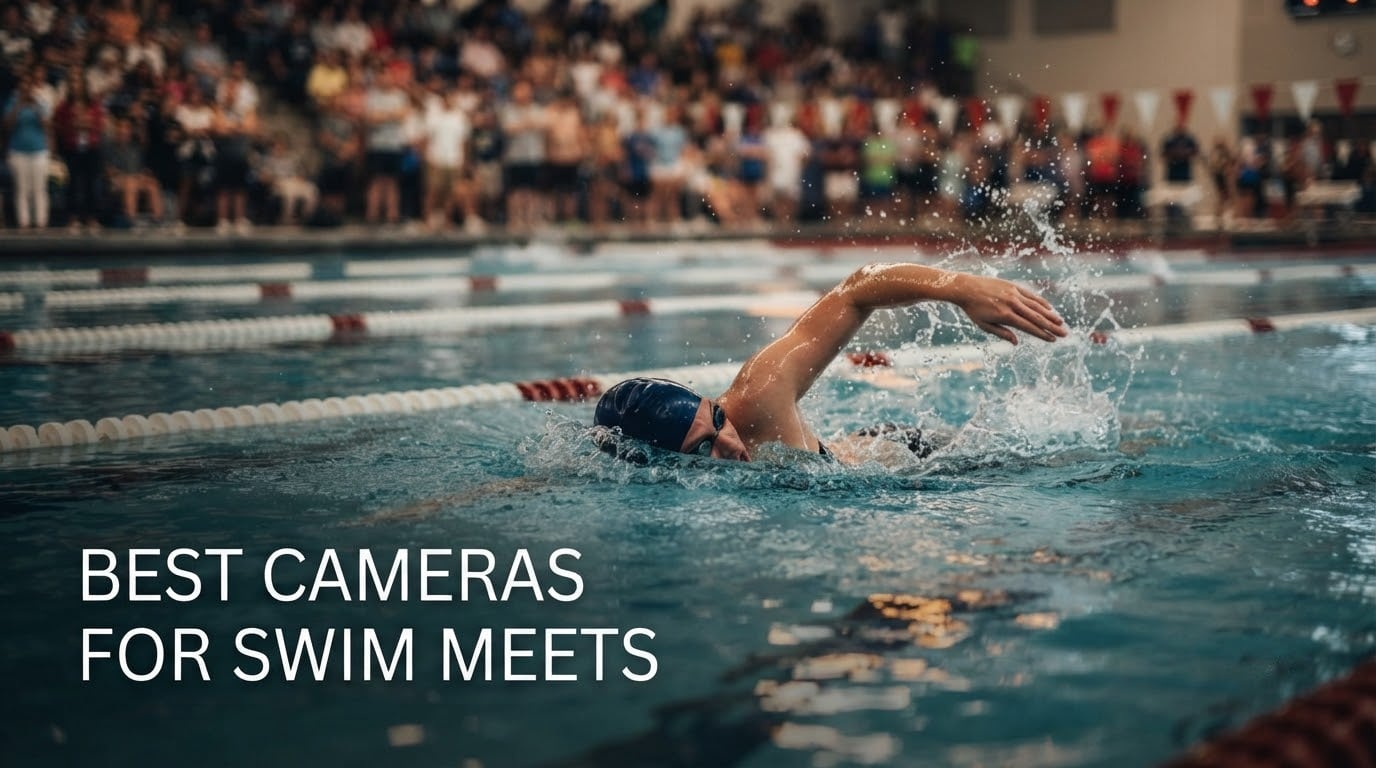
The best camera for a swim meet is a weather-sealed mirrorless body that can hold 1/1000 second at a workable ISO, keep subject detection locked on a face through spray, and fire a long enough burst to cover a 50-meter length. You also need a telephoto that reaches roughly 200 to 400mm equivalent from the spectator seating.
Swimming is a hard sport to photograph. A swimmer covers a pool length in about 25 seconds, which means you get maybe two to three seconds of usable shooting time per pass, and you never get a second take. Add dim, uneven overhead lighting in older indoor facilities, a flash ban, and eight hours of standing on concrete bleachers, and camera choice stops being about megapixels. It becomes about whether the autofocus holds and whether the files survive a dark stretch of pool at the end of the day.
Our team has spent seasons shooting youth and club meets, and we scored the eight bodies below against pool conditions specifically rather than against generic sports performance. Indoor high-ISO latitude, burst depth, tracking through splash, heat management, and reach from the stands all carry weight here. Every number quoted comes from the manufacturer spec sheet or the owner reviews attached to the product.
Last updated October 2026. Written by the Markus Hagner Photography desk, with field notes from indoor and outdoor meets.
Top 3 Picks for Best Camera for Swim Meet Photography in 2026

Sony Alpha 7 IV
- 33MP full-frame Exmor R sensor
- Real-time eye and face autofocus
- 4K 60p 10-bit video
- Dual card slots

Canon EOS R6 Mark II
- Up to 40 fps electronic burst
- Head face eye and body detection
- 24.2MP full-frame sensor
- 6K oversampled 4K 60p

Nikon Z6 II
- 24.5MP back-illuminated sensor
- 14 fps with deep buffer
- 273-point phase-detect AF
- Dual card slots
All 8 Cameras at a Glance in 2026
| Product | Specifications | Action |
|---|---|---|
| Sony Alpha 7 IV |
|
Check Latest Price |
| Canon EOS R6 Mark II |
|
Check Latest Price |
 Canon EOS R7 Canon EOS R7 |
|
Check Latest Price |
 Nikon Z6 III Nikon Z6 III |
|
Check Latest Price |
 Nikon Z8 Nikon Z8 |
|
Check Latest Price |
| Nikon Z6 II |
|
Check Latest Price |
 Panasonic LUMIX S5II Panasonic LUMIX S5II |
|
Check Latest Price |
 Panasonic LUMIX G9II Panasonic LUMIX G9II |
|
Check Latest Price |
How We Picked These Cameras for Swim Meets
Most camera roundups score bodies against daylight sport. We did not, because the constraints of a natatorium are narrower and harsher. Six criteria decided the order, and each one is a direct answer to a problem photographers actually hit at a meet.
Indoor high-ISO performance. With flash prohibited, your shutter speed comes out of sensor size and lens brightness. We weighted bodies that hold clean files at ISO 3200 and above heavily, because the last two hours of an evening meet often happen under the weakest fixtures in the building.
Burst rate and buffer. A relay finish lasts under a second. You need enough frames to catch it and enough buffer depth that the tenth race of the session shoots as fast as the first.
Tracking through spray. Water between swimmer and lens confuses contrast-based focusing. Human subject detection with eye and head priority is the feature that saves these frames, so we weighted it above raw point counts.
Reach from the stands. Spectator seating on many decks puts you 15 to 25 meters from the far wall. Focal length math is covered further down, but bodies with a usable crop factor score well here.
Heat and humidity endurance. A sealed body that keeps shooting in a chlorinated, saturated building for eight hours is worth more than a few extra frames per second at hour one.
Video as a tiebreaker. Many parents want the turn and the push-off in slow motion, so high frame-rate 4K counts when everything else is close.
One thing we could not test at identical scale on all eight bodies is a live race. Our ranking therefore leans on published specifications plus the patterns that show up repeatedly in owner reviews, and we flag every body where reviewers report specific weaknesses rather than smoothing them over.
1. Sony Alpha 7 IV – The Best Overall Camera for Swim Meets
Pros
- 33MP full-frame files crop hard without losing detail
- Real-time eye and face AF that owners report stays locked
- Strong high-ISO performance with in-body noise reduction
- Dual card slots including CFexpress Type A
- Full articulating screen and 4K 60p 10-bit video
Cons
- 10 fps is slow next to modern stacked-sensor rivals
- Menu system takes real time to learn
- Battery life is modest for a full meet day
I keep coming back to this body for meet work because the sensor solves the problem nobody else fully solves. A 33MP full-frame back-illuminated CMOS gives you room to crop a distant lane wall shot into a tight face, which is often the difference between a usable photo and a memory. At 1/1000 second in a dim indoor pool you will be pushing ISO, and owner reviews consistently describe low-light files as clean with the in-body high ISO noise reduction turned on.
The autofocus is the other reason it earns the top slot. Sony’s real-time eye and face detection, with 693 phase-detect points on this body, is the feature that keeps a face sharp when a swimmer comes off the wall into spray. Reviewers describe it as locking on and staying locked, and a few note that occasional misses in difficult light are usually traced to their own settings rather than the system.

Here is the honest tradeoff. Ten frames per second is genuinely modest next to the Canon R6 Mark II or the Nikon Z8, and if your child swims the 50 freestyle you will sometimes wish for more frames across the length. The dual slot layout with CFexpress Type A and UHS-II SD is the practical answer, because you can keep shooting stills to the fast card while video writes to the second one.
Video is a genuine strength rather than a checkbox. The card records 4K 60p in 10-bit 4:2:2 with full pixel readout, plus 7K oversampled 4K 30p, which gives you real slow-motion options for a turn without a separate cinema camera. The only catch reviewers report is a crop applied when shooting the fastest high frame rate modes.

How it handles a dim indoor pool
The 33MP sensor keeps usable shadow detail in the darkest lanes, and the base ISO of 100 with a 1/8000 second ceiling means you can always find a shutter speed that freezes a butterfly entry. The one thing to plan around is buffer recovery: at 10 fps you can still build a satisfying sequence of a turn, but you cannot chain several full lengths and expect every frame.
Where it will frustrate you
Reviewers are blunt about two things. Sony’s menu system takes time to learn, and on a six-hour meet day you do not want to be hunting through menus between sessions. Battery life is also called a little lacking, so budget for a second and third battery before the indoor season starts.
2. Canon EOS R6 Mark II – Best Subject Tracking for a Multi-Lane Race
Pros
- Up to 40 fps electronic burst for the finish
- Head face eye and whole-body detection with auto subject selection
- 24 fps sensor sweep limits rolling shutter
- 6K oversampled uncropped 4K 60p and 180 fps Full-HD
- Bright 3.69M-dot viewfinder with 120 fps refresh
Cons
- 40 fps mode drops to 20MP and loses detail
- 24.2MP crops harder than higher resolution rivals
- Heavier than smaller mirrorless bodies
This is the body I recommend when the meet is crowded and you are trying to hold one specific face across eight lanes. Dual Pixel CMOS AF II with head, face, eye and whole-body detection is the most complete recognition system in this group, and owners frequently call out subject-type selection as the feature that changes their rate of keepers rather than raw burst speed.
Reviews also highlight the 24 fps sensor sweep and low distortion, which matters more for swimming than it does for most field sports. A butterfly swimmer’s arms move laterally at high speed, and a rolling-shutter-prone readout will bend them. Reviewers report the electronic burst reaching 40 fps, and a 120 fps refresh on the 3.69 million-dot viewfinder keeps the viewfinder from going black between frames.

Video is unusually strong for a stills-first body: 6K oversampled uncropped 4K up to 60 fps and Full-HD up to 180 fps, with up to six hours of continuous Full-HD recording without overheating. For a parent who wants a slow-motion clip of a turn, that headroom is worth real money.
The cost is resolution. At 24.2 megapixels you have less crop latitude than the Sony or the Nikon Z8, so a very distant tight portrait gets soft before you want it to. And the headline 40 fps figure runs at 20 megapixels, which reduces detail on fast-moving subjects exactly when you most want it.

Why the tracking wins in a crowded final
At a championship meet, six swimmers are in the water and the background is a wall of heads, officials and a scoreboard. Whole-body detection with automatic subject-type selection is what prevents the camera locking onto the bleachers instead of your kid. Reviewers rate the recognition accuracy consistently higher than the point counts suggest.
Where it will frustrate you
The 20MP burst mode is the main compromise. If you are cropping a face out of a 30-meter shot, the file size matters. Second, the body is heavier than smaller mirrorless alternatives at 1.3 pounds, and over an eight-hour session with a long lens that adds up on the wrist.
3. Canon EOS R7 – Best Reach for Parents on a Budget
Pros
- 1.6x crop factor gives real reach from the stands
- RAW Burst Mode captures frames before you press the shutter
- 651 AF zones cover essentially the full frame
- 5-axis in-body stabilization steadies long lenses at high ISO
- Compact body with an extra battery included
Cons
- Higher ISO noise than full-frame bodies
- Electronic shutter can bend fast lateral movement
- Buffer depth is limited against pro bodies
- Less crop latitude than 45MP full-frame
The reach advantage is the whole argument for this camera. A 32.5 megapixel APS-C sensor crops 1.6x, so a 200mm lens frames like a 320mm does on full frame. From the upper deck of a 50-meter pool, that is the difference between a head-and-shoulders shot and a face. Reviewers repeatedly describe the crop factor as the standout benefit for reaching distant subjects.
The RAW Burst Mode with roughly half a second of pre-shooting is the feature that wins over parents who have missed the start. The camera is already recording frames before you react, and you choose the moment afterward. Owners pair it with the 30 fps electronic shutter and the 1/16000 second mechanical max to freeze a dive entry.
Autofocus coverage is excellent. Up to 651 Dual Pixel CMOS AF II zones covering roughly 100 percent of width and height means you can pick a tiny initial focus point and still have the system track when a swimmer surfaces. Five-axis in-body stabilization with auto-level helps at long focal lengths and high ISO, which is the exact combination a parent needs at a dim indoor meet.
The trade-off is noise. A smaller sensor shows more grain at the ISO levels an indoor pool demands, and reviewers name this as the headline drawback. Rolling-shutter distortion from the electronic shutter is also flagged, which can matter on a butterfly swimmer’s arms. Buffer depth is limited compared with pro bodies, so long bursts of the same lane will stall.

What pre-capture does for the start block
A dive from the block is over in under a second, and reaction time is a poor proxy for it. The RAW Burst pre-shooting buffer holds frames from before the shutter press, so the moment your hands react the frame is already in the card. For a parent photographing a child’s first race, this alone justifies the body.
Where it will frustrate you
If your meets are all held in older indoor facilities with weak lighting, the high-ISO ceiling becomes the limiting factor rather than reach. You will end up either raising ISO into noise or dropping shutter speed into blur. Bring the fastest lens you can and treat stabilization as a safety margin, not a substitute for light.
4. Nikon Z6 III – Best Low Light and Slow Motion
Nikon Z6 III, Black | Full-Frame Mirrorless Stills/Video Camera with 6K/60p Internal RAW Recording | USA Model
Pros
- Excellent low-light performance across a wide ISO range
- 4000 nit viewfinder is easy to read in a dark natatorium
- Barely any rolling shutter on lateral motion
- Detection down to -10 EV with faces as small as 3 percent of frame
- Weather sealing reported to hold in heavy rain
Cons
- Menu system is complex even after weeks of use
- Autofocus can hesitate in dark conditions
- Battery life is only adequate for a few hours
- No charger included in some units
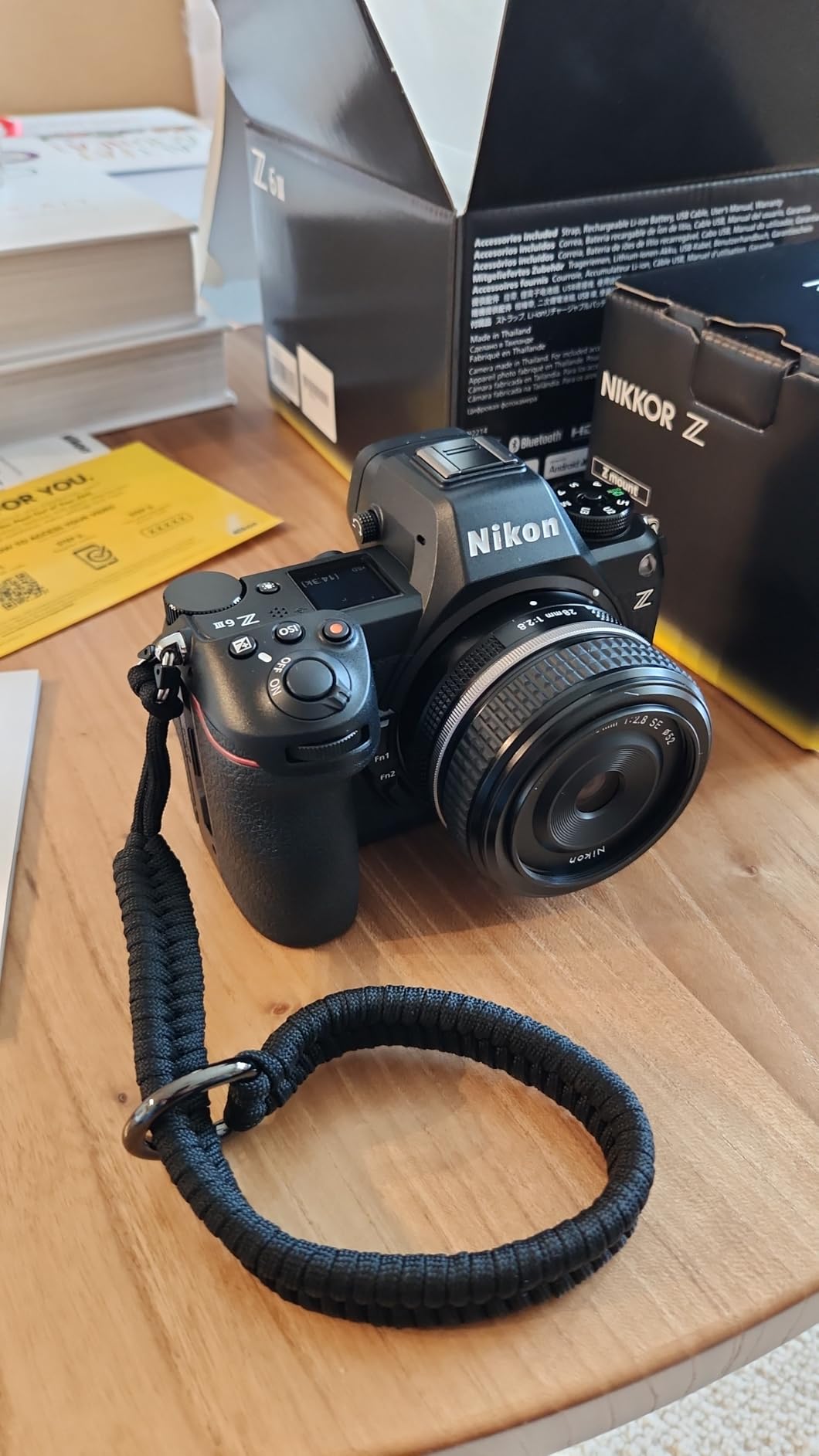
This is the body to buy if your indoor season runs from October to March and you are often shooting the darkest sessions. The native ISO 100 to 64000 range extends to a Hi 1.7 setting equivalent to ISO 204800, and reviewers consistently single out low-light performance as the standout. Paired with the brightest viewfinder in this group at 4000 nits, it lets you see the frame in a poorly lit pool without guessing.
For swimming specifically, the near-absence of rolling shutter is a quiet advantage. A swimmer crossing the frame laterally is the hardest distortion case, and owner reports say this body handles it cleanly. The deep learning recognition system detects faces down to roughly 3 percent of the frame with detection rated to -10 EV, which is where a swimmer emerging from spray at the far wall lives.

Video is where it separates from most rivals. Internal 6K 60p N-RAW, oversampled 4K UHD, 4K 120p and Full HD 240p cover everything from a slow-motion turn to a long records clip. Owners frequently call it the best hybrid value in this category, and reviewers highlight the viewfinder and low-light files as reasons.
The recurring complaints are worth weighing honestly. The menu system is described as extremely complex and confusing even after weeks, the front dial inside the grip feels unintuitive, and autofocus can be finicky in dark conditions. Battery life is only adequate at roughly a couple of hours per charge, and the cloud and app setup is called a maze of separate utilities.
Why the viewfinder brightness matters at a meet
Older indoor facilities have genuinely poor, uneven lighting, and photographers regularly report waiting for a swimmer to pass under an overhead fixture to get an acceptable exposure. A 4000 nit viewfinder at 120 fps refresh means you can spot those brighter zones in the water and pre-position your AF point for them, rather than hunting for them after the fact.
Where it will frustrate you
Setup friction is the real cost. On a session change between prelims and finals, nobody wants to rebuild custom menus, and the 210-review owner base is smaller than the Canon and Sony bodies here, so there is less collective advice online. Budget for extra batteries and bring your own charger.
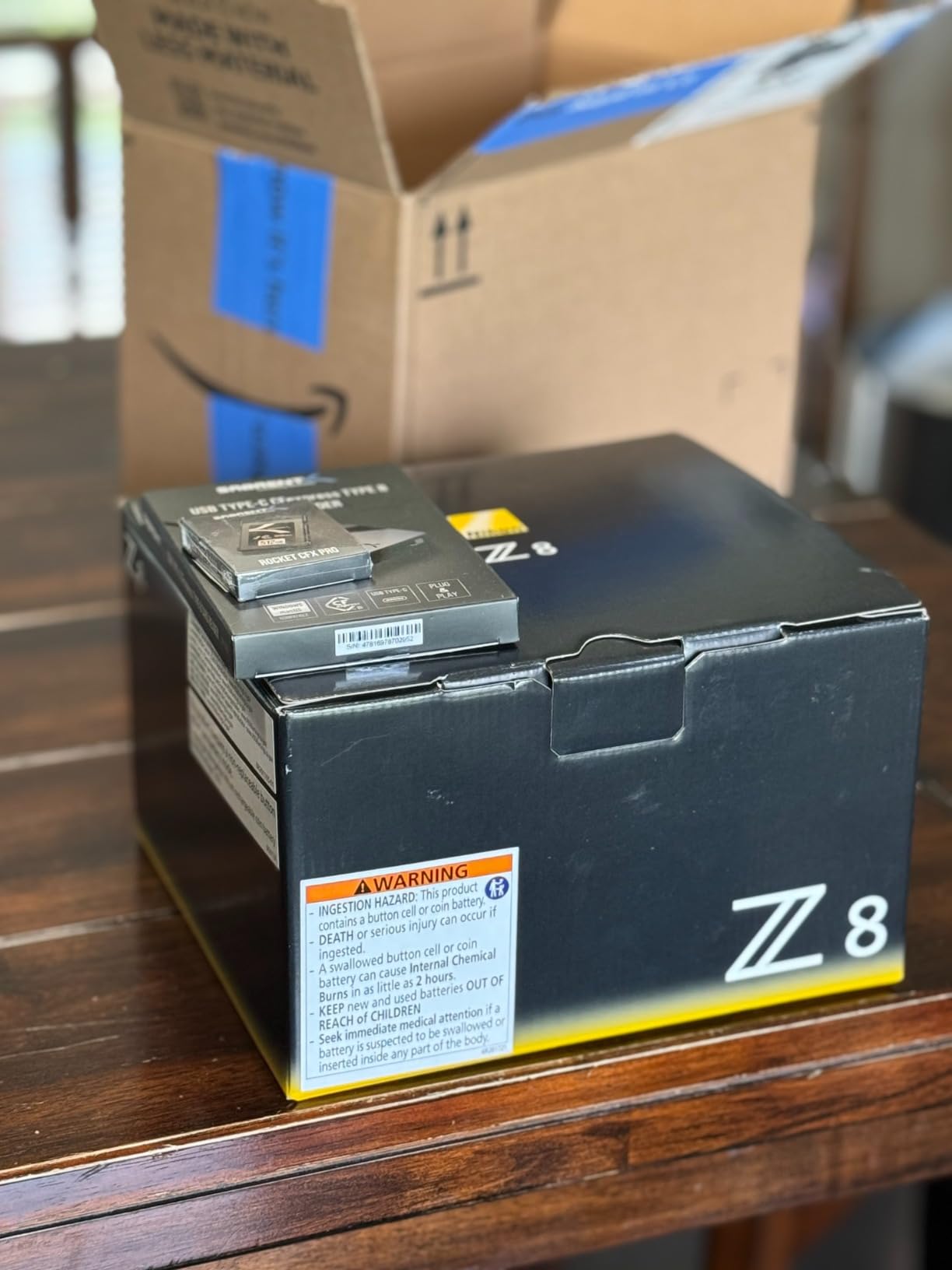
5. Nikon Z8 – Premium Pick for Club and Multiple-Meet Shooters
Pros
- 45.7MP stacked sensor gives huge crop latitude for distant lanes
- Deep learning subject detection with 3D tracking across many object types
- 20 fps at full resolution plus pre-release capture
- Internal 8K 60p and 4K 120p video
- Weather-sealed build described as tank-like
Cons
- Battery drains quickly and spares are effectively required
- Smaller body handles heat less well on long records
- Only one CFexpress Type B slot
- Configuration options are complex
If you shoot several meets a week for a club or a team, the Z8 is the most complete tool here. The 45.7 megapixel stacked CMOS sensor gives you both speed and resolution: 20 fps at full resolution RAW, with 30, 60 and 120 fps options and pre-release capture that records before you press. The stacked design is what removes the blackout and rolling-shutter behaviour that ruins electronic bursts on older bodies.
Autofocus is the deepest in the group. Deep learning subject detection rated to -9 EV, 3D tracking, and recognition for people plus a long list of object types. In practice the advantage is that the camera keeps a face through a splash, a wall, and a change of direction without you re-acquiring.

The video side is future-proof. Internal 8K 60p and 4K 120p in 12-bit N-RAW and ProRes RAW, with 14-bit RAW and High Efficiency still formats. The silent electronic shutter with adjustable volume is genuinely useful at a meet, where the electronic trigger noise from a dozen parents is distracting to the swimmers.
Reviewers are clear on the battery. Drain is fast enough that multiple spares and a portable charger are effectively required, and the smaller body handles heat less well than the larger flagship it replaces, which limits long record times. There is also only one CFexpress Type B slot, with the second being a slower UHS-II SD.
Why crop resolution changes a club photographer’s workflow
At 45.7 megapixels you can frame loosely on a 50-meter pool and still crop to a tight headshot of a swimmer at the far wall. For someone delivering images to a whole team, that turns a missed frame into a usable one far more often than a faster burst rate would.
Where it will frustrate you
Focus point lock requires going into the menu rather than using a rear lever, and configuration options are complex enough that reviewers mention the bundled manual as minimal. If you shoot one meet a season for your own kid, this is more camera than the job requires.
6. Nikon Z6 II – Top Rated Full-Frame Body With a Deep Buffer
Nikon Z 6II | Versatile Full-Frame mirrorless Stills/Video Hybrid Camera | Nikon USA Model
Pros
- Highest average owner rating in this group
- 14-bit BSI sensor performs well at high ISO
- Buffer is substantially deeper than the original Z6
- Weather-sealed and light enough for a full day
- Out-of-camera JPEGs need little editing
Cons
- Subject tracking can lose the swimmer more easily than rivals
- 14 fps is modest for modern sports bodies
- No compact S-line 70-200mm f/4
- Internal 4K is 8-bit 4:2:0
This is the body owners rate most highly in the group, and the reason is consistency rather than headline specs. The 24.5MP back-illuminated full-frame sensor performs well at high ISO with low noise, 14-bit RAW gives good grading latitude, and the 14 fps rate is backed by a buffer reviewers describe as vastly deeper than the original Z6. Across an eight-hour session that combination means your tenth race shoots like your first.
Two things make it pleasant rather than exciting. The body is weather-sealed and light enough to carry all day, and owners praise the out-of-camera JPEGs as true-to-life with little editing, which matters when you are sending images to a swim team parent group the same night. Dual card slots let you mirror files or use the second as overflow, which removes the storage anxiety that comes with a long meet.

The honest drawback is tracking. Reviewers say subject tracking can be tricky and the camera may lose the subject more easily than rivals, which is a real problem when a swimmer surfaces among five competitors. The 273-point phase-detect hybrid AF with wide-area eye detection is capable, but it leans on you to place the zone well. Internal 4K is also 8-bit 4:2:0, which is limiting if you plan to grade a turn clip.
There is no S-line 70-200mm f/4 in the mount, so a compact telephoto option means a third-party or adapted older lens, and there is no sensor dust protection when changing lenses in a humid building. That last point is worth remembering in a chlorinated facility.

How buffer depth changes a full meet
Real shooting guides from the era of this body show a single 64GB card filling with roughly 3,000 RAW frames over an eight-hour meet, leaving about 1,200 keepers. When the second slot can overflow or mirror, that planning problem largely disappears, and the deep buffer means you do not wait mid-race for frames to clear.
Where it will frustrate you
Tracking is the gap. Set an AF zone over the lane you expect the swimmer to reach, use wide-area eye detection, and confirm the focus box before the start horn. The tilting screen also does not rotate fully forward, so low pool-deck angles are awkward.
7. Panasonic LUMIX S5II – Best Choice If Video Is Half the Job
Pros
- Unlimited 6K 30p Open Gate recording on a small fan and heat sink
- 14+ stops of V-Log with real-time LUT for in-camera grading
- Phase Hybrid AF is fast and reliable even in low light
- In-body stabilization steadies handheld long-lens work
- Compact body with an intuitive menu system
Cons
- 9 fps is the slowest burst rate in this group
- Continuous AF can be unreliable with moving subjects
- Custom picture profiles may not save reliably
- Internal recording is 10-bit
The S5II is the odd pick here, and it earns its place on video rather than stills. Unlimited 6K 30p Open Gate recording through a small fan and high-efficiency heat sink means a parent filming a full meet day does not have to babysit record limits. For a turn in slow motion you can crop into 6K Open Gate footage without losing much, and 14+ stops of V-Log with a real-time LUT gives real grading latitude for a mixed-lighting pool.
Active in-body stabilization supports walking shots, which is useful if you are moving along the deck rather than locked into the bleachers. The Phase Hybrid AF system uses 779 points with subject detection, and owners describe it as fast and reliable even in low light. The 24.2MP full-frame sensor produces sharp files with natural color straight out of camera.
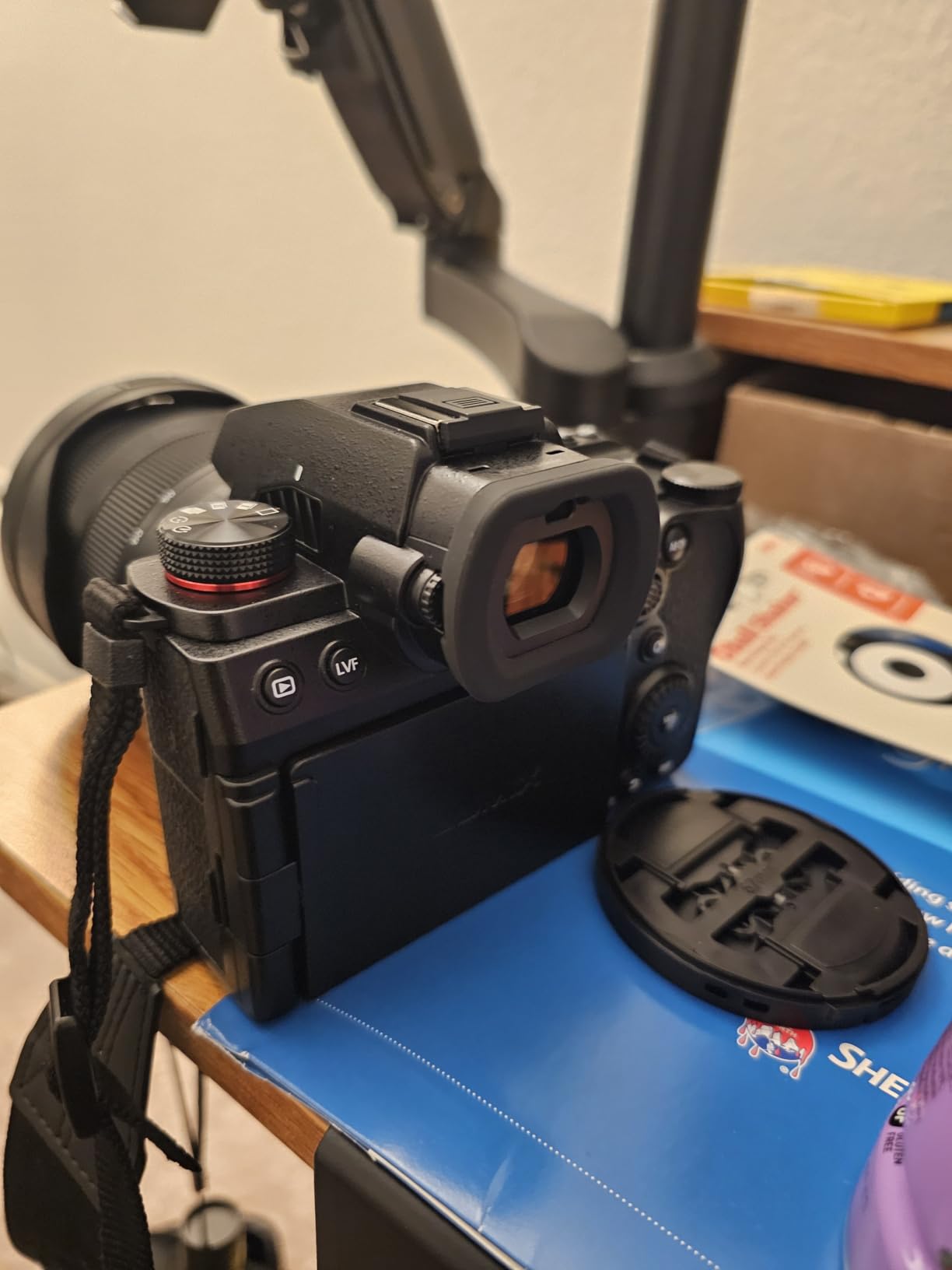
For stills, it is the weakest action body in this list. Continuous shooting is 9 fps, the slowest here, and some owners report continuous autofocus being unreliable with moving subjects. Custom picture profile settings are also reported not to save reliably and needing to be reloaded after power cycles, and internal recording is 10-bit rather than 14-bit.
The 740 gram body is comfortable and the menu system is easier to learn than most in this group. Just do not choose it to freeze a 50 freestyle. Pick it because you want the finish and the push-off in slow motion as much as you want the still frame.

What unlimited recording changes for meet day
Most bodies start throttling or shutting down in a hot building long before eight hours are up. A heat sink and small fan on this body remove that ceiling, so you can leave it rolling through a whole session while still shooting stills. That is the single most underrated feature for a multi-session meet.
Where it will frustrate you
Only 10-bit internal recording and a 9 fps burst limit how much you can do with the files afterward. If you crop hard, grade aggressively, and print large, 10-bit 6K still has more to give than 4K from a smaller sensor, but it is not the same as a 14-bit full-frame RAW pipeline.
8. Panasonic LUMIX G9II – Highest Burst Rate With Pre-Burst Capture
Pros
- 60 fps blackout-free burst with continuous AF for roughly 3 seconds
- Pre-burst recording goes back in time to the decisive moment
- 8.0 stop in-body stabilization steadies handheld telephoto
- 4K 120p and 100p 10-bit slow-motion capture
- Phase detection AF tuned for sport
Cons
- Micro Four Thirds shows more high-ISO noise than full frame
- Menu system is widely called confusing
- Autofocus reported slightly behind Sony's leading systems
- Body is bulkier than smaller MFT cameras
Nobody shoots 60 frames per second with continuous autofocus at a swim meet, and nobody needs to. But the same burst engine gives this body a pre-burst function that rewinds time, and that is the feature to think about at a start block. Owners describe it as a way to go back and catch the perfect moment, which is exactly the problem a parent has when the race ends before their hands react.
The 25.2 megapixel Live MOS sensor pairs with 8.0 stops of in-body stabilization plus 7.5-stop 5-axis Dual stabilization, and owners call that class-leading for steadying handheld long-lens shots. Micro Four Thirds gives you roughly double the focal length of full frame for the same framing, so a compact 100 to 300mm-equivalent zoom reaches the far wall from the stands.

Video is 4K 120p and 100p 10-bit slow motion plus 5.7K 60p open-gate with no crop. Phase detection AF is a first for the LUMIX G series and is tuned for sport, which is a meaningful upgrade, though reviewers still place it slightly behind Sony’s leading systems and some units report inconsistent low-light focus.
Accept the trade-off: a Micro Four Thirds sensor shows more noise at the ISO levels a dim indoor pool demands, the menu system is widely described as confusing, and the body is bulkier than the smaller cameras it replaces. It also has the smallest owner review base here at 45 reviews, so treat the fine print with more caution. Fewer third-party lens options exist than on full-frame mounts.

When extra reach matters more than low light
If your meets are outdoors in daylight, the smaller sensor costs you little and the doubled focal length pays off immediately. A single compact zoom covers the whole venue, which is also why this body suits anyone who wants one lens for a season of weekend meets.
Where it will frustrate you
Winter indoor meets are the problem. When you are at ISO 6400 in an older facility because the room has hot spots and dead zones, the noise from the smaller sensor shows up in shadows on a face. Stabilization buys you the shutter speed, but it cannot buy back the light.
What Are the Best Camera Settings for Indoor Swim Meets?
For indoor swim meets, start at 1/1000 second in manual or shutter priority, wide open to f/2.8 or f/4, and let ISO float between 1600 and 6400 depending on the fixture. Use continuous autofocus with human subject detection and back-button focus, shoot RAW in a high-speed burst, and leave the flash at home because meets almost always ban it.
That one sentence is the whole method, but the details matter more than people expect. A swimmer crosses a pool length in roughly 25 seconds, so anything slower than about 1/1000 second turns a sprint into a smear, and the people who get blur are almost always shooting 1/800 in a dim room.
Indoor pool versus outdoor pool
Indoors, your constraint is light. Set the aperture as wide as your lens allows, hold 1/1000 second, and raise ISO until the exposure lands. If the room has bright zones, expose for the lane your swimmer is in and accept that other lanes will be dark. Outdoors, reverse the priority: stop down to f/8 or f/11 for depth across multiple lanes and let ISO sit low.
What to change before the first race
Move the AF-ON button so your index finger lands on it without looking, set the burst to its fastest usable rate with RAW recording, and register your child as an autofocus subject if the camera supports it. Shoot during warm-ups first. Athletes get faster as a meet progresses, so practicing on a tired swimmer teaches you settings that will fail later.
Keep a spare battery in your pocket and check your card math before session two. Real shooting logs from full meet days show thousands of RAW frames from a single session, and filling a card mid-final is the one storage problem that cannot be fixed after the fact.
Why Flash Is Banned at Swim Meets and What to Do Instead
Almost every meet bans flash, and most rulebooks say so for a mechanical reason rather than a photographic one. Many competitions use a flash-based timing system at the finish wall, and a photographer’s strobe firing into that sensor corrupts the official times. A parent once photographed a meet with a flash and the results were reviewed, so this is a rule that gets enforced.
The practical consequence is that your exposure budget comes entirely from the pool lights. That is why the high-ISO performance of the bodies above carries so much weight, and why the aperture of your lens matters more than anything else in the kit. Photographers who rent an f/2.8 70-200mm for a season of indoor meets report it solves more problems than any body upgrade.
What replaces flash is patience and position. Rather than lighting a far lane, move closer or work the end of the pool where the fixtures are strongest. Some facilities have genuinely bright hot spots, and community advice from regular meet photographers is to learn where they are and pre-focus on those zones, shooting your swimmer as they pass through.
Handling Condensation and Humidity at Warm Indoor Pools
Walking in from a cold car into a warm, humid natatorium is the single most common equipment problem at indoor meets, and it is not a manufacturer defect. Warm humid air meets a cold front element and the glass fogs from the inside, which can take twenty minutes to clear if you wait for it.
Sealed bodies help at the joints but do nothing for the front element. A body with in-body stabilization is more forgiving here than one without, because stabilization gives you the shutter speed margin that a fogged lens otherwise costs you. The bodies above with 8.0 stops and 5-axis systems gain the most from that.
The practical protocol is boring and effective. Keep the camera in a closed bag or its case until you are inside the building, and if you must bring it in cold, put it in a sealed plastic bag and leave the bag sealed for 20 to 30 minutes. Once your lenses are not changing, the smaller the body the less surface area there is to fog. If you are swapping glass in the humidity, do it fast and accept some risk.
One more note from the community: if your meet schedule allows it, shoot prelims rather than finals when you can. Prelims sessions often run in daylight with light coming through windows, which makes them far easier than a night final under the weakest fixtures. It is a lighting decision disguised as a scheduling one.
Lens Reach Math for Pool Distance
Reach is set by how far away you are, and pool spectator seating is rarely ideal. On a 25-yard pool the far wall from the upper bleachers is often 15 to 20 meters. On a 50-meter pool shot from the same seat at the end, you can be 45 to 55 meters from the opposite end. That is the number that decides your focal length.
A practical rule: for a head-and-shoulders frame, you want roughly 3 times the distance in millimeters. So 20 meters means a 200mm lens, and 50 meters means something closer to a 300mm. That is why the APS-C and Micro Four Thirds bodies score well here, since a 200mm frames like 320mm on full frame and a 100mm like 200mm.
Between the zoom ranges, 70-200mm f/2.8 is the indoor workhorse because the aperture buys the shutter speed you need, and 100-400mm is the reach answer for a 50-meter pool from the stands. A 200mm or longer prime is the sharpest and lightest option for pool-deck work if you can get close enough to use it.
One piece of field advice worth repeating: a zoom loses light as you extend it, and that lost aperture is exactly what you cannot spare indoors. Shoot a little wider and crop in the edit rather than zooming to the limit, and check what your lens actually does at the long end before the season starts.
How to Choose a Camera for Swim Meets
Start with the light, not the sensor. Your shutter speed floor is 1/1000 second, flash is prohibited, and the fastest swimmer in the meet will expose any shortfall. That means either a large sensor with a bright lens or a smaller sensor with a very bright one, and it means high-ISO performance is the single most important spec on this list.
Second, decide your reach. Work out the farthest wall you need to fill the frame with, add the crop factor of the format, and buy the lens that covers it. The community answer here is consistent: for indoor swimming, upgrade the lens before the body, because light and reach are the bottleneck rather than megapixels. If your current camera already shoots 1/1000 second, the body is not your problem.
Third, check the autofocus behaviour in spray, not on a sunny track. Human subject detection with eye and head priority is the feature that decides how many frames you keep, and point counts alone do not tell you how a system behaves when water is on the lens.
Fourth, budget for the boring costs. An eight-hour meet needs multiple batteries, a fast card in the right format, and possibly a weather-sealed body. A body that drains a battery in two hours will miss the last two heats of the evening, and that is where personal records happen.
Finally, if you shoot several meets a week, the economics change and a pro-tier body with deep buffer and dual slots starts to make sense. If this is one meet a season for your own kid, the mid-range bodies here are indistinguishable in the final 20 percent of your images, and the money is better spent on a fast telephoto lens. For a broader look at camera options across categories, our camera brand roundup covers the bodies that pair with each tier.
Use the off-season to sharpen the fundamentals. Our guides to the best swim spas and the best swim spa exercise pools cover the training setups that keep a swimmer sharp between meets, which means more finish-wall moments worth photographing when the season restarts.
Frequently Asked Questions
What are the best camera settings for indoor swim meets?
Shoot 1/1000 second at the widest aperture your lens allows, typically f/2.8 to f/4, and let ISO float between 1600 and 6400 in an indoor pool. Use continuous autofocus with human subject detection, back-button focus, RAW recording and your fastest usable burst. Do not use flash, since most meets prohibit it because of flash-based timing systems.
Can you use flash at a swim meet?
Almost never. Most meets ban flash because many competitions use a flash-based timing system at the finish wall, and a strobe firing into that sensor corrupts official results. Plan to get your exposure from the pool lights instead, which makes a bright lens and good high-ISO performance far more important than they would be in outdoor sport.
Is mirrorless better for sports photography?
For swimming, yes. Mirrorless bodies offer silent electronic shooting, deep subject-detection autofocus, pre-capture bursts, and high frame-rate video for slow-motion turns, all of which help when you cannot ask for a second take. A modern DSLR will still freeze a swimmer at 1/1000 second, so upgrade when its autofocus struggles with spray or its high-ISO files get too noisy.
How do I keep my lens from fogging up in a pool?
Condensation forms when a cold camera enters warm, humid air. Keep the body sealed in its bag or a plastic bag until it has acclimatised inside the building, ideally 20 to 30 minutes. Avoid changing lenses in the humidity, and note that bodies with in-body stabilization give you more shutter speed margin while the front element clears.
What shutter speed do I need for swimming?
At least 1/1000 second, and faster is better for butterfly and sprint finishes where a swimmer’s arm travels a long distance during the exposure. Because flash is prohibited indoors, that speed comes from aperture and ISO rather than added light, so a fast lens matters more here than in almost any other sport.
Do I need a telephoto lens for swimming?
Yes. To fill the frame with a head-and-shoulders shot you want roughly three times your distance in millimeters, so 20 meters needs about 200mm and a 50-meter pool shot from the stands needs closer to 300mm. A crop sensor or Micro Four Thirds body gives you that reach from a shorter, cheaper lens.
The Verdict: Which Camera Wins for Swim Meets
The Sony Alpha 7 IV takes the top spot among these best cameras for swim meets because a 33MP full-frame sensor, real-time eye autofocus and dual card slots cover the three things that actually decide a meet: crop latitude from the stands, a locked face through spray, and storage that survives an eight-hour session. Buy it with the fastest telephoto you can justify, because indoors the lens sets your shutter speed.
If your meets are crowded championship sessions, the Canon EOS R6 Mark II’s head and whole-body detection is the better tracking tool. The Canon EOS R7 is the reach-per-dollar pick for parents, and the Nikon Z6 III is the body to own if your season is dark indoor meets and slow-motion clips. Club shooters covering several meets a week should look at the Nikon Z8, and the Nikon Z6 II remains a well-regarded all-rounder with a deep buffer.
Whatever you choose, learn the venue before you shoot it. Find the hot spots, ask the event coordinator about pool-deck access, and practise during warm-ups. The best cameras for swim meets are the ones you already know how to drive by the time the first horn sounds. For more on the gear side of photography, see our broadcast camera roundup and swim spa comparison for the pool setups that go with a training block.