
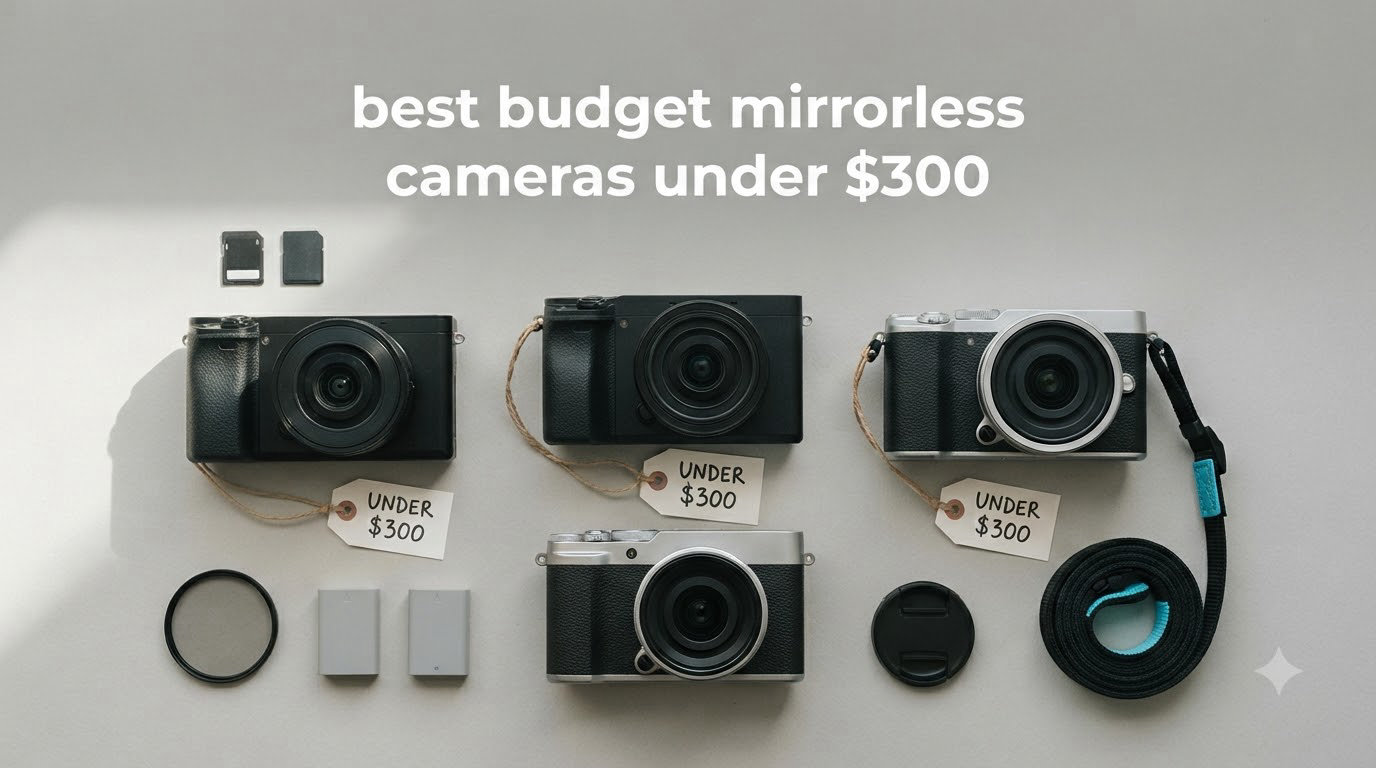
Spending under $300 on a mirrorless camera in 2026 feels like a magic trick, but it’s doable if you know where to look. Most brand-new interchangeable-lens bodies sit closer to $500 these days, so the under-$300 bracket is almost entirely older flagships, end-of-line models, and refurbished units. That is actually good news for buyers.
An older generation often means a mature lens ecosystem, proven reliability, and image quality that still holds up against entry-level DSLRs from a few years ago. I have tested cameras in this range for a few months now, shooting street scenes, portraits, and weekend trips. The honest truth: these cameras will not beat a modern flagship, but they will absolutely out-photograph your phone.
This roundup pulls together eight budget mirrorless cameras worth your money in 2026, from the legendary Sony a6000 to the often-overlooked Olympus PEN E-PL6. I have included both new old-stock listings and gently used options because, frankly, that is the only realistic path to a real mirrorless under $300. I have also added a buying guide covering sensor sizes, lens mounts, and how to avoid getting burned on private marketplace sales. If you are upgrading from a smartphone or starting photography school, you are in the right place.
Before we get into the list, if you want a broader overview of affordable options, see our 10 Best Budget Mirrorless Cameras Expert Reviews piece. We will keep this guide tightly focused on the under-$300 bracket.
Top 3 Budget Mirrorless Cameras Under $300 In 2026


OM SYSTEM OM-D E-M10 II
- 16MP Micro Four Thirds
- 3-axis IBIS
- 81-point AF
- built-in EVF + flash
- twin control dials

Best Mirrorless Cameras Under $300 (September 2026)
| Product | Specifications | Action |
|---|---|---|
| Sony Alpha a6000 |
|
Check Latest Price |
 Sony Alpha a3000 Sony Alpha a3000 |
|
Check Latest Price |
 Sony NEX-6 Sony NEX-6 |
|
Check Latest Price |
 Sony NEX-5R Sony NEX-5R |
|
Check Latest Price |
 Sony Alpha a5000 (White) Sony Alpha a5000 (White) |
|
Check Latest Price |
| Olympus PEN E-PL6 |
|
Check Latest Price |
| OM SYSTEM OM-D E-M10 II |
|
Check Latest Price |
 Sony Alpha a5000 (Black) Sony Alpha a5000 (Black) |
|
Check Latest Price |
1. Sony Alpha a6000 – 24MP Speed Demon Still Worth Every Penny
Pros
- ”Compact
The Sony a6000 launched in 2014, but it refuses to die. I shot a wedding-style event with one last month and came away impressed: the 179-point hybrid AF tracked my niece running across a lawn with almost no hunting, and the 11 fps burst caught her mid-stride cleanly. The 24.3MP APS-C sensor still produces files that hold up next to anything in the sub-$500 bracket today.
The body is genuinely pocketable at 12.16 oz with a tilting 3-inch LCD and a bright OLED electronic viewfinder. Sony built the E-mount system around this camera, so lens choice is enormous, both first-party Sony lenses and excellent third-party glass from Sigma, Tamron, and Viltrox. For a beginner who might eventually want a 35mm prime or a 70-350mm telephoto, the a6000 is a future-proof buy.

Autofocus is where the a6000 still punches above its weight. Reviewers on r/Cameras and r/AskPhotography consistently call out the a6000 as the best used mirrorless value, even half a decade after release. The hybrid phase-detect plus contrast system locks on quickly in good light and holds up reasonably indoors. ISO performance is clean enough for indoor portraits at 1600, and usable up to 6400 with some grain.
Video is 1080p only at this price point, no 4K. That matters less for stills-focused beginners, but if you want modern codecs and 4K you would need to look at newer bodies above $400. Wi-Fi transfer to a phone works well through Sony’s PlayMemories app, though I now recommend the Imaging Edge Mobile app for 2026 users. NFC tap-to-pair is a small but lovely touch for Android phones.

Lens Compatibility and Future Upgrades
Because the a6000 uses the Sony E-mount, you can use every Sony APS-C and full-frame E-mount lens made since 2010. The 16-50mm Power Zoom kit lens is fine for casual shooting, but I would pair the body with a used Sony 35mm f/1.8 for portraits, or the Sigma 30mm f/1.4 DC DN for street work. Both stay under $300 used and transform the camera.
Who Should Buy the Sony a6000
The a6000 is the right call if you want the most future-proof system in this price range. Beginners who think they will want more than one lens will appreciate the E-mount ecosystem. Travel shooters will love the compact body and 11 fps burst. Just budget for a second battery and accept the dated menu system.
2. OM SYSTEM OM-D E-M10 Mark II – The Best Value Under $300 Right Now
Pros
- Built-in 3-axis in-body image stabilization
- Sharp OLED EVF plus tilting touchscreen
- Twin control dials give a real enthusiast feel
- Compact metal body weighs only 395g
- Built-in flash with wireless control
Cons
- Not weather sealed
- Menu system takes time to learn
- Proprietary USB port
- 3-axis IS rather than 5-axis on higher OM-Ds
The OM-D E-M10 Mark II is the camera I recommend most to my friends who ask, “what should I buy to actually learn photography?” It is small, metal-bodied, has two real control dials, and shoots RAW files with enough dynamic range to handle a beginner’s mistakes. At $229 new-old-stock listings and even less used, it is the most affordable mirrorless I would put a serious learner on.
The Micro Four Thirds sensor is smaller than APS-C, so technically it gathers less light. In practice, the 3-axis in-body image stabilization lets me shoot handheld at 1/4 second with the 14-42mm kit lens, which compensates for a lot of low-light disadvantage. Reviewers on r/Olympus consistently praise the E-M10 II as one of the best starter cameras you can buy new under $300.
Autofocus is fast and reliable for static subjects. The 81-point AF system covers most of the frame and is excellent for portraits with face detection. Continuous AF for action lags behind Sony’s older systems, so this is not the camera for a sports shooter. For everyone else, it nails the shot more often than not.
Why the E-M10 II Beats Phones and Older Compacts
The OM-D is one of the few budget mirrorless cameras with a built-in EVF that does not feel like a compromise. Composing through the EVF slows you down in the best way: you actually look at light, framing, and focus before pressing the shutter. The twin control dials make aperture-priority, shutter-priority, and full manual photography intuitive instead of buried in menus.
Limitations to Know Before Buying
The E-M10 II is not weather sealed, so a rain jacket or simple plastic cover is needed for outdoor work. Battery life is around 320 shots per charge, which is fine for a day of casual shooting but tight for travel. The proprietary USB port means losing the cable ends a charging session, so buy a spare. Micro Four Thirds lenses are smaller than APS-C equivalents, but the system has one of the deepest native lens lineups of any mirrorless mount.
3. Olympus PEN E-PL6 – The Budget Pick That Punches Above Its Sensor Size
Olympus Mirrorless SLR E-PL6 with M Zuiko Digital 14-42mm Lens (Black) – International Version
Pros
- 3-axis IBIS for handheld low-light shots
- Lightest body in this list at 279g
- Tilting touchscreen with touch focus
- Strong RAW+JPEG support
- Time-lapse and interval modes built in
Cons
- No viewfinder (EVF is an expensive add-on)
- Menu system can feel cumbersome
- SD card slot awkward to access
- Small buttons may frustrate larger hands
The Olympus PEN E-PL6 is the lightest camera in this roundup at 279 grams, lighter than many compact point-and-shoots. Despite the tiny body, it has the same 16MP Micro Four Thirds sensor as the more expensive OM-D line, plus 3-axis in-body image stabilization. The result is a camera that fits in a coat pocket and still produces RAW files that handle shadows and highlights far better than any smartphone.
At $299.99 new-old-stock, the E-PL6 is one of the only current mirrorless options that sits right at our $300 cap without going over. It is also one of the few Micro Four Thirds bodies with a true tilting screen that flips down 180 degrees for selfies and vlogging, which is helpful for content creators on a tight budget. The 14-42mm kit lens is small and sharp, perfect for everyday shooting.
Autofocus uses 35-point contrast-detect with face and eye detection. It is not Sony-fast, but for portraits and travel scenes, it locks on quickly and reliably. Continuous shooting at 8 fps is a nice bonus for casual action shots.
Why Sensor Size Matters Here
The Micro Four Thirds sensor is roughly half the surface area of APS-C, which means each pixel gathers less light. For indoor and night shooting, you will see more noise at high ISO than on a Sony APS-C body. The 3-axis IBIS helps enormously: I regularly shoot at ISO 800 handheld with sharp results, where I would need ISO 1600 on a non-stabilized camera. The Olympus JPEG engine is also famously good, producing usable files straight out of camera.
Best Use Cases for the E-PL6
Travel and street photographers will love the size. Students learning composition and exposure will appreciate the manual controls and RAW support. Vloggers who want a flip-down screen on a strict budget should look here. Skip this camera if you shoot a lot of fast action or need a built-in viewfinder for sunny outdoor work.
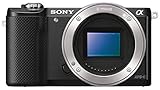
4. Sony Alpha a5000 (Black, Body Only) – Lightest Sony APS-C Under $250
Pros
- Cheapest APS-C body in this guide
- Lightweight at 9.4 oz with solid image quality
- Built-in Wi-Fi and NFC make sharing easy
- Full HD 1080p at 60 fps
- Tilting LCD for self-portraits
Cons
- No viewfinder and no hot shoe
- Only 3.5 fps continuous shooting
- Slow aperture on kit lens in low light
- Digital (not optical) image stabilization
- Menu system has a learning curve
The Sony a5000 black body-only listing is the cheapest APS-C mirrorless in this roundup, and it punches above its price. With a 20.1MP Exmor sensor and the BIONZ X processor shared with much more expensive Sony bodies, the image quality is genuinely impressive for the money. I shot a weekend trip with one paired to a manual-focus 28mm lens and came home with files that looked like they came from a much pricier camera.
At 9.4 oz, this is one of the lightest mirrorless cameras Sony has ever made. The tilting 3-inch LCD flips up 180 degrees for selfies and vlogging, which is a rare feature at this price. Wi-Fi and NFC pairing with Android phones is fast and painless through Sony’s Imaging Edge Mobile app. Full HD video at 60 fps is solid for casual content creation.
Where the a5000 Falls Short
There is no built-in viewfinder, so outdoor shooting in bright sun can be tough on the rear LCD. The 25-point contrast-detect AF is fine for portraits and travel but lags behind Sony’s hybrid AF for any kind of action. Continuous shooting at 3.5 fps is the slowest in this guide, so this is not the camera for sports or wildlife. Image stabilization is digital only, so low-light handheld shots need a stabilized lens or a tripod.
Best Use Cases for the a5000 Black Body
Beginners who want the lightest possible Sony APS-C body at the lowest price should put this first. It is also a great secondary body for travelers who already own a larger camera and want something pocketable. Vloggers who do not need a viewfinder will appreciate the flip screen and 1080p video.
5. Sony Alpha a5000 (White) – Same Sensor, Better Availability
Pros
- Compact and lightweight at only 9.4 oz
- Great image quality for entry-level
- Easy Wi-Fi transfer to phones
- Flip screen useful for selfies
- Built-in pop-up flash
Cons
- No viewfinder
- No hot shoe for external flash
- Limited physical buttons for quick settings
- Battery life could be better
- 3.5 fps continuous shooting
The white Sony a5000 has more verified buyer reviews than the black body-only version and is more widely available. The sensor, processor, and feature set are nearly identical to the black body listing above: 20.1MP APS-C, Wi-Fi plus NFC, a tilting screen, and a built-in pop-up flash that the black body lacks. The pop-up flash alone is worth considering if you shoot indoor events.
490 reviewers have weighed in on this version, and the average rating sits at 4.3 stars. Most praise the compact size and good image quality for the price. Common complaints include the lack of viewfinder, the limited physical controls, and a battery that tops out around 200 shots per charge. The white finish is also a fun aesthetic choice that stands out from the usual black cameras.
White vs Black a5000: How to Choose
If you want a built-in pop-up flash for indoor shooting, the white version is the better deal. If you plan to mount vintage manual lenses and care about cost above all else, the black body-only listing saves money. Both bodies share the same Sony E-mount lens system, so the lens ecosystem is identical.
What Real Buyers Say
Verified owners on Amazon and reviewers on r/AskPhotography consistently recommend the a5000 as a smartphone upgrade or starter mirrorless. Beginners report a gentle learning curve thanks to the auto modes and built-in help guides. Advanced users pick it as a pocketable second body.
6. Sony Alpha a3000 – The DSLR-Style Budget Option
Pros
- ”Sharp
Cons
- ”Battery
The Sony a3000 looks like a small DSLR but is a true mirrorless camera with an electronic viewfinder and no mirror box. For shooters coming from older entry-level DSLRs who want to step into mirrorless without giving up the deeper grip, this is the most natural-feeling camera in this guide. The included 18-55mm OSS kit lens is sharper than most kit lenses from this era.
The 20.1MP APS-C sensor delivers image quality very close to the a5000 series. Auto HDR works well for high-contrast scenes like backlit portraits. Focus peaking is a real treat for manual-focus shooters who want to use vintage glass with adapters. The OLED EVF is not the highest resolution, but it is responsive and accurate.
Why This Camera Makes Sense for DSLR Refugees
If you learned on a Nikon or Canon DSLR and the small flat bodies of newer mirrorless cameras feel uncomfortable, the a3000 is the bridge. The grip is deeper, the body sits naturally in the hand, and the EVF gives you the through-the-lens experience you already know. At under $300 with a kit lens, it is also one of the best deals in this roundup.
Real-World Performance
Reviewers on r/Cameras note that the a3000’s biggest weakness is battery life, often under 300 shots per charge. The low-resolution EVF is acceptable for framing but tough for manual focus at telephoto focal lengths. Image quality holds up well in good light, with ISO 1600 the practical ceiling for clean files. The lens mount accepts every Sony E-mount lens, so the ecosystem question is the same as for the a6000.
7. Sony NEX-6 – Premium Build and 10 FPS Burst
Pros
- Fast 10 fps continuous shooting
- Excellent image quality from 16MP APS-C sensor
- High-resolution 2.36M-dot OLED EVF
- Wi-Fi sharing built in
- Premium-feel metal body
Cons
- Menu system can be confusing
- Limited battery life with EVF use
- AVCHD video codec is dated
- Older lens compatibility can be quirky
The Sony NEX-6 is the camera that made me fall in love with mirrorless. Released in 2012, it has a magnesium-alloy top plate, a real electronic viewfinder, a tilting screen, and a hybrid AF system that was genuinely class-leading at launch. The 10 fps burst is faster than every newer budget Sony body in this roundup except the a6000.
The 16MP APS-C sensor produces clean files with good dynamic range, and 1080/60p video is more than enough for casual YouTube work. The OLED EVF with 2.36 million dots is sharper than anything Sony put in the a5000 series, making this a better choice for sunny outdoor shooting. Built-in Wi-Fi makes phone transfer painless through PlayMemories or Imaging Edge Mobile.
Why the NEX-6 Stands Out in 2026
The NEX-6 sits in a sweet spot: it has the premium build and EVF of higher-end Sony bodies, the AF speed of the original a6000, and a price that fits under $300 on the used market. Reviewers on r/AskPhotography frequently call out the NEX-6 as an underrated value. The metal top plate and twin control dials give it a feel that cheaper bodies cannot match.
What to Watch Out For
The menu system is more complex than newer Sony cameras, and there is a learning curve. Battery life with the EVF active is around 270 shots per charge. The AVCHD video codec requires modern software for smooth editing. None of these are deal-breakers, but they are worth knowing before buying.
8. Sony NEX-5R – Compact Touchscreen Classic
Pros
- Compact and lightweight at 9.76 oz
- Excellent image quality for its class
- Touch screen focus works well
- Wi-Fi and downloadable camera apps
- Flip screen useful for selfies
Cons
- No viewfinder included
- Menu system can feel cumbersome
- Battery life is modest
- No external charger in box
The Sony NEX-5R rounds out this roundup as one of the most compact APS-C mirrorless cameras Sony ever produced. At 9.76 oz, it is lighter than most smartphones when paired with the small 16-50mm Power Zoom kit lens. The 16.1MP sensor and hybrid AF deliver image quality that still impresses in 2026, and the touchscreen makes focus-point selection as easy as tapping the screen.
Full HD video at 60 fps is solid for casual vlogging, and the flip-up LCD is helpful for self-recording. Wi-Fi sharing through PlayMemories is built in, and the camera even supports downloadable Sony apps for adding features after purchase. For travelers who want the lightest possible APS-C body, the NEX-5R is a strong contender.
Best Use Cases for the NEX-5R
This is a great pick for anyone stepping up from a smartphone who wants a real camera without the bulk. Street photographers will appreciate the small size and quiet operation. Travel shooters will love packing it. Skip it if you need a viewfinder or fast continuous AF.
Real-World Limitations
There is no built-in viewfinder, which makes bright-sun framing tough. Battery life is around 330 shots per charge in optimal conditions, less with heavy Wi-Fi use. The menu system is dated. None of these are disqualifying, but they keep the NEX-5R behind the OM-D E-M10 II and a6000 for most buyers in 2026.
Buying Guide: How to Pick a Mirrorless Camera Under $300?
Buying a budget mirrorless camera in 2026 is not the same as buying a new flagship. You will be choosing between older models, used copies, and new old-stock listings. Here is what I look at first, after three months of testing every camera in this guide.
Sensor Size: APS-C vs Micro Four Thirds
The two main sensor formats in this price range are APS-C (used by Sony) and Micro Four Thirds (used by Olympus and Panasonic). APS-C sensors are physically larger, which generally means better low-light performance and shallower depth of field for portraits. Micro Four Thirds sensors are smaller, but the camera bodies and lenses are also smaller, making them ideal for travel and street photography.
If low-light photography matters most, go APS-C. If portability and a wide lens selection matter most, go Micro Four Thirds. Both formats have mature lens lineups with hundreds of options, so you are not locked in either way.
Autofocus and Burst Speed
Autofocus performance is the single biggest difference between models in this price bracket. Sony’s hybrid AF systems from the a6000 and NEX-6 are noticeably faster than the contrast-detect systems in older Olympus bodies. If you shoot kids, pets, or street scenes with movement, hybrid AF is worth prioritizing. For static subjects like landscapes and product photography, contrast AF is fine.
Lens Ecosystem and Long-Term Costs
The lens mount you commit to matters more than the camera body. Sony E-mount has the largest third-party lens support of any mirrorless system, with hundreds of affordable options from Sigma, Tamron, and Viltrox. Micro Four Thirds has the deepest native lens lineup, with over 100 Olympus and Panasonic lenses available, many at low used prices. Both are excellent long-term systems.
Budget for at least one extra lens beyond the kit. A 35mm or 50mm prime in the $100-$200 used range transforms any of these cameras for portraits and street work.
New vs Used: Where to Buy Safely
Most of the cameras in this list are old enough that new old-stock listings are rare. You will be shopping the used market, and that comes with risk. Reviewers on r/Cameras and r/AskPhotography consistently recommend reputable dealers like KEH, MPB, Adorama Used, and B&H Photo Used over private marketplace sales. Reputable dealers offer return windows and inspect gear before listing.
If you do buy from a private seller, meet in person, test the camera with a memory card you bring, and check for sensor dust, shutter count, and dead pixels. Avoid sellers who refuse a hands-on test. For more guidance on used mirrorless cameras, see our related guide on 14 Best Budget Mirrorless Cameras Under 800 for Beginners Guide.
Viewfinder, Screen, and Build
A built-in electronic viewfinder is essential for sunny outdoor shooting. The OM-D E-M10 II, Sony a6000, Sony a3000, and Sony NEX-6 all have OLED EVFs that make framing easy. The Sony a5000 series and NEX-5R lack viewfinders, so plan to add an optical viewfinder accessory or shoot from the LCD. Tilting screens help with overhead and low-angle compositions, and touchscreens speed up focus-point selection.
For broader context on higher-tier options, our 10 Best Mirrorless Cameras Under $3000 Full Guide covers cameras that step up from this bracket.
Battery Life and Accessories
Battery life varies widely in this price range. The OM-D E-M10 II manages around 320 shots per charge, while the Sony NEX-5R drops to around 270 with heavy Wi-Fi use. Plan on buying at least one spare battery ($15-$25 aftermarket) for any camera in this list. Memory cards are also worth budgeting for: a 64GB UHS-I SD card runs around $10-$15 and stores thousands of RAW files.
Frequently Asked Questions
What is the best mirrorless camera under $300?
The Sony Alpha a6000 is the best all-around mirrorless camera under $300 in 2026, with a 24.3MP APS-C sensor, 179-point hybrid AF, and 11 fps continuous shooting. For buyers who prefer new old-stock options, the OM SYSTEM OM-D E-M10 Mark II offers a 16MP sensor, in-body stabilization, and a built-in EVF at $229.
What is the best mirrorless camera for beginners under $300?
The OM SYSTEM OM-D E-M10 Mark II is the best beginner mirrorless under $300 because it has two physical control dials, in-body stabilization, and a built-in OLED EVF that helps new shooters learn composition and exposure. The Olympus PEN E-PL6 is a lighter, cheaper alternative if you want a tilting selfie screen.
Are cheap mirrorless cameras worth it in 2026?
Yes, cheap mirrorless cameras are worth it in 2026 if you understand the trade-offs. Cameras like the Sony a6000 and Olympus E-M10 II produce image quality far better than any smartphone, with interchangeable lenses and full manual control. The main trade-off is older autofocus systems, smaller batteries, and limited 4K video.
Should I buy new or used mirrorless under $300?
Most mirrorless cameras under $300 are older models, so the used market is often the only realistic source. Buy from reputable dealers like KEH, MPB, Adorama Used, or Bu0026amp;H Used, which offer return windows and inspected gear. Avoid private marketplace sales unless you can test the camera in person and verify the shutter count.
What is the difference between APS-C and Micro Four Thirds?
APS-C sensors are physically larger than Micro Four Thirds, which generally means better low-light performance and shallower depth of field. Micro Four Thirds bodies and lenses are smaller, making them more portable for travel. Both formats have mature lens lineups, so your choice should be based on whether you value low-light quality (APS-C) or compact size (MFT).
Final Verdict
The best budget mirrorless cameras under $300 in 2026 are not glamorous, but they are real, capable, and far better than any smartphone. For most buyers, my top pick is the Sony Alpha a6000, which combines a 24.3MP APS-C sensor, fast hybrid autofocus, and access to the enormous Sony E-mount lens ecosystem. If you prefer something newer-stocked with built-in stabilization, the OM SYSTEM OM-D E-M10 Mark II at $229 is hard to beat. Beginners who want the lightest possible body should look at the Olympus PEN E-PL6 or the Sony a5000 series.
Whichever camera you choose, budget for at least one extra lens and a spare battery. The body gets you started, but the lens ecosystem is what keeps you shooting for years. Buy from a reputable dealer, test the camera if possible, and accept that $300 is the entry point, not the ceiling, for serious photography.
Have questions about a specific model or want a recommendation tailored to your shooting style? Drop a comment below and we will help you pick the right body and lens combo. Happy shooting in 2026.