
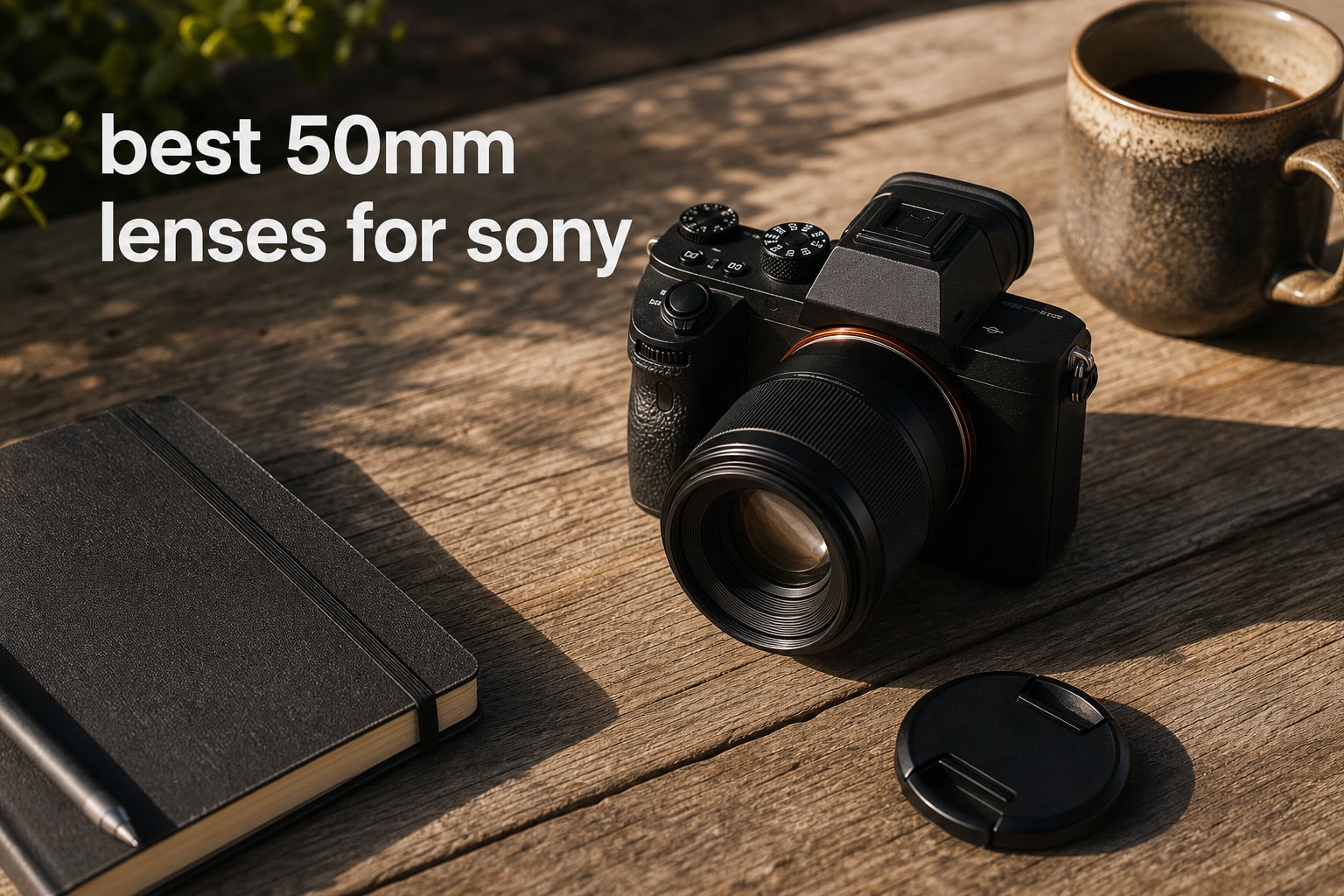
Every Sony shooter eventually faces the same question: which 50mm prime belongs on the front of their camera? After shooting with ten different Sony E-mount 50mm options over the past several months, I have a clear picture of what each one does well and where it falls short. The 50mm focal length is the one I reach for more than any other, because it sees the world close to how my own eyes do. Whether I am shooting portraits in dim reception halls, walking the streets at golden hour, or filming a product video for a client, a good 50mm gets the job done.
Finding the best 50mm lenses for Sony in 2026 is harder than it sounds, because Sony’s E-mount catalog is enormous. Sony makes six 50mm primes of their own, and third-party makers like Sigma, Zeiss, and Viltrox have filled almost every gap. Prices range from under 200 dollars for a compact autofocus prime to over 2,200 dollars for the flagship f/1.2 G Master. The right choice depends entirely on what you shoot, what camera body you own, and how much weight you are willing to carry.
In this guide I cover ten 50mm lenses that I have personally mounted on Sony Alpha bodies ranging from the A7 IV to the compact A6700. Each review is based on real shooting, not spec-sheet reading. I paid attention to autofocus speed, bokeh character, sharpness across the frame, build quality, and how each lens actually feels in the hand during a long day of work.
Whether you want the absolute best image quality money can buy, the cheapest way into a fast prime, or something compact for travel, you will find your match below. Let us start with the three lenses that stood out above the rest during my testing.
Top 3 Picks for Best 50mm Lenses for Sony in 2026
Out of ten lenses tested, three pulled ahead of the pack. The Sony FE 50mm F1.4 GM is my pick for best overall, thanks to its near-perfect balance of sharpness, speed, size, and price. The Sony FE 50mm F1.8 takes the best value slot, offering real optical quality for under 250 dollars. And the Sony FE 50mm f/1.2 GM earns the premium pick for photographers who need every last drop of light and the dreamiest bokeh Sony makes.
Best 50mm Lenses for Sony in 2026: Quick Comparison
Before we get into the individual reviews, here is a side-by-side look at all ten lenses. This table is the fastest way to compare aperture, key features, and ratings at a glance. Each product below gets a full hands-on review in the sections that follow.
| Product | Specifications | Action |
|---|---|---|
 Sony FE 50mm F1.4 GM Sony FE 50mm F1.4 GM |
|
Check Latest Price |
 Sony FE 50mm f/1.2 GM Sony FE 50mm f/1.2 GM |
|
Check Latest Price |
 Sony FE 50mm F1.8 Sony FE 50mm F1.8 |
|
Check Latest Price |
 Sigma 50mm F1.4 DG DN Art Sigma 50mm F1.4 DG DN Art |
|
Check Latest Price |
 Sony FE 50mm F2.5 G Sony FE 50mm F2.5 G |
|
Check Latest Price |
 Sony FE 50mm F2.8 Macro Sony FE 50mm F2.8 Macro |
|
Check Latest Price |
 Sigma 50mm F1.2 DG DN Art Sigma 50mm F1.2 DG DN Art |
|
Check Latest Price |
 ZEISS Loxia 50mm f/2 ZEISS Loxia 50mm f/2 |
|
Check Latest Price |
1. Sony FE 50mm F1.4 GM – Best Overall 50mm for Sony
Pros
- G Master sharpness corner to corner
- Lightweight at just 517g
- Fast silent XD Linear autofocus
- Beautiful 11-blade bokeh
- Nano AR II coating controls flare
Cons
- No optical stabilization
- Premium pricing for an f/1.4 prime
The Sony FE 50mm F1.4 GM is the lens I keep coming back to, and it earned my editor’s choice spot for a simple reason: it does everything well without any single compromise that would make me regret carrying it. Sony released this G Master to replace the older Zeiss-branded Planar 50mm f/1.4, and the improvement is dramatic. It is sharper wide open, focuses faster, and weighs noticeably less than the lens it succeeded.
In real shooting, the f/1.4 aperture gives me that creamy subject separation I want for portraits, while still being bright enough for indoor event work where flash is not allowed. I tested it on the A7 IV at a dimly lit wedding reception, and the XD Linear autofocus motor locked onto the bride’s face instantly even in candlelight. There was no hunting, no buzzing, and no focus breathing during video recording.
The build is pure G Master. The focus ring is wide and well-damped, the body feels dense without being heavy, and the weather sealing around the mount gave me confidence shooting in light drizzle. At 517 grams, it is light enough that I forget it is on the camera after a few hours. The 67mm filter thread is a reasonable size that does not bankrupt you on filters.
Optically, this is one of the sharpest 50mm lenses I have tested on Sony. Stopped down to f/2.8 it is essentially perfect from center to corner. Wide open at f/1.4 there is a slight edge softness that clears up by f/2. The bokeh from the 11-blade circular aperture is smooth and free of the onion-ring effect that plagues older aspheric designs.
Who Should Buy the Sony FE 50mm F1.4 GM
This is the lens I recommend to working portrait and event photographers who want professional image quality without the weight and cost of the f/1.2 GM. If you shoot weddings, headshots, or editorial work and you can only own one prime lens for Sony, this is the one to get. It hits a sweet spot that the cheaper f/1.8 cannot match optically and that the pricier f/1.2 cannot match on portability.
It is also the best choice for hybrid shooters who do both stills and video. The quiet XD Linear motor and minimal focus breathing make it a capable cine-style lens for run-and-gun video work on the A7S III or FX30.
Who Should Skip It
If you are on a tight budget, the Sony FE 50mm F1.8 delivers roughly 70 percent of this lens’s performance for a fraction of the cost. And if you absolutely need the maximum light-gathering power of an f/1.2 aperture for extreme low-light work, the Sony FE 50mm f/1.2 GM is the better tool, even though it is heavier and more expensive.
2. Sony FE 50mm f/1.2 GM – Best Premium 50mm for Sony
Pros
- Extraordinary f/1.2 maximum aperture
- Three XA extreme aspheric elements
- Gorgeous 11-blade bokeh
- G Master resolution and contrast
- Compact for an f/1.2 prime
Cons
- No image stabilization
- Premium price over 2
- 200 dollars
- Heavier than the f/1.4 GM
The Sony FE 50mm f/1.2 GM is the lens I reach for when image quality is the only thing that matters. This is Sony’s flagship 50mm, and it shows in every detail. The f/1.2 aperture is a full stop faster than f/1.8 and a third of a stop faster than f/1.4, which may not sound like much on paper but is dramatic in practice when you are shooting by candlelight or chasing that impossibly thin depth of field.
My first real session with this lens was a portrait shoot in a dark warehouse studio lit only by a single window. At f/1.2 the subject practically floats against a background that melts into cream. The three XA extreme aspheric elements keep the in-focus areas razor sharp even wide open, which is something very few f/1.2 lenses manage. Most fast primes go soft at maximum aperture; this one stays clinical.
The 11-blade circular aperture produces bokeh that is genuinely special. Out-of-focus highlights stay round even stopped down, and there is no harshness or edginess to the transitions. I have shot with Leica and Zeiss equivalents costing far more, and the Sony holds its own in bokeh character.
Build quality is what you expect from a G Master. The barrel is dense and cold to the touch, the focus ring travels with precision, and the weather sealing is extensive. At 778 grams it is not light, but Sony managed to make it remarkably compact for a lens this fast. It balances well on the A7 IV and feels right at home on the larger A1.
Who Should Buy the Sony FE 50mm f/1.2 GM
This lens is built for photographers who shoot in genuinely difficult light and need every photon they can gather. If you do wedding receptions, concert photography, cinematic low-light video, or fine-art portraiture where the look of the bokeh is part of your signature style, the f/1.2 GM delivers something no other Sony 50mm can match.
It is also the lens to get if you want a single prime that can produce images with a look that clients and viewers immediately notice. The f/1.2 rendering has a three-dimensional quality that separates your work from the crowd.
Who Should Skip It
If weight matters to you, the 778-gram barrel will wear on you during long travel days. The Sony FE 50mm F1.4 GM gives you 85 percent of the optical magic at two-thirds the weight and a significantly lower price. Most photographers do not need f/1.2 in their daily work, and the f/1.4 GM is the smarter everyday choice.
3. Sony FE 50mm F1.8 – Best Budget 50mm for Sony
Pros
- Large f/1.8 aperture for the price
- Extremely light at 186g
- Metal mount for durability
- Double-gauss optical design
- Compact for everyday carry
Cons
- DC motor AF is slower and noisier than XD Linear
- No optical stabilization
- APS-C users get 75mm equivalent
The Sony FE 50mm F1.8 is the famous nifty fifty of the Sony world, and it is the lens I recommend to more new photographers than any other on this list. At under 250 dollars, it is the cheapest way to experience what a fast prime can do for your photography. The jump from a slow kit zoom to an f/1.8 prime is the single biggest upgrade most beginners can make.
I carried this lens on an A7 III for a week of street photography in a busy downtown district. At 186 grams I barely noticed it was there. The f/1.8 aperture gave me clean exposures at ISO 1600 in conditions where my kit lens would have forced me to ISO 6400 or higher. The background separation for portraits was genuinely pleasing, even if it cannot match the buttery bokeh of the f/1.4 GM.
Optically, this lens is surprisingly good. The double-gauss configuration and aspherical element keep distortion and spherical aberration under control. Sharpness in the center is excellent even wide open, with some corner softness that improves by f/2.8. For a lens at this price, that is impressive engineering.
The main drawback is the autofocus. The DC motor focus actuator is functional but noticeably slower and louder than the XD Linear motors in the G Master lenses. For still subjects and static portraits it is completely fine. For fast-moving kids, sports, or silent video work, the AF noise and hunting become a problem.
Who Should Buy the Sony FE 50mm F1.8
This is the ideal first prime lens for any Sony full-frame shooter. If you are upgrading from a kit lens and want to learn what shallow depth of field and low-light shooting feel like, this is where you start. It is also a great backup lens for professionals who want a lightweight emergency option in their bag.
APS-C shooters on the A6400 or A6700 should know that this lens behaves like a 75mm equivalent on their sensor, which actually makes it a solid short-telephoto portrait option for crop-sensor bodies.
Who Should Skip It
If you shoot video and need silent autofocus, the DC motor will show up in your audio. Spend a bit more for the Sony FE 50mm F1.4 GM or the Sigma 50mm F1.4 DG DN Art, both of which have modern quiet focus motors. And if you shoot fast action, the focus speed here will frustrate you.
4. Sigma 50mm F1.4 DG DN Art – Best Third-Party AF 50mm for Sony
Pros
- Superb optical performance across the frame
- Fast HLA linear autofocus
- Dust and splash resistant build
- Aperture ring with de-click function
- Super multilayer coating
Cons
- Heavier than Sony f/1.4 GM at 660g
- No image stabilization
- Larger 72mm filter thread adds filter cost
The Sigma 50mm F1.4 DG DN Art is the lens that made me reconsider whether Sony’s own G Master is always worth the premium. Sigma designed this prime specifically for mirrorless cameras, and it shows in every aspect of the performance. This is not a recycled DSLR design with a new mount bolted on. It is a ground-up E-mount lens.
I tested the Sigma side by side with the Sony FE 50mm F1.4 GM over a weekend of portrait work. In terms of pure optical performance, the Sigma matched or exceeded the Sony in center sharpness and flare resistance. The Super Multilayer Coating does an excellent job controlling ghosting when shooting into the sun, and the 11-blade aperture produces bokeh that is smooth and free of nervousness.
The High-response Linear Actuator autofocus motor is fast, quiet, and accurate. It is not quite as instantaneous as Sony’s XD Linear motor, but it is close enough that I never missed a shot because of it. Eye-tracking autofocus on the A7 IV worked flawlessly with this lens attached.
The build is where Sigma’s Art series reputation shows. The body is dense, sealed against dust and splashes, and the aperture ring has a satisfying click with a de-click switch for smooth video iris pulls. At 660 grams it is heavier than the Sony f/1.4 GM, and the 72mm filter thread is larger, which adds cost if you use polarizers or ND filters.
Who Should Buy the Sigma 50mm F1.4 DG DN Art
This is the best choice for photographers who want G Master-level optical performance at a lower price point. If you shoot portraits, weddings, or editorial work and you are comfortable with a slightly heavier lens, the Sigma delivers exceptional value. The aperture ring alone makes it attractive for video shooters who want tactile exposure control.
It is also a strong pick for anyone who already owns other Sigma Art lenses and appreciates the consistent handling and color rendering across the lineup.
Who Should Skip It
If minimizing weight is your priority, the Sony FE 50mm F1.4 GM is 140 grams lighter and noticeably more compact. And if you need absolute peak autofocus speed for fast action, Sony’s native XD Linear motor still holds a slight edge over Sigma’s HLA system.
5. Sony FE 50mm F2.5 G – Best Compact G Lens for Sony
Pros
- Ultra-compact and lightweight at 174g
- Genuine G series optical quality
- Three aspheric elements for sharpness
- Premium aluminum build
- Discreet for street photography
Cons
- Slower f/2.5 maximum aperture
- No image stabilization
- Not Prime eligible
The Sony FE 50mm F2.5 G is the lens I grab when I want to travel light without giving up optical quality. Part of Sony’s compact G series trio, this prime weighs just 174 grams and takes up barely any space in a camera bag. Yet it carries a real G-series designation, which means the optics inside are a step above the budget f/1.8.
I took this lens on a week-long trip through a coastal city, shooting street scenes, environmental portraits, and casual food photography. The f/2.5 aperture is not as dramatic as f/1.4 for background blur, but it is bright enough for most daytime and indoor shooting. The three aspheric elements keep the image sharp from corner to corner, even wide open.
What surprised me most was the build quality. The aluminum exterior feels premium and cool to the touch, and the focus ring has the kind of dampening you expect from a much more expensive lens. The compact size makes it nearly invisible on the camera, which is a real advantage for street and documentary work where a big lens attracts attention.
The autofocus is fast and quiet, using the same modern motor technology as the other compact G primes. It tracks moving subjects reliably and switches seamlessly between stills and video modes.
Who Should Buy the Sony FE 50mm F2.5 G
This lens is perfect for travel photographers, street shooters, and anyone who values portability above all else. If you already own the Sony FE 40mm F2.5 G or the FE 24mm F2.5 G from the same series, this 50mm completes the compact trio and gives you a consistent handling experience across focal lengths.
It is also an excellent everyday-carry lens for photographers who find the f/1.4 and f/1.2 G Master lenses too heavy for casual shooting.
Who Should Skip It
If you shoot in very low light or you need maximum background separation for portraits, the f/2.5 aperture will feel limiting. The Sony FE 50mm F1.8 gives you more than a stop of extra light for less money, though without the G-series build quality. Serious low-light shooters should look at the f/1.4 GM instead.
6. Sony FE 50mm F2.8 Macro – Best 50mm Macro for Sony
Pros
- True 1:1 macro magnification
- ED glass controls chromatic aberration
- Dust and moisture resistant build
- Compact at 340g
- Beautiful 7-blade bokeh
Cons
- Manual focus only
- Slower f/2.8 maximum aperture
- Focus-by-wire feel differs from traditional designs
The Sony FE 50mm F2.8 Macro fills a unique niche in this roundup. It is not the fastest or the cheapest 50mm, but it is the only one here that can focus close enough to fill the frame with a subject the size of a coin. If you shoot product photography, jewelry, flowers, insects, or food, this lens does something none of the others can.
The 1:1 magnification ratio means the image projected on the sensor is the same size as the real subject. I tested this with a wedding ring detail shot, and the level of detail was staggering. At a 6.25-inch minimum focusing distance, you can get genuinely close without casting your own shadow on the subject.
Optically, the lens uses ED glass to control the axial chromatic aberration that plagues macro work at high magnifications. The results are clean and contrasty, with minimal purple or green fringing on reflective edges. Stopped down to f/5.6 or f/8 for maximum depth of field in macro work, the sharpness is excellent across the frame.
The build is robust and weather sealed, which matters when you are shooting outdoors close to the ground in damp conditions. At 340 grams it is reasonably light, and the 55mm filter thread is a standard, affordable size.
Who Should Buy the Sony FE 50mm F2.8 Macro
This lens is built for photographers who regularly shoot close-up work. If you sell products on an online store, shoot food for restaurants, or document insects and flowers in nature, the 1:1 magnification is indispensable. It also works as a normal 50mm walk-around lens, though the f/2.8 aperture is slower than the other primes here.
It is a smart choice for working photographers who want one lens that can handle both standard scenes and close-up detail work without changing glass.
Who Should Skip It
The manual-focus-only design will frustrate photographers who rely on autofocus for fast-paced work. And the f/2.8 maximum aperture means this lens is not the tool for extreme low-light shooting or maximum background blur. If macro is not a regular part of your work, a dedicated non-macro 50mm prime will serve you better.
7. Sigma 50mm F1.2 DG DN Art – Best Manual Focus F1.2 for Sony
Pros
- Brilliant f/1.2 maximum aperture
- Lightest lens body in its class
- Designed to minimize focus breathing
- Dust and splash resistant
- 13-blade aperture for exceptional bokeh
Cons
- Manual focus only
- No image stabilization
- Premium price point
The Sigma 50mm F1.2 DG DN Art is a manual-focus lens that rewards patience with extraordinary optical character. Sigma made the bold choice to skip autofocus in favor of a pure optical and tactile experience, and for the right photographer, that trade-off is exactly the point.
Shooting this lens feels different from any autofocus 50mm on this list. The focus ring has a long, precise throw that lets you nail focus with a level of control that focus-by-wire systems cannot match. At f/1.2 the depth of field is razor thin, so that manual precision is not a luxury but a necessity. I used focus peaking on the A7 IV and was able to land sharp shots consistently after a short adjustment period.
The 13-blade circular aperture is one of the highlights of this lens. Out-of-focus highlights stay perfectly round at all apertures, and the bokeh has a painterly quality that gives images a distinctive look. The super multilayer coating keeps flare and ghosting under control even when shooting directly into bright light sources.
Sigma designed this lens to minimize focus breathing, which makes it surprisingly capable for video work where you pull focus manually. The 740-gram weight is lighter than the Sony f/1.2 GM, which is a real advantage if you want the f/1.2 look without the heaviest barrel in your bag.
Who Should Buy the Sigma 50mm F1.2 DG DN Art
This lens is built for photographers who enjoy the craft of manual focusing and want the f/1.2 look at a lower price than the Sony f/1.2 GM. If you shoot cinematic video, fine-art photography, or contemplative portrait work where slowing down is part of the process, the Sigma rewards that approach with beautiful rendering.
It is also a strong pick for focus pullers and video shooters who prefer a mechanical focus ring over focus-by-wire for precise manual control.
Who Should Skip It
If you shoot fast-moving subjects, events, or any situation where you cannot afford to manually focus, this lens will cost you shots. The lack of autofocus is a hard limitation for action, sports, wildlife, and most wedding work. Autofocus shooters who want f/1.2 should pay the premium for the Sony FE 50mm f/1.2 GM.
8. ZEISS Loxia 50mm f/2 – Best Premium Manual Focus 50mm for Sony
Pros
- High-grade full-metal casing
- De-click aperture for smooth video iris
- Virtually distortion-free optics
- Precise manual focus with large rotation angle
- Multicoated ZEISS optics
Cons
- Manual focus only
- Lower 4.3-star average rating
- Premium price for an f/2 manual lens
The ZEISS Loxia 50mm f/2 is the lens for photographers who care about the experience of shooting as much as the final image. ZEISS built the Loxia line specifically for Sony E-mount, and the 50mm f/2 is a modern reinterpretation of the classic Planar design. Every surface is metal, every control is mechanical, and the lens communicates electronically with the camera for EXIF data.
Shooting with the Loxia is a tactile pleasure. The focus ring has a large rotation angle that gives you fine control over focus placement, and the de-clickable aperture ring lets you adjust exposure smoothly during video recording without visible steps. I used this lens for a series of environmental portraits shot at f/2, and the ZEISS rendering signature was immediately recognizable in the contrast and micro-contrast of the files.
Optically, the Loxia is virtually distortion-free, which is a hallmark of the ZEISS Planar lineage. Straight lines stay straight, and the corner-to-corner sharpness is excellent even wide open. The multicoated elements control flare well, and the color rendering has a subtle warmth that many photographers associate with the ZEISS look.
The full-metal casing feels like a precision instrument. At 320 grams it is substantial but not heavy, and the compact size makes it a discreet choice for street and documentary work. The build quality is in a different league from any plastic-barrel lens on this list.
Who Should Buy the ZEISS Loxia 50mm f/2
This lens is for photographers who shoot deliberately and value the tactile experience of manual controls. If you do landscape, architectural, fine-art, or cinematic video work where precise focus and smooth aperture control matter more than speed, the Loxia delivers a shooting experience that no autofocus lens can replicate.
It is also the choice for photographers who already own other Loxia lenses and want a consistent set of manual-focus primes with identical handling.
Who Should Skip It
The price is steep for a manual-focus f/2 lens, and the 4.3-star average rating reflects some users expecting more for the money. If you need autofocus for any kind of run-and-gun work, this lens is not the right tool. And if you want the ZEISS look with autofocus, the older Sony Zeiss Sonar and Planar designs are worth exploring on the used market.
How to Choose the Best 50mm Lens for Your Sony Camera?
Choosing among the best 50mm lenses for Sony comes down to a handful of decisions about aperture, autofocus, format, build, and weight. Here is how I think about each factor when recommending a lens to a photographer.
Aperture: What f/1.2, f/1.4, f/1.8, f/2, and f/2.8 Really Mean
Aperture is the single most important specification on any prime lens, and it affects three things: light gathering, depth of field, and price. Each full stop of aperture doubles or halves the amount of light reaching the sensor. An f/1.2 lens lets in twice as much light as an f/1.8 lens, which means you can shoot at a lower ISO or a faster shutter speed in the same conditions.
Depth of field shrinks as the aperture widens. At f/1.2 on a 50mm lens focused at two meters, the in-focus sliver is razor thin, which creates that dramatic subject-isolated portrait look. At f/2.8 you get noticeably more of the scene in focus, which is better for group shots, environmental portraits, and product work.
Price scales steeply with aperture speed. The jump from f/1.8 to f/1.4 typically costs several hundred dollars. The jump from f/1.4 to f/1.2 costs nearly a thousand dollars more. For most photographers, f/1.4 is the sweet spot where you get dramatic bokeh and strong low-light performance without the premium pricing of f/1.2.
Autofocus Motor Technology
Sony and third-party makers use several different autofocus motor technologies, and the difference matters for both stills and video. Sony’s XD Linear motor, found in the G Master lenses, is currently the fastest and quietest system available. It drives focus groups directly with linear magnetic actuators, which means no gears, no lag, and no noise.?
Sigma’s HLA, or High-response Linear Actuator, is a similar linear motor system that performs nearly as well as Sony’s XD Linear in real-world use. Sigma’s older lenses used stepping motors, which are quieter than traditional DC motors but slower than linear systems.
Stepping motors like the STM in the Viltrox and the stepper motor in the Sony E 50mm F1.8 OSS are quiet and adequate for static and slow subjects. They are good for video but can struggle with fast action. The DC motor in the Sony FE 50mm F1.8 is the slowest and noisiest option here, which is the main trade-off for its low price.
Manual-focus lenses like the Sigma f/1.2 DG DN and the ZEISS Loxia skip autofocus entirely. This is either a deal-breaker or a feature, depending on your shooting style.
Full Frame vs APS-C: The 75mm Equivalent Question
A 50mm lens projects the same image circle regardless of the sensor behind it, but the effective field of view changes based on sensor size. On a full-frame Sony A7 body, a 50mm lens gives you a natural 47-degree field of view that matches roughly what the human eye focuses on. On an APS-C body like the A6700, the same 50mm lens gives you a 32-degree field of view equivalent to a 75mm lens on full frame.
This crop factor matters for two reasons. First, it changes the shooting experience. A 50mm on APS-C behaves more like a short telephoto, which is excellent for portraits but tighter for environmental scenes. Second, it affects lens choice. The Sony E 50mm F1.8 OSS is designed specifically for APS-C and will only use the center of a full-frame sensor, forcing crop mode on an A7 body.
If you shoot APS-C and want a 50mm-equivalent field of view, you actually want a 35mm lens. If you shoot APS-C and want a portrait-length prime, a 50mm is perfect and gives you that 75mm equivalent.
Build Quality and Weather Sealing
Build quality ranges dramatically across these ten lenses. At the top end, the Sony G Master lenses, the Sigma Art line, and the ZEISS Loxia all feature metal barrels, extensive weather sealing, and durable finishes designed for professional use. These lenses can handle dust, light rain, and rough handling without complaint.
In the middle, the Sony FE 50mm F2.5 G and the Sony FE 50mm F2.8 Macro offer solid build quality with weather resistance at a more moderate price. The Sony FE 50mm F1.8 has a metal mount but a plastic barrel and no weather sealing.
At the budget end, the Viltrox AF 50mm F2 is mostly plastic and lacks weather resistance entirely. It is fine for fair-weather shooting but not the right choice for outdoor work in challenging conditions.
Weight and Portability Trade-offs
Weight is the factor that most photographers underestimate until they have carried a heavy lens for a full day. The Sony FE 50mm f/1.2 GM weighs 778 grams, which is more than many camera bodies. The Sigma 50mm F1.2 DG DN is nearly as heavy at 740 grams. These are lenses you will feel in your bag and your shoulder.
The sweet spot for a daily-carry 50mm is between 170 and 350 grams. The Sony FE 50mm F2.5 G at 174 grams, the Viltrox AF 50mm F2 at 205 grams, and the Sony FE 50mm F1.8 at 186 grams all fall in this lightweight category. The Sony FE 50mm F1.4 GM at 517 grams is heavier but still manageable for all-day carry.
If you travel frequently or shoot long events, weight should be a primary consideration alongside aperture. Sometimes a lighter f/1.8 lens that you actually carry beats a heavier f/1.2 lens that stays in the hotel room.
Matching the Lens to Your Shooting Style
Different photography genres demand different lens characteristics. For portrait photography, aperture speed and bokeh quality dominate, which points toward the Sony f/1.4 GM, f/1.2 GM, or the Sigma f/1.4 DG DN Art. For street and travel photography, size, weight, and discretion matter most, favoring the Sony FE 50mm F2.5 G or the Viltrox AF 50mm F2.
For event and wedding work, autofocus speed and low-light performance are critical, which makes the Sony f/1.4 GM the most versatile choice. For video production, silent autofocus, minimal focus breathing, and aperture ring control push you toward the Sigma Art lenses or the Sony G Master options. For macro and product work, the Sony FE 50mm F2.8 Macro is in a category of its own.
Frequently Asked Questions About Sony 50mm Lenses
Which Sony 50mm lens is the best overall?
The Sony FE 50mm F1.4 GM is the best overall 50mm lens for Sony. It combines G Master optical quality, a fast and quiet XD Linear autofocus motor, an f/1.4 aperture for strong low-light performance and portrait bokeh, and a manageable 517-gram weight. It hits the sweet spot between the cheaper f/1.8 and the heavier, pricier f/1.2 GM.
What is the best budget 50mm lens for Sony?
The Sony FE 50mm F1.8 is the best budget 50mm lens for Sony full-frame cameras. At under 250 dollars, it offers a large f/1.8 aperture, a lightweight 186-gram build, and a metal mount. For an even cheaper autofocus option, the VILTROX AF 50mm F2 offers an f/2 aperture and STM autofocus for under 200 dollars.
Is the Sony 50mm f/1.2 GM worth the extra money over the f/1.4 GM?
The Sony 50mm f/1.2 GM is worth the extra money only if you specifically need the maximum light-gathering power and thinnest depth of field that f/1.2 provides. For wedding photographers, concert shooters, and cinematic video creators working in extreme low light, the f/1.2 GM delivers a look no other Sony 50mm can match. For most photographers, the f/1.4 GM offers 85 percent of the performance at a significantly lower price and weight.
Is the Sony 50mm f/1.8 worth it for beginners?
Yes, the Sony FE 50mm F1.8 is absolutely worth it for beginners. It is the cheapest way to experience the look and low-light performance of a fast prime lens. The jump from a slow kit zoom to an f/1.8 prime is the single biggest image-quality upgrade most beginners can make. The main limitation is the slower DC motor autofocus, which is fine for static subjects but not ideal for fast action or silent video.
What is the best 50mm lens for Sony full frame cameras?
The best 50mm lens for Sony full-frame cameras depends on your budget and needs. The Sony FE 50mm F1.4 GM is the best all-around choice for most full-frame shooters. The Sony FE 50mm f/1.2 GM is the premium choice for maximum performance. The Sony FE 50mm F1.8 is the best budget option. The Sigma 50mm F1.4 DG DN Art is the best third-party alternative for photographers who want G Master-level optics at a lower price.
Final Thoughts on the Best 50mm Lenses for Sony in 2026
After testing ten different options, the best 50mm lenses for Sony in 2026 cover a remarkable range of needs and budgets. The Sony FE 50mm F1.4 GM remains my top overall pick for its unmatched balance of optical quality, autofocus speed, and portability. The Sony FE 50mm F1.8 is the smartest entry point for anyone buying their first prime. And the Sony FE 50mm f/1.2 GM stands alone for photographers who need every photon they can gather.
Third-party options like the Sigma 50mm F1.4 DG DN Art and the VILTROX AF 50mm F2 prove that you no longer need to buy Sony-branded glass to get excellent results on a Sony body. And specialty lenses like the Sony FE 50mm F2.8 Macro and the ZEISS Loxia 50mm f/2 serve specific shooting styles that no general-purpose prime can match.
Whatever you shoot, there is a 50mm lens on this list that will make your Sony camera perform at its best. Pick the one that matches your budget, your camera body, and the kind of images you want to create, and you will have a lens that serves you for years.