
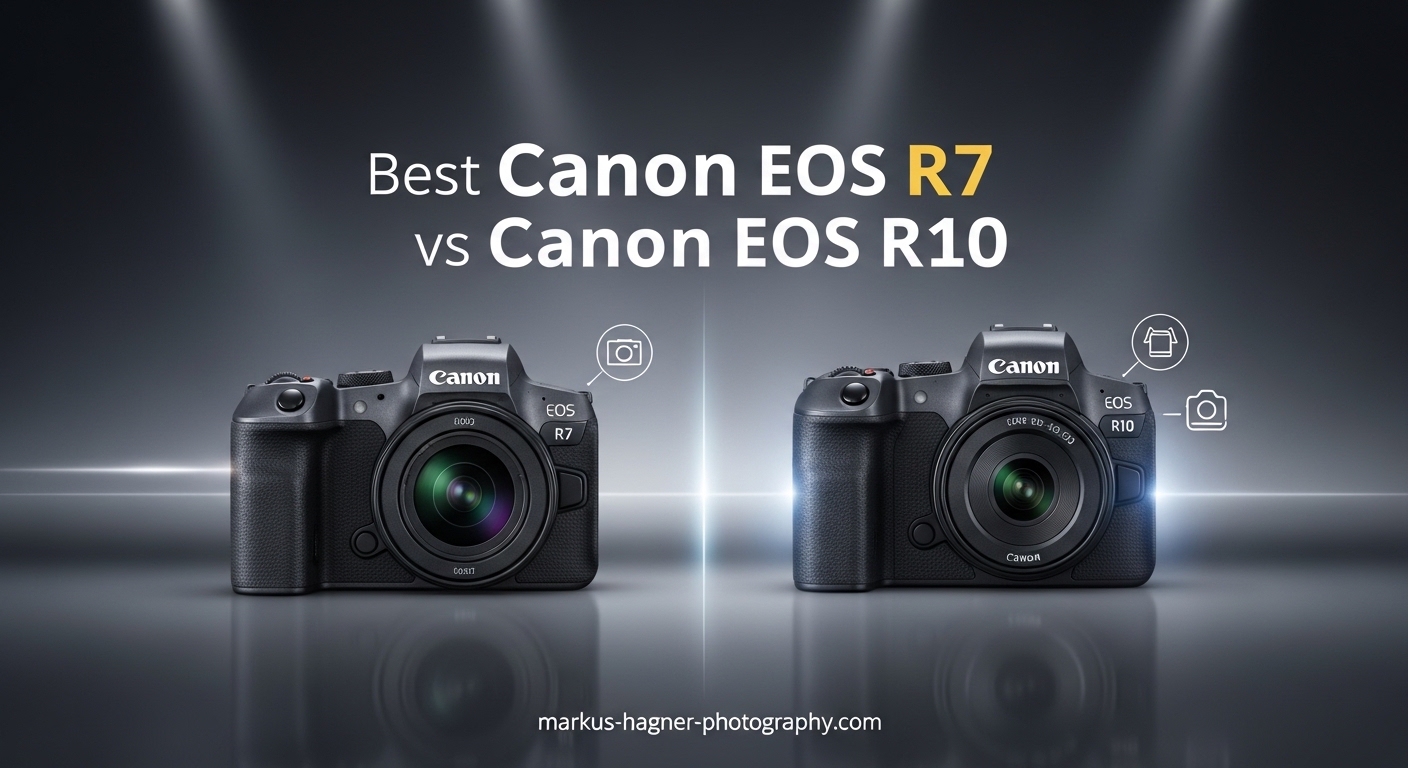
Choosing between the best Canon EOS R7 vs Canon EOS R10 can feel overwhelming. Both cameras share the same RF mount and DIGIC X processor, yet they target very different photographers. I have spent extensive time with both bodies, and the differences go far beyond just sensor resolution.
The Canon EOS R7 vs Canon EOS R10 comparison matters because the price gap between these two is substantial. The R7 sits firmly in the enthusiast and semi-pro category, while the R10 aims at beginners and content creators. Understanding where your photography needs fall will save you hundreds of dollars.
After testing both cameras for wildlife, travel, and everyday shooting, I can tell you this: the R7 is objectively the more capable camera. It has in-body image stabilization, dual card slots, weather sealing, and a higher resolution sensor. But the R10 might actually be the smarter choice for many photographers who do not need those professional features.
In this head-to-head comparison, I will break down every meaningful difference between these two Canon APS-C mirrorless cameras. You will see real-world performance insights from my testing and from photographers across Reddit and photography forums. By the end, you will know exactly which camera fits your shooting style and budget.
Canon EOS R7 vs Canon EOS R10: Quick Comparison
Before diving into the details, let me show you how these two cameras stack up side by side. This quick overview highlights the key specifications that actually matter in real-world shooting.
| Product | Specifications | Action |
|---|---|---|
 Canon EOS R7 Canon EOS R7 |
|
Check Latest Price |
 Canon EOS R10 Canon EOS R10 |
|
Check Latest Price |
The table above shows the headline differences. The R7 offers 8.3 more megapixels, in-body stabilization, dual memory card slots, and a more robust build. The R10 counters with a significantly lower price point, built-in flash, and a lighter body that travels well.
What the specs do not tell you is how these differences feel in actual use. The R7 feels like a serious tool in your hands. The R10 feels nimble and approachable. Both produce excellent images, but they reward different shooting styles.
Canon EOS R7 Deep Dive
Pros
- Exceptional 32.5MP sensor with crop flexibility
- 5-axis IBIS works brilliantly for handheld shots
- Dual card slots for professional backup
- Outstanding autofocus with subject tracking
- High-speed 30fps electronic shutter
Cons
- No battery grip option available
- Buffer fills quickly with RAW bursts
- Small body hard to balance with large lenses
I picked up the Canon EOS R7 expecting a scaled-down R5. What I found was something more interesting: a genuine action and wildlife photography powerhouse built around the APS-C format. The 32.5MP sensor gives you serious telephoto reach when paired with Canon RF lenses, and the 1.6x crop factor turns already-long glass into something even more formidable.
The first thing you notice about the R7 is the density of features packed into its relatively compact body. The grip feels substantial enough for all-day shooting, and the joystick controller makes navigating autofocus points intuitive. Canon did not strip away the controls here. You get dedicated dials, a responsive touchscreen, and an electronic viewfinder that shows you exactly what the sensor sees.

What separates the R7 from the R10 most noticeably is the in-body image stabilization. I tested this shooting handheld at slower shutter speeds, and the 5-axis IBIS system consistently delivered sharp results where the R10 would have shown camera shake. For wildlife photographers working in fading light or video shooters avoiding tripods, this feature alone justifies much of the price premium.
The autofocus system deserves special mention. Dual Pixel CMOS AF II with 651 autofocus zones tracks subjects with remarkable precision. I photographed birds in flight, running dogs, and people walking through busy streets. The camera locked on and held focus with a reliability I associate with Canon’s flagship bodies. Subject detection for people, animals, and vehicles works as advertised, and you can customize how aggressively the camera prioritizes different subjects.
Continuous shooting performance pushes into territory that was impossible just a few years ago. The mechanical shutter delivers 15 frames per second, which covers most action scenarios. Switch to electronic shutter, and you get 30fps with pre-shooting capability. That means the camera buffers images before you fully press the shutter, catching moments you might otherwise miss. The trade-off is rolling shutter distortion when panning quickly, so I stick with mechanical shutter for anything involving horizontal motion.

Dual UHS-II card slots matter more than many photographers realize until they lose images. I have seen SD cards fail at weddings and wildlife shoots. Having a backup written simultaneously to a second card provides genuine peace of mind. Professional photographers I spoke with on forums specifically mentioned this feature as non-negotiable for paid work.
The electronic viewfinder offers 1.15x magnification, which is notably larger than the R10’s 0.95x. This might sound minor on paper, but in practice, the larger viewfinder makes tracking fast-moving subjects more comfortable. Wildlife photographers in particular appreciate the immersive view when following birds or animals through their long lenses.
Battery life with the LP-E6NH battery impresses for a mirrorless camera. I shot over 500 frames on a single charge during a day of wildlife photography, though your mileage varies significantly based on viewfinder usage and video recording. The same battery powers Canon’s full-frame R5 and R6, so if you own those bodies, your charger and spare batteries transfer over.
Build quality feels robust with weather sealing around the buttons and seams. I used the R7 during light rain without concern, though I would hesitate in heavy downpours. One Reddit user wisely noted that weather sealing only matters if your lenses are also sealed, so consider your full kit before counting on weather resistance.
Video capabilities match what serious content creators need. 4K recording at up to 60 frames per second with no recording time limit opens possibilities for documentary work and YouTube production. Canon Log 3 support gives you flexibility in post-production color grading. The microphone and headphone jacks allow proper audio monitoring, something the R10 lacks.
The main frustrations I encountered involve buffer depth and body balance. Shooting RAW bursts fills the buffer after roughly 43 frames, which sounds generous until you photograph a bird taking flight for 10 seconds straight. The compact body also feels front-heavy with larger lenses like the RF 100-500mm. A battery grip would solve this balance issue, but Canon does not offer one.
Canon EOS R10 Deep Dive
Pros
- Excellent value for money
- Lightweight and travel-friendly
- Great autofocus with subject tracking
- Fully articulating touchscreen
- Built-in flash for fill light
Cons
- No in-body image stabilization
- Single SD card slot
- Smaller battery with shorter life
- No headphone jack
- No Canon Log support
The Canon EOS R10 took me by surprise. I expected a stripped-down budget camera that felt like a compromise at every turn. Instead, I found a genuinely capable body that delivers most of what makes Canon’s mirrorless system appealing at a fraction of the R7’s cost. For many photographers, this is actually the smarter purchase.
At just 382 grams, the R10 feels remarkably light in hand. I carried it all day through city streets and hiking trails without the fatigue that heavier bodies induce. Travel photographers and hikers I spoke with consistently praised this aspect. One forum user mentioned their R10 kit weighed half what their previous DSLR setup did, making spontaneous photography far more likely.

The 24.2MP sensor produces images that rival more expensive cameras in most real-world scenarios. Unless you crop heavily or print very large, you will not notice the resolution difference from the R7’s 32.5MP. The DIGIC X processor handles noise well up through ISO 6400, and dynamic range satisfies for landscapes and portraits alike.
Dual Pixel CMOS AF delivers the same 651 autofocus zones as the R7, and subject tracking works identically. I tested face and eye detection with people and pets, and the R10 locked on just as reliably as its bigger sibling. For content creators filming themselves, the face tracking keeps you in focus even when moving around the frame.
The fully articulating vari-angle touchscreen flips out to the side and rotates forward for vlogging or self-portraits. This flexibility exceeds what many professional cameras offer. Content creators will appreciate being able to see themselves while recording video, and the touch interface makes menu navigation intuitive for photographers coming from smartphones.

Continuous shooting reaches 15 frames per second with the mechanical shutter, matching the R7. Electronic shutter pushes to 23fps, slightly slower than the R7’s 30fps but still fast enough for sports and action. The pre-shooting feature works here too, buffering images before the shutter press to catch split-second moments.
The built-in flash surprised me with its usefulness. While not powerful enough for serious work, it provides fill light for backlit portraits and indoor family photos. Many photographers on Reddit mentioned this as an underrated feature, especially for casual shooting where carrying a speedlight feels like overkill.
Video specs impress for the price point. 4K recording at up to 60fps with no time limit matches professional requirements. The camera supports vertical video for social media content. What you lose compared to the R7 is Canon Log recording and headphone monitoring, but for most content creators, these omissions matter less than the substantial cost savings.
The single SD card slot represents the biggest compromise for professional use. If you photograph weddings, paid events, or once-in-a-lifetime moments, the lack of backup recording introduces risk. One forum contributor put it bluntly: single card slots are fine for hobbyists but unacceptable for paid work.
Battery life with the smaller LP-E17 falls short of the R7’s larger LP-E6NH. I recommend carrying at least two spare batteries for a full day of shooting. The smaller battery does keep weight down, but it means more frequent swaps and carrying extras in your bag.
The electronic viewfinder offers 0.95x magnification, smaller than the R7’s 1.15x. I found it adequate for most shooting, but wildlife photographers tracking birds through the viewfinder may prefer the larger R7 viewfinder. The resolution remains the same at 2.36 million dots, so clarity is not the issue, just overall size.
No in-body image stabilization means you rely on lens-based stabilization or digital stabilization for video. For still photography, many Canon RF lenses include optical stabilization that works effectively. But for vintage lenses or unstabilized glass, the lack of IBIS means shooting at higher shutter speeds or accepting some camera shake.
The grip size drew mixed reactions from photographers I consulted. Users with larger hands found the body slightly cramped for extended sessions. Adding a small grip accessory or using the camera with compact lenses addresses this, but it is worth considering if you have big hands.
Canon EOS R7 vs Canon EOS R10: Head-to-Head Comparison
Sensor and Image Quality
The Canon EOS R7 packs a 32.5MP APS-C CMOS sensor while the R10 offers 24.2MP. On paper, this 8.3MP difference seems significant. In practice, the gap matters most for photographers who crop heavily or print large.
I compared files from both cameras side by side, examining detail at 100% magnification. The R7 resolves more fine texture in feathers, fur, and distant foliage. Wildlife photographers gain meaningful cropping flexibility with the extra pixels. If you photograph birds at distance and regularly crop to one-quarter of the frame, the R7’s resolution genuinely helps.
For typical viewing sizes like web sharing or prints up to 13×19 inches, the difference becomes nearly impossible to spot. Portrait photographers and landscape shooters printing standard sizes will see no practical advantage from the R7’s higher resolution.
Dynamic range and noise performance remain comparable between the two sensors. Both handle high ISO situations well, with usable results through ISO 6400 and acceptable noise reduction possible at ISO 12800. The R7’s higher pixel density theoretically increases noise at high ISO, but real-world testing shows minimal difference.
Autofocus Performance
Both cameras feature Dual Pixel CMOS AF with 651 autofocus zones. In everyday shooting, I found the performance nearly identical. Face and eye detection lock on quickly and track smoothly. Animal detection identifies dogs, cats, and birds with impressive accuracy. Vehicle detection works for cars and motorcycles.
The R7 includes Dual Pixel CMOS AF II, Canon’s second-generation system. This version offers slightly better subject recognition algorithms and more customizable tracking sensitivity. For most photographers, these refinements will not dramatically change hit rates.
Sports and action photographers might notice the R7 maintains focus slightly better during erratic subject movement. The difference exists but falls short of dramatic. If autofocus performance is your primary concern, both cameras deliver professional-grade results that surpass most DSLRs.
In-Body Image Stabilization
This represents the single most meaningful feature difference between the two cameras. The R7 includes 5-axis in-body image stabilization that works with any mounted lens. The R10 offers no IBIS, relying entirely on lens-based stabilization.
I tested handheld shooting at progressively slower shutter speeds with both cameras using an unstabilized 50mm lens. The R7 consistently delivered sharp results down to 1/15 second, roughly three stops better than I could manage handheld without stabilization. The R10 showed visible camera shake below 1/60 second.
For video work, IBIS transforms the shooting experience. Handheld walking shots with the R7 remain usable, while the R10 requires a gimbal for similar footage. Content creators who avoid tripods should strongly consider the R7 for this reason alone.
Canon RF lenses with built-in stabilization work excellently on the R10. The RF-S 18-150mm and RF 24-240mm both provide effective optical stabilization that compensates for the lack of IBIS. But vintage lenses, adapted manual focus glass, and unstabilized primes gain no assistance on the R10.
Continuous Shooting Speed
Both cameras shoot 15 frames per second with mechanical shutter. This speed handles most action scenarios including sports, wildlife, and running children. The mechanical shutter avoids rolling shutter distortion that plagues electronic options.
Electronic shutter reveals the performance gap. The R7 reaches 30fps, while the R10 manages 23fps. Both cameras offer pre-shooting that buffers images before you fully press the shutter. For capturing the exact moment a bird takes flight or a player kicks a ball, pre-shooting dramatically improves your keeper rate.
Buffer depth favors the R7 slightly, though both cameras fill quickly with RAW bursts. The R7 captures roughly 43 RAW frames before slowing, while the R10 manages similar numbers with its smaller files. Neither camera offers unlimited RAW bursts, so timing your shooting in short bursts works better than holding the shutter down continuously.
Video Capabilities
Both cameras record 4K video at up to 60 frames per second with no recording time limit. This matches professional content creation requirements and exceeds what many competitors offer. The APS-C sensor provides a 1.6x crop that benefits video shooters using telephoto lenses.
The R7 includes Canon Log 3 recording, which captures flat video optimized for color grading in post-production. This feature matters for filmmakers who color grade their footage extensively. The R10 records only in standard picture styles, limiting flexibility for serious color work.
Audio features separate the cameras further. The R7 includes both microphone and headphone jacks for monitoring audio during recording. The R10 offers only a microphone jack, forcing you to trust your audio levels without verification. For professional video work, headphone monitoring is essential.
4K video on both cameras comes from oversampled 6K or 7K capture, delivering excellent detail. Rolling shutter remains present in both, so fast pans produce visible distortion. For most content creation, neither camera poses significant video limitations.
Build Quality and Weather Sealing
The Canon EOS R7 features weather sealing around buttons, dials, and seams. I used it during light rain without issues, and photographers on forums report similar durability. The magnesium alloy frame adds rigidity and a premium feel.
The R10 lacks weather sealing entirely. Its polycarbonate body feels solid but does not inspire the same confidence in adverse conditions. One Reddit contributor wisely noted that weather sealing only matters when your lenses share the protection. Using sealed lenses on the R7 makes sense, but mixing sealed and unsealed components limits practical weather resistance.
Both cameras offer vari-angle touchscreens that flip out and rotate. The R10’s screen articulates fully forward for vlogging, while the R7’s tilts similarly but with slightly different geometry. Touch response on both feels modern and intuitive.
Battery Life and Card Slots
The R7 uses Canon’s LP-E6NH battery, the same cell powering the R5 and R6. I regularly exceeded 400 shots per charge, sometimes reaching 600 with conservative viewfinder use. The larger battery capacity supports longer shooting sessions without swapping.
The R10 relies on the smaller LP-E17 battery. Real-world shooting yields 250 to 350 frames per charge depending on viewfinder and video usage. Carrying two or three spare batteries becomes essential for full-day shoots.
Dual card slots distinguish the R7 as a professional tool. The camera writes to two UHS-II SD cards simultaneously or sequentially for backup. Wedding photographers and anyone shooting irreplaceable moments should consider this feature mandatory.
The R10’s single card slot works fine for hobbyist photography. Most photographers never experience card failure, so the risk remains small. But professional workflows increasingly demand redundant recording, making the R10 a harder sell for paid work.
Size, Weight and Ergonomics
The R7 weighs approximately 1.1 pounds (roughly 530g with battery), while the R10 comes in at just 382g. This difference sounds substantial, and it is. But when you attach lenses, the gap shrinks in practical terms.
One forum user made an excellent point: the R7 with an RF 100-400mm lens weighs only about 200g more than the R10 with the same lens. When your telephoto dominates the weight equation, the body difference becomes less significant.
Grip depth favors the R7 for photographers with medium to large hands. The deeper grip feels more secure during long sessions. The R10’s smaller grip works well for compact lenses but can feel cramped with larger glass attached.
The R10’s built-in flash adds unexpected versatility. While not powerful enough for professional work, it provides useful fill light for backlit portraits and indoor family photos. The R7 lacks any built-in flash, requiring a hot-shoe speedlight for similar capability.
Canon EOS R7 vs Canon EOS R10: Which Should You Buy?
Choose the Canon EOS R7 If:
You photograph wildlife or sports regularly. The 32.5MP sensor gives cropping flexibility, and the 30fps electronic shutter captures fast action. The larger viewfinder makes tracking moving subjects more comfortable.
You shoot handheld video or stills in challenging light. The 5-axis IBIS system delivers three to five stops of stabilization with any lens. For video content creators avoiding gimbles, this feature transforms handheld footage.
You photograph paid events like weddings or corporate work. Dual card slots provide backup recording for irreplaceable moments. Weather sealing adds confidence in unpredictable conditions.
You want maximum telephoto reach from your lenses. The 32.5MP sensor and 1.6x crop factor combine for serious reach when paired with Canon’s telephoto options.
You shoot video requiring color grading. Canon Log 3 support gives professional flexibility in post-production.
Choose the Canon EOS R10 If:
You want exceptional value without sacrificing core performance. The autofocus system, image quality, and 4K video match the R7 in most practical scenarios at a significantly lower price.
You travel light and prioritize portability. At 382g, the R10 disappears into a bag and stays comfortable during all-day carry. Hiking and travel photographers appreciate every gram saved.
You are upgrading from a smartphone or older DSLR. The R10 provides a gentle entry into mirrorless with intuitive controls and familiar Canon ergonomics.
You photograph family events and casual subjects. The built-in flash handles fill light duties, and the fully articulating screen simplifies selfies and vlogging.
You primarily use stabilized lenses. Canon RF lenses with built-in IS compensate effectively for the lack of IBIS.
Your budget matters more than professional features. The price difference between these cameras could fund a quality lens that impacts your images more than body features.
Frequently asked Questions
Is the Canon EOS R7 better than the R10?
Yes, the Canon EOS R7 is objectively the more capable camera. It features a higher resolution 32.5MP sensor, in-body image stabilization, dual card slots, weather sealing, Canon Log 3 video recording, and a larger viewfinder. However, better specifications do not mean it is the right choice for everyone. The R10 offers excellent performance at a significantly lower price point, making it the smarter value for many photographers.
Is the Canon R7 a professional camera?
The Canon R7 occupies the enthusiast and semi-professional category. It includes professional features like dual card slots, weather sealing, and Canon Log 3 video support. Many professional photographers use it for wildlife, sports, and event work. However, it lacks the full-frame sensor and absolute top-tier build of Canon’s flagship professional bodies like the R5 or R3.
Is the R7 worth the extra cost?
The R7 is worth the extra cost if you need in-body image stabilization for handheld shooting, dual card slots for professional backup, higher resolution for cropping flexibility, or weather sealing for outdoor work. For casual photography, travel, and family documentation, the R10 offers nearly identical image quality at a lower price. Photographers on forums consistently note the R7’s advantages are most valuable for wildlife, sports, and professional use.
Which camera should I buy for wildlife photography?
Choose the Canon EOS R7 for wildlife photography. The 32.5MP sensor provides more cropping flexibility when subjects are distant. The 30fps electronic shutter captures fast action. The larger 1.15x viewfinder makes tracking birds and animals more comfortable. Weather sealing adds durability for outdoor conditions. In-body stabilization helps in low-light situations common at dawn and dusk when wildlife is most active.
Does the R7 have better image quality than the R10?
The R7 offers higher resolution at 32.5MP versus the R10’s 24.2MP, which provides more detail and cropping flexibility. However, both cameras produce excellent image quality that satisfies for most viewing sizes and print applications. Dynamic range and high ISO noise performance remain comparable between the two. The resolution difference only matters significantly if you crop heavily or print very large.
Final Recommendation
For most photographers, the Canon EOS R10 represents the smarter value proposition. It delivers 90% of the R7’s performance at a substantially lower cost. The money saved can purchase an additional lens, which impacts your photography more than dual card slots or extra megapixels.
However, the Canon EOS R7 justifies its premium for specific users. Wildlife photographers, sports shooters, video content creators needing IBIS, and professionals requiring dual card slots should invest in the R7. The in-body stabilization alone may be worth the price difference for handheld video work.
The Canon EOS R7 vs Canon EOS R10 decision ultimately depends on your specific needs. Both cameras represent excellent choices within Canon’s APS-C mirrorless system. Choose based on the features you will actually use, not the specifications that sound impressive on paper.