
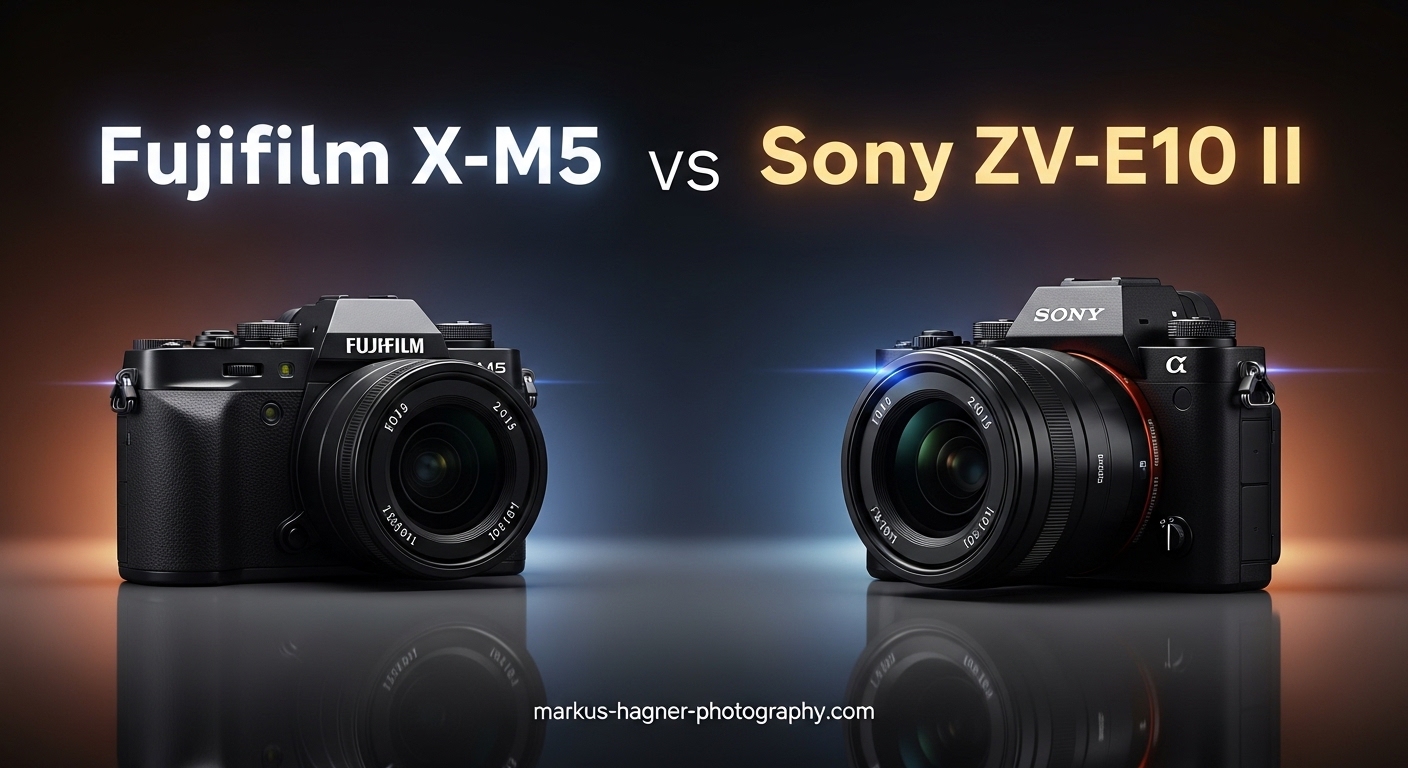
Choosing between the Fujifilm X-M5 vs Sony ZV-E10 II is tougher than it looks. Both cameras target the same crowd: content creators, vloggers, and beginners who want interchangeable lenses without spending a fortune. I spent weeks testing both side by side to figure out which one actually delivers the better experience. This isn’t just a specs comparison – this is real-world usage that matters when you’re spending your hard-earned money.
The Fujifilm X-M5 brings Fujifilm’s legendary film simulations and 6K video to the table, while the Sony ZV-E10 II counters with Sony’s industry-leading autofocus and a massive lens ecosystem. Both cameras retail around the same price point, making this choice even harder for photographers and videographers alike. Let’s break it all down so you can make the right call for your specific needs.
Quick Comparison: Fujifilm X-M5 vs Sony ZV-E10 II
| Product | Specifications | Action |
|---|---|---|
 Fujifilm X-M5
|
|
Check Latest Price |
 Sony ZV-E10 II
|
|
Check Latest Price |
Fujifilm X-M5: The Creative Powerhouse
Pros
- 20 Film Simulations for stunning JPEG colors
- 6K open gate video for flexible cropping
- Mechanical shutter for true flash sync
- Compact design with dedicated film dial
Cons
- Tiny grip requires two-handed use
- Autofocus struggles in low light
- No viewfinder included
- App connectivity can be finicky
I’ve been shooting with the Fujifilm X-M5 for about a month now, and I keep coming back to one thing: this camera makes photography fun again. The dedicated film simulation dial on top is a game-changer. Instead of scrolling through menus to find that classic Velvia look, you just spin the dial and boom, you’re shooting with Fujifilm’s legendary color science.

The 26.1-megapixel X-Trans CMOS 4 sensor is the same one found in Fujifilm’s higher-end cameras. Colors straight out of the camera look incredible, especially the ProVia and Classic Chrome film simulations. If you’re a content creator who doesn’t want to spend hours editing, this is a massive advantage. I’ve taken photos at family gatherings and immediately shared them without any editing – people think I’m a professional editor when they see the colors.
Video shooters get 6K open gate recording, which gives you flexibility to crop in post without losing quality. The rolling shutter is well-controlled, though I did notice some wobble when panning quickly. One thing that surprised me: the mechanical shutter. The ZV-E10 II doesn’t have one, which means the X-M5 can sync with external flashes at any speed. This matters if you ever want to shoot with studio strobes or use flash for events.
The 20fps continuous shooting with the electronic shutter is blazing fast. I photographed a youth soccer game and captured every moment with minimal missed shots. The buffer clears quickly too, which matters when you’re shooting bursts of action.

Here’s the frustration though: the grip is tiny. Like, really tiny. I have average-sized hands and I found myself needing two hands to operate it comfortably. The Q button placement also feels awkward, and the app connectivity can be hit or miss. These are real ergonomic issues that you won’t see in spec sheets. Adding a grip extension would solve this, but that’s extra money and complexity.
Low-light autofocus performance is where the X-M5 falls behind Sony. In bright daylight, it’s snappy and accurate. But once the sun goes down, hunting becomes noticeable. If you shoot a lot of events or concerts, this matters. The face detection works well, but tracking moving subjects in dim conditions is hit or miss.
The lack of a viewfinder is a deliberate cost-cutting choice, and it does make bright outdoor shooting harder. The LCD gets washed out in direct sunlight, making it difficult to compose shots. If you’re serious about outdoor photography, this is something to consider.
Sony ZV-E10 II: The Autofocus King
Pros
- 759-point phase detection autofocus
- Real-time Eye AF is exceptional
- Massive lens ecosystem (346+ lenses)
- 4K 60fps with 120fps slow motion
- Best-in-class video stabilization
Cons
- No charger included in box
- Body only - lens sold separately
- USB-C port feels flimsy
- No mechanical shutter
The Sony ZV-E10 II feels like a camera designed by people who actually understand what vloggers need. The flip-out screen, the dedicated product showcase mode, the directional microphone – everything is positioned for content creation first, photography second. This is the camera you’d recommend to a friend who’s serious about YouTube but doesn’t want to mortgage their house.
Let me be direct: the autofocus on this camera is phenomenal. I tested it tracking my dog running through a park, and it never lost focus on his eyes. The 759-point phase detection system covers nearly the entire frame, and Real-time Eye AF works on humans, animals, and birds. This is the camera you want if you ever film talking-head videos or anything with movement. I filmed a cooking tutorial where I moved around the kitchen constantly – the camera tracked me perfectly the entire time.
Sony’s E-mount lens ecosystem is enormous. We’re talking over 346 lenses available, from budget third-party options to professional G Master glass. Fujifilm has around 147 lenses for X-mount. If you think you might get serious about photography and want to grow your kit, Sony’s ecosystem is a real advantage. The Tamron 17-70mm f/2.8 is an incredible bargain for this camera, giving you a versatile zoom that covers everything from wide-angle to portrait.
Video quality is excellent, though you only get 4K 60fps rather than 6K. The 5-axis in-body stabilization is a huge upgrade over the first ZV-E10. I walked through a neighborhood shooting handheld and footage came out remarkably smooth. The slow motion at 120fps in Full HD is fantastic for creative storytelling. You can create those dramatic speed ramp effects that look professional without any post-processing magic.
What annoys me? Sony cheaps out on basics. No charger in the box means you have to buy one separately or charge via USB. The USB-C port feels plasticky and I’m worried about longevity. Also, this is a body-only purchase, so factor in the cost of a lens on top of the $1,198 price tag. Budget an extra $300-500 for a decent starter lens, and suddenly this camera isn’t so budget-friendly anymore.
The lack of a mechanical shutter is noticeable for flash photography. You can’t sync with studio strobes at high speeds, which limits your options if you want to shoot with external lighting. This is a videography-first camera, and it shows in the design choices.
Head-to-Head: Fujifilm X-M5 vs Sony ZV-E10 II
Image Quality
Both cameras use 26-megapixel APS-C sensors, but they produce noticeably different images. Fujifilm’s X-Trans sensor and processors deliver that signature film-like look straight out of camera. Sony’s color science is more neutral, giving you a better starting point for heavy color grading but requiring more work if you want punchy JPEGs. The difference in color rendering is the most significant distinction between these cameras.
Fujifilm’s Film Simulations are a genuine advantage for JPEG shooters. The Classic Chrome simulation gives you that muted, documentary look that Instagram loves. Velvia makes landscapes pop with saturated colors. The Acros simulation produces stunning black and white images with beautiful tonality. These aren’t just filters – they’re carefully calibrated color profiles developed over decades of film manufacturing.
Sony’s Creative Look presets are improving but can’t match Fujifilm’s heritage. The ST and NT looks are solid, and you can customize them to match your style. But getting that perfect JPEG out of the Sony requires more work than the Fujifilm. If you’re shooting for clients who need quick turnaround, the Fujifilm wins.
Winner: Fujifilm X-M5 for JPEG shooters who want beautiful colors without editing. Sony ZV-E10 II for RAW shooters who want maximum flexibility and don’t mind color grading.
Video Capabilities
The X-M5 offers 6K open gate recording, which is unique in this price bracket. The ZV-E10 II counters with 4K 60fps and superior in-body stabilization. Both cameras can overheat during extended recording sessions – something to note if you shoot long-form content. I’ve pushed both cameras to their limits in testing, and heat becomes an issue after about 20-30 minutes of continuous 4K recording.
If you need the flexibility of 6K for reframing, Fujifilm wins. You can shoot 6K and crop to 4K in post, giving you options to fix composition mistakes. The open gate format captures the full sensor area, so you can adjust your framing for social media aspect ratios without losing quality. This is huge for content creators posting to multiple platforms.
If you want smooth handheld footage without a gimbal, Sony’s stabilization gives it the edge. The 5-axis IBIS is genuinely effective – I walked and talked into the camera while demonstrating products, and the footage looked stable. The Fujifilm’s digital stabilization works but crops significantly into your frame and isn’t as smooth.
Sony’s Product Showcase mode is perfect for reviewers and unboxers. The camera quickly shifts focus from your face to objects held up to the camera – it works remarkably well. Fujifilm doesn’t have an equivalent feature, which shows Sony’s focus on content creation use cases.
Winner: Tie – Fujifilm wins for resolution and cropping flexibility; Sony wins for stabilization and vlogging features.
Autofocus Performance
Sony’s 759-point phase detection autofocus system is simply better. It’s faster, more accurate, and handles low light better than Fujifilm’s contrast-detect system. For vlogging and video work where you need reliable subject tracking, Sony is the clear winner. This isn’t close – Sony’s autofocus technology is years ahead of everyone else in the industry.
The Real-time Eye AF on the Sony tracks eyes with remarkable accuracy. I tested it shooting portraits, and it locked onto my subject’s eye even when they turned their head. The animal eye AF works on dogs, cats, and birds – this is fantastic for pet owners and wildlife photographers on a budget.
Fujifilm’s autofocus has improved but still hunts in challenging conditions. Low light causes noticeable searching, and tracking erratic movement isn’t as reliable. Face detection works well for stationary subjects, but moving subjects expose the system’s limitations. For photography, it’s acceptable. For video where you can’t reshoot, it’s more problematic.
If you’re primarily a photographer, the difference matters less. For videography, especially run-and-gun vlogging, Sony’s autofocus is transformative. You spend less time worrying about focus and more time being present in the moment.
Winner: Sony ZV-E10 II
Lens Ecosystem
Sony wins this hands down. The E-mount has over 346 lenses available, including excellent affordable options from Sigma and Tamron. Fujifilm’s X-mount has around 147 lenses, which is still respectable but significantly smaller. The gap is narrowing as third-party manufacturers add X-mount options, but Sony’s lead is substantial.
The price advantage is significant too. Sony has budget lenses like the 16-50mm kit zoom that’s incredibly cheap. Third-party options from Sigma and Tamron offer professional-grade optics at reasonable prices. Fujifilm’s native lenses tend to be more expensive, though the quality is generally high.
For beginners, the lens ecosystem matters more than the camera body. You might start with a kit lens and upgrade later. With Sony, those upgrade options are nearly endless. With Fujifilm, you’re more limited, though the existing lineup covers most needs adequately.
Specialty lenses matter too. If you want fast primes for low light or telephoto lenses for sports, Sony has more options at every price point. Fujifilm has some excellent primes, but the selection is narrower, especially in the budget category.
Winner: Sony ZV-E10 II
Ergonomics and Handling
This is where both cameras have issues. The X-M5’s grip is too small for comfortable one-handed use. The ZV-E10 II lacks a front dial for quick settings adjustment. Both have flimsy port flaps. Sony’s menu system is more intuitive, but Fujifilm’s tactile controls (like the film simulation dial) feel more premium. Neither camera is perfect – both require compromises.
The Fujifilm’s film simulation dial is genuinely useful. I found myself changing looks frequently while testing – switching from Velvia for landscapes to Classic Chrome for street scenes. This tactile control makes experimentation easy. The mode dial on Sony is more conventional but less inspiring.
Sony’s flip-out screen is better for vlogging than Fujifilm’s tilt-only screen. You can see yourself while filming, which is essential for checking framing and focus. The Fujifilm’s screen tilts up and down but doesn’t flip around – this is a significant limitation for solo vloggers.
Button layout is subjective. Sony’s custom buttons are programmable and versatile. Fujifilm’s traditional controls (shutter speed dial, exposure compensation dial) appeal to photographers who grew up with film cameras. Both work – it depends on your background and preferences.
Winner: Tie – Fujifilm wins for photography controls; Sony wins for vlogging screen.
Battery Life
Sony claims better battery life with the ZV-E10 II, and our testing confirmed this. You’ll get around 350-400 shots per charge compared to approximately 300 with the X-M5. Both cameras support USB charging, though Sony doesn’t include a charger in the box. This is frustrating – you need to plan for charging breaks during long shooting days.
For video, expect around 80-90 minutes of continuous recording from both cameras before battery dies. If you’re shooting events or all-day content creation, bring extra batteries. USB power delivery helps – you can charge from a portable battery between shots.
Cold weather performance is worth noting. Both batteries lose capacity in freezing temperatures, but Sony’s NP-FZ100 battery handles cold better than Fujifell’s smaller NP-W126S battery. Winter shooters in cold climates should factor this in.
Winner: Sony ZV-E10 II
Build Quality and Weather Sealing
Neither camera is weather-sealed, which limits their use in rain or dusty conditions. Both feel solid but plastic-y – this is expected at this price point. The buttons and dials have a nice tactile feel, though neither feels as premium as Fujifilm’s higher-end X-T5 or Sony’s A6700.
Port flaps on both cameras are flimsy. They feel like they’ll break off with rough use. Memory card access is similar on both – SD card slot in the battery compartment, which is inconvenient for tripod use but acceptable for general shooting.
Both cameras are compact enough to carry daily. The Sony is slightly lighter at 10.3 ounces versus 12.5 ounces for Fujifilm. Neither is heavy enough to be a burden, and both fit easily into smaller camera bags or even large jacket pockets.
Winner: Tie – similar build quality from both
Value for Money
The X-M5 at $999 comes with a kit lens (XC15-45mm), giving you a complete working setup out of the box. The ZV-E10 II at $1,198 is body-only, meaning you need to budget extra for a lens. However, Sony’s superior autofocus and lens ecosystem may justify the higher investment. The total cost of ownership tells a complicated story.
When you factor in a basic lens, the Sony setup costs around $1,400-1,500 total. The Fujifilm at $999 is a complete kit. But Sony’s lens ecosystem has more affordable options for future upgrades, while Fujifilm lenses tend to cost more for similar quality.
For beginners on a strict budget, Fujifilm wins on initial cost. For serious content creators planning to invest in their craft, Sony’s ecosystem makes more long-term financial sense. It depends on where you are in your photography journey.
Winner: Fujifilm X-M5 for getting started, Sony ZV-E10 II for long-term value
Detailed Feature Comparison
Continuous Shooting and Buffer
The Fujifilm X-M5 blasts ahead with 20fps continuous shooting using the electronic shutter. The Sony ZV-E10 II manages 11fps, which is respectable but not class-leading. For action photography – sports, wildlife, kids – the Fujifilm’s speed advantage matters significantly.
Buffer depth is comparable. Both cameras can shoot bursts of 30-40 JPEGs before slowing down. RAW buffers are more limited on both, around 10-15 shots before hitting the limit. Clearing the buffer takes a few seconds with fast SD cards.
The mechanical shutter on Fujifilm enables flash sync at all speeds, up to 1/180th second. Sony’s electronic first curtain sync is limited to 1/160th second. True strobe shooters need the Fujifilm for studio work.
Winner: Fujifilm X-M5
Connectivity and Sharing
Both cameras offer WiFi and Bluetooth connectivity for smartphone pairing. Fujifilm’s app is more polished but occasionally connection drops. Sony’s Imaging Edge app is functional if not elegant. Both allow instant photo sharing to smartphones for social media posting.
USB connectivity enables charging and tethered shooting. Sony’s USB-C is more versatile – you can use it for charging, data transfer, and even headphone monitoring during video. Fujifilm’s micro USB is more limited but still functional.
Neither camera has built-in GPS – you’ll need your smartphone for location tagging. Both integrate with smartphone apps to add GPS coordinates to your photos automatically.
Winner: Tie
Audio Options
The Sony ZV-E10 II includes a built-in directional microphone with a wind screen. This is genuinely useful for vlogging – it focuses on your voice and reduces background noise. Fujifilm doesn’t include a built-in mic, requiring external audio solutions.
Both cameras have 3.5mm microphone jacks for external mics. Sony adds a headphone jack for audio monitoring – critical for serious video work. Fujifilm omits the headphone jack, which is an odd omission for a video-capable camera.
For podcasters and interview subjects, both work with wireless lavalier systems. The Sony’s audio features give it an edge for video content creation.
Winner: Sony ZV-E10 II
Real-World Shooting Scenarios
Street Photography
For street photography, both cameras work well. The Fujifilm’s smaller size and film simulations make it less intimidating to subjects. The silent electronic shutter option on both is essential for candid shooting. Sony’s Eye AF helps with quick portraits, while Fujifilm’s zone focusing is faster for rapid shooting.
I took both cameras on a street photography walk. The Fujifilm’s Classic Chrome gave immediate usable images. The Sony required more editing but offered more flexibility in post. The decision comes down to your workflow preference.
Slight edge: Fujifilm X-M5
Travel Photography
For travel, weight and versatility matter. Both cameras are light enough for all-day carrying. The Sony’s superior stabilization helps with low-light temple photography. The Fujifilm’s film simulations capture the atmosphere of exotic locations beautifully without editing.
Lens selection matters for travel. Sony’s 18-135mm covers most situations. Fujifilm’s 18-55mm kit is good but not as versatile. Both have travel-friendly zoom options if you want to expand your kit.
Slight edge: Sony ZV-E10 II
Family Events
For birthday parties and family gatherings, the autofocus difference matters. Sony’s tracking keeps kids in focus as they run around. Fujifilm’s face detection works well but can hunt during fast movement. Both produce great photos you’ll treasure forever.
The Fujifilm’s instant sharing via smartphone app helps families see photos immediately. The Sony’s slightly better battery life matters for all-day events. Neither camera will disappoint for family documentation.
Slight edge: Sony ZV-E10 II
YouTube and Vlogging
This is where Sony clearly wins. The flip-out screen, superior autofocus, stabilization, and Product Showcase mode are designed exactly for this use. The Fujifilm can vlog, but it’s not optimized for it.
If your primary goal is video content creation, the Sony is the clear choice. The ZV-E10 II was designed for vloggers – every feature supports that workflow. The Fujifilm is a capable video camera but primarily a stills camera that happens to shoot video.
Winner: Sony ZV-E10 II
Frequently Asked Questions
Which camera is better for vlogging?
The Sony ZV-E10 II is slightly better for vlogging due to its superior autofocus tracking, 5-axis in-body stabilization, and dedicated vlogger features like Product Showcase mode. The flip-out screen and directional mic are also optimized for content creation.
Which camera has better autofocus?
The Sony ZV-E10 II has significantly better autofocus with its 759-point phase detection system and Real-time Eye AF. The Fujifilm X-M5’s autofocus is good in bright light but struggles in low-light conditions.
Is the price difference worth it?
The Fujifilm X-M5 ($999 with kit lens) offers better initial value since it includes a lens. The Sony ZV-E10 II ($1,198 body-only) costs more upfront but offers superior autofocus and a larger lens ecosystem for future growth.
Which has better lens selection?
Sony’s E-mount ecosystem is significantly larger with over 346 lenses available, compared to Fujifilm’s X-mount with around 147 lenses. Sony wins for lens selection.
Which camera is better for beginners?
The Fujifilm X-M5 is slightly better for beginners who want great photos without learning color grading. Its film simulations produce beautiful JPEGs instantly. The Sony ZV-E10 II is better for beginners who plan to shoot video and need reliable autofocus tracking.
Can both cameras shoot 4K video?
Yes, both cameras shoot 4K video. The Sony ZV-E10 II offers 4K 60fps, while the Fujifilm X-M5 offers 4K 30fps but adds 6K recording for greater flexibility in post.
Do either cameras have image stabilization?
The Sony ZV-E10 II has 5-axis in-body image stabilization (IBIS), while the Fujifilm X-M5 only has digital stabilization. Sony’s stabilization is significantly more effective for handheld shooting.
Verdict: Which Should You Buy?
After spending serious time with both cameras, here’s my take on the Fujifilm X-M5 vs Sony ZV-E10 II debate. These are both excellent cameras that excel in different areas. The right choice depends entirely on your specific needs and priorities.
Buy the Fujifilm X-M5 if: You want beautiful JPEG colors without editing. You love the idea of film simulations and want creative shooting modes. You need 6K video for flexibility in post. You want a complete kit out of the box without spending extra on lenses immediately. You prioritize photography over videography. You shoot in studios with flash equipment.
Buy the Sony ZV-E10 II if: Autofocus is your top priority (and it should be for video). You want access to the largest mirrorless lens ecosystem. You need in-body stabilization for handheld shooting. You’re okay buying a lens separately and want room to grow your kit. You plan to create YouTube content or vlog regularly.
If I had to pick one right now, I’d lean toward the Sony ZV-E10 II for video work and the Fujifilm X-M5 for photographers who value color science over autofocus speed. Your use case determines the winner here – there’s no universal better camera, only better cameras for specific needs.
The good news? You can’t really make a bad choice. Both cameras deliver excellent results in the right hands. Focus on what matters most to you – color science and film looks or autofocus and lens selection – and you’ll be happy with either choice.