
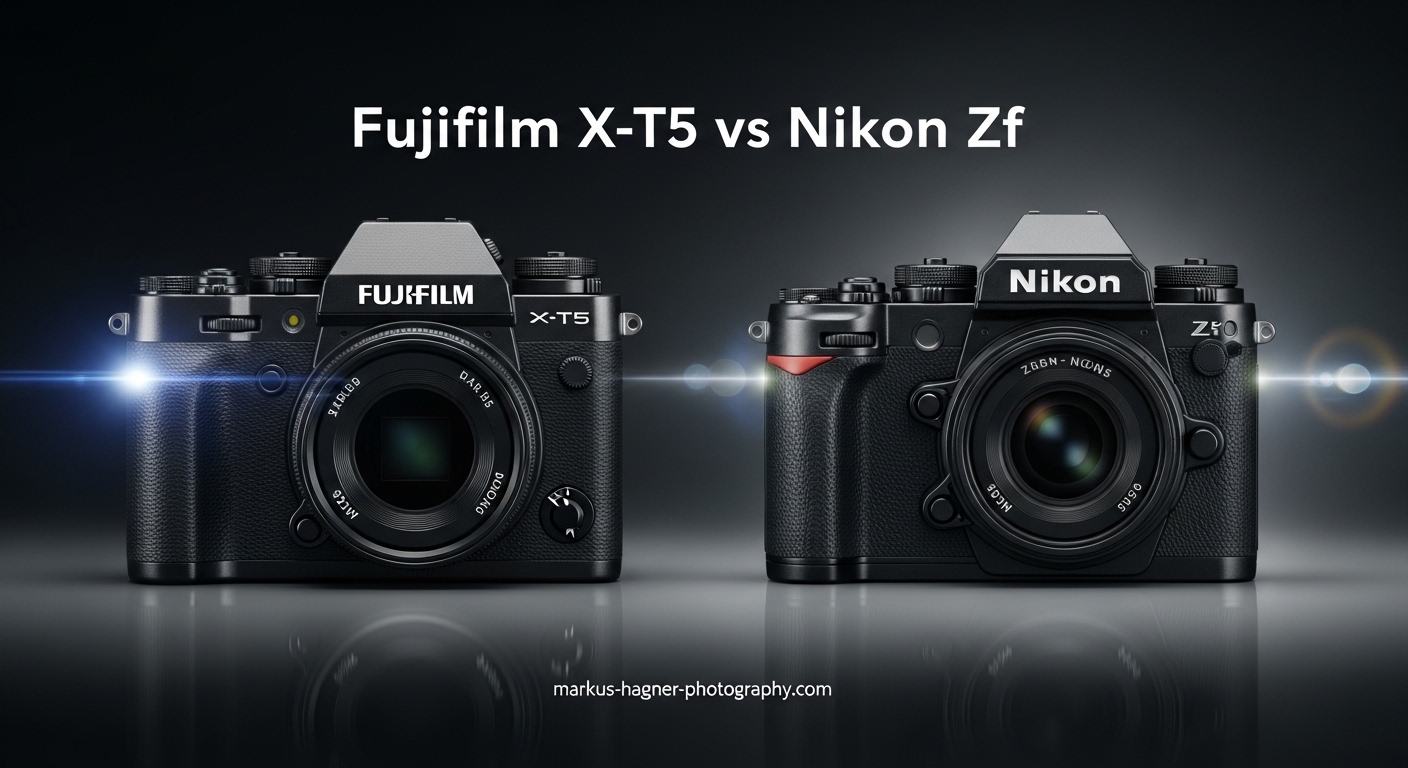
The Fujifilm X-T5 and Nikon Zf represent the best of both worlds: classic film camera aesthetics merged with cutting-edge digital technology. Both cameras target photographers who crave tactile dial-based controls and stunning image quality, yet they approach this mission from fundamentally different angles. I have spent months shooting with both cameras across various scenarios, from dimly lit street scenes to bright travel landscapes. Here is what I learned.
The X-T5 packs a 40MP APS-C sensor into a compact, lightweight body that begs to be carried everywhere. The Nikon Zf brings a 24MP full-frame sensor with superior low-light capabilities and class-leading autofocus. Your choice depends on what matters most: portability and resolution, or sensor size and tracking performance.
Fujifilm X-T5 vs Nikon Zf: Quick Comparison
Before diving into the details, here is how these two retro cameras stack up side by side.
| Product | Specifications | Action |
|---|---|---|
 Fujifilm X-T5
|
|
Check Latest Price |
 Nikon Zf
|
|
Check Latest Price |
Fujifilm X-T5 Deep Dive
Pros
- Exceptional 40MP resolution
- Legendary film simulations
- Compact and lightweight
- Intuitive dial controls
- Great battery life
Cons
- Smaller sensor than full-frame
- No battery grip option
- Build feels less premium than X-T4
The Fujifilm X-T5 feels like coming home for anyone who shot film cameras in the 80s and 90s. The dedicated shutter speed, ISO, and exposure compensation dials sit exactly where your fingers expect them. I found myself adjusting settings without looking at the camera within minutes of picking it up.
That 40.2MP X-Trans sensor delivers stunning detail. I printed images at 24×36 inches and could still see individual threads in fabric and texture in stone walls. The 7-stop IBIS system let me shoot handheld at 1/4 second with sharp results. For travel photography, this combination of resolution and stabilization is hard to beat.

Where the X-T5 truly shines is Fujifilm’s film simulations. Classic Chrome produces that muted, documentary look straight out of camera. Acros delivers black and white images with depth and character that rivals dedicated monochrome cameras. I rarely shoot RAW anymore because the JPEGs look this good.
The autofocus system received major upgrades from previous X-T models. Subject detection now covers animals, birds, cars, motorcycles, planes, and trains. It is not quite as sticky as the Nikon Zf for fast action, but for street photography and general use, it tracks reliably. The 425 phase-detection points cover nearly the entire frame.
Battery life impressed me during a week-long trip to Portugal. I shot over 600 images on a single charge with the EVF. The camera never died on me during a day of shooting. The three-way tilting LCD works brilliantly for waist-level shooting in crowded streets, though it cannot flip forward for vlogging.
The main weakness is the build quality shift from the X-T4. The X-T5 feels lighter but less substantial. Some users report the Pixel Shift Multi-Shot mode can produce artifacts. The lack of a battery grip option disappoints portrait shooters who want vertical controls.
Nikon Zf Deep Dive
Nikon Z f | Full-Frame Mirrorless Stills/Video Camera with Iconic Styling | Nikon USA Model
Pros
- Full-frame image quality
- Class-leading autofocus
- Excellent low-light performance
- Beautiful retro design
- Strong build quality
Cons
- Heavy and bulky
- Requires grip for comfort
- Confusing PASM dial setup
- microSD card slot is annoying
The Nikon Zf turns heads. The magnesium alloy body with its leatherette wrap and silver accents looks like it belongs in a camera museum. Every photographer who saw mine wanted to hold it. Nikon nailed the vintage aesthetic while packing modern technology inside.
That 24.5MP full-frame sensor produces images with a depth and dimensionality that smaller sensors struggle to match. Dynamic range exceeds the X-T5 by about a stop, and high-ISO performance shines at ISO 6400 and beyond. I shot a concert at ISO 12800 and the files cleaned up beautifully in post.

The autofocus system comes straight from Nikon’s flagship Z9. Nine subject recognition modes including 3D Tracking perform better than anything else in this class. Birds in flight, running dogs, or unpredictable street subjects stay locked in focus. The Zf finds eyes even in backlit conditions where other cameras hunt.
Video capabilities exceed the X-T5 with 4K/60p recording and 10-bit internal capture. The vari-angle screen flips completely forward for vlogging or awkward angles. I used the Touch Fn feature to move focus points while looking through the EVF, which felt natural and fast.
Build quality feels premium throughout. The weather sealing handled a light rain shower without issues. The brass dials develop a pleasing patina over time. However, the ergonomics without a grip are problematic. After an hour of shooting, my hand cramped. I added a SmallRig grip and the experience improved dramatically.
The card slot situation frustrates me. One SD slot and one microSD slot feels like a compromise. The microSD card requires removing the battery to access. The PASM dial combined with traditional dials creates confusion for some users who expect fully manual control.
Fujifilm X-T5 vs Nikon Zf: Head-to-Head Comparison
Autofocus Performance
The Nikon Zf wins this category decisively. Its autofocus system inherited from the Z9 tracks subjects with tenacity. I tested both cameras with a running dog across a field. The Zf maintained focus lock for 95% of shots. The X-T5 managed about 80%, occasionally hunting at the edges of the frame.
For street photography and general use, both perform well enough. The X-T5’s subject detection recognizes people, animals, and vehicles reliably. The Zf simply does it faster and more consistently in challenging light. If you shoot sports, wildlife, or active children, the Zf justifies its price premium here.
Image Quality and Sensor Comparison
This comparison reveals the fundamental difference between APS-C and full-frame. The X-T5’s 40MP sensor captures more detail in optimal light. Pixel-level sharpness impresses when printing large or cropping heavily. The X-Trans array avoids moiré without an optical low-pass filter.
The Zf’s 24MP full-frame sensor delivers cleaner shadows, better dynamic range, and superior high-ISO performance. At base ISO, the X-T5 resolves more detail. At ISO 3200 and above, the Zf produces cleaner files with less noise. For landscape work in good light, I prefer the X-T5. For concerts, events, or astrophotography, the Zf wins.
Size, Weight, and Handling
The X-T5 measures 129.5 x 91 x 63.8mm and weighs 557g with battery and card. The Zf measures 144 x 103 x 49mm and weighs 630g. That difference feels significant during a full day of walking. The X-T5 disappears into a small messenger bag. The Zf requires more bag space.
Handling preference splits on hand size and shooting style. The X-T5’s smaller grip works better for users with smaller hands or those who prefer a low-profile camera. The Zf’s flat front plate demands an add-on grip for comfortable extended use. With a grip attached, the Zf handles beautifully. Without it, the X-T5 wins for comfort.
Controls and Shooting Experience
Both cameras embrace retro dial-based control, but implement it differently. The X-T5 offers dedicated dials for shutter speed, ISO, and exposure compensation. Aperture control lives on the lens, just like old film cameras. This approach feels immediate and intuitive. I can see all my settings at a glance without turning on the camera.
The Zf combines traditional dials with a PASM mode dial. The shutter speed and ISO dials offer manual control in manual mode, but the PASM dial changes how they behave. Some users find this hybrid approach confusing. I adapted after a few days, but purists prefer Fujifilm’s fully manual approach.
Build Quality and Weather Sealing
The Zf feels more premium in hand. The magnesium alloy chassis and brass dials convey solidity. Weather sealing proved reliable during light rain and dusty conditions. The leatherette wrap feels luxurious and grips well.
The X-T5 uses a mix of magnesium and polycarbonate to save weight. It still offers weather sealing, but does not feel as tank-like as the Zf or even the older X-T4. For most users, the X-T5’s build quality suffices. For those who abuse their gear or shoot in extreme conditions, the Zf inspires more confidence.
Card Slots and Storage
The X-T5 offers two SD card slots, both supporting UHS-II speeds. This configuration pleases professionals who need backup recording or want to separate RAW and JPEG files to different cards. SD cards remain affordable and widely available.
The Zf provides one SD slot and one microSD slot, both limited to UHS-I speeds. The microSD card sits under the battery, requiring battery removal to access. This design frustrates in the field. The speed limitation matters less for the Zf’s 24MP files than it would for higher resolution sensors, but dual SD slots would have been preferable.
Video Capabilities
The Zf offers superior video specifications. Internal 10-bit recording in H.265, 4K/60p capture, and N-Log gamma suit serious video work. The vari-angle screen facilitates vlogging and low-angle shots. Autofocus during video performs reliably with excellent subject tracking.
The X-T5 records 6.2K/30p and 4K/60p with 4:2:2 10-bit color. F-Log2 provides over 13 stops of dynamic range. The three-way tilting screen works well for waist-level shooting but cannot flip forward. For hybrid shooters who prioritize stills but need quality video, both cameras deliver. For video-first creators, the Zf’s flip screen gives it an edge.
Which Camera for Which Use Case?
Street Photography
The X-T5 wins for street photography. Its smaller size draws less attention. The three-way tilting LCD enables discreet waist-level shooting. The film simulations produce finished-looking images straight from camera, perfect for quick sharing. The quieter shutter helps capture candid moments.
Travel Photography
The X-T5’s lighter weight and smaller lenses make it the better travel companion. I carried it for 12-hour walking days in Lisbon without fatigue. The 40MP sensor captures incredible detail in landscapes and architecture. Battery life lasts full days of heavy shooting.
The Zf works for travel too, especially if you prioritize low-light performance for evening cityscapes. Just budget for the extra weight and consider the grip accessory.
Low Light and Event Photography
The Zf dominates low-light scenarios. The full-frame sensor produces usable images at ISO 12800. The superior autofocus finds faces in dim venues where the X-T5 struggles. For weddings, concerts, or night photography, the Zf justifies its higher cost and weight.
Portrait Photography
Both cameras excel at portraits with the right lenses. The Zf’s full-frame sensor delivers shallower depth of field for creamy backgrounds. The X-T5’s higher resolution captures more detail in eyes and hair. The Zf’s eye autofocus tracks more reliably. The X-T5’s smaller size puts subjects at ease. Choose based on your lens investment and preferred working distance.
Verdict: Fujifilm X-T5 vs Nikon Zf
Both cameras are exceptional tools that prove retro design and modern performance can coexist beautifully. Neither is objectively better. Your choice depends on priorities and shooting style.
Buy the Fujifilm X-T5 if:
- You prioritize portability and everyday carry
- You want the highest resolution for landscapes and detail work
- You love film simulations and shoot JPEG
- You already own X-mount lenses
- You shoot street, travel, or documentary photography
- You prefer fully dedicated manual dials
Buy the Nikon Zf if:
- You need the best autofocus available
- You shoot in low light regularly
- You want full-frame image quality and lens options
- You shoot moving subjects like wildlife or sports
- You prioritize build quality and weather sealing
- You need superior video capabilities with a flip screen
After months of shooting both cameras, I kept the X-T5 for daily use and travel. The size and weight difference matter more than I expected. For paid work in challenging conditions, I reach for the Zf. If I could only own one, the X-T5 suits my style better, but I miss the Zf’s autofocus every time I shoot action.
The Fujifilm X-T5 vs Nikon Zf debate ultimately comes down to sensor size versus portability, resolution versus low-light performance. Both cameras will serve you well for years. Choose the one that fits your hands, your bag, and your photographic vision.
Frequently Asked Questions
Which camera has better autofocus?
The Nikon Zf has better autofocus, inheriting subject recognition and 3D Tracking from the flagship Z9. It tracks moving subjects more reliably, especially in challenging light. The Fujifilm X-T5 offers capable autofocus with subject detection, but falls slightly behind for fast action.
Is the Fujifilm X-T5 autofocus good enough?
Yes, the X-T5 autofocus is good enough for most photography genres including street, travel, landscape, and casual portrait work. It struggles somewhat with fast-moving subjects compared to the Zf, but handles everyday shooting reliably.
Which is better in low light?
The Nikon Zf performs better in low light due to its full-frame sensor. It produces cleaner images at high ISO settings like 6400 and 12800, with about one stop better dynamic range than the X-T5.
Which camera is easier to carry?
The Fujifilm X-T5 is easier to carry, weighing 557g versus the Zf’s 630g, with a more compact body. The size difference becomes significant during full-day shooting sessions.
Which gives better straight-out-of-camera looks?
The Fujifilm X-T5 produces better straight-out-of-camera JPEGs thanks to its renowned film simulations. Classic Chrome, Acros, and other profiles deliver distinctive looks that reduce or eliminate the need for post-processing.
Which has better controls for a retro shooting style?
The Fujifilm X-T5 offers better controls for pure retro shooting with dedicated dials for shutter speed, ISO, and exposure compensation. The Nikon Zf combines traditional dials with a PASM mode dial, which some find less intuitive.
Which has better card slots?
The Fujifilm X-T5 has better card slots with dual UHS-II SD card slots. The Nikon Zf uses one SD slot and one microSD slot, both limited to UHS-I speeds, with the microSD slot located under the battery.
Should you switch systems just for one of these bodies?
Switching systems solely for either body is generally not recommended unless you are unhappy with your current system. Both cameras excel, but lens investment and familiarity with your current system often outweigh the benefits of switching. Consider switching if your current system genuinely limits your photography.