
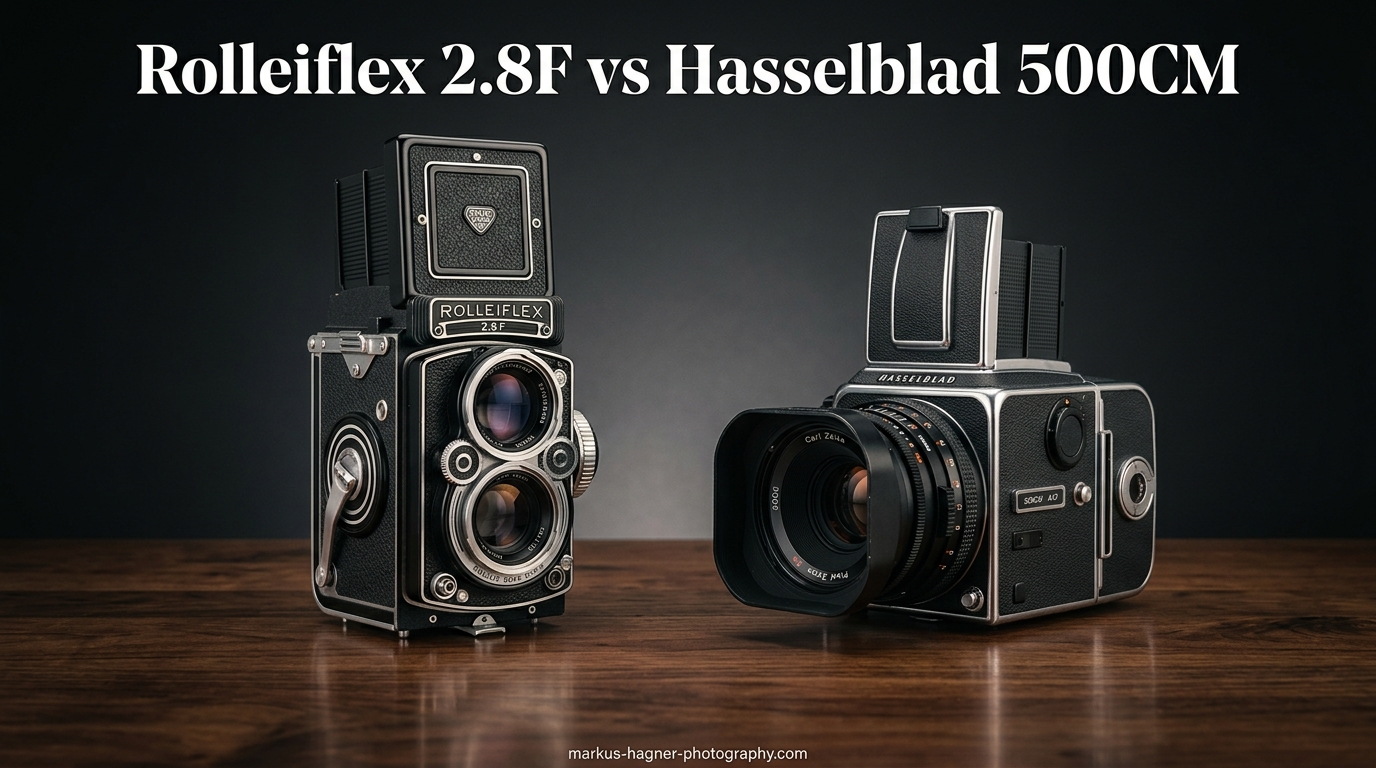
The Rolleiflex 2.8F vs Hasselblad 500CM debate has divided film photographers for decades. Both are iconic medium format cameras that produce stunning 6×6 square images on 120 film, yet they take fundamentally different approaches to photography.
The Rolleiflex 2.8F is a twin-lens reflex (TLR) camera prized for its portability, quiet operation, and elegant simplicity. The Hasselblad 500CM is a modular single-lens reflex (SLR) system beloved for its interchangeable lenses, film backs, and professional versatility.
After years of shooting both systems, I can tell you that neither is universally “better.” The right choice depends entirely on how you shoot, what you photograph, and whether you value portability or system flexibility more.
Quick Comparison: Rolleiflex 2.8F vs Hasselblad 500CM
Here’s how these two medium format legends stack up against each other at a glance:
| Feature | Rolleiflex 2.8F | Hasselblad 500CM |
|---|---|---|
| Camera Type | Twin-Lens Reflex (TLR) | Single-Lens Reflex (SLR) |
| Format | 6×6 cm (120 film) | 6×6 cm (120/220 film) |
| Lens | Fixed 80mm f/2.8 (Planar or Xenotar) | Interchangeable (50mm-500mm available) |
| Weight | ~1220g (body only) | ~1500g (body + 80mm) |
| Dimensions | 147 x 109 x 102mm | 180 x 112 x 100mm (folded) |
| Viewfinder | Waist-level (viewing lens) | Waist-level or prism options |
| Film Backs | Fixed (remove camera from tripod to reload) | Interchangeable A12 backs |
| Shutter | Synchro-Compur leaf shutter | Leaf shutter in each lens |
| Flash Sync | All speeds (1/500s) | All speeds (1/500s) |
| Shutter Noise | Near-silent | Audible mirror slap |
| Parallax Error | Yes (at close distances) | No (SLR design) |
| Digital Back Compatible | No | Yes (Hasselblad CFV series) |
| Production Years | 1960-1981 | 1970-1994 |
Rolleiflex 2.8F: The Quintessential TLR
What Made the Rolleiflex 2.8F So Special?
The Rolleiflex 2.8F represents the pinnacle of twin-lens reflex camera design. Introduced in 1960, it refined decades of Rolleiflex engineering into what many consider the perfect TLR. The dual-lens system uses one lens for viewing and one for capturing, allowing you to see your subject continuously without viewfinder blackout.
What sets the 2.8F apart is its Carl Zeiss f/2.8 lens, available in either Planar or Xenotar design. Both are exceptional, though collectors often debate which is superior. The Planar tends to be slightly sharper wide open, while the Xenotar offers slightly more contrast.
The viewing lens matches the taking lens optically, so you see exactly what the image will look like in terms of perspective and depth of field. This makes the Rolleiflex incredibly intuitive for composing square-format images.
Handling and Ergonomics
Hold a Rolleiflex 2.8F and you immediately understand its appeal. The camera feels solid yet manageable in your hands. At roughly 1220 grams, it’s substantial but noticeably lighter than a comparable Hasselblad setup.
The waist-level viewing experience is unique. You look down into a bright focusing screen, composing from above. This creates a more contemplative, deliberate shooting style that many photographers find addictive. It also makes the Rolleiflex far less intimidating to subjects than eye-level cameras.
The focusing knob falls naturally under your left thumb. You can rack focus quickly and smoothly, much faster than with many SLR systems. The coupled exposure meter (when working properly) simplifies exposure calculation.
Best Use Cases for the Rolleiflex 2.8F
The Rolleiflex excels at street photography, candid portraits, and documentary work. Its near-silent leaf shutter won’t disturb subjects or draw attention. You can shoot at waist level without raising the camera to your face, making you appear less threatening to passersby.
The camera also shines for travel photography. Without interchangeable lenses and backs to carry, your kit stays compact. One camera, one lens, one film type. This simplicity forces creative discipline and keeps you focused on seeing rather than gear-switching.
Portrait photographers love the Rolleiflex for the connection it creates with subjects. Looking down at the viewfinder means you can maintain eye contact between shots. The square format naturally suits portrait composition.
Hasselblad 500CM: The Modular Professional System
What Is Special About the Hasselblad 500CM?
The Hasselblad 500CM represents the gold standard of modular camera design. Introduced in 1970 as an evolution of the 500C, it refined Victor Hasselblad’s vision of a camera system that could adapt to any professional situation.
What makes the 500CM special is its complete modularity. The body is essentially a light-tight box with a mirror and focal plane. The lens, film back, viewfinder, and focusing screen are all interchangeable. This means you can configure the camera exactly how you need it for any given situation.
The Zeiss lenses designed for the Hasselblad V system are legendary. The 80mm f/2.8 Planar that comes with most 500CM kits is one of the finest normal lenses ever made. But you can also mount anything from a 30mm fisheye to a 500mm telephoto, giving you creative options impossible with a TLR.
Handling and Ergonomics
The Hasselblad 500CM is heavier than the Rolleiflex at around 1500 grams with the standard 80mm lens. It’s also larger, though the camera folds into a surprisingly compact package when not in use. The body itself is quite flat, with the lens protruding forward.
Loading film requires the interchangeable A12 backs. You can carry multiple backs pre-loaded with different film stocks and swap them mid-roll. This flexibility is impossible with the Rolleiflex, which requires you to finish or waste a roll before changing film types.
The standard waist-level finder is bright and clear, though you can also attach a prism finder for eye-level shooting. The Accu-Matte focusing screen introduced with the 500CM is significantly brighter than earlier Hasselblad screens.
Best Use Cases for the Hasselblad 500CM
The Hasselblad dominates in studio environments. The interchangeable film backs let you shoot color and black-and-white simultaneously. The ability to add a prism finder makes it easier to compose vertical shots. Tripod mounting is straightforward with the built-in quick-coupling plate.
Professional portrait and wedding photographers have used the 500CM for decades. The system flexibility means you can adapt to any lighting situation. The interchangeable lenses let you choose the perfect focal length for each shot.
Landscape photographers appreciate the ability to use wide-angle lenses like the 50mm Distagon. The 500CM also accepts digital backs like the Hasselblad CFV series, making it a bridge between classic film photography and modern digital capture.
Rolleiflex 2.8F vs Hasselblad 500CM: Head-to-Head Comparison
Size and Weight
The Rolleiflex 2.8F is noticeably smaller and lighter than the Hasselblad 500CM. With a weight difference of about 280 grams, the Rolleiflex is easier to carry for extended periods. The TLR has a smaller footprint, though it is taller than the folded Hasselblad.
For street photography or travel, the weight difference matters. I can carry a Rolleiflex all day without fatigue. The Hasselblad becomes noticeable after a few hours, especially if you add extra lenses and backs to your bag.
Image Quality and Lens Performance
Both cameras produce exceptional image quality. The Zeiss lenses on both systems are world-class. In practical use, most photographers cannot tell the difference between Rolleiflex and Hasselblad images when shot with similar technique.
The Rolleiflex lens is permanently aligned with the film plane, which can theoretically improve sharpness. The Hasselblad’s retrofocus lens design (required to clear the mirror box) is more complex but Zeiss has engineered excellent performance from these designs.
At wide apertures, the Rolleiflex may have a slight sharpness advantage due to its simpler symmetric lens design. Both lenses improve significantly when stopped down to f/5.6 or f/8.
Versatility and System Flexibility
The Hasselblad wins decisively on versatility. With interchangeable lenses, film backs, viewfinders, and focusing screens, you can configure the 500CM for any situation. You can shoot wide-angle landscapes in the morning and telephoto portraits in the afternoon.
The Rolleiflex offers one focal length and one film at a time. To change film, you must remove the camera from your tripod and open the back. There’s no way to shoot wide or telephoto without buying a completely different Rolleiflex model.
However, this limitation can be liberating. Many photographers find that working with a single focal length improves their seeing and composition. The Rolleiflex forces you to work within constraints that can spark creativity.
Quiet Operation and Shutter Performance
The Rolleiflex is nearly silent in operation. The leaf shutter makes a soft click that barely registers in quiet environments. This makes it ideal for street photography, candid portraits, and any situation where discretion matters.
The Hasselblad has audible mirror slap. It’s not loud by SLR standards, but it’s definitely noticeable. For quiet environments or candid work, the Hasselblad can disturb subjects or draw attention.
Both cameras offer flash synchronization at all shutter speeds thanks to their leaf shutters. This is a significant advantage over focal-plane shutter cameras for flash photography.
Handholding and Stability
You can handhold the Rolleiflex at slower shutter speeds than the Hasselblad. With no mirror movement to cause vibration, the TLR is inherently more stable. I regularly shoot at 1/30 second handheld with sharp results.
The Hasselblad’s mirror slap introduces vibration that can affect sharpness at slower shutter speeds. Many photographers use the mirror pre-lock feature to reduce this, though it adds an extra step to the shooting process.
Both cameras benefit from a tripod, but the Rolleiflex is more forgiving of handheld technique. The waist-level viewing position also provides a stable three-point contact with your body.
Viewfinder and Focusing Experience
The Rolleiflex viewing experience is unique to TLRs. You see the image continuously, even during exposure. There’s no viewfinder blackout. However, you must account for parallax error at close distances since the viewing lens is above the taking lens.
The Hasselblad, as an SLR, shows you exactly what the film will see. What you see through the viewfinder is what you get, with no parallax issues. But the viewfinder blacks out during exposure as the mirror flips up.
Focusing speed is comparable between the two, though the Rolleiflex focusing knob allows very quick focus adjustments. Some photographers find the Rolleiflex faster to focus in dynamic situations.
Maintenance and Long-Term Ownership
Both cameras require periodic CLA (clean, lubricate, adjust) service. Budget for this when purchasing either system. A good CLA can cost several hundred dollars but will keep the camera running for decades.
The Hasselblad has a maintenance advantage: if you drop it, individual components can be replaced. Damage the body? Replace it while keeping your lenses and backs. The Rolleiflex is a unitized design, so serious damage often requires complete replacement.
Parts availability favors Hasselblad in 2026. The V system was produced in larger numbers, and many parts are interchangeable between models. Rolleiflex parts have become scarcer since production ended, though skilled technicians can still service them.
Digital Back Compatibility
The Hasselblad 500CM accepts modern digital backs like the CFV series from Hasselblad and third-party options. This gives the camera a pathway to digital capture while maintaining the classic V-system experience.
The Rolleiflex has no digital back option. It’s purely a film camera. If you want medium format digital, you’ll need a different system entirely.
Frequently Asked Questions
What made the Rolleiflex 2.8F so special?
The Rolleiflex 2.8F combined exceptional Zeiss optics (Planar or Xenotar f/2.8), near-silent leaf shutter operation, compact portability, and elegant twin-lens reflex design. Its viewing lens matches the taking lens, allowing continuous subject viewing without blackout. The camera represents the pinnacle of TLR engineering and was used by legendary photographers including Vivian Maier.
What is special about the Hasselblad 500CM?
The Hasselblad 500CM is a fully modular professional camera system with interchangeable lenses, film backs, viewfinders, and focusing screens. It features legendary Zeiss optics, robust build quality, and compatibility with modern digital backs. The camera was used extensively by NASA and professional photographers worldwide for its exceptional image quality and system flexibility.
Which is better for street photography: Rolleiflex or Hasselblad?
The Rolleiflex is better for street photography due to its near-silent leaf shutter, lighter weight (280g less than the Hasselblad), and less intimidating waist-level shooting style. You can shoot candidly without drawing attention. The Hasselblad’s mirror slap is audible and its weight becomes noticeable during extended street sessions.
Can you handhold a Hasselblad 500CM?
Yes, you can handhold a Hasselblad 500CM, though it requires good technique. At approximately 1500g with the 80mm lens, it’s substantial but manageable. For sharp results, use shutter speeds of 1/125 second or faster, or engage the mirror pre-lock to reduce vibration from mirror slap. Many photographers successfully handheld the 500CM for decades of professional work.
What Rolleiflex did Vivian Maier use?
Vivian Maier primarily used a Rolleiflex 2.8C and later a Rolleiflex 3.5T for her iconic street photography. The twin-lens reflex design allowed her to shoot discreetly from waist level while maintaining a natural demeanor on the streets of Chicago and New York. Her Rolleiflex images demonstrate the camera’s exceptional capabilities for candid documentary work.
Verdict: Which Should You Choose?
Choose the Rolleiflex 2.8F If:
You prioritize portability and want a camera you can carry all day without fatigue. The Rolleiflex is significantly lighter and more compact than the Hasselblad system.
You shoot street photography, candid portraits, or documentary work where quiet operation matters. The near-silent leaf shutter won’t disturb subjects or draw attention.
You prefer simplicity over system complexity. One camera, one lens, one film type. The Rolleiflex removes the temptation to constantly switch lenses and backs.
You enjoy the unique waist-level viewing experience of a TLR. Looking down into the viewfinder creates a different relationship with your subjects and environment.
Choose the Hasselblad 500CM If:
You need system flexibility for professional work. The interchangeable lenses, film backs, and viewfinders let you adapt to any situation.
You shoot in a studio environment where the system’s versatility matters. Multiple film backs let you shoot different stocks simultaneously.
You want the option of digital capture. The 500CM accepts modern digital backs, making it a bridge between film and digital workflows.
You prefer the SLR viewing experience with no parallax error. What you see is exactly what the film captures.
My Recommendation
For most photographers choosing between these two legends, I recommend starting with the Rolleiflex 2.8F. Its simplicity, portability, and unique shooting experience make it an excellent introduction to medium format photography. The fixed lens forces creative discipline, and the quiet operation opens up candid photography possibilities.
If you find yourself wanting more focal length options or the ability to shoot multiple film types, the Hasselblad 500CM awaits. It’s the more versatile system, but that versatility comes with weight, complexity, and cost.
Many photographers end up owning both. The Rolleiflex becomes the everyday carry camera, while the Hasselblad serves studio and specialized work. Both cameras hold their value well, making them relatively safe investments in your photographic journey.