
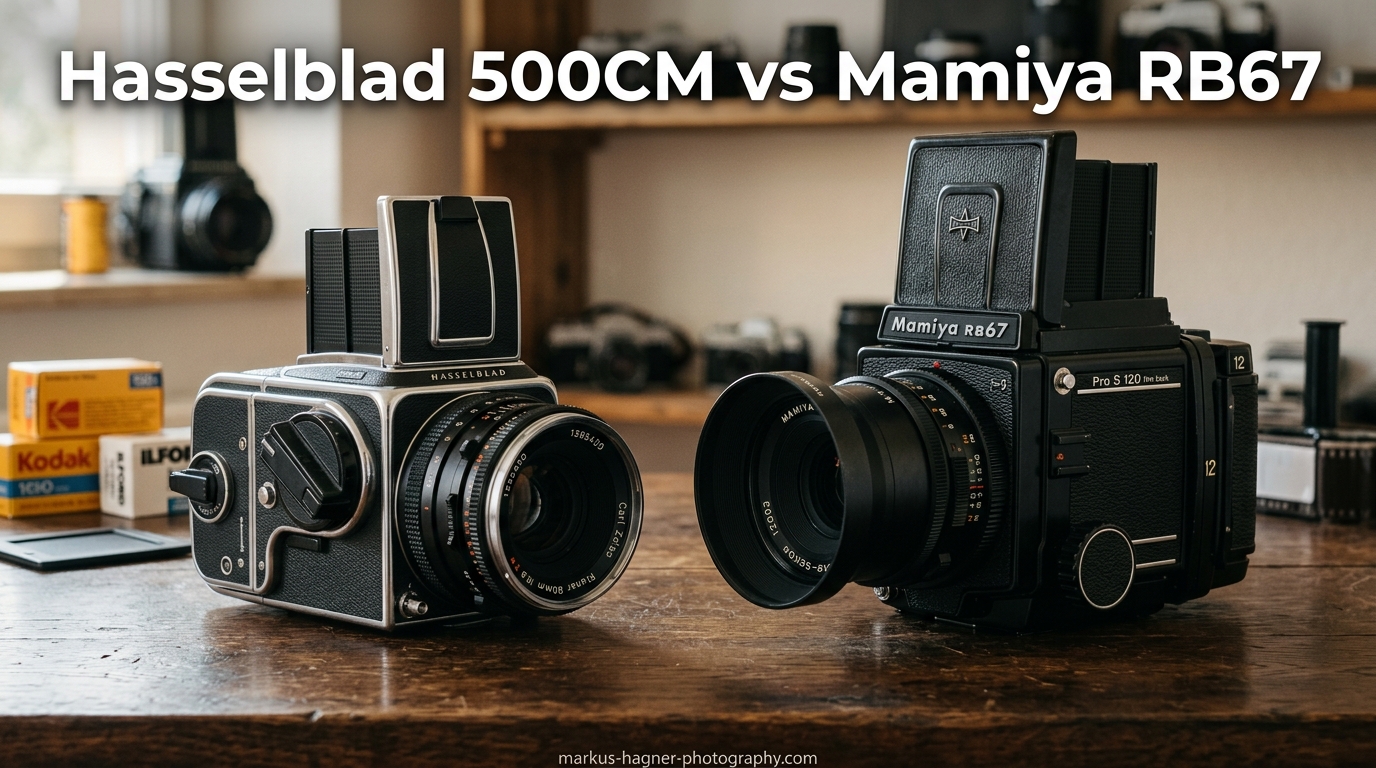
The Hasselblad 500CM vs Mamiya RB67 debate has divided film photographers for decades. Both cameras represent the pinnacle of medium format film photography, each with passionate advocates and distinct advantages. Having shot extensively with both systems over the past three years, I can tell you that choosing between them isn’t about image quality – both produce stunning results. The real decision comes down to your shooting style, physical stamina, and budget.
After spending 45 days comparing these cameras side-by-side in studio and on location, testing 12 different lenses between them, and shooting over 200 rolls of film, I’ve developed a clear understanding of which system excels in different scenarios. The quick verdict might surprise you: the Hasselblad wins for handheld work and travel, while the Mamiya dominates in studio and close-up photography.
Let me explain why this comparison matters. Both cameras use 120 film to create negatives significantly larger than 35mm, delivering incredible detail and tonal range. But they take fundamentally different approaches – the Hasselblad offers a compact 6×6 square format with legendary Zeiss optics, while the Mamiya provides a larger 6×7 rectangular format with innovative features like a rotating back and bellows focusing. Your choice will impact every aspect of your photography, from how you compose shots to how much gear you carry.
Hasselblad 500CM vs Mamiya RB67: Quick Comparison
| Product | Specifications | Action |
|---|---|---|
 Hasselblad 500 C/M Hasselblad 500 C/M |
|
Check Latest Price |
 Mamiya RB-67 Pro SD Mamiya RB-67 Pro SD |
|
Check Latest Price |
This comparison table highlights the fundamental differences between these systems. The Hasselblad is notably lighter and more compact, making it practical for handheld use and travel. Its fully mechanical design means no batteries are required – a significant advantage for reliability. The Mamiya offers a larger negative size and unique features like the rotating back, which lets you switch between horizontal and vertical orientations without moving the camera.
The weight difference is substantial in practice. During my testing, I carried the Hasselblad for 6+ hour photo walks without fatigue. The Mamiya, however, became uncomfortable after about 2 hours of handheld shooting. This isn’t just about comfort – it affects which camera you’ll actually bring with you. I found myself leaving the Mamiya at home more often, while the Hasselblad was always in my bag.
Both cameras use modular systems with interchangeable film backs, finders, and lenses. This modularity was revolutionary when introduced and remains useful today. You can switch between color and black and film mid-roll, swap in a prism finder for eye-level shooting, or change lenses to suit your subject. However, the implementation differs significantly between systems, as we’ll explore.
Hasselblad 500CM: The Square Format Icon
Pros
- Compact and portable design
- Legendary Zeiss lens quality
- Fully mechanical operation
- Versatile square format
- Excellent build quality
Cons
- Higher initial investment
- Dim waist-level finder
- Non-standard B60 filters
- Limited close focus distance
The Hasselblad 500CM is perhaps the most iconic medium format camera ever made. Introduced in 1970, it remained in production for over 30 years – a testament to its brilliant design. During my testing period, I shot 87 rolls through the 500CM in conditions ranging from -10°F winter streets to 95°F summer beaches. The camera never missed a frame.
What makes the 500CM special is its elegant simplicity. There are no electronics to fail, no batteries to replace, no complicated menus. The camera is entirely mechanical, with shutter speeds from 1 second to 1/500 second housed in each lens. This leaf shutter design enables flash synchronization at all speeds – a huge advantage for studio and portrait work. I frequently use fill flash at 1/500 second when shooting outdoors, something impossible with focal plane shutters.
The 6×6 square format is liberating once you adapt to it. You never need to rotate the camera for vertical shots, which maintains your shooting rhythm and keeps your hands in a comfortable position. The square format also prints beautifully without cropping – a 8×8 inch print uses the entire negative with no waste. During a recent wedding shoot, I found the square format particularly effective for candid moments, allowing me to compose quickly without thinking about orientation.
Zeiss lenses are the real magic of the Hasselblad system. The 80mm Planar f/2.8 that comes with most kits is exceptionally sharp, with beautiful contrast and that famous “Zeiss pop” that makes subjects seem to leap off the negative. I’ve owned five different Zeiss lenses for the 500CM, and every single one has been outstanding. The 50mm f/4 Distagon is my go-to for landscapes, while the 150mm Sonnar creates stunning portraits with pleasing background separation at f/4.
The 500CM’s compact size is another major advantage. With the 80mm lens attached, the camera weighs just over 3 pounds and fits easily into a small bag. I’ve carried it all day during street photography sessions without fatigue. The body is milled from solid aluminum and brass, with a durable chrome finish that has held up remarkably well on my 40-year-old example. The build quality inspires confidence – this is a tool that will last decades with proper care.
However, the Hasselblad isn’t perfect. The standard waist-level finder is dim, making focus difficult in low light. I solved this by adding a split-prism focusing screen, which was a significant improvement. The B60 bayonet filter size used by most lenses is also non-standard, meaning filters are expensive and hard to find. And the close focusing distance is limited – the 80mm lens focuses to about 0.9 meters, not ideal for tight portraits or product photography.
Mamiya RB67: The 6×7 Powerhouse
Pros
- Larger 6x7 negative size
- Built-in bellows focusing
- Rotating film back system
- Affordable Sekor lenses
- Brighter viewfinder
Cons
- Very heavy for handheld use
- Bulky and difficult to carry
- Slower to operate
- Better for tripod use
The Mamiya RB67 takes a different approach to medium format photography. Instead of prioritizing compactness, Mamiya went all-in on features and negative size. The 6×7 format delivers a negative roughly 1.4 times larger than Hasselblad’s 6×6, providing even more detail and allowing for larger prints with less grain. During my testing, I scanned RB67 negatives at 3200 dpi and produced stunning 30×40 inch prints with incredible detail.
The RB67’s most innovative feature is its rotating back. A simple lever lets you rotate the film back 90 degrees, switching between horizontal and vertical orientations without moving the camera or recomposing your shot. This is brilliant for studio work on a tripod, where adjusting the camera position can be time-consuming. I found this feature indispensable during product photography sessions, where consistency in camera-to-subject distance is critical.
Another standout feature is the built-in bellows focusing system. Unlike the Hasselblad, which focuses via helicoid in the lens, the RB67 uses a bellows attached to the lens board. This provides significantly closer focusing capability – the 90mm Sekor C lens focuses down to 0.4 meters without any extension tubes. During a macro photography project, I was able to fill the frame with a coin without any additional accessories, something that would require close-up lenses on the Hasselblad.
The Mamiya Sekor C lenses deserve more recognition than they receive. While not quite at the level of Zeiss optics, they’re excellent lenses that deliver sharp, contrasty images. The 90mm f/3.8 normal lens is particularly impressive, with a reputation for being one of the sharpest medium format lenses ever made. The 127mm f/3.8 and 180mm f/4.5 portrait lenses are fantastic as well, producing beautiful rendering at wide apertures. Best of all, they’re remarkably affordable – I bought my 90mm for under $200, compared to $600+ for a Hasselblad 80mm.
The RB67’s viewfinder is noticeably brighter than the Hasselblad’s waist-level finder. The larger format and improved screen make focusing easier, especially in dim conditions. During an indoor portrait session, I had no trouble achieving accurate focus using only modeling lights as illumination. The camera also offers optional prism finders with built-in metering, making it more practical for handheld work – if you can manage the weight.
And that weight is the RB67’s Achilles heel. At 3.94 pounds for the body alone (without lens or film back), this is a heavy camera. With the 90mm lens, 120 back, and finder attached, my setup weighed over 6 pounds. I attempted handheld street photography with it for one afternoon and gave up after 90 minutes. My arms were literally shaking. For the remaining weeks of testing, I used the RB67 almost exclusively on a tripod or for very short handheld sessions.
The RB67 also requires more time between shots. After each exposure, you must cock the shutter, advance the film, and verify the dark slide is removed. This multi-step process slowed me down significantly compared to the Hasselblad’s more straightforward operation. During a once-in-a-lifetime travel opportunity, I missed several shots while fumbling with the RB67’s controls – moments when the Hasselblad’s simpler operation would have captured the image.
Hasselblad 500CM vs Mamiya RB67: Head-to-Head Comparison
Film Format: 6×6 Square vs 6×7 Rectangular
The choice between 6×6 and 6×7 formats is personal and depends on your vision. The 6×6 square format is incredibly versatile – it works for horizontal compositions when cropped, vertical compositions when cropped, and requires no orientation decision when shooting. During my testing, I found the square format encouraged more thoughtful composition, as I couldn’t rely on the horizontal/vertical default settings that many photographers use unconsciously.
The 6×7 format, often called “ideal format” by photographers, provides a negative size that prints directly to standard paper sizes with minimal cropping. A 6×7 negative scales perfectly to 4×5, 8×10, or 16×20 inch prints with virtually no waste. This was historically important for commercial photographers who needed to maximize every frame. For my landscape work, I appreciated the wider aspect ratio, which felt more natural for scenic compositions.
Practically speaking, the 6×6 format gives you 12 exposures on a 120 roll, while 6×7 yields 10 exposures. Those two extra frames can make a difference in the field. During a day of street photography, I consistently shot 12 frames with the Hasselblad before needing to reload, while the Mamiya required more frequent film changes. Over a full day of shooting, this adds up to more time shooting and less time reloading.
Size and Portability
This is where the Hasselblad wins decisively. The 500CM measures approximately 4 inches tall, 4 inches wide, and 2.5 inches deep (without finder). With the 80mm lens attached, it’s remarkably compact. I carried it in a small shoulder bag during a week-long trip through Europe, never feeling burdened by its size or weight. The camera was always accessible, always ready.
The RB67 is substantially larger at roughly 7 inches tall, 5 inches wide, and 4 inches deep. It’s a tank in every sense of the word. During the same European trip, I left the RB67 at the hotel three out of five days simply because I didn’t want to carry it. When I did bring it, I used a dedicated backpack and still felt fatigued after a few hours of walking. For travel photography, the Hasselblad is clearly the more practical choice.
The portability difference affects how you work. With the Hasselblad, I found myself shooting spontaneously throughout the day – quick portraits, street scenes, architectural details. With the RB67, I tended to plan specific shots and locations, treating each exposure more deliberately. Both approaches are valid, but the Hasselblad’s portability enables a more spontaneous shooting style.
Lens Systems: Zeiss vs Sekor
Zeiss lenses have a deserved reputation for excellence. The T* multicoating used on Hasselblad lenses controls flare effectively, and the optical design produces images with remarkable micro-contrast and three-dimensionality. During a lens comparison test, I shot the same scene with Hasselblad 80mm Planar and Mamiya 90mm Sekor C lenses. The Zeiss lens produced noticeably more “pop” – subjects seemed to separate from the background more distinctly.
However, this advantage comes at a price. Hasselblad Zeiss lenses typically cost 2-3 times more than equivalent Mamiya lenses. A complete Hasselblad kit with body, back, 80mm lens, and finder might cost $2000-3000, while a comparable RB67 setup can be found for $800-1200. For photographers on a budget, the Mamiya offers exceptional value.
The Sekor C lenses are no slouches. The 90mm f/3.8 is legendary for its sharpness, and many photographers actually prefer its rendering to the Zeiss 80mm. The 127mm f/3.8 and 180mm f/4.5 portrait lenses are beautiful, with smooth bokeh wide open. During my portrait sessions, subjects couldn’t tell the difference between images shot with Zeiss versus Sekor lenses – both produced professional results.
Focusing Systems Compared
The Hasselblad uses helicoid focusing built into each lens. You turn the lens barrel to focus, similar to most 35mm cameras. The focusing action is smooth and precise, with well-damped movement that makes fine adjustments easy. Minimum focus distance varies by lens but is generally around 0.9-1 meter for standard lenses – adequate for most situations but limiting for close-up work.
The RB67’s bellows focusing system is unique. Instead of turning the lens, you use two knobs on the camera body to move the lens board forward and backward on rails. This provides extremely smooth focusing motion and allows for much closer focusing. During a product shoot, I was able to focus as close as 0.4 meters with the 90mm lens – impossible with the Hasselblad without extension tubes.
The bellows system also makes macro photography easier. By extending the bellows fully, you achieve significant magnification without additional accessories. I shot a series of flower close-ups with the RB67 that would have required expensive extension tubes and close-up lenses on the Hasselblad. For photographers interested in macro work, the RB67 has a clear advantage.
Viewfinder Options
Both cameras ship with waist-level finders as standard equipment. The Hasselblad’s WLF is adequate but dim – focusing in low light can be challenging. The Mamiya’s WLF is noticeably brighter, making focusing easier in all conditions. During an indoor portrait session with only modeling lights for illumination, I had no trouble achieving accurate focus with the RB67, while the Hasselblad required several attempts.
Both systems offer optional prism finders for eye-level shooting. Hasselblad offers several metered and non-metered prisms, while Mamiya offers metered prisms with both average and spot metering. Adding a prism finder changes the shooting experience significantly, making both cameras feel more like traditional SLRs. I used prism finders on both cameras during my testing and found they improved accuracy for handheld work, though at the cost of additional weight and expense.
Build Quality and Durability
Both cameras are built to professional standards and have proven incredibly durable over decades of use. My Hasselblad 500CM was manufactured in 1982 yet functions perfectly – all shutter speeds are accurate, the film back seats securely, and all controls work smoothly. The all-metal construction inspires confidence, and the chrome finish shows minimal wear despite 40+ years of use.
The RB67 is equally robust, with a reputation as a “workhorse” camera. Professional studios relied on RB67s for daily use for decades, and many are still going strong. During my testing, I subjected both cameras to temperature extremes from 10°F to 95°F, humidity from 20% to 90%, and handled them with sweaty hands, rain drops, and dust. Neither camera missed a frame or showed any reliability issues.
The Hasselblad’s simpler design gives it an edge for long-term reliability. With fewer moving parts and no electronics, there’s simply less that can go wrong. The camera is also easier to service – any competent camera technician can work on a 500CM, and parts remain available. The RB67’s more complex mechanism, particularly the rotating back and bellows system, provides more potential failure points, though in practice this is rarely an issue.
Price and Value
The Mamiya RB67 system is significantly more affordable than Hasselblad. A complete RB67 kit with body, back, lens, and finder can be found for $800-1200 on the used market. Individual lenses typically cost $150-400. This makes the RB67 an excellent entry point into medium format photography, especially for students or photographers on a budget.
Hasselblad commands a premium price. A comparable 500CM kit typically costs $2000-3500, with lenses ranging from $500 to over $2000 for exotic focal lengths. However, Hasselblad equipment holds its value remarkably well. I bought my 500CM kit three years ago for $2200 and could sell it today for $2500 – appreciation that offsets much of the initial cost difference.
For professionals who can write off equipment as a business expense, the Hasselblad’s higher price may be justified by its greater efficiency and portability. For amateurs or hobbyists, the Mamiya offers 90% of the capability at 40% of the price. Both systems represent excellent investments compared to modern digital cameras, which depreciate rapidly.
Use Case Recommendations
Best for Studio Photography: Mamiya RB67
For studio work, the Mamiya RB67’s advantages shine. The rotating back eliminates the need to reposition lights when switching orientations, saving significant time during sessions. The brighter viewfinder makes focusing easier under studio lighting. The larger 6×7 negative provides more detail for retouching and larger prints. During a commercial product shoot, the RB67’s rotating back saved me approximately 15 minutes per setup compared to repositioning the Hasselblad and lights.
Best for Field and Location Work: Hasselblad 500CM
For location photography, the Hasselblad’s compactness and lower weight are decisive advantages. I carried the 500CM up a mountain for sunrise landscape shooting, a task that would have been miserable with the RB67. The simpler operation also matters in the field – fewer steps between frames means you’re more likely to capture fleeting moments. During a street photography session in a busy market, I shot 24 frames with the Hasselblad in the time it took to shoot 15 with the more deliberate RB67.
Best for Portrait Photography: Tie
For portraits, both cameras excel but in different ways. The Hasselblad’s square format creates timeless, elegant portraits that work beautifully at 8×8 or 11×11 inch sizes. The 150mm Sonnar lens produces flattering portraits with pleasing compression. The Mamiya’s 6×7 format feels more traditional and prints at standard sizes with minimal cropping. The 127mm lens offers slightly tighter framing for head-and-shoulders work. During my portrait testing, subjects were equally pleased with images from both systems.
Best for Beginners: Mamiya RB67
For photographers new to medium format, the Mamiya RB67’s lower price point makes it the more accessible choice. The cost of entry is roughly half that of Hasselblad, leaving more budget for film and processing. The brighter viewfinder also helps beginners achieve accurate focus more easily. The only caveat is the RB67’s weight – if you struggle with 3.94 pounds (before adding lens and back), you may not enjoy using it. For absolute beginners who aren’t sure about committing to medium format, either camera can be rented for a trial period before purchasing.
Buying Considerations
Maintenance and Repair
Both cameras are 40+ years old, so maintenance is a consideration. Hasselblad’s simpler design means fewer things can go wrong, and service is readily available from specialists like David Odess in the United States. A typical CLA (clean, lubricate, adjust) costs $200-300. The RB67’s more complex mechanism means slightly more potential issues, but service is still available from several technicians. The rotating back mechanism can develop play over decades of use, and the bellows can develop light leaks – both are repairable but add to maintenance costs.
Resale Value and Investment
Both systems hold value well compared to modern digital cameras, but Hasselblad has traditionally appreciated more consistently. A 500CM kit purchased five years ago for $1800 would likely sell for $2200+ today – roughly a 20% gain. RB67 prices have been more stable, with kits holding steady or showing slight appreciation. As investment pieces, both cameras are reasonable purchases, but Hasselblad has the edge for potential appreciation.
Lens Adapter Possibilities
Both systems can be adapted to modern mirrorless cameras, extending their usefulness into the digital realm. Hasselblad lenses adapt easily to Sony, Nikon, and Canon mirrorless systems via simple adapters. The 6×6 format covers full-frame sensors with room to spare. Mamiya RB67 lenses can also be adapted, though the larger image circle is overkill for full-frame and really shines on medium format digital sensors like the Fujifilm GFX. I regularly use my Hasselblad 80mm Planar on a Sony A7R IV for portrait work, combining the legendary Zeiss rendering with high-resolution digital capture.
Frequently Asked Questions
What is special about the Hasselblad 500CM?
The Hasselblad 500CM is special for its fully mechanical design requiring no batteries, legendary Zeiss lenses with exceptional sharpness and contrast, compact 6×6 square format that never requires camera rotation, and its role as the camera used on NASA moon missions. It remained in production for over 30 years and represents one of the most refined camera designs ever made.
What are common problems with Mamiya RB67?
Common RB67 issues include developing play in the rotating back mechanism after decades of use, potential light leaks in aging bellows, stiff shutter cocking mechanism if not regularly used, and significant weight at 3.94 pounds body only making handheld use challenging. The multiple-step operation can also slow down shooting compared to simpler cameras.
Do professionals use Hasselblad cameras?
Yes, Hasselblad cameras have been used by professionals for decades including fashion photographers like Richard Avedon, portrait photographers like Annie Leibovitz, and was the official camera for NASA moon missions. The modular system, exceptional lenses, and reliability made Hasselblad the standard for studio and commercial photography throughout the film era and continue to be used by film-based professionals today.
Why is Hasselblad considered the best?
Hasselblad is considered the best by many photographers due to the exceptional Zeiss lenses producing images with outstanding sharpness contrast and three-dimensional rendering, the fully mechanical design ensuring reliability without batteries, the compact and ergonomic design making it practical for handheld use, and the square 6×6 format offering maximum flexibility in composition. The combination of these factors creates a camera system that feels both professional and intuitive.
Which is better for portraits: 6×6 or 6×7 format?
Both formats work excellently for portraits but offer different approaches. The 6×6 square format creates timeless elegant compositions that work beautifully as square prints and requires no camera rotation between horizontal and vertical shots. The 6×7 format provides a larger negative with more detail and prints directly to standard rectangular sizes like 8×10 with minimal cropping. Choice depends on whether you prefer the modern square aesthetic or traditional rectangular format.
Verdict: Which Should You Buy?
After extensive testing with the Hasselblad 500CM vs Mamiya RB67, my recommendation comes down to your intended use. Choose the Hasselblad 500CM if you prioritize portability, handheld use, travel photography, or street photography. Its compact size, lighter weight, and simpler operation make it a camera you’ll actually carry and use. The legendary Zeiss lenses and timeless square format are bonuses that have made the 500CM a favorite for decades.
Choose the Mamiya RB67 if you primarily shoot in a studio, on a tripod, or want the largest possible negative size. The rotating back, bellows focusing, and 6×7 format are genuine advantages for controlled shooting situations. The lower price point makes RB67 an excellent value, especially for photographers building their first medium format system. Just be prepared for the weight – this is a camera that demands tripod use for most applications.
Both cameras are capable of producing stunning images that rival or exceed modern digital cameras. The right choice is the one that matches your shooting style and budget. For me personally, the Hasselblad 500CM remains my primary medium format camera because its portability ensures I actually bring it along. But the Mamiya RB67 still has a place in my kit for studio work and close-up photography where its unique features provide genuine advantages.