
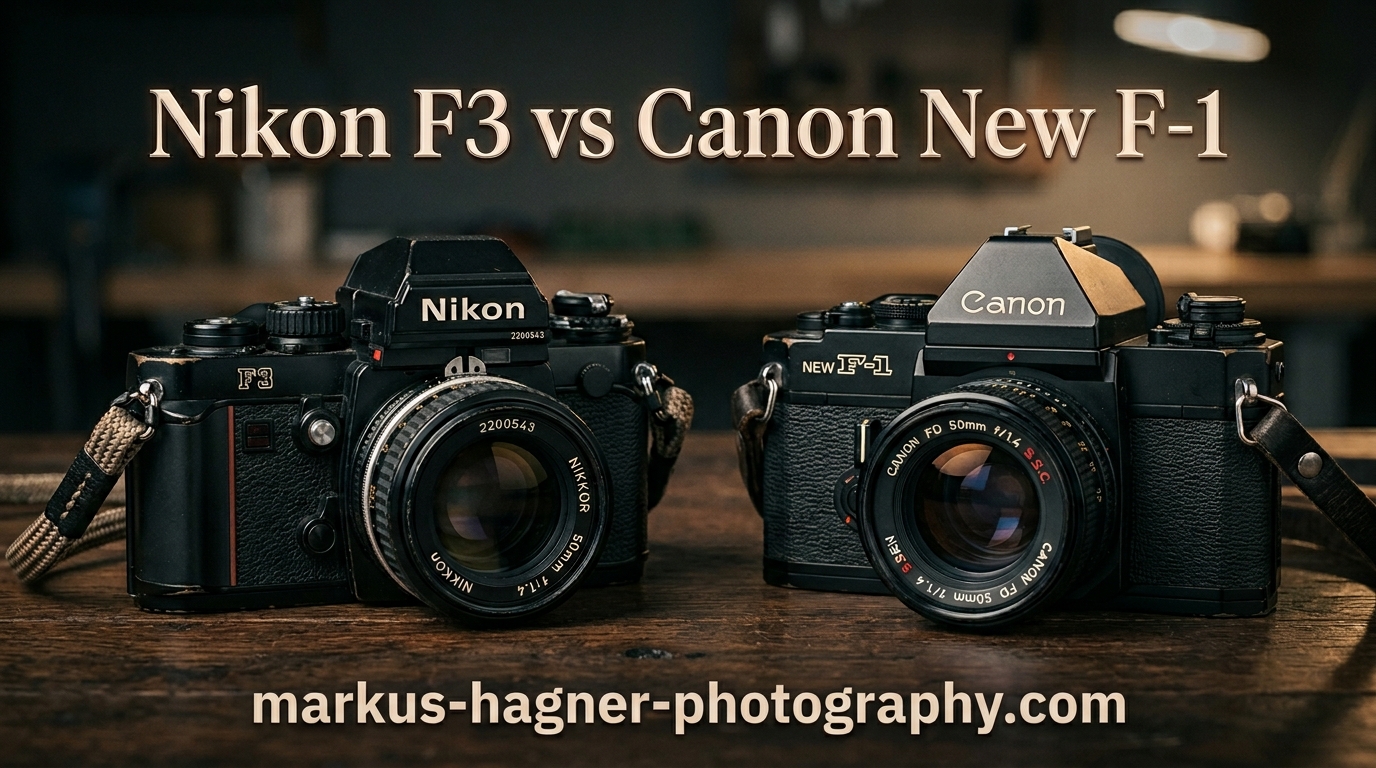
In the early 1980s, professional film photographers faced a difficult choice: the Nikon F3 vs Canon New F-1. These two cameras represented the pinnacle of 35mm film camera technology, each crafted by manufacturers obsessed with creating the ultimate professional tool. Decades later, this debate continues among film photography enthusiasts, collectors, and those seeking a reliable vintage camera for their analog journey.
The Nikon F3 arrived in 1980 as Nikon’s third-generation professional SLR, building upon the legacy of the F and F2. The Canon New F-1 followed in 1981, replacing the original F-1 and representing Canon’s most advanced professional camera of the era. Both cameras were designed for demanding professional use, featuring robust construction, sophisticated metering systems, and extensive lens ecosystems that remain relevant today.
This comprehensive comparison examines every aspect of these legendary cameras, from build quality and viewfinder systems to lens availability and real-world shooting experience. Whether you’re a film photography novice exploring your first manual focus camera or a seasoned collector deciding between these two icons, this guide will help you make an informed decision.
Nikon F3: The Photojournalist’s Companion
The Nikon F3 represents the third generation of Nikon’s professional SLR system, launched in 1980 with significant technological advancements over its predecessors. Designed by the legendary camera architect Yoshikazu Sunayama, the F3 introduced aperture priority automatic exposure to Nikon’s professional lineup while maintaining the rugged reliability that made the F series famous.
One of the most notable aspects of the Nikon F3 is its association with space exploration. NASA selected the F3 for use on Space Shuttle missions, making it one of the few cameras to travel in space. This endorsement from the space agency speaks volumes about the camera’s reliability and precision engineering.
The F3 was Nikon’s first professional camera to feature aperture priority auto exposure, a mode that quickly became popular among photojournalists who needed to react quickly to changing light conditions. The camera’s built-in TTL meter, located in the interchangeable viewfinder, provided accurate center-weighted readings that served professionals well in virtually every shooting scenario.
Famous photographers including Steve McCurry (known for his iconic “Afghan Girl” portrait) relied on the Nikon F3 for professional assignments. The camera’s reputation as a reliable workhorse in challenging conditions cemented its place in photography history.
Key Nikon F3 Specifications
- Film Format: 35mm
- Lens Mount: Nikon F-mount
- Shutter Speeds: 8s to 1/2000s + Bulb
- Flash Sync: 1/80s
- Metering: Center-weighted TTL
- Auto Exposure: Aperture Priority
- Battery: Two 1.55V SR44 or one DL76
- Weight: 760g (body only)
- Production: 1980-2002
Canon New F-1: Canon’s Professional Powerhouse
The Canon New F-1 debuted in 1981 as the successor to the original Canon F-1, which had been Canon’s flagship since 1971. The New F-1 represented a complete redesign, incorporating modern features while maintaining the modular system concept that made the original F-1 popular among professionals.
Perhaps the most distinctive feature of the Canon New F-1 is its unique metering system. Unlike most cameras of the era, the New F-1 placed its metering cell in the camera body rather than the viewfinder, allowing for accurate readings regardless of which interchangeable finder was attached. This design decision gave photographers unprecedented flexibility in choosing viewfinders without sacrificing metering accuracy.
The New F-1’s match-needle metering system became legendary among film photographers. The viewfinder displays two needles: one for the metered exposure value and another showing your current settings. Aligning these needles by adjusting aperture or shutter speed provides an intuitive way to achieve perfect exposures, particularly appreciated by photographers who prefer shooting in full manual mode.
One significant advantage of the Canon New F-1 over many contemporary cameras is its mechanical shutter operation. The camera can fire at speeds from 1/125 to 1/2000 seconds without any battery power, making it remarkably reliable in situations where battery failure would leave other cameras helpless.
Key Canon New F-1 Specifications
- Film Format: 35mm
- Lens Mount: Canon FD mount
- Shutter Speeds: 2s to 1/2000s + Bulb
- Flash Sync: 1/90s
- Metering: Center-weighted (body-based)
- Auto Exposure: Aperture Priority + Shutter Priority
- Battery: One 4LR44 or 4SR44
- Weight: 775g (body only)
- Production: 1981-1992
Build Quality and Design: Which Camera Feels More Professional?
When comparing the build quality of the Nikon F3 and Canon New F-1, we’re examining two cameras that represent the absolute pinnacle of 1980s mechanical engineering. Both were designed to withstand decades of professional use, and both have proven their durability in real-world conditions. However, there are meaningful differences in their construction philosophies.
Nikon F3 Build Quality
The Nikon F3 features a titanium-shielded brass body with extensive use of metal components throughout its construction. The camera’s angular, purposeful design reflects its photojournalist heritage, prioritizing function over aesthetics. Every control feels solid and precise, with the shutter release, film advance lever, and mode dial providing satisfying tactile feedback.
Nikon’s attention to detail is evident in features like the self-diagnosis LCD display in the viewfinder, which shows battery status, exposure compensation, and shooting mode information. The F3’s film advance lever is notably smooth, requiring only a short 136-degree throw for complete cocking, making rapid shooting comfortable even during extended sessions.
The F3’s exterior is finished with a durable black enamel that has proven resistant to wear over decades. The camera’s prongs and mechanical couplings are constructed from brass, ensuring longevity even with heavy professional use. Many F3 bodies from the 1980s remain in excellent working condition today, a testament to their robust construction.
Canon New F-1 Build Quality
The Canon New F-1 employs a more conventional brass and aluminum construction, finished with a distinctive textured black coating that provides excellent grip even in wet conditions. The camera has a slightly chunkier, more substantial feel compared to the F3, though the weight difference is minimal at just 15 grams.
One area where the New F-1 particularly excels is its modular system design. The camera accepts interchangeable focusing screens, viewfinders, motor drives, and film backs, allowing photographers to configure the system for specific assignments. This modularity was a key selling point for professionals who needed versatility in their equipment.
The New F-1’s shutter is a cloth-curtain mechanical design that has earned a reputation for reliability. As mentioned, it operates mechanically (without batteries) for shutter speeds from 1/125 to 1/2000 seconds, a feature that has saved countless shoots when batteries failed unexpectedly. For photographers working in remote locations or cold conditions where battery performance suffers, this mechanical operation is invaluable.
Comparing Durability
Both cameras are exceptionally durable, with decades of proven reliability in professional use. The Nikon F3 has a slight edge in extreme condition performance, with its sealed construction providing better resistance to dust and moisture. The Canon New F-1’s modular design, while offering versatility, introduces more potential points of failure over time.
Common issues to watch for in older examples include worn shutter curtains (more common in heavily-used cameras), meter calibration drift, and in the case of the New F-1, potential shutter squeal that can develop over time. Both cameras benefit from professional CLA (Clean, Lubricate, Adjust) service if purchasing a used example, ensuring smooth operation for decades to come.
Lens Ecosystems: Nikon F-Mount vs Canon FD Mount
One of the most critical factors in choosing between these two camera systems is the lens ecosystem. Both Nikon F-mount and Canon FD-mount have extensive lens lineups spanning decades, but there are significant differences in availability, adaptability, and modern utility.
Nikon F-Mount Lens System
The Nikon F-mount, introduced in 1959, is one of the most enduring lens mounts in photography history. The system encompasses an incredible range of lenses from the pre-AI era through modern AF-D and AF-S lenses, all of which mount on the F3 (though some compatibility considerations apply).
For use with the F3, the most relevant lenses are the AI-S (Automatic Indexing Shutter) and AI (Automatic Indexing) lenses, produced from 1977 onward. These lenses communicate aperture information to the camera’s metering system and are fully compatible with all F3 functions including Aperture Priority exposure.
Nikon’s lens lineup for the F-mount system is remarkably comprehensive, covering focal lengths from 6mm fisheye to 1200mm super telephoto. The system includes numerous legendary lenses that remain highly regarded today, including:
- Wide Angle: 20mm f/2.8, 24mm f/2, 28mm f/2.8, 35mm f/2
- Standard: 50mm f/1.4, 50mm f/1.8, 55mm f/2.8 Micro
- Short Telephoto: 85mm f/1.8, 105mm f/2.5, 135mm f/2.8
- Zoom: 35-70mm f/2.8, 80-200mm f/2.8, 24-50mm f/3.5-4.5
Perhaps the most significant advantage of the Nikon F-mount system today is its adaptability to modern mirrorless cameras. Numerous third-party manufacturers produce high-quality adapters that allow F-mount lenses to be used on Sony E-mount, Canon RF-mount, Nikon Z-mount, and other mirrorless systems. The F-mount’s relatively long flange distance (46.5mm) means adapters can be designed without corrective optics, maintaining full optical quality.
Canon FD Mount Lens System
The Canon FD mount, introduced in 1971, was Canon’s flagship lens mount until the introduction of EOS autofocus cameras in 1987. The FD system represents Canon’s finest manual focus lenses, known for their optical excellence and innovative features like the FDn and New FD lens generations with automatic aperture indexing.
For the New F-1, the New FD lenses (introduced in 1978) offer full compatibility with all camera functions, including auto exposure and TTL flash metering. These lenses feature a breech-lock mount design that ensures precise lens-to-body connection and prevents lens rotation during use.
Canon’s FD lens lineup is equally impressive, offering coverage from 14mm ultra-wide to 800mm telephoto. Notable lenses include:
- Wide Angle: 14mm f/2.8L, 20mm f/2.8, 24mm f/2.8, 35mm f/2
- Standard: 50mm f/1.4, 50mm f/1.8 SSC, 55mm f/1.2 SSC
- Short Telephoto: 85mm f/1.2L, 100mm f/2.8 Macro, 135mm f/2.5
- Zoom: 28-70mm f/2.8L, 70-200mm f/4L, 35-70mm f/4
The primary challenge with Canon FD lenses in the modern era is adaptation to mirrorless cameras. Unlike Nikon F-mount, the FD mount’s shorter flange distance (42mm) requires adapters with corrective optics to achieve infinity focus, which can affect image quality, particularly at wide apertures and in edge sharpness. However, some photographers appreciate the “vintage” rendering these adapters provide.
Lens Availability and Pricing
Both lens systems offer excellent availability on the used market, with prices ranging from affordable (consumer-grade zooms) to premium (professional primes and telephotos). Nikon F-mount lenses tend to command slightly higher prices on average, partly due to their continued relevance for modern mirrorless adaptation.
Ergonomics and Handling: Daily Use in Real-World Conditions
How a camera feels in the hand affects not just comfort but also shooting efficiency, particularly during extended sessions or in demanding conditions. The Nikon F3 and Canon New F-1 have distinct handling characteristics that appeal to different photographers.
Nikon F3 Ergonomics
The Nikon F3 features a angular, purposeful design that fits comfortably in the hand while providing easy access to all major controls. The shutter release is positioned at a natural angle for the index finger, with the film advance lever within easy reach for thumb operation.
Control placement on the F3 is logical and well-considered. The mode dial位于相机顶部,允许快速切换手动和光圈优先模式。对焦环位于镜头上,光圈环位于其后,两者都可轻松操作。快门速度和ISO感光度转盘位于相机前部,虽然有些用户觉得这些控制装置难以触及,但它们位置合理,便于在拍摄时进行快速调整。
The F3’s film advance lever requires just a 136-degree throw, one of the shortest in professional cameras, enabling comfortable rapid shooting. The shutter release has a satisfying, precise feel with no creep or预先生.
Canon New F-1 Ergonomics
The Canon New F-1 has a more substantial, chunkier body that some photographers find more comfortable for extended use. The camera’s deeper grip provides secure handling, particularly appreciated by photographers with larger hands.
Control layout on the New F-1 differs notably from the F3. Shutter speed is selected via a dial surrounding the shutter button, allowing thumb operation without removing your eye from the viewfinder. Aperture is adjusted on the lens, as is standard practice. This separation of controls can feel more intuitive for manual mode shooting, as each setting has its dedicated control.
The New F-1’s film advance lever requires a slightly longer throw than the F3, but many photographers find its action equally smooth. The rewind crank folds flat against the body when not in use, contributing to the camera’s sleek profile.
Battery Dependency
A significant difference between these cameras is their battery dependency. The Nikon F3 requires batteries for virtually all functions, including metering and Aperture Priority operation. Without batteries, the F3 defaults to 1/125 second shutter speed in Aperture Priority mode.
The Canon New F-1 offers more flexibility with its mechanical shutter operation. As mentioned, the New F-1 can fire at speeds from 1/125 to 1/2000 seconds without any battery power, making it far more reliable in emergency situations. This mechanical operation is a significant advantage for photographers who cannot afford camera failure.
Additional Features and Accessories
Both cameras accept a wide range of accessories including motor drives, film winders, data backs, and interchangeable focusing screens. The Nikon F3 offers several viewfinder options including the standard DE-2, the high-magnification DE-3, and the waist-level FT-2. Diopter correction lenses are available for users who need viewfinder prescription adjustment.
The Canon New F-1’s modular design extends to its viewfinder system, with the standard New F-1 viewfinder being interchangeable with the FA-1 for photomicrography or the sports finder for fast action. The New F-1 also accepts the FN-100 focusing screen with split-image and microprism focusing aids.
Data backs are available for both cameras, allowing photographers to imprint date, time, or frame numbers onto their negatives. The Nikon F3’s data back (MB-2) offers more formatting options, while the Canon New F-1’s Date Back 6 provides simpler year/month/day imprinting
Technical Specifications Comparison
| Specification | Nikon F3 | Canon New F-1 |
|---|---|---|
| Film Format | 35mm | 35mm |
| Lens Mount | Nikon F-mount | Canon FD mount |
| Shutter Speeds | 8s to 1/2000s + Bulb | 2s to 1/2000s + Bulb |
| Flash Sync Speed | 1/80s | 1/90s |
| Metering Type | Center-weighted TTL (in viewfinder) | Center-weighted (in body) |
| Auto Exposure | Aperture Priority only | Aperture Priority + Shutter Priority |
| Battery Required | Yes (all functions) | No (mechanical 1/125-1/2000) |
| Battery Type | 2x SR44 (1.55V) | 1x 4LR44 or 4SR44 |
| Viewfinder Coverage | 92% | 97% |
| Viewfinder Magnification | 0.8x | 0.77x |
| Body Weight | 760g | 775g |
| Interchangeable Viewfinder | Yes | Yes |
| Motor Drive Compatible | Yes (MD-4) | Yes (FD-1) |
| Data Back Available | Yes (MB-2) | Yes (Date Back 6) |
| Film Advance | Manual lever | Manual lever |
| Production Period | 1980-2002 | 1981-1992 |
Modern Considerations: Buying, Maintaining, and Adapting
For photographers considering these cameras today, several practical factors extend beyond pure specification comparisons. Understanding the modern landscape helps ensure a satisfying purchase decision.
Current Market Prices and Availability
Both the Nikon F3 and Canon New F-1 are readily available on the used market through various channels including eBay, camera shows, specialized vintage camera shops, and online marketplaces. Prices vary significantly based on condition, included accessories, and whether the camera has received recent CLA service.
The Nikon F3 typically ranges from $200-500 for bodies in good working condition, with prices climbing for examples with low shutter actuations, original accessories, or recent service records. The DE-2 viewfinder adds approximately $50-100 to the price.
Canon New F-1 bodies generally fall in the $250-550 range, with the New FD lenses adding to overall system cost. The more complex modular system can sometimes result in lower prices for bodies without their original finders or accessories.
Common Issues and Reliability
As cameras approaching 40-45 years of age, both systems have specific issues to watch for when purchasing used examples:
Nikon F3 Common Issues:
- Shutter accuracy may drift over time, particularly at slow speeds
- Meter electronics can fail or become inaccurate
- Rubber eyepiece and grip materials may deteriorate
- Film advance mechanism may become stiff without regular use
Canon New F-1 Common Issues:
- Shutter squeal is a common issue that may require lubrication
- Mirror damper foam degrades over time, causing potential mirror slap
- Viewfinder screens may become dim or develop dead spots
- Light seals should be replaced as standard maintenance
Investing in a CLA (Clean, Lubricate, Adjust) service from a qualified camera technician is strongly recommended for any used purchase. This service typically costs $100-200 but ensures reliable operation for years to come.
Adapting to Modern Mirrorless Cameras
For photographers who wish to use these vintage lenses on modern mirrorless cameras, both systems offer possibilities with important caveats:
Nikon F-mount on Mirrorless:
Adapters for Nikon F-mount lenses to Sony E-mount, Canon RF-mount, Nikon Z-mount, and other mirrorless systems are widely available from various manufacturers. The F-mount’s 46.5mm flange distance allows for simple, optically neutral adapters that maintain full image quality. This makes F-mount lenses particularly attractive for photographers who shoot both film and digital.
Canon FD-mount on Mirrorless:
FD lenses require adapters with corrective optics to achieve infinity focus due to the mount’s shorter 42mm flange distance. These optical adapters may introduce some image quality degradation, particularly at wider apertures. However, many photographers appreciate the unique “vintage” rendering these combinations produce, and the optical quality of FD lenses often survives this adaptation well.
Verdict: Which Camera is Right for You?
After examining every aspect of these two legendary cameras, the question remains: which should you choose? The answer depends on your specific needs, shooting style, and priorities.
Choose the Nikon F3 If:
- You plan to adapt vintage lenses to modern mirrorless cameras
- You primarily shoot in Aperture Priority mode
- You value the AE Lock feature for complex lighting situations
- You want access to the most extensive range of interchangeable viewfinders
- You appreciate the legendary reputation of Nikon glass
- You need slightly better weather sealing for challenging conditions
Choose the Canon New F-1 If:
- You prefer shooting in full Manual mode with intuitive match-needle metering
- You need mechanical shutter operation for reliability without batteries
- You want Shutter Priority auto exposure capability
- You prioritize viewfinder clarity and 97% frame coverage
- You appreciate the exceptional optical quality of Canon FD lenses
- You prefer the more substantial, chunky body design
Final Thoughts
Both the Nikon F3 and Canon New F-1 represent extraordinary achievements in camera engineering. These are not merely vintage cameras but professional instruments that served photojournalists, portrait photographers, and serious enthusiasts for decades. Either choice will provide an excellent platform for exploring film photography or expanding your manual focus lens collection.
The good news is that you cannot make a wrong choice between these two legends. Both cameras offer exceptional build quality, sophisticated metering systems, and access to some of the finest manual focus lenses ever produced. Your decision should ultimately come down to which camera’s specific strengths align best with your shooting preferences and future plans.
If possible, try handling both cameras in person before purchasing. The feel of the shutter release, the action of the film advance, and the brightness of the viewfinder are deeply personal considerations that no specification can fully capture. Whether you choose Nikon or Canon, you’re joining a community of photographers who appreciate these remarkable machines.Verdict: Which Camera is Right for You?
After examining every aspect of these two legendary cameras, the question remains: which should you choose? The answer depends on your specific needs, shooting style, and priorities.
Choose the Nikon F3 If:
- You plan to adapt vintage lenses to modern mirrorless cameras
- You primarily shoot in Aperture Priority mode
- You value the AE Lock feature for complex lighting situations
- You want access to the most extensive range of interchangeable viewfinders
- You appreciate the legendary reputation of Nikon glass
- You need slightly better weather sealing for challenging conditions
Choose the Canon New F-1 If:
- You prefer shooting in full Manual mode with intuitive match-needle metering
- You need mechanical shutter operation for reliability without batteries
- You want Shutter Priority auto exposure capability
- You prioritize viewfinder clarity and 97% frame coverage
- You appreciate the exceptional optical quality of Canon FD lenses
- You prefer the more substantial, chunky body design
Final Thoughts
Both the Nikon F3 and Canon New F-1 represent extraordinary achievements in camera engineering. These are not merely vintage cameras but professional instruments that served photojournalists, portrait photographers, and serious enthusiasts for decades. Either choice will provide an excellent platform for exploring film photography or expanding your manual focus lens collection.
The good news is that you cannot make a wrong choice between these two legends. Both cameras offer exceptional build quality, sophisticated metering systems, and access to some of the finest manual focus lenses ever produced. Your decision should ultimately come down to which camera’s specific strengths align best with your shooting preferences and future plans.
If possible, try handling both cameras in person before purchasing. The feel of the shutter release, the action of the film advance, and the brightness of the viewfinder are deeply personal considerations that no specification can fully capture. Whether you choose Nikon or Canon, you’re joining a community of photographers who appreciate these remarkable machines.
Frequently Asked Questions
Is the Nikon F3 a professional camera?
Yes, absolutely. The Nikon F3 was Nikon’s flagship professional SLR when released in 1980 and was used extensively by professional photojournalists worldwide. Its use by NASA on Space Shuttle missions further confirms its professional-grade construction and reliability. The F3 was designed to meet the demanding requirements of daily professional use in challenging conditions.
Is the Canon New F-1 a good camera?
The Canon New F-1 is widely regarded as an excellent professional camera. Released in 1981, it was Canon’s top-tier 35mm SLR and offered advanced features like body-based metering, both Aperture and Shutter Priority auto exposure, and a legendary viewfinder. Its match-needle metering system remains popular among photographers who prefer manual shooting, and its mechanical shutter operation without batteries provides unmatched reliability.
Which is better for beginners?
Both cameras are excellent for beginners learning film photography. The Canon New F-1’s match-needle metering system is often considered more intuitive for understanding exposure, as it provides immediate visual feedback on how aperture and shutter speed affect the metered exposure. The Nikon F3’s Aperture Priority mode allows beginners to control depth of field while the camera handles shutter speed, similar to modern digital camera operation. Either choice provides an excellent platform for learning exposure fundamentals.
Which camera has better lens selection?
Both systems offer extensive lens lineups with excellent availability on the used market. Nikon F-mount has a slight advantage for modern mirrorless adaptation due to its longer flange distance, allowing adapters without corrective optics. However, Canon FD lenses are also highly regarded for their optical quality. The “better” system depends on your specific lens requirements and whether you plan to use the lenses on modern digital cameras.
Do these cameras need special batteries?
The Nikon F3 uses two 1.55V silver oxide (SR44) or one DL76 lithium battery. The Canon New F-1 uses one 4LR44 or 4SR44 battery. Both battery types are readily available from camera stores and online retailers. Remember that the New F-1 can still operate mechanically without batteries for shutter speeds 1/125-1/2000, while the F3 requires batteries for all electronic functions.
How much should I budget for a good example?
Budget $250-450 for a quality body in good working condition. Additional budget for a CLA (Clean, Lubricate, Adjust) service is strongly recommended at $100-200. Budget another $100-300 for a standard lens like a 50mm f/1.4 or 50mm f/1.8. Remember that lens quality significantly impacts image results, so investing more in better lenses often makes sense than focusing solely on the body.
Which camera is more reliable long-term?
Both cameras have proven extremely reliable when properly maintained. The Canon New F-1’s mechanical shutter operation without batteries gives it an edge in situations where battery failure is a concern. Both benefit from regular use to keep mechanisms lubricated and functioning smoothly. With appropriate CLA service every 10-15 years, either camera should provide decades more reliable service.
Conclusion: The Legacy Continues
The Nikon F3 vs Canon New F-1 debate has persisted for over four decades, and it remains relevant today precisely because both cameras represent the absolute best that 1980s camera engineering had to offer. These were not consumer products designed for casual use but professional instruments built to withstand the rigors of daily photojournalism, commercial photography, and serious amateur pursuit.
Choosing between these two legends ultimately comes down to understanding your specific needs. If you value the ability to adapt lenses to modern mirrorless cameras, prefer Aperture Priority shooting, and appreciate Nikon’s comprehensive lens ecosystem, the F3 remains an excellent choice. If you prioritize the intuitive match-needle metering for manual shooting, need mechanical shutter reliability, and appreciate Canon’s exceptional viewfinder clarity, the New F-1 may be your ideal camera.
Whatever you choose, you’re not just acquiring a camera but joining a tradition of photography that produced some of the most iconic images in history. The Nikon F3 and Canon New F-1 are more than mere tools—they’re gateways to a rich photographic heritage that continues to inspire photographers today.