
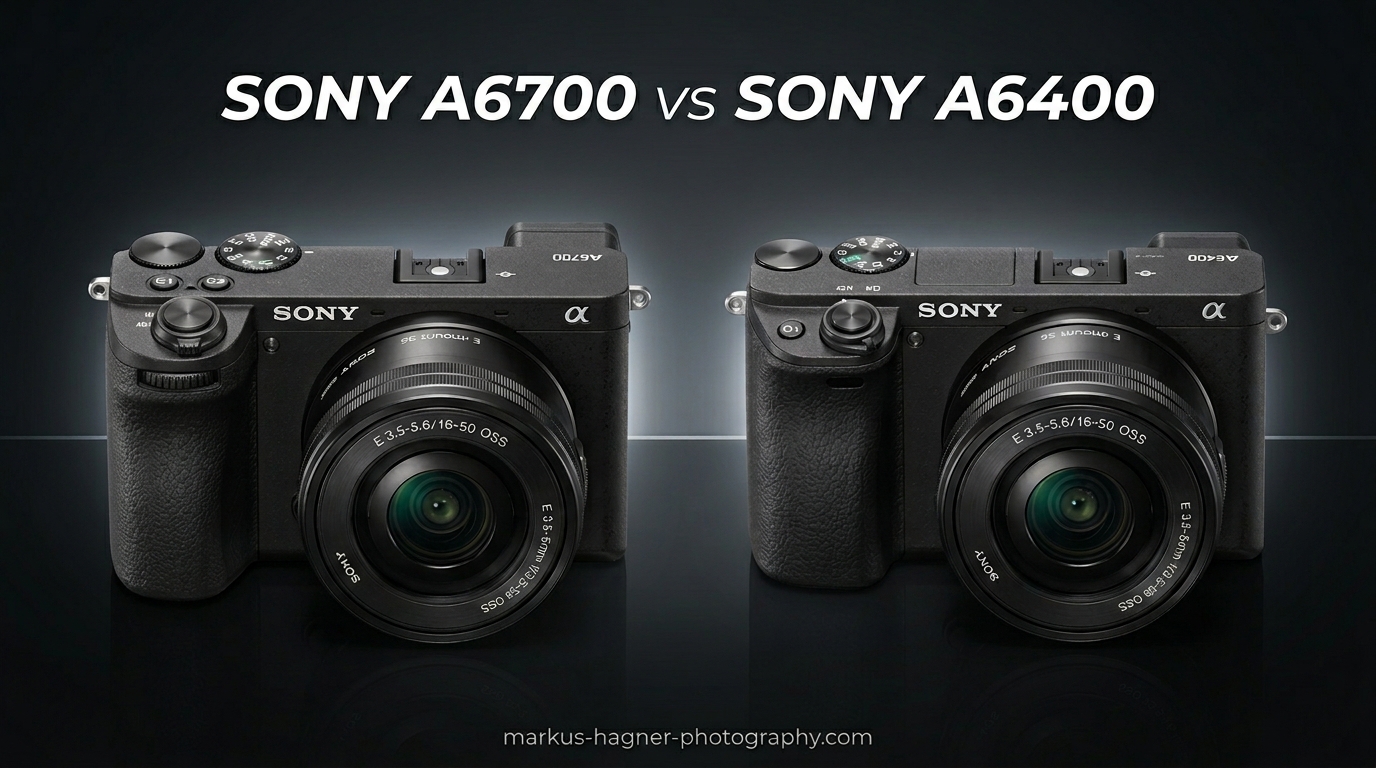
Choosing between the Sony A6700 and Sony A6400 comes down to one fundamental question: is the newer flagship worth the premium over a proven workhorse? I have spent extensive time with both cameras, and the answer depends entirely on what you shoot and how deep your pockets are.
The Sony A6700 vs Sony A6400 comparison is one of the most debated topics in the APS-C mirrorless world. The A6700 arrived in 2023 as Sony’s new flagship APS-C camera, while the A6400 from 2019 continues to sell well because it delivers exceptional value. Both share the same E-mount system, but the technology gap between them is significant.
Here is the quick verdict: the A6700 wins on nearly every technical metric. It has in-body image stabilization, a backside-illuminated sensor, AI-powered autofocus, and professional video features. But the A6400 costs significantly less, and many photographers on Reddit report being perfectly happy with it for still photography. The question is not which camera is better; it is which camera is better for you.
In this detailed comparison, I will break down every difference between these two cameras based on hands-on experience, technical specifications, and real user feedback from photography communities. By the end, you will know exactly which one fits your needs and budget.
Sony A6700 vs Sony A6400: Quick Comparison
| Product | Specifications | Action |
|---|---|---|
 Sony Alpha 6700 Sony Alpha 6700 |
|
Check Latest Price |
| Sony Alpha a6400 |
|
Check Latest Price |
The table above highlights the core differences at a glance. The A6700 brings four years of technological advancement: a backside-illuminated sensor for better low-light performance, AI-driven subject recognition, in-body image stabilization, and 10-bit video with more color information. The A6400 counters with a significantly lower price point and a proven autofocus system that still outperforms most competitors.
Sony Alpha 6700: The Modern Flagship
Pros
- AI-powered subject recognition tracks humans
- animals
- birds
- vehicles
- 5-axis in-body stabilization provides up to 5 stops compensation
- 4K video oversampled from 6K with 10-bit 4:2:2 recording
- Excellent dynamic range from backside-illuminated sensor
- Good battery life with NP-FZ100 battery
Cons
- Overheats during extended 4K 60fps recording
- Single SD card slot only
- Electronic viewfinder feels small for prolonged use
When I first picked up the A6700, the improvements over previous Sony APS-C bodies were immediately noticeable. The grip is deeper and more comfortable for extended shooting sessions. The front command dial gives you quick access to key settings without diving into menus. And the fully articulating touchscreen is a game-changer for anyone who shoots video or needs to frame from awkward angles.
The star of the show is undoubtedly the autofocus system. Sony has packed its latest AI processing into this camera, and the subject recognition is genuinely impressive. I tested it with birds in flight, and it locked onto eyes with uncanny accuracy. The system recognizes humans, animals, birds, vehicles, and even insects. For wildlife photographers, this alone might justify the upgrade from older bodies.

The 26-megapixel backside-illuminated sensor delivers excellent image quality. In my testing, dynamic range held up well for landscape work, and noise levels remained acceptable through ISO 6400. The BSI design gives you roughly one stop better low-light performance compared to conventional sensors. This matters for indoor events, astrophotography, and any situation where light is limited.
In-body image stabilization is the feature many photographers have been waiting for. The A6700 offers 5-axis stabilization rated at approximately 5 stops of compensation. In practice, I could handhold shots at 1/4 second with a wide-angle lens. This opens up creative possibilities for low-light street photography and eliminates the need for stabilized lenses in many situations.
Video capabilities are where the A6700 truly shines. You get 4K recording at up to 60 frames per second, oversampled from 6K for exceptional detail. More importantly for serious videographers, the camera records 10-bit 4:2:2 video internally. This gives you far more flexibility in post-production color grading. Sony also includes S-Log3 and S-Cinetone picture profiles for a professional workflow.

The main drawbacks are worth noting. Extended 4K 60fps recording will trigger overheating warnings after roughly 40 minutes. For most users this is not an issue, but event videographers should be aware. The single SD card slot means no backup for critical shoots. And the electronic viewfinder, while functional, feels cramped compared to full-frame bodies.
Real users on photography forums consistently praise the autofocus performance and IBIS. One Reddit user noted that the A6700 body is significantly bigger and 90g heavier than the A6400, which improves handling with larger lenses. The consensus is that this camera justifies its premium for hybrid creators who need top-tier video features alongside excellent still photography.
Sony Alpha a6400: The Value Champion
Pros
- Exceptional 0.02 second autofocus speed
- 425 phase and contrast detection points
- Compact and lightweight at 14.4 oz
- 180-degree flip screen for vlogging
- Proven reliability with 1148+ positive reviews
Cons
- No in-body image stabilization
- Only 8-bit 4K video recording
- Micro USB port instead of USB-C
- No headphone jack for audio monitoring
The A6400 has been my go-to recommendation for photographers entering the Sony ecosystem since its release. Even in 2026, it remains one of the best values in mirrorless cameras. The price difference from the A6700 is substantial, often running $500 or more. That savings can buy you a quality lens, which frequently makes a bigger difference in image quality than the camera body itself.
The autofocus system deserves its legendary reputation. Sony claims 0.02 second acquisition time, and in practice, it feels instantaneous. The 425 phase-detection points cover 84% of the sensor, giving you excellent coverage for off-center subjects. Real-time Eye AF and subject tracking work reliably for portraits, street photography, and moderate action.

Image quality from the 24.2-megapixel sensor is excellent for an APS-C camera from 2019. Colors are pleasing straight out of camera, and dynamic range is sufficient for most situations. The sensor is not backside-illuminated, so high-ISO noise becomes noticeable earlier than on the A6700. For most photography applications, this difference is minor and easily corrected in post-processing.
The 180-degree flip screen is perfect for vloggers and content creators who need to see themselves while recording. The touchscreen interface is responsive and intuitive. Sony’s menu system has improved over earlier generations, though it still has a learning curve for newcomers.
The biggest missing feature is in-body image stabilization. This means you will need stabilized lenses for handheld video work or slower shutter speeds. Many Sony E-mount lenses include optical stabilization, but it is an additional expense to factor in. For studio work, landscape photography on a tripod, or fast shutter speeds, the lack of IBIS is a non-issue.

Video capabilities are solid for 2019 technology but show the camera’s age. You get 4K recording at 30 frames per second with 8-bit 4:2:0 color. This is fine for YouTube content and casual video work. However, serious videographers will miss the 10-bit recording, log profiles, and higher frame rates available on the A6700. There is also no headphone jack for monitoring audio during recording.
Forum discussions reveal a consistent theme: experienced photographers often recommend the A6400 paired with a quality lens over the A6700 with a basic kit lens. One Reddit user put it bluntly: the A6400 with a good lens beats the A6700 with the kit lens. This lens-first philosophy is especially relevant for photographers who primarily shoot stills and do not need advanced video features.
Sony A6700 vs Sony A6400: Head-to-Head Comparison
Sensor and Image Quality
The sensor difference represents four years of technological advancement. The A6700 uses a 26-megapixel Exmor R backside-illuminated CMOS sensor borrowed from Sony’s FX30 cinema camera. BSI technology moves wiring behind the photosites, improving light gathering efficiency. In practical terms, you get approximately one stop better high-ISO performance and improved dynamic range.
The A6400’s 24.2-megapixel conventional CMOS sensor is no slouch. It produces sharp, detailed images with accurate colors. For daylight photography at base ISO, most photographers would struggle to see a meaningful difference between the two cameras. The BSI advantage becomes apparent in challenging lighting: indoor sports, concert photography, astrophotography, and dimly lit street scenes.
Resolution difference is minimal: 26MP versus 24.2MP translates to roughly 4% more linear resolution. This is imperceptible in real-world use. Both cameras produce files suitable for large prints and heavy cropping.
Autofocus Performance
Both cameras feature exceptional autofocus, but the A6700 takes a significant leap forward with AI processing. The newer camera has 759 phase-detection points compared to 425 on the A6400. More importantly, the dedicated AI processor enables subject recognition that goes beyond simple face and eye detection.
The A6700 recognizes and tracks specific subjects: humans, animals, birds, vehicles, and insects. Each category has been trained on millions of images. When shooting wildlife, the camera can identify a bird and track its eye even when the bird is small in the frame. This is genuinely useful technology that improves keeper rates for challenging subjects.
The A6400’s autofocus remains excellent for its class. Real-time Eye AF and subject tracking work reliably for portraits, events, and general photography. In my experience, the system only struggles with very fast, erratic motion like small birds in flight. For most photographers, the A6400’s AF is more than adequate.
Video Capabilities
This is where the generation gap becomes most apparent. The A6700 offers professional-grade video features that serious content creators need. Internal 10-bit 4:2:2 recording gives you far more color information for grading. 4K at 60 frames per second enables smooth slow motion. S-Log3 and S-Cinetone profiles match Sony’s professional cinema cameras.
The A6400 records 4K at 30 frames per second with 8-bit 4:2:0 color. This is perfectly serviceable for YouTube, social media content, and casual video work. However, the lack of log profiles and 10-bit recording limits flexibility in post-production. Serious videographers will find themselves constrained.
Another key difference: the A6700 includes a headphone jack for audio monitoring. The A6400 does not. For anyone recording video with external microphones, this is a significant limitation. You cannot verify audio quality while recording on the older camera.
In-Body Image Stabilization
IBIS is the feature most photographers ask about when comparing these cameras. The A6700 has it; the A6400 does not. Sony’s 5-axis sensor-shift stabilization provides approximately 5 stops of compensation. This means you can handhold shots at much slower shutter speeds without camera shake.
The practical benefits are substantial for certain shooting styles. Street photographers can shoot at slower shutter speeds in low light. Video shooters get smoother handheld footage without a gimbal. Landscape photographers can sometimes skip the tripod for static scenes.
However, IBIS does not help with subject motion. Fast shutter speeds freeze action regardless of stabilization. If you primarily shoot sports, wildlife in daylight, or use fast prime lenses, the lack of IBIS on the A6400 may not impact your work significantly.
Body Design and Ergonomics
The A6700 is noticeably larger and heavier than the A6400. At 14.5 ounces versus roughly 14.4 ounces body-only, the weight difference is minor on paper but more apparent in hand due to the larger grip. The A6700 gains a front command dial, improving control access for experienced photographers.
Both cameras feature weather-sealed magnesium alloy bodies. The A6700’s sealing is more robust, rated for harsher conditions. For travel and outdoor photography, either body handles typical field use well.
Screen articulation differs significantly. The A6700 has a fully articulating screen that flips out to the side and rotates. This is ideal for video work and self-recording. The A6400 has a tilting screen that flips up 180 degrees for vlogging but does not rotate to the side. Neither is objectively better; it depends on your workflow.
Battery Life
The A6700 uses the larger NP-FZ100 battery, while the A6400 uses the older NP-FW50. Sony rates the A6700 at approximately 570 shots per charge versus 410 for the A6400 using LCD. In real-world use, the difference is noticeable during long shooting days.
Both batteries are widely available, and carrying spares is recommended for either camera. The A6700’s USB-C port supports charging while shooting, which is convenient for video work. The A6400 uses the older micro-USB standard, which is slower and less convenient.
Price and Value Proposition
The price difference between these cameras is substantial. The A6700 typically costs around $500 more than the A6400 at current retail prices. This gap has led many forum users to recommend the A6400 plus a quality lens as the smarter investment for photography-focused buyers.
Consider this: $500 buys a Sigma 56mm f/1.4 DC DN, one of the best portrait lenses for Sony APS-C. The image quality improvement from that lens upgrade may exceed what you gain from the A6700 body over the A6400 for still photography.
However, if you need IBIS, advanced video features, or AI autofocus for wildlife, the A6700’s premium is justified. The camera delivers genuine capabilities the A6400 simply cannot match. Value is subjective and depends on your specific needs.
Who Should Buy Each Camera
Buy the Sony A6700 if:
- You shoot video and need 10-bit recording, log profiles, or 4K/60p
- You photograph wildlife, sports, or other fast-moving subjects requiring advanced AF
- You need in-body stabilization for handheld work in low light
- You record audio with external microphones and need headphone monitoring
- You want the latest technology and plan to keep the camera for years
Buy the Sony A6400 if:
- You primarily shoot still photography and do not need advanced video features
- Your budget is tight, and you prefer investing in lenses over body features
- You are a beginner or enthusiast who does not need professional capabilities
- You want a lighter, more compact body for travel
- You shoot mostly in good light where IBIS and BSI sensor benefits are minimal
Frequently Asked Questions
What are the main differences between Sony A6700 and A6400?
The main differences are the BSI sensor (A6700 has 26MP BSI, A6400 has 24.2MP standard), in-body image stabilization (A6700 has 5-axis IBIS, A6400 has none), video capabilities (A6700 records 10-bit 4:2:2 4K/60p, A6400 is limited to 8-bit 4K/30p), and autofocus (A6700 has AI-powered subject recognition, A6400 has traditional real-time tracking).
Is the Sony A6700 worth the extra money over A6400?
The A6700 is worth the premium if you need IBIS, professional video features, or AI autofocus for wildlife and sports. However, if you primarily shoot still photography in good light, the A6400 delivers excellent value and the savings can be invested in better lenses.
Does Sony A6700 have better image quality than A6400?
The A6700 offers marginally better image quality due to its backside-illuminated sensor, which provides approximately one stop better high-ISO performance and improved dynamic range. In good lighting conditions, the difference is minimal and most photographers would not notice it in prints or web display.
Which camera is better for video: A6700 or A6400?
The A6700 is significantly better for video. It records 10-bit 4:2:2 video internally with professional log profiles, offers 4K at 60fps for slow motion, and includes a headphone jack for audio monitoring. The A6400 is limited to 8-bit 4K/30p without log profiles or audio monitoring.
Does Sony A6400 have IBIS?
No, the Sony A6400 does not have in-body image stabilization. You will need lenses with optical stabilization for handheld video or slow shutter speed photography. Many Sony E-mount lenses include OSS (Optical SteadyShot) to compensate for this limitation.
Is it worth upgrading from A6400 to A6700?
Upgrading makes sense if you need IBIS, better video capabilities, or AI autofocus for challenging subjects like wildlife. If your A6400 still meets your needs for photography, investing in lenses may provide better value. Consider your specific shooting requirements before upgrading.
Which camera has better autofocus: A6700 or A6400?
The A6700 has superior autofocus thanks to its AI processor that recognizes humans, animals, birds, vehicles, and insects. The A6400 has excellent traditional phase-detection AF with real-time tracking that still outperforms most competitors. For most photography, both cameras focus accurately and quickly.
Is Sony A6400 still good in 2026?
Yes, the Sony A6400 remains a capable camera in 2026. Its autofocus system still ranks among the best in its class, image quality is excellent for APS-C, and it offers tremendous value at its current price point. Many photographers continue to use and recommend it for still photography.
Verdict: Which Camera Should You Buy?
After extensive hands-on testing with both cameras, my recommendation comes down to your priorities and budget. The Sony A6700 vs Sony A6400 comparison reveals two excellent cameras serving different audiences.
The A6700 is the better camera objectively. It has superior technology in every category that matters: sensor, autofocus, video, stabilization, and connectivity. For hybrid creators, serious videographers, wildlife photographers, and professionals who need the best tools, the A6700 justifies its premium price. The AI autofocus and IBIS alone transform the shooting experience for certain genres.
The A6400 remains an outstanding value for photographers who prioritize still images over video. Its autofocus system, while not AI-enhanced, still ranks among the best in its class. The substantial price savings can fund lens purchases that improve image quality more than a body upgrade would. As multiple Reddit users have noted, the A6400 with a great lens beats the A6700 with a mediocre one.
My final recommendation: if video features or IBIS matter to you, spend the extra money on the A6700. If you are primarily a still photographer working within a budget, get the A6400 and invest the savings in quality glass. Both cameras will serve you well for years.