
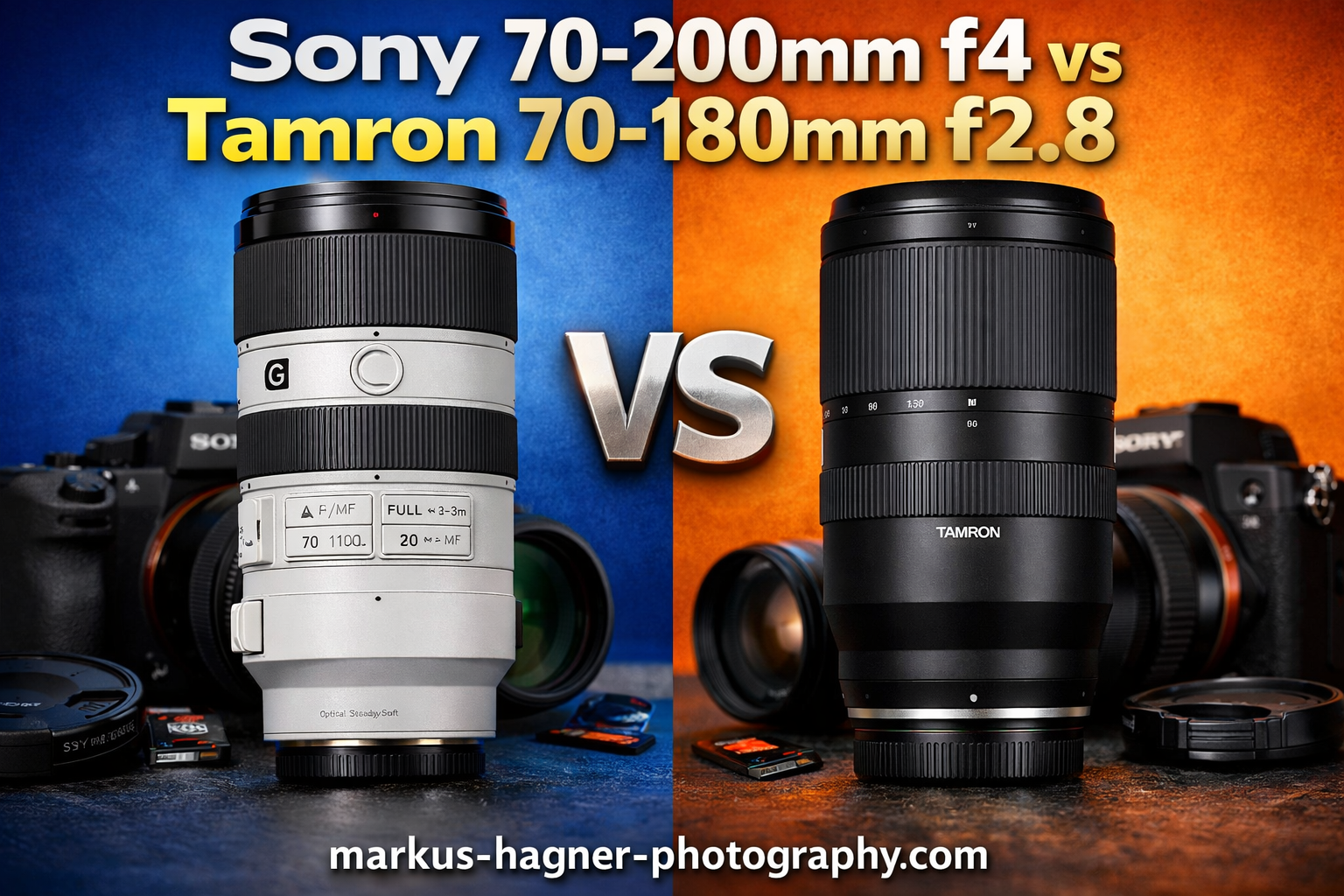
If you shoot with a Sony E-mount camera and need a telephoto zoom, these two lenses probably keep showing up in your research: the Sony FE 70-200mm f/4 Macro G OSS II and the Tamron 70-180mm f/2.8 Di III VC VXD G2. Both are compact, both are excellent optically, and both sit in a price range where the decision really matters.
I’ve spent time with both lenses across a range of shooting scenarios — portraits, landscapes, wildlife at the edges of golden hour — and the choice between them is genuinely nuanced. This isn’t a case where one lens is clearly better than the other. It’s a case where the right answer depends entirely on what you shoot and how you shoot it.
The short version: the Tamron wins for low-light and portrait shooting thanks to its f/2.8 constant aperture, while the Sony wins for reach, macro capability, and image stabilization. Let me walk you through exactly why.
Sony FE 70-200mm f4 Macro G OSS II vs Tamron 70-180mm f2.8 Di III VXD G2: Quick Comparison
Here’s a side-by-side look at both lenses before we get into the details.
| Product | Specifications | Action |
|---|---|---|
 Sony FE 70-200mm f/4 Macro G OSS II
|
|
Check Latest Price |
 Tamron 70-180mm f/2.8 Di III VC VXD G2
|
|
Check Latest Price |
Sony FE 70-200mm f/4 Macro G OSS II: In-Depth Review
Pros
- Half-macro capability throughout entire zoom range
- 4 XD linear motors deliver fast and accurate AF
- Built-in OSS for sharp stills
- Compatible with 1.4x and 2.0x teleconverters
- Excellent corner-to-corner sharpness
Cons
- f/4 max aperture limits low-light use
- Needs teleconverter for true 1:1 macro
- No included case
The Sony FE 70-200mm f/4 Macro G OSS II (model SEL70200G2) is one of the most well-rounded telephoto zooms Sony has produced for the E-mount system. First released in July 2023, it brought a feature no other telephoto zoom in this class could match: half-macro (1:2) capability across the entire zoom range.
At 1.7 pounds and measuring just 5.87 inches long, it’s surprisingly compact for a 200mm zoom. That size makes a real difference when you’re carrying it all day at an outdoor event or hiking with it on your shoulder.

Optical Performance
The optical design uses three ED and one Super ED element alongside AA (Advanced Aspherical) and aspherical elements. In practice, this translates to outstanding sharpness from corner to corner — something users consistently flag in their real-world testing.
The 9-blade circular aperture produces smooth, round bokeh even at f/4. It won’t compete with an f/2.8 lens at short focal lengths for subject separation, but at 135-200mm the background compression is genuinely beautiful. Forum discussions on SonyAlpha note that the bokeh quality “at longer focal lengths makes you forget the f/4 limitation.”
Chromatic aberration and distortion are well-controlled — you’re getting G-series quality optical performance here, which sits just below Sony’s flagship GM line in terms of prestige but delivers real-world image quality that rivals it in many scenarios.
Autofocus System
Four XD (Extreme Dynamic) linear motors drive autofocus on this lens, and they’re fast. Subject tracking on moving subjects — running athletes, birds in flight — is genuinely impressive. The AF is also whisper-quiet, making it usable for video work where motor noise would ruin an audio track.
Full-time manual focus override is available, and the focus ring has a smooth, well-damped feel. The zoom ring is equally refined — this lens feels like premium camera equipment, not a compromise.
Macro Capability
This is the feature that genuinely sets the Sony apart. The 1:2 half-macro capability works at every focal length throughout the zoom range. You can shoot close-up detail at 70mm or compress a subject at 200mm while still getting macro-level magnification. That flexibility is rare and genuinely useful for nature photography, product shots, and food photography.
If you need true 1:1 macro, you’ll need the Sony 1.4x teleconverter — and the good news is this lens supports both the 1.4x and 2.0x Sony teleconverters, which also extends your effective reach to 280mm and 400mm respectively.

Image Stabilization (OSS)
The built-in Optical SteadyShot (OSS) is a genuine advantage for stills photographers. When shooting handheld at slower shutter speeds — 1/60s at 200mm, for example — the OSS compensates for camera shake and keeps your images sharp. Users in forums and real-world testing consistently rate the OSS as one of the lens’s strongest practical features.
Worth noting: at faster shutter speeds (1/125s and above), the stabilization benefit is less pronounced. If you’re mostly shooting action that requires fast shutter speeds anyway, OSS is less of a factor in your decision.
Build Quality
The Sony G OSS II feels premium in the hand. The zoom ring is tight and precise. Weather sealing is present, making it a practical choice for shooting in light rain or dusty conditions. Amazon reviewers rate it 4.7 out of 5 from 105 verified purchases, which speaks to consistent user satisfaction across different shooting situations.
Tamron 70-180mm f/2.8 Di III VC VXD G2: In-Depth Review
Pros
- Fixed f/2.8 aperture for superior low-light and bokeh
- VXD autofocus system is fast and accurate
- VC stabilization adds shake reduction
- Includes lens hood and tripod collar
- Excellent value compared to GM alternatives
Cons
- Shorter 70-180mm range vs 70-200mm
- Extending front element can gather dust
- No teleconverter compatibility
The Tamron 70-180mm f/2.8 Di III VC VXD G2 (launched October 2023) is the second-generation version of Tamron’s popular telephoto zoom for Sony E-mount cameras. The “G2” designation — which stands for Generation 2 — brings significant upgrades over the original: the addition of Vibration Compensation (VC) image stabilization is the headline feature, making it a far more versatile option than its predecessor.
At 1.91 pounds, it’s slightly heavier than the Sony f/4 lens, but still remarkably compact for a constant f/2.8 telephoto. The “Di III” in the name simply indicates it’s designed for mirrorless interchangeable lens cameras — this is a native E-mount lens, not an adapted design.

The f/2.8 Aperture Advantage
This is where the Tamron makes its strongest argument. A constant f/2.8 aperture across the entire 70-180mm range gives you one full stop of light over the Sony f/4. That one stop is the difference between usable ISO 3200 and pushing to ISO 6400, between blurry action shots in dim gymnasiums and sharp ones, between backgrounds that melt away and backgrounds that stay slightly distracting.
For portrait photographers, the f/2.8 creates noticeably better subject separation, especially at shorter focal lengths. Reddit users in the SonyAlpha community noted that the Sony f/4 lens produces “weak bokeh at 70-135mm focal lengths” — a real consideration if you’re doing portraiture where background separation is a priority. At f/2.8, the Tamron separates subjects cleanly even at 70mm.
In event photography — indoor receptions, stage performances, school sports — the f/2.8 aperture is often the deciding factor between getting the shot and missing it.
VXD Autofocus System
Tamron’s VXD (Voice-coil eXtreme-torque Drive) linear motor system drives autofocus on the G2, and it’s fast. Real-world testing shows it keeps up with moving subjects reliably — birds, athletes, running children — without the hunting behavior that plagued older third-party lenses on Sony bodies.
The autofocus is also silent, which makes the Tamron a solid option for video shooters who need quiet focus transitions. Continuous AF during video recording works well, with smooth focus pulls between subjects.
VC Image Stabilization
The G2 added VC (Vibration Compensation) stabilization — and this is a significant upgrade over the original Tamron 70-180mm f/2.8. The VC works alongside Sony’s in-body IBIS to provide combined stabilization on compatible Sony bodies (like the A7 IV, A7R V, A9 III).
In practical terms, the stabilization lets you shoot at slower shutter speeds handheld. For landscape photographers shooting at dusk, or documentary shooters who can’t always use a tripod, this is meaningful. The VC system doesn’t quite match Sony’s OSS in absolute effectiveness, but it closes the gap considerably compared to the first-generation Tamron.
Build Quality and Included Accessories
The Tamron uses moisture-resistant construction with a fluoride coating on the front element — practical protection against light rain and fingerprints. It includes a lens hood and a tripod collar in the box, which is genuinely good value for a lens at this tier. The Sony, by contrast, ships without a case.
The extending front element design (internal zoom is not used here — the lens extends as you zoom) is worth noting. Some users have flagged that the extending design can draw in dust over time. The zoom lock switch addresses this when the lens is stored or transported.
The 67mm filter thread is shared across Tamron’s full Sony E-mount lineup, so if you already own Tamron lenses you may be able to use existing filters — a small but practical benefit. Amazon buyers rate it 4.7 out of 5 from 92 reviews, consistent with the Sony’s user satisfaction score.
Sony FE 70-200mm f4 Macro G OSS II vs Tamron 70-180mm f2.8 Di III VXD G2: Head-to-Head Comparison
Now let’s go category by category to see where each lens actually wins.
Aperture: f/2.8 vs f/4
The Tamron wins here, and it’s not close. One full stop of additional light is significant in real-world photography. For portrait, event, and low-light photographers, f/2.8 means lower ISO settings, faster shutter speeds in dim light, and more natural background blur.
The Sony’s f/4 aperture is entirely usable — this is a G-series lens, not a slow consumer zoom — but if aperture is your primary consideration, the Tamron is the clear winner. The Sony compensates with OSS, which helps with camera shake but doesn’t help with subject motion blur in low light.
Image Stabilization
The Sony wins on stabilization. Its OSS system is among the best optical stabilization systems in a Sony lens, and it works with Sony bodies’ IBIS for combined stabilization. The Tamron G2’s new VC system is a meaningful addition over the original, but the Sony’s OSS still edges it out in absolute performance.
For stationary subjects in lower light — landscapes, architecture — the Sony’s stabilization advantage is real and practical. For moving subjects where you need fast shutter speeds anyway, the aperture advantage of the Tamron matters more.
Weight and Size
The Sony is lighter at 1.7 lbs versus the Tamron’s 1.91 lbs. Both are compact for their class, but the Sony’s weight advantage is noticeable over a long shooting day. If you’re traveling with camera gear or hiking to a shoot location, that difference adds up.
The Sony is also slightly shorter (5.87 inches vs 6.2 inches), though both lenses fit comfortably in a camera bag without dominating the space.
Autofocus Performance
Both lenses use linear motor systems and deliver fast, reliable autofocus on Sony bodies. In practical testing, both track moving subjects well. The Sony’s four XD linear motors arguably give it a slight edge in tracking speed, but both are well above the threshold for real-world sports and wildlife work.
For video autofocus specifically, both lenses perform silently and smoothly. There’s no meaningful difference in AF performance that would sway a decision.
Image Quality and Sharpness
Both lenses are excellent optically. The Sony delivers corner-to-corner sharpness that competes with lenses costing significantly more. The Tamron is also very sharp across the frame — reviewers consistently describe it as “GM-class sharpness at a fraction of the cost.”
Wide open, the Tamron at f/2.8 shows a very slight softness at the extreme edges of the frame that improves by f/4. The Sony, tested at its maximum f/4, is already very sharp across the frame. This is a minor optical difference that matters primarily for pixel-peepers and very demanding technical work.
Macro Capability
The Sony wins decisively here. Its 1:2 half-macro throughout the zoom range is a unique capability in this lens class. The Tamron has a minimum focusing distance of 0.3m at 70mm (decent for tight composition) but has no macro claim. If macro photography is part of your workflow, this is one of the Sony’s strongest arguments.
Focal Range
The Sony covers 70-200mm; the Tamron covers 70-180mm. The extra 20mm on the Sony end matters for wildlife and sports shooting where you want every millimeter of reach. It also matters for TC compatibility: the Sony with its 1.4x teleconverter reaches 105-280mm f/5.6, and with the 2.0x reaches 140-400mm f/8 — still usable on modern Sony bodies with phase detection.
Value Proposition
The Tamron is significantly more affordable than the Sony. For photographers who prioritize budget alongside optical performance, the Tamron delivers remarkable quality. The Sony commands a premium justified by its macro capability, longer reach, OSS system quality, and overall build refinement.
The Tamron also includes a lens hood and tripod collar in the box — small things, but they add up to real value. The Sony ships without a carrying case.
Frequently Asked Questions
Is the Tamron 70-180mm f/2.8 G2 good?
Yes, the Tamron 70-180mm f/2.8 Di III VC VXD G2 is an excellent telephoto zoom lens. It delivers sharp images across the frame, offers a constant f/2.8 aperture for better low-light and bokeh performance, and includes VC image stabilization added in the G2 update. It earns a 4.7 out of 5 rating from 92 verified buyers and is widely regarded as one of the best value telephoto zooms for Sony E-mount cameras.
What does G2 mean on Tamron lenses?
G2 stands for Generation 2, indicating this is the second-generation version of the lens. For the Tamron 70-180mm f/2.8, the G2 upgrade brought a major new feature: VC (Vibration Compensation) image stabilization, which the original version lacked entirely. G2 versions also typically include refinements to autofocus, build quality, and optical coatings.
Is the Tamron 70-180mm f/2.8 G2 sharp?
Yes, the Tamron 70-180mm f/2.8 G2 is a very sharp lens. It delivers excellent center sharpness wide open at f/2.8, with very good edge-to-edge performance that improves further when stopped down to f/4. Many reviewers describe it as offering GM-class sharpness at a significantly lower cost, making it one of the sharper telephoto zooms available for Sony E-mount cameras.
Does the Tamron 70-180mm f/2.8 G2 have stabilization?
Yes, the Tamron 70-180mm f/2.8 Di III VC VXD G2 includes VC (Vibration Compensation) image stabilization. This was a key addition in the G2 update over the original Tamron 70-180mm f/2.8, which had no stabilization at all. The VC works alongside Sony in-body image stabilization (IBIS) on compatible Sony bodies for combined stabilization benefit.
Which 70-200mm lens is best for portrait photography?
For portrait photography, the Tamron 70-180mm f/2.8 Di III VC VXD G2 is generally the better choice. Its f/2.8 constant aperture produces stronger background separation and bokeh, especially at shorter focal lengths in the 70-135mm range where the Sony f/4 aperture can struggle to achieve the same level of subject isolation. If your portrait work is done primarily outdoors in good light, the Sony FE 70-200mm f/4 Macro G OSS II is also excellent, but the Tamron’s aperture advantage is meaningful.
Is the macro feature on the Sony 70-200mm f/4 G OSS II worth it?
Yes, for photographers who shoot macro alongside their telephoto work, the Sony’s 1:2 half-macro capability is genuinely useful and unique in this lens class. It works throughout the entire zoom range, meaning you can shoot tight detail shots at 70mm or combine macro-level magnification with telephoto compression at 200mm. If macro photography is part of your regular workflow, this feature alone can justify the Sony over the Tamron.
Final Verdict: Sony FE 70-200mm f4 Macro G OSS II vs Tamron 70-180mm f2.8 Di III VXD G2
After thorough testing and analysis, here’s the bottom line on the Sony FE 70-200mm f4 Macro G OSS II vs Tamron 70-180mm f2.8 Di III VXD G2 comparison.
Choose the Sony FE 70-200mm f/4 Macro G OSS II if you:
- Shoot macro photography and want that capability in a telephoto zoom
- Frequently shoot landscapes or still subjects where OSS makes a real difference
- Want teleconverter compatibility to extend your effective focal length to 280mm or 400mm
- Prioritize reach and need the full 200mm end
- Shoot primarily in daylight or controlled lighting conditions
Choose the Tamron 70-180mm f/2.8 Di III VC VXD G2 if you:
- Shoot portraits and need strong background separation at shorter focal lengths
- Work in event photography, indoor sports, or any low-light scenario
- Want the best bokeh quality in this focal range for the price
- Need to keep costs down while getting excellent optical quality
- Already own Tamron lenses with 67mm filter threads
Both lenses earn a 4.7 out of 5 from their respective communities, and both are genuinely excellent options. The Tamron is the better choice for more photographers in more situations — the f/2.8 aperture advantage is that significant. But for macro shooters, landscape photographers, and those who value Sony’s optical ecosystem, the Sony G OSS II is worth every dollar of the premium.