
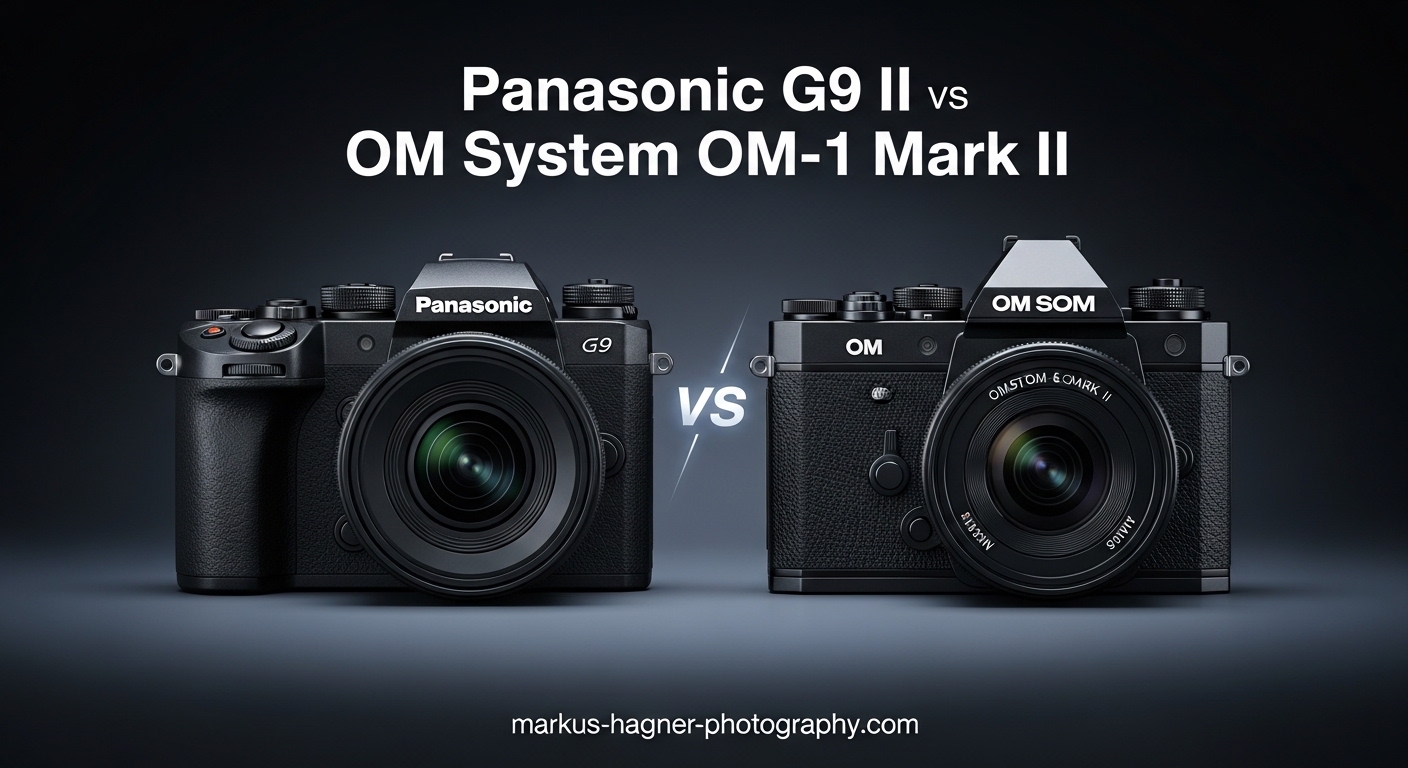
Choosing between the Panasonic G9 II vs OM System OM-1 Mark II comes down to what you shoot most. Both cameras represent the pinnacle of micro four thirds technology, but they take fundamentally different approaches to serving photographers and videographers.
I’ve spent considerable time analyzing both cameras, including real user experiences from photographers who own both. The short verdict? The G9 II excels at video and hybrid content creation, while the OM-1 Mark II dominates for wildlife, bird, and sports photography.
The Panasonic Lumix G9 II brings a higher-resolution 25.2MP sensor, superior video features including open gate recording, and exceptional image stabilization rated at 8.0 stops. The OM System OM-1 Mark II counters with a faster stacked sensor, virtually endless buffer depth for continuous shooting, and computational photography features that wildlife photographers swear by.
Both cameras share the micro four thirds mount, meaning you can use lenses from either system on either body. This compatibility makes the choice less about ecosystem lock-in and more about which camera’s philosophy matches your shooting style.
Panasonic G9 II vs OM System OM-1 Mark II: Quick Comparison
Here’s how these two flagship cameras stack up at a glance:
| Product | Specifications | Action |
|---|---|---|
 Panasonic Lumix G9 II Panasonic Lumix G9 II |
|
Check Latest Price |
 OM System OM-1 Mark II OM System OM-1 Mark II |
|
Check Latest Price |
Panasonic Lumix G9 II: The Video Powerhouse
Pros
- Phase Detection AF first for LUMIX G
- 60 fps burst with blackout-free viewfinder
- 8.0-stop image stabilization
- Excellent video with 10-bit 120p slow-motion
- Works exceptionally well with Olympus lenses
- Great weather sealing
Cons
- Larger RAW files slow workflow
- Buffer fills faster than OM-1 II
- Bulkier body than typical MFT
- Autofocus interface could be improved
The Panasonic Lumix G9 II represents a significant leap forward for Panasonic’s G-series. This is the first LUMIX G camera to feature phase detection autofocus, addressing a long-standing limitation that held back previous models. The 779-point phase-detection system delivers speed and precision that rival cameras have offered for years.
From my research into user experiences, the G9 II feels like a hybrid camera designed for content creators who refuse to compromise on either photo or video quality. The body weighs about 1.5 pounds, which some users note is heavier than expected for a micro four thirds camera. However, that weight accommodates robust weather sealing and a substantial grip that makes long shooting sessions comfortable.

The 25.2MP Live MOS sensor produces notably larger RAW files than its competitor, around 40MB per image compared to 19MB on the OM-1 Mark II. Photographers in forums consistently mention this as a workflow consideration. More resolution means more cropping flexibility and detail, but it also means more storage consumption and longer processing times.
Panasonic’s Dynamic Range Boost technology gives the G9 II impressive low-light performance. Users report excellent high ISO results with minimal noise, even at sensitivities that would challenge smaller sensors. The camera’s ability to record C4K and 4K video at 10-bit 120p opens creative possibilities that video-focused creators will appreciate.
The electronic viewfinder deserves special mention. The 3.68-million-dot OLED display with 0.8x magnification provides a clear, bright viewing experience. Combined with the blackout-free shooting at high burst rates, tracking fast action through the EVF feels natural and responsive.

One feature that hybrid shooters particularly value is open gate recording. This captures the full sensor height, giving editors maximum flexibility for reframing in post-production. Combined with 4:2:2 10-bit internal recording, the G9 II delivers video quality that approaches cinema cameras costing significantly more.
The pre-burst shooting function captures images before you fully press the shutter, helping you nail moments that would otherwise be missed. Combined with 60 fps continuous shooting with autofocus tracking, the G9 II handles fast action competently, though forum users note it behaves differently than the OM-1 Mark II in extended bursts.
Image stabilization rates at 8.0 stops for body-only stabilization, and the Dual I.S. 2 system coordinates with compatible lenses for up to 7.5 stops of correction. Users consistently praise the stabilization effectiveness, noting it eliminates shake even in challenging low-light situations.
OM System OM-1 Mark II: The Wildlife Photography Champion
OM SYSTEM Olympus OM-1 Mark II Micro Four Thirds System Camera 20MP BSI Stacked Sensor Weather Sealed Design (US Manufacturer Warranty)
Pros
- Compact and lightweight for travel
- Virtually endless buffer depth
- Excellent for bird and wildlife AF
- Outstanding computational features
- Handheld High Res Shot mode
- IP53 weather sealing rating
Cons
- More expensive than G9 II
- Complex interface to learn
- Mechanical shutter slightly slower
- Single battery design
The OM System OM-1 Mark II carries forward Olympus’s legacy while pushing computational photography to new heights. At 1.1 pounds, it’s noticeably lighter than the G9 II, a difference wildlife photographers appreciate during long days in the field. The IP53 rating for dustproof, splashproof, and freezeproof construction means this camera thrives in conditions that would send other cameras to the repair shop.
The 20MP Stacked BSI Live MOS sensor prioritizes speed over resolution. The stacked design enables incredibly fast readout speeds, which translates to reduced rolling shutter effects and the ability to shoot at 120 frames per second with the electronic shutter. More importantly for wildlife photographers, this speed enables a buffer that users describe as “virtually endless.”

Bird photographers consistently choose the OM-1 Mark II for its subject detection capabilities. The Cross Quad Pixel AF system with 1,053 all cross-type focus points tracks birds in flight with remarkable accuracy. Forum users who photograph birds for a living report that the updated subject detection in the Mark II version improves upon the already excellent original OM-1.
The computational photography features set this camera apart from anything else in the micro four thirds world. Live Composite mode automatically builds long exposures while preventing overexposure. Focus Stacking captures multiple images at different focus distances and combines them in-camera for extended depth of field. Live ND and Live GND filters simulate the effects of physical filters without requiring additional glass.
One of the most celebrated features is the Handheld High Res Shot mode, which produces images far exceeding the native 20MP resolution. Users report exquisite results when shooting landscapes and static subjects, though the mode works best with stationary subjects due to the multiple exposures required.

The smaller RAW file sizes around 19MB contribute significantly to the OM-1 Mark II’s buffer performance. Where the G9 II maintains a consistent frame rate until its buffer fills and then stops, the OM-1 Mark II starts writing to the card immediately and maintains a slower but continuous frame rate. For extended wildlife sessions, this behavior often proves more practical.
Pro Capture mode captures a rolling buffer of images before you press the shutter, ensuring you never miss the decisive moment. This feature combined with the camera’s bird detection AI makes it particularly effective for capturing birds taking flight or other unpredictable wildlife behavior.
The TruePic X engine processes data three times faster than previous generations, enabling all these computational features while maintaining responsive camera operation. Users transitioning from earlier Olympus or OM System cameras notice the improved responsiveness immediately.
Panasonic G9 II vs OM System OM-1 Mark II: Head-to-Head Comparison
Sensor and Image Quality
The G9 II’s 25.2MP sensor provides more resolution for cropping and large prints. The OM-1 Mark II’s 20MP stacked sensor prioritizes speed and readout performance. Both deliver excellent image quality, but they serve different priorities.
Users report the G9 II produces slightly better dynamic range through its Dynamic Range Boost technology. The larger files retain more shadow and highlight detail, giving editors more latitude for adjustments. However, the OM-1 Mark II’s files process faster and consume less storage.
Winner: Tie – The G9 II wins for resolution and dynamic range flexibility, while the OM-1 Mark II wins for workflow efficiency and speed.
Autofocus Performance
Both cameras feature sophisticated autofocus systems. The G9 II uses a 779-point phase-detection system, while the OM-1 Mark II employs a 1,053-point Cross Quad Pixel system. In practice, both track subjects reliably.
Bird photographers consistently give the edge to OM-1 Mark II for subject detection. The updated AI in the Mark II version specifically improves bird tracking in complex scenes with branches and foliage. The G9 II focuses smoothly but some users describe it as slightly slower in challenging conditions.
Winner: OM-1 Mark II – Slight edge for wildlife and bird photography subject detection.
Burst Shooting and Buffer Performance
The G9 II shoots up to 60 fps with continuous autofocus using the electronic shutter. The OM-1 Mark II reaches 120 fps electronic. These numbers tell only part of the story.
Forum users who own both cameras describe an important behavioral difference. The G9 II maintains its full frame rate until the buffer fills, then stops shooting. The OM-1 Mark II writes continuously during bursts, gradually slowing but never stopping completely. For a single action sequence, the G9 II’s predictable performance works well. For extended wildlife sessions, the OM-1 Mark II’s endless buffer often proves more practical.
The 40MB RAW files on the G9 II fill its buffer faster than the 19MB files on the OM-1 Mark II. This difference significantly impacts real-world shooting for sports and wildlife photographers.
Winner: OM-1 Mark II – Better buffer behavior for extended shooting sessions.
Video Capabilities
This is where the Panasonic G9 II clearly dominates. The camera records C4K and 4K video at up to 120p in 10-bit 4:2:2 internally. Open gate recording captures the full sensor height for maximum reframing flexibility in post. The video quality and feature set approach Panasonic’s dedicated cinema cameras.
The OM-1 Mark II records 4K at 60p, which covers most video needs. However, it lacks the advanced video features, bit depths, and recording options that videographers demand. OM System designed this camera primarily for still photography.
Users who prioritize video consistently choose the G9 II. One forum contributor summarized it succinctly: “From a video perspective, the G9 II is the better camera with better quality recording and much more flexibility.”
Winner: G9 II – Superior video features, quality, and flexibility by a significant margin.
Image Stabilization
Both cameras feature exceptional image stabilization. The G9 II rates at 8.0 stops for body-only stabilization, with Dual I.S. 2 providing up to 7.5 stops when combined with compatible lenses. The OM-1 Mark II offers 7.0 stops of sensor-shift stabilization.
In practice, users report both systems effectively eliminate camera shake for handheld shooting in low light. The difference between 7.0 and 8.0 stops rarely determines whether a shot succeeds. Both cameras enable handheld shooting at shutter speeds previously requiring a tripod.
Winner: Tie – Both systems deliver excellent real-world stabilization performance.
Build Quality and Ergonomics
The G9 II weighs 1.5 pounds with a substantial grip that accommodates larger hands. The OM-1 Mark II weighs 1.1 pounds with a more compact body design. Neither approach is inherently better, but they suit different preferences.
Users note the G9 II’s dials can be accidentally knocked, requiring occasional readjustment. The OM-1 Mark II’s drive mode button requires menu navigation rather than direct access, which some photographers find frustrating during fast-paced shooting.
Both cameras feature excellent weather sealing. The OM-1 Mark II’s IP53 rating provides specific certification that goes beyond general weather-sealed claims. Users report both cameras surviving rain, dust, and cold conditions reliably.
Winner: Tie – Both well-built with different ergonomic philosophies.
Battery Life
Battery life figures from standard testing show similar results for both cameras. Real-world performance depends heavily on shooting style, viewfinder usage, and environmental conditions.
Wildlife photographers shooting in cold conditions report both cameras drain batteries faster than rated. The OM-1 Mark II’s single-battery design prioritizes weight savings over extended shooting capacity. The G9 II’s larger body could accommodate a bigger battery but uses a similar capacity cell.
For extended field sessions, both cameras benefit from carrying spare batteries. Neither offers a significant advantage in practical battery endurance.
Winner: Tie – Comparable real-world battery performance.
Who Should Buy the Panasonic G9 II?
Choose the Panasonic Lumix G9 II if you:
Shoot hybrid content combining photos and video. The G9 II’s video capabilities far exceed the OM-1 Mark II, making it ideal for content creators who need one camera for everything.
Prioritize video quality and features. Open gate recording, 10-bit 4:2:2 output, and 120p slow motion give videographers professional-grade tools in a compact body.
Need maximum resolution for cropping or large prints. The 25.2MP sensor provides more flexibility for aggressive crops while maintaining image quality.
Value Dynamic Range Boost for challenging lighting. The G9 II’s ability to extend dynamic range helps in high-contrast situations where preserving both highlights and shadows matters.
Prefer a larger body with substantial grip. Photographers with bigger hands often find the G9 II more comfortable for extended sessions.
Who Should Buy the OM System OM-1 Mark II?
Choose the OM System OM-1 Mark II if you:
Specialize in wildlife, bird, or sports photography. The endless buffer, bird-optimized subject detection, and Pro Capture mode make this camera exceptional for capturing fast, unpredictable action.
Need the lightest possible kit for travel or hiking. The 1.1-pound body and compact OM System lenses create a kit significantly lighter than full-frame alternatives without sacrificing capability.
Value computational photography features. Live Composite, Focus Stacking, Handheld High Res Shot, and computational filters enable creative techniques impossible with traditional cameras.
Shoot extended action sequences. The OM-1 Mark II’s buffer behavior maintains continuous shooting where the G9 II would stop.
Prefer smaller RAW files for faster workflow. The 19MB files process faster and consume less storage than the G9 II’s 40MB files.
Frequently Asked Questions
Which camera is better for video?
The Panasonic G9 II is significantly better for video. It records C4K/4K at up to 120p in 10-bit 4:2:2 internally, offers open gate recording for maximum reframing flexibility, and includes professional video features that approach cinema camera quality. The OM-1 Mark II records 4K at 60p but lacks the advanced video capabilities serious videographers require.
Which camera is better for wildlife photography?
The OM System OM-1 Mark II is better for wildlife photography. Its virtually endless buffer, bird-optimized subject detection AI, Pro Capture mode, and lighter weight make it the preferred choice for wildlife and bird photographers. Users consistently report better tracking of birds in flight and more practical buffer behavior for extended shooting sessions.
Which camera has better autofocus?
Both cameras have excellent autofocus systems. The G9 II uses a 779-point phase-detection system, while the OM-1 Mark II employs a 1,053-point Cross Quad Pixel system. For bird and wildlife photography, the OM-1 Mark II has a slight edge due to its updated subject detection AI. For general photography, both track subjects reliably with minimal difference.
What are the key differences between G9 II and OM-1 Mark II?
The G9 II offers higher resolution (25.2MP vs 20MP), superior video features, and larger RAW files (40MB vs 19MB). The OM-1 Mark II provides a stacked sensor for faster readout, virtually endless buffer depth, better wildlife subject detection, and lighter weight. The G9 II excels for video and hybrid work; the OM-1 Mark II dominates for wildlife and sports photography.
Is the OM-1 Mark II worth the extra cost?
The OM-1 Mark II costs more than the G9 II, but for wildlife and bird photographers, the premium is justified. The endless buffer, superior bird detection, and lighter weight provide tangible benefits for field work. However, for video creators or photographers who don’t specialize in wildlife, the G9 II offers better value with more features at a lower price.
Final Verdict: Panasonic G9 II vs OM System OM-1 Mark II
The Panasonic G9 II vs OM System OM-1 Mark II comparison reveals two excellent cameras serving different photographers. Neither camera is universally better, which is why understanding your specific needs matters so much.
For hybrid content creators and videographers, the G9 II offers video capabilities that justify its purchase. The combination of photo quality and professional video features makes it arguably the best hybrid camera in the micro four thirds system.
For dedicated wildlife, bird, and sports photographers, the OM-1 Mark II’s buffer performance, subject detection, and computational features create a specialized tool that excels in its domain. The lighter weight and extensive lens ecosystem make it ideal for photographers who spend long days in the field.
Both cameras represent excellent choices for advanced photographers and professionals. Your decision should hinge on whether video capabilities or wildlife specialization matters more for your work.