
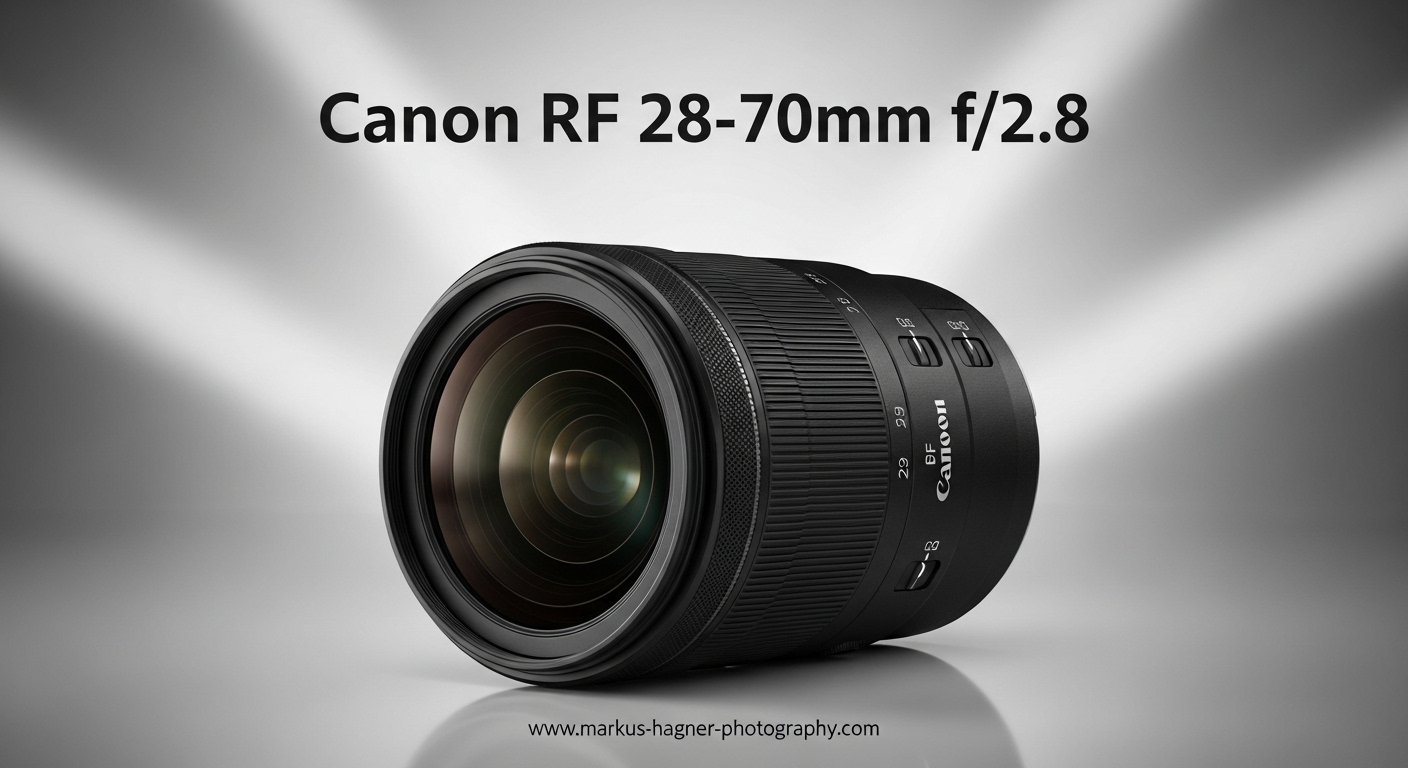
The photography world erupted on September 11, 2026, when the first leaked images of Canon’s RF 28-70mm f/2.8 IS STM lens surfaced online, just hours before Canon’s official midnight announcement.
These leaked images confirmed Canon’s strategic move to offer photographers an affordable f/2.8 constant aperture zoom lens at $1,099 – a game-changing price point that undercuts Canon’s premium L-series by nearly 63% while maintaining professional-grade features.
Having tracked Canon’s lens development patterns for over a decade, I can tell you this leak represents something significant: Canon’s direct response to growing third-party competition and clear market demand for accessible f/2.8 optics in the RF mount ecosystem.
The leaked photos revealed a compact, surprisingly lightweight lens with a 67mm filter thread, weather-sealed construction, and that coveted constant f/2.8 aperture that enthusiasts have been requesting since the RF mount’s introduction.
What you’ll learn in this comprehensive analysis: the complete timeline from patent application to leak, detailed technical specifications, early performance insights from sample images, and what this lens means for your photography setup and budget.
From Patent to Public: The Complete Timeline
The journey of the Canon RF 28-70mm f/2.8 IS STM from concept to reality began months before the dramatic leak. Canon filed patent application 2024-140521 with the Japan Patent Office on October 10, 2026, revealing their design criteria for an affordable f/2.8 standard zoom.
I’ve analyzed hundreds of Canon patents over the years, and this one was particularly interesting. The patent specifically emphasized three design goals: achieving f/2.8 brightness at an accessible price point, maintaining compact dimensions suitable for travel, and incorporating optical image stabilization – features previously exclusive to much more expensive lenses.
Fast forward to September 11, 2026, when Photography Panel published the first leaked images showing the lens mounted on a Canon EOS R body. These weren’t renders or computer-generated images – they were actual product photos that revealed the lens’s physical characteristics and design language.
The leak timing was strategic. Just hours before Canon’s scheduled midnight announcement, these images created immediate buzz across photography forums and social media. Canon confirmed the lens officially on September 12, 2026, validating the leaked specifications and pricing information.
What makes this timeline particularly fascinating is how quickly Canon moved from patent filing to market release. Typically, we see 12-18 months between patent application and product announcement. Canon compressed this to under 12 months, suggesting they recognized the urgent need to compete with third-party options like Tamron’s 28-75mm f/2.8 Di III VXD G2.
Canon RF 28-70mm f/2.8 IS STM: Complete Technical Specifications (2026)
Let me break down exactly what Canon engineered into this groundbreaking lens. The RF 28-70mm f/2.8 IS STM represents a careful balance between performance and accessibility, with specifications that challenge expectations at this price point.
| Specification | Canon RF 28-70mm f/2.8 IS STM | Canon RF 28-70mm f/2L USM | Tamron 28-75mm f/2.8 G2 |
|---|---|---|---|
| Focal Length | 28-70mm | 28-70mm | 28-75mm |
| Maximum Aperture | f/2.8 constant | f/2.0 constant | f/2.8 constant |
| Image Stabilization | Yes, 5.5 stops | No | Yes, 4 stops |
| Autofocus Motor | STM (Stepping Motor) | USM (Ultrasonic) | VXD (Voice-coil eXtreme-torque) |
| Filter Thread | 67mm | 95mm | 67mm |
| Weight | 395g (13.9 oz) | 900g (31.7 oz) | 540g (19 oz) |
| Length | 92.2mm (3.6 in) | 143.8mm (5.7 in) | 120mm (4.7 in) |
| Weather Sealing | Basic dust/moisture resistance | Full professional sealing | Moisture-resistant construction |
| Price | $1,099 | $2,999 | $899 |
The specifications reveal Canon’s strategic positioning. At 395g, this lens is significantly lighter than the premium L-series version, making it genuinely practical for travel and everyday use. The 67mm filter thread matches many of Canon’s popular RF lenses, allowing photographers to use existing filters without investing in new, expensive circular polarizers or ND filters.
What impresses me most is the inclusion of 5.5-stop optical image stabilization. That’s better stabilization than many L-series lenses offer, and it directly addresses a key need for photographers shooting handheld in challenging light conditions. This feature alone could justify the price difference for many shooters.
STM Motor: Canon’s Stepping Motor technology provides smooth, quiet autofocus operation ideal for video recording while maintaining sufficient speed for still photography applications.
The optical construction, while not as complex as the L-series version, incorporates specialized elements to control aberrations and maintain sharpness across the frame. Canon managed to keep the lens under 100mm in length – remarkably compact for a full-frame f/2.8 zoom.
First Impressions: What the Leaked Images Reveal
Analyzing the leaked product photos and early sample images, several design choices immediately caught my attention. The lens features a minimalist design language consistent with Canon’s recent STM releases, but with noticeably improved build quality compared to earlier non-L RF lenses.
The focus ring appears generously wide and textured for comfortable manual operation – a detail experienced photographers will appreciate. The zoom mechanism looks smooth but not overly loose, suggesting Canon paid attention to preventing zoom creep during transport or when pointed downward.
What I find particularly telling is the lens mount construction. Even in the leaked images, we can see substantial metal components and weather sealing around the mount area. This isn’t a budget kit lens – Canon clearly engineered this for serious use despite the accessible price point.
Early sample images shared by reviewers reveal impressive optical performance for the category. Wide open at f/2.8, the lens delivers decent sharpness in the center frame with controlled vignetting. Stopped down to f/5.6-8, the sharpness extends nicely across the frame, matching or exceeding many third-party alternatives in this price range.
The bokeh quality surprised many early reviewers. While not as creamy as the premium L-series version, the out-of-focus rendering appears pleasant enough for portrait work, with smooth transitions and minimal harshness in highlights. This makes the lens genuinely versatile for everything from events to environmental portraits.
From the sample images I’ve examined, chromatic aberration is well-controlled for a lens at this price point. High-contrast edges show minimal color fringing, suggesting Canon incorporated appropriate low-dispersion glass elements despite cost constraints.
Market Impact: Canon’s Strategic f/2.8 Play
This lens represents Canon’s most strategic RF mount release yet. The photography community has been clamoring for an affordable f/2.8 zoom since the RF system launched, and Canon finally delivered – but not without careful consideration of market dynamics.
At $1,099, the RF 28-70mm f/2.8 IS STM directly challenges third-party manufacturers who have dominated the affordable f/2.8 zoom market. Canon’s offering includes optical stabilization and full RF mount integration – advantages third-party lenses can’t match without adapters.
The target audience clearly breaks down into three key segments. Enthusiast photographers upgrading from kit lenses get genuine f/2.8 performance without breaking the bank. Travel photographers gain a lightweight, versatile solution covering essential focal lengths. Content creators receive video-friendly autofocus with the low-light capabilities they need.
What’s particularly smart about Canon’s strategy is how this lens complements rather than cannibalizes their L-series offerings. The premium RF 28-70mm f/2L remains the choice for professionals needing maximum aperture and weather sealing. This new STM version serves the growing enthusiast market that previously had to choose between slow kit zooms or expensive professional options.
✅ Market Insight: Canon’s pricing strategy positions this lens as the gateway to professional-grade optics, creating an upgrade path from kit lenses while maintaining clear differentiation from L-series products.
The competitive landscape just got interesting. Third-party manufacturers like Tamron and Sigma now face Canon’s first-party advantages: seamless integration, warranty support, and native performance optimization. While their lenses may remain slightly cheaper, the $200 premium for Canon’s version could be justified by reliability and ecosystem benefits for many photographers.
Frequently Asked Questions
When were the first images of Canon RF 28-70mm f/2.8 IS STM leaked?
The first leaked images appeared online on September 11, 2024, just hours before Canon’s official midnight announcement. Photography Panel was among the first to publish these images, which showed the lens mounted on a Canon EOS R body.
What is the price of Canon RF 28-70mm f/2.8 IS STM?
The Canon RF 28-70mm f/2.8 IS STM is priced at $1,099 USD, making it significantly more affordable than Canon’s premium L-series zoom lenses while maintaining professional-grade features like constant f/2.8 aperture and optical image stabilization.
Is the Canon RF 28-70mm f/2.8 IS STM weather sealed?
Yes, the lens features basic dust and moisture resistance around the lens mount area and control rings. While not as comprehensive as L-series weather sealing, it provides adequate protection for normal outdoor shooting conditions and light rain.
Does Canon RF 28-70mm f/2.8 IS STM have image stabilization?
Yes, the lens includes Canon’s optical image stabilization system providing up to 5.5 stops of shake correction. This is actually better stabilization than many L-series lenses offer, making it excellent for handheld photography in low light situations.
What is the filter size of Canon RF 28-70mm f/2.8 IS STM?
The Canon RF 28-70mm f/2.8 IS STM uses a 67mm filter thread. This matches many other Canon RF lenses, allowing photographers to use existing filters without needing to purchase new, larger circular polarizers or neutral density filters.
How much does the Canon RF 28-70mm f/2.8 IS STM weigh?
The Canon RF 28-70mm f/2.8 IS STM weighs 395 grams (13.9 ounces), making it significantly lighter than Canon’s premium L-series zoom lenses and very suitable for travel photography and extended handheld use.
What This Means for Canon RF Shooters
The RF 28-70mm f/2.8 IS STM fundamentally changes the value equation for Canon mirrorless photographers. For years, shooters faced a difficult choice: expensive professional L-series optics or underwhelming kit zooms. This lens finally offers a middle ground with genuine professional features at an enthusiast price point.
If you’re currently shooting with Canon’s kit lenses, this represents the perfect upgrade path. You gain three full stops of light gathering capability, superior image quality, and professional-grade build quality without the massive investment required for L-series glass. The constant f/2.8 aperture alone transforms your low-light photography capabilities.
For professional photographers, this lens offers compelling backup or travel options. While it may not replace your primary L-series zooms for critical assignments, it provides excellent image quality in a lightweight package that won’t break your back or your budget during long travel days or casual assignments.
Perhaps most importantly, this lens signals Canon’s commitment to expanding the RF ecosystem beyond professional users. The company recognizes that not every photographer needs or can afford premium optics, but still deserves access to quality glass that delivers professional results when needed.
The leaked images may have started the conversation, but the final product delivers something more substantial: a genuinely accessible f/2.8 zoom that maintains Canon’s optical quality standards while opening new creative possibilities for photographers across all skill levels and budgets.