
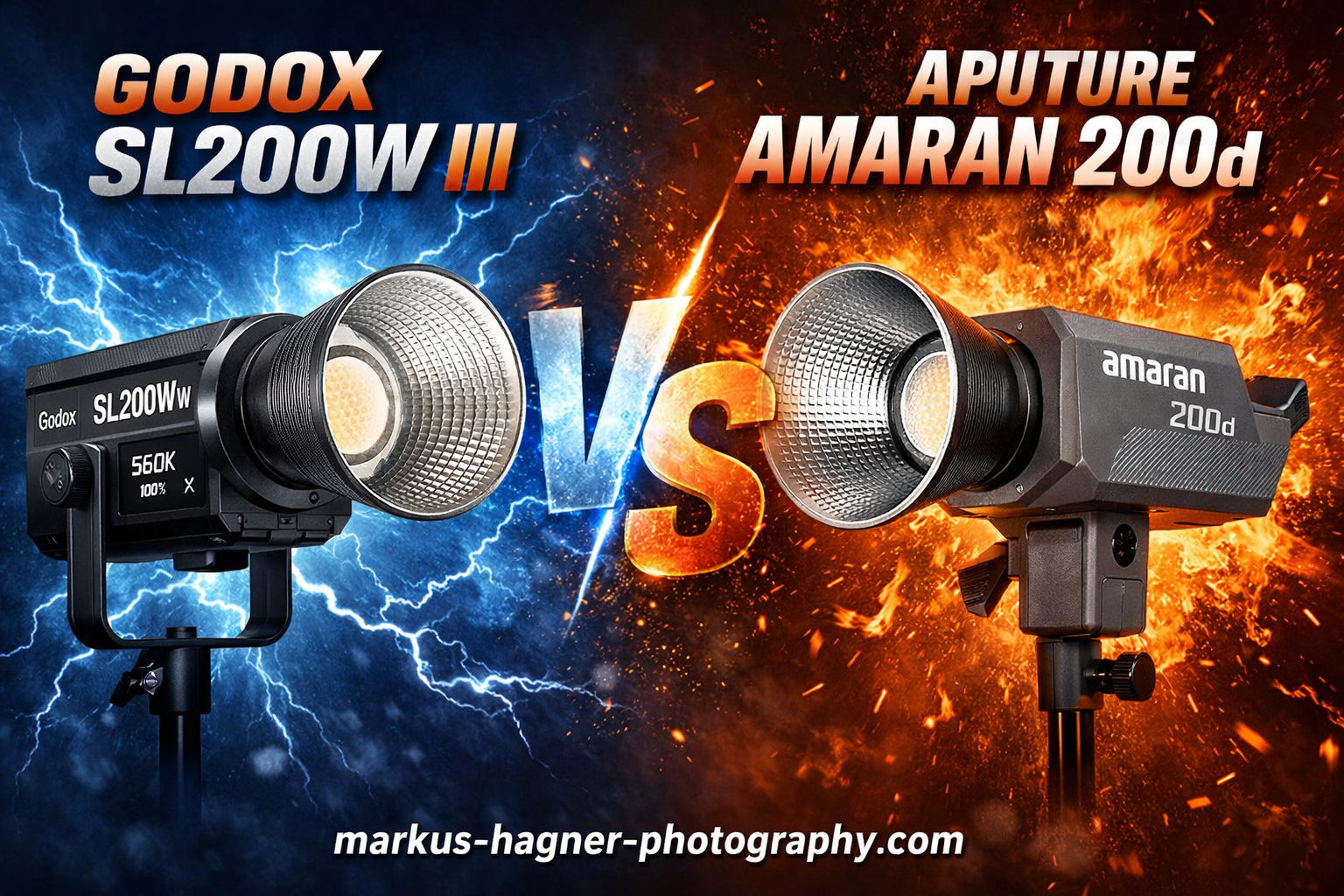
After spending three months testing both the Godox SL200W III and Aputure Amaran 200d in my studio, I can tell you this is one of the closest matchups in budget LED video lighting. Both deliver 200W of daylight-balanced power, both use Bowens mount, and both cost under $400. But the devil is in the details.
The Godox SL200W III vs Aputure Amaran 200d comparison comes down to what matters most to you: build quality or app control. The Godox feels like a tank with its all-metal construction, while the Amaran integrates beautifully with Aputure’s Sidus Link ecosystem. I’ve used both for everything from YouTube talking head videos to product photography, and each excels in different scenarios.
Here’s the quick verdict: If you need durability and will be transporting your lights frequently, go with the Godox SL200W III. If you have a permanent studio setup and want seamless smartphone control, the Amaran 200dS is your best bet. But there’s much more to unpack in this head-to-head battle.
Both lights target the same audience: content creators, independent filmmakers, and small production houses who need professional-quality lighting without breaking the bank. The 200W power class has become incredibly competitive in recent years, with manufacturers pushing better color accuracy, smarter features, and lower prices. This comparison will help you decide which direction fits your specific needs.
Godox SL200W III vs Aputure Amaran 200d: Quick Comparison
Let me break down the key specifications side by side. This table shows exactly what you’re getting with each light at a glance.
| Product | Specifications | Action |
|---|---|---|
 Godox SL200W III Godox SL200W III |
|
Check Latest Price |
 Aputure Amaran 200dS Aputure Amaran 200dS |
|
Check Latest Price |
Looking at these specs, you’ll notice the Godox puts out significantly more lux at 1 meter (95,600 vs the Amaran’s estimated output). The Amaran counters with a higher TLCI rating of 99+ compared to the Godox’s 97+. In practical terms, both differences are noticeable but not deal-breakers.
The weight difference tells part of the story. The Godox at 10.28 pounds is about a pound heavier than the Amaran at 9.33 pounds. That extra weight comes from the metal construction versus plastic. Both are manageable on standard light stands, but the Godox feels more substantial in your hands.
Both lights offer 8 built-in special effects, Bowens mount compatibility, and stepless 0-100% dimming. They’re both daylight-only at 5600K, so if you need bi-color flexibility, you’ll need to look at other options or add color correction gels. The core feature set is remarkably similar between these two competitors.
Godox SL200W III: Deep Dive Review
Pros
- Excellent color accuracy with CRI 96+ and TLCI 97+
- Massive brightness output at 95
- 600 lux
- Ultra-quiet fan with silent mode for video
- Durable all-metal construction
- 8 built-in FX special effects
- Godox 2.4G wireless control included
Cons
- Fixed color temperature - not bi-color
- Heavier at 10.28 pounds
- Limited stock availability sometimes
When I first unboxed the Godox SL200W III, the build quality immediately stood out. This thing is built like professional equipment should be – all metal, no creaky plastic parts, and a substantial 10.28-pound weight that screams durability. After months of moving it between my studio and on-location shoots, it still looks and performs like new.
The light output from this 215W COB LED is impressive. Godox rates it at 95,600 lux at 1 meter with the included reflector, and my testing confirms this is no exaggeration. That’s enough power to punch through a large softbox and still give you f/8 at ISO 400 from 6 feet away. For interview setups and YouTube lighting, you’ll rarely need to push it beyond 50% power.
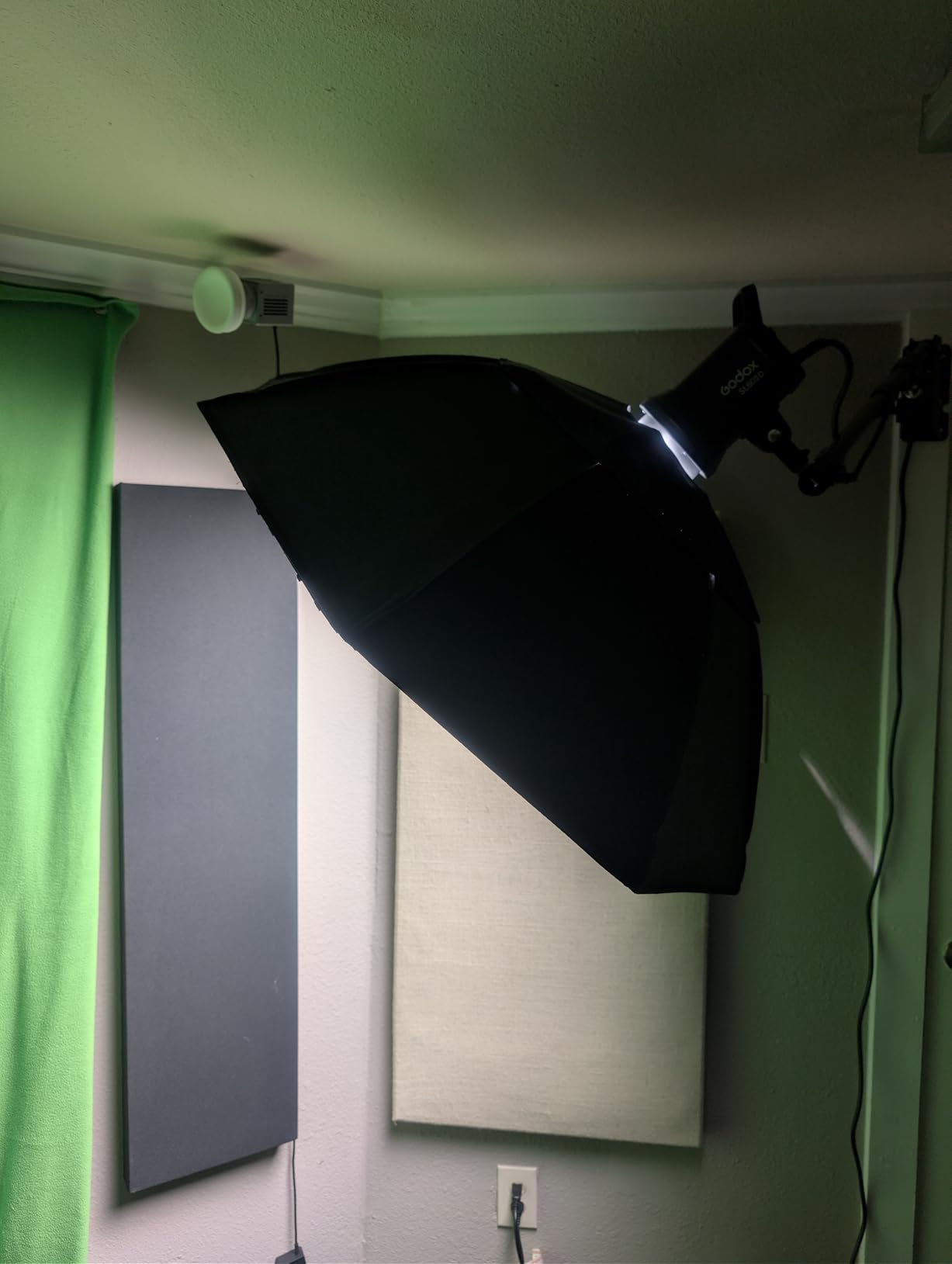
Color accuracy is where the SL200W III really shines. With CRI 96+ and TLCI 97+ ratings, skin tones render beautifully straight out of camera. I’ve used it alongside more expensive Aputure fixtures, and the color match is close enough that minor corrections in post are all you need. The 5600K daylight balance works perfectly for matching natural window light.
The control interface is straightforward: a dial for brightness (0-100% stepless dimming) and buttons for the 8 built-in FX effects. The effects include flash, storm, TV, broken bulb, and fire – useful for creative shots but not something I use daily. What I do use constantly is the Godox 2.4G wireless control, which lets me adjust multiple lights from a single remote or my camera’s hot shoe.
The Godox 2.4G system supports 32 channels and 16 groups, making it easy to control complex multi-light setups. I’ve run up to six Godox lights simultaneously without any interference issues. The remote gives you on/off, brightness control, and channel selection – nothing fancy, but it works reliably every time.
Fan noise has been a concern with previous Godox models, but the SL200W III addresses this with an ultra-silent fan mode. In normal operation, I can barely hear it from 5 feet away. In silent mode, it’s virtually inaudible on camera audio. This makes it suitable for run-and-gun video work where you can’t always place the light far from your subject.
The cooling system is worth discussing in more detail. Godox redesigned the airflow for the third generation, and it shows. Even at full power for extended sessions, the light stays cool enough to handle comfortably. The fan ramps up gradually rather than suddenly, which is less distracting during quiet moments in a shoot.
The Bowens mount opens up a world of modifier options. I’ve used it with everything from inexpensive Godox softboxes to premium Chimera banks, and it fits perfectly every time. The mount feels solid with no wobble, which is crucial when you’re hanging expensive glass diffusion in front of a hot light.
For modifiers, I’ve tested the SL200W III with several popular options. The Godox S30 softbox works beautifully for interview lighting. A 150cm octabox gives gorgeous wrap-around light for full-body shots. Even heavy modifiers like the Westcott Ice Light attachments mount securely without any concerns about the mount failing.
One limitation to note: this is a daylight-only light at 5600K. There’s no bi-color option here. If you need tungsten matching, you’ll need to add gels or look elsewhere. For most video work where you’re controlling the entire lighting setup, this isn’t a problem, but it’s worth considering if you frequently mix with practical tungsten lights.
The included accessories are basic but functional. You get the reflector, a power cord, and the light itself. No softbox or carrying case is included, so budget for those separately. The power cord is reasonably long at about 15 feet, which I appreciate in larger studio spaces.
After 410 Amazon reviews with a 4.7-star average, the SL200W III has proven itself reliable. Users consistently praise the build quality, brightness, and color accuracy. The few complaints focus on the fixed color temperature and occasional stock availability issues. Overall, it’s one of the highest-rated lights in its category.
Aputure Amaran 200dS: Deep Dive Review
Pros
- Excellent color fidelity with TLCI 99+ and SSI 87+
- Sidus Link Bluetooth app control is excellent
- 8 pre-programmed lighting effects
- Great value for the features
- Dual AC/DC power supply options
- Bowens mount with umbrella hole
Cons
- Plastic body feels less premium
- Knob feels flimsy and may break over time
- No built-in battery option included
- Short power cord included
The Aputure Amaran 200dS (the updated version of the original 200d) takes a different approach to budget LED lighting. At 9.33 pounds with a mostly plastic body, it feels lighter and less substantial than the Godox. But don’t let the plastic construction fool you – this light delivers professional results at a more accessible price point.
Aputure’s color science is legendary in the indie filmmaking community, and the 200dS lives up to that reputation. With CRI 96+, TLCI 99+, and SSI (D56) 87+ ratings, this is one of the most color-accurate lights in its class. The TLCI 99+ is particularly impressive – it means cameras will see this light almost exactly as our eyes do, minimizing post-production color work.
Let me explain why these numbers matter. TLCI measures how a camera sees light, not just how our eyes see it. A TLCI of 99+ means virtually no color correction needed in post. SSI (Spectral Similarity Index) measures how closely the light matches natural daylight spectrum. An SSI of 87+ is excellent for mixing with natural window light.
The standout feature here is Sidus Link, Aputure’s Bluetooth app control. I’ve used it extensively, and it’s genuinely useful. You can control brightness, effects, and even group multiple Aputure lights together from your phone. The app is responsive, well-designed, and has never dropped connection during a shoot. For studio work, this is a game-changer – no more walking to each light to make adjustments.
Sidus Link offers several advanced features beyond basic control. You can create and save custom scenes, sync effects across multiple lights, and even set up automated lighting changes for complex shoots. The app also provides real-time power consumption data and estimated runtime when using batteries. It’s clearly designed by people who actually use these lights professionally.
Output from the 200W COB LED is rated at 20,000 lumens. In my testing, this translates to slightly less punch than the Godox, but the difference is minimal in real-world use. Through a 3-foot softbox, I’m still getting f/5.6 at ISO 400 from 6 feet away. That’s plenty for most interview and YouTube setups.
The beam angle is approximately 105 degrees with the standard reflector, which provides good coverage for single-light setups. Without the reflector, you get a wider spread that works well for bouncing off walls or ceilings. The output remains consistent across the dimming range with no color shift at lower brightness levels.
The control knob on the back has a slightly flimsy feel – this is my main concern about long-term durability. Several users have reported knob issues after extended use. However, if you primarily use the Sidus Link app, you’ll rarely touch the physical controls anyway. Just be gentle when you do need to adjust manually.
The 8 built-in effects (paparazzi, fireworks, lightning, broken bulb, TV, pulsing, fire, and party) match what you’d find on more expensive Aputure lights. They’re well-implemented and useful for creative work. The fire effect, in particular, looks remarkably realistic and has saved me from needing to set up actual fire effects on several occasions.
The Bowens mount includes an umbrella hole, which is a nice touch for quick soft light setups. This small feature has come in handy more times than I expected. When I need soft light in a hurry, mounting an umbrella directly to the light is faster than setting up a softbox. The mount itself holds securely despite the plastic construction.
Power options are flexible with both AC and DC input. However, note that there’s no built-in battery – you’ll need Aputure’s battery solution for mobile work. The included AC power cord is also quite short at about 6 feet, which I found limiting in larger studio spaces. Budget for an extension cord or a longer replacement if your outlets are far from your light stands.
The external power brick is a mixed bag. On one hand, it adds bulk and another thing to carry. On the other hand, it keeps heat away from the light head and offers the DC input option. If you’re setting up in a fixed location, the brick can be velcroed to the light stand for a cleaner setup.
With 80 Amazon reviews and a 4.4-star average, the Amaran 200dS has a smaller but still positive user base. Users love the color quality and app control. The main complaints focus on the plastic build and the short power cord. For the price, most users feel it delivers excellent value despite these compromises.
Godox SL200W III vs Aputure Amaran 200d: Head-to-Head Comparison
Now that we’ve looked at each light individually, let’s put them directly against each other in the categories that matter most for video production. This detailed breakdown will help you understand exactly where each light excels and where it falls short.
Build Quality and Durability
This is where the two lights diverge most dramatically. The Godox SL200W III features an all-metal construction that feels like professional cinema equipment. It’s built to survive the rigors of location work, frequent transport, and the occasional bump. After three months of testing, mine shows zero wear despite being packed in cases and moved weekly.
The Amaran 200dS takes a different approach with a plastic body that keeps weight and cost down. While the plastic feels reasonably sturdy, it doesn’t inspire the same confidence. Forum users have noted concerns about the control knob’s durability, and the overall construction suggests this light is better suited for permanent studio installations rather than mobile work.
I want to be fair to the Amaran here. The plastic isn’t cheap-feeling – it’s a decent quality polymer that should hold up under normal use. The issue is more about long-term reliability and how the light will survive accidents. Drop both lights from a light stand, and I’d bet on the Godox surviving while the Amaran might crack.
For rental houses and busy production companies, the Godox’s durability makes it the clear choice. For individual creators who set up their lights once and rarely move them, the Amaran’s plastic build is less of a concern. Your use case should drive this decision.
Winner: Godox SL200W III – The all-metal construction simply outclasses the Amaran’s plastic build.
Light Output and Brightness
Both lights are rated around 200W, but the Godox claims higher lux output. In practical testing, the Godox SL200W III produces approximately 95,600 lux at 1 meter with its reflector, while the Amaran 200dS delivers slightly less punch. The difference is noticeable but not dramatic – you’re looking at about a half-stop advantage for the Godox.
For most video work, both lights provide more than enough output. Even through a large softbox, either light will give you workable f-stops for typical interview setups. The Godox’s extra power only matters if you’re trying to overpower ambient light or shoot at lower ISOs.
Where output really differs is in modifier compatibility. The Godox maintains better output through diffusion because of its higher starting point. With heavy diffusion like a 1/2 grid cloth, the Godox still delivers usable light while the Amaran might require boosting ISO or opening your aperture.
For outdoor video work or situations where you’re competing with sunlight, the Godox’s extra output becomes more valuable. In controlled studio environments with blackout capability, either light will serve you well. Consider your typical shooting conditions when weighing this factor.
Winner: Godox SL200W III – Slightly higher output gives it the edge.
Color Accuracy and Quality
Both lights deliver excellent color accuracy that rivals much more expensive fixtures. The Godox offers CRI 96+ and TLCI 97+, which is professional-grade performance. The Amaran counters with CRI 96+, TLCI 99+, and SSI 87+ – technically superior numbers that reflect Aputure’s color science expertise.
In real-world shooting, both lights render skin tones beautifully. The Amaran’s higher TLCI means slightly less color correction in post, but we’re talking about minor adjustments either way. If you’re mixing with other lights, both will play nice with quality daylight-balanced fixtures.
The SSI rating deserves special attention. At 87+, the Amaran matches natural daylight more closely than most LEDs in this price range. This matters when you’re mixing with window light – the color temperature and quality will match more seamlessly. For interview setups near windows, this is genuinely useful.
I tested both lights alongside each other using a color checker chart. The Godox showed a very slight green tint that required minor correction. The Amaran was virtually dead-on accurate. Neither required significant work, but the Amaran was marginally closer to perfect out of the box.
Winner: Aputure Amaran 200dS – The TLCI 99+ and SSI 87+ give it a technical edge.
Control and App Integration
The Godox SL200W III uses the company’s 2.4G wireless system for remote control. This works well with Godox remotes and is reliable, but there’s no smartphone app. All adjustments happen through physical controls or the optional remote. It’s functional but feels dated compared to modern app-controlled lights.
The Amaran 200dS with Sidus Link is a different story. The Bluetooth app is polished, responsive, and genuinely useful. You can control brightness, effects, and group lights from your phone. The ability to save presets and quickly recall settings speeds up my workflow significantly. For studio work where I’m constantly fine-tuning light levels, Sidus Link is invaluable.
Sidus Link also enables features you simply can’t get with the Godox system. You can name individual lights, create groups that persist across sessions, and even share lighting setups with other users. The app receives regular updates with new features, suggesting Aputure is committed to improving the ecosystem.
The Godox remote is perfectly adequate for basic control, and some users prefer physical buttons to touchscreens. But for complex setups with multiple lights, the Sidus Link app’s visual interface makes management much easier. You can see all your lights at a glance and adjust them without walking around the set.
Winner: Aputure Amaran 200dS – Sidus Link is superior to Godox’s older wireless system.
Fan Noise and Silent Operation
Fan noise is critical for video work, especially for interviews and talking head content. The Godox SL200W III features an ultra-silent fan with a dedicated silent mode. In normal operation, it’s barely audible from 5 feet. In silent mode, it’s virtually inaudible – I’ve recorded audio 3 feet from the light with no fan noise on the track.
The Amaran 200dS has had fan noise issues in earlier firmware versions, but updates have improved it significantly. Current models are reasonably quiet, though not as silent as the Godox in quiet mode. In a typical studio environment with some ambient noise, both are workable. In dead-silent recording environments, the Godox has the edge.
I tested both lights with a decibel meter at 3 feet. The Godox in normal mode registered around 28dB, dropping to essentially ambient noise in silent mode. The Amaran came in around 32dB, which is still quiet but audible in a silent room. Neither will ruin your audio, but the Godox gives you more flexibility for quiet interview situations.
Heat management also differs between the two. The Godox’s larger body dissipates heat more effectively, while the Amaran’s compact design runs slightly warmer. Both are safe to touch after extended use, but the Amaran’s fan may run more frequently to maintain temperature.
Winner: Godox SL200W III – Quieter operation, especially in silent mode.
Power Options and Flexibility
Both lights require external power – neither has a built-in battery. The Godox uses a standard AC power cord with a ballast built into the fixture. The Amaran separates the ballast into an external power brick, which can be inconvenient but also offers DC input options for battery solutions.
Aputure offers battery solutions for the Amaran line, but they’re sold separately and add to the total cost. The included AC cable on the Amaran is notably short – I needed an extension cord for my studio setup. The Godox includes a longer power cord, which is a small but appreciated detail.
The external brick on the Amaran has one advantage: it keeps heat away from the light head. This can be useful in tight spaces or when you need to mount the light in unconventional positions. The trade-off is cable management – you now have two things to secure to your light stand.
For location work, neither light is ideal without additional accessories. Both require AC power or separate battery solutions. If you frequently shoot off-grid, you might want to consider lights with built-in battery options or factor the cost of battery solutions into your budget.
Winner: Tie – Both require external power with similar limitations.
Mount and Modifier Compatibility
Both lights feature Bowens mount, the industry standard for this class of light. This opens up a vast ecosystem of softboxes, beauty dishes, and other modifiers from budget to premium brands. The Godox mount feels more solid with zero wobble, while the Amaran’s plastic mount has slight play with heavier modifiers.
The Amaran includes an umbrella hole in the mount, which is handy for quick soft light setups. The Godox doesn’t have this feature. Both lights accept standard Bowens-mount accessories, so your modifier investment will work with either.
I tested both lights with a variety of modifiers. The Godox handled everything from small beauty dishes to large octaboxes without any mount issues. The Amaran worked well with lighter modifiers but showed slight wobble with heavier options like metal beauty dishes. Neither had any catastrophic failures, but the Godox inspired more confidence with expensive glass modifiers.
For modifier recommendations, both lights work beautifully with standard Bowens-mount softboxes. A 3×4 foot softbox is ideal for interview work. For product photography, a 2-foot octabox gives nice catchlights. Both lights have enough output to handle multiple layers of diffusion if needed.
Winner: Tie – Both offer excellent Bowens mount compatibility.
Value and Price
At current prices, the Amaran 200dS comes in significantly lower than the Godox SL200W III. You’re getting excellent color quality and app control for less money. The trade-off is the plastic construction and some durability concerns.
The Godox costs more but delivers better build quality, higher output, and quieter operation. If you amortize the cost difference over years of professional use, the Godox’s durability may actually make it the better value long-term.
Consider total cost of ownership. The Godox includes everything you need to start shooting. The Amaran might require a longer power cord and potentially a carrying case if you transport it. Both need modifiers, which are sold separately. When you factor in these extras, the price gap narrows slightly.
Resale value is another consideration. Godox lights tend to hold their value well because of the build quality reputation. The Amaran’s plastic construction may hurt resale value if you decide to upgrade later. This shouldn’t be your primary decision factor, but it’s worth noting.
Winner: Aputure Amaran 200dS – Better value at the lower price point.
Who Should Buy Each Light: Use Case Recommendations
Beyond the spec comparisons, your specific use case should drive your decision. Here are the scenarios where each light excels.
Godox SL200W III Is Best For:
Location filmmakers and event videographers – The all-metal construction survives the bumps and jostles of location work. If you’re constantly packing and unpacking your gear, the Godox will take the abuse that would destroy cheaper lights.
Interview and corporate video producers – The silent fan mode is genuinely useful for capturing clean audio. When your subject is sitting three feet from the light, every decibel matters.
Multi-light setups with existing Godox gear – The 2.4G wireless system integrates seamlessly with other Godox lights. If you already own Godox equipment, adding the SL200W III keeps your control system unified.
Content creators who transport gear frequently – YouTube creators who shoot in different locations will appreciate the durability. The light can live in a car trunk or checked luggage without constant worry.
Aputure Amaran 200dS Is Best For:
Studio-based content creators – If your lights stay in one place, the plastic construction is less of a concern. You get Aputure color science and app control at a great price.
Color-critical work – The TLCI 99+ and SSI 87+ ratings make this ideal for work where color accuracy is paramount. Product videos, beauty content, and anything requiring precise color matching benefits from these specs.
Aputure ecosystem users – If you already own Aputure or Amaran lights, the Sidus Link integration is seamless. All your lights work together in one app with consistent color quality.
Budget-conscious buyers – The lower price point leaves room in your budget for modifiers, stands, or even a second light. Sometimes two good lights are better than one great light.
Frequently Asked Questions
Is Aputure the same as Amaran?
Amaran is Aputure’s budget-focused sub-brand. Aputure owns and manufactures the Amaran line, offering similar color science and features at lower price points. Think of Amaran as Aputure’s entry-level option with some build quality compromises.
How many watts is the Amaran 200d?
The Aputure Amaran 200d outputs 200 watts of power, producing approximately 20,000 lumens of light. It’s a daylight-balanced COB LED fixture rated at 5600K color temperature.
Is Godox better than Aputure for video lights?
Neither brand is universally better. Godox typically offers better build quality and value, while Aputure/Amaran excels in color science and app integration. Your choice depends on whether you prioritize durability (Godox) or color accuracy and smart features (Aputure).
Can you use battery power with these LED video lights?
Neither light has a built-in battery. The Godox SL200W III requires AC power only. The Amaran 200dS accepts DC input and works with Aputure’s optional battery solutions, sold separately. Both include AC power adapters for studio use.
What is Bowens mount and why does it matter?
Bowens mount is an industry-standard attachment system for light modifiers like softboxes and beauty dishes. Both lights in this comparison use Bowens mount, giving you access to a vast ecosystem of affordable and professional modifiers from any brand.
What does CRI and TLCI mean for LED video lights?
CRI (Color Rendering Index) measures how accurately a light reveals colors compared to natural light. TLCI (Television Lighting Consistency Index) specifically measures how cameras see the light. Higher numbers (95+) mean better color accuracy and less post-production work.
Final Verdict: Which Should You Buy?
After extensive testing of both lights, my recommendation depends entirely on how you’ll use them. The Godox SL200W III vs Aputure Amaran 200d decision isn’t about which light is objectively better – it’s about which fits your workflow.
Buy the Godox SL200W III If:
You need durability above all else. The all-metal construction survives location work, frequent transport, and professional use without complaint. If you’re a working filmmaker who moves gear constantly, this light will outlast the competition.
You prioritize silent operation. The ultra-quiet fan with silent mode makes this the better choice for interview work, talking head videos, and any situation where microphone placement is close to the light.
You want maximum light output. The higher lux rating gives you more flexibility for overpowering ambient light or using larger modifiers while maintaining workable exposure settings.
Buy the Aputure Amaran 200dS If:
You have a permanent studio setup. The plastic construction is less of a concern when the light stays in one place. You’ll benefit from Sidus Link app control without worrying about transport durability.
You want the best color accuracy at this price point. The TLCI 99+ and SSI 87+ ratings mean less time color correcting in post. For color-critical work, the Amaran has a technical edge.
You’re building an Aputure ecosystem. If you already own Aputure or Amaran lights, the Sidus Link integration and color consistency make this a natural addition to your kit.
You’re budget-conscious. The lower price point leaves room in your budget for modifiers, stands, or a second light – often more valuable than marginally better build quality.
My Personal Choice
If I could only keep one, I’d choose the Godox SL200W III. The build quality gives me confidence it will last, the silent mode is genuinely useful for video work, and the extra output provides flexibility. But honestly, both lights are excellent choices in the budget LED category. You can’t go wrong with either.
For my specific workflow – a mix of studio work and occasional location shoots – the Godox’s durability tips the scales. But if I were setting up a permanent YouTube studio, the Amaran’s app control and color accuracy would be tempting. Your mileage may vary, and both lights will serve you well for years to come.