
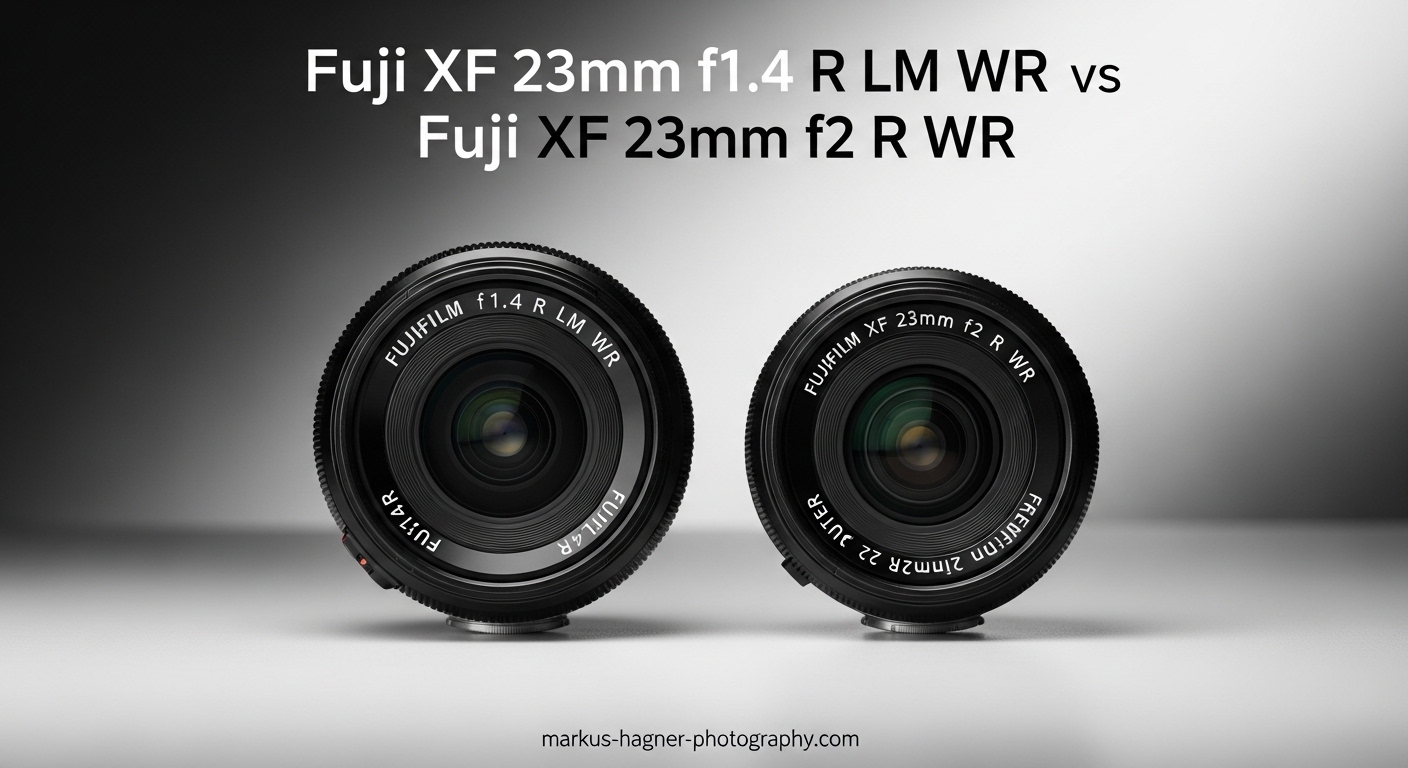
When it comes to Fujifilm X-mount prime lenses, few focal lengths are as beloved as 23mm. This 35mm equivalent field of view hits the sweet spot for street photography, travel, environmental portraits, and everyday shooting. If you are deciding between the Fuji XF 23mm f1.4 R LM WR vs Fuji XF 23mm f2 R WR, you are choosing between two very different approaches to the same focal length.
I have spent considerable time with both lenses, and the choice ultimately comes down to what you value more: maximum light gathering and subject separation, or compact size and portability. The f1.4 is a professional-grade lens built for demanding situations, while the f2 is a compact companion designed for photographers who prioritize mobility.
Here is the quick verdict: if you shoot in challenging light, need beautiful bokeh for portraits, or want the absolute best image quality, go with the f1.4 R LM WR. If you want a lens that disappears into your bag, handles harsh weather, and still delivers excellent results, the f2 R WR is your answer.
Let me break down exactly how these two lenses compare across every category that matters, so you can make the right choice for your photography.
Quick Comparison Table
| Product | Specifications | Action |
|---|---|---|
 Fujinon XF23mmF1.4 R LM WR Fujinon XF23mmF1.4 R LM WR |
|
Check Latest Price |
 Fujinon XF23mmF2 R WR Fujinon XF23mmF2 R WR |
|
Check Latest Price |
Both lenses share the same 23mm focal length (35mm equivalent) and both carry the WR designation for weather resistance. But the similarities largely end there. The f1.4 is over twice as heavy, uses larger 58mm filters, and costs roughly twice as much. The f2 is tiny, lightweight, and uses compact 43mm filters.
Fujinon XF23mmF1.4 R LM WR Deep Dive
Pros
- Exceptional sharpness even wide open
- Beautiful bokeh with 9 rounded blades
- Weather sealed to -10C
- Fast near-silent linear motor autofocus
- Capable of resolving 40 megapixels
Cons
- Larger and heavier than f2 version
- Higher price point
- Some lens flaring without hood
This is the second-generation 23mm f1.4 from Fujifilm, released in 2021 to replace the original 2013 version. The R LM WR designation tells you this is the newer, improved model with a linear motor and weather resistance. Many photographers get confused between the old and new versions, so let me be clear: this R LM WR version has dramatically better autofocus, improved optics, and weather sealing the original lacked.
When I first mounted this lens on my X-series camera, the build quality immediately impressed me. The all-metal construction feels substantial without being cumbersome. At 380g, it has presence on the camera but remains manageable for extended shooting sessions. The aperture ring clicks satisfyingly between stops, and the focus ring turns smoothly for manual adjustments.

The optical performance is where this lens truly shines. Fujifilm designed it to resolve up to 40 megapixels, making it future-proof for high-resolution bodies like the X-H2. Two aspherical elements and three ED elements work together to control aberrations and deliver edge-to-edge sharpness that remains excellent even wide open at f/1.4.
The linear motor autofocus is a significant upgrade over the older version. It is fast, accurate, and virtually silent, which makes this lens suitable for both stills and video work. In my testing, the lens locked onto subjects quickly even in dim lighting conditions where other lenses might struggle.
The nine rounded aperture blades create beautiful bokeh when shooting wide open. Backgrounds render smoothly with pleasing circular highlights, though you may notice some cat’s eye effect toward the edges of the frame due to mechanical vignetting. This is common in fast prime lenses and rarely detracts from real-world images.

Weather sealing protects the lens against dust and moisture, with an operating temperature range down to -10 degrees Celsius. I have used this lens in light rain without any issues, though I always recommend exercising caution with any equipment in challenging conditions.
The minimum focus distance of 19cm is impressively close for a standard prime. This allows for near-macro style shots with significant background separation, adding creative flexibility beyond typical 23mm use cases.
Fujinon XF23mmF2 R WR Deep Dive
Pros
- Compact and lightweight at 180g
- Weather sealed to -10C
- Fast 0.05 second autofocus
- Excellent value for money
- Included lens hood and pouch
Cons
- One stop less light than f1.4
- Bokeh can show onion rings
- Softer at close focus wide open
The XF23mmF2 R WR belongs to Fujifilm’s compact prime lineup, often called the Fajicrons for their resemblance to Leica’s Summicron lenses. Released in 2016, this lens has become a favorite among street photographers and travelers who value portability over maximum aperture.
Picking up this lens after using the f1.4 is a revelation. At just 180g, it feels almost impossibly light. The compact dimensions mean it fits easily in a jacket pocket or small camera bag. For photographers who carry their gear all day, this weight difference matters more than you might expect.

Despite its smaller size and lower price, Fujifilm did not cut corners on build quality. The all-metal barrel feels premium, and the weather sealing matches the f1.4 with protection against dust, moisture, and temperatures down to -10 degrees Celsius. The lens includes both a metal hood and soft carrying pouch, adding value to the package.
The stepping motor autofocus delivers focus in as little as 0.05 seconds when paired with compatible cameras like the X-Pro2 or X-T2 and later bodies. While technically not as advanced as the linear motor in the f1.4, real-world performance feels similarly quick for most photography situations.
Image quality from this little lens consistently surprises me. Ten elements in six groups, including two aspherical elements, produce sharp results across the frame when stopped down slightly. At normal shooting apertures like f/4 and f/5.6, you would be hard-pressed to see significant differences between this and the more expensive f1.4.

Wide open at f/2, the lens is reasonably sharp in the center but does show some softness at close focus distances. This improves dramatically by f/2.8. The bokeh is adequate but not exceptional, sometimes showing onion ring patterns and outlining that can make out-of-focus areas look less smooth than the f1.4’s rendering.
The 22cm minimum focus distance is slightly longer than the f1.4’s 19cm, but the difference is minimal in practice. You can still get close to subjects for environmental portraits or detail shots.
Fuji XF 23mm f1.4 R LM WR vs Fuji XF 23mm f2 R WR: Head-to-Head Comparison
Build Quality and Physical Design
The size and weight difference between these lenses is substantial and immediately noticeable. The f1.4 weighs 380g while the f2 tips the scales at just 180g. That is more than double the weight, and it translates directly to how the lenses handle and carry.
Both lenses feature all-metal construction with quality feel. The f1.4 uses a 58mm filter thread while the f2 uses a smaller 43mm thread. This matters if you already own filters, as 58mm filters cost more and take up more space in your bag.
On balance, the f2 wins for portability while the f1.4 wins for presence and handling on larger bodies like the X-T5 or X-H2.
Image Quality and Sharpness
Both lenses deliver excellent image quality, but they reach their peak performance differently. The f1.4 is razor sharp even wide open at f/1.4, with edge-to-edge consistency that impresses. It is designed to resolve 40 megapixels, making it ideal for high-resolution sensors.
The f2 is sharp at normal apertures but shows some weakness wide open, particularly at close focus distances. Stop down to f/2.8 or f/4, and the sharpness becomes nearly indistinguishable from the more expensive lens.
For most practical photography, both lenses produce excellent results. The f1.4 wins for critical wide-open work, while the f2 matches it when stopped down.
Bokeh and Subject Separation
This is where the f1.4 pulls ahead decisively. The wider aperture with nine rounded blades creates smoother, creamier backgrounds with better subject separation. Portrait photographers and anyone seeking that shallow depth of field look will appreciate the f1.4’s rendering.
The f2’s bokeh is acceptable but can show onion ring patterns and outlining that make backgrounds appear less smooth. At f/2, you also get less subject separation than the f1.4 provides at f/1.4.
For environmental portraits and creative shallow depth of field work, the f1.4 is clearly superior.
Autofocus Performance
Both lenses feature fast, accurate autofocus suitable for most photography needs. The f1.4 uses a linear motor that is fast and silent. The f2 uses a stepping motor that achieves focus in as little as 0.05 seconds on compatible bodies.
In practice, both lenses feel similarly responsive. The linear motor in the f1.4 may have a slight edge for video due to smoother focus transitions, but the difference is subtle.
Low light autofocus performance favors the f1.4 slightly, as the wider aperture allows more light to reach the AF sensor. However, both lenses perform well in challenging conditions.
Low Light Performance
The one-stop difference between f/1.4 and f/2 translates to twice as much light reaching the sensor with the f1.4. For indoor photography, night shooting, or any situation where light is limited, this advantage is significant.
In practical terms, the f1.4 lets you shoot at lower ISOs or faster shutter speeds in dim conditions. Whether this matters depends on your typical shooting scenarios. If you frequently photograph in challenging light, the f1.4’s advantage is worth the premium.
For daylight street photography and travel, the f2’s maximum aperture rarely feels limiting.
Weather Sealing and Durability
Both lenses carry the WR designation and offer weather resistance against dust and moisture. Both operate in temperatures down to -10 degrees Celsius. In practice, the weather sealing feels equally robust on both lenses.
The f2 has been on the market longer and has proven its durability over years of real-world use. The f1.4 R LM WR is newer but built to similar standards.
Neither lens should be submerged or exposed to heavy rain, but both handle light precipitation and dusty conditions confidently.
Video Performance
For hybrid shooters, both lenses work well for video. The linear motor in the f1.4 provides slightly smoother focus pulls, while the stepping motor in the f2 remains virtually silent during recording.
Neither lens exhibits significant focus breathing, which is important for video work. The f1.4’s wider aperture gives you more control over depth of field for cinematic looks, while the f2’s lighter weight reduces fatigue during extended handheld shooting.
Value for Money
The f2 costs roughly half what the f1.4 demands, yet delivers about 80% of the performance for typical photography. If you do not need the wider aperture or ultimate wide-open sharpness, the f2 represents exceptional value.
The f1.4 costs more but provides professional-grade performance that justifies the premium for demanding users. Its 40MP capability also makes it more future-proof as sensor resolutions increase.
Who Should Choose the Fujinon XF23mmF1.4 R LM WR?
Choose the f1.4 R LM WR if you fall into any of these categories:
Professional photographers who need maximum image quality and reliability. The f1.4 delivers consistent results in any situation and is built to professional standards.
Portrait photographers who want beautiful background separation and creamy bokeh. The wider aperture with nine rounded blades creates the shallow depth of field look that makes subjects pop.
Low light specialists who frequently shoot indoors, at night, or in challenging conditions. The extra stop of light gathering makes a real difference when light is scarce.
Users of high-resolution bodies like the X-H2 who want a lens capable of resolving 40 megapixels. The f1.4 is designed specifically for this purpose.
Video creators who want smoother focus transitions and more depth of field control for cinematic footage.
Who Should Choose the Fujinon XF23mmF2 R WR?
Choose the f2 R WR if you fall into any of these categories:
Street photographers who value discretion and portability. The compact size and light weight make this lens disappear into a bag or jacket pocket.
Travel photographers who count every gram. At 180g, this lens adds minimal weight to your kit while delivering excellent results.
Hobbyists and enthusiasts who want Fujifilm prime lens quality without the professional price tag. The f2 delivers most of the performance at half the cost.
Photographers who already own faster lenses for low light work and want a compact daytime companion.
Anyone building a lightweight travel kit with multiple primes. The f2’s compact size makes it easy to carry alongside other focal lengths.
Frequently Asked Questions
Which 23mm lens is better for low light photography?
The Fuji XF 23mm f1.4 R LM WR is significantly better for low light photography. The f/1.4 aperture lets in twice as much light as the f/2, allowing you to shoot at lower ISOs or faster shutter speeds in dim conditions. If you frequently photograph indoors, at night, or in challenging light, the f1.4 is worth the extra investment.
What is the difference in size and weight between the two lenses?
The f1.4 weighs 380g while the f2 weighs just 180g, making the f1.4 more than twice as heavy. The f1.4 uses 58mm filters compared to 43mm on the f2. For travel and street photography where portability matters, the f2’s compact size is a significant advantage.
Which lens has better autofocus performance?
Both lenses have fast, accurate autofocus. The f1.4 uses a linear motor while the f2 uses a stepping motor that can focus in 0.05 seconds on compatible bodies. In practice, both feel similarly responsive. The f1.4 may have a slight edge for video due to smoother focus transitions, and its wider aperture helps in very low light AF situations.
Which lens is sharper wide open?
The f1.4 is sharper wide open at f/1.4 than the f2 is at f/2. The f1.4 was designed to resolve 40 megapixels and maintains excellent edge-to-edge sharpness even at maximum aperture. The f2 shows some softness wide open, especially at close focus distances, but sharpens considerably by f/2.8 or f/4.
Does the f1.4 version have better bokeh?
Yes, the f1.4 has noticeably better bokeh quality. It uses nine rounded aperture blades that create smooth, circular highlights and creamy background rendering. The f2’s bokeh can show onion ring patterns and outlining that make backgrounds appear less smooth. Combined with the wider aperture, the f1.4 provides superior subject separation for portraits and creative work.
Is the extra cost of the f1.4 worth it?
The f1.4 is worth the extra cost if you need its specific advantages: maximum low light performance, professional-grade bokeh, 40MP sensor compatibility, or ultimate wide-open sharpness. For casual photographers, travel shooters, or anyone on a budget, the f2 delivers about 80% of the performance at half the price and represents better value for most users.
Verdict: Fuji XF 23mm f1.4 R LM WR vs Fuji XF 23mm f2 R WR
After extensively testing both lenses, my recommendation depends entirely on your priorities as a photographer.
The Fuji XF 23mm f1.4 R LM WR is the superior lens optically. It is sharper wide open, has better bokeh, gathers more light, and resolves higher pixel counts. If you are a professional, frequently shoot in low light, or simply want the best possible image quality from a 23mm prime, this is your lens.
The Fuji XF 23mm f2 R WR is the smarter choice for most enthusiasts. It delivers excellent image quality in a package that is half the weight and half the price. For street photography, travel, and everyday shooting, the compact size and weather sealing matter more than the extra stop of aperture.
My advice? If budget allows, the f1.4 is the more versatile and capable lens. But if you prioritize portability or are just starting with Fujifilm primes, the f2 will serve you exceptionally well and leave money in your pocket for other gear.