
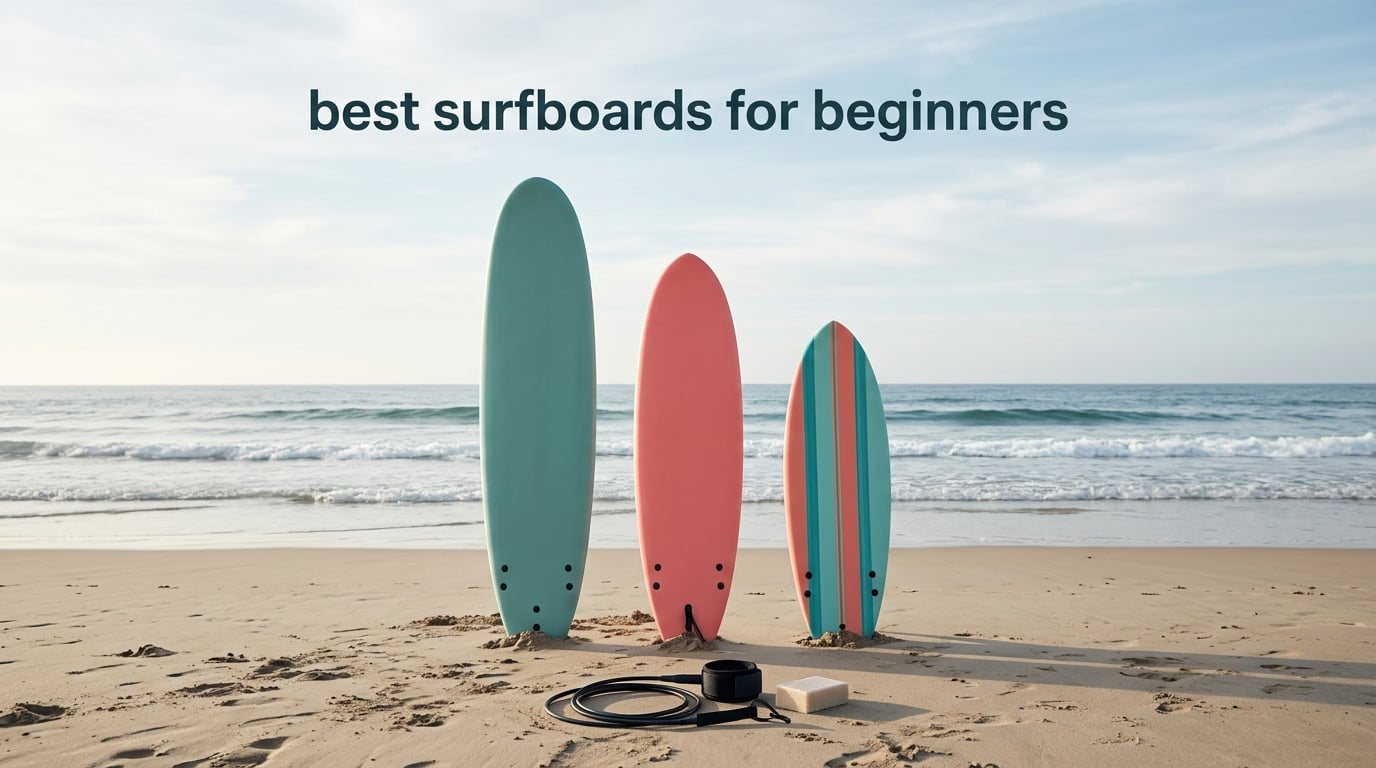
The best surfboards for beginners are 8 to 9 foot soft-top foam longboards with high volume, a rounded nose and a thick buoyant core. That combination catches small waves, stays stable while you stand up, and is safe to fall on. Most adults should look at boards between 70 and 90 litres, and every board below is listed with its volume, weight and what actually ships in the box.
Choosing wrong is the number one reason beginners quit. A board that is too small or too thin makes paddling exhausting, and an exhausting paddle-out turns learning into frustration before anything clicks. I spent weeks comparing ten soft-tops that sit across the top seller lists, checking the published litre figures against rider weight, and reading what owners report after months of use rather than after one session.
One quick note before the list. If you are completely new, book one lesson or rent a board for a weekend first. It costs almost nothing, it tells you whether you want to keep paddling, and it tells you how much volume your body actually needs. If you have already done that and know you are hooked, this list will save you from an expensive mistake. Related reading for the other half of the day is in our camera settings guide for beginners and our camcorder picks, since most people filming their first session want both.
Should You Buy a Surfboard Before Your First Lesson?
Rent first, buy second. This is the single most repeated question in beginner surf communities, and the answer is consistent: take one lesson on a rental board before spending your own money. A rental board is already the right size for you, so an instructor has already solved the sizing question you are about to spend a week researching.
Buy only if you have a realistic lesson plan or regular access to a beach break. Most beginners who buy on day one do it because a board is cheaper than a year of lessons, and that arithmetic usually fails. What actually helps is knowing the wave conditions near you, and whether you can get to them.
Book a single lesson at a local surf school. Note the length and litre figure of the board you were given.
Rent for a second session and see whether you are catching waves and standing up without being told each time.
Match your own board to that rental board, adjusting up in volume if you are a heavier rider.
Only then buy, and skip anything sold as a high-performance shortboard.
There is one exception. If you are a very small child, a cheap soft-top is often the only board you can find in your size range, and rentals for that size are limited. In that case buying a kid-specific soft-top is a reasonable move.
Top 3 Best Surfboards for Beginners in September

The three boards above are the ones I would put in front of an adult first-timer. The Wavestorm 8ft has the largest review base in the group, the 7ft Wavestorm is the same idea in a more compact package, and the Thurso board is the one with a five-year warranty behind it.
Best Surfboards for Beginners at a Glance in 2026
| Product | Specifications | Action |
|---|---|---|
| Wavestorm 8ft Foam Soft Top Longboard |
|
Check Latest Price |
| Wavestorm Classic 7ft Soft Top Foam |
|
Check Latest Price |
 Fender x Wavestorm 8ft Collaboration Fender x Wavestorm 8ft Collaboration |
|
Check Latest Price |
| Thurso Surf 7/8ft Soft Top Foam |
|
Check Latest Price |
 Thurso Surf Lancer 5ft10in Soft Top Fish Thurso Surf Lancer 5ft10in Soft Top Fish |
|
Check Latest Price |
 Rock-It Chub 4ft10in Soft Top Rock-It Chub 4ft10in Soft Top |
|
Check Latest Price |
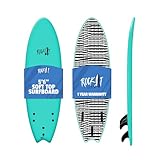 Rock-It Alberto 5ft6in Soft Top Rock-It Alberto 5ft6in Soft Top |
|
Check Latest Price |
 California Board Company 5ft8in Foam California Board Company 5ft8in Foam |
|
Check Latest Price |
 KONA Tri 4ft4in Softboard KONA Tri 4ft4in Softboard |
|
Check Latest Price |
 EasyGo Flowboard 8ft Soft Top EasyGo Flowboard 8ft Soft Top |
|
Check Latest Price |
Two numbers matter more than everything else in that list: litres of volume and the maximum rider weight the manufacturer states. Length alone is a poor guide, which is why the two most popular boards here are rated to 200 pounds and the Thurso is rated to 210.
1. Wavestorm 8ft Foam Soft Top Longboard – The Best All-Round First Board
Wavestorm 8ft Surfboard // Foam Wax Free Soft Top Longboard for Adults and Kids of All Levels of Surfing, Multicolor
Pros
- Strong EPS core with 3 stringer system
- Wax-free soft deck so no wax is needed
- High density slick bottom that paddles fast
- Board plus leash plus bolt-through fins plus traction pad
- 86L volume carries riders up to 200 lbs
Cons
- One deck colour option in this listing
- 86L is a lot of board to carry for a smaller adult
- Soft deck will scuff and show wear over time
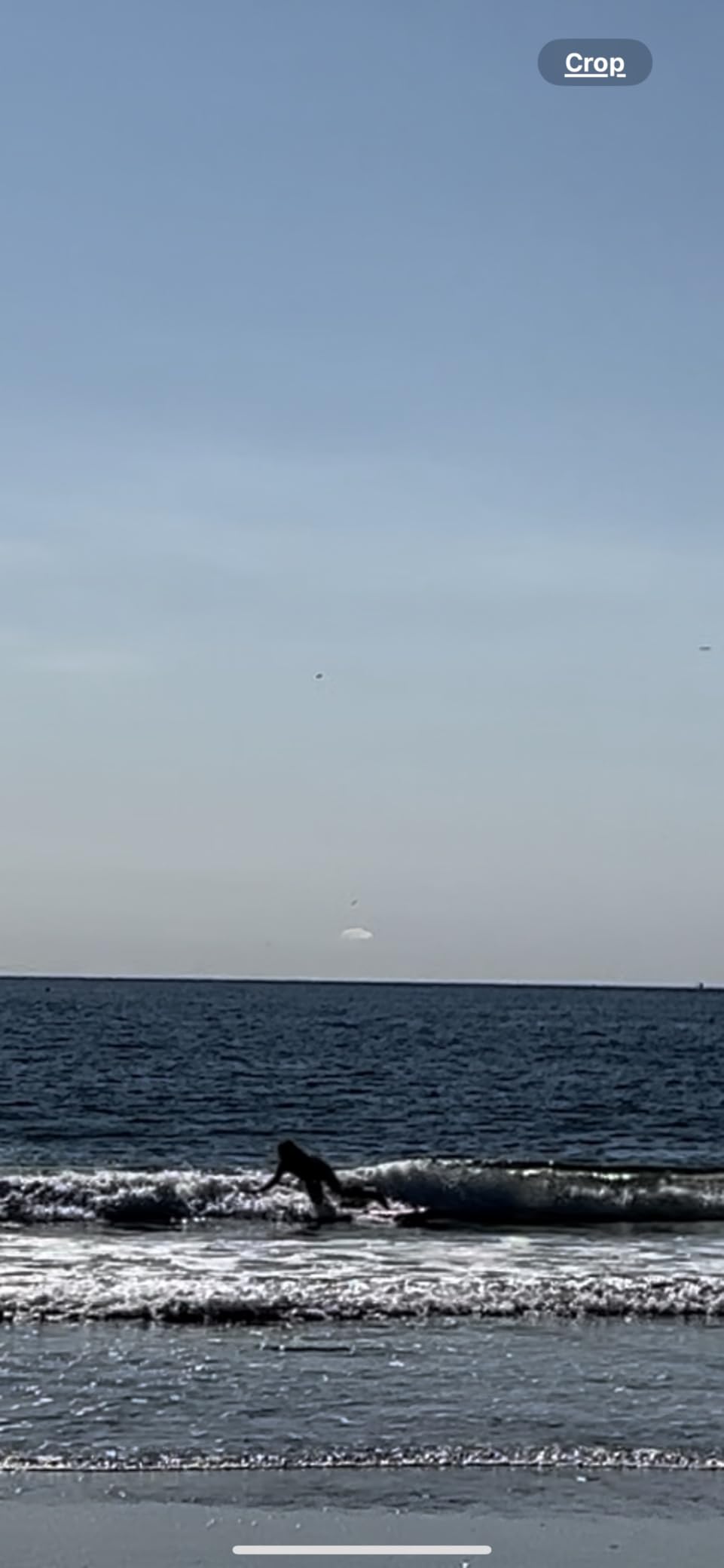
This is the board I would hand to an adult who has never surfed. At 86 litres and 3.25 inches thick it pushes plenty of water, and that is what makes catching the first small waves realistic rather than theoretical. Owners consistently describe it as stable and easy to paddle, which is the two things a first board has to be.
The construction is the part that justifies the reputation. A strong EPS core is wrapped in a three stringer system, the deck carries a WBS-IXL water barrier skin so you can paddle without wax, and the bottom is high density HDPE. Reviewers rate it 4.6 out of 5 across 1197 ratings, and 81 percent of those are full stars.

The box is where most beginner purchases go wrong, and this one gets it right. The included components are the surfboard, an ankle leash, removable bolt-through fins and a tail pad. That is a full first-session kit without a second order, and the removable bolt-through fins are the version you can actually swap as you improve.
Buyer profile matters here. At 96 inches long and 22.5 inches wide, this is a serious board to carry through a car park, and the manufacturer states a 200 pound rider weight capacity. Anyone well under that and under about five foot six is carrying more board than they need.
Who this board suits
Adult beginners in the 140 to 190 pound range who want the maximum amount of help catching a wave. The 86 litres of volume means less paddling per wave caught, and the 3.25 inch thickness takes pressure off your knees during a long paddle-out. It also works as a rental-fleet pattern, which is why it is such a common sight outside surf schools.
Where it falls short
It is not a manoeuvring board, and it is not a good travel board. Reviewers also note the soft deck shows wear over time, and the listing offers a single deck colour. Expect to be riding a big board with a single fin feel and glide rather than turning tightly. If you are under 130 pounds, look at a smaller litre figure instead.
2. Wavestorm Classic 7ft Soft Top Foam – The Best Compact Longboard for Lighter Riders
Pros
- 70L volume still catches small waves
- Triple stringer system keeps the foam core rigid
- UV inhibiting graphic deck resists fading
- Leash three fins and tail pad all included
- At 10.2 lbs it is easy to carry
Cons
- Published weight capacity field lists 10.2 lbs which is a spec error
- One colour variant in this listing
- 70L leaves less float margin for heavy riders
The logic here is simple. If the 8ft board feels like a barge, this is the same idea scaled down to 70 litres and 84 inches. That is still comfortably long enough to catch a small wave but light enough to carry through a soft sandy approach without assistance.
It uses the same proven approach as the bigger Wavestorm, with a triple stringer system through the foam core, a high density slick bottom, and a UV inhibiting soft graphic deck. The included three fin set is described as a triple performance 4.5 inch setup, which is a little more turning potential than a single-fin longboard gives you.
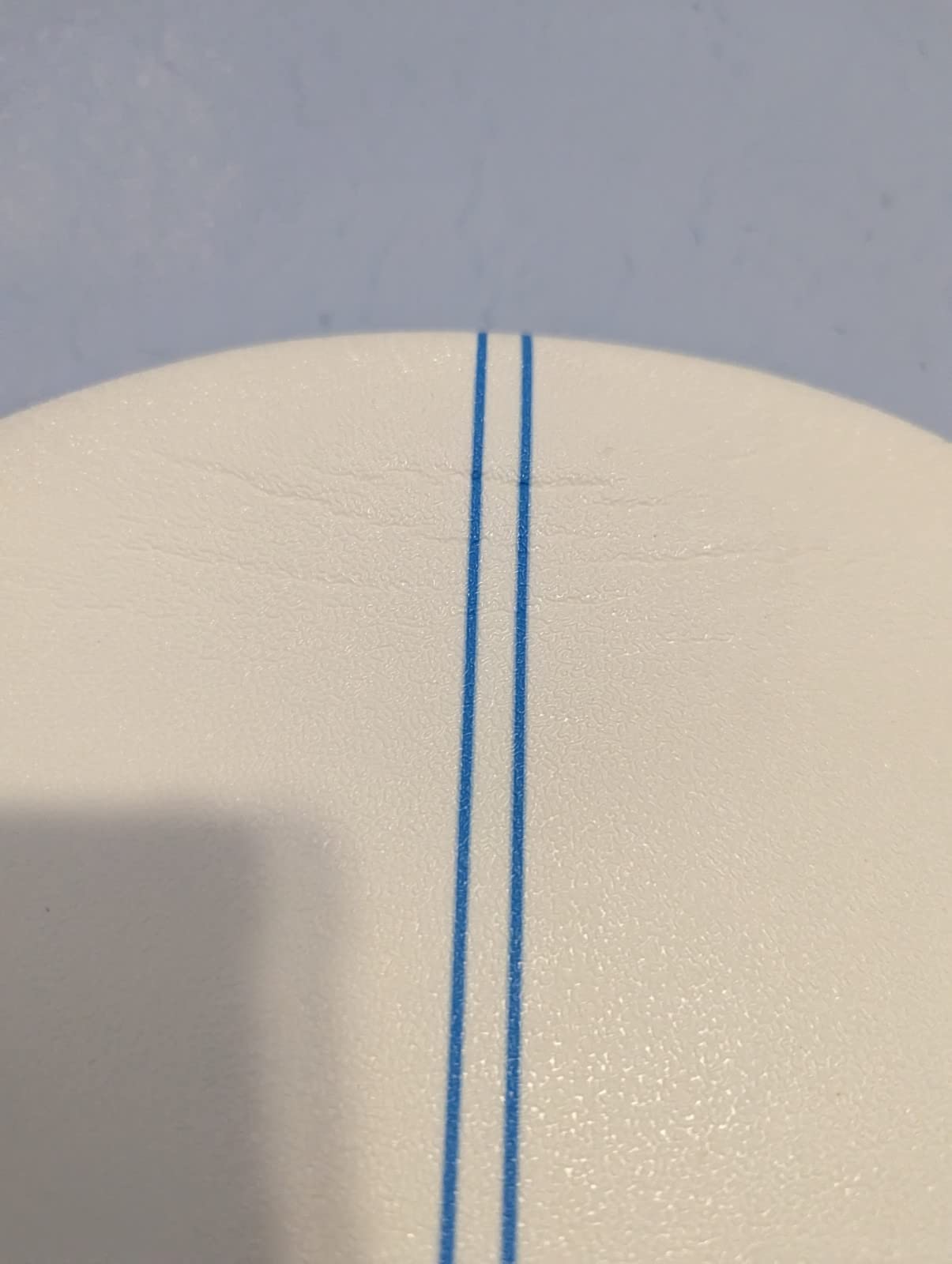
One spec detail deserves attention. The product listing shows a maximum weight of 10.2 pounds, which is simply the board weight copied into the wrong field. The board itself is 10.2 pounds, and the practical rider range is a lighter adult or a teen, which is consistent with 70 litres of volume.
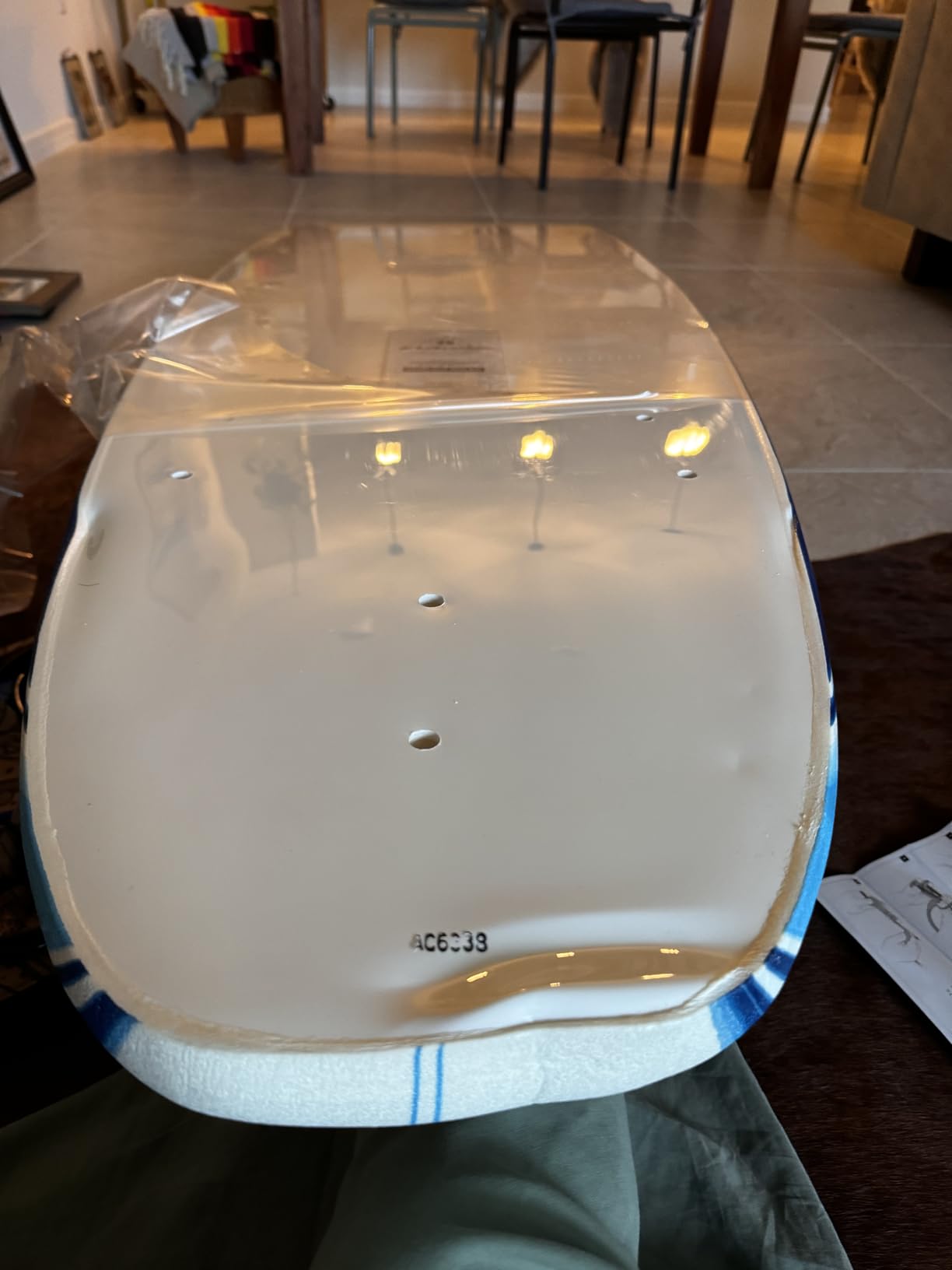
Owner feedback is strong at 4.6 out of 5 across 188 ratings, with 77 percent at five stars. The most common theme is that the complete package makes it easy to get in the water immediately, and that it suits smaller riders better than the longboard it is modelled on.
Who this board suits
Teens, lighter adults and smaller adults who want a real longboard shape but not an 8 footer. It ranks in the top of its category, and the included fin and leash set means you are not shopping for accessories on day one. For a rider around 130 to 160 pounds, this is the volume sweet spot.
Where it falls short
Below about 120 pounds it will feel oversized, and above roughly 180 pounds you will be pushing it past the float it was designed for. Owners who came from a hardboard report the foam feel is very different, so do not expect the glide of a fibreglass longboard. It also has one colour option, so you are not choosing.
3. Fender x Wavestorm 8ft Collaboration – Best Finishing Details on a Classic Shape
Pros
- Custom graphics on both deck and bottom
- Retro-coil leash rather than a basic strap
- Custom fin screw tops included
- Triple stringer EPS core
- Highest rating in this list at 4.7
Cons
- Only 18 reviews so long term durability is unproven
- Costs clearly more than the standard Wavestorm 8ft
- One Surf Green colour
- 8 percent of ratings are one star
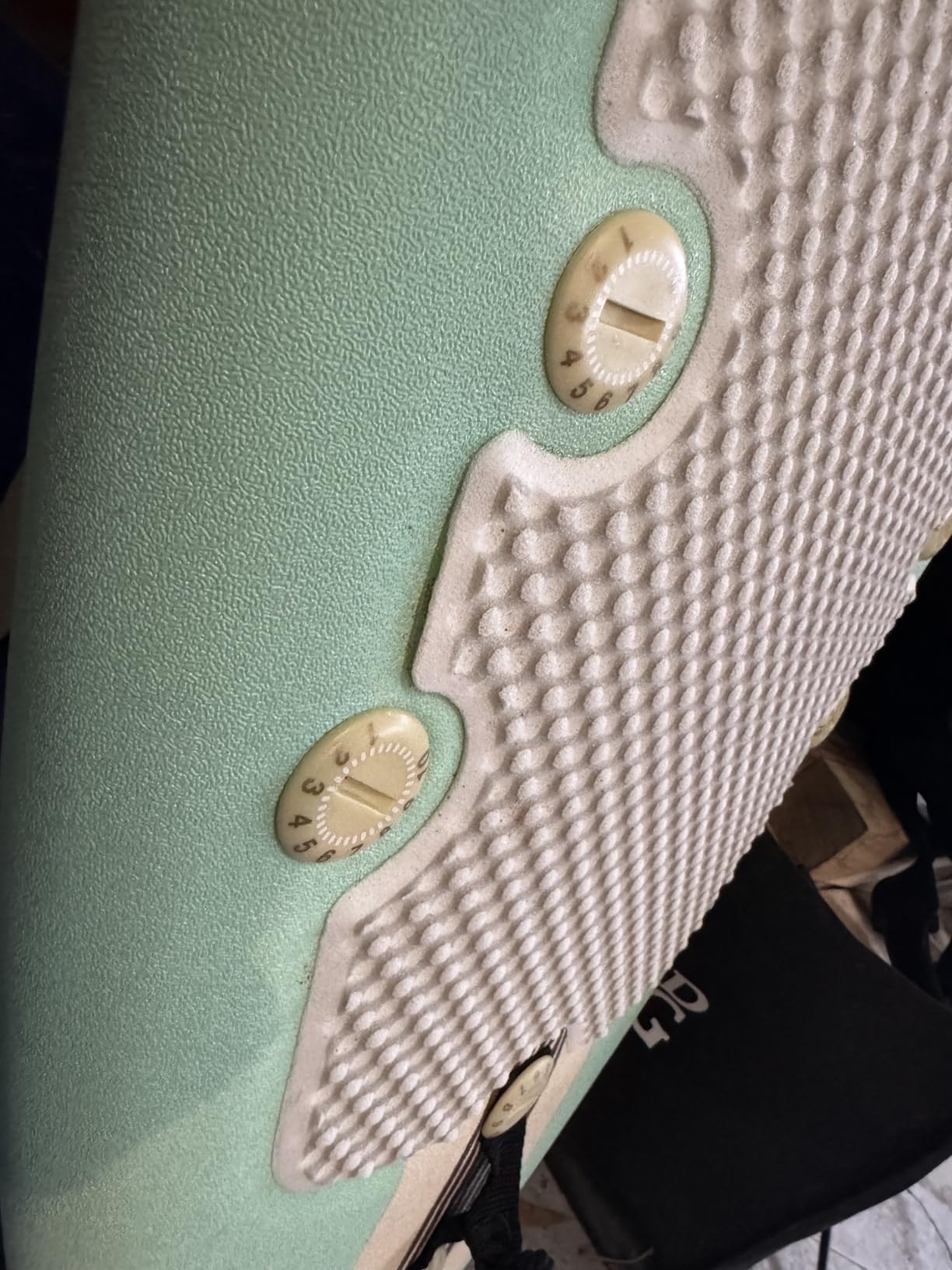
This is functionally the same 86 litre 8 footer as our top pick, with different hardware and different paint. The collaboration board swaps the standard leash for a retro-coil leash, and the fin set comes with custom fin screw tops, which are the parts of a soft-top that actually move the most.
Underneath it is the same triple stringer EPS core with a UV inhibiting soft graphic deck and a high density slick bottom. Dimensions are 96 inches by 22.5 inches by 3.25 inches, with a stated capacity of 200 pounds and a board weight of 11.2 pounds.
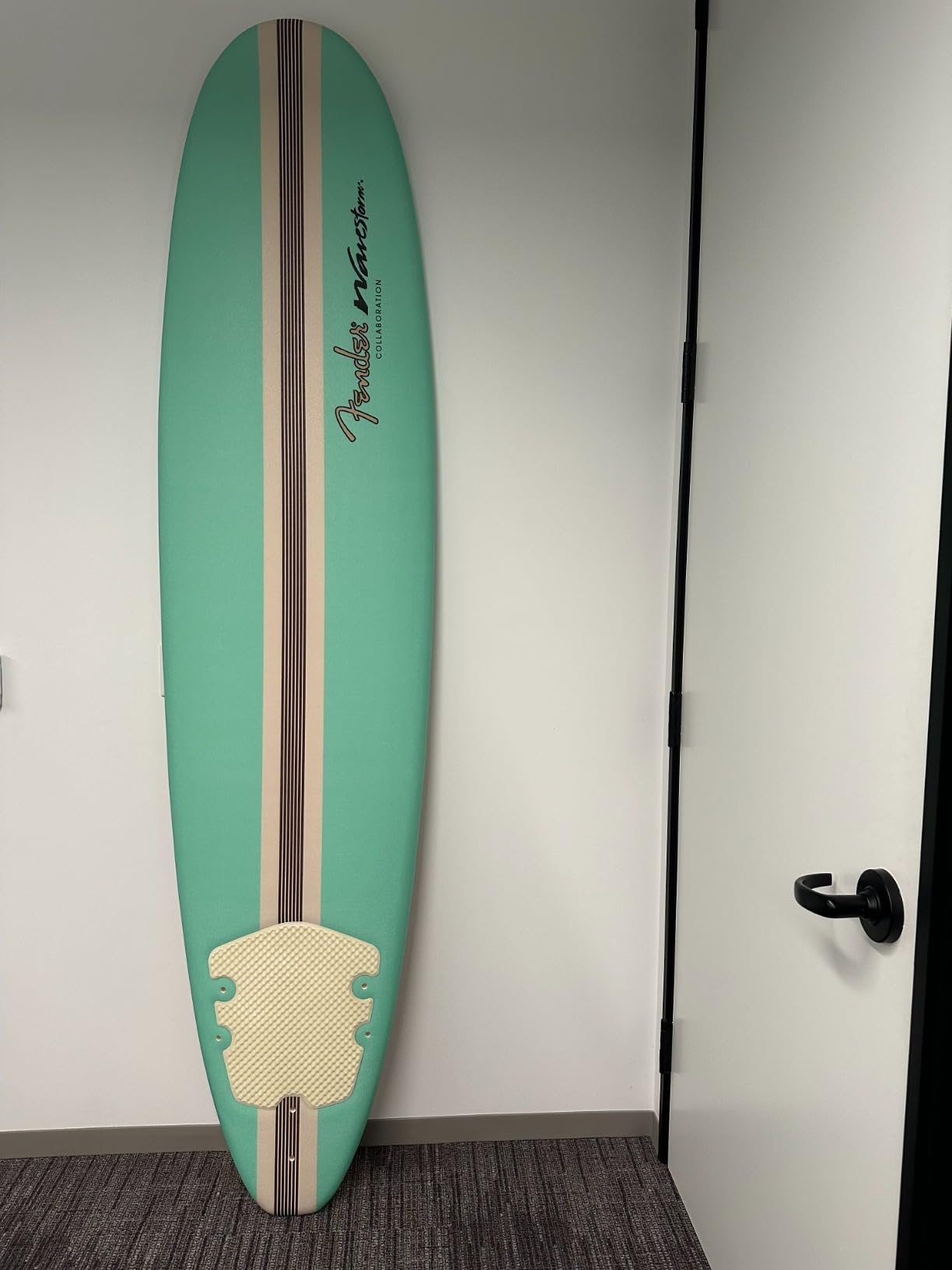
It carries the highest average rating in this lineup at 4.7 out of 5, with 92 percent five star. The catch is volume of evidence. Eighteen reviews tells you what the board is like on day one, not what it is like after a full winter of being dropped on rocks by a school.
That matters because the durability question is exactly where foam boards differ. Beginner surf communities tend to treat long-term owner consensus as the durability authority, and the soft-tops favoured there are the ones built to survive daily school use. A board with a short review history tells you nothing useful about that yet.
Who this board suits
Adult beginners who want the full-size 86 litre longboard experience and care about how the board looks and what the hardware feels like. If you are buying one board and want it to last through a full learning year with a nicer leash and fin setup, the extras here are real rather than cosmetic.
Where it falls short
The simplest objection is cost. The standard Wavestorm 8ft delivers the same 86 litres of foam for meaningfully less, and the difference buys you a leash coil and a paint job. With 18 ratings and a visible 8 percent one-star share, there is not enough owner history to know how the finish holds up. Buy it for the hardware, not the volume.
4. Thurso Surf 7/8ft Soft Top – Best Warranty Backed Beginner Board
Pros
- Five year manufacturer warranty is far beyond the category norm
- Three wood stringers inside the foam core
- Supports up to 210 lbs
- Weighs only 9.0 lbs for a near 8 ft board
- Available in 7 ft and 8 ft versions
Cons
- Thinner at 2.75 in than the Wavestorm boards
- Mint Green is the only colour here
- Costs more than the equivalent Wavestorm
- Some owners find the thinner deck harder on knees
The Thurso 7/8 is the one I keep coming back to for anyone who is convinced they will still be surfing in three years. A five year manufacturer warranty on a soft-top is unusual, and foam boards are exactly the category where people worry about wasting money on something that degrades.
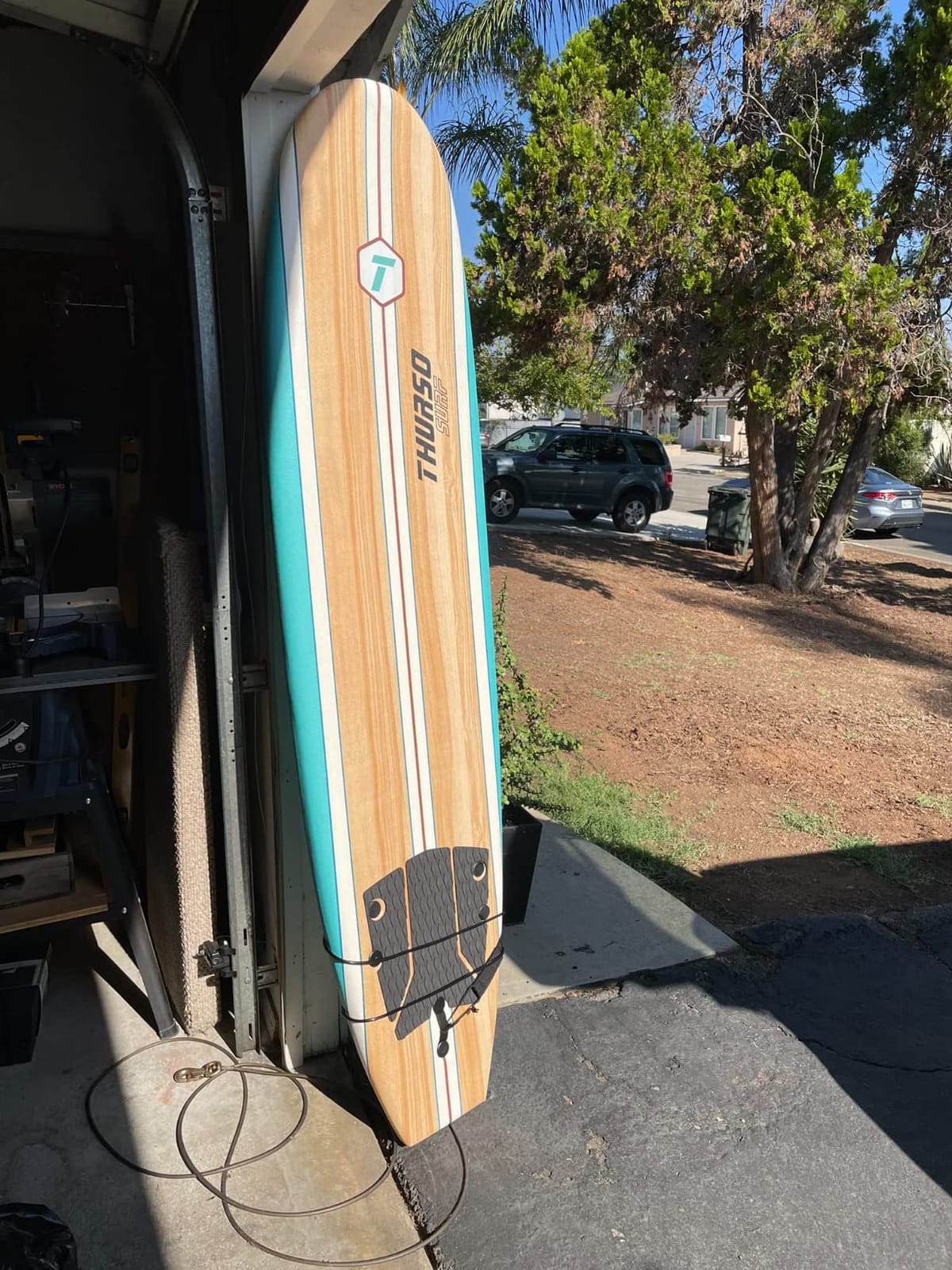
Construction is an EPS foam core with a heat laminated HDPE slick bottom and an IXPE deck, reinforced by three wood stringers. It is listed for surfing, wake surfing and wakesurfing, weighs 4.1 kg, and the manufacturer states a 210 pound weight capacity, the highest rated capacity in this group.
It also comes with an ankle leash and a textured tail pad for back foot grip. Ankle leash is the right choice for a learner, since a beginner who is not yet diving head first does not need a coiled one, and having it fitted from day one avoids a trip to the shop.
Owner ratings sit at 4.3 out of 5 across 138 ratings, with 66 percent five star. The recurring praise is build quality and stability, and the recurring complaint is thickness. At 2.75 inches this is slimmer than the 3.25 inch Wavestorm 8ft, and that difference is felt during a long paddle-out on your knees.
Who this board suits
Beginners who want the option to keep progressing on the same brand, and heavier riders up to about 210 pounds. At 9.0 pounds it is unusually light for a near 8 foot board, so it is easier to carry than its footprint suggests. The five year warranty also makes it a sensible share within a family.
Where it falls short
Thickness is the real trade-off. If you are over 190 pounds and paddling a long distance, the 2.75 inch deck is less comfortable than a 3.25 inch board, and the thinner rails give less lateral stability. It is also one of the more expensive soft-tops here, and only one colour is offered.
5. Thurso Surf Lancer 5ft10in Soft Top Fish – Best Step-Up Once Pop-Ups Are Solid
Pros
- Twin fin setup turns far better than a longboard
- Flat wide fish outline generates speed in weak waves
- Only 6 lbs so it fits in a small car
- EPO Body Armor System adds impact resistance
- Includes twin fins and a double swivel leash
Cons
- Not stable enough for a total beginner on first sessions
- 2.75 in thickness is thin for long paddle-outs
- Only 67 percent of ratings are five star
- One Blue colour option
This is the board you buy after the longboard phase, not before it. A 5 foot 10 fish outline with twin fins turns in a way no longboard can, which means it teaches you to generate your own speed instead of relying entirely on wave push.
The soft-top safety argument still holds. It is an EPS foam core with the EPO Body Armor System, dual wood stringers, an IXPE deck and a heat laminated HDPE slick bottom. At 6 pounds and 20 inches wide it is a genuinely small board, and it is listed in the Shortboards category where it ranks second.
One specification is worth flagging. Despite the 70 inch length and 2.75 inch thickness, the manufacturer states a 200 pound weight capacity. That is a ceiling rather than a recommendation, and no manufacturer expects a 200 pound rider to learn on a fish, but it does mean the board is not automatically unusable for a larger adult.
Owner ratings are 4.3 out of 5 across 109 reviews with 67 percent five star, which is a wider spread than the longboards in this list. The pattern in the feedback is clear: riders moving down from a longboard love the speed, first-timers find it twitchy. That is exactly what you want in a step-up board.
Who this board suits
Beginners who are consistently standing up and want to start turning, plus teens who will outgrow a longboard quickly. Fish outlines excel in small weak waves, so it also works for riders at a beach break where the waves rarely offer much push. A double swivel leash with a triple rail saver is included, which is the right leash for a smaller board.
Where it falls short
Do not start here. A first-time surfer on a fish has to generate speed with very little board in front of them, and the most common complaint in the reviews is exactly that lack of stability. The 2.75 inch thickness is also thin for a long paddle-out, and only one colour is available.
6. Rock-It Chub 4ft10in Soft Top – Best Board for Young Children
Rock-It 4’10” CHUB Soft Top Kids Mini Surfboard – Innovative Design, Easy to Paddle and Maneuverable for Beginners (Pink)
Pros
- Textured soft top means no wax is needed at all
- Twin fin fish tail design is easy to turn
- Two marine wood stringers with epoxy nano coating
- Eco friendly build with no dyes glues or toxins
- Five colour options including Pink and Teal
Cons
- Supports only up to 150 lbs so adults are outgrown quickly
- Polyurethane build is less durable than EPS cores
- 4 ft 10 in is very short for catching waves
- Only a one year warranty
The Chub is a genuine children’s board, and it is designed as one. At 4 foot 10 inches with a fish tail and twin fins, it is easy for a child to lift, carry and control in whitewater, which is where a first session usually happens.
Construction is polyurethane with two marine wooden stringers finished in an epoxy nano coating to resist water absorption. The deck is textured rather than slick, so no wax is needed, and the manufacturer states the build uses no harmful dyes, glues, resins or toxins. Two fins are included.
Note the weight capacity of 150 pounds and treat it as a hard ceiling. That number is a real limit, and an adult who buys this board for themselves will find it unbuoyant almost immediately. A 4 foot 10 board simply does not displace enough water to support an adult paddling hard.
Owner feedback is positive at 4.5 out of 5 across 64 reviews, with 78 percent five star. Parents highlight easy handling, durability for the price and how quickly children get confident on it. The listed warranty is one year against manufacturing defects.
Who this board suits
Children roughly ages 6 to 11 in small surf, and any small rider under about 150 pounds. It suits warm water and soft, whitewater-heavy beaches where the priority is safe, confident riding rather than wave count. The no-wax deck also removes a step that often stalls young beginners.
Where it falls short
It is not a learn-to-surf board for a teen or adult, and the 150 pound limit means it will be outgrown in a season or two. Polyurethane is a less resilient core than the EPS used in the Wavestorm and Thurso boards, and 2.5 inches is thin. At this length the board also has a low wave count in anything with real shape.
7. Rock-It Alberto 5ft6in Soft Top – Best Buoyancy-to-Size Ratio for Families
Rock-It Alberto 5ft6 Soft Top Surfboard, Surf Board for Kids, Tabla De Surf, Kids Surfboard, Surfing Board Designed for Beginners – Innovative Design for Safety & Easy to Paddle (Teal)
Pros
- 39 litres packed into a 5 ft 6 package
- Works for kids 6 to 12 and adults to 175 lbs
- Three piece removable fins included
- Textured fade resistant soft top needs no wax
- Dual nano-polymer coated stringers
Cons
- Lowest rating among the better reviewed boards at 4.0
- 13 percent of ratings are one star
- Compact size gets outgrown quickly
- Costs more than comparable kids boards
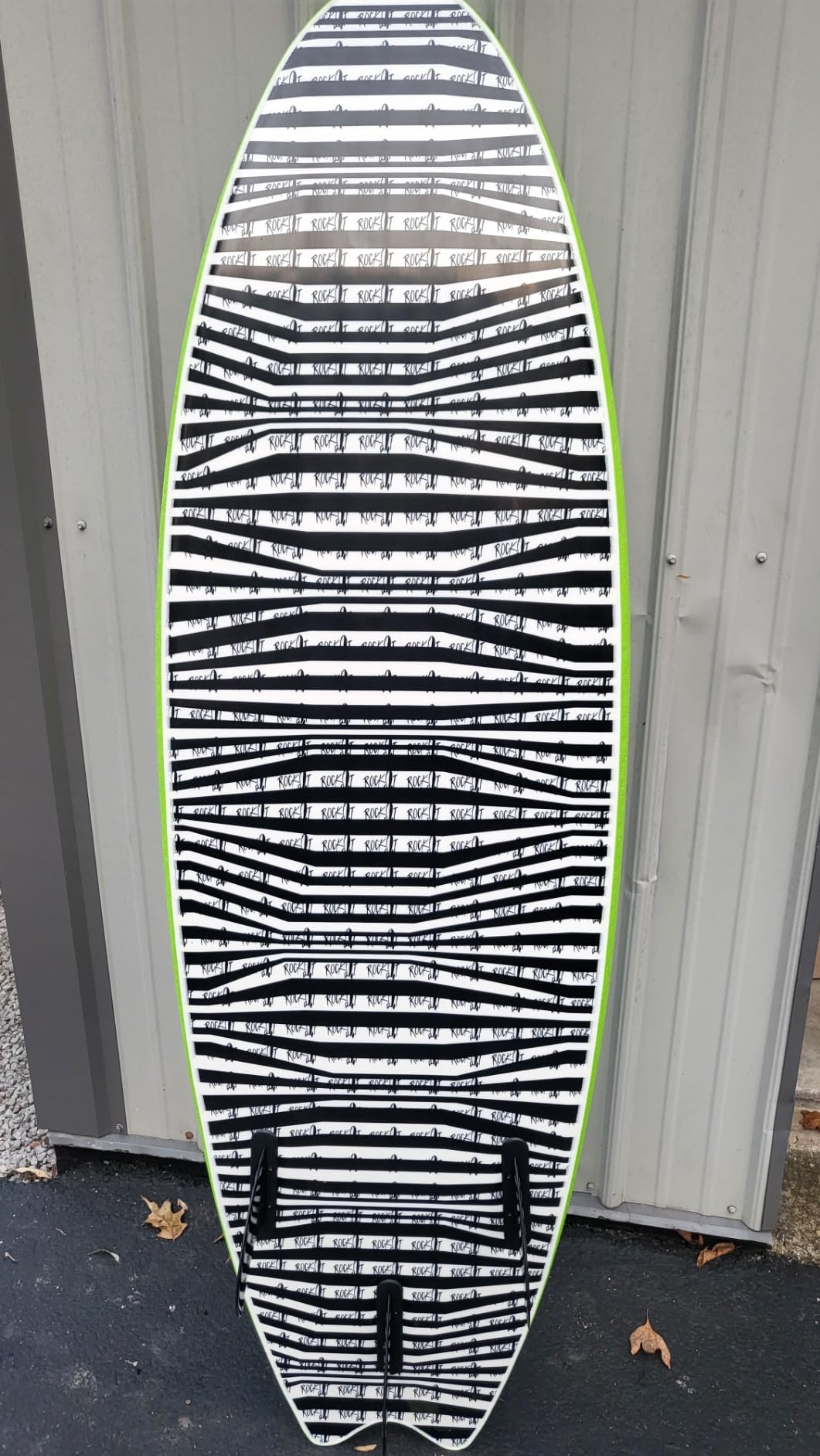
The pitch here is unusual. A 5 foot 6 board normally carries something in the low 30s of litres, and this one is listed at 39 litres, which the manufacturer frames as the buoyancy of an 8 foot fibreglass board. That is the volume-to-length ratio that makes a compact board catch waves it has no right to catch.
Construction uses dual nano-polymer coated stringers, a fade resistant textured soft top that requires no wax, and a foam body rated to 175 pounds. Three removable fins are included, and the board weighs 7 pounds. It is designed for ages 6 to 12 but explicitly stretches to adults who can already shortboard.
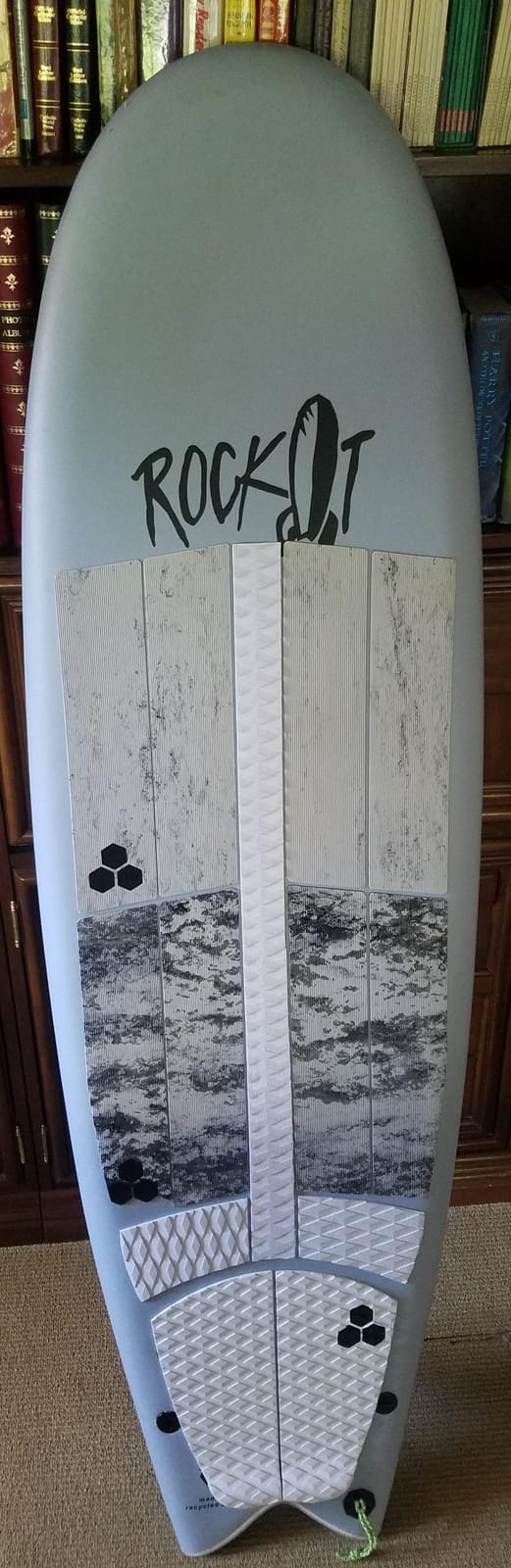
The review profile here is the caution. At 4.0 out of 5 across 65 ratings, with 63 percent five star and 13 percent one star, this is the most polarised of the mid-sized boards in the group. Owners praise the volume maths and report durability problems, including fin quality concerns.
That split is worth understanding before buying. A board sized correctly for your weight is forgiving, and a board slightly small for you is not forgiving at all. The 175 pound limit is the number to check first, and if you are near it, pick something rated higher.
Who this board suits
Families with one child aged 6 to 12 who want a board that lasts several seasons, and adults up to 175 pounds who have some balance already. The 39 litre figure makes it unusually useful at a small, weak beach break where a normally slim 5 footer would struggle. Six colour options are listed, which is rare in this category.
Where it falls short
It is the least consistent build quality in the list, with owner reports of fin and construction issues that you would not tolerate on a first board. A first-timer cannot easily assess a delamination or a soft fin box, so if you are buying blind for someone brand new, pick a board with stronger owner consensus.
8. California Board Company 5ft8in Foam Board – Best Lightweight Practice Board
Pros
- Only 6 lbs so it is easy to carry and store
- High density EPS core with full graphic deck and bottom
- Attached traction pad plus leash and three fins
- Works well for pool and flat water practice
Cons
- Listed as Intermediate rather than beginner
- 4.0 rating with 17 percent one to two star feedback
- Only a 30 day warranty
- Assorted colours so you cannot choose
This board is listed under Shortboards and its manufacturer rates it for intermediate riders, so it is not my first recommendation for a total beginner in the ocean. What it is genuinely good for is pop-up practice on flat water before you ever face a wave.
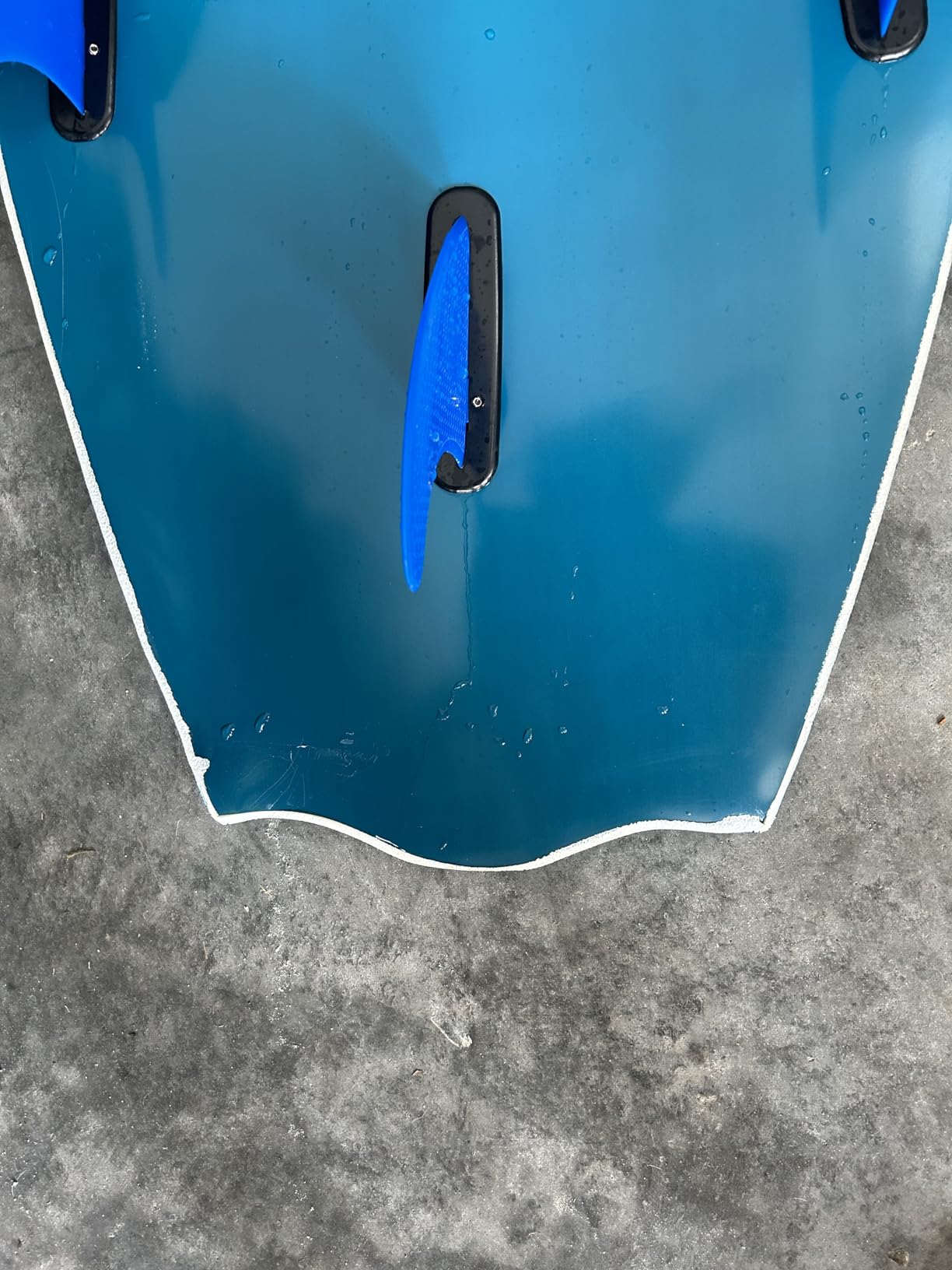
The spec sheet is sensible. A high density EPS core, full graphic deck and bottom, an attached traction pad for grip, a surf leash and three blue fins, at 6 pounds and 68 inches by 21.75 inches by 2.75 inches. Rated capacity is 180 pounds.
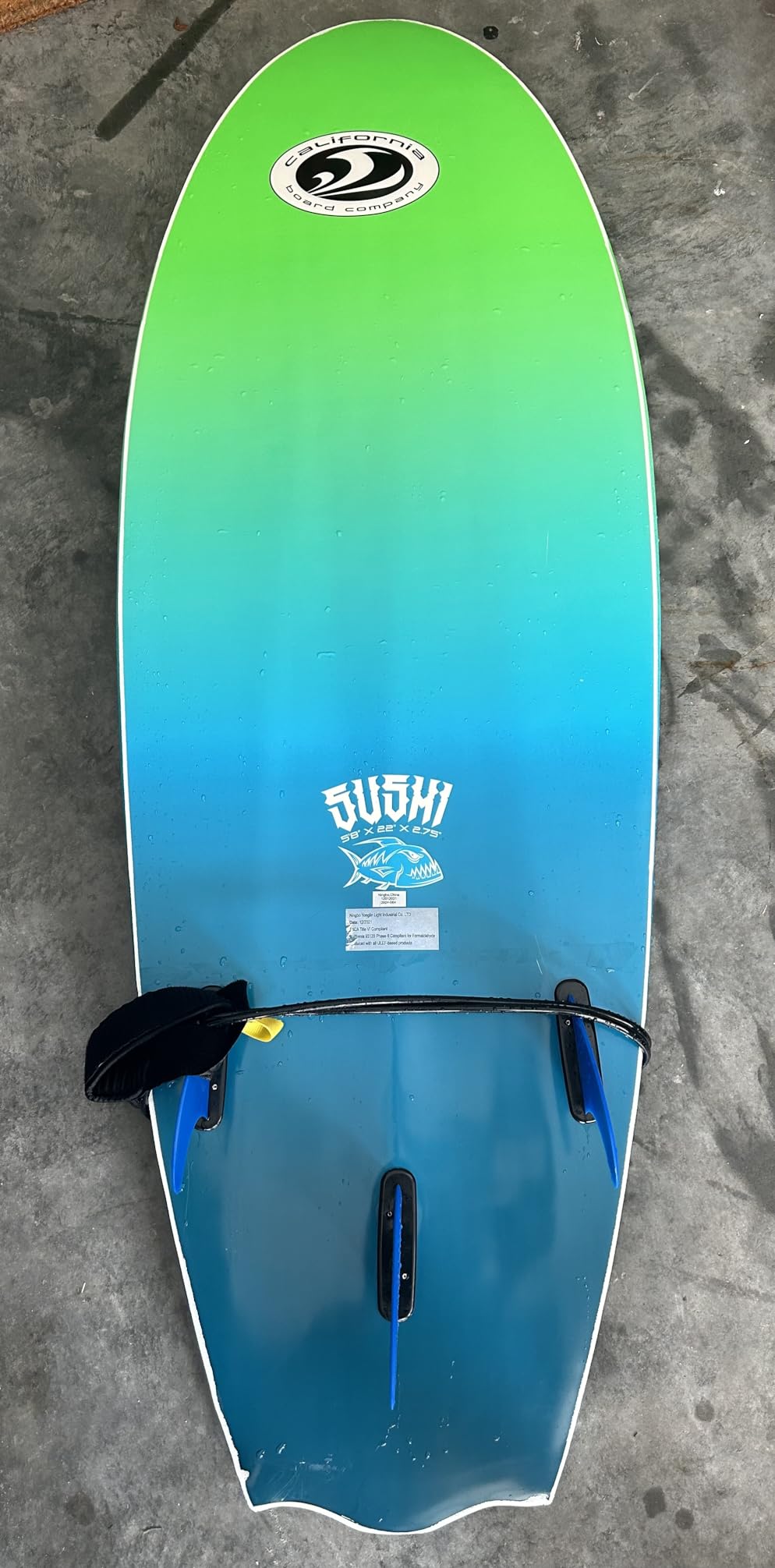
The package is complete for a starter, which is more than some competitors offer. Board, leash, three fins and a fitted traction pad means you can practise on land, in a pool or on a very flat day without buying anything else. The 30 day manufacturer warranty is short, so inspect it on arrival.
Long-term feedback is the weak point. At 4.0 out of 5 across 64 ratings, 17 percent sit at one or two stars, and owners specifically call out fin durability and inconsistent build quality. Reviewers also note it is better suited to kids and lighter adults than to a heavy adult beginner.
Who this board suits
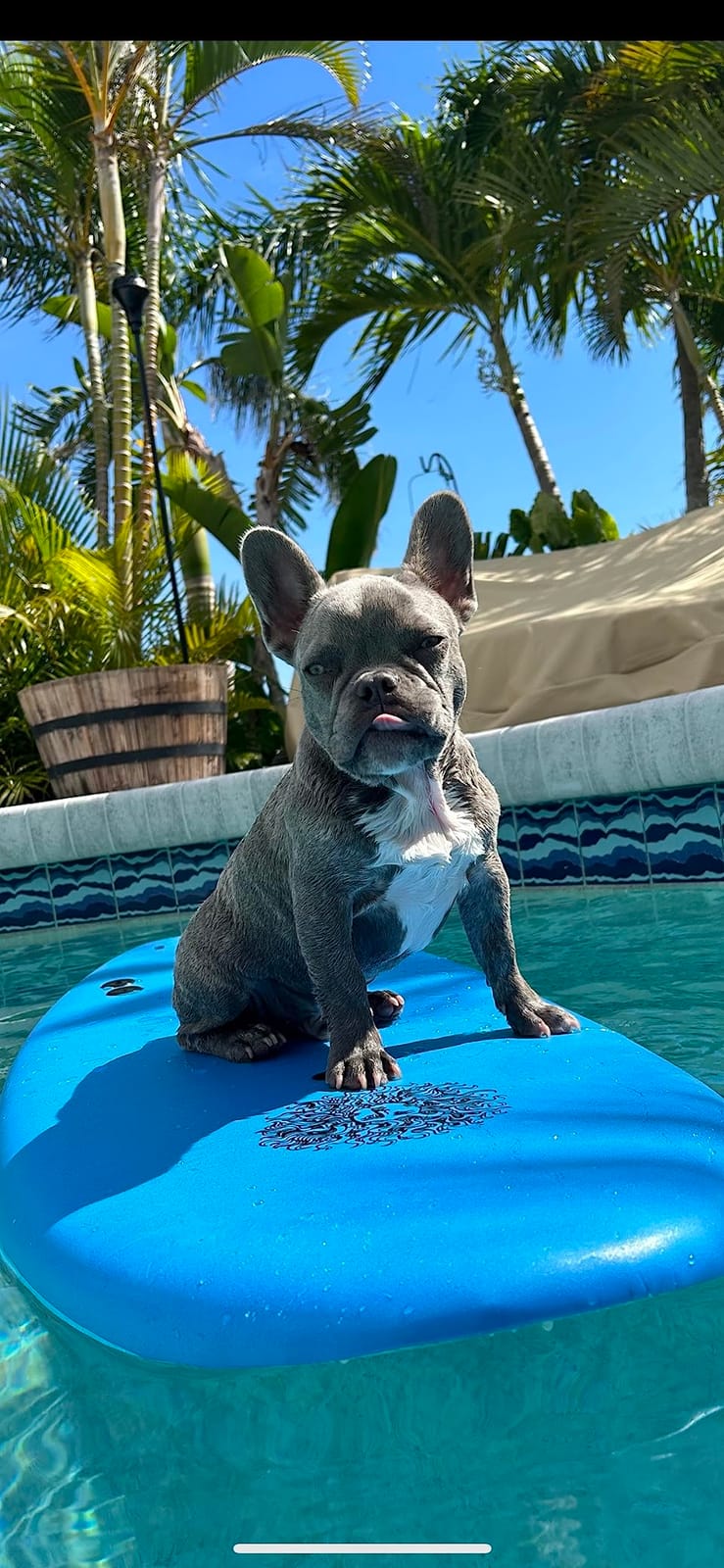
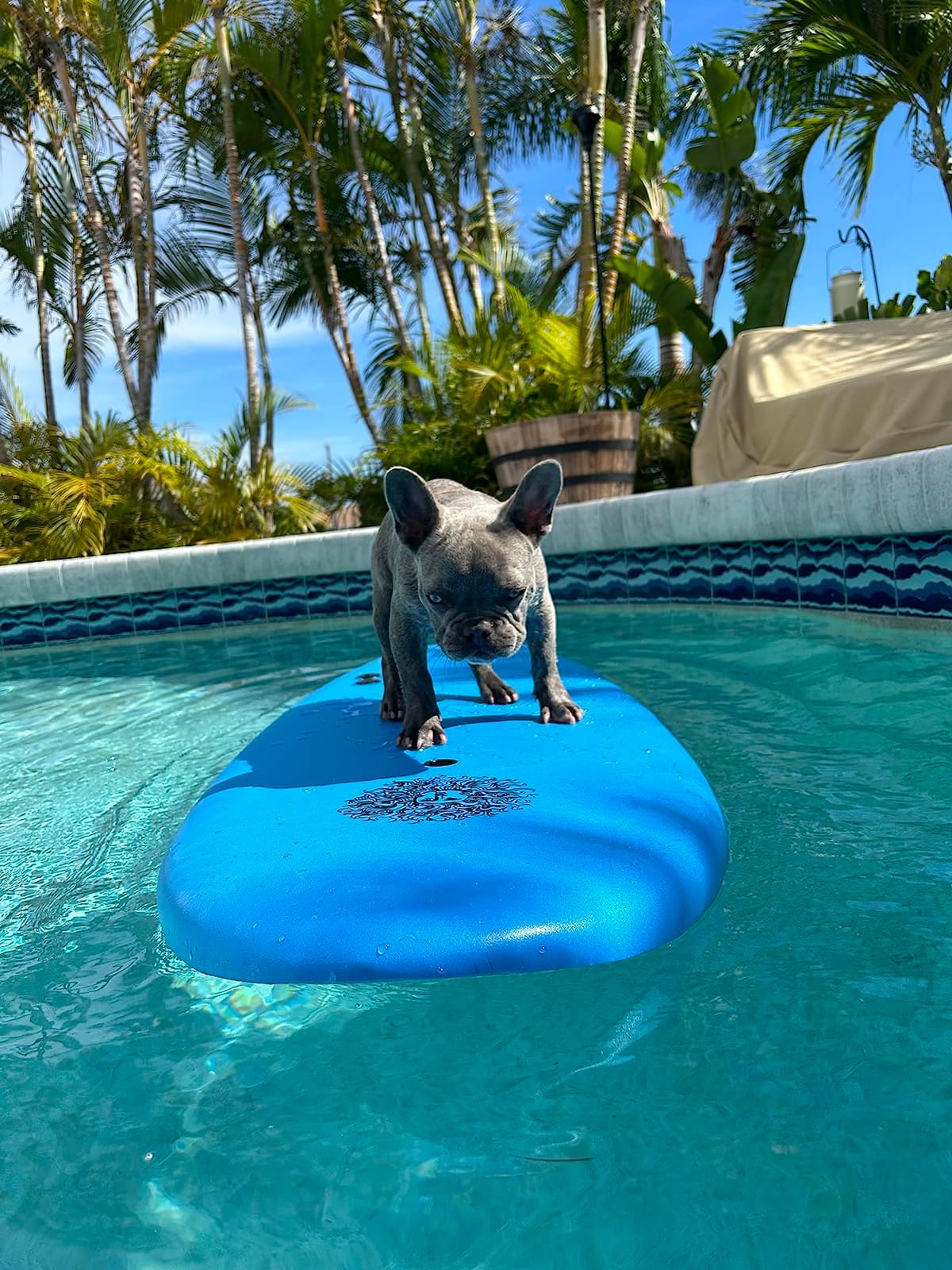
Anyone drilling pop-up technique in a swimming pool, a flat bay or very small indoor water. At 6 pounds it is genuinely easy to carry alone, which matters for pool sessions where you are going alone. It also works for a light adult or older child who wants something small to store.
Where it falls short
Do not start your ocean progression here. The manufacturer lists it as intermediate, the 2.75 inch thickness gives you little padding, and the owner feedback on fin and build consistency is not reassuring for a purchase you cannot easily return. Colours are assorted rather than selectable.
9. KONA Tri 4ft4in Softboard – Best Multi-Use Board for Small Riders
Pros
- Doubles as a bodyboard boogie board or softboard
- Carries the highest average rating in this lineup at 4.8
- Fins and leash included
- Compact enough to travel with
- Works for children and smaller adults
Cons
- Very little volume for a teen or adult
- Categorised as a bodyboard rather than a surfboard
- Only 31 ratings across the whole listing
- 30 day return policy
This is a hybrid and it does not pretend otherwise. The listing is filed under Bodyboards, and the manufacturer describes it as a surfboard, bodyboard, boogie board or softboard. For a small child in shallow water, that versatility is the point.
It is a 4 foot 4 inch polyester soft top at 19.5 inches wide and 2.5 inches thick, weighing 4.5 kg. Fins and a leash are included. At that length you are not learning wave selection or trimming, you are learning to lie on a board and then, eventually, to stand on it in whitewater.
The 4.8 average rating is the highest in this lineup, with 93 percent of ratings at five stars, but it comes from 31 reviews. Treat that as encouraging rather than conclusive. The category placement also matters: a bodyboard gets a very different wave and rider profile than a surfboard.
For an adult beginner this is not a path to surfing. At 4 foot 4 inches with 2.5 inches of thickness there is simply not enough displaced water to support a 170 pound adult paddling out, no matter how well the board is made. It is also a single colour in this variant.
Who this board suits
Young children in shallow water and families on a beach holiday who want one board that works lying down and standing up. It travels easily, which is useful if you are flying to a surf destination rather than driving to it. The 30 day return policy gives you a short window to check it over.
Where it falls short
It is a bodyboard classification, not a surfboard, and the volume is minimal for anyone approaching a teenager. There is no stated rider weight capacity, which means you are guessing. Riders who want to progress to riding real waves will need a longer board within a season.
10. EasyGo Flowboard 8ft Soft Top – Most Specs in a Packed Package
Pros
- Widest board in the group at 24 inches
- Two internal wood stringers for rigidity
- Package includes 3 fins a 6 ft leash and a traction pad
- Available in 6 ft 7 ft and 8 ft lengths
- Removable fins make transport and storage easier
Cons
- Lowest rated board here at 3.8
- 21 percent of ratings are one star
- Listed as Intermediate rather than beginner
- 30 day limited warranty and no stated weight capacity
On paper this is the most generous specification in the group. At 8 feet long and 24 inches wide with two internal wood stringers, it is wider than the 22.5 inch Wavestorm 8ft, and it comes with three fins, a 6 foot leash and a high performance traction pad in the box.
Construction is a soft foam top with an HDPE bottom for speed, custom graphics on the deck, and removable fins for convenient carrying. The listing offers 6 foot, 7 foot and 8 foot versions, so the same design covers a wider range of riders than most single-size boards here.
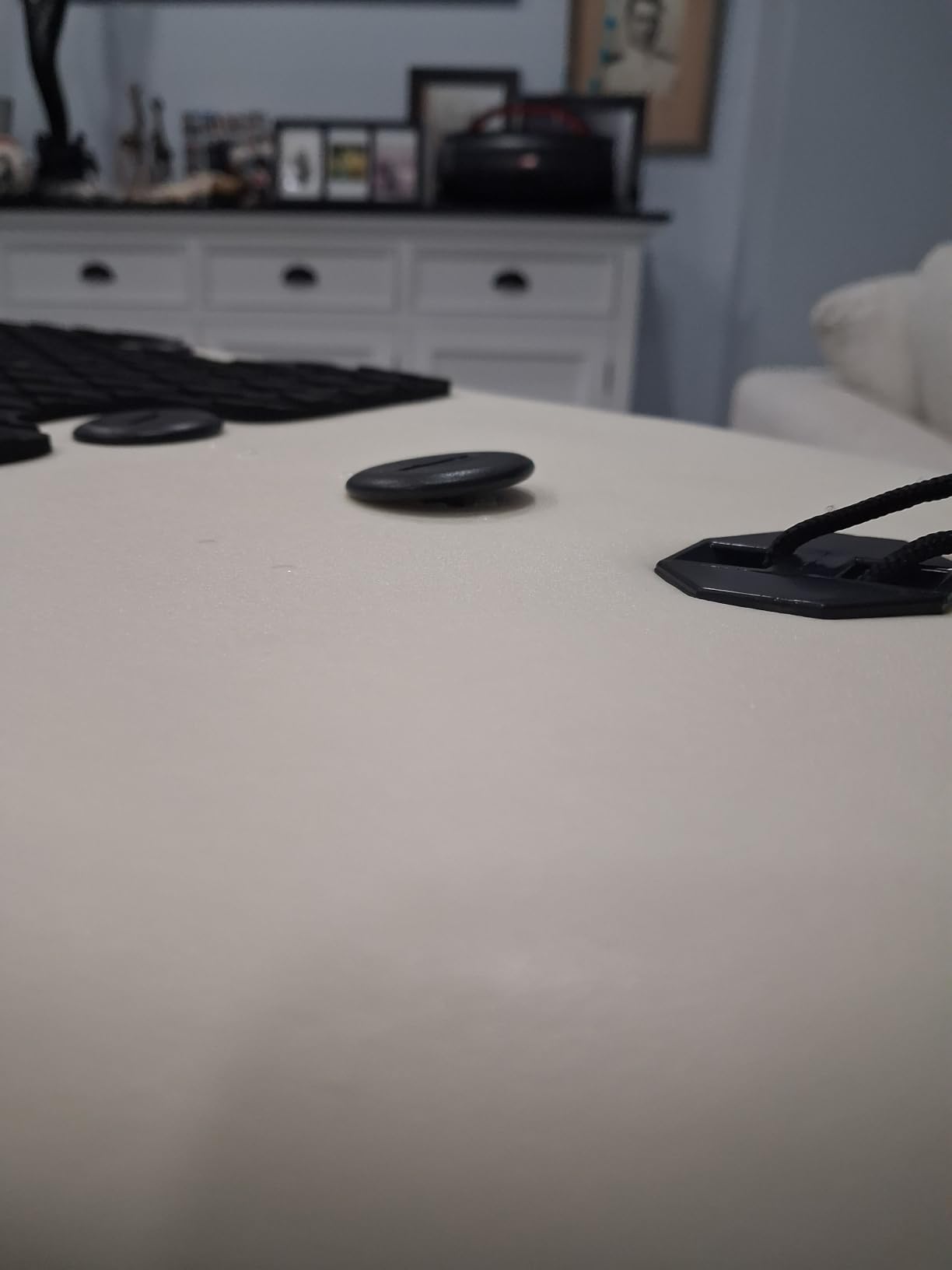
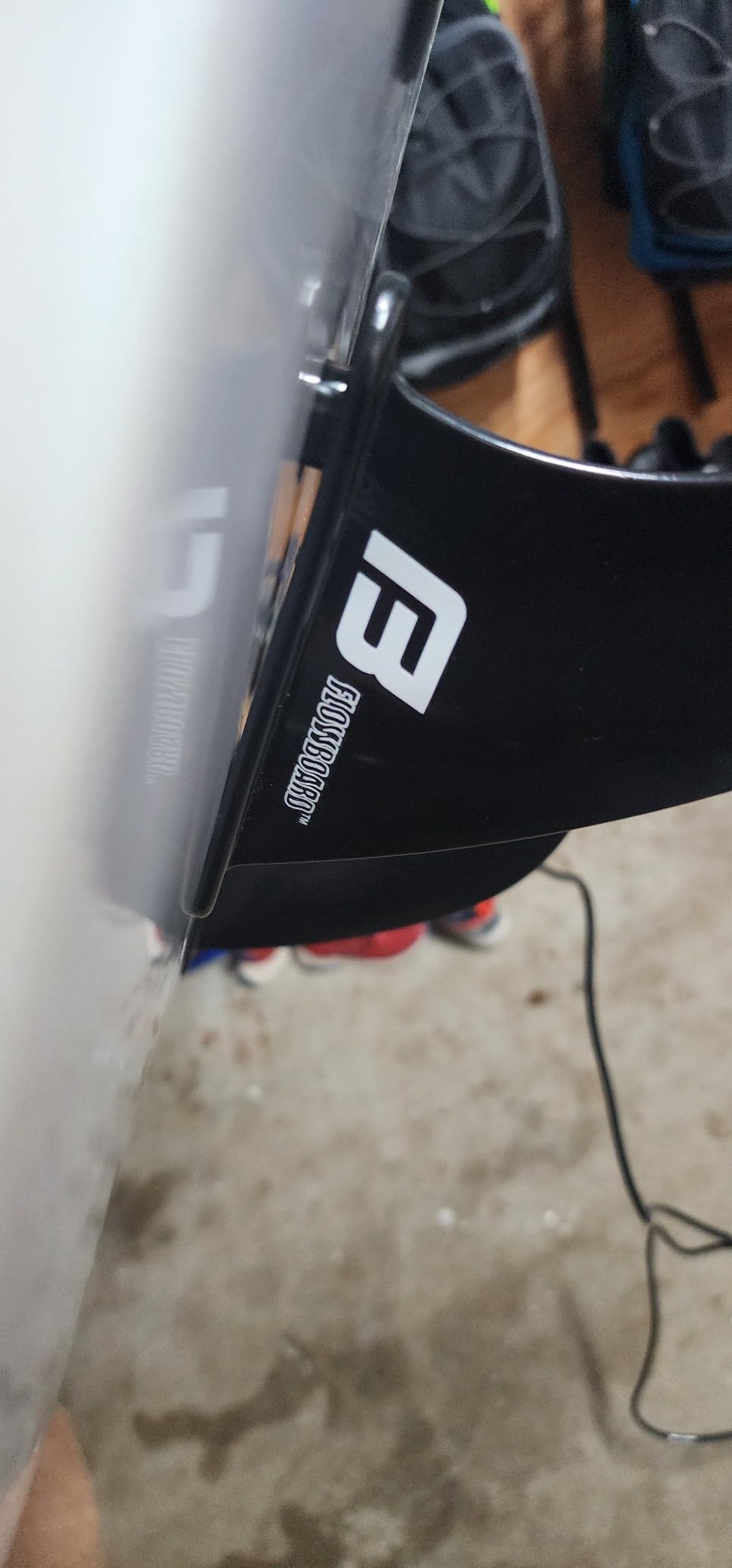
Here is the honest problem. At 3.8 out of 5 across 74 ratings, this is the lowest rated board in the lineup, and 21 percent of those ratings are one star. The specific complaints are build quality: delamination, fin box problems and graphics peeling. That is real, repeated and relevant to a first purchase.
It is also listed as an intermediate skill level rather than beginner, and no rider weight capacity is stated anywhere on the listing. The thickness field even reads 3 feet rather than 3 inches, which tells you the specification sheet is not carefully maintained.
Who this board suits
Budget-conscious buyers who want maximum width, stringers and a full accessory package in one purchase, and riders who want the option of 6, 7 or 8 foot lengths from the same design. The removable fins are a genuine plus if you are storing boards in a garage or transporting them regularly.
Where it falls short
Consistency is the issue. A 21 percent one-star share is too high for a first board, because a beginner usually cannot tell a delamination from normal wear until it is too late. The 30 day limited warranty is short, and with no stated weight capacity you are estimating whether 8 feet is right for your body.
How to Size Your First Surfboard by Height and Weight
Size your first board by weight first and height second. Every board in the list above states a maximum rider weight, and that number is more reliable than any height chart, because height charts ignore the one variable that actually determines whether you float. Our beginner camcorder guide follows the same rule: match the tool to the person using it, not to a marketing spec.
Match Volume in Litres First, Length Second
Volume is measured in litres and it tells you how much space the board occupies. More volume means more buoyancy, which means more of your weight is carried by the water rather than by your arms. That is the difference between catching a wave on the fifth paddle and not catching it at all.
As a working guide, riders under about 130 pounds do well around 55 to 70 litres, riders between 130 and 180 pounds sit comfortably in the 70 to 90 litre range, and riders above 190 pounds want the highest rated capacity you can find. The two boards rated to 200 pounds in this lineup are both 86 litre 8 footers.
The community rule of thumb that keeps surfing is simple: a beginner board should be roughly 10 inches longer than the rider is tall, with at least 2.5 inches of thickness. Every board in this list meets that minimum, and the ones over 3 inches give you a real cushion when a wave dumps on you.
What Is Volume and Why Beginners Should Prioritise It
Three terms do most of the work in surfboard shopping, and getting them straight saves a return. A soft-top, softboard or foamie are three names for the same thing: an EPS foam core under a soft, non-slip deck, safe to fall on and cheap to replace. Rocker is how much the board curves upward at the nose, and beginners want low rocker because a flat board planes faster. A stringer is a wooden or composite spine running down the middle that stops the board folding in half.
Construction matters less to beginners than brands suggest, with one exception. An EPS core is lighter and more resilient than polyurethane, so most of the boards here use it. Epoxy laminated bottoms add durability on rocks. But the three specs that change your first session are length, width and thickness, and after that it is volume.
Soft-Top vs Hardboard: Which Comes First
Buy the soft-top first, and treat the hardboard as the year-two upgrade. A soft-top is safe, forgiving and cheap to replace, which means you are not protecting an expensive investment while learning to pop up. Once you are standing consistently and catching waves on your own, a long epoxy or fibreglass board is a sensible next step.
The soft-top ceiling is real, though. Foam boards are heavier, less responsive and have a fixed flex that never changes. That is fine for a first year and limiting after that. Plan the progression rather than upgrading twice, and expect a typical learner to move from a long soft-top to a 7 foot hard longboard before touching anything shorter.
What Comes in the Box: Leash, Fins, Tail Pad and Wax
Check what is included before you order, because this is the most common first-purchase mistake. Across these ten boards, the packages vary widely. The Wavestorm 8ft, the 7ft Wavestorm, the Fender collaboration and the Thurso 7/8 all include a leash, fins and a tail pad. The Rock-It Alberto includes three removable fins but no leash is listed. The Chub and the KONA softboard both list fins, and the Chub needs no wax at all.
Wax is a separate purchase for any board with a slick deck, and it is a few dollars a bar. An ankle leash is the right type for a beginner on a longboard, and a coiled leash only makes sense once you are diving head first. Removable bolt-through fins are worth paying for because they can be changed as you improve.
Budget for a wetsuit as well. In any water cold enough to be worth surfing in, a wetsuit is a bigger factor in whether you enjoy the session than the board is, and it is the one piece of kit you should try on in person. If you also plan to film the session, our landscape photography tips for beginners cover how to keep horizons level from the shoreline.
Four Beginner Buying Mistakes to Avoid
Buying too small. A board that is under-volume for your weight cannot be paddled hard enough to catch a wave, and no amount of technique fixes that in month one.
Buying too thin. Anything under 2.5 inches will hurt your knees and lower back during a 20-minute paddle-out.
Buying a shortboard labelled as a beginner board. A 5 foot 6 or 5 foot 8 shape requires real skill, and several boards in this list are honestly marked as intermediate.
Ignoring the rating and the warranty. The manufacturer weight capacity is the most useful number on the page, and a five year warranty is a genuine signal about build confidence.
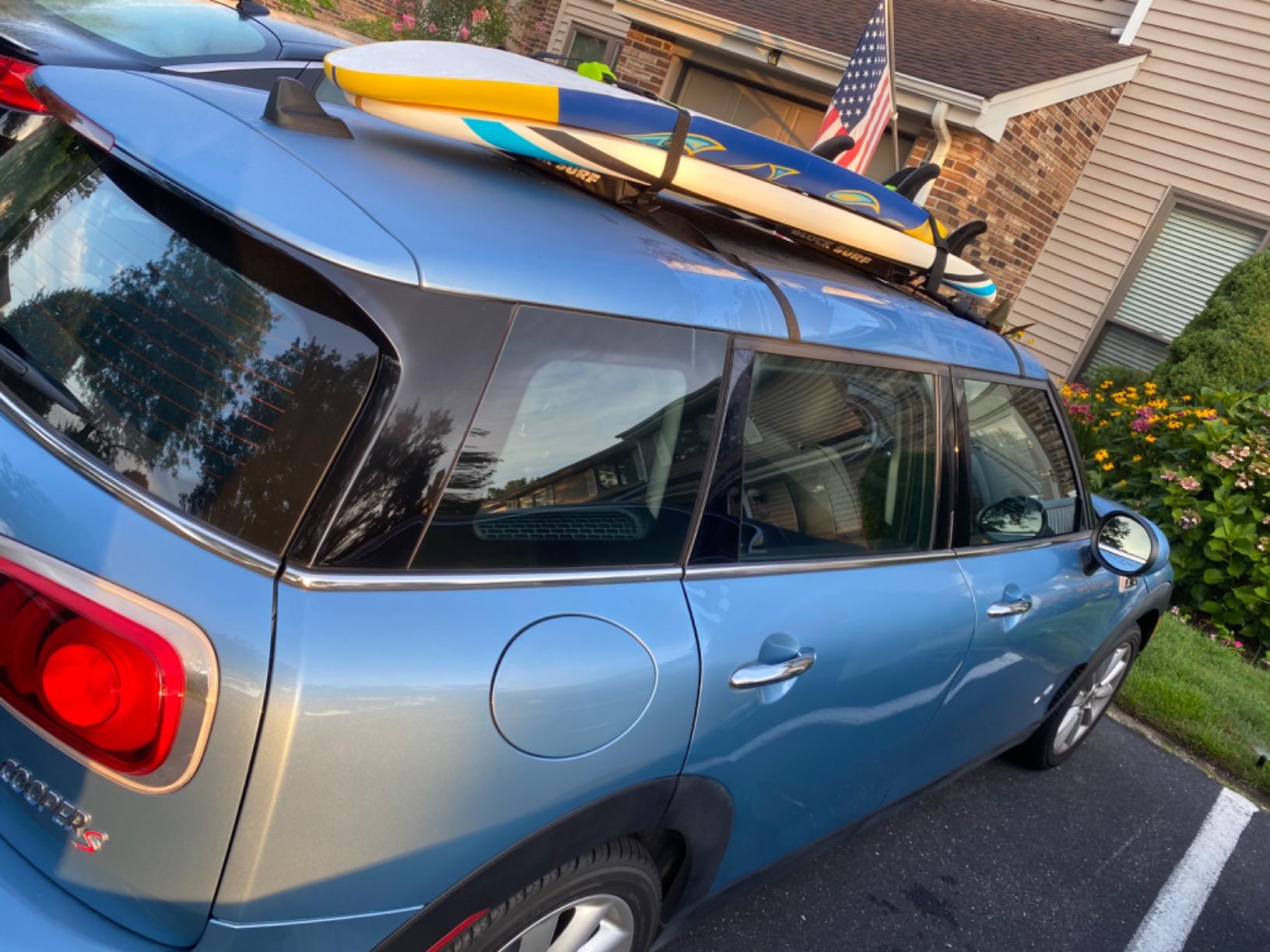
One more practical note. If you are buying an 8 footer, plan the transport before you buy. Soft-top boards with removable fins travel far more easily than bolt-through setups, and a board bag plus roof rack or a rear-door rack is the practical solution for most people. Our camera gimbal picks for beginners apply the same logic to filming: stabilise the tool before worrying about the shot.
Frequently Asked Questions
What is the best foam board for beginners?
The best foam board for beginners is a high-volume soft-top longboard between 8 and 9 feet, with a rounded nose and at least 2.5 inches of thickness. For adults we prefer an 8 foot board around 80 to 90 litres, because that volume catches small waves and keeps the pop-up stable. Boards in the 70 litre range work for teens and lighter adults, and anything under 6 feet is too small for a genuine first board.
What size surfboard is best for a beginner?
Weight matters more than height. Riders under about 130 pounds do well with 55 to 70 litres, riders between 130 and 180 pounds want 70 to 90 litres, and heavier riders should look for the highest stated capacity available. As a shape rule, a beginner board should be roughly 10 inches longer than the rider is tall, with a minimum thickness of 2.5 inches. Between 8 and 9 feet is the standard adult choice.
Is a 7 foot surfboard suitable for beginners?
Yes, a 7 foot soft-top is one of the most sensible first boards for a teen or a lighter adult. Around 70 litres it still catches small waves and glides well, and it is considerably easier to carry than an 8 footer. The trade-off is float: below about 120 pounds it will feel oversized, and above roughly 180 pounds you will be pushing it past what it was designed to support.
Do beginners need a soft top surfboard?
Most beginners do, and for a year it is the right call. A soft deck is safe to fall on, it is forgiving when you miss a wave, and it is inexpensive to replace if a lesson ends badly. The exception is an adult who already surfs and wants a hardboard for glide. For a genuine first year, the safety and forgiveness of a soft-top outweigh the extra weight and lower responsiveness.
Should I buy my own surfboard or rent one?
Rent first. Book one lesson or rent for a weekend, note the length and litre figure of the board you were given, and buy a board that matches it. The rental confirms that you want to keep paddling and gives you an instructor’s sizing answer for free. The exception is a small child, where rental boards in that size are scarce and a cheap kid-specific soft-top is a reasonable buy.
Is 40 too late to learn to surf?
No. Adults learn on exactly the same soft-top longboards as teenagers, and the board is chosen to support your weight rather than your age. A realistic path is a first year of weekly lessons on an 8 foot soft-top, then a move to a harder longboard once you are standing consistently. Nobody progresses past beginner level faster by starting younger, because the limiting factor is paddle power and balance, not age.
The Best Surfboard for Beginners Is the One That Matches Your Weight
The Wavestorm 8ft soft-top is the pick for most adults, because 86 litres, a 3.25 inch deck and a full accessory package cover the widest range of beginner conditions, and it has the deepest owner history in this group at 1197 ratings. If you are lighter, the 7ft Wavestorm gives you the same design in a manageable 70 litre package, and if you want a warranty behind the foam, the Thurso 7/8ft covers up to 210 pounds with five years of cover.
Everything else on this list has a narrower job. The Thurso Lancer and the 5 foot boards are step-up or family options, the Chub and the KONA softboard are for children, and the EasyGo Flowboard is the one I would approach with caution given its owner feedback. Match litres to your body weight, buy the leash and fins in the same order, and give the lesson a try before the purchase.