
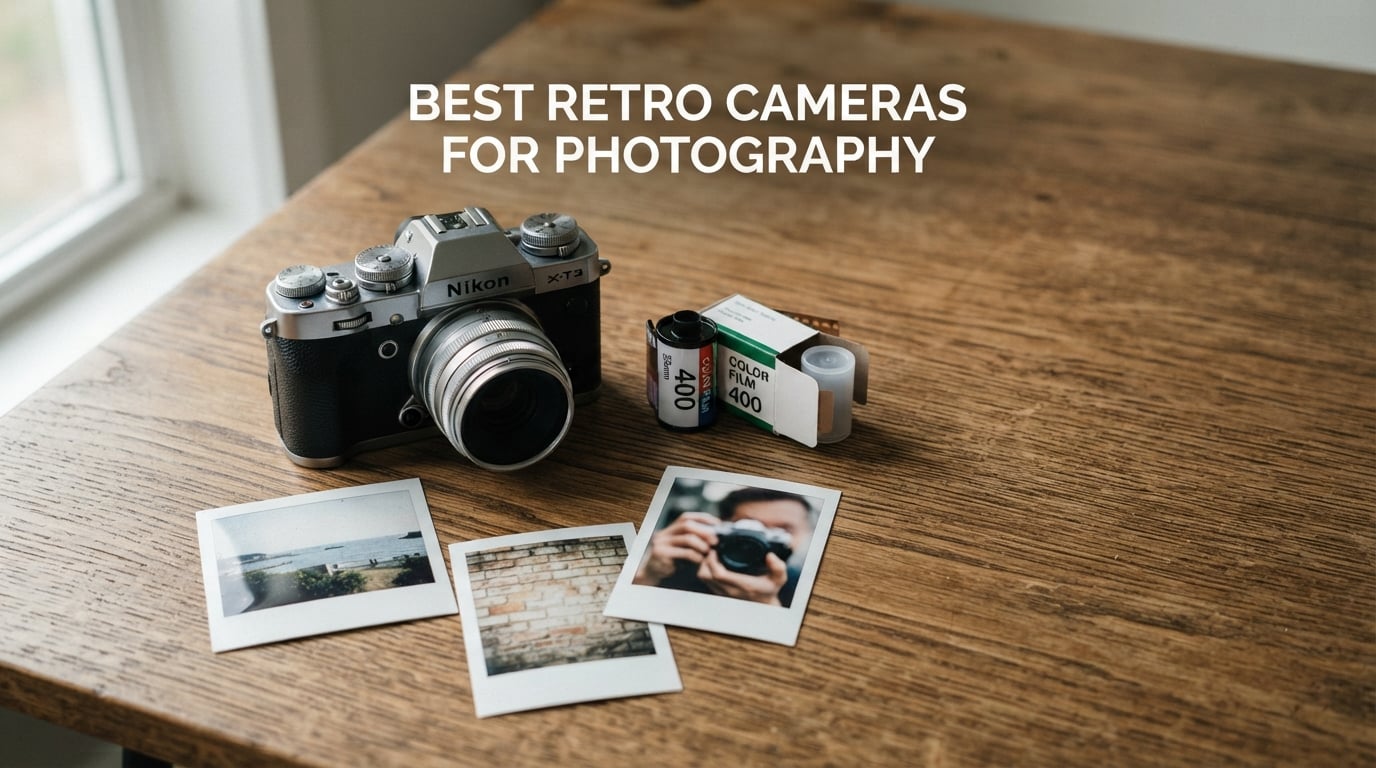
The best retro cameras for photography pair a classic-looking body and tactile controls with a shooting experience that makes each frame feel deliberate. My short answer for 2026 is this: choose the Fujifilm X-E5 when you want serious interchangeable-lens digital files, the Kodak EKTAR H35N when half-frame 35mm appeals, and the Instax Mini EVO when sharing a physical print matters most.
A retro camera is not only a silver-and-black shell. It may have physical dials, an aperture ring, a rangefinder- or SLR-inspired silhouette, an optical or electronic viewfinder, or a film-like output path; some are actual film cameras, while others are digital cameras with retro looks.
I approached this selection by separating the experience from the appearance. A photographer who wants dependable autofocus and editing latitude needs a different tool from someone who wants one printed souvenir, a roll of 35mm frames, or a small digital camera that encourages casual everyday carry.
The Top 3 Retro Camera Picks Are the X-E5, EKTAR H35N, and Mini EVO
These three cover the widest range of photographic intent: high-resolution digital work, a half-frame film routine, and instant prints with digital control. The remaining picks make sense when a simple reusable 35mm camera, Polaroid format, compact digital novelty, or a different Fujifilm-style workflow is the priority.
These Are the Best Retro Cameras for Photography in 2026
The list below runs from an advanced APS-C mirrorless kit through real 35mm and half-frame cameras to instant and small digital models. Read the features as a starting point, then use the individual sections to match the camera to how you actually want to shoot.
| Product | Specifications | Action |
|---|---|---|
 Fujifilm X-E5 with XF23mmF2.8 Fujifilm X-E5 with XF23mmF2.8 |
|
Check Latest Price |
 Fujifilm Instax Mini EVO Fujifilm Instax Mini EVO |
|
Check Latest Price |
 Kodak Snapic A1 Kodak Snapic A1 |
|
Check Latest Price |
 Kodak EKTAR H35N Kodak EKTAR H35N |
|
Check Latest Price |
 CHUZHAO Vintage Mini CHUZHAO Vintage Mini |
|
Check Latest Price |
 EJXHKNF Vintage Digital EJXHKNF Vintage Digital |
|
Check Latest Price |
 Polaroid Now 3rd Gen Polaroid Now 3rd Gen |
|
Check Latest Price |
 Fujifilm X Half Fujifilm X Half |
|
Check Latest Price |
1. Fujifilm X-E5 Is the Best Interchangeable-Lens Retro Pick
Pros
- 40.2MP X-Trans sensor
- seven-stop IBIS
- AI subject detection
- film simulation dial
- X Mount lenses
Cons
- No flash included
- limited review volume
The Fujifilm X-E5 is the camera I would put first for someone who wants the retro-camera feeling without giving up modern capture tools. Its 40.2-megapixel X-Trans 5 HR sensor and X-Processor 5 put it in a very different class from the compact novelty cameras here, while the silver rangefinder-style body and machined aluminum top plate keep the visual appeal honest.
The included XF 23mm f/2.8 R WR lens gives the kit a compact, fixed-field-of-view starting point, but it is not a fixed-lens system. Fujifilm states compatibility with more than 40 X Mount optics and accessories, which matters if your interest grows from street photography into portraits, close work, or longer travel lenses.
For hand-held evening walks, the stated seven-stop in-body image stabilization is the feature I would notice before the headline resolution. The 425-point autofocus system also includes AI-based subject detection, and the listed 13 frames per second means this body is built for more than slow, static compositions.
The X-E5 Works Best for Photographers Building a Lens System
Choose this model if you want manual-feeling controls alongside a current APS-C sensor, stabilization, and subject-aware autofocus. The configurable Film Simulation dial has three customizable settings, so it offers a fast route to a preferred JPEG look without pretending that film simulation and film capture are the same thing.
I also like the balance of a 1.18-pound listed weight against a compact rangefinder form. It should suit a photographer who wants to carry one small prime on a city walk but retain the option to change lenses for a planned assignment.
The X-E5 Makes Less Sense for Built-In-Flash Simplicity
This kit does not include a flash, so it is not the self-contained answer for parties or snapshots in dim rooms. Anyone who wants a one-button, printed result or a no-settings camera will find the next few options less demanding.
The available Amazon review base is also far smaller than several cameras below, with 68 reviews at the time the product data was collected. That does not change the specified hardware, but it is a sensible reason to read current owner feedback before deciding.
2. Fujifilm Instax Mini EVO Is the Best Hybrid Instant Choice
Pros
- 100 effect combinations
- dual shutter buttons
- selfie mirror
- microSD saving
- phone printing
Cons
- Film sold separately
- no waterproofing
The Instax Mini EVO makes the retro idea social rather than technical. It is a hybrid instant camera that lets you save images to a microSD card, print 2 by 3 inch Instax Mini photos, and use Bluetooth for smartphone control and app transfer.
Its headline creative option is a matrix of 10 lens effects and 10 film effects, giving 100 combinations. I see that as an invitation to make deliberate choices before printing rather than as a substitute for a larger sensor or a fully adjustable camera.
The physical layout is unusually considerate for a small camera: there are separate shutter buttons for portrait and landscape orientation, plus a built-in selfie mirror. That is useful when the photograph includes the people holding the camera, not just the scene in front of it.
The Mini EVO Is Right When Prints Are Part of the Photograph
Pick the Mini EVO for trips, birthdays, and casual portrait sessions where a print handed over in the moment has more value than a large file. The ability to print smartphone images broadens the role of the camera, while saving camera images to microSD avoids making every frame a one-chance print decision.
Its 590-review, 4.6-rating data point suggests substantial buyer experience compared with newer specialist models. That community feedback is useful because real users tend to care about printing rhythm and framing as much as a specification sheet.
The Mini EVO Is Not a Substitute for a Weather-Sealed Camera
No waterproofing is listed, so I would keep it protected in wet conditions. Film is also separate from the camera, which means the ongoing physical-print workflow needs planning before an event or trip.
The product information lists digital image stabilization, a hybrid viewfinder, and compact dimensions of 3.4 by 4.8 by 1.4 inches. Those are practical portability points, but they do not turn this into a high-resolution interchangeable-lens body.
3. Kodak Snapic A1 Is the Best Simple Reusable 35mm Camera
Pros
- Three-element glass lens
- two-zone focus
- auto flash
- multiple exposure
- 117g body
Cons
- Film not included
- AAA battery not included
- 1/100 shutter
The Kodak Snapic A1 is the cleanest route into actual 35mm photography on this list. It is a compact reusable point-and-shoot with automatic exposure, an optical viewfinder, a three-element glass lens, and a stated weight of 117 grams.
I would choose it over a disposable camera when I want the same simple pace without throwing away the body after one roll. The two-zone focus design makes more sense for a casual film camera than complex menus would, because it asks the photographer to select the appropriate focus zone and concentrate on timing.
The built-in auto flash includes red-eye reduction, and there is a multiple-exposure capability for people who want a little creative uncertainty in a film frame. Those are meaningful features for a lightweight 35mm camera, especially when the aim is snapshots rather than technical control.
The Snapic A1 Fits First-Time 35mm Shooters
Use the Snapic A1 if loading a roll, advancing through it, and waiting for developed frames sounds appealing rather than inconvenient. Automatic exposure reduces the learning curve, while the optical viewfinder keeps the act of framing separate from a bright rear screen.
I would pack it for daylight walks, holidays, and family moments where small size matters. The product data reports 103 reviews and a 4.5 average rating, with comments that favor the image quality and straightforward handling.
The Snapic A1 Has Clear Low-Light and Speed Limits
The stated maximum shutter speed is 1/100 second, so it is not the tool for freezing fast action. Film and the AAA battery are not included, and the camera’s automatic approach leaves little room for exposure experimentation compared with a manual film body.
That limitation is not necessarily a flaw; it is the point of selecting a simple point-and-shoot. I would simply reserve it for situations where flash, a slower pace, and imperfect results are part of the expected look.
4. Kodak EKTAR H35N Is the Best Half-Frame Film Pick
Pros
- Half-frame format
- coated glass lens
- star filter
- bulb mode
- tripod mount
Cons
- Film not included
- AAA battery not included
- focus-free lens
The Kodak EKTAR H35N answers a question that many new film shooters ask: how can I make a 35mm roll go farther without using a disposable body? Its half-frame format records two images in the area normally used for one standard 35mm frame, which is why it can yield twice the shots per roll.
This is not a Pentax 17, but it covers the underrepresented half-frame idea with a much simpler focus-free approach. The listed 22mm coated glass and aspheric lens, manual film advance and rewind, and top-mounted frame counter make its mechanics visible in a pleasingly old-school way.
I would treat the H35N’s star filter and bulb function as its real differentiators. The star filter creates a four-beam flare effect around lights, while bulb mode, a tripod mount, and cable-release compatibility invite light trails and longer exposures when the camera is held still.
The H35N Is Great for High-Volume Creative Film Walks
Choose the H35N for a visual diary, a concert-adjacent night walk, or a trip where you expect to make many small observations. Half-frame changes the rhythm: two vertical images can sit beside one another on a developed strip, and that pairing can become part of the storytelling.
Its 110-gram listed weight also supports the everyday-carry case. The 677-review, 4.4-rating record is the largest film-camera review sample in this group, so it has more owner feedback than a niche, newly released alternative.
The H35N Requires Comfort with Focus-Free Film Shooting
The camera is focus-free, which favors daylight scenes and uncomplicated distances over precise close-ups. Film, an AAA battery, a cable release, and a tripod are not included, so the bulb-mode setup requires extra gear.
I would not choose it when every frame must be critically sharp or when fast, low-light autofocus is the expectation. It is better understood as a creative 35mm tool with a fixed, playful point of view.
5. CHUZHAO Vintage Mini Is the Best Pocket TLR-Style Digital Camera
Pros
- TLR-style design
- autofocus
- 1080p video
- 16GB card included
- four-hour battery claim
Cons
- No flash
- fixed focal length
- basic low-light AF
The CHUZHAO Vintage Mini is for the person drawn to the shape of a twin-lens-reflex camera but who wants immediate digital files. The small black M1 has a 12-megapixel CMOS sensor, autofocus, a 1.54-inch LCD, FHD 1080p video, and a supplied 16GB card.
I would not compare its image potential with the APS-C Fujifilm at the top of this list. Its appeal is the tiny TLR-style body, one fixed focal length, simple autofocus, and the fact that it can go into a pocket instead of a dedicated camera bag.
The listed 1000mAh battery is rated for more than four hours of shooting. That claim and USB connectivity make the camera easier to keep around for casual photos and short clips than a film camera that needs a finished roll before you can see the results.
The CHUZHAO Fits Casual Digital Nostalgia and Gifts
Choose this camera when the experience of carrying a fun object is as important as technical output. The user data includes more than 1,000 reviews at a 4.3 average, and the product notes position it for teens, beginners, and portable shooting.
For an everyday walk, I would use it as a light, low-pressure camera rather than a replacement for a phone in difficult lighting. Its compact form makes it a reasonable way to practice noticing scenes without bringing a large system.
The CHUZHAO Is Limited for Dark Scenes and Focal-Length Variety
There is no flash, and the fixed lens gives no optical framing flexibility. The supplied information also warns that its basic autofocus may struggle in low light, so dim interiors and quick night subjects are not its strongest setting.
The 12MP specification and small LCD are enough for its intended casual role, but they do not promise the large-print detail or extensive editing latitude of a larger-sensor camera. Set expectations around its character rather than its megapixel number.
6. EJXHKNF Vintage Digital Camera Is the Best CCD-Style Compact Option
Pros
- CCD sensor
- waist-level screen
- autofocus
- 16GB card
- creative filters
Cons
- No flash
- digital zoom only
- four-hour battery claim
This EJXHKNF compact speaks directly to the renewed interest in vintage digital cameras and unusual viewing angles. It specifies a CCD sensor, 64-megapixel still capture, autofocus, a 2.4-inch IPS display, 16GB of included storage, and 2.7K video recording.
The waist-level screen is the feature I find most relevant to its retro identity. Looking down to frame can slow a photograph down and change the way strangers react compared with holding a phone at eye level, though the screen is still a modern digital display rather than a true reflex finder.
It also has Original, Vintage, and Black and White filters, plus 16x digital zoom. Those modes can make experimentation easy, but I would separate a filter look from genuine sensor character and remember that the listed zoom is digital rather than optical.
The EJXHKNF Helps Beginners Try a Vintage-Digicam Look
Choose it if a CCD compact, waist-level composition, straightforward autofocus, and in-camera filters appeal more than interchangeable lenses. The compact body and included card support travel and quick personal projects, while the 2.7K video setting offers a simple moving-image option.
I would use the waist-level screen for still subjects, cafes, markets, and self-portraits where composition can be considered for a moment. That is a more reliable use case than treating 16x digital zoom as a telephoto lens.
The EJXHKNF Is Not Built Around Night Flash or Optical Reach
No flash is listed, the camera is not water resistant, and the battery claim is four hours. Digital zoom magnifies the existing image rather than adding the optical detail that a longer lens can capture.
The 163-review, 4.3-rating data offers a useful but modest pool of buyer feedback. I would verify the current user experience and return policy before relying on a lesser-known compact for a once-only event.
7. Polaroid Now 3rd Generation Is the Best Classic Instant Format Pick
Pros
- Twin-lens autofocus
- double exposure
- self-timer
- USB-C charging
- i-Type and 600 film
Cons
- Not water resistant
- one-year warranty
- instant-film workflow
The Polaroid Now 3rd Generation gives the list its most familiar instant-camera silhouette. It works with Polaroid i-Type and 600 film and combines an optical viewfinder with automatic exposure, a twin-lens autofocusing system, double exposure, a self-timer, and a USB-C rechargeable battery.
I would pick it when the larger, unmistakably Polaroid-style object and image are the point. Unlike a hybrid that lets you decide what to print later, instant film asks for commitment at the shutter press, and that limitation can make the result feel more meaningful.
The listed battery life is 150 photos, described as more than 15 film packs, and there is a tripod mount for self-timer shots. It is a practical specification set for group photos, while the creative double-exposure mode gives a straightforward way to layer two moments on one frame.
The Polaroid Now Works Best for Shared Physical Moments
Select the Now when you want a distinctive, immediate object to give away or pin up. Its 1,313 reviews give it the largest review pool in this roundup, and the 4.2 average reflects a product with a broad base of buyers rather than a specialist camera audience.
For a party or portrait session, I would make the optical viewfinder, self-timer, and twin-lens autofocus the center of the workflow. The camera’s retro appeal comes from the visible process as much as the print itself.
The Polaroid Now Requires an Instant-Film Mindset
This model is not water resistant and includes a one-year warranty. It also uses an instant-film process, so each exposure belongs to a physical medium rather than an unlimited digital card.
That makes it less suitable for someone who wants to shoot hundreds of variations, inspect them immediately, and edit later. The Mini EVO is the better fit for that hybrid approach; the Now is for photographers who value the directness of Polaroid film.
8. Fujifilm X Half Is the Best Digital Camera for Analog-Inspired Play
Pros
- Compact body
- 26 analog options
- dial controls
- app sharing
- Instax printer support
Cons
- 18MP resolution
- no weather resistance
- film not included
The Fujifilm X Half takes a different route from the X-E5. It is an 18-megapixel mirrorless camera with an optical viewfinder, dial-based control, 26 analog-inspired film and filter options, app sharing, and the ability to print to a compatible Instax printer.
I would view it as a camera built around a playful, finite-feeling image-making process rather than around maximum resolution. Its Film Camera mode and 2-in-1 mode, which combines stills and/or video, provide a distinct workflow for photographers who want an old-school camera feel with digital delivery.
The product data lists a compact, light body at 0.98 pounds, ISO 100 to 6400, and video options at 1080p and 1440p. Those are useful practical limits to understand before calling it a replacement for a higher-resolution, all-purpose mirrorless kit.
The X Half Suits Photographers Who Want a Guided Creative Process
Choose the X Half if changing analog-inspired looks in camera, using dials, sharing through an app, and optionally making Instax prints sound more attractive than changing lenses. The 26 available options give photographers room to create a consistent visual series without later editing every file from scratch.
I would take this one on a personal trip or a photo walk where the goal is to respond to a scene and keep moving. The 2-in-1 mode adds a reason to think in pairs and sequences rather than isolated single images.
The X Half Is Not the Detail-First or Weather-Ready Choice
The listed 18MP resolution is lower than the X-E5’s 40.2MP sensor, and no water resistance is stated. The product information also calls out compatible Instax printing, but any film needed for printing is not included.
Its 73 reviews at a 4.0 average provide less consensus than the Mini EVO or Polaroid Now. I would buy it for its particular controls and image-making concept, not on the assumption that it will cover every kind of photography.
Choose a Retro Camera by the Shooting Experience You Want
The first choice is not brand; it is whether you want a digital file, an actual negative, or a print at the scene. Digital cameras are the sensible route when autofocus, stabilization, repeatable results, and editing flexibility matter, while film and instant cameras trade speed and convenience for a more constrained, tactile process.
The Fujifilm X-E5 is the strongest fit here for a photographer who wants a modern mirrorless retro camera and lenses that can grow with them. The X Half and Mini EVO turn the decision toward analog-inspired effects and a smaller, more self-contained system.
Digital Retro Cameras Give You More Control After the Shutter Press
A digital camera with a retro look usually gives you an SD-card workflow, immediate review, and the option to adjust files later. In this group, the X-E5 adds a 40.2MP APS-C sensor, seven-stop IBIS, AI-based subject detection, and interchangeable X Mount lenses, while the compact digital choices emphasize portability and simpler capture.
Film simulation modes are not film stock, but they can help create a consistent JPEG mood. The X-E5’s configurable film simulation dial and the X Half’s 26 analog-inspired options are useful if you prefer to make aesthetic decisions while shooting instead of building every look in software.
Film Cameras Give You a Different Pace and a Physical Negative
The Snapic A1 and EKTAR H35N use 35mm film, so each roll has to be loaded, shot, rewound, and developed. Forum discussions repeatedly point to film and developing costs as a real pain point, which is why it makes sense to choose film for the process and look rather than assuming it is the convenient option.
Half-frame is especially interesting when you expect to shoot a lot, because the H35N yields two exposures where standard 35mm uses one. Its focus-free setup is simple, but it also means you should choose it for its character, not because you need precise focus control.
Instant Cameras Turn the Photo into a Shared Object
The Mini EVO and Polaroid Now are both instant options, but their workflow differs. The Mini EVO stores images to microSD and can print from a smartphone, whereas the Polaroid Now uses i-Type or 600 film and makes the physical frame at the moment of exposure.
I suggest the Mini EVO for people who want effects, selective printing, and a compact hybrid system. I suggest the Polaroid Now for people who want the larger classic instant format, twin-lens autofocus, and the ritual of an image emerging in front of everyone.
A Lens System Matters More Than Body Style for Long-Term Digital Use
Interchangeable lenses change what a retro mirrorless body can do. The X-E5 works with more than 40 X Mount optics and begins with an XF 23mm f/2.8 R WR kit lens, so it offers room to move from a wide everyday view to a portrait or telephoto lens later.
By contrast, the CHUZHAO has a fixed focal length and the EJXHKNF’s 16x zoom is digital only. Fixed-lens simplicity is a benefit when you want no decisions, but it is a real limit if you already know that different focal lengths shape your photography.
Focusing and Stabilization Should Match Your Subjects
For moving people, children, and street scenes, autofocus behavior matters more than decorative dials. The X-E5 lists 425-point autofocus with AI-based subject detection and 13 frames per second, while the Mini EVO, CHUZHAO, EJXHKNF, and Polaroid Now offer more modest autofocus approaches suited to their formats.
Stabilization also deserves attention for hand-held lower-light work. The X-E5 specifies up to seven stops of IBIS; the Mini EVO lists digital image stabilization; and several film or basic compact choices do not present stabilization as a feature, so shutter speed and steadier handling become more important.
The Retro Look Comes from Choices, Not Just a Filter
The retro look often comes from warm or muted color, direct flash, visible grain, square or vertical framing, and a composition that feels less polished than a commercial digital image. A camera can support that approach, but it cannot automatically create a meaningful photograph.
With a digital model, I would begin with one film simulation or filter, expose carefully, and resist stacking effects. With the H35N, a star filter or bulb exposure can create a strong visual signature; with the Snapic A1, the limitation of automatic exposure can become part of the result.
Size and Carry Habit Decide Whether a Camera Gets Used
A camera that stays at home will not improve anyone’s photography. The Snapic A1 at 117 grams, the H35N at 110 grams, the CHUZHAO’s pocket-oriented design, and the X Half at 0.98 pounds all make a credible case for regular carry, but they produce very different files and require different supplies.
I would select the body you will willingly bring on an ordinary Tuesday. For some people that is an APS-C kit with a small prime; for others it is a focus-free film camera, a hybrid instant camera, or a tiny TLR-style digital object.
Community Feedback Is Useful When It Is Read in Context
Photography forums put real photo samples and hands-on reports above a bare specification list, and that is good advice. They also flag recurring concerns such as hard-to-find popular Fujifilm models, limited lens selections in certain systems, lack of IBIS in some bodies, and older mirrorless autofocus performance.
Check recent owner images that match your intended subjects, then compare them with the listed limits of the exact model. In this roundup, review counts range from 68 for the X-E5 to more than 1,300 for the Polaroid Now, so the depth of public feedback varies considerably.
These Retro Camera Questions Have Straight Answers
What is the best retro camera for beginners?
The best beginner choice depends on the desired workflow. The Fujifilm Instax Mini EVO is approachable for people who want guided effects and selectable prints, while the Kodak Snapic A1 is a simple reusable 35mm option for those who specifically want film. For a serious digital path with room to learn, the Fujifilm X-E5 provides physical-style controls, autofocus, stabilization, and interchangeable lenses.
Which digital camera looks like a film camera?
The Fujifilm X-E5 has a silver rangefinder-style body, machined aluminum top plate, film simulation dial, and interchangeable lens design that closely recalls a classic camera while remaining fully digital. The Fujifilm X Half also uses film-camera-style dial control and analog-inspired options, while the CHUZHAO and EJXHKNF use small TLR-style and vintage compact cues.
What is the most affordable retro digital camera?
Among the digital cameras in this selection, the compact CHUZHAO Vintage Mini and EJXHKNF Vintage Digital Camera are the simpler entry-level choices. Both include a memory card and autofocus, but they have important limits such as no flash and smaller, less capable systems than the Fujifilm mirrorless bodies. Choose by the photos you need, not appearance alone.
Why are retro cameras popular again?
Retro cameras are popular because physical controls, slower framing, direct flash, film-like color, and printed images offer a deliberate alternative to phone photography. Community discussions also show renewed interest in early digital compact cameras and CCD sensors. The appeal is part design and part process: the camera makes photographers pause and make a frame intentionally.
What is the difference between mirrorless and rangefinder retro cameras?
Mirrorless describes a camera system that uses an electronic image sensor and lacks a DSLR mirror box; it can look like a classic SLR or rangefinder. A rangefinder-style camera describes body shape and, on true rangefinder cameras, a focusing/viewing method. In this list, the Fujifilm X-E5 is mirrorless with rangefinder-style design and an electronic viewfinder, rather than a traditional mechanical rangefinder.
The Fujifilm X-E5 Is the Overall Retro Camera Choice for 2026
For most photographers who want one camera to make considered images over time, the Fujifilm X-E5 is the standout because it combines a 40.2MP APS-C sensor, seven-stop IBIS, subject-detection autofocus, a film simulation dial, and an expandable lens system. The Kodak EKTAR H35N is my film recommendation for half-frame experimentation, while the Instax Mini EVO is the pick for flexible instant prints.
The best retro cameras for photography are the ones that create a useful reason to take them with you. Match the camera to the process you enjoy, check recent owner photos for your subjects, and select the model whose limitations you will be happy to work with.