
The best bridge cameras with zoom put a wide-angle view and a serious telephoto reach behind one fixed lens. That is the appeal: I can frame a broad landscape, then move toward a distant bird or detail without packing a separate lens bag.
A bridge camera sits between a compact camera and an interchangeable-lens camera. It usually has a shaped handgrip, manual shooting options, an electronic viewfinder or rear screen, and a long zoom lens that cannot be removed.
For this guide, I reviewed the 10 supplied camera listings and ranked them by stated optical zoom, focal-range coverage, stabilization, video options, recording format, screen features, and buyer-facing review data. I have not treated a manufacturer specification as a hands-on result, and I have not guessed at features the listings do not state.
The first rule is simple: prioritize optical zoom, not digital zoom. Optical zoom changes the lens’s focal length, while digital zoom crops or enlarges the image; the latter can be useful for framing but does not create extra optical reach.
The two Nikon superzooms lead on reach. The COOLPIX P1100 is listed with a 125x 24-3000mm lens, and the COOLPIX P950 has an 83x 24-2000mm lens; those numbers matter most for distant wildlife, moon scenes, and subjects that cannot be approached.
Reach is not the whole story. Forum discussions repeatedly point to the same trade-off: users like the convenience and birding reach of a superzoom, but they also report small-sensor limits in dim light, bulk on long outings, and the need to manage battery use during heavy shooting.
That is why this list does not sell a bridge camera as a replacement for every camera. A phone remains convenient for quick sharing, and a larger-sensor interchangeable-lens camera can offer a different route to image quality and low-light flexibility, but an all-in-one superzoom remains a practical answer when changing lenses is not realistic.
One supplied Minolta model has a 10x optical zoom and is better described by its listing as a digital camera than as a superzoom bridge model. It still receives its own review because every supplied product belongs in this roundup, but it is not my choice for readers whose main goal is distant-subject reach.
The top three bridge cameras with zoom answer three different needs
Here is the short answer for readers comparing the leading options. The Nikon COOLPIX P1100 is the strongest choice when the stated 24-3000mm range is the reason for buying; its 125x optical zoom, Dual Detect VR, RAW support, 4K Ultra HD video, and bird-watching mode form the most reach-focused package in this group.
Nikon COOLPIX P1100: 125x optical zoom, 24-3000mm, Dual Detect VR, and RAW support; best for the longest stated reach.
Nikon COOLPIX P950: 83x optical zoom, 24-2000mm, Dual Detect VR, and 4K UHD; best for photographers who want extreme reach with external microphone support listed.
Panasonic LUMIX FZ80D: 60x optical zoom, 20-1200mm, Power O.I.S., 4K video, and 4K Photo; best for a 20mm-wide to 1200mm-long stated range.
I would choose between these three by starting at the far end of the lens, not by megapixel count alone. A 3000mm equivalent is a specialist tool for distant subjects, while the FZ80D’s 20mm wide end gives it a different advantage for large scenes, interiors, and travel context.
The listings also show a useful distinction in buyer-feedback volume. The P1100 has 163 listed reviews, the FZ80D has 228, and the P950 listing has one; ratings are a signal to read, not a substitute for checking whether the camera’s reach, format, and controls fit your own work.
The best bridge cameras with zoom in 2026 include every supplied model
| Product | Specifications | Action |
|---|---|---|
 Nikon COOLPIX P1100 Nikon COOLPIX P1100 |
|
Check Latest Price |
 Nikon COOLPIX P950 Nikon COOLPIX P950 |
|
Check Latest Price |
 Panasonic LUMIX FZ80D Panasonic LUMIX FZ80D |
|
Check Latest Price |
 Minolta MN67Z Minolta MN67Z |
|
Check Latest Price |
 Minolta MN53Z Minolta MN53Z |
|
Check Latest Price |
 KODAK PIXPRO AZ528 KODAK PIXPRO AZ528 |
|
Check Latest Price |
 KODAK PIXPRO AZ425 KODAK PIXPRO AZ425 |
|
Check Latest Price |
 KODAK PIXPRO AZ405 KODAK PIXPRO AZ405 |
|
Check Latest Price |
 Minolta MN40Z Minolta MN40Z |
|
Check Latest Price |
 Minolta 64MP Digital Camera Minolta 64MP Digital Camera |
|
Check Latest Price |
The table puts stated reach first because it is the clearest way to narrow this category. It also makes an important boundary obvious: these cameras range from a 10x optical zoom to a 125x optical zoom, so they do not all serve the same type of photographer.
My rankings favor the P1100 for maximum reach, the P950 for a 24-2000mm alternative, and the FZ80D for a wide 20-1200mm range with 4K options. The remaining cameras are worth considering when their stated combinations of zoom, screen, wireless sharing, batteries, or bundled accessories match a narrower brief.
1. The Nikon COOLPIX P1100 is the strongest choice for maximum optical reach
Pros
- 125x optical zoom
- 4K Ultra HD video
- RAW format support
- Dual Detect VR
Cons
- Controls can be complex
- Listed rating is 4.3
The Nikon COOLPIX P1100 is the direct answer for a photographer who wants the longest optical range in this set. Its 125x lens covers a stated 24-3000mm range, so it begins at a useful wide angle and extends to a very long telephoto perspective without a lens change.
I rank it first because the listing combines that reach with 16MP capture, Dual Detect Optical VR, 4K Ultra HD video, RAW (.NRW) support, a rotating LCD, Wi-Fi, and a bird-watching mode. The 250x Dynamic Fine Zoom figure should be kept separate from the 125x optical figure when comparing true lens reach.
At 3000mm equivalent, stabilization and shooting technique become central rather than optional. Dual Detect VR is the stated stabilization system, yet a firm stance, controlled shutter use, and realistic expectations for distant moving subjects remain sensible because a far-away subject is also more affected by haze, heat shimmer, and camera movement.
The P1100 is best when distant wildlife is the priority
Birders, wildlife observers, and moon photographers are the clearest audience for this camera’s stated range. A 24-3000mm lens can cover the scene around an animal and then isolate a distant subject from the same position, a major reason all-in-one superzooms remain attractive.
The listed RAW support is also meaningful for photographers who want an editable file rather than a JPEG-only workflow. It does not change the physical sensor size, but it gives a more flexible starting point for processing exposure and color choices.
The P1100 needs patient control use at the long end
This is not a small, casual pocket camera, and the supplied listing notes that some users find its controls complex. I would reserve time to learn the zoom, stabilization, focus, and rotating-screen controls before relying on it for a once-only wildlife sighting.
The listing’s 4.3 rating is based on 163 reviews, which is more context than a single review but still not a technical test. Read the current listing feedback alongside the specification sheet, especially if low-light action or rapid autofocus is your main concern.
2. The Nikon COOLPIX P950 is a 24-2000mm superzoom with 4K UHD
Pros
- 83x optical zoom
- 4K UHD video
- Dual Detect VR
- External microphone support
Cons
- Listed weight is 5.35 pounds
- Only one listed review
The Nikon COOLPIX P950 is the right step down from the P1100 when 2000mm is sufficient for your subjects. Its stated 83x optical zoom runs from 24mm to 2000mm, and that is still an unusually broad fixed-lens range for wildlife, distant landmarks, and compressed telephoto views.
The listing specifies a 16MP 1/2.3-inch CMOS sensor, 4K UHD at 30p, Dual Detect Optical VR, Wi-Fi, Bluetooth, SnapBridge app support, and external microphone support. That combination gives it a more video-conscious feature list than a basic 1080p-only bridge camera.
I would treat the P950 as a reach-first camera with a substantial carry commitment. The listing gives its weight as 5.35 pounds, so it belongs in a camera bag or on a supportive strap plan rather than in the lightweight end of a travel setup.
The P950 is best when 2000mm reach is enough
A 24-2000mm range gives a photographer a long runway from general scenes to remote subjects. It is a strong match for an outing where switching lenses is awkward and where one camera must cover broad views, animals, and occasional video clips.
The external microphone support may matter to a creator who needs audio options beyond the camera body. Confirm the microphone compatibility and recording settings in the manual before treating that port as a complete audio solution.
The P950 needs cautious interpretation of its rating
The supplied listing shows a 5.0 rating, but it is based on one customer review. I would not use that figure as evidence of broad owner consensus; the detailed optical range and listed functions are firmer comparison points here.
Community discussions often praise the P950 class of cameras for reach while acknowledging bulk and small-sensor limits. If dim interiors or dusk action are your regular subjects, consider how much light is available before deciding that zoom alone answers the brief.
3. The Panasonic LUMIX FZ80D is the 20mm-wide 60x zoom option
Pros
- 20mm wide-angle start
- 4K video and 4K Photo
- Power O.I.S.
- Post Focus feature
Cons
- Menus can be complex
- Listed rating is 4.2
The Panasonic LUMIX FZ80D is the direct pick for photographers who value a 20mm wide starting point as much as long telephoto reach. Its stated 60x 20-1200mm lens starts wider than the Nikon models in this guide and still reaches far enough for many wildlife and travel situations.
The supplied data lists an 18.1MP MOS sensor, Power O.I.S., 4K video recording, 4K Photo mode, and Post Focus. Those last two features make the FZ80D a distinctive choice for someone who wants to extract a chosen moment from a 4K sequence or select a focus point after capture where the function applies.
I see the FZ80D as a practical all-round superzoom rather than a substitute for the P1100’s 3000mm specialty. A 1200mm endpoint can still be very long, while 20mm gives more room for architecture, landscapes, groups, and travel scenes where backing up is impossible.
The FZ80D is best when wide scenes and long subjects share a trip
Travelers who shoot buildings in the morning and distant animals later in the day can make good use of this 20-1200mm coverage. The fixed lens keeps the kit simple and removes the risk of carrying or changing extra glass in a dusty or crowded location.
4K video and 4K Photo give the camera a stated hybrid role. For a fast moment, 4K Photo can be worth exploring, but it is not the same as evaluating a dedicated high-speed stills workflow.
The FZ80D needs menu practice before an important shoot
The listing records some complaints about menu complexity, so I would set up the camera before traveling rather than learn its settings under time pressure. Save the manual, identify stabilization and video controls, and make a few practice sequences at both ends of the zoom.
The 4.2 listed rating comes from 228 reviews, which offers more buyer-feedback volume than several listings here. It still cannot predict your results, especially with low-light subjects, where a small-sensor camera needs more care with available light and subject motion.
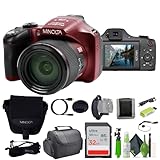
4. The Minolta MN67Z is the 67x option with an articulating screen
Pros
- 67x optical zoom
- 20MP capture
- Fully articulating LCD
- Optical stabilization
Cons
- Listed rating is 3.9
- Fewer listed reviews
The Minolta MN67Z makes its case through a stated 67x optical zoom, 20MP capture, and a fully articulating 3.0-inch LCD. It also lists optical image stabilization, 1080p Full HD video, 27 intelligent shooting modes, and a bundle with a memory card, bag, cleaning kit, vlogging tripod, and accessories.
Its 67x figure sits above the 53x and 52x options in this roundup but below the two Nikon superzooms. That makes it a middle-reach alternative for a shopper who values an articulating screen and included accessories alongside a long fixed lens.
Video stops at 1080p in the supplied specification, so I would not choose it over a 4K-listed option if 4K recording is non-negotiable. The articulating display is a clearer point of difference for low-angle framing, high-angle composition, and self-facing work.
The MN67Z is best when screen flexibility matters with long zoom
A fully articulating screen can help when a direct eye-level position is uncomfortable or blocked. It is useful for framing from a lower viewpoint, holding the camera higher in a crowd, and seeing the screen while facing the camera for a simple vlogging setup.
The stated 27 shooting modes may help a beginner explore different subjects without beginning from manual exposure. I would still learn the optical zoom and stabilization behavior first, because those affect long-range framing on every mode.
The MN67Z needs a realistic buyer-feedback reading
The supplied listing shows a 3.9 rating from 45 reviews. That is not a reason to dismiss the camera automatically, but it is a reason to read the details behind the score rather than assume its specification list tells the whole ownership story.
The bundled accessories may reduce the number of items a new owner needs to source separately, but they do not replace a spare-power plan or practice with the camera. Long-zoom sessions consume attention and battery capacity, so bring charged power and review your storage needs before an outing.
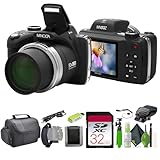
5. The Minolta MN53Z is a 53x bridge camera with Wi-Fi
Pros
- 53x optical zoom
- 16MP BSI CMOS sensor
- Wi-Fi connectivity
- Optical stabilization
Cons
- 1080p video only
- 22 listed reviews
The Minolta MN53Z is a bridge digital camera with a stated 53x optical zoom, 16MP BSI CMOS sensor, optical stabilization, Wi-Fi, and 1080p Full HD video. Its supplied bundle includes a 32GB memory card, bag, cleaning kit, vlogging tripod, and accessories, which gives a new photographer a ready group of basic items.
I would put it in the middle of the list because 53x is serious reach, though it does not include the supplied focal-length equivalent. That missing number makes a direct framing comparison with the 24-3000mm Nikon, 20-1200mm Panasonic, and 24-1248mm KODAK less precise.
The BSI CMOS description points to its stated sensor design, but it should not be treated as a blanket promise about night performance. Small-sensor bridge cameras can be very capable in good light, yet their low-light results depend on the available light, shutter needs, and subject movement.
The MN53Z is best when wireless sharing is part of the plan
Wi-Fi is a helpful listed feature for a photographer who expects to move selected images to a phone or tablet. Check the app instructions and connection routine before a trip, because sharing workflow is most useful when it is already familiar.
The included vlogging tripod may also appeal to a beginner making simple recorded pieces. Its 1080p specification is appropriate for Full HD needs, while buyers requiring 4K should focus on a listing that expressly provides it.
The MN53Z needs a focal-range check before wildlife work
Because this listing states 53x optical zoom but does not provide a millimeter-equivalent focal range, I would verify the full lens coverage before buying for a specific birding location. Zoom multipliers are useful, but the wide and telephoto endpoints reveal more about how a lens frames a subject.
The 4.7 rating is based on 22 reviews in the supplied data. That is a positive figure with limited volume, so balance it against the camera’s stated video limit and your own need for handling, reach, and support information.
6. The KODAK PIXPRO AZ528 is a 52x camera with a 24-1248mm lens
Pros
- 24-1248mm optical range
- 6fps burst mode
- Built-in Wi-Fi
- Optical stabilization
Cons
- JPEG workflow concerns
- Mixed buyer feedback
The KODAK PIXPRO AZ528 gives a clearly stated 52x 24-1248mm optical range, which is unusually useful information in a bridge-camera listing. The 24mm wide end covers a broad view, while 1248mm creates a strong telephoto option for distant buildings, wildlife, and outdoor activity.
Its listed features include a 16MP BSI CMOS sensor, 1080p Full HD video, 6fps burst shooting, built-in Wi-Fi, and optical image stabilization. I would regard the 6fps mode as the important action-oriented feature, while remembering that a burst rate alone does not tell us focus tracking behavior.
This is the one product section where the primary phrase matters most: among the best bridge cameras with zoom, the AZ528 has a balanced stated 24-1248mm range for a reader who wants both a wide starting point and more than 1200mm of optical reach. Its listed buyer feedback is mixed, so it earns a careful rather than automatic recommendation.
The AZ528 is best when 24mm to 1248mm coverage is the goal
The supplied focal range makes this model easy to place against the others. It offers slightly more telephoto reach than the FZ80D’s stated 1200mm endpoint, though the Panasonic starts wider at 20mm and adds 4K functions.
For daytime wildlife or travel, that 24mm-to-1248mm span can cover an establishing view and a distant detail from one fixed lens. Optical stabilization is welcome at the long end, but it is not a guarantee against blur from a moving animal.
The AZ528 needs buyer-review scrutiny before a long trip
The listing shows a 4.3 rating from 686 reviews, with a mixed distribution that includes reports of reliability issues. I would read recent detailed reviews and confirm the return and support terms available to you before relying on it as the only camera for an important trip.
It records 1080p rather than the 4K option listed on the P1100, P950, or FZ80D. That may be entirely adequate for a Full HD workflow, but it is a real specification difference for buyers who intend to deliver 4K footage.
7. The KODAK PIXPRO AZ425 is a 42x bridge camera with rechargeable power
Pros
- 42x optical zoom
- 20MP capture
- Rechargeable Li-Ion battery
- Panorama mode
Cons
- No RAW support
- JPEG-only workflow
The KODAK PIXPRO AZ425 offers a stated 42x optical zoom, 20MP CMOS sensor, 24mm wide-angle lens, optical image stabilization, 1080p Full HD video, panorama mode, and a rechargeable Li-Ion battery. It is a straightforward bridge-camera option for photographers who do not need 60x, 83x, or 125x reach.
The 24mm wide lens is a practical starting point for landscapes and general travel scenes. Its supplied focal-length field only states 24mm, rather than a full telephoto-equivalent endpoint, so I would confirm the long-end equivalent if a specific subject distance is driving the decision.
The listing calls out wildlife and sports, which are sensible contexts for a 42x lens, but no supplied data establishes high-end subject tracking. Use the stated optical stabilization to steady framing and choose shutter settings suited to movement instead of expecting stabilization to freeze fast action.
The AZ425 is best when 42x reach and simple Full HD are enough
This model fits a photographer who wants more reach than a compact camera often offers while keeping the workflow focused on stills, 1080p clips, and panorama scenes. The rechargeable battery creates a familiar charge-at-home routine for regular use.
A 20MP capture specification can leave room for ordinary cropping, but it does not replace getting close enough through optical zoom. I would use the full lens reach carefully before cropping heavily, especially when detail is important.
The AZ425 needs a JPEG-first workflow acceptance
The supplied data lists JPEG-only shooting and no RAW support. That makes it a less fitting match for a photographer who expects significant exposure or color adjustments from a RAW file after every session.
Its 4.1 rating is based on 1k+ reviews in the product data, which gives a broader base of buyer feedback than many models here. Still, focus on comments about the subjects you shoot, such as fast wildlife, family events, or travel scenes, rather than relying only on an aggregate score.
8. The KODAK PIXPRO AZ405 is a 40x option that uses AA batteries
Pros
- 24-960mm range
- AA battery power
- 20MP BSI CMOS
- Optical stabilization
Cons
- JPEG only
- No RAW support
The KODAK PIXPRO AZ405 is a 40x bridge camera with a stated 24-960mm equivalent lens, a 20MP BSI CMOS sensor, optical image stabilization, 1080p Full HD video, Wi-Fi, and AA battery power. That AA detail is its most distinctive practical trait in this lineup.
I would choose it for a trip where easily sourced backup batteries matter more than 4K recording or a longer telephoto endpoint. A set of compatible AA batteries can be carried and exchanged without waiting for a camera-specific battery to charge, though you still need to test the batteries and carry enough capacity.
The 24-960mm range spans wide travel views and genuinely long telephoto framing. It falls short of the AZ528’s stated 1248mm endpoint and the FZ80D’s 1200mm endpoint, but it still provides a large jump beyond an ordinary 10x compact lens.
The AZ405 is best when replaceable power suits the trip
AA power can be helpful for remote travel, long days away from outlets, or a family kit where shared rechargeable cells are already part of the plan. I would bring tested spares and keep them warm in cold conditions, as battery performance can change with temperature.
This is a planning advantage, not a claim of unlimited battery life. Screen use, zooming, Wi-Fi transfers, video recording, and image review all influence how much power a real outing consumes.
The AZ405 needs JPEG-only editing expectations
The supplied data identifies JPEG-only capture with no RAW support, so this camera is best for an uncomplicated shoot-and-share workflow. Wi-Fi can support transferring selected images, but wireless sharing does not expand the editing latitude of a JPEG capture.
The 4.1 rating from 1.6k listed reviews is substantial buyer-feedback volume. I would use that volume to look for recurring reports about the work you expect it to do, while making the final decision on lens range and power format first.
9. The Minolta MN40Z is a 40x Wi-Fi camera for straightforward sharing
Pros
- 20MP photos
- 40x optical zoom
- Wi-Fi support
- Face and smile detection
Cons
- No water resistance
- Limited shooting modes
The Minolta MN40Z combines a stated 20MP resolution, 40x optical zoom, optical image stabilization, 1080p Full HD video, Wi-Fi, and face, smile, and blink detection. It is a feature set aimed at general family, travel, and everyday photography rather than a specialist long-reach system.
I would put its face-oriented detection tools ahead of more distant-subject choices if candid people photos are as important as landscape or travel views. These features can assist with ordinary portraits and group moments, while the 40x zoom adds framing flexibility from farther away.
The listing does not provide a millimeter-equivalent focal range, so 40x alone should not be used to assume the same wide-angle starting point as the 24mm KODAK models. Anyone who needs a specific field of view for interiors or architecture should verify the lens endpoints before committing.
The MN40Z is best when family features and Wi-Fi matter
Face, smile, and blink detection can make a simple family-photo workflow easier, particularly for photographers who do not want to configure every setting manually. Wi-Fi supports the same practical direction: selecting photos for sharing after a day out.
Its 20MP specification is sufficient for normal digital sharing and prints, but megapixels should not become the deciding comparison point. Lens coverage, available light, subject motion, and stabilization usually determine whether a distant scene is captured cleanly.
The MN40Z needs weather protection from the user
The supplied listing says it is not water resistant. I would keep it protected in rain, spray, or dusty conditions and avoid treating its bridge-style body as weather sealed, because no weather-sealing specification is supplied.
Limited shooting modes are also listed as a drawback. That makes this a better match for a photographer who values direct, familiar functions over a deep menu of specialist controls.
10. The Minolta 64MP Digital Camera is a 10x compact-style alternative
Pros
- 64MP capture
- 4K Ultra HD video
- Macro shooting
- SD card and case included
Cons
- 10x zoom is limited
- Limited flash modes
The Minolta 64MP Digital Camera is the outlier in this group because its stated 10x optical zoom is far below the 40x-to-125x reach of the bridge-camera listings. It has 64MP capture, 4K Ultra HD video, macro shooting, anti-shake technology, face detection, a 3-inch LCD, and a supplied 32GB SD card, battery, and case.
It earns a full place here because it is one of the 10 supplied products, but I would not call it the best choice for serious superzoom work. A 10x lens can be useful for general travel and everyday framing, yet it cannot match a 960mm, 1200mm, 2000mm, or 3000mm-equivalent bridge lens for a distant bird or far-away subject.
Its listed 4K video and macro mode create a different use case from the extreme-reach models. The camera may fit someone who wants close-detail images and 4K clips more than a large fixed-lens superzoom body.
The 64MP Minolta is best when macro and 4K matter more than reach
Macro shooting is the relevant feature for close subjects such as flowers, small objects, or textures. The 64MP still-image specification may give a photographer scope for detailed capture, but it says nothing by itself about long-distance optical magnification.
The included SD card, battery, and case make the supplied package immediately usable for basic photography. Before relying on it for a long day, I would test storage capacity, charge the included battery, and make a short 4K recording to confirm your preferred workflow.
The 64MP Minolta is not the bridge choice for birding
For birding, wildlife across a field, or moon-focused photography, choose one of the actual superzoom models above. The P1100’s stated 125x, P950’s 83x, FZ80D’s 60x, MN67Z’s 67x, and other 40x-plus options supply fundamentally more optical reach.
The supplied listing shows a 4.0 rating from 131 reviews and notes limited flash modes. That is enough information to place it as a general digital-camera alternative, not as a replacement for the purpose-built bridge cameras in this roundup.
The bridge-camera buying guide starts with optical reach and subject distance
Start by naming the subject you cannot get close to. If it is a far-off bird, wildlife across water, or the moon, the stated telephoto endpoint is the priority; the P1100 reaches 3000mm, the P950 reaches 2000mm, the AZ528 reaches 1248mm, the FZ80D reaches 1200mm, and the AZ405 reaches 960mm.
Use the optical zoom number as a quick comparison, then look for millimeter equivalents where available. A multiplier does not tell you where the lens begins, while the endpoints reveal whether the camera is also wide enough for a landscape, building, family group, or travel scene.
Optical zoom is the reach figure that should guide the shortlist
Optical zoom comes from the physical lens range. It preserves the lens’s native view of the scene at each focal length, unlike digital zoom, which enlarges part of an existing image and can make fine detail less convincing.
Do not confuse the P1100’s 250x Dynamic Fine Zoom claim with its 125x optical zoom. The camera’s 24-3000mm optical range is the apples-to-apples specification to compare with other fixed lenses.
A wider starting point is useful when travel scenes matter
More telephoto reach is not automatically better if your trips include buildings, broad landscapes, or indoor group shots. The FZ80D’s 20mm wide end is wider than the listed 24mm starting points on the P1100, P950, AZ528, AZ425, and AZ405.
A wide starting point can save a photograph when there is no space to step back. I would choose a 20mm or 24mm-listed camera over a model with unknown wide-end coverage if this type of framing is central to your work.
Stabilization helps framing but cannot stop subject movement
Every product in the supplied data lists optical stabilization or anti-shake, with the Nikons specifically listing Dual Detect VR and the Panasonic listing Power O.I.S. Stabilization is particularly helpful for handholding a long lens, where a small movement becomes obvious in the frame.
It does not freeze a flying bird, a running child, or a moving vehicle. For those subjects, you still need a shutter speed that stops the action, sufficient light, and a camera behavior that works for the pace of your scene.
Sensor size sets realistic low-light expectations
The supplied P950 specification identifies a 1/2.3-inch sensor, and several other listings identify CMOS, BSI CMOS, or MOS sensor types without a stated size. None of those labels alone allows a reliable image-quality ranking, but the forum discussion is correct to flag low light as a real category limitation for small-sensor superzooms.
I would use bridge cameras most confidently in good light or when the subject is still enough for a sensible exposure. If evening wildlife, indoor action, or very high ISO work is the main project, look beyond zoom claims and seek sample images made in conditions like your own.
RAW capture matters when post-processing is part of the plan
Among the supplied products, the P1100 specifically lists RAW (.NRW) support. The AZ405 and AZ425 are specifically noted as JPEG-only with no RAW support, which is a useful workflow boundary rather than a minor footnote.
RAW files are not magic, but they offer more room for later adjustment than a JPEG-first workflow. Choose a model with confirmed RAW support if you routinely refine exposure and color after photographing difficult scenes.
Video needs should separate 4K from Full HD before buying
The P1100 lists 4K Ultra HD, the P950 lists 4K UHD at 30p, the FZ80D lists 4K recording and 4K Photo, and the 64MP Minolta lists 4K Ultra HD. The MN53Z, MN67Z, AZ528, AZ425, AZ405, and MN40Z list 1080p Full HD video.
Choose the specification that matches the format you actually deliver and edit. A 4K label does not answer questions about audio, autofocus, stabilization behavior, recording duration, or heat, so check the manual for those details before planning serious video work.
Handling and battery planning protect an all-day shooting plan
A huge zoom range is less helpful if you leave the camera behind or run out of power. The P950 is listed at 5.35 pounds, the AZ405 uses AA batteries, the AZ425 uses a rechargeable Li-Ion battery, and several bundles include a spare or supplied battery, so their field routines differ.
Pack appropriate charged power, enough card space, a secure strap, and protection from rain or dust. No supplied listing establishes weather sealing, so I would use a cover or bag rather than expose any of these cameras to harsh weather as if they were sealed bodies.
A smartphone wins for sharing while a bridge camera wins for optical reach
A smartphone is usually easier to carry, connect, and share from immediately. A bridge camera earns its space when a fixed optical lens can place a distant subject much larger in the frame than the phone can without leaning heavily on digital enlargement.
I would bring a phone for location, backup sharing, and casual scenes, then carry the bridge camera when wildlife, sports, distant details, or varied focal lengths are the purpose of the day. This division accepts the strengths of both tools instead of forcing one to do every job.
Bridge cameras remain relevant despite fewer new models
Some bridge-camera lines have been discontinued because phones improved and interchangeable-lens systems expanded, not because the fixed-lens superzoom idea stopped making sense. A 20-1200mm, 24-2000mm, or 24-3000mm lens in one body remains a specific solution that neither a normal phone lens nor a single compact zoom directly duplicates.
Buy based on the real activity in front of you: reach for wildlife, wide-to-long travel coverage, simple family features, or close macro work. That approach is more useful than choosing a camera solely because it has the highest megapixel number or newest-looking body.
The bridge-camera FAQ gives the short answers buyers need
Why are bridge cameras being discontinued?
Bridge cameras are not universally being discontinued, but fewer new models can reflect strong phone cameras and the growth of mirrorless systems. They still fill a distinct role: a fixed lens that reaches from wide angle to long telephoto without carrying or changing lenses. The supplied Nikon, Panasonic, KODAK, and Minolta listings show that all-in-one zoom cameras remain available for photographers who need reach and simple packing.
What is the best camera for bridge inspection?
For inspecting physical bridges, a consumer bridge camera is not automatically the right tool. Professional inspection can require a documented imaging workflow, safe access, trained personnel, and sometimes specialist remote or measurement equipment. A long-zoom camera may record distant visual details from a safe position, but it cannot replace an inspection method or professional judgment.
What camera has the strongest zoom?
In this 10-product roundup, the Nikon COOLPIX P1100 has the strongest stated optical zoom: 125x, covering 24-3000mm. It also lists Dual Detect Optical VR, 16MP capture, 4K Ultra HD video, and RAW support. Its 250x Dynamic Fine Zoom is a separate digital-enhancement figure, so compare the 125x optical number when judging true lens reach.
What is the newest bridge camera?
The supplied product data does not provide verified release dates, so it cannot establish one newest bridge camera. The Nikon COOLPIX P1100, P950, Panasonic LUMIX FZ80D, and other models in this list should be compared by stated focal range, stabilization, video, format support, and current availability rather than an unverified release-date claim.
The best choice is the bridge camera that matches your actual distance
For the furthest possible optical reach, I would begin with the Nikon COOLPIX P1100 and its stated 125x 24-3000mm lens. For an 83x 24-2000mm alternative with 4K UHD and external microphone support listed, the Nikon COOLPIX P950 is the next specialist option.
The Panasonic LUMIX FZ80D is the strongest all-rounder here for a photographer who values its 20mm wide start, 60x reach, 4K video, 4K Photo, and Power O.I.S. The KODAK and Minolta models give additional routes through 40x to 67x zoom, Wi-Fi, screen flexibility, AA power, or straightforward Full HD shooting.
The best bridge cameras with zoom in 2026 are not defined by one number. Match the optical endpoint to your subject distance, check the wide end for your travel scenes, accept the small-sensor low-light trade-offs, and choose RAW, video, screen, and power features that support how you actually photograph.