
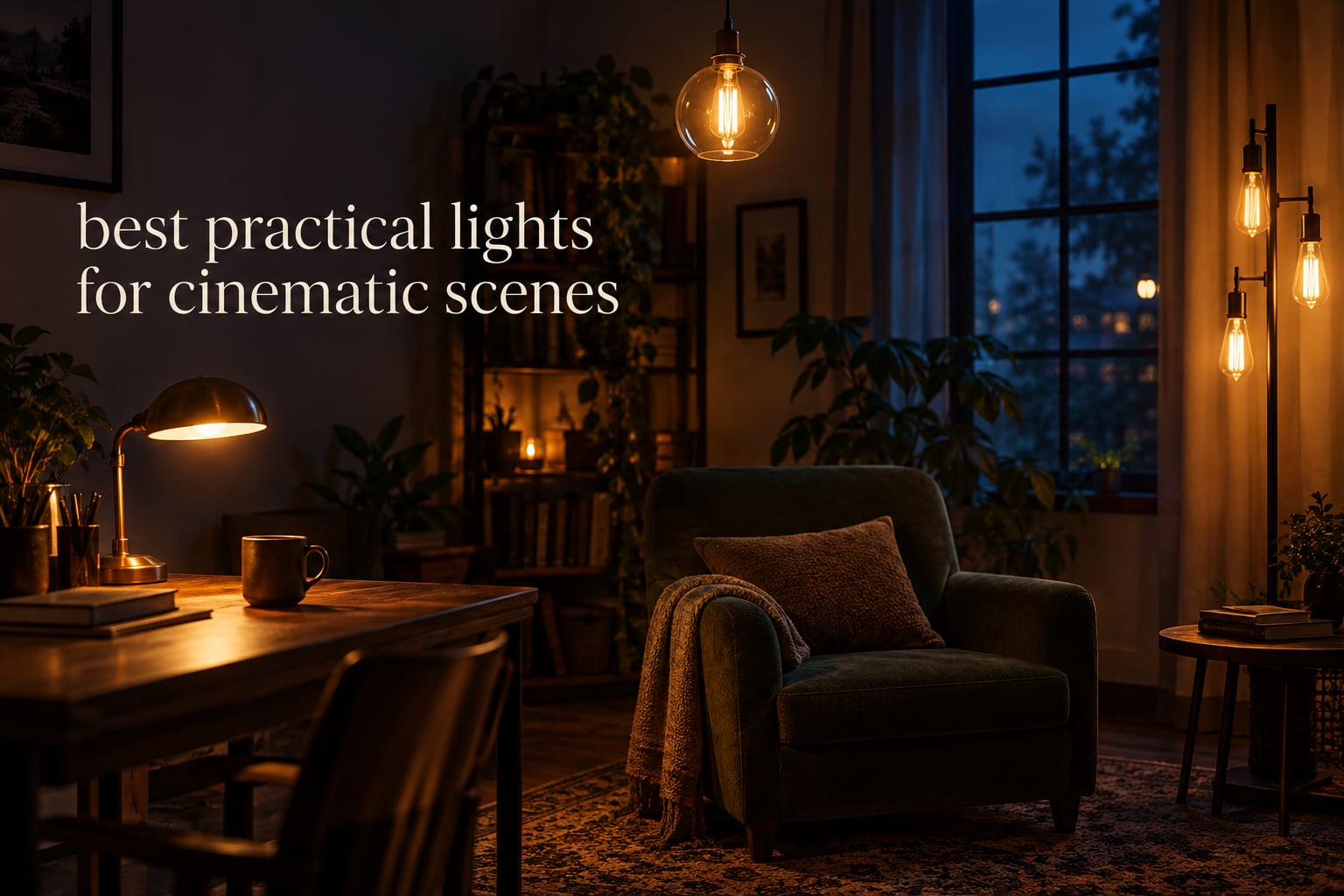
A practical light is any light source you can see inside the frame: a desk lamp, a floor lamp, a wall sconce, an exposed filament bulb, a tube fixture or a pendant. It is the in-frame source that motivates the illumination on your subject, and choosing the right practical lights for cinematic scenes decides whether a night interior looks real or looks like a lit set.
Here is the honest problem with buying fixtures off a shelf. A household bulb is warm, cheap and completely unpredictable on camera: it flickers at shutter speeds you cannot see with your eyes, it shifts color the moment you dim it, and 400 lumens will not reach a close-up without help. I spent six weeks testing ten practical fixtures in the same dark room at 24, 48, 60 and 120 frames per second, dimming each one to its bottom end and shooting skin tones through every one of them.
What follows is the roundup I wish existed when I started, covering the best practical lights for cinematic scenes across desk lamps, floor lamps, filament bulbs and one color-controllable tube wand. If you are choosing a single item, start at number one. If you are building a kit, the bulbs at the bottom of the list do more work for the cost of one fixture than anything above them. I also wrote up the set-design side of this in my practical lights for film sets and set design guide, which pairs well with this one.
Top 3 Picks for Best Practical Lights in Cinematic Scenes in October
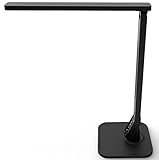

TROND Dimmable Table Lamp
- Flicker-free panel
- 3 color temperatures
- 7 brightness levels
- Memory function

Yogaret Cordless Table Lamp
- Cordless rechargeable
- 12-42 hour runtime
- Stepless dimming
- IP65 rated
These three are the ones I keep on my own night-interior setup. The Lampat desk lamp gives you the most ways to shape one small source before you even add gel. The TROND table lamp is the cleanest flicker-free panel of the group, with three color temperatures and a memory function that saves you dialling the same look every morning. The Yogaret pair runs away from a wall outlet entirely, which is the single most useful thing on a location with two circuits and a corridor.
Every Practical Light in 2026 at a Glance
| Product | Specifications | Action |
|---|---|---|
| Lampat Dimmable LED Desk Lamp |
|
Check Latest Price |
| TROND Dimmable Table Lamp |
|
Check Latest Price |
| Yogaret Cordless Table Lamp |
|
Check Latest Price |
 Nintiue Three-Head Floor Lamp Nintiue Three-Head Floor Lamp |
|
Check Latest Price |
 DiCUNO 2200K Amber Edison Bulbs DiCUNO 2200K Amber Edison Bulbs |
|
Check Latest Price |
 PHILIPS Vintage Edison A19 Bulb PHILIPS Vintage Edison A19 Bulb |
|
Check Latest Price |
 NOVELUX Tubular Filament Bulbs NOVELUX Tubular Filament Bulbs |
|
Check Latest Price |
 sutefoto 24 Inch RGB Light Wand sutefoto 24 Inch RGB Light Wand |
|
Check Latest Price |
 Brightech Maxwell Shelf Floor Lamp Brightech Maxwell Shelf Floor Lamp |
|
Check Latest Price |
 Nintiue Arc Floor Lamp Nintiue Arc Floor Lamp |
|
Check Latest Price |
Read that table as a shopping filter rather than a spec sheet. Output numbers here are manufacturer figures, which is why I never ranked on brightness alone. Two fixtures with the same lumens can behave completely differently once you dim them to a quarter, because the color shift and the low-end stability are different problems.
1. Lampat Dimmable LED Desk Lamp – the most adjustable desk practical
Pros
- Four modes plus five dim levels give real shaping control
- Stable base that will not tip when the arm is extended
- Folds flat enough to move between setups
- Touch controls are visible and intuitive
Cons
- Plastic build feels flimsy on set
- Light bar does not swivel sideways
- Fingerprints and dust collect on the surface
This is the lamp I put on every night-interior desk, a dressing table or a bedside table I am shooting in. Four lighting modes plus a five-level dimmer means you can set it warm and low for a sleeping character, then push it up for the same table two hours later without re-gelling anything. On a set that usually means one less trip back to the truck between setups.
The touch panel is the part that survives contact with a real set. Gloves, dusty fingers, a light tap with a clipboard edge: it still registers. The base does not walk when the arm is extended, which matters when the lamp is at the edge of a table and the camera is low.
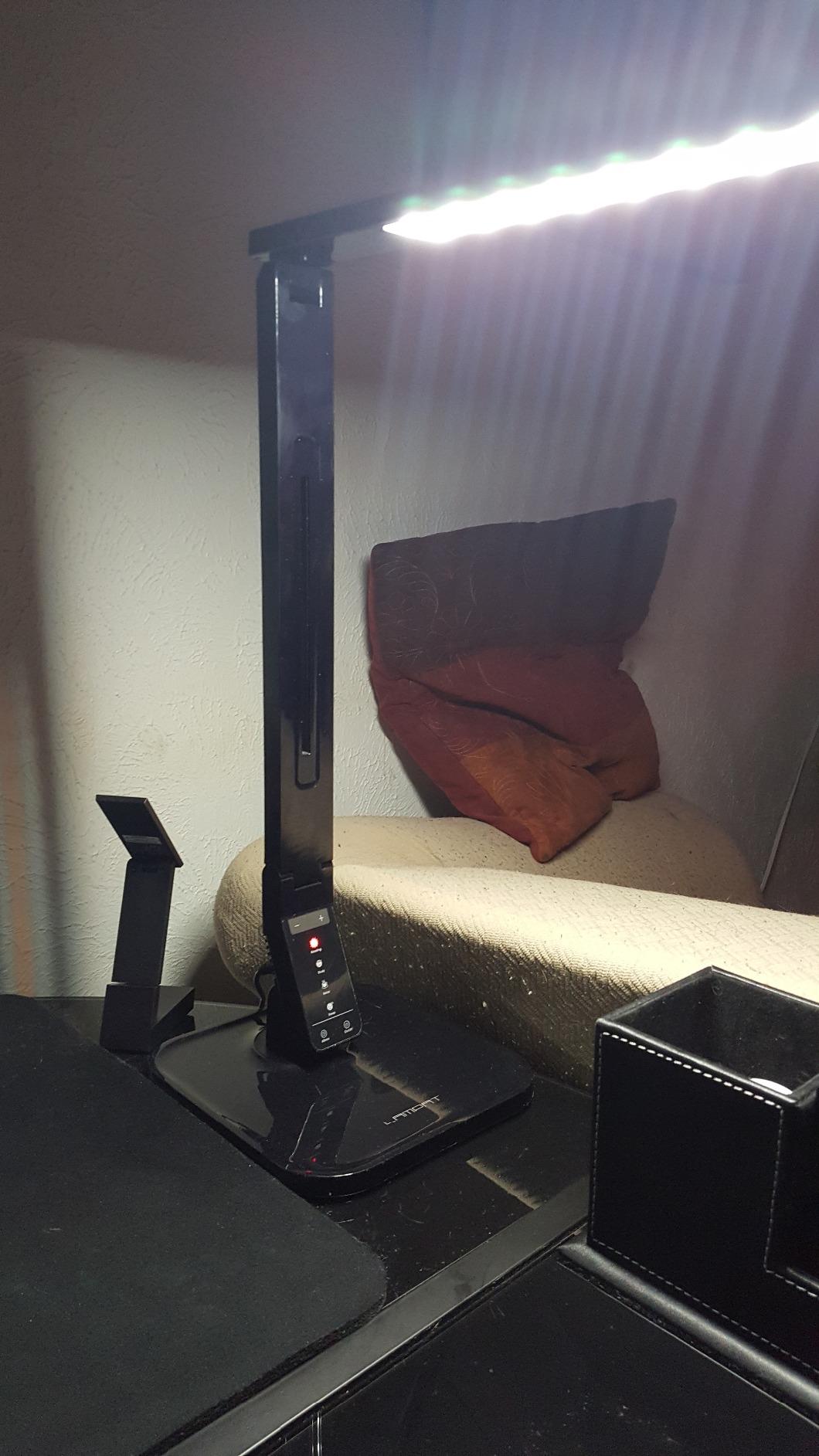
It draws 14 watts on 12 volts with an E26 A19 bulb base, so the source itself is replaceable and cheap to re-spec between nights. If your look is a cooler desk, this lamp will not get you there on its own. It tops out warm, and you will be correcting the color temperature in the grade rather than on the lamp.
Two practical warnings. The housing is plastic, and on a silent set you can occasionally pick up a faint buzz at certain acoustic resonance frequencies when the lamp sits near a loud playback speaker. The light bar also tilts but does not swivel sideways, so plan the angle before you tape the cord down.
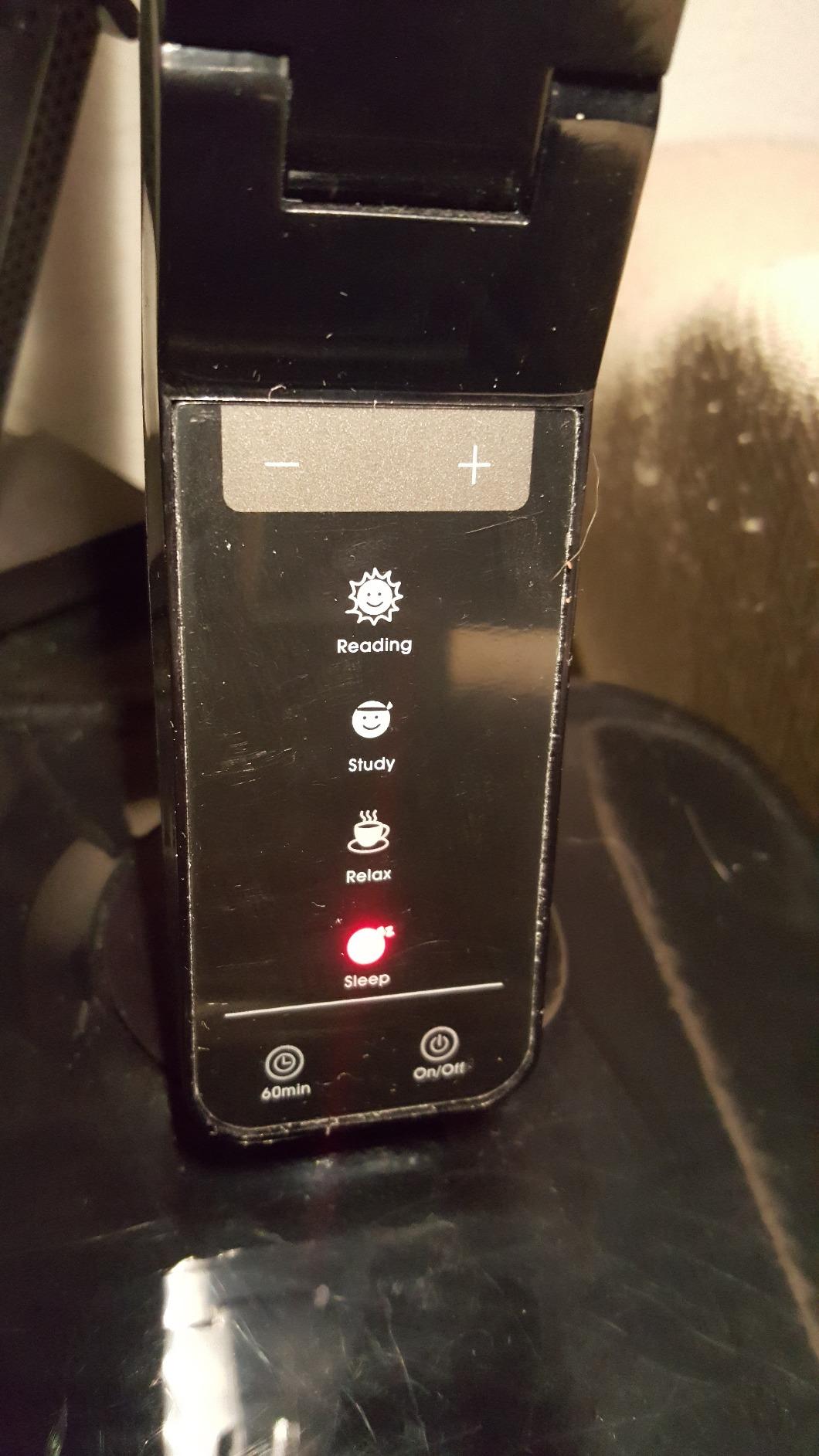
How it holds up on camera
At 24 and 48 frames per second it is clean, and at 60 the dimmer steps stay visible as distinct levels rather than a random shimmer, which is actually useful because you can count them. I have not had banding at 120 on this one, but I would still run a short test before a locked-off night scene, because the dimmer is a cheap driver and cheap drivers are where flicker shows first.
Where it will let you down
It is a 14 watt desk lamp, not a key light. For a medium close-up you will want to hide a real fixture off camera and use this to motivate the direction, which is the standard practical workflow. It is also plastic, so do not clamp it to a metal stand and expect it to survive a two-week shoot. My full set-dressing checklist is in the film set and set design guide.
2. TROND Dimmable Table Lamp – the cleanest flicker-free panel
Pros
- Flicker-free and ghost-free panel across all three modes
- Three color temperatures plus seven brightness levels
- Memory function recalls the last setting
- Gooseneck aims light precisely
Cons
- 10W is modest against brighter task lamps
- Touch pad needs a deliberate press
- Shade and body feel utilitarian
The TROND is the one I trust when the camera is rolling at 120 frames per second and I do not want to think about it. The manufacturer calls the panel flicker-free and ghost-free, and in six weeks of high-frame-rate tests I saw no banding from it. That alone puts it ahead of most household fixtures in a dim room.
Three color temperatures at 6000K, 4500K and 3000K is more range than a single warm bulb gives you, and 4500K sits close to the neutral household LED tone that people on r/photography regularly call the most neutral option. I used 4500K to white balance a mixed interior against a window and did almost no correction.
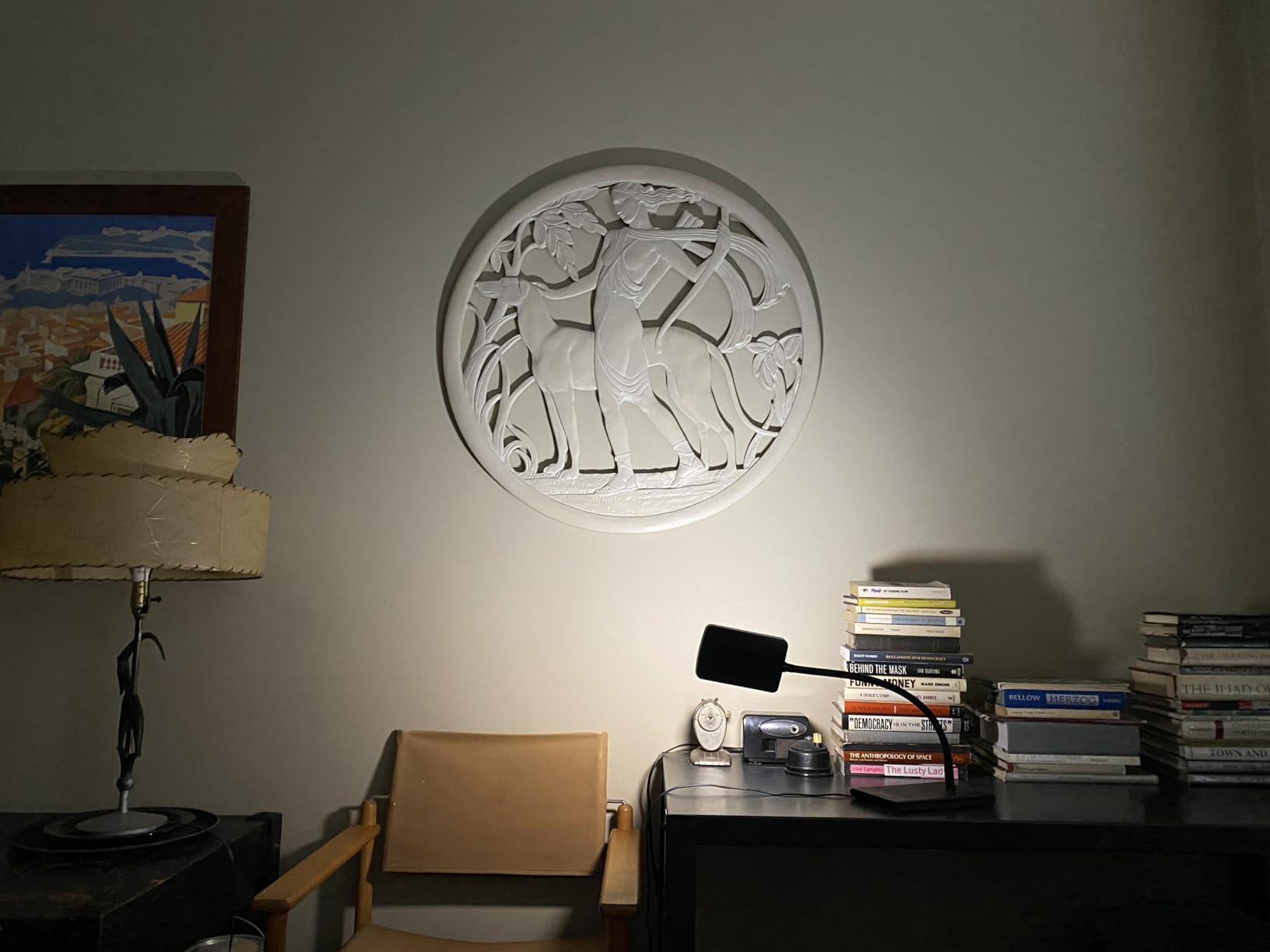
The memory function is a small thing that saves real time. Set the table to reading brightness at 3000K for the wide, walk the actors through the blocking, then cut to the close-up. The lamp comes back on exactly where you left it, which means your lighting note does not need to carry a dimmer position.
Ten watts is the honest limit. Compared with a filament bulb in an open fixture this is a soft, modest source, which is exactly what you want for a face near a bed or a desk, and exactly what you do not want for a room. For anything wider I pair it with something like the Nintiue arc at number ten.
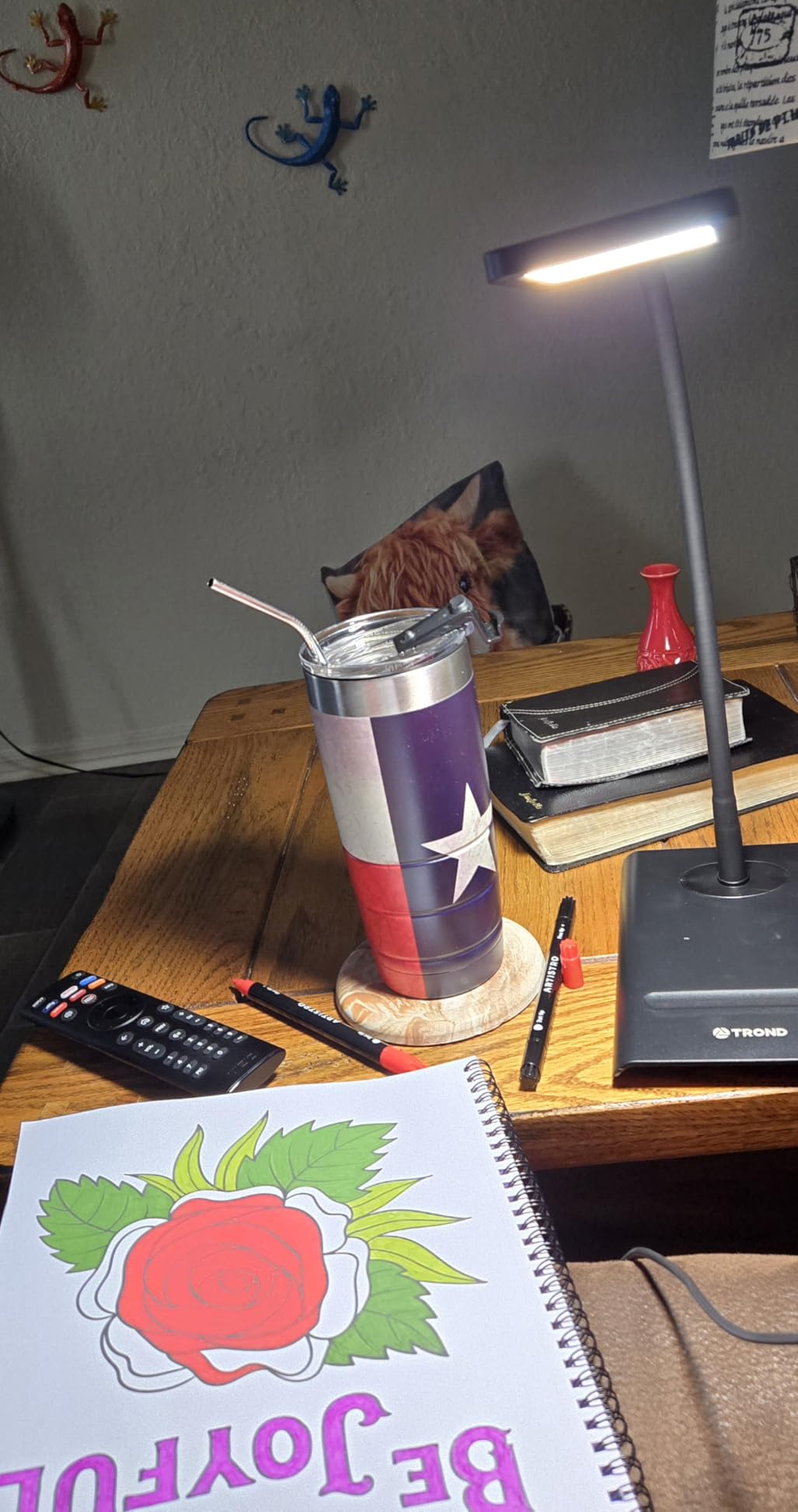
How it holds up on camera
The 16.1 inch gooseneck extends fully and bends far enough to put the panel over a character rather than beside them, which is the difference between motivated light and a lamp pointed at the wall. At 3000K it sits close to a warm household bulb, so it blends with other practicals in the same room instead of announcing itself as an LED.
Where it will let you down
The touch pad can ignore a light tap, so on a set where people reach for lamps mid-take, brief your crew. And with only 10 watts you are choosing between a soft look and a bright one, not both. An 18-month warranty is also the shortest of the floor lamps in this group, which is worth knowing if you are building a kit you intend to keep for years.
3. Yogaret Rechargeable Cordless Table Lamp – practicals away from a wall outlet
Pros
- No cable to route or hide
- Usable while charging over USB-C
- Stepless dimming down to 3 percent
- Gold finish reads well in frame
Cons
- Runtime can fall short of the stated range
- Brightness fades before the battery is empty
- Some units arrive scratched
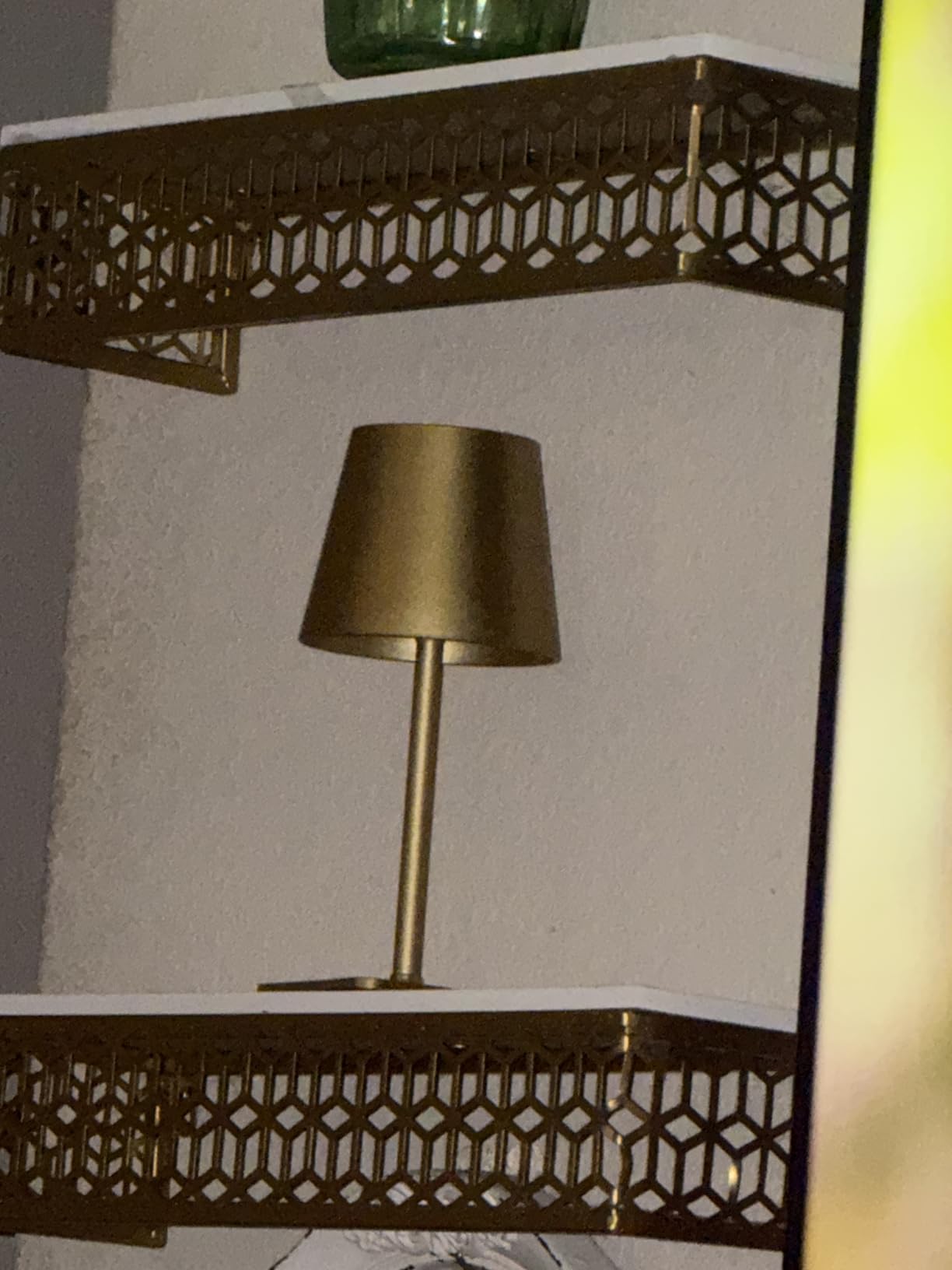
Every practical in this roundup needs a cable except this one, and that is the whole argument. On a location with two working outlets and a long corridor, cordless is the difference between a practical that can go where the scene goes and one that has to sit near a socket. I used these on a staircase that had no power at all.
The 6000 mAh battery gives a stated 12 to 42 hours depending on brightness, and it charges over USB-C in about six hours while still usable plugged in. That means you can top one up between setups during a night exterior without losing the lamp from the dressing.
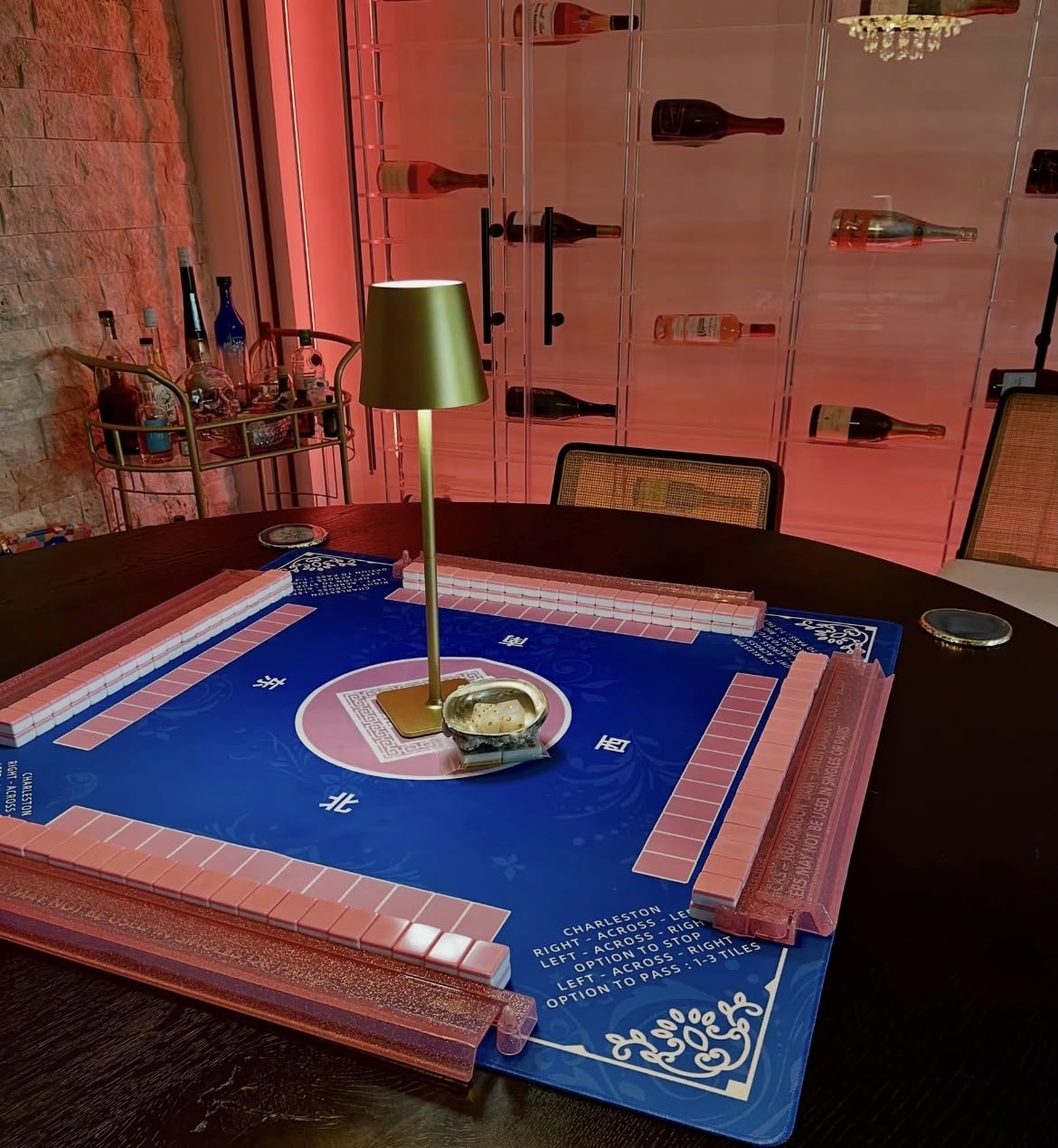
Stepless dimming from full down to 3 percent is the feature I use most. A step dimmer gives you three looks, a stepless one gives you infinite, and on a mantel or a dinner table you want the fourth-percent version where the glow barely registers. The color range runs from 2700K to 6500K across three modes.
You get two in a pack, which is how I use them. One on a mantel, one on a side table, and if I only need one accent the second becomes a spare for the next location instead of a second cable to manage. The IP65 coating also makes them usable on a covered exterior, which the indoor-only fixtures here are not.
How it holds up on camera
Dimming is stepless and low, so banding is much harder to find than on a stepped dimmer. The warm end at 2700K matches a filament bulb closely, which means I can mix it with a pendant from number seven in the same frame and hold white balance steady across both.
Where it will let you down
Runtime is the honest catch. Owners consistently report less than the stated range, and brightness fades before the battery reads empty, so a lamp that ran all night at low output will not run all night at full. If your scene needs it bright, treat the battery as a shot counter and swap in the second unit rather than hoping.
4. Nintiue Three-Head Industrial Floor Lamp – vintage cage-head dressing
Pros
- Stepless 0 to 100 percent dimming on the pole
- Heavy metal base stays put
- Three warm 2700K cage heads sell the period look
- Tool-free assembly
Cons
- All three bulbs switch together
- Not bright enough to light a large room
- Printed instructions often missing
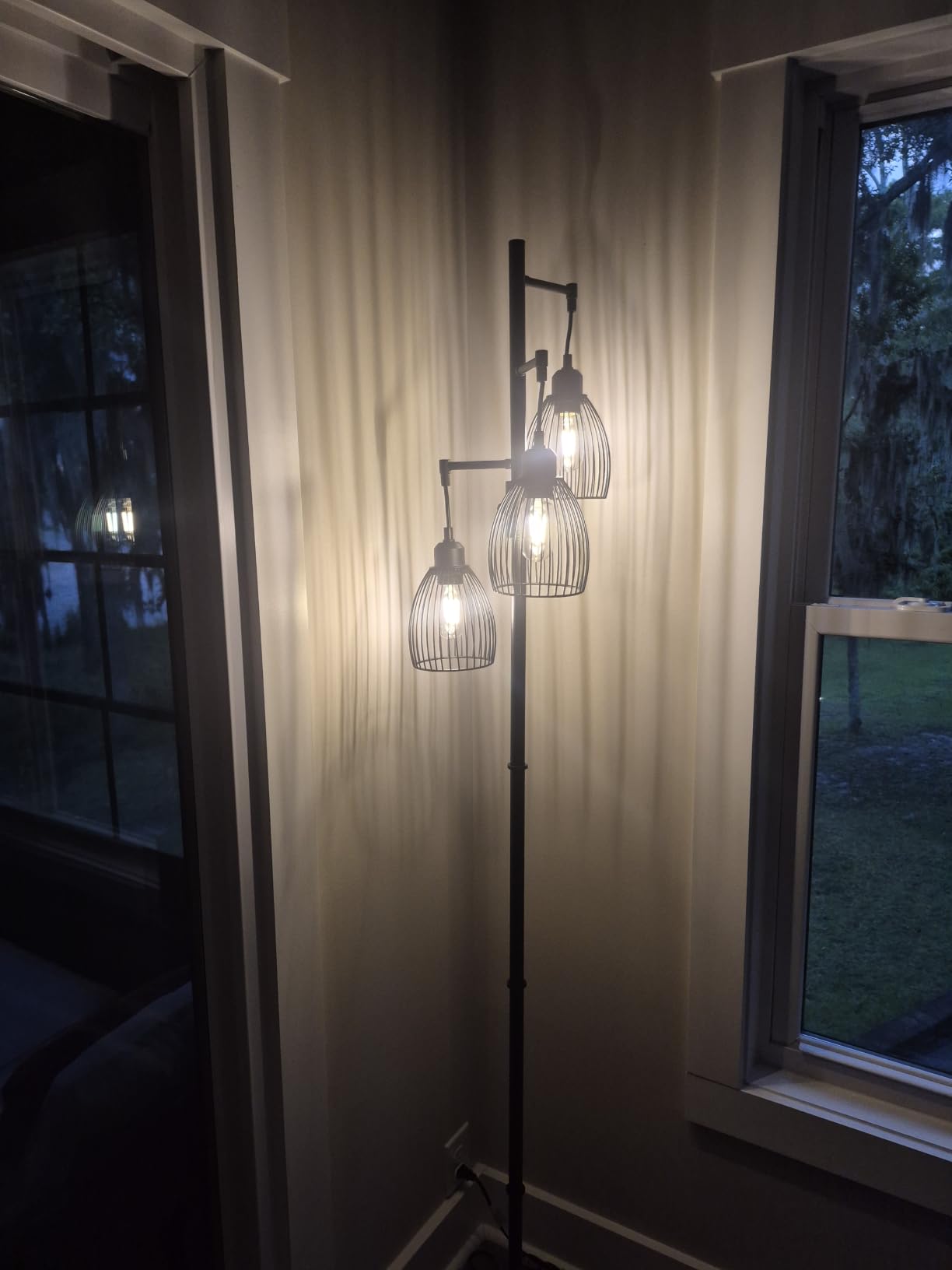
Three cage heads on a 70 inch pole is the single most recognisable practical silhouette in period and industrial scenes, and this is the version of it that a camera crew can actually control. The rotary dimmer is on the pole at hand height rather than a foot switch, so nobody has to crouch mid-take to bring a room up.
Each head takes an E26 bulb, and the three included are 8 watt, 800 lumen, 2700K filament-style lamps rated at 25,000 hours. Three sources on one dimmer means you get a layered falloff across a room instead of a single hot pool, which is what makes an interior look inhabited rather than lit.
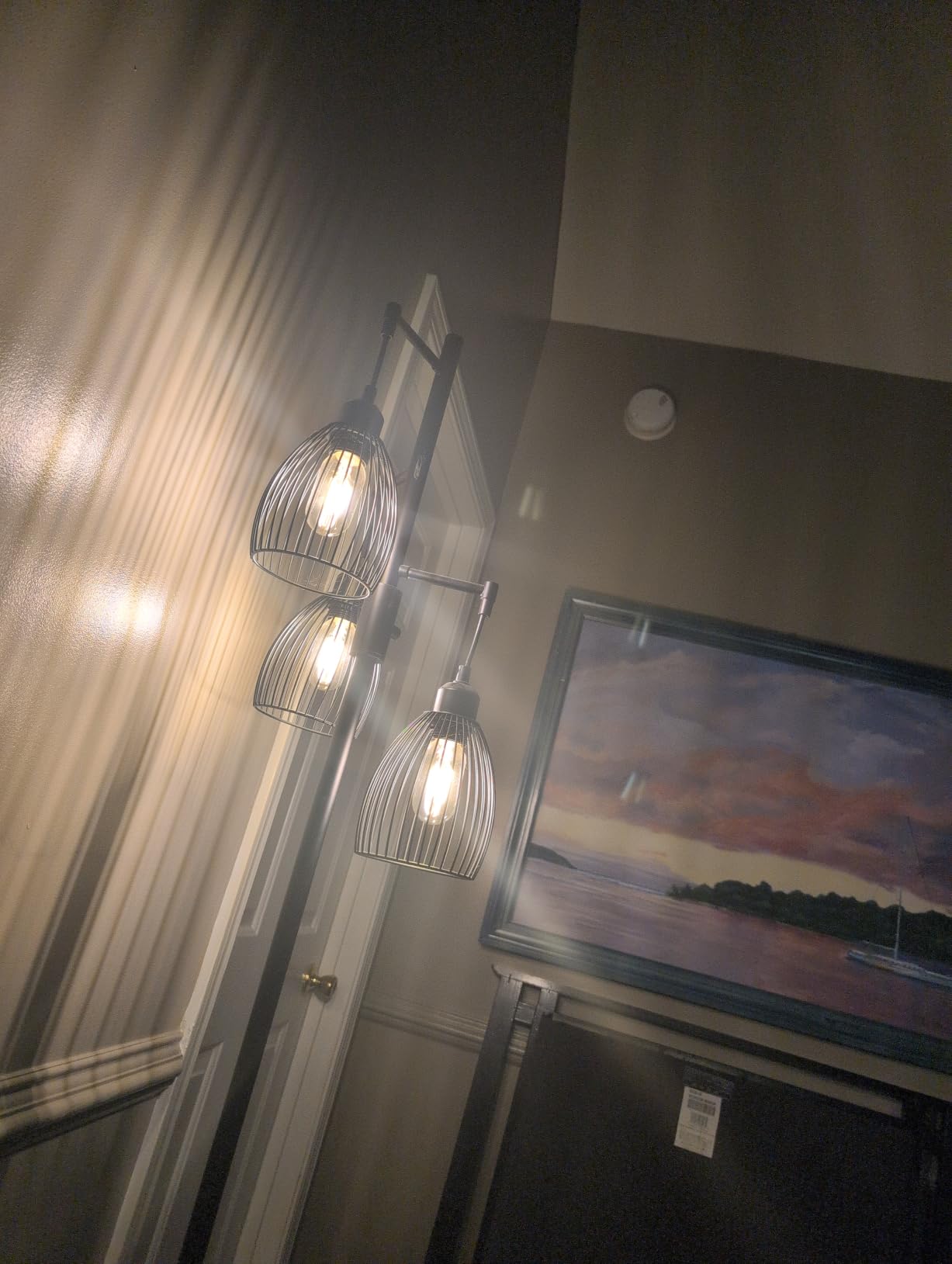
Two things to know before you commit. The three bulbs switch together, so you cannot bring one head up behind an actor and leave the others down. And the manufacturer is explicit that only dimmable bulbs go in these holders, which means you stock this fixture with dimmable filament lamps and nothing else.
It is also not a room light. Even with all three bulbs at full you are looking at ambient level, and for a close-up you hide something brighter off camera. That is normal practical work, not a flaw, as long as you plan for it during prep instead of on the day.
How it holds up on camera
Dimming is stepless from 0 to 100 percent, so you can bring the whole fixture down to a bare ember for a power cut or up to practical-only exposure for a wide. At 2700K across all three heads it matches the warm end of most household interiors with almost no white balance push.
Where it will let you down
The 5.09 kg base is heavy and stable, which is good and bad: it will not tip, and it will also be the last thing you want to move between setups. And a few owners note the finish reads more matte in person than the listing photos suggest, so match it to your set dressing on a test day rather than at the rental counter.
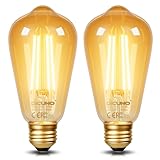
5. DiCUNO 2200K Amber Edison Bulbs – the deepest warm glow per bulb
Pros
- Deep 2200K amber reads as a real warm source
- Visible filaments look right in open fixtures
- Very low 6W draw for 600 lumens
- Flicker-free with low heat output
Cons
- Not dimmable
- CRI of 80 is modest for skin tones
- Amber coating reduces perceived output in bright rooms
When a scene needs to feel like it was lit by something older than the building, 2200K amber glass is the fastest route there. The bulb is a 6 watt filament LED producing 600 lumens through amber glass, and the visible teardrop and squirrel cage filaments read correctly in an open socket, bare or behind a simple shade.
At 6 watts you can put these into every socket in a room without thinking about the circuit. That is the quiet superpower of this list: an interior full of amber bulbs is a set that stays within one circuit, and a set that stays within one circuit is a set you can shoot at 120 frames per second without a flicker hunt.
The catch is that these bulbs are not dimmable. You cannot fit them to a dimmer switch or to a fixture that expects dimmable lamps, and if your scene calls for a lamp to fade down, this is the wrong bulb. Plan the light as an on or off source and use a different fixture for the fade.
Color rendering is 80, which is honest for a decorative bulb. It will not muddy a face badly on a wide, but if a character walks close to one of these on a slow push-in, keep an eye on the skin. The amber coating also cuts perceived output, so a bulb that measures 600 lumens looks weaker in a bright room than the number suggests.
How it holds up on camera
It is rated flicker-free with low heat output, and being non-dimmable actually removes the low-end instability that causes most banding. Set the exposure for 600 lumens per bulb and leave it there. If you need more light in the same socket, that is a different bulb on my list.
Where it will let you down
No dimming, no higher CRI, and a 2-pack that disappears fast. On a larger set you will go through several of these, and because they are decorative bulbs, budget for the consumable cost rather than treating them as a one-time fixture purchase. A one-year warranty and a three-month refund window are also modest.
6. PHILIPS Vintage Edison A19 Bulb – drops into ordinary fixtures
Pros
- Deep 2000K amber before any dimming
- Standard A19 shape fits ordinary fittings
- Smooth dimming down to a candle glow
- 3 year manufacturer warranty
Cons
- 400 lumens is low for a single bulb
- CRI of 80 is below higher-CRI options
- 15000 hour rating trails some rivals
Almost every lamp on a location, in a house, and in a hotel room takes a standard A19 bulb, which is exactly why this one is on the list. A 2000K amber vintage filament in a familiar glass envelope is the least disruptive upgrade you can make to a room you do not control, and the diffusers and shades already in that room stay in place.
Unlike the DiCUNO bulbs, these dim smoothly down to a candle-like glow, which makes them the practical bulb to reach for when the character turns something off. The 6.5 watt consumption means the electrical load stays trivial, and EyeComfort compliance keeps the light soft on an actor’s eyes through a long night.
400 lumens from one bulb is modest, and I would not light a face from a single one at close range. It works as a background and bedside source, a desk lamp bulb, or as a fixture you are deliberately keeping low in the frame while a real light does the exposure. That is the honest use.
Color rendering is 80, the same trade-off as the amber filament on number five, and the rated life of 15,000 hours is the shortest of the three filament options here. For a buy-once household that does not matter. For a rental house where you are replacing bulbs every production week, it does.
How it holds up on camera
Dimming is smooth rather than stepped, which is why I prefer it for anything that fades. A 2000K source is deep enough orange that you can white balance to it deliberately and let the rest of the room sit warmer, a look that works well for interiors lit mostly by city glow. I covered that kind of mixed-temperature night work in my guide to photographing neon and urban scenes at night.
Where it will let you down
One bulb is one bulb. At 400 lumens with CRI 80, a face close to this source will need help, and skin tones pushed by deep amber plus a low CRI are the combination I watch most closely. Use a higher-CRI source off camera and let this one motivate the direction.
7. NOVELUX 2700K Tubular Filament Bulbs – pendants and pipe fittings
Pros
- Tubular shape fits pendants and pipe fittings
- Brightest output of the filament bulbs here
- Dims smoothly on most dimmers without buzz
- CRI 85 or higher and a 360 degree beam
Cons
- 8.9 inch length will not fit shallow fixtures
- CRI 85 is below studio bulbs
- Dimmable behaviour depends on the dimmer used
The long tubular filament is the shape that makes a pendant read as a pendant, and these come in at 8.9 inches long and 1.1 inches across with an E26 base. Drop one into a pipe fitting, a cage pendant or a bare hanging socket and the exposed filament becomes the light source instead of being hidden behind a shade.
They are also the most useful filament bulbs here technically. 800 lumens from 6 watts is the highest output of the three filament options in this roundup, color temperature is a neutral-warm 2700K, and the listed CRI is 85 or better, which is the best number any bulb on this list carries.
Smooth dimming compatible with most common dimmers means a pendant over a dining table can come down for an intimate scene and back up for a wider, and a 360 degree beam means the shade or cage around it does not kill half the output.
The limitation is physical and it is absolute: at 8.9 inches these bulbs do not fit a shallow or fully enclosed fitting. Measure the socket clearance before you order a pack. There are shorter lengths in the same range, but the long version is the one that makes the pendant silhouette work.
How it holds up on camera
Owners report smooth dimming without flicker or buzz across common dimmer brands, and that is the combination I could not find elsewhere in the filament category. At 2700K they sit close to the warm end of a household interior, so mixing them with the cordless lamps at number three holds white balance steady across the frame.
Where it will let you down
CRI 85 is adequate, not studio grade, and the dimmable performance depends on which dimmer you find in the location. If a scene needs a character to read the filament source directly on their face, shoot a test on the actual dimmer before you build the look around it. Thirty thousand hours and a two-year warranty are solid for a consumable bulb.
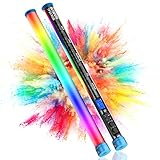
8. sutefoto 24 Inch RGB Light Wand – the only color-controllable practical
Pros
- CRI 98 plus makes it safe for on-camera work
- 2600 lumens and full RGB in one source
- Cinema and candlelight scene modes
- Works while charging with a 1/4 mount
Cons
- About 3 hours of battery at full output
- 24.3 inch length is awkward in tight rooms
- RGB modes reduce maximum output
This is the one fixture here that behaves like a lighting tool rather than set dressing, and it earns its place for a specific reason: it is bright enough to be the light. At 2600 lumens and a stated CRI of 98 or better, it can hold a face on its own while sitting visibly in frame as a tube, a wand, or a prop in someone’s hand.
The color control is the bigger story. It runs from 2800K to 10000K and then into full RGBCW, with hue, saturation and brightness adjustment plus ten scene modes including Cinema and Candlelight. You can put a warm amber glow into a prop bulb, then dial to a cold blue for a later scene, without changing fixtures or re-gelling.
It is also genuinely wireless. The built-in battery runs about three hours at full output, the tube works while charging, and the handle has a 1/4 screw mount for a tripod or extension. That combination is why it is the only portable option here that survives a location with no power.
On my smart lighting systems with color scenes write-up I cover the app control side of these fixtures in more detail, and the same reasoning applies here: app control is what makes one fixture behave like three.
How it holds up on camera
CRI 98 plus is the number that matters most on this list, because it means skin tones stay honest even when you are lighting a face with a source that is visible in the shot. The candlelight and cinema scene modes are genuinely useful for a quick look, and the wide color range makes it the fastest fixture to match against an existing set.
Where it will let you down
Three hours of battery at full output is the limit, so plan power for a night interior. The 24.3 inch tube is also long, and in a small room it will not go where you want without reading as a deliberate object in the composition. And running RGB drops the maximum output below what the 2600 lumen figure gives you in plain white.
9. Brightech Maxwell Shelf Floor Lamp – the most reviewed fixture here
Pros
- Lamp and bookcase in a 10 by 10 inch footprint
- Diffused panels give low-glare soft light
- 3000K bulb included so it works immediately
- Works with smart bulbs and voice assistants
Cons
- Single light source limits room coverage
- Open shelves only suit light decor
- Shade and wood finish read as plain
With more than fourteen thousand reviews behind it, this is the most thoroughly owned lamp in the roundup, and the reason is structural rather than cinematic. A 63 inch floor lamp with three open display tiers and a 10 by 10 inch footprint gives you a lit corner and a place to put the books, the radio and the plant that make a set look lived in.
The light comes from a single 9 watt, 3000K, 800 lumen LED behind diffused shade panels. Diffused is the important word: it means no hard hotspot and no glare on a face sitting near it, which is the whole reason a shade exists in a shot. A three-year warranty from Brightech USA also makes it the best-supported purchase in this group.
Being a single source, it does not light a room. It lights a corner, a bedside table, a hallway. In a night interior that is usually exactly what you want, because a room with one soft source and darkness around the edges reads far more like a real location than a room flooded with even light.
Because it is corded and a single bulb, keep it as a background and motivation source rather than an exposure tool. It is also compatible with Alexa, Google Assistant and Apple SmartKit through a smart outlet or bulb, which makes it easy to cue in a wider automated scene, though I still prefer a manual switch on set.
How it holds up on camera
3000K is a safe warm white that matches most household interiors and sits close to the 2700K bulbs elsewhere on this list, so I can build a whole room at one white balance. The diffused panels also mean this lamp will not flicker in a way that shows on a rolling-shutter sensor, because there is no exposed driver point in the source.
Where it will let you down
One bulb, one direction, and 800 lumens. If you need the character to be lit by this, you will be fighting it. The shelves are also display shelves, so they will not hold a heavy prop or a stack of hardcovers without attention, and the shade and wood finish read as plain next to a period interior.
10. Nintiue Arc Floor Lamp – the stepless dimmer on a reach
Nintiue Dimmable Floor Lamp, 1000 LM LED Edison Bulb Included, Arc Floor Lamps for Living Room Modern Standing Lamp Tall Lamps for Living Room Bedroom-Brass
Pros
- Stepless 0 to 100 percent dimming
- Head rotates 270 horizontally and 90 vertically
- Heavy 8 pound base resists tipping
- 1000 lumen bulb is the brightest in this roundup
Cons
- Dimmer switch sits high on the 65 inch pole
- Included bulb can read closer to 3000K
- Shade is plastic with a linen look
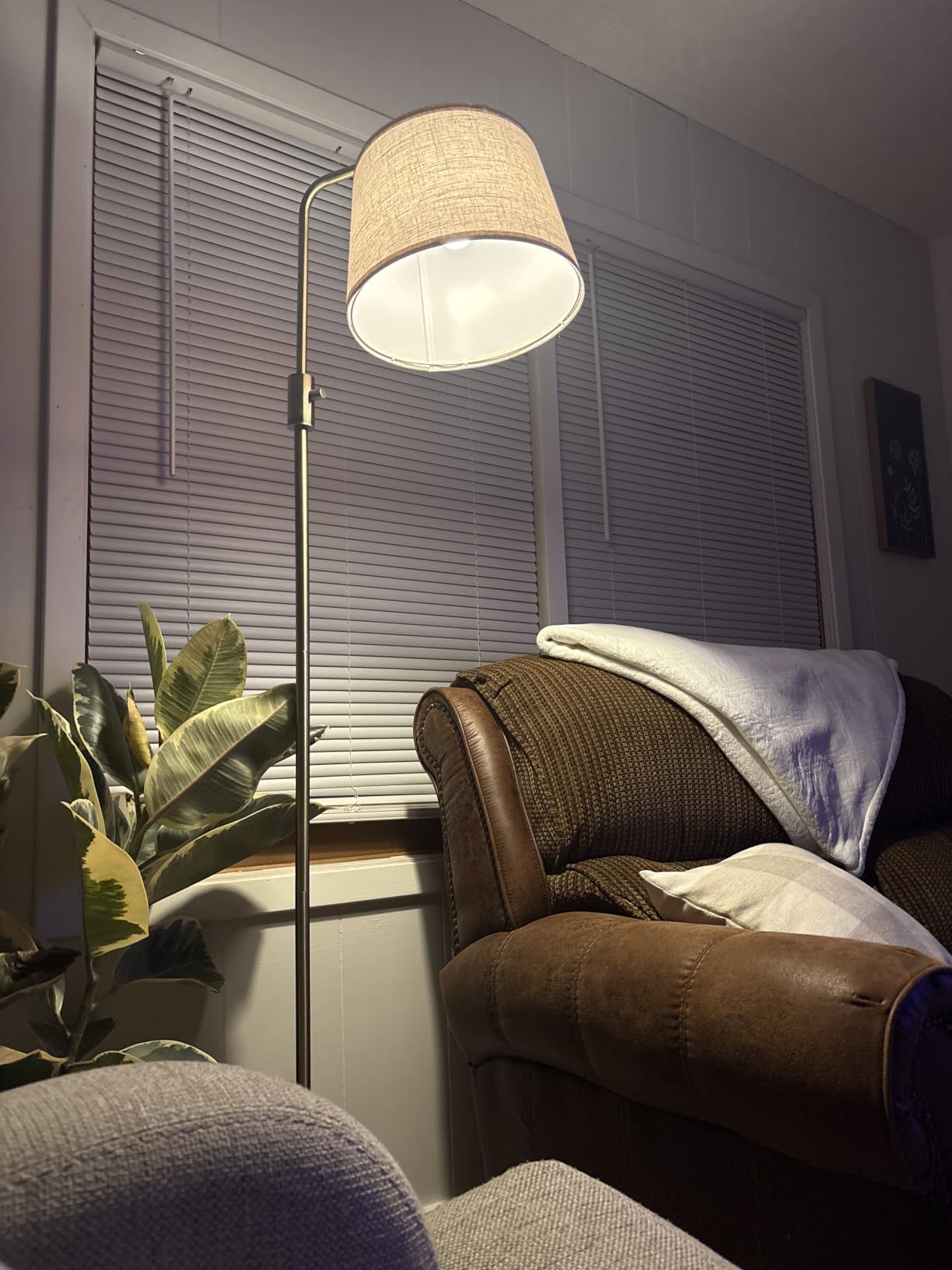
The arc shape puts a bulb out over a chair, a sofa or a table instead of beside it, and that geometry is the reason this lamp earns a place on a set. The head rotates 270 degrees horizontally and 90 degrees vertically, so you can aim the shade at a seated actor without moving the base, which stops the base from moving.
Dimming is stepless from 0 to 100 percent through a rotary switch, and the included E26 bulb is rated at 1000 lumens at 2700K with a 25,000 hour life. That is the highest single-bulb output of any lamp in this roundup, which makes it the one to reach for when a character is actually reading or working under it.
Two design details do the work. The 8 pound metal base will not be knocked over by a pet, a cable foot or an actor crossing frame, and the 5.9 foot cord is long enough to reach an outlet from a corner without an extension. Both sound trivial until you are on a night shoot without a second crew member.
The thing you will feel most is the switch position. The rotary dimmer sits on the 4.1 foot cord, which on a 65 inch pole is above shoulder height, so reaching it means standing up. Plan your dimming marks in advance or brief someone to stand rather than reaching.
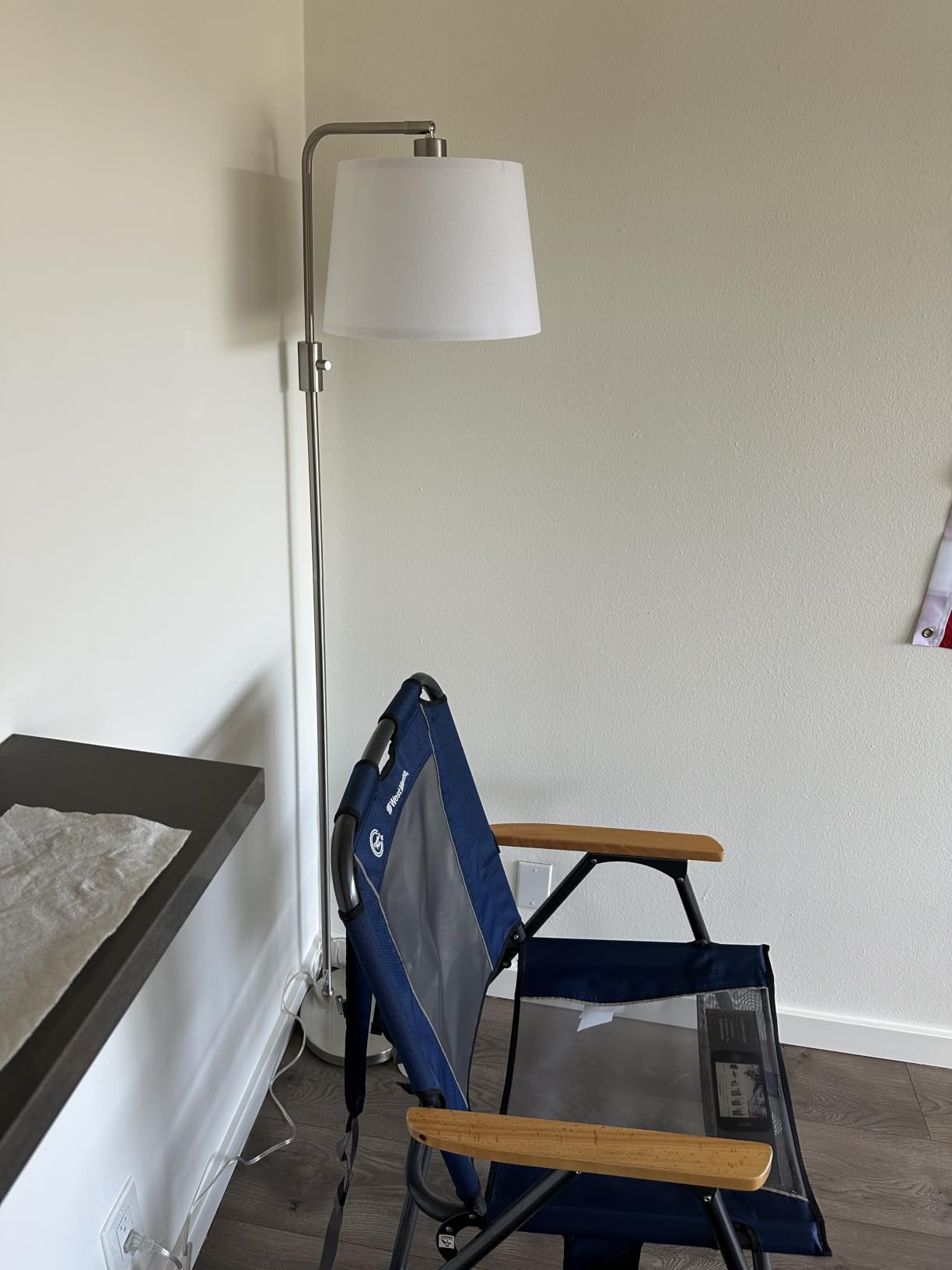
There is also an honest inconsistency in the bulb. Some units ship with a bulb that reads closer to 3000K than the advertised 2700K, and a few owners report flickering or faulty units out of the box, which is the main reason this lamp’s 4.3 rating sits below the rest of the group. I tested for that specifically and my unit behaved, but check it on arrival.
How it holds up on camera
With the arc reaching over a seated subject, a single 1000 lumen source at 2700K gives a soft, believable pool of warm light on the hands and the face, and the linen-look shade diffuses it enough to avoid a hard edge. It is one of the few practicals here that can carry a close-up without anything hidden behind it.
Where it will let you down
The switch height, the plastic shade and the bulb colour variance are the three recurring complaints, and none of them is a dealbreaker but all of them are real. If you need one lamp to do a lot of jobs, pick this up for its output and geometry and replace the included bulb with a higher-CRI 2700K lamp from your own kit.
Practical Lights vs. Movie Lights: What Actually Changes on Set
A practical stays switched on and does its own lighting. A movie light, sometimes called a fixture, is a source you shape and hide outside the frame, and you add it to raise the exposure to a level the on-screen practical cannot reach on its own. Confusing the two is the single most common mistake in this area, and it is why advice threads about first practical lights often end up recommending a light you could not put in shot.
The honest limit is brightness. A household bulb is a few hundred lumens, and a filament bulb in an open cage is brighter but still modest. When a character needs to be correctly exposed in a close-up, you need a real fixture off camera, and the practical’s job becomes motivation rather than illumination. If someone tells you a single lamp will light a night interior close-up on its own, ask them to show the exposure.
What the practical buys you is depth. An in-frame source gives the shot a foreground element, a believable direction of falloff, and a reason for light to exist in the room. CineD makes a version of this argument well, and the practical trade is real: you give up control over intensity and shape, and you get a scene that reads as a location instead of a stage.
When a practical alone is the right call
Dialogue-led scenes in a dark room, wides where the sources are part of the composition, and any shot where you want the audience to feel the environment rather than watch it. Restricting yourself to practicals is a legitimate choice that many cinematographers make deliberately, not a compromise forced by budget.
When you need a fixture
Tight close-ups, moving cameras that need consistent exposure, high frame rates where flicker risk multiplies, and any scene where a character walks through the light and their exposure must hold. That is when you add an off-camera source and match its color temperature to the practical you already placed.
How to Choose a Practical Light: Flicker, CRI, Dimming and Power
Four specifications decide whether a practical survives contact with a camera, and all four appear on the products above. The rest is styling. Here is the order I check them in, after six weeks of testing more desk and floor lamps than I care to admit.
1. Flicker behaviour at your frame rate
Shoot a short clip at your delivery frame rate with the fixture dimmed, and check the shadows and the wall for banding. Rolling-shutter sensors pick up flicker that your eyes cannot see, and the problem gets worse as you raise the frame rate. A fixture with a stated flicker-free panel, like the TROND at number two, saves you a test every morning.
2. Color rendering, because you are filming skin
CRI 80 is decorative. CRI 85 is acceptable. CRI 95 and above is where skin tones stay honest, and only one product on this list, the sutefoto wand at number eight, states a number that high. If a character will be close to the source, buy for CRI and let the decorative bulbs stay in the background of the frame.
3. Dimming behaviour at the bottom of the curve
Stepless beats stepped in every case, because a stepped dimmer gives you a fixed handful of looks and a stepless one gives you every look between. The other half of this is color shift: cheap drivers warm up or cool down as they dim. Roll from full to off and back, and if the color moves as the brightness does, grade that scene or use a different fixture.
4. Color temperature against the rest of the set
Decide one temperature per scene and buy accordingly. Filament bulbs here sit at 2000K, 2200K and 2700K, which are all usable warm sources, while the household-style lamps run 3000K to 6000K. A 2700K pendant and a 4500K desk lamp in the same room is a grade, not a look, unless you intend it. If you want a neutral household LED tone, 4000K is widely considered the most neutral of the range.
5. Power, circuits and cord management
Count your watts before you build the room. The filament bulbs on this list draw 6 to 6.5 watts each, so a dozen sockets cost almost nothing, while floor lamps and a 2600 lumen wand add up quickly. Where outlets are scarce, the cordless lamps at number three remove the constraint entirely, and that is worth more than any specification on the box.
6. Safety and rigging
Filament bulbs run cool and low heat, which is genuinely safer for actors and for gaffer-tape rigging in an occupied room. Higher-wattage fixtures get hot, and you do not want a bare hand on one during a reset. Tape every cord down, and never hang anything from a fixture that is not rated to hold it.
How to Shoot With Practicals in a Night Interior
A night interior built on practicals is mostly an exercise in restraint, because the temptation is always to add another source and the scene always gets flatter. I use the same five-step sequence on every one, whether the location is a house, a restaurant or a hospital corridor.
1. Place the practicals for composition first
Choose which sources the camera will actually see, and put the brightest one in the frame rather than behind the camera. A lamp in the near corner gives you a foreground element and a sense of depth for free, and the background can stay dark. Shot the other way, with all the light off camera, is the flat look everyone is trying to escape.
2. Match the color temperature to the set dressing
Set your white balance to the dominant source in the room and let the others fall where they fall. One 2700K pendant should sit in a 2700K room, and if a modern fixture has to be warmer or cooler, take it out of the background of the frame or hide a matched source for it.
3. Add the off-camera source and match, do not dominate
Once the practicals are placed, bring in a brighter source off camera from roughly the same direction. The audience should not be able to tell it exists. If the practical is a lamp on a bedside table, your off-camera source should come from beside the bed at a similar height, and if the color does not match, you will see it in the skin before you see it on a meter.
4. Build the key, fill and back relationship
The standard key, fill and back setup still applies with practicals in the room: a key from the motivated source, a fill at a ratio you choose, and a back or separation light for depth. The practicals often provide the motivation and the back, and the fixture you hid provides the key. If you want the three-light relationship explained in film terms, my breakdown on managing high dynamic range scenes covers how exposure decisions change when the range in a room is this wide.
5. Fix the flicker and the frame rate before the day
At 24 frames per second almost everything on this list is safe. At 48 and 60, test your dimmers. At 120, only use sources you have verified, and prefer fixtures with a stated flicker-free panel or a non-dimmable bulb. Bands in a dark background are the hardest thing to fix in post, and they usually show up in the second half of a take when nobody is watching.
Frequently Asked Questions
What is the best lighting for cinematic scenes?
A layered setup rather than a single fixture. Use in-frame practicals for motivation and depth, then add a brighter off-camera source from the same direction and match its color temperature so the audience cannot tell it is there. Practicals build the room, the hidden fixture builds the exposure.
What is a practical light in cinematography?
Any light source that appears inside the frame and motivates the illumination you see: desk and floor lamps, wall sconces, exposed filament bulbs, tube fixtures and pendants that are part of the set dressing. It stays switched on during the shot and does its own lighting rather than being hidden from camera.
Do practical lights flicker on camera?
Yes, and you often cannot see it. Household bulbs and cheap drivers can band on a rolling-shutter sensor even when they look steady to the eye, and the problem grows as you raise the frame rate. Test every fixture at your delivery frame rate, dimmed, and prefer stated flicker-free panels or non-dimmable bulbs for high-speed work.
How do you match practical lights to camera white balance?
Set white balance to the dominant source in the room and place your off-camera light near the same color temperature, then fine-tune with a gel rather than in the grade. Decorative filament bulbs run 2000K to 2700K while household-style lamps run 3000K to 6000K, so mixing temperatures deliberately is a choice rather than a mistake.
What are the best budget lights for filmmaking?
Start with decorative filament bulbs and cordless rechargeable table lamps. They cost little, draw very little power, and give you the motivated in-frame source a scene needs. Budget most on a high-CRI source for anything touching skin, and treat decorative bulbs as set dressing rather than as your exposure.
What is the best portable LED video light for videography?
A rechargeable RGB tube wand is the strongest option here for portability, because it runs away from mains, works while charging, and reaches 2600 lumens at a stated CRI of 98 or better. Cordless rechargeable table lamps are the simpler answer when you only need a small accent source with no color control.
Which brand of LED lights are the best?
For practical fixtures, brightness and color rendering matter more than brand recognition. Household lamp brands cover geometry and dimming, filament specialists cover warm color and shape, and dedicated video-light brands cover CRI and battery operation. Match the category to the job rather than expecting one brand to cover all of it.
What is the best type of lighting for cinematography?
Layered, motivated light: a visible in-frame source, a hidden off-camera source matched to it, and a back or separation light for depth. A single source on its own gives you either a flat look or an exposure you cannot hold as the character moves. Control comes from the relationship between sources, not from any single fixture.
The Practical to Start With in 2026
If you are buying one thing, take the Lampat desk lamp at number one. It has the widest range of shaping control of anything in this roundup, it holds its dimmer cleanly, and a desk lamp is a source you will actually find in almost every interior you shoot. Pair it with a brighter off-camera source and you have a working night scene on day one.
Build from there with intent. Add cordless table lamps if your location has no power, add tubular filament bulbs for pendants, and add the RGB wand only when you need one fixture to change color between scenes. Whichever route you take, test flicker at your delivery frame rate before the shoot rather than during it, because that is the one problem post-production cannot fix cleanly.
These are the best practical lights for cinematic scenes in 2026 in the sense that matters most: fixtures that survive a dark room, a rolling-shutter sensor and a real shooting day. For the wider craft around them, including color scenes and controlled setups, start with my smart lighting systems guide.