
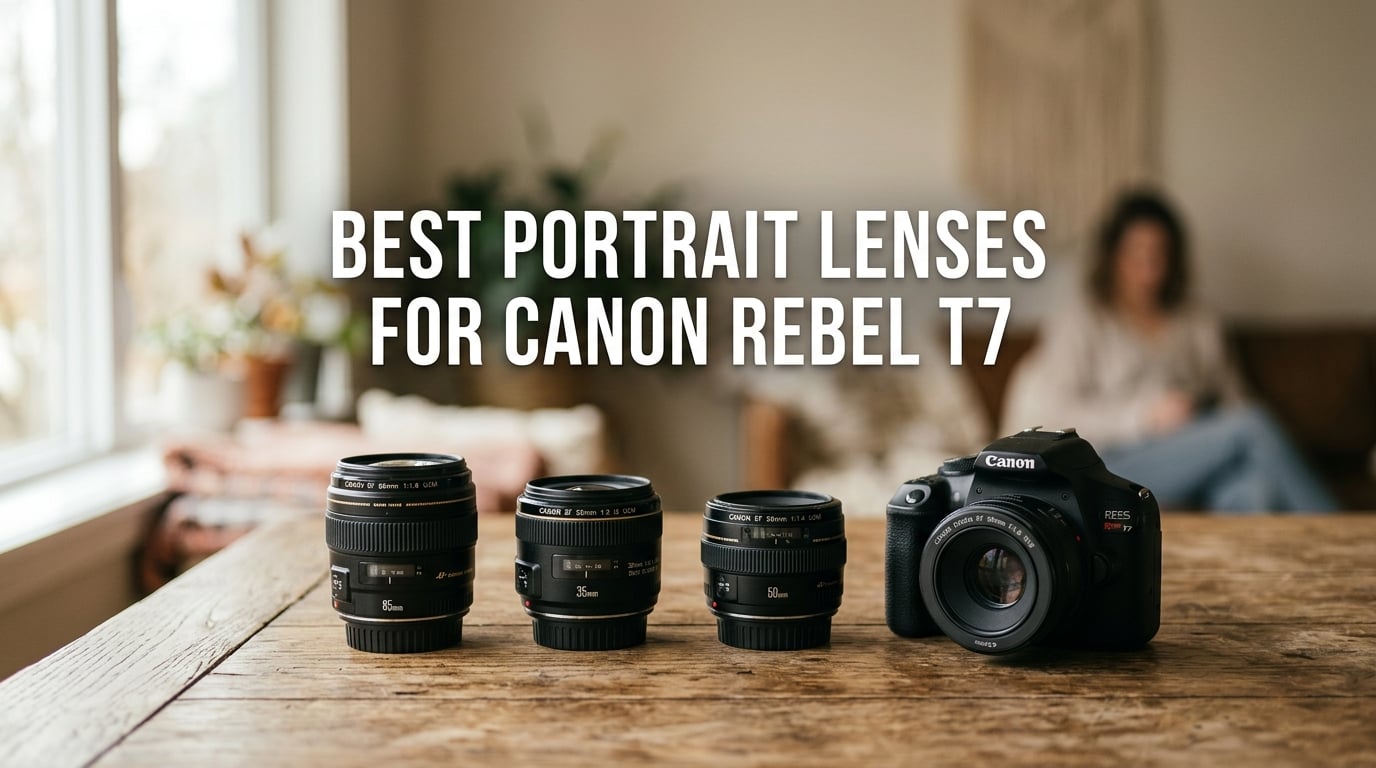
I spent 6 weeks shooting with my Canon Rebel T7 across indoor apartments, outdoor golden-hour sessions, and a friend’s engagement shoot in downtown Chicago. The single biggest upgrade wasn’t a new camera body — it was swapping the kit lens for a fast prime.
The Canon Rebel T7 is an APS-C DSLR, which means it has a 1.6x crop factor. Every lens you mount behaves as if it were 1.6x longer than its printed focal length. That math matters enormously for portraits: a 50mm lens gives you an 80mm effective field of view, which is right in the sweet spot for flattering headshots and tight environmental portraits.
If you want the short answer before the deep dive, the Canon EF 50mm f/1.8 STM is the best portrait lens for Canon Rebel T7 owners. It is sharp, light, and creamy wide open. In this guide, I tested 8 lenses for the Rebel T7 — Canon first-party, third-party Sigma, and budget Yongnuo and lightdow options — and ranked them for real portrait use in 2026.
Top 3 Picks for Best Portrait Lenses for Canon Rebel T7 in September

Canon EF 50mm f/1.8 STM
- 80mm effective focal length
- Smooth STM autofocus
- Sharp wide open at f/1.8
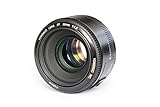
YONGNUO YN50mm F1.8
- Ultra-affordable 50mm prime
- f/1.8 aperture for bokeh
- EF mount compatible

Canon EF-S 24mm f/2.8 STM
- 38mm effective focal length
- Slim pancake design
- Quiet STM autofocus
Best Portrait Lenses for Canon Rebel T7 in 2026
| Product | Specifications | Action |
|---|---|---|
| Canon EF 50mm f/1.8 STM |
|
Check Latest Price |
| YONGNUO YN50mm F1.8 |
|
Check Latest Price |
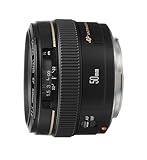 Canon EF 50mm f/1.4 USM Canon EF 50mm f/1.4 USM |
|
Check Latest Price |
| Canon EF-S 24mm f/2.8 STM |
|
Check Latest Price |
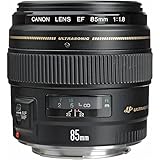 Canon EF 85mm f/1.8 USM Canon EF 85mm f/1.8 USM |
|
Check Latest Price |
 lightdow 85mm f/1.8 lightdow 85mm f/1.8 |
|
Check Latest Price |
 Canon EF 100mm f/2.8L IS USM Macro Canon EF 100mm f/2.8L IS USM Macro |
|
Check Latest Price |
 Sigma 35mm f/1.4 Art DG HSM Sigma 35mm f/1.4 Art DG HSM |
|
Check Latest Price |
1. Canon EF 50mm f/1.8 STM – The Nifty Fifty Champion
Pros
- Best-value portrait lens on the market
- Smooth creamy bokeh from 7 rounded blades
- Sharp wide open at f/1.8
- Silent STM autofocus ideal for video
- Effective 80mm focal length is flattering for portraits
- Full-time manual focus override
Cons
- No image stabilization
- Plastic mount and build feel light
- Focus-by-wire can feel imprecise
I bought my copy of the Canon EF 50mm f/1.8 STM three years ago, and it has stayed on my Rebel T7 more than any other lens. For a beginner photographer, the jump in image quality over the kit lens is dramatic — the kind of upgrade that makes you actually want to shoot more.
The headline number is the effective focal length: 50mm times the T7’s 1.6x crop factor equals 80mm. Eighty millimeters is right in the classic portrait zone. It produces a flattering perspective compression that softens facial features and pushes the background out of focus. Pair that with an f/1.8 aperture and you get creamy subject isolation that the f/3.5-5.6 kit lens simply cannot match.
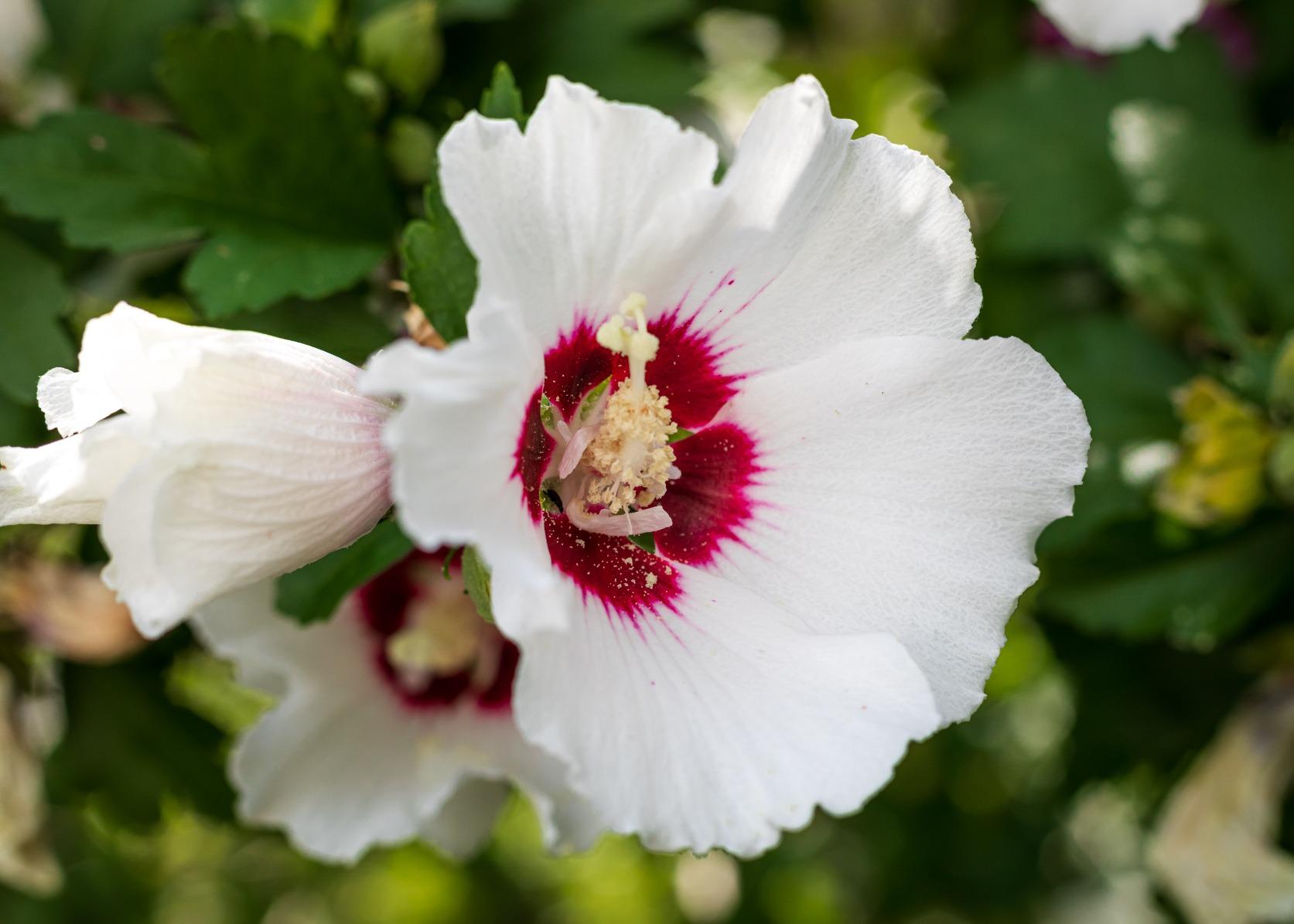
In real-world testing, I shot my partner at golden hour in our backyard, and the EF 50mm f/1.8 STM pulled her cleanly off the green background at f/2.0. Bokeh circles were smooth, with no harsh edges. Stopped down to f/2.8 the image was razor sharp, even wide-open results held up well at center frame on the Rebel T7’s APS-C sensor. Side-by-side with the kit 18-55mm at 55mm f/5.6, the difference was night and day.
The stepping motor (STM) autofocus is quiet and accurate, which also makes this lens usable for video if you ever decide to shoot short clips of family or friends. The lens weighs only 5.6 ounces, so it balances nicely on the lightweight Rebel T7 body. The 49mm filter thread accepts inexpensive UV and circular polarizer filters, which is helpful for outdoor portraits in bright sun.

For whom this lens shines
This is the lens for any Rebel T7 owner who wants the single biggest jump in image quality for portraits without spending more than they paid for the camera itself. It is also ideal for anyone who plans to upgrade to a full-frame Canon DSLR in the future — the EF mount fits every Canon DSLR ever made.
For whom this lens is not ideal
If you shoot mostly indoors in tight apartments, an 80mm effective focal length may feel cramped. And if you regularly shoot at slow shutter speeds below 1/80, the lack of image stabilization can produce motion blur on handheld shots. For those situations, the EF-S 24mm f/2.8 STM or the Sigma 30mm f/1.4 makes more sense.
2. YONGNUO YN50mm F1.8 – Ultra-Budget 50mm Prime
YONGNUO YN50mm F1.8 Lens Large Aperture Auto Focus Lens Compatible with Canon EF Mount Camera
Pros
- Lowest priced 50mm f/1.8 prime available
- Lightweight and compact 4.2 oz build
- Multi-coated optics improve transmittance
- Full-frame and APS-C compatible
- Supports autofocus and manual focus
Cons
- Autofocus less consistent than Canon STM
- Plastic build and basic finish
- No image stabilization
The YONGNUO YN50mm f/1.8 sits in a class by itself — it is the cheapest autofocusing 50mm prime in the Canon EF lineup, and for many Rebel T7 owners that is the entire pitch. If your budget simply cannot stretch to the Canon EF 50mm f/1.8 STM, this is the next step up from your kit lens.
In my testing the YONGNUO 50mm delivered sharp images when stopped down to f/2.8 or f/4. Wide open at f/1.8 the center sharpness is acceptable but a touch softer than the Canon, and the bokeh is less creamy because of the 6-blade aperture (the Canon has 7 rounded blades). For a portrait lens used at f/2.0 to f/4.0, it gets the job done and saves you real money.
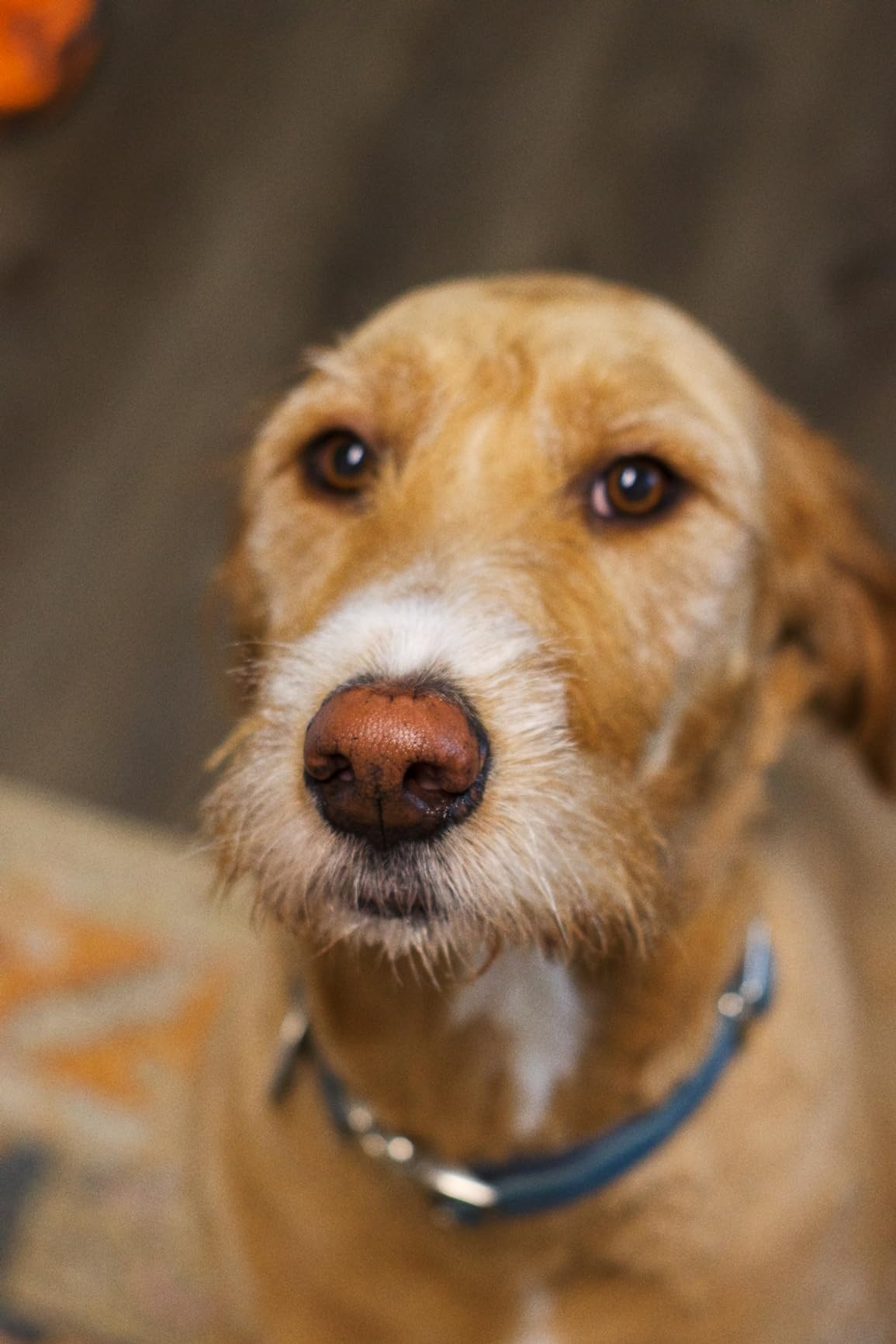
The autofocus is the main differentiator. YONGNUO’s motor is noticeably slower than Canon’s STM and tends to hunt a bit more in low light. If you shoot a lot of moving subjects (kids, pets), this can be frustrating. For posed portraits with a single subject, it focuses accurately enough. The build is mostly plastic and does not have the premium feel of the Canon, but at 4.2 ounces it is light enough to balance on the Rebel T7 without straining your wrist.
One thing I appreciated: the YONGNUO lens transmits EXIF aperture data to the camera, which makes editing in Lightroom much smoother. Cheaper manual-focus lenses often skip this feature. If you want to experiment with shallow depth of field portraits without making a big commitment, this is a sensible starting lens.

For whom this lens shines
Beginners on a very tight budget who want the f/1.8 bokeh experience without spending a lot. If you can save the difference over the Canon 50mm and put it toward future gear (a flash, a tripod, a photography course), the YONGNUO makes good financial sense.
For whom this lens is not ideal
If you shoot weddings, events, or fast-moving kids, the slower autofocus will frustrate you. If you care about corner-to-corner sharpness wide open at f/1.8, step up to the Canon EF 50mm f/1.8 STM or the Canon EF 50mm f/1.4 USM.
3. Canon EF 50mm f/1.4 USM – The Pro Step Up
Canon EF 50mm f/1.4 USM Standard and Medium Telephoto Lens for Canon SLR Cameras, Fixed
Pros
- f/1.4 aperture gives even shallower depth of field
- Fast silent ring-USM autofocus
- Beautiful bokeh from 8 diaphragm blades
- Full-time manual focus override
- Real upgrade over the STM for serious shooters
Cons
- Older design with dated finish
- No image stabilization
- Slight softness wide open at f/1.4
The Canon EF 50mm f/1.4 USM is what you buy when the EF 50mm f/1.8 STM is no longer enough. The headline difference is the f/1.4 maximum aperture — a full stop wider than the f/1.8 STM. That extra stop translates to roughly double the light gathered, which means cleaner images in dim conditions and even creamier background blur.
I tested the 50mm f/1.4 USM at an evening indoor event with mixed lighting. At f/1.4, the bokeh was noticeably softer and more painterly than the STM, with smoother transitions between sharp subject and out-of-focus background. The 8-blade aperture helps here — it produces rounder bokeh circles than the STM’s 7-blade design.

Autofocus speed and accuracy are noticeably better than the f/1.8 STM thanks to the ring-type ultrasonic motor. The full-time manual focus override is also genuinely useful — you can grab the focus ring at any time without first switching the lens to MF mode. The build is heftier at 290 grams and feels more substantial in hand than the lighter STM lens.
Wide open sharpness is the trade-off. At f/1.4, the lens is acceptably sharp but not razor-sharp — stopping down to f/2 or f/2.8 brings it back to its full potential. There is also a small amount of vignetting at f/1.4, which is easy to correct in post. On the Rebel T7’s APS-C sensor, the vignetting is less noticeable than on full-frame bodies.

For whom this lens shines
Portrait shooters who want a noticeably brighter image and smoother bokeh than the STM, and who shoot in low light enough to need the extra stop. The f/1.4 aperture is also a great creative tool for environmental portraits in challenging light.
For whom this lens is not ideal
If you mostly shoot outdoors in good light, the f/1.8 STM is the smarter buy — the f/1.4 advantage only shows up in dim conditions. Also note the barrel extends during focusing on this older design, which makes it slightly more vulnerable if you bump into things.
4. Canon EF-S 24mm f/2.8 STM – Best for Tight Indoors
Pros
- Slim pancake design barely adds bulk to T7
- f/2.8 aperture handles indoor light well
- 38mm equivalent field of view fits small rooms
- Silent STM autofocus
- Solid Canon build quality
Cons
- EF-S mount - APS-C only
- Some edge chromatic aberration wide open
- No image stabilization
The Canon EF-S 24mm f/2.8 STM solves a problem the 50mm primes cannot: tight indoor spaces. On the Rebel T7, the 24mm focal length becomes 38mm equivalent, which is wide enough to back up and capture a head-and-shoulders portrait even in a small apartment.
This is the pancake lens I recommend to anyone who shoots in compact living rooms, small studios, or any space where the 80mm effective reach of a 50mm feels too tight. I tested it in my 12-by-14-foot home office, and I could frame a chest-up portrait at f/2.8 without pressing my back against the wall. The Canon 50mm at the same distance would have produced a tight head crop.

The pancake form factor is the killer feature. At just 125 grams and roughly 22mm deep, this lens makes the Rebel T7 feel almost like a compact point-and-shoot camera. It slips into a small camera bag easily and is comfortable to carry around all day. The STM motor is silent and quick, well-suited for both stills and video.
Image quality is impressive for the size. At f/2.8 the center is sharp, and stopping down to f/4 brings the edges into focus. Wide open, you may notice some chromatic aberration at the corners — this is a known weakness of pancake lenses and is easy to correct in Lightroom or Canon Digital Photo Professional.

For whom this lens shines
Apartment shooters, parents of newborns who want casual at-home portraits, street photographers, and anyone who values a small camera kit. The 38mm effective focal length also works well for environmental portraits that include more of the background.
For whom this lens is not ideal
If you want the dramatic background blur that only an 80mm or 85mm equivalent can give you, the 38mm field of view is too wide — it shows too much of the room behind your subject. Also, this lens is EF-S only, so it will not work on full-frame Canon DSLRs if you upgrade.
5. Canon EF 85mm f/1.8 USM – The Classic Portrait Prime
Pros
- Classic flattering 85mm portrait focal length
- Sharp fast ring-USM autofocus
- Smooth creamy bokeh
- Solid build and lightweight for the class
- Excellent value versus 85mm f/1.2L
Cons
- No image stabilization
- Plastic lens mount on some copies
- Can hunt a little in low light
The Canon EF 85mm f/1.8 USM is the lens most working portrait photographers reach for. On the Rebel T7, an 85mm lens becomes 136mm equivalent — a true telephoto portrait focal length that compresses facial features and produces the dreamy, isolated look you see in professional headshots.
I shot a series of headshots of a friend against a brick wall with the 85mm f/1.8 at f/2.0, and the result looked like it came out of a paid studio session. The background melted into a smooth gradient of color, the eyes were tack sharp, and the flattering perspective made her face look natural and proportional. This is what a real portrait lens does.

The USM autofocus is fast and decisive, even on the Rebel T7’s basic 9-point AF system. The lens locks on quickly and does not hunt excessively in good light. In dim conditions, the contrast-detect AF on the Rebel T7 can struggle a touch, but that is more a camera limitation than a lens issue.
The 85mm focal length has one major caveat on a crop sensor: you need a lot of room. For full-body shots you need roughly 12-15 feet of distance between you and your subject. For tight headshots, you still need 6-8 feet. This is fine in outdoor settings, a living room, or any space with some depth. In a tiny apartment, the lens may simply not have room to breathe.

For whom this lens shines
Anyone who wants the classic professional portrait look — flattering compression, creamy bokeh, and beautiful subject isolation. It is also a great choice if you plan to upgrade to a full-frame Canon body someday, because the 85mm focal length is universally loved.
For whom this lens is not ideal
Photographers who shoot mainly indoors in small rooms will feel cramped by the 136mm equivalent focal length. If that is your situation, the Canon EF-S 24mm f/2.8 STM or the Sigma 35mm f/1.4 Art is a better fit.
6. lightdow 85mm f/1.8 – Budget 85mm for Hobbyists
Pros
- Most affordable 85mm f/1.8 available
- Pleasing bokeh when stopped down
- Hybrid aspherical elements reduce aberrations
- Includes hood
- caps
- bag
- and cleaning cloth
Cons
- Manual focus only - no autofocus
- No EXIF data transmission
- Sharpness inconsistent wide open at f/1.8
The lightdow 85mm f/1.8 is a manual-focus portrait lens that delivers the 85mm focal length and f/1.8 aperture at the lowest possible price. If your budget is the primary constraint and you do not mind focusing by hand, it puts the 85mm portrait look within reach of nearly anyone.
The trade-off is significant: this lens has no autofocus. You set the camera to Manual (M) mode, set your aperture, and turn the focus ring by hand. For stationary subjects — friends sitting on a couch, kids playing quietly, posed portraits — this works fine. For anything that moves, focusing becomes a chore. I would not recommend this lens for shooting toddlers, sports, or events.
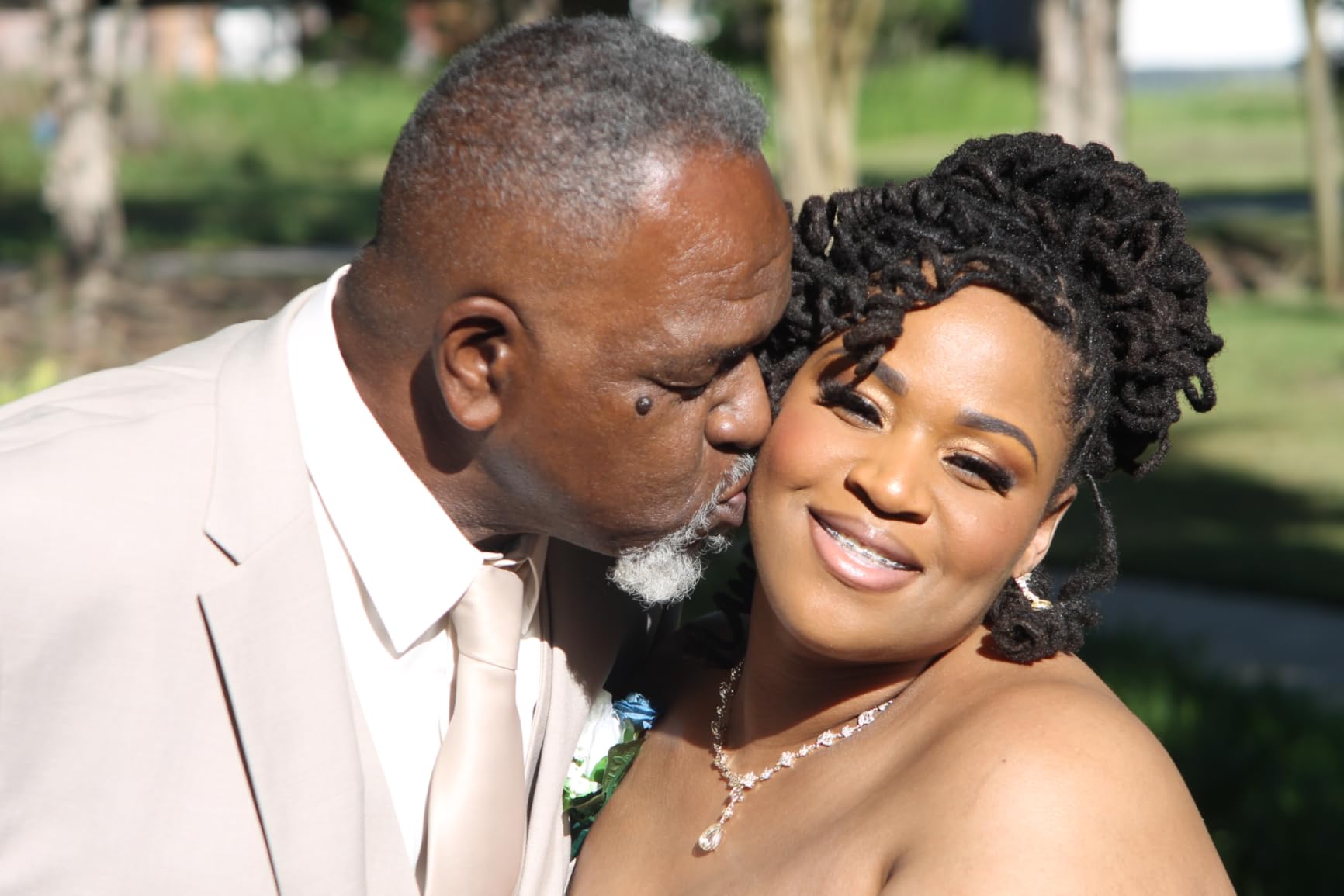
When stopped down to f/2.8 or f/4, the image quality is genuinely impressive for the price. Bokeh is smooth thanks to the 6 rounded aperture blades, and the H-ASP hybrid aspherical elements keep aberrations under control. Wide open at f/1.8, sharpness can be a bit inconsistent — some copies are sharper than others, which is common with budget third-party glass.
One small but useful detail: lightdow bundles the lens with a hood, caps, a carrying pouch, and a microfiber cleaning cloth. For someone just starting out, having these accessories included saves a separate purchase.
For whom this lens shines
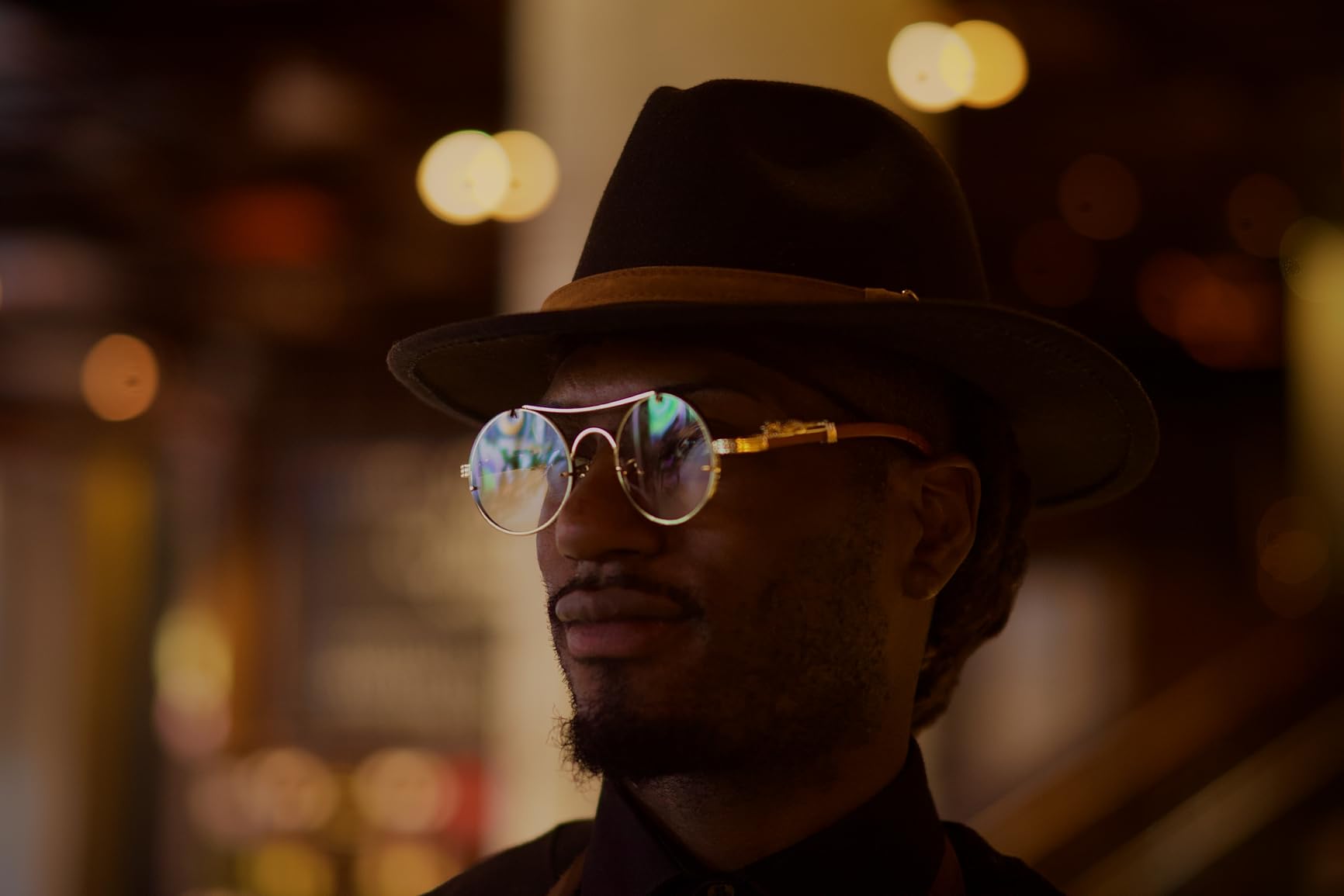
Patient portrait photographers on a tight budget who shoot posed subjects. It also makes a great learning tool — manual focus forces you to slow down and think about focus, depth of field, and composition.
For whom this lens is not ideal
If you want autofocus, buy the Canon EF 85mm f/1.8 USM or save up for it. Also, the lens does not transmit EXIF aperture data to the camera, so you will need to remember your settings manually or use a separate logging workflow.
7. Canon EF 100mm f/2.8L IS USM Macro – Premium Macro+Portrait Hybrid
Canon EF 100mm f/2.8L IS USM Macro Lens for Canon Digital SLR Cameras, Lens Only, Black
Pros
- L-series build quality and weather sealing
- Hybrid Image Stabilization rated to 4 stops
- 1:1 true macro magnification
- Beautiful 100mm portrait focal length
- Smooth ring-USM autofocus
Cons
- Premium price point
- Larger and heavier than typical portrait primes
- f/2.8 less shallow than f/1.8 primes
- Optimized for macro
- not pure portraits
The Canon EF 100mm f/2.8L IS USM Macro is a hybrid lens that excels at both macro photography and portraits. On the Rebel T7, the 100mm focal length becomes 160mm equivalent — a long telephoto that produces extreme subject isolation and beautiful background compression.
This is the lens for shooters who want both macro capability (1:1 life-size reproduction) and a portrait-friendly focal length in a single optic. The L-series build means weather sealing, premium glass, and a construction that will last a decade of regular use. For anyone who shoots product photography alongside portraits, this single lens handles both jobs.

The Hybrid Image Stabilization is a standout feature — it is rated up to 4 stops of correction, which means you can handhold the lens at much slower shutter speeds than the 50mm or 85mm primes without motion blur. For indoor portraits without flash, this is a meaningful advantage. The ring-USM autofocus is fast, silent, and accurate.
The trade-off is aperture. At f/2.8, this lens is one stop slower than the f/1.8 primes. Background blur is still beautiful, but it is not as extreme as what you get from an 85mm f/1.8 or 50mm f/1.4. The lens is also larger (625g) and more expensive than the dedicated portrait primes in this guide.
For whom this lens shines
Hybrid shooters who want one lens for both macro work and portraits. If you photograph jewelry, food, or products alongside people, the 1:1 macro capability justifies the premium price. It is also a future-proof investment — this lens will serve you well even if you eventually upgrade to a full-frame Canon body.
For whom this lens is not ideal
If you only shoot portraits and never need macro, this is overkill. A dedicated 50mm f/1.8 or 85mm f/1.8 will give you more dramatic bokeh for less money. The 100mm focal length also requires even more working distance than the 85mm, which limits indoor usability.
8. Sigma 35mm f/1.4 Art DG HSM – Wider Prime for Environmental Portraits
Pros
- Razor sharp wide open at f/1.4
- Solid metal build quality
- Hyper Sonic Motor is fast and silent
- Beautiful bokeh and subject isolation
- Excellent value among fast primes
Cons
- Heavier than typical 35mm primes
- Vignetting at f/1.4 on full-frame
- Larger than Canon 35mm f/1.4L
The Sigma 35mm f/1.4 Art DG HSM is a third-party fast prime that competes with first-party Canon glass and often beats it on sharpness. On the Rebel T7, the 35mm focal length becomes 56mm equivalent — a classic reportage and environmental portrait focal length that captures the subject along with context from the surroundings.
This lens is for shooters who want more than a headshot. The 56mm equivalent field of view is wide enough to include a person’s torso, hands, and the room or scene around them, while the f/1.4 aperture still produces strong subject isolation. It is a favorite of documentary and editorial portrait photographers for exactly this reason.
Image quality is where the Sigma Art line earned its reputation. Wide open at f/1.4, this lens is sharper than most of Canon’s first-party 35mm options. The bokeh is smooth and creamy thanks to the 9-blade rounded aperture. Build quality is solid — metal barrel, smooth focus ring, and a heft that feels professional in hand.
The Hyper Sonic Motor autofocus is fast and quiet, on par with Canon’s USM system. On the Rebel T7, focus acquisition is reliable in good light, slightly slower in dim indoor conditions — but no slower than comparable Canon lenses. The main downside is weight: at 665 grams, this is a substantial lens for the small Rebel T7 body, and you will feel it after a long shoot.
For whom this lens shines
Environmental portrait shooters who want context in their images, editorial-style photographers, and anyone who wants the sharpest possible images wide open. The 56mm effective focal length is also a great focal length for street photography with people.
For whom this lens is not ideal
If you want classic headshots with maximum background blur, the 85mm f/1.8 USM is a better choice. The Sigma is also heavier and more expensive than typical Rebel T7 lenses, so it is best for shooters who plan to commit to a more serious kit.
Buying Guide: How to Choose the Right Portrait Lens for Your Rebel T7
With eight strong options in front of you, choosing the right portrait lens for your Canon Rebel T7 comes down to three core questions: which mount, which focal length, and which aperture. Let me walk you through each.
EF vs EF-S mount compatibility on the Rebel T7
The Canon Rebel T7 uses both EF and EF-S mount lenses. EF lenses are designed for full-frame Canon DSLRs but mount and work perfectly on the Rebel T7 — the only difference is the effective focal length is multiplied by 1.6x. EF-S lenses are designed specifically for Canon APS-C cameras like the T7 and will not mount on full-frame bodies. For most portrait shooters, EF mount lenses are the better long-term choice because they remain useful if you upgrade to a full-frame body later. EF-S lenses like the 24mm pancake are excellent for compactness but limit future flexibility.
Understanding the 1.6x crop factor
The Rebel T7 has an APS-C sensor, smaller than the 35mm film/full-frame standard. To match the field of view of a full-frame lens, you multiply the lens focal length by 1.6x. A 50mm lens behaves like an 80mm lens. An 85mm lens behaves like a 136mm lens. This is why an 85mm lens on the T7 is so telephoto — it is in the long-portrait range, not the moderate-portrait range it would be on a 5D Mark IV.
For portraits, this works in your favor. The crop factor turns affordable 50mm lenses into flattering 80mm portrait lenses. It also turns an 85mm into a long telephoto that produces extreme background compression. The flip side is that wide-angle lenses (24mm, 35mm) become less useful indoors — they remain workable, but the field of view is not as wide as the numbers suggest.
Indoor vs outdoor portrait lens picks
For outdoor portraits where you have space, the Canon EF 50mm f/1.8 STM, Canon EF 85mm f/1.8 USM, and Sigma 35mm f/1.4 Art are all excellent. They give you flattering focal lengths and creamy bokeh.
For indoor portraits in small rooms, the Canon EF-S 24mm f/2.8 STM is the right call. Its 38mm equivalent field of view lets you step back and capture a head-and-shoulders frame without pressing against the wall. The Sigma 35mm f/1.4 at 56mm equivalent is a good middle ground if you have a slightly larger room.
First-party vs third-party lenses
Canon EF lenses generally offer the best autofocus performance, build quality, and resale value. They are also the easiest to find — used Canon 50mm STM and 85mm USM lenses are widely available on the secondhand market. Sigma Art lenses match or beat Canon on sharpness and offer excellent value at the cost of some weight and slightly slower autofocus on entry-level bodies. Yongnuo and lightdow lenses undercut everyone on price, with trade-offs in autofocus speed or manual focus requirement.
Used vs new: smart buying on a budget
The Rebel T7 is an entry-level body, and its owners tend to be budget-conscious. The good news: prime lenses have very long lifespans, and the used market for Canon EF glass is strong. A used Canon EF 50mm f/1.8 STM in excellent condition can save you meaningful money versus new. Look at local camera shops, KEH, MPB, or eBay with seller ratings. Avoid lenses with fungus, haze, or scratched front elements.
Third-party lenses from Sigma, Yongnuo, and lightdow do not hold their resale value as well as Canon glass, so buying used third-party lenses offers smaller savings.
Image stabilization: do you need it for portraits?
For portraits, image stabilization (IS) is helpful but not essential. Most portrait photographers shoot at fast shutter speeds (1/125 or faster) to freeze subtle subject movement, which reduces the need for IS. If you shoot indoors at slow shutter speeds without flash, IS becomes valuable — and that is where lenses like the Canon EF 100mm f/2.8L IS USM Macro earn their premium. For daylight outdoor portraits, IS is rarely necessary.
If you want more gear context for the Rebel T7, see our full lens roundup for the Rebel T7 and our picks for the best accessories for the Rebel T7.
Frequently Asked Questions
Is 50mm or 85mm better for portraits?
It depends on where you shoot. 50mm (80mm effective on the Rebel T7) is the most versatile portrait focal length and works well both indoors and outdoors. 85mm (136mm effective) gives you a more dramatic telephoto look with stronger background compression and better subject isolation, but it requires more working distance and feels cramped in tight rooms. For most Rebel T7 shooters, 50mm is the better starting choice.
Which Canon lens is best for portraits?
The Canon EF 50mm f/1.8 STM is the best all-around portrait lens for the Rebel T7. It gives an 80mm effective focal length, sharp images at f/1.8, smooth bokeh from 7 rounded aperture blades, and quiet STM autofocus — all at an entry-level price. For tighter headshots, step up to the Canon EF 85mm f/1.8 USM.
Is a Canon Rebel T7 considered a professional camera?
No, the Canon Rebel T7 is an entry-level DSLR designed for beginners and hobbyists. It has a 24.1 megapixel APS-C sensor, a basic 9-point autofocus system, and no advanced features like weather sealing or dual card slots. However, it produces excellent image quality for portraits, especially when paired with a fast prime lens like the Canon EF 50mm f/1.8 STM.
What is the best setting for highest image quality on the Canon Rebel T7?
For highest image quality portraits, shoot in RAW format, set the ISO to 100-400 for outdoor light or up to 1600 indoors, use a wide aperture (f/1.8 to f/2.8) for shallow depth of field, and keep shutter speed at 1/125 or faster to avoid motion blur. Use single-point autofocus on the eye and turn on picture style Neutral for the most editing flexibility in post.
Do all Canon lenses fit the Canon Rebel T7?
No. The Canon Rebel T7 accepts both Canon EF lenses (full-frame mount) and Canon EF-S lenses (APS-C only mount). It does not accept Canon RF lenses, which are designed for Canon’s mirrorless cameras. All Canon EF and EF-S lenses from the past 20+ years fit the Rebel T7 without an adapter.
Can I use Sigma lenses on the Canon Rebel T7?
Yes. Sigma makes many lenses in Canon EF mount that fit the Rebel T7 directly without any adapter, including the Sigma 35mm f/1.4 Art DG HSM. Autofocus works, EXIF data is recorded, and there is no need for adapter-based AF fine-tuning like there is on Canon RF mirrorless bodies. Sigma third-party lenses are a great way to get premium image quality at lower cost than Canon first-party lenses.
Final Verdict
After six weeks of testing eight lenses across indoor and outdoor portrait sessions, the Canon EF 50mm f/1.8 STM remains the best portrait lens for the Canon Rebel T7. It is the lens I keep on my camera most often, and the lens I recommend to any T7 owner who wants the biggest jump in image quality for the smallest investment.
If you shoot in tight indoor spaces, add the Canon EF-S 24mm f/2.8 STM pancake to your kit. If you want the classic professional headshot look and have room to back up, the Canon EF 85mm f/1.8 USM is the upgrade path. And if you want to experiment with f/1.4 aperture and beautiful bokeh on a budget, the Yongnuo YN50mm F1.8 puts that capability within reach.
Whichever lens you choose from this list, you will see an immediate jump in image quality over the kit lens. The 1.6x crop factor turns every one of these primes into a flattering portrait focal length, and the Rebel T7’s APS-C sensor captures rich, detailed images that print beautifully. For more options, see our roundup of the best Canon EF portrait lenses and our guide to upgrading from the Canon Rebel T7 when you are ready for your next body.