
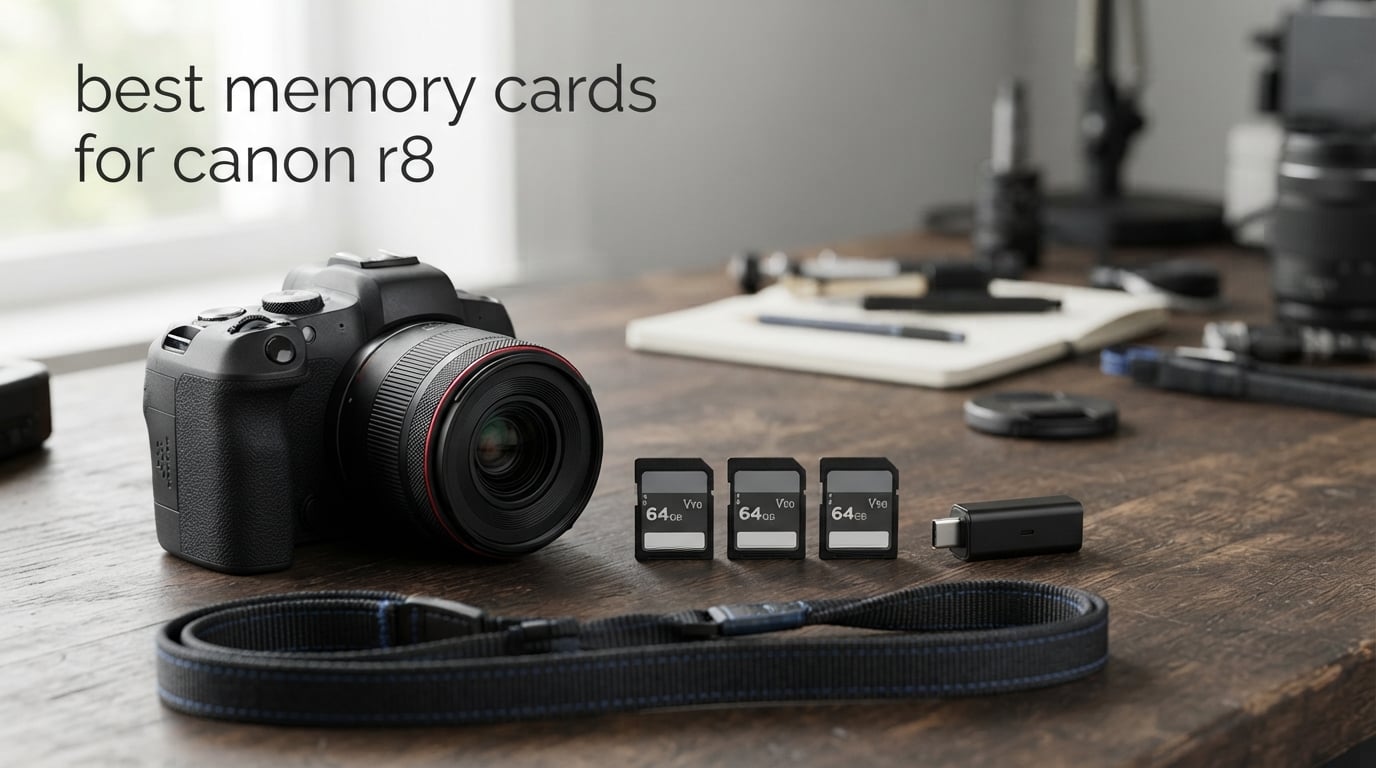
The best memory cards for Canon R8 are UHS-II SDXC cards rated V60 when you want dependable 4K video capture and faster recovery after high-speed bursts. The EOS R8 has one SD card slot, so the card you choose has to cover both the day’s stills and video rather than share the task with a second card.
My practical starting point is simple: choose V30 for stills and lighter 4K work, V60 for 4K 60fps and a more responsive hybrid workflow, and V90 when the highest sustained-write headroom matters more than capacity. The R8’s 24.2MP full-frame files and 40fps electronic shutter can fill its buffer quickly, making the card’s sustained write rating more useful than an impressive peak read number alone.
This guide compares all 12 supplied Canon R8 SD card options using their stated capacities, interfaces, video classes, transfer claims, warranties, customer ratings, and review feedback. Community discussions repeatedly point to V60 as the sensible middle ground, while also reminding us to buy cards from established sellers because counterfeit media can look convincing until it fails.
Top picks are three Canon R8 cards for distinct shooting needs (September 2026)
For most R8 owners, the SanDisk Extreme PRO UHS-II V60 is the all-round choice, the Lexar Professional Silver Pro V60 is a strong 128GB V60 alternative, and the SanDisk Extreme UHS-I V30 suits stills-first shooters. These three picks make the speed-class decision clear before you compare every card below.


Canon R8 memory cards in 2026 need a clear speed-class match
V30, V60, and V90 describe minimum sustained video write speeds of 30, 60, and 90MB/s. Since the R8 records at up to 340 Mbps, which is about 42.5MB/s, V60 gives useful margin for the camera’s higher-demand video modes; that is why it is the default recommendation for hybrid shooters.
UHS-II cards add a second row of contacts and can transfer data faster in a UHS-II camera, while UHS-I cards still work in the R8 at their own interface limit. A UHS-II SDXC card also supports the exFAT file system at capacities above 32GB, avoiding the FAT32 4GB-file limitation associated with SDHC media in long recordings.




1. SanDisk Extreme PRO UHS-II V60 is the best all-round Canon R8 card
Pros
- V60 sustained class
- 256GB capacity
- 280MB/s read
- extensive protection
- lifetime limited warranty
Cons
- UHS-I alternatives suit lighter work
I would put this 256GB SanDisk at the top of a single-card R8 kit because it combines the UHS-II interface with a V60 class and a stated 150MB/s shot speed. Its 4.9 rating from 3.3k+ reviews is the strongest rating in this group, and the supplied data lists a lifetime limited manufacturer warranty.
It is designed for 6K and 4K UHD recording, though the R8 itself is a 4K camera. The 280MB/s claimed transfer speed is also helpful after a long shoot if your reader supports that performance.
The real distinction is the 60MB/s minimum video rating, not the peak transfer claim. That sustained rating gives the R8 breathing room for 4K 60fps recording and makes this one of the best memory cards for Canon R8 owners who move between video and bursts.
The best fit is a hybrid shooter who wants one 256GB card
I would choose this card for travel, event coverage, or creator work where changing media mid-session is inconvenient. Its stated drop, water, temperature, magnetic, and X-ray protection is an added reason to treat it as a dependable field card.
The trade-off is that a V30 card can cover a stills-first routine
If you only record short 4K clips and rarely push bursts, a UHS-I V30 option can be enough. That does not make this V60 card excessive for mixed work; it simply means its capability may go unused in a photo-only routine.
2. SanDisk Extreme PRO UHS-I V30 is the familiar high-volume stills choice
Pros
- 256GB capacity
- 140MB/s shot speed
- 4K support
- lifetime limited warranty
- 88.9k+ reviews
Cons
- V30 minimum class
- UHS-I interface
This 256GB UHS-I Extreme PRO is backed by 88.9k+ reviews and a 4.8 rating, which makes it the group’s clearest popularity signal. Its stated 140MB/s shot speed is suitable for sequential burst photography and its V30 classification supports 4K UHD capture.
I see it as a sensible card for photographers who prioritize RAW stills, family events, travel, and short clips. SanDisk lists QuickFlow-enabled offloads up to 200MB/s when paired with its compatible reader, while the card itself is rated at up to 120MB/s read in its technical details.
The limitation is straightforward: V30 promises 30MB/s sustained video writing, whereas V60 promises twice that. Forum users commonly say V30 works for photos, but recommend moving to V60 for 4K 60fps on the R8.
The best fit is a photographer who records occasional 4K clips
I would pick this model when still photography is the primary job and broad review history matters. The temperature, water, and X-ray resistance claims also suit a card that stays in the camera during ordinary travel.
The better alternative is V60 for frequent 4K 60fps capture
Choose the UHS-II V60 SanDisk or another V60 entry here if long 4K 60fps takes are routine. A card’s advertised burst speed is not a substitute for its guaranteed video speed class.
3. SanDisk Extreme UHS-I V30 is the straightforward 256GB V30 option
Pros
- 256GB capacity
- 130MB/s write
- 180MB/s read
- 4K UHD support
- lifetime limited warranty
Cons
- V30 video class
- UHS-I interface
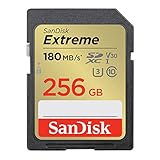
The SanDisk Extreme offers 256GB, UHS-I, and V30 in a card with a 4.7 rating from 21.7k+ reviews. Its stated 130MB/s write speed and 180MB/s read speed make it a credible general-purpose SDXC card for the R8.
It supports 4K UHD and sequential bursts, with the same basic U3/V30 combination that photographers recognize on many cameras. I like its simple fit for a shooter who needs roomy storage without seeking the faster UHS-II bus.
For the Canon R8, the important boundary remains video mode rather than brand name. The V30 badge sets the minimum sustained level, so I would not select this one as my main card for demanding 4K 60fps sessions.
The best fit is a 4K-light photographer who needs 256GB
This card makes sense for day trips, portraits, and general photography with intermittent video. The listed water, temperature, and X-ray resistance helps when cards are moved between bag, reader, and camera.
The sensible upgrade is UHS-II V60 for faster workflow headroom
A faster card is warranted when you frequently empty the R8 buffer or make higher-demand video a core part of the job. The Lexar Silver Pro and PNY EliteX-PRO60 supply that V60 floor.
4. ProGrade Digital Iridium V90 is the specialist sustained-write choice
Pros
- V90 class
- 200MB/s write
- 300MB/s read
- 100 percent card testing
- 3-year warranty
Cons
- 128GB capacity
- more speed than most R8 modes need
The ProGrade Digital Iridium is a 128GB UHS-II V90 card with stated 300MB/s read and 200MB/s write performance. It carries a 4.8 rating from 2.7k+ reviews, a three-year warranty, and the manufacturer’s claim of 100 percent card testing.
V90 guarantees at least 90MB/s sustained writing, so this card brings more continuous-write margin than a V60 card. I would view that headroom as useful for a shooter who values a strong buffer recovery margin, even though the R8’s stated maximum 340 Mbps video bitrate does not require V90.
ProGrade also lists serialized component and manufacturing tracking plus Refresh Pro support. Those claims speak to a workflow-focused product rather than merely a high peak-speed label.
The best fit is a demanding shooter who prefers V90 assurance
I would choose this card for intense burst sequences, frequent offloads, and an established V90 workflow across several cameras. Its Canon compatibility is explicitly listed by the manufacturer.
The more proportionate choice is V60 for ordinary R8 video
V60 remains enough for the R8’s recorded bitrate and 4K 60fps use according to the research supplied for this guide. Pick V90 for extra margin and workflow preference, not because it is mandatory for every R8 owner.
5. Lexar Professional Silver Pro V60 is the balanced 128GB UHS-II pick
Pros
- V60 class
- 280MB/s read
- 120MB/s write
- UHS-I backward compatibility
- lifetime limited warranty
Cons
- 128GB capacity
- less write speed than faster V90 cards
Lexar’s 128GB Silver Pro pairs a UHS-II interface with V60 classification, 280MB/s claimed read speed, and 120MB/s claimed write speed. Its 4.8 rating from 1.3k+ reviews and category rank of #7 give it a strong evidence base among the V60 choices.
I would call this the balanced pick for an R8 owner who wants the right video class without moving into a V90 card. It is also backward-compatible at the highest UHS-I speeds, useful if the card occasionally goes into older gear.
Capacity is the deciding question here. One hundred twenty-eight gigabytes is enough for many photo days and planned clips, but a long hybrid shoot benefits from either disciplined offloading or a 256GB version of your preferred class.
The best fit is a planned 4K 60fps creator workflow
I would use it for a day of organized shooting where media is transferred at the end. The V60 guarantee is the point: it matches the R8’s high-demand video use more directly than a V30 label.
The larger-capacity alternative is a 256GB V60 card
The SanDisk Extreme PRO UHS-II V60, PNY EliteX-PRO60, and Lexar 1800x listed here provide 256GB options. That extra space reduces card changes when the R8’s single slot is your only recording destination.
6. SanDisk Extreme PRO 128GB V30 is a fast-read UHS-I alternative
Pros
- 250MB/s read
- 4K UHD V30
- data recovery software
- weather resistance
- lifetime limited warranty
Cons
- V30 class
- 128GB capacity
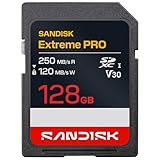
This newer 128GB SanDisk Extreme PRO lists a 250MB/s read figure and V30 rating for 4K UHD video. It has a 4.8 rating from 631 reviews, plus RescuePRO Deluxe data recovery software and a lifetime limited warranty in the supplied specifications.
Its product detail page says 170MB/s write performance is available on 256GB through 1TB capacities, so I would not assume that figure belongs to this 128GB version. That distinction matters: select based on the exact capacity listing rather than applying a product-family maximum to every card.
The card is described as water-, temperature-, dust-, X-ray-, and wearout-proof. Those resilience claims are a welcome bonus for frequent location work, although a protected case is still prudent.
The best fit is a stills-first user who values fast file reads
I would consider this for photography and modest 4K work when 128GB is enough. Fast reading can shorten transfers, but it does not change the V30 minimum sustained video designation.
The better match is V60 if 4K 60fps is non-negotiable
Move to V60 when the R8’s 4K 60fps mode is part of every session. That choice is about recording consistency, not simply chasing the largest published read number.
7. Lexar Professional 2000x V90 is the fastest stated Lexar option here
Pros
- V90 class
- 260MB/s write
- 300MB/s read
- 8K rated
- durability claims
Cons
- 128GB capacity
- V90 is not required for R8
The Lexar Professional 2000x lists 300MB/s read and 260MB/s write speeds alongside its UHS-II V90 rating. It has a 4.8 rating from 2.6k+ reviews and is specified for cinema-quality video, including 8K-capable workflows that go beyond the R8.
For the Canon body, its value is speed reserve: a 90MB/s minimum sustained class and high stated write performance can support rapid buffer clearing. It remains backward-compatible with UHS-I devices, though only at UHS-I speeds in those devices.
Lexar also specifies temperature, vibration, X-ray, and drop protection with a limited lifetime warranty. I would keep the distinction clear between those manufacturer claims and the protection a proper card wallet provides in daily transport.
The best fit is a photographer who also owns higher-demand cameras
I would select this model if the card needs to move between the R8 and cameras that genuinely benefit from V90 media. Its strong claimed write speed also appeals to burst-heavy work.
The leaner choice is V60 for an R8-only kit
A V60 UHS-II card provides the sustained performance the R8 needs for its listed 4K data rate. The Silver Pro, PNY, and SanDisk V60 choices preserve the useful UHS-II interface without V90 overcapacity.
8. Gigastone 256GB V30 is the basic long-storage UHS-I card
Pros
- 256GB capacity
- V30 4K support
- mini case
- 5-year warranty
- durability claims
Cons
- 100MB/s transfer
- UHS-I V30 limit
Gigastone’s 256GB card is a UHS-I A1 V30 SDXC option with a stated transfer speed up to 100MB/s. It holds a 4.7 rating from 2.6k+ reviews, comes with a mini case, and has a five-year limited manufacturer warranty.
I would see it as the uncomplicated capacity-first entry in this roundup. The A1 classification relates to application performance, which does not add a meaningful advantage for the R8, while the V30 marking is the relevant recording specification.
The manufacturer lists water, temperature, X-ray, shock, and magnetic resistance. Its lower transfer claim versus the UHS-II cards means offloads and buffer recovery are not its strongest reason to buy.
The best fit is a casual photo and short-clip workflow
This is the kind of card I would reserve for travel photos, social clips, and backup capacity. The included case is practical, because a single tiny card is easy to misplace when the R8 offers only one slot.
The stronger option is V60 for sustained 4K 60fps work
Do not interpret 4K compatibility as proof that every 4K setting is equally appropriate. For the R8’s 4K 60fps setting, the research recommends a V60 minimum.
9. PNY EliteX-PRO60 V60 is the 256GB speed-focused alternative
Pros
- V60 class
- 180MB/s write
- 280MB/s read
- 256GB capacity
- durability claims
Cons
- Less community history than top picks
- V60 not V90
The PNY EliteX-PRO60 is a 256GB UHS-II V60 card with stated 280MB/s read and 180MB/s write speeds. That write claim is stronger than the listed 120MB/s of the Lexar Silver Pro, while its 4.7 rating is based on 1.3k+ reviews.
Its V60 rating is the key compatibility feature for Canon R8 4K work, and PNY explicitly positions it for mirrorless cameras, burst photography, and 4K UHD. I would put it on the shortlist for an owner who wants roomy capacity and a published 180MB/s write specification.
PNY lists magnetic, shock, temperature, and water resistance, along with a limited lifetime warranty. Like every UHS-II entry, it remains compatible with UHS-I devices at UHS-I speeds.
The best fit is a high-volume R8 hybrid shooter
I would choose this card for long days that mix stills, 4K video, and large batches of files. The combination of 256GB and V60 reduces the two common frustrations: running short of media and choosing a V30 card for demanding video.
The V90 alternative is for extra sustained-write margin
Select a V90 card if you have a specific need for 90MB/s minimum sustained writing or use multiple demanding camera bodies. The R8 does not require V90 simply to access its 4K 60fps mode.
10. SanDisk Extreme PRO UHS-II V90 is the maximum-headroom 256GB option
Pros
- 300MB/s write
- V90 class
- 256GB capacity
- IP68 rating
- 6-meter drop claim
Cons
- More performance than R8 needs
- limited review history
This 256GB SanDisk Extreme PRO is the most aggressive specification in the list: UHS-II, V90, and stated 300MB/s read and write speeds. It is rated 4.7 from 982 reviews and includes a lifetime limited manufacturer warranty.
SanDisk specifies IP68 water and dust resistance, drop resistance up to 6 meters, and two years of RescuePRO Deluxe data recovery software. It also states up to 352 minutes of 4K UHD at 60fps for this capacity, though actual R8 recording time will vary by selected mode and camera settings.
I would consider this a capability-first card rather than a necessity-first Canon R8 choice. The V90 floor and symmetric 300MB/s claims give the most headroom among the 256GB products supplied here.
The best fit is a demanding multi-camera video workflow
This card fits someone who wants a 256GB V90 card for the R8 and other bodies that place greater demands on media. Its ruggedness claims may also matter to outdoor shooters who work in rough conditions.
The practical alternative is a V60 card for R8-only recording
For the R8’s stated 340 Mbps maximum rate, V60 already offers a 60MB/s minimum write specification above the approximate 42.5MB/s data rate. That makes V60 the more proportionate class for most owners.
11. Lexar Professional 1800x V60 is the flexible-capacity UHS-II choice
Pros
- V60 class
- 256GB capacity
- 180MB/s write
- temperature range
- multiple capacity options
Cons
- One-year warranty
- reported write variation
The 256GB Lexar Professional 1800x is a UHS-II V60 SDXC card with stated 270MB/s read and 180MB/s write speeds. Its 4.6 rating comes from 370 reviews, so I would weigh the smaller review base alongside its strong on-paper specifications.
Lexar says this series is available from 64GB through 1TB and designed to operate from 32°F to 158°F. That capacity range is useful if you want one card family across a small R8 kit, although this reviewed listing is the 256GB model.
Review feedback mentions that some users report lower write speeds than advertised, so I would treat the V60 rating as the dependable baseline and peak write figures as a best-case claim. Its listed warranty is one year, shorter than several competitors here.
The best fit is a shooter who wants 256GB V60 storage
I would consider this one for 4K and burst shooting when the UHS-II V60 combination is the priority. Its stated operating-temperature range can matter for work in cold or hot environments.
The better choice is a longer-warranty card for extra reassurance
Warranty terms are part of the decision when one card carries every file from a day’s work. The SanDisk and Lexar Silver Pro listings state lifetime limited coverage, while ProGrade lists three years.
12. Lexar Armor Silver Pro V60 is the toughest stated 128GB design
Pros
- Stainless steel body
- IP68 rating
- 5-meter drop claim
- V60 class
- lifetime limited warranty
Cons
- 120MB/s write
- 44-review sample
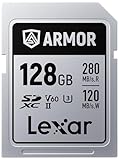
The Lexar Armor Silver Pro is a 128GB UHS-II V60 card distinguished by a stainless-steel construction that Lexar claims is 37 times stronger than typical SD cards. It is also stated to be IP68 dust- and water-resistant and drop-resistant to 5 meters.
I like the physical-design angle for travel and outdoor use, especially because this model omits the usual write-protection switch and surface ribs. Its stated write speed is 120MB/s and read speed reaches up to 280MB/s with a USB 3.2 card reader.
The trade-off is limited feedback volume: the supplied listing has 44 reviews and a 4.5 rating. The V60 class still makes it technically appropriate for the R8’s high-demand video modes, but I would not treat a tough shell as a replacement for keeping a backup card.
The best fit is an outdoor shooter who values physical resilience
I would pick the Armor Silver Pro for a kit exposed to weather, rough bags, or frequent handling. Its V60 rating and UHS-II interface mean the rugged construction does not require a speed compromise for the R8.
The higher-capacity choice is better for long sessions
One hundred twenty-eight gigabytes can be plenty for a controlled shoot, but 256GB gives more breathing room for full-frame RAW sequences and lengthy 4K sessions. Choose capacity around your offloading habits, not just a theoretical record-time estimate.
The right Canon R8 card depends on video mode, capacity, and workflow
The direct answer is that a UHS-II SDXC V60 card is the sensible default for the Canon EOS R8. It meets the 4K 60fps recommendation from the research, provides a 60MB/s minimum sustained write rate, and helps a one-slot camera recover from large bursts more comfortably than many UHS-I options.
V60 is enough for the Canon R8 because its stated bitrate is lower
The R8 records at up to 340 Mbps, or about 42.5MB/s, while V60 guarantees 60MB/s sustained writing. A V30 card may suit photos and lighter video, but it has less margin and is not the recommended baseline for 4K 60fps.
V90 guarantees 90MB/s and brings additional write reserve, not a required recording mode the R8 otherwise cannot access. I would reserve V90 for heavy buffer use, a multi-camera kit, or a personal preference for maximum card headroom.
UHS-II is preferable because it improves the single-slot workflow
The R8 accepts UHS-I and UHS-II SD cards, but UHS-II cards can communicate through their extra contacts and offer faster potential transfers. A card still needs a compatible reader to realize its advertised offload speed, so a slow reader can erase much of that advantage at the computer.
Peak read speed affects copying files and peak write speed can help burst recovery, but the V label is the guaranteed sustained video floor. That is why a V60 UHS-II card is a more informative purchase target than a card selected from read speed alone.
SDXC is preferable because it supports capacities above 32GB and exFAT
Every reviewed card above is 128GB or 256GB SDXC media. SDXC typically uses exFAT, while SDHC uses FAT32; FAT32 has a 4GB maximum file size that can split long video into separate files.
Use the R8’s in-camera format command before a major shoot after you have copied and checked any files elsewhere. Formatting in the camera sets up the file system the body expects, while formatting on a computer can introduce an unsuitable format or leave compatibility questions behind.
A 128GB card suits planned sessions while 256GB gives breathing room
Capacity is not a speed rating, but it changes how safely you can work with the R8’s lone card slot. I would choose 128GB for a controlled photo session or short video project and 256GB for travel, events, longer clips, or a preference to avoid card swaps.
Record-time claims are always conditional on codec, frame rate, scene detail, audio, and camera settings. Check remaining time in the R8 before a long take instead of relying on a capacity estimate from a different camera or mode.
Fast burst shooting benefits from sustained writing and clear buffer habits
The EOS R8 can shoot at up to 40fps using its electronic shutter, so a fast sequence can fill the buffer in seconds. A UHS-II V60 or V90 card is a prudent choice when action photography is a regular assignment, although it cannot change the camera’s internal buffer size.
Let the access light finish its work before opening the card door, and pause after long bursts when you can. Those habits reduce the chance of interrupting writes, which matters more on a camera with no second slot for redundant recording.
Trusted sourcing and a backup card reduce avoidable card failures
Forum participants repeatedly recommend established brands and reputable sellers because counterfeit cards can report false capacity or unstable performance. Test a new card during a low-stakes shoot before taking it on travel, paid work, or an important family event.
I also keep a second formatted card in a protective case, even when the primary card is high capacity. No warranty or protection rating restores a missed recording opportunity, and a backup card is the simplest response to the R8’s single-slot design.
Common Canon R8 memory card questions have direct answers
What is the best SD card for Canon R8 according to Reddit discussions?
Forum discussions commonly call a UHS-II V60 SDXC card the sweet spot for the Canon R8. A V30 card can work for stills and lighter video, while V60 is the recommended minimum for 4K 60fps. Among the supplied products, the SanDisk Extreme PRO UHS-II V60, Lexar Silver Pro V60, and PNY EliteX-PRO60 match that profile.
Is V60 enough for a Canon R8?
Yes. V60 is enough for the Canon R8 because it guarantees 60MB/s sustained writing, while the camera records at up to 340 Mbps, about 42.5MB/s. V60 is the preferred class for 4K 60fps and provides more margin than V30. V90 is optional extra headroom rather than a requirement for normal R8 recording.
What SD card does Canon recommend for the R8?
The Canon R8 uses one full-size SD card slot and supports UHS-II SD cards as well as UHS-I cards. For the camera’s more demanding video and burst workflow, choose an SDXC UHS-II card with a V60 or V90 video speed class. Format the card in the camera before important recording sessions.
What SD cards do professional photographers use with the Canon R8?
Photographers who shoot demanding bursts or hybrid jobs commonly choose UHS-II V60 or V90 SDXC cards from established brands such as SanDisk, Lexar, ProGrade, and PNY. The right choice depends on required capacity, sustained video class, claimed write performance, warranty, and whether the card will also be used in higher-demand camera bodies.
The best memory cards for Canon R8 balance V60 speed with your capacity needs
Choose the SanDisk Extreme PRO UHS-II V60 for the strongest all-round 256GB recommendation, the Lexar Silver Pro V60 for a focused 128GB UHS-II choice, or the PNY EliteX-PRO60 when a stated 180MB/s write figure and 256GB suit your workflow. Pick V30 only when you understand its lighter video role, and use V90 when its extra sustained-write margin fits work beyond the R8.
The right move in 2026 is to match the card to the recording mode you actually use, format it in the R8, and carry a tested spare. That approach makes choosing among the best memory cards for Canon R8 far simpler than comparing peak-speed labels in isolation.