
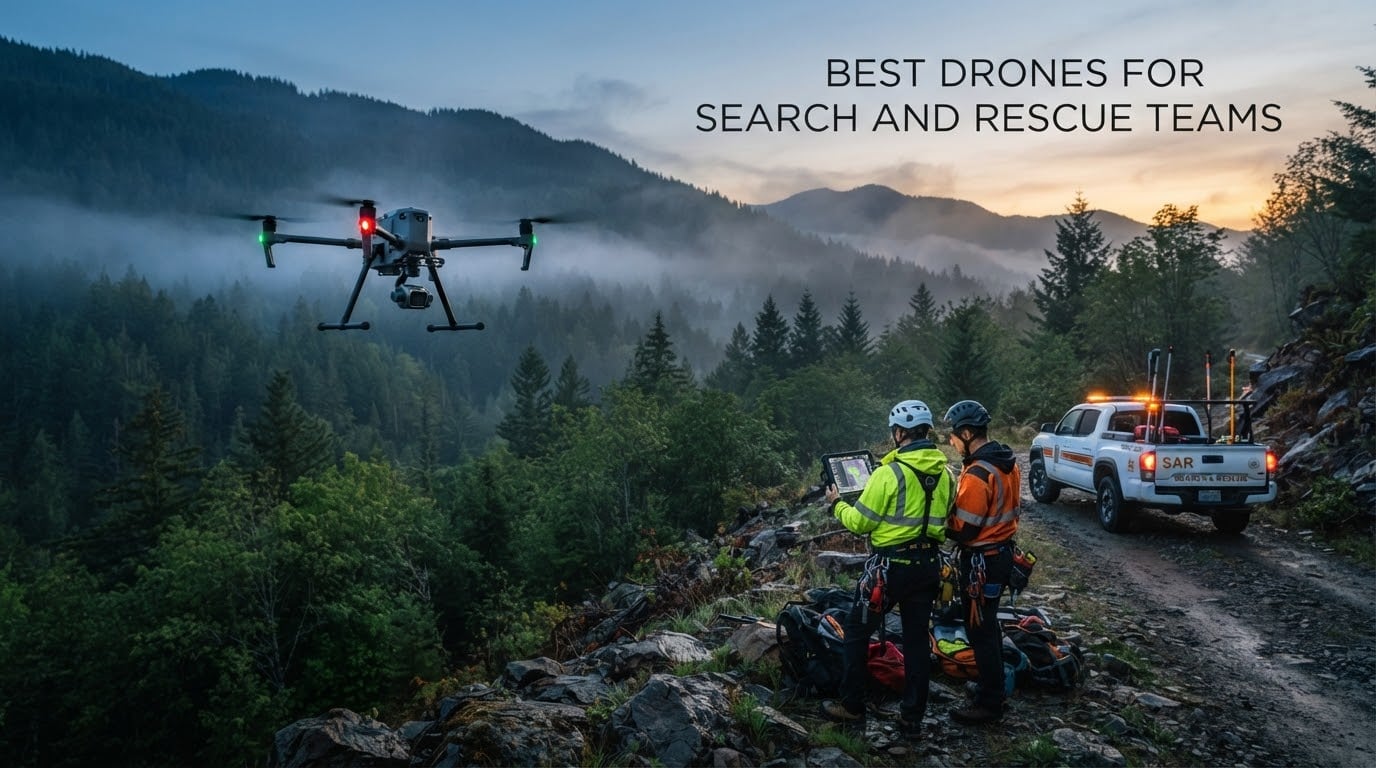
The best drones for search and rescue teams are not the ones with the longest spec sheet. They are the aircraft that launch in under a minute from a truck tailgate, hold a readable picture in low light, run a grid pattern over a hillside without a pilot babysitting every turn, and hand ground teams a coordinate instead of a guess.
Our team works through thermal-capable airframes the way a mission lead thinks: by night capability, by how the crew reads the image, by whether the airframe survives a wet hillside, and by what a complete kit costs once batteries, charging and training are counted. That last point matters more than most roundups admit. Communities on our search and rescue drone guide consistently underestimate the cost of a working kit by pricing only the airframe.
Four buyer types show up in almost every inquiry we get. Volunteer teams want one aircraft a coordinator can carry to a trailhead and fly on a weekend budget. County sheriff and ranger offices want incident overwatch and short-range missing person work. Fire and emergency management departments want thermal in rain. State wildland and disaster programs want payload capacity and a platform that works for a full rotation. Our picks below are segmented the same way, because one winner does not fit all five mission classes.
We also want to be straight about the evidence. The enterprise thermal category is thin on published owner feedback, and several platforms in this roundup carry only a handful of reviews. Where that is the case, we say so plainly instead of dressing a spec sheet up as a field test. If you want a second read on the same airframes from a recreational angle, our broader drone buying guide covers the consumer side of the market.
Top 3 Picks for Best Drones for Search and Rescue Teams in 2026

Autel EVO II Dual 640T V3
- 640x512 thermal at 30 fps with 13mm lens
- 50MP RYYB visible camera
- 38 minute flight time
- 15 km SkyLink 2.0 transmission
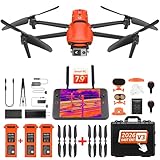
Autel EVO II Dual 640T Enterprise V3
- Same 640x512 thermal core as our top pick
- 42 minute endurance
- Strobe and loudspeaker payloads in the box
- 7.9 inch controller at 2000 nits
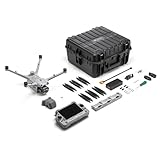
DJI Matrice 4TD
- IP55 weatherproofing for rain and freezing conditions
- Triple lens array with thermal and NIR auxiliary light
- Built in laser range finder
- Anti-ice propellers for cold weather
Two of these three are the same thermal core in different airframes, and that is not a coincidence. The 640×512 uncooled microbolometer is the practical baseline for a search crew, so the decision between the two is really a decision about endurance and payloads versus size. The Matrice 4TD earns its place for a different reason entirely: it is the only airframe here rated IP55, and rain, sleet and cold are common on the calls that matter most.
The Six Best Drones for Search and Rescue Teams in October
| Product | Specifications | Action |
|---|---|---|
| Autel EVO II Dual 640T V3 |
|
Check Latest Price |
| Autel EVO II Dual 640T Enterprise V3 |
|
Check Latest Price |
| DJI Matrice 4TD |
|
Check Latest Price |
 Autel EVO MAX 4N V2 Autel EVO MAX 4N V2 |
|
Check Latest Price |
 Autel EVO Max 4T V2 Autel EVO Max 4T V2 |
|
Check Latest Price |
 Autel EVO Lite 640T Enterprise Autel EVO Lite 640T Enterprise |
|
Check Latest Price |
Two entries deserve a note before the profiles. The EVO II Dual 640T V3 and the EVO II Dual 640T Enterprise V3 share a thermal sensor, so treat them as one imaging decision wearing two airframes. The EVO Max 4T V2 and the EVO MAX 4N V2 are different machines with confusingly similar names: the 4T leads on zoom, the 4N leads on starlight night vision.
What Types of Drones Are Used for Search and Rescue?
Search and rescue teams fly five broad categories of aircraft, and the right category follows the mission rather than the budget.
Portable thermal first response. Lightweight thermal airframes that one pilot can launch from a vehicle in under a minute. This is the category most volunteer teams and small departments should start in.
Compact enterprise thermal. Larger carbon fiber platforms with longer endurance, brighter controllers and modular payloads such as a spotlight, strobe or loudspeaker. Built for full rotations and repeat sorties.
Rugged all-weather airframes. Higher ingress protection ratings and cold-weather hardware for teams that fly in rain, snow and freezing conditions without waiting for weather to pass.
Multi-sensor night platforms. Aircraft combining thermal, starlight night vision, a zoom camera and a laser rangefinder, so a crew can work an unlit shoreline or forest at night with more than one way to see.
Autonomy and networked platforms. Aircraft with mesh networking, anti-jamming and GNSS-denied navigation, aimed at teams building toward beyond visual line of sight operations and multi-aircraft searches.
A search and rescue drone is simply an unmanned aircraft used to detect a missing person’s heat signature, narrow the search area, and give ground teams a confirmed location faster than a visual sweep alone. The drone flies a systematic grid pattern, the thermal camera finds heat contrast anomalies, the visible zoom camera confirms whether the contact is a person rather than a rock or a recently parked vehicle, and the range finder measures the distance so ground teams can navigate straight to it.
1. Autel EVO II Dual 640T V3 – The Most Proven All-Rounder
Pros
- Largest published owner base in the enterprise thermal class
- 360 degree obstacle avoidance across 19 sensor groups
- D-RI ranges for detection recognition and identification
- 15 km tri-band transmission with automatic hopping
- Free infrared thermal analysis tool for post-mission work
Cons
- No modular payload support on this non-Enterprise build
- One owner reported thermal sensor failure before a year from water damage
- Extended coverage is a costly add-on with terms reviewers call unreliable
This is the airframe we send a team to when the brief is a missing person report at dusk and nobody knows the terrain yet. The thermal core is a 640×512 sensor running at 30 fps behind a 13mm lens with 16x digital zoom, and the visible side is a 50MP 0.8 inch RYYB CMOS with 4x lossless zoom. That pairing matters more than the resolution numbers suggest, because the visible camera is what turns a thermal contact into a confirmed person.
Owners consistently report stable, quiet and responsive flight with the 360 degree obstacle avoidance behaving as advertised, and several describe landing accuracy of roughly two feet. The published 38 minute flight time has held up in real use for at least one buyer, and the 15 km SkyLink 2.0 link hops automatically across three bands, which is what keeps the picture stable when you are working a canyon or a crowded festival site.

The ten thermal palettes, spot and regional and central temperature measurement, and a temperature alarm with isotherm are the features that get used most on a real call. For a search crew the D-RI ranges matter most: detection and recognition and identification give an interpreter a consistent vocabulary for telling incident command how confident they are before ground teams are committed to a location.

Where the EVO II Dual 640T V3 earns its place
This is the pick for a team that flies in mixed conditions and wants one aircraft that handles an open meadow, a treeline and a parking structure without a payload change. The 50MP visible camera gives you documentation and scene assessment, not just detection, which is exactly what an incident commander wants when a call turns into a report.
Autel’s after-sales responsiveness comes up repeatedly in owner feedback, and the free thermal analysis tool means a volunteer coordinator can pull temperature data off recorded frames the night of a call instead of the following week.
Where the EVO II Dual 640T V3 falls short
Two limits deserve a place in your budget conversation. This is the non-Enterprise build, so there is no modular accessory support, and buyers say some wish they had known that before ordering.
One owner reported the thermal sensor stopped working before a year, with the maker attributing it to water damage and declining repair. Another flagged a cracked camera-cover vent on the case. With a rating of 4 across 53 reviews, this is a solid workhorse rather than an flawless one, and a team in a wet climate should budget for a spare airframe or a second battery set.
2. Autel EVO II Dual 640T Enterprise V3 – Most Versatile with Payloads in the Box
Pros
- 42 minute endurance from larger propellers and longer arms
- Strobe and spotlight and loudspeaker payloads included
- 7.9 inch controller readable in direct sun
- Enterprise app with D-RI subject identification
- Operates from -10 to 40 degrees C
Cons
- RTK module is an optional add-on not included in the bundle
- Only 11 published reviews so long-term field history is thin
Take the same 640×512 thermal sensor and put it in a reinforced carbon fiber enterprise airframe with larger propellers and longer arms, and you get 42 minutes of flight time instead of 38. That four-minute gain is not a marketing number for a search crew. It is the difference between completing a second grid pass before the battery forces a land-and-swap and losing the pattern.
The payload bundle is the real differentiator. This listing includes a modular strobe, a spotlight and a loudspeaker, which means one aircraft can illuminate a scene at night, signal to a subject on a shoreline or ridge, and make announcements at an incident scene without a second vehicle carrying accessories. The 7.9 inch touch controller runs at roughly four times typical mobile device brightness, and on a bright hillside that difference decides whether your interpreter can read the screen without a hood over it.
The thermal measurement modes match the rest of the family: spot, regional, central, temperature alarm, isotherm and image enhancement, with D-RI ranges through the enterprise app. Operating temperature is listed from -10 to 40 degrees C, which covers most of the year in temperate climates but is worth checking against your local winter conditions.
Who should buy the Enterprise V3 over the standard V3
Departments that run repeat sorties, work incident overwatch at night, or need to address a subject verbally without landing should look here first. The loudspeaker and spotlight turn it from a sensor platform into a communications platform, and that changes what a single aircraft can accomplish on a shoreline or a collapsed structure call.
Bright outdoor readability and the longer endurance also make this the more comfortable airframe for a two-pilot rotation, where one person flies the grid and the other reads the thermal feed.
Where the Enterprise V3 falls short
RTK positioning is supported but not included, so teams that need survey-grade accuracy for mapping or evidence have a second purchase to plan for. With 11 published reviews averaging 4.8 stars and no one-star ratings at all, the enthusiasm is genuine but the sample is small.
Treat this as a well-specified airframe with limited long-term field history rather than a proven fleet workhorse. If your program depends on reliability data, ask the dealer for fleet references in your own climate.
3. DJI Matrice 4TD – The All-Weather Pick for Rain, Snow and Cold
DJI Matrice 4TD Quadcopter with RC Plus 2 Enterprise, Thermal, Wide & Tele Lenses, Laser Range Finder, Low-Noise Anti-Ice Propellers, IP55
Pros
- IP55 rating for rain dust and freezing conditions
- Anti-ice propellers built for cold weather flights
- Laser range finder built into the airframe
- Reviewer read a water tower from 10 miles away
- Battery held about 35 minutes per pack in 20 mph wind
Cons
- A very small published review base so field history is limited
- An attached spotlight can trigger object detection warnings
- DJI Care is not currently available in the US
Weather is the single biggest reason a search crew grounds a perfectly good aircraft. This is the only platform in our roundup with a published IP55 ingress rating, paired with low-noise anti-ice propellers, which is a deliberate design choice for cold-weather and wet-weather deployment rather than a marketing label.
What practitioners on r/searchandrescue consistently say is that the Matrice 4T generation is the current benchmark, and that teams operating in variable weather should step up to the weatherproofed variant. That forum consensus, the imagery package and the all-weather specification line up with our own read, and it is why this aircraft takes the third slot even though only two reviews are published.
The triple lens array combines a high-resolution thermal sensor with a NIR auxiliary light for night work, and the built-in laser range finder gives you target distance without a separate accessory. A published reviewer reports reading a water tower from 10 miles away, and another measured roughly 35 minutes of flight per pack in 20 mph wind with 30 mph gusts, which is the kind of number that tells you the airframe is not simply quoting a lab figure.
When the Matrice 4TD is the right buy
Coastal, mountain and northern teams should start here. IP55 means a steady drizzle or a wet launch site no longer grounds the sortie, and the anti-ice propellers address the other common limit, which is performance in freezing air rather than in rain.
It also fits a program that wants room to grow. Dock 3 compatibility and FlightHub 2 integration mean an agency can move toward automated, remotely operated drone programs later without changing airframe.
When the Matrice 4TD is the wrong buy
If your calls are almost entirely daylight, urban and short-range, you are paying for weather capability you may use a handful of times a year. The same money in a lighter platform buys more batteries and more flight hours.
Two practical warnings. An attached spotlight can interfere with front and side object detection and trigger warnings in flight, so confirm your payload combination in the field.
4. Autel EVO MAX 4N V2 – The Pick for Unlit Night Searches
Pros
- Starlight camera detects light sources 5 km or more in dark open areas
- Laser rangefinder to 1200 m with 1 m accuracy
- A-Mesh networking for multi-aircraft and relay operations
- ABX41-D battery supports hot-swapping
- Anti-jamming plus GPS spoofing countermeasures
Cons
- Only 3 published reviews so reliability and support quality are not well documented
- Sits at the premium end of the enterprise thermal class
- Starlight camera is a 2.3MP sensor so it is a supplement not a replacement
Thermal is the sensor that finds people. Starlight night vision is the sensor that gives your crew enough context to understand what they found. The EVO MAX 4N V2 carries a 0.0001 lux starlight camera that detects light sources 5 km or more in dark open environments and sees through glass obstructions, alongside the 640×512 thermal module, a 50MP wide camera and a laser rangefinder reaching 1200 m.
That four-in-one package changes night operations. On an unlit shoreline or a forest at 2am, a crew that only has thermal is reading shapes and guessing. A starlight feed gives the interpreter a real image to compare against, which cuts the false positives that waste a ground team’s night.
The airframe also carries the most ambitious communications and autonomy package in this roundup. SkyLink 3.0 runs four frequency bands across six antennas with AES-256 encryption and up to 20 km transmission, A-Mesh 1.0 handles drone to drone networking for relay and multi-aircraft collaboration, and the anti-jamming modules cover RF and EMI interference plus GPS spoofing. The ABX41-D battery supports hot-swapping with in-place detection, so a fresh pack goes in without a power cycle.
Who this airframe is built for
Teams running night searches where the area has no ambient light, urban searches where a subject may be behind a window, and programs moving toward multi-aircraft or relay operations. The 7.9 inch 2000-nit controller is easy to read at night, and the -20 to 50 degrees C operating range covers serious winter work.
For a team that has already proven its thermal workflow and now needs to fly darker, this is the natural next step rather than the natural first purchase.
Where the 4N falls short
Three published reviews, all five star, is not a reliability record. Owners praise the night vision and zoom quality and one pilot compares it favorably to DJI platforms on controller feel, but long-term support quality is essentially undocumented, so you are buying largely on published specifications.
It also sits at the premium end of the enterprise thermal class, and the starlight camera is a 2.3MP sensor. Use it to give context to a thermal contact, not as your primary confirmation sensor.
5. Autel EVO Max 4T V2 – The Zoom Confirmation Workhorse
Pros
- 48MP zoom camera with 10x optical and up to 160x hybrid zoom
- 720 degree obstacle avoidance detecting 0.5 inch obstacles
- AES-256 local storage and AES-128 transmission encryption for case data
- Triple-screen visible thermal and map display
- 42 minute flight time with IP43 protection
Cons
- Only 1 published review so there is no independent long-term reliability history
- RTK and spotlight and speaker payloads are sold separately
- IP43 protection is lighter than an IP55 airframe in wet conditions
Here is the argument for zoom: a search crew does not just need to detect a person, it needs to confirm one. A thermal contact on a boulder sunlit at noon, a deer bed, or the exhaust stack of an idling vehicle will all look like a body at range. The 48MP zoom camera with 10x optical and up to 160x hybrid zoom is what lets an interpreter clear a false positive from a helicopter’s altitude instead of sending a team to walk it out.
The single published review on this airframe comes from a field user and credits exactly that combination, reporting that the thermal camera reliably surfaces subjects not obvious to the naked eye and that the zoom is used to confirm detail. The same reviewer praises the obstacle avoidance around buildings and trees and the 42 minute endurance on longer outdoor jobs, and notes the features work together in practice rather than only on the spec sheet.
Two details matter for a public safety buyer beyond the sensor. Data is protected with AES-256 local storage and AES-128 transmission encryption, which matters when imagery becomes evidence, and the triple-screen display shows visible, thermal and map simultaneously, so a pilot and an interpreter can work the same feed without stepping on each other.
Where the EVO Max 4T V2 fits
This is the aircraft for a crew whose problem is confirmation rather than detection. Ridge searches, a large open field with heavy sun, and vehicle or structure searches all benefit from the reach of a 160x hybrid zoom, because each cleared false positive saves a ground team an hour of walking.
The anti-interference suite detects RC interference, GNSS jamming and GNSS spoofing, and the A-Mesh networking supports one controller for multiple aircraft with master-slave dual control, which makes it workable for a team building toward multi-aircraft search.
Where the EVO Max 4T V2 falls short
With one published review, durability and long-term support experience are simply unknown. The listing itself is strong; the field history is not there yet, so plan for a spare airframe if this becomes a program asset rather than a second aircraft.
RTK, the spotlight and the speaker are all separate purchases, and the IP43 rating is a step down from a weatherproofed airframe in sustained rain. If your operations are wet-weather heavy, weigh this against the Matrice 4TD before you commit.
6. Autel EVO Lite 640T Enterprise – Best Value for Solo and Volunteer Teams
Pros
- 866 g airframe one pilot can carry and deploy from a vehicle
- Same 640x512 thermal core as the higher tier EVO II Dual
- AI target recognition plots people and vehicles directly onto the map
- 40 minute flight time with 12 m/s wind resistance
- Three batteries and four propeller pairs plus a rugged case included
Cons
- 6 inch controller at 800 nits is smaller and dimmer than the 7.9 inch enterprise screens
- 12 km transmission is shorter than the 15 to 20 km airframes in this class
- Only 2 published reviews so long-term durability is not documented
This is the airframe we recommend when the question is what a volunteer team or a solo coordinator should buy first. At 866 g it is a genuinely portable aircraft, and portability is the operational variable that decides whether your drone gets flown on a Saturday call or stays in a case in a closet.
Critically, it carries the same 640×512 thermal core as the higher tier EVO II Dual 640T family, with a 9mm lens at 30 fps and 16x digital zoom. Paired with a 48MP 1/2 inch CMOS visible camera on a three-axis stabilised gimbal, that gives a small team detection plus confirmation without moving up an airframe class.
The feature that surprises people is in the software. The Autel Enterprise app carries AI target recognition and positioning that automatically detects and plots people, vehicles and boats onto the map. For a volunteer team with no dedicated sensor operator, that removes a meaningful amount of screen work during a search, and it is a genuine advantage over a bare thermal airframe at the same sensor resolution.
Why this is the volunteer team pick
The bundle includes three batteries, four propeller pairs and a rugged case, which is exactly the starter kit configuration that gets described in community threads about what a first SAR drone purchase should contain. One aircraft, three packs and a charging solution in the box means a team can fly a real multi-sortie call on day one.
Forty minutes of flight time, 17 m/s max speed and 12 m/s wind resistance are real field numbers rather than marketing figures, and 12 km of SkyLink 2.0 transmission with automatic channel selection gives a pilot room to work a large grid without losing the feed.
Where the EVO Lite 640T falls short
The controller is the compromise. A 6 inch screen at 800 nits is smaller and dimmer than the 7.9 inch enterprise controllers, and an interpreter squinting at a dim display during a long night search is a real, underappreciated problem. Bring a hood or a sun shade if you can.
Transmission range is also shorter than the 15 to 20 km airframes in this class, so very large areas need closer range discipline. With two published reviews, long-term durability remains undocumented, which is another reason to buy a spare battery set rather than a second airframe.
How to Choose a Search and Rescue Drone in 2026
Start with the mission, not the spec sheet. Write down your three most common call types and the conditions in which you fly them. A team that mostly works missing person reports in open terrain at dusk has completely different requirements from a flood response unit working a river corridor in rain at night, and the same airframe will not be optimal for both.
Understand what thermal sensitivity actually means
A SAR thermal drone is a quadcopter carrying an uncooled microbolometer sensor that reads heat contrast between a subject and its background. NETD, the net equivalent temperature difference, describes how small a temperature change the sensor can register against a dark scene, expressed in millikelvins. A lower number means finer sensitivity, which is what lets you pick a person out of dark woodland rather than only off an open field at a distance.
Radiometric capability is the second term you will meet. A radiometric sensor records actual temperature values at measured points, so a spot, regional or central measurement can be logged and attached to a case file. For a search crew, that turns a vague anomaly into a documented reading.
640 x 512 is the practical baseline in this category and it is what every platform in our roundup carries. What separates them is the lens, the zoom, the palette tools and how well the visible camera confirms the contact. Buyers routinely over-spend chasing resolution they cannot use and under-spend on the workflow around the sensor.
Make sure you can confirm, not just detect
Detection is finding a heat anomaly. Identification is knowing it is a person. A crew that cannot clear a false positive from a sun-warmed rock, an animal or an idling vehicle will burn ground-team hours chasing nothing, and that is the most expensive failure mode in search work.
Look for a strong optical or hybrid zoom on the visible camera, a picture-in-picture mode that keeps the thermal and visible frames at the same magnification, and D-RI ranges so your interpreter can state a confidence level to incident command. A single published review of the EVO Max 4T V2 describes exactly this workflow, using the zoom to confirm what the thermal camera surfaced.
Check compliance before you fall in love with the airframe
This is the question public safety buyers ask first, and it is worth answering before the purchase order rather than after. Can law enforcement still use DJI drones? The honest answer is that federal law enforcement procurement is restricted by Section 848 of the National Defense Authorization Act, which bars the procurement and use of covered list communications equipment and services, and the current administration has moved to add major drone manufacturers to that list. Fire departments, EMS, volunteer SAR groups and many other non-federal agencies sit in different regulatory positions, and the fastest way to find your own position is to ask your agency counsel directly rather than rely on a roundup.
The second mechanism is Blue sUAS, the Department of Defense’s list of commercially available components and products that the Secretary of Defense has certified as safe to use. If your agency requires a compliant supply chain, verify each platform’s current status directly with the Blue sUAS program and with your contracting officer, because listings change and vendors market compliance loosely.
Practical steps that take an afternoon: check the aircraft’s current Blue sUAS status, confirm whether your jurisdiction is covered by any Section 848 rule, and ask whether your imagery handling needs an air-gapped or encrypted workflow. Of the platforms here, the EVO Max 4T V2 lists AES-256 local storage and AES-128 transmission encryption and the EVO MAX 4N V2 lists AES-256 encryption on its SkyLink 3.0 link, which is useful information for a chain of custody conversation either way.
Budget for the kit, not the aircraft
Community answers about first drone purchases consistently bundle a thermal aircraft, spare batteries, a charger, and a power bank or generator. That is the correct mental model, and it is where most volunteer teams under-budget.
Your real cost components are the airframe, a battery set sized for your longest realistic rotation, a charging solution that works in the field rather than only in a station, a rugged case, pilot training and recurrent certification, insurance, and a spare airframe if your program depends on the aircraft being there every call. Because prices move constantly, compare the complete kit across vendors rather than comparing headline airframe figures, and ask each vendor for the total cost of a three-battery field-ready configuration.
For a small team, the EVO Lite 640T Enterprise’s included three batteries and rugged case is a genuine advantage. For a department running repeat sorties, the 42 minute endurance of the enterprise platforms means fewer swaps per call, which reduces crew fatigue and battery wear over a season.
Think about crew workflow and training
The bottleneck in drone-assisted search is not hardware, it is the people reading the feed. Experienced operators in the drone community put it plainly: you need to learn how to search, and the drone is one tool inside a search system rather than a replacement for ground teams or aviation assets.
Plan a two-person minimum for anything but a daylight visual sweep: one pilot flying the pattern, one sensor operator reading thermal and calling contacts. Decide in advance who writes the coordinates down, who relays them to incident command, and how a ground team confirms receipt. Set the standard that a contact is never dispatched on thermal alone, and practice the confirm-before-you-commit habit until it is automatic.
If your program includes night operations, plan for the additional training and the applicable waiver or authorization requirements before the first night call, not after.
Know when not to launch
The most useful advice in the community is also the least sellable: a drone is not always the right tool. If a manned helicopter is already working the area, adding an aircraft can create an airspace conflict rather than a capability. Weather below your platform’s limits, crew fatigue, an unverified launch site near power lines or an active fire line, and situations where the image chain of custody cannot be maintained are all reasons to hold.
Also be realistic about cold subjects. Thermal detection is strongest when there is heat contrast against the background, so recovery searches for a subject who has been missing for a long time have a lower success rate than a live search. A drone can still contribute, but set expectations with the people waiting at home before you launch.
Finally, plan the integration. The teams that get real value from a SAR drone run it as one branch of a documented search plan, with a handoff from air to ground teams and a clear decision on when the aircraft stops being useful. We covered that workflow in more detail in our search and rescue operations guide.
Frequently Asked Questions
What types of drones are used for search and rescue?
Teams use five broad categories: portable thermal first response aircraft that one pilot can launch from a vehicle, compact enterprise thermal platforms with longer endurance and modular payloads, rugged all-weather airframes with high ingress protection and anti-ice hardware, multi-sensor night platforms combining thermal, starlight night vision, zoom and a laser rangefinder, and autonomy or networked platforms built for mesh networking, anti-jamming and multi-aircraft search. The right category follows the mission type and conditions, not the budget alone.
How much does a search and rescue drone cost?
Prices change constantly, so compare a complete field-ready kit rather than a headline airframe figure. The real cost components are the aircraft, a battery set sized for your longest rotation, field-capable charging, a rugged case, pilot training and recurrent certification, insurance, and ideally a spare airframe. Ask every vendor for the total cost of a three-battery field-ready configuration, and budget for a second aircraft if your program cannot afford a grounded call.
Can law enforcement still use DJI drones?
It depends on your agency and your jurisdiction, and you should not rely on a roundup for the answer. Section 848 of the National Defense Authorization Act restricts federal procurement and use of covered communications equipment and services, and major drone manufacturers have been moved onto the covered list. Fire, EMS and volunteer SAR organizations sit in different positions. Ask your agency counsel and contracting officer, and verify current Blue sUAS certification directly with the program before you buy.
Is 640×512 thermal enough to find a person?
For most search and rescue work, yes. A 640×512 uncooled microbolometer at 30 fps is the practical baseline in the enterprise thermal category, and every platform in this roundup meets it. Sensitivity is only part of the story: the lens, NETD figure, palette tools, and above all the visible zoom camera used to confirm a contact decide how well a crew actually performs. Detection is not identification, so plan the confirm step before dispatching a ground team.
How long does it take to deploy a search and rescue drone?
On a well-rehearsed program, unpack, power up, connect the controller and get airborne takes about a minute, which is the entire argument for a portable airframe. Endurance is the number that matters after launch: the platforms here run 38 to 42 minutes per battery, and hot-swappable battery designs let a fresh pack go in with minimal power cycling. Rehearsal matters more than hardware, so time your team’s own setup before and after a training day.
Which drone is best for security surveillance?
That is a different mission from search and rescue. A search and rescue thermal drone is optimized to detect a heat signature and reduce a search area, while a surveillance platform is built for extended observation, low light monitoring and tracking. For fixed perimeter and campus monitoring, a dedicated surveillance aircraft with longer endurance and low-light imaging is the better tool. Every pick in this roundup can provide incident overwatch, but that is a by-product of their thermal sensors rather than their purpose.
Conclusion
The best drones for search and rescue teams come down to one question: what conditions do you actually fly in? If your calls are dusk and open terrain, the Autel EVO II Dual 640T V3 is the most proven all-rounder, with the largest owner base in the class and a visible camera good enough to document what you find. If you need endurance, payloads and a screen you can read in daylight, step up to the EVO II Dual 640T Enterprise V3. If the weather decides your callouts, the DJI Matrice 4TD is the one built for rain, dust and freezing air. For genuinely unlit night work, the EVO MAX 4N V2 adds starlight vision and a 1200 m rangefinder. When your problem is clearing false positives at distance, the EVO Max 4T V2’s 160x hybrid zoom earns its place. And for a volunteer team or a solo coordinator buying one aircraft, the 866 g EVO Lite 640T Enterprise with three batteries in the box is the honest starting point.
Whichever you choose, budget the kit rather than the airframe, run your compliance questions past agency counsel before the purchase order, and rehearse the crew workflow. A drone reduces the area you have to search and the hours your volunteers spend walking it. In 2026, that is still the biggest lever most teams have not pulled.