
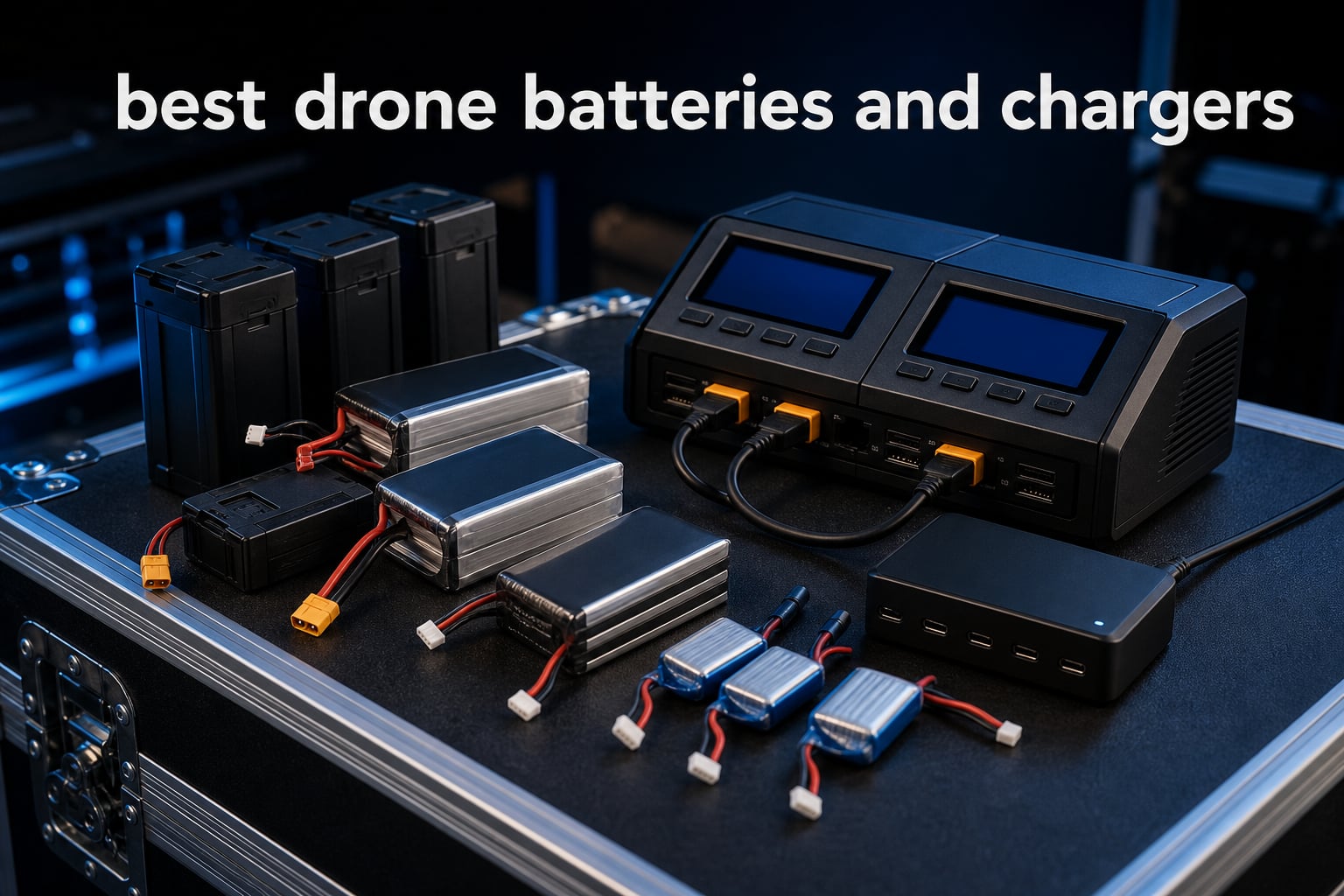
The best drone batteries and chargers are the ones that match your aircraft’s battery chemistry, cell count, connector, and intended flying routine. A fast-looking charger is the wrong buy if it cannot balance your pack, feed your DJI hub, or physically connect to your tiny-whoop batteries.
This guide separates the 12 options by job: high-output balance charging for FPV packs, dedicated DJI Mini hubs, a six-port 1S station, a multi-battery starter kit, and compact USB-C power. I would begin with the compatibility line on your battery label, then narrow the list by how many packs you want ready between flights.
For most LiPo pilots, a balance charger with storage mode is more useful over time than a basic charging lead. Community discussions repeatedly point to slow in-drone charging, uncertain storage levels, and worn packs as everyday frustrations; a charger that can read and manage the right battery type addresses more of those problems.
There is no single “best” battery for every drone. The HOTA D6 Pro stands out for serious multi-chemistry RC and FPV work, the LYONGTECH hub is a focused answer for listed DJI Mini batteries, and the VIFLY WhoopStor V3 is the specialized pick for several 1S packs at once.
The top three drone charging picks fit distinct pilots (September 2026)
Choose the HOTA for 1S–6S hobby packs and AC/DC flexibility, the LYONGTECH for the Mini 4K, Mini 2, Mini 2 SE, or Mini SE battery family, and the VIFLY when your flying bag is mostly 1S tiny-whoop batteries. Their stated specifications solve three very different charging tasks rather than competing as interchangeable products.

These 12 drone batteries and chargers cover the main flight setups in 2026
The table below is a quick compatibility filter, not a replacement for checking the battery label and connector before purchase. DJI-specific hubs are not balance chargers for loose FPV packs, while a 1S board cannot charge a 6S flight pack.
| Product | Specifications | Action |
|---|---|---|
 HOTA D6 Pro Dual Charger HOTA D6 Pro Dual Charger |
|
View on Amazon |
| LYONGTECH DJI Mini Hub |
|
View on Amazon |
 VIFLY WhoopStor V3 VIFLY WhoopStor V3 |
|
View on Amazon |
 OVONIC D15 OVONIC D15 |
|
View on Amazon |
 Hanatora DJI Mini Hub Hanatora DJI Mini Hub |
|
View on Amazon |
 HTRC N2B6V2 HTRC N2B6V2 |
|
View on Amazon |
 SSUPCHG XHR Charger SSUPCHG XHR Charger |
|
View on Amazon |
 YATEOO Mini Battery Kit YATEOO Mini Battery Kit |
|
View on Amazon |
 Zosam 100W GaN Adapter Zosam 100W GaN Adapter |
|
View on Amazon |
 ToolkitRC M8D ToolkitRC M8D |
|
View on Amazon |
 VICMILE 450mAh Set VICMILE 450mAh Set |
|
View on Amazon |
 ISDT 608AC ISDT 608AC |
|
View on Amazon |
The HOTA D6 Pro is the strongest all-round choice for 1S–6S FPV packs
Pros
- Dual AC/DC power
- Wide battery support
- Large IPS screen
- Many protection types
Cons
- Two outputs only
- FPV-style XT60 setup
The HOTA D6 Pro is the broadest fit here for an FPV pilot who owns more than one kind of pack. Its stated support covers 1S–6S lithium battery types plus NiZn, NiCd, NiMH, smart batteries, lead acid, and Eneloop cells, so I would shortlist it before buying separate chargers for different RC gear.
It has two outputs, an AC rating of 200W, a DC rating of 325W, and a stated charge-current range up to 15A. That AC/DC split matters: household power works for home charging, while its 6.5–30V DC input opens a path to a suitable field power source.
The product listing also calls out power distribution and protections for overheating, time, capacity, reverse input, short circuit, over-current, output voltage, and overcharge. Those are practical guardrails, but they do not replace selecting the correct battery type, cell count, current, and balance lead in the menu.
At 584g and about 3 by 4.12 by 4.24 inches, it is compact enough for a gear case but not a pocket USB-C solution. The XT60 connection is familiar to many FPV users, though adapters and the correct charge lead still need to match each pack.
The HOTA D6 Pro works best when you charge varied RC battery types
I would choose this model for a pilot moving between 2S, 4S, and 6S LiPo packs or who also charges non-drone hobby batteries. Dual independent outputs are useful when two compatible packs need attention without treating them as one parallel group.
The HOTA D6 Pro needs a real DC source for its highest stated output
Its DC specification is higher than its AC specification, so field use calls for a correctly rated DC source and sensible power budgeting. A vehicle socket, power station, or bench supply must meet the charger’s input requirements; the charger itself is not a battery bank.
The LYONGTECH hub is the focused answer for listed DJI Mini batteries
Pros
- Mini-series compatibility
- Storage and discharge modes
- Power bank function
- Battery-level check
Cons
- Not for loose LiPo packs
- Model-specific fit
The LYONGTECH hub is made for DJI Mini 4K, Mini 2, Mini 2 SE, and Mini SE batteries rather than generic XT60-equipped LiPos. That focus makes the decision simple: if those are your listed aircraft batteries, the shape and functions are more relevant than high wattage figures from a hobby charger.
It provides full charging, storage charging, discharge, and power-bank functions. The listing says storage mode brings batteries to 60% for long-term storage, which directly addresses a common pilot question about leaving flight batteries full between weekends.
It lists three ports, a maximum 3A input across 5V, 9V, or 12V, and an 80-minute battery charge-time specification. I would treat that time as a product estimate rather than a promise for every adapter and battery condition, because input power and pack state affect any charge session.
The ability to check a battery level without reinstalling it in the drone is a small but welcome workflow detail. Its power-bank use also makes a Mini battery more flexible around a field bag, subject to the product’s stated function and the remaining charge in the pack.
The LYONGTECH hub fits Mini 4K and Mini 2-family owners who need storage control
This is a strong fit when you fly the specific Mini models named by the manufacturer and want more than simple top-off charging. The storage and discharge functions make it easier to put batteries away at a less stressful state than a full charge.
The LYONGTECH hub does not replace a universal LiPo balance charger
It is not the tool for a loose 2S, 4S, or 6S FPV pack with a balance connector. Pilots with both DJI Mini and FPV gear may need this type of hub for the Mini batteries and a separate balance charger for the other packs.
The VIFLY WhoopStor V3 is the dedicated six-port choice for 1S tiny-whoop packs
Pros
- Six independent channels
- 1S storage mode
- Multiple input options
- LCD and memory
Cons
- 1S batteries only
- Needs compatible connectors
The VIFLY WhoopStor V3 is purpose-built for 1S LiPo batteries, and that specialization is its main advantage. Six independent channels let a tiny-whoop pilot manage several packs through one unit instead of waiting for a one-pack USB lead to finish.
It accepts PH2.0 and BT2.0 connectors, so connector matching still comes before the port count. Its stated charge-current range is 0.3A to 1.3A, which gives users a range to match to a small pack rather than one fixed charging rate.
Storage and discharge functions are part of the design, supported by a color LCD and a memory function that remembers the last settings. That is valuable for pilots who cycle through a set of 1S batteries and do not want every pack to sit full after a short session.
The charger can take Type-C PD 3.0, XT60, or DC input, with PD and QC support for 9V and 12V fast charging. At 140g, it is much easier to include in a tiny-whoop travel case than a full bench charger.
The WhoopStor V3 is right for pilots who rotate several compatible 1S packs
I would use this format when a single tiny-whoop flight is brief and multiple batteries make up one session. Independent channels are simpler to reason about than forcing unlike packs into a parallel setup.
The WhoopStor V3 cannot charge 2S or larger FPV batteries
The 1S limit is absolute for this product category, even if a pack physically seems small. Anyone who also flies 2S or 6S models needs another charger with stated support for those cell counts.
The OVONIC D15 is a compact dual-channel charger for 1S–3S LiPo packs
Pros
- Two 15W channels
- High-accuracy balancing
- Multiple protections
- Abnormal battery detection
Cons
- LiPo-focused
- Limited to 1S-3S
The OVONIC D15 focuses on the low-cell-count LiPo range from 1S through 3S. Its dual-channel 15W plus 15W layout is a sensible match for smaller RC drone packs when a large bench charger would be unnecessary.
The listing identifies XT60 or EC3 cable connectors and an AC input at 120V, so buyers should check both connector and regional power compatibility. Its physical size is listed at 3.93 by 3.34 by 1.33 inches, which makes it a tidy home or travel-case option.
OVONIC lists high-accuracy balancing at five per mille, abnormal battery detection, 98% conversion efficiency, and protection against overvoltage, overtemperature, overcharge, overcurrent, and short circuit. I like the inclusion of abnormal battery detection, though any damaged, swollen, or hot pack belongs out of service rather than on a charger.
The 2.4A current specification and 15W-per-channel design set realistic expectations. This is a small-pack tool, not the choice for a 6S FPV pilot seeking large-channel output.
The OVONIC D15 suits small LiPo fleets that need two separate channels
I would look at it for compatible 1S, 2S, or 3S packs where two batteries often need attention at the same time. Two channels help keep pack management straightforward without assuming that batteries are identical enough for parallel charging.
The OVONIC D15 is limited when your flying moves beyond 3S packs
Buyers planning to fly 4S or 6S FPV batteries should skip this one and move to a charger with that cell-count support. The stated capability is specific, and respecting it is part of safe battery handling.
The Hanatora hub brings storage charging to the DJI Mini 5, 4, and 3 series
Pros
- Broad listed Mini support
- Two-way hub
- Storage function
- LED level indicator
Cons
- Only for listed Mini batteries
- Two battery capacity
The Hanatora hub is designed around DJI Mini 5 Pro, Mini 4 Pro, Mini 3, Mini 3 Pro, and their listed standard and Plus batteries. It gives owners of those models a tailored hub rather than asking them to adapt an aircraft battery to a generic RC charger.
It charges two batteries simultaneously and includes full-charge, storage-charge, and power-bank functions. The LED battery-level indicator is useful when deciding which packs are ready before leaving home.
Hanatora specifies USB-C and USB-A connections, 15V input, 8.5V output, and a maximum 3.8A current rating. Its stated 65-minute battery charge time depends on the supported input setup and battery state, so use it as an approximate planning figure.
The hub measures 4.69 by 1.22 by 8.5 inches, making it more of a slim accessory than a universal bench unit. It carries an FCC specification and a stated one-year manufacturer warranty.
The Hanatora hub suits compatible Mini pilots who want a two-battery routine
I would choose it when the named Mini generations are in your kit and you regularly carry two batteries. Storage charging is the particular differentiator for an owner who does not fly every day.
The Hanatora hub requires an exact DJI Mini model and battery match
Do not infer compatibility from the word “Mini” alone. Check the aircraft and battery against the Mini 5 Pro, Mini 4 Pro, Mini 3, and Mini 3 Pro list before relying on this hub.
The HTRC N2B6V2 is a flexible 80W charger for mixed hobby battery types
Pros
- Many battery chemistries
- Storage and balance modes
- Capacity checking
- Memory function
Cons
- DC input listed
- Two ports
The HTRC N2B6V2 covers a wide selection of battery types: LiPo, LiFe, Li-ion, NiMH, NiCd, Pb, and smart batteries. For a drone owner who also charges RC vehicles or other hobby equipment, that range can keep the charging station simpler.
Its feature list includes charge, discharge, balance, and storage modes, along with terminal-voltage control and battery capacity and voltage checking. Those tools matter when older packs begin to feel inconsistent, because storage and balance information gives a clearer starting point than guessing from flight time alone.
The charger is rated at 80W and 6A, supports LiPo packs from 1S to 6S, and lists an 11V input with an 18V output. I would review the manual and select the proper external source before calling it a field charger, since the stated input is DC.
Data storage and memory loading are included for repeated settings. That is helpful when your battery collection is stable, but verify each program before starting a charge when moving to a different chemistry or cell count.
The HTRC N2B6V2 fits hobbyists who charge more than just drone packs
This is a sensible middle ground for compatible LiPo, Li-ion, nickel, or lead-acid battery users who want mode control. Storage and balance functions make it more capable than a basic plug-in lead for managing battery health.
The HTRC N2B6V2 needs a compatible DC power arrangement
Its listed 11V input is not the same as having a built-in AC power supply. Plan the whole charging setup, including the source and the correct leads, before taking it away from the bench.
The SSUPCHG charger is the simple pick for compatible 2S and 3S XHR LiPos
Pros
- Straightforward setup
- 2S and 3S focus
- Multiple protections
- Wide AC input
Cons
- Cannot charge 2S and 3S together
- LiPo and XHR only
The SSUPCHG unit is intentionally narrow: it is for 2S and 3S LiPo batteries with an XHR plug. That limited remit can be an advantage for a beginner with exactly those packs, since there are fewer battery types and menus to sort through.
Its listed operating method is simply connecting the AC cable and battery, then plugging it in. AC100–240V input also makes the power side more straightforward than a DC-only hobby charger, subject to using the right local mains cable and a compatible battery.
The smart-chip feature is paired with over-voltage, over-temperature, overcharging, over-current, and short-circuit protections. I would still charge on a nonflammable surface and stay present, because protection circuits are a backup rather than permission to leave LiPos unattended.
The product cannot charge 2S and 3S batteries at the same time, and it is not for other battery chemistries. It is a focused solution, not the right upgrade path for a pilot about to add 4S packs or other connector types.
The SSUPCHG charger helps beginners with a fixed 2S or 3S XHR battery type
I would choose it for a compatible RC drone, plane, truck, or boat battery when uncomplicated AC charging is the priority. Confirm the pack is LiPo, has the required XHR connection, and has either two or three cells.
The SSUPCHG charger cannot support a mixed-cell-count charging session
Do not plan to load one 2S pack and one 3S pack together. Pilots who need varied battery formats or simultaneous packs should choose a multi-channel balance charger with those stated capabilities.
The YATEOO kit adds two 2400mAh batteries and a hub for listed DJI Mini drones
Pros
- Two batteries and charger
- Listed Mini compatibility
- Multi-layer protection
- Power-bank function
Cons
- Dormant packs need drone activation
- Only for listed Mini models
The YATEOO package combines two 2400mAh, 7.7V batteries with a charger and USB-C cable for DJI Mini 4K, Mini 2, Mini 2 SE, and Mini SE models. It is the most direct option in this list for a compatible Mini pilot who needs additional flight packs and a charging accessory in one package.
The hub uses 5V/3A maximum input and offers a USB output at 5V/2A for its bi-directional power-bank function. The technical details state a 150-minute fast-charge figure for three batteries using dual USB-C input, while smart sequential charging prioritizes the battery with the highest charge.
YATEOO lists over-charge, over-discharge, over-current, short-circuit, and over-temperature protections. The listing also says a dormant battery needs activation by installing it in the drone first, so that step should be part of setup rather than a surprise during a flight day.
Extra packs can make a short flying session less stop-start; forum users often suggest three or four batteries for a more relaxed session. I would inspect fit, battery status, and the exact model compatibility before relying on any add-on flight battery.
The YATEOO kit fits DJI Mini owners who need both batteries and a charging hub
This bundle makes sense when your aircraft is one of the listed Mini models and you want more packs than the original set provides. The sequential hub behavior and power-bank function add practical use around a travel kit.
The YATEOO kit requires activation and model confirmation before flying
The stated dormant-battery activation step means the first setup should happen before a trip, not at a launch point. Check that the product’s Mini 4K, Mini 2, Mini 2 SE, or Mini SE list matches the aircraft in your hand.
The Zosam 100W GaN adapter is the portable power source for compatible DJI accessories
Pros
- Four charging ports
- 100W maximum
- Compact GaN design
- USB-C cable included
Cons
- Power adapter not a battery hub
- Output is shared across ports
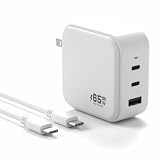
The Zosam is not a battery charger by itself; it is a 100W GaN USB power adapter intended to feed compatible DJI charging accessories and other USB devices. That distinction is useful when the drone’s hub already manages the battery and only needs a capable wall source.
It has four ports: three USB-C and one USB-A. Its listed output profiles reach 20V/5A with 100W maximum, and the product includes a 5.8-foot USB-C to USB-C cable.
The compatibility list names DJI Mini, Air 3, Neo, Mavic 3, Avata, and Matrice 4 series charging accessories. I would verify the requirements of the specific DJI hub or charger first, because the adapter does not change the input limits of the accessory connected to it.
GaN construction and a compact rectangular body make this a travel-friendly power component, while the listed protections include short circuit, overheating, overcurrent, and overcharge. Four devices connected at once share the adapter’s available output, so prioritize the drone hub when charge time matters.
The Zosam adapter works when a compatible DJI hub needs a stronger USB-C source
I would add this to a travel setup built around USB-C-powered accessories rather than use it as a substitute for a purpose-made battery hub. The three USB-C ports also leave room for a controller, phone, or other compatible device.
The Zosam adapter cannot balance or store a loose drone battery
This product supplies USB power; it has no battery bay, balance port, or storage-charge program. A LiPo pack still needs the correct dedicated charger, while a DJI battery still needs its matching hub or aircraft charging system.
The ToolkitRC M8D is the high-output DC choice for advanced 1S–8S setups
Pros
- Very high stated output
- Two 8S channels
- Touchscreen and dial
- Adjustable flip screen
Cons
- Requires DC input
- Few listed reviews
The ToolkitRC M8D has the highest stated charging output in this group: 1600W and 50A, with two independent channels for up to 8S batteries. It is aimed at an experienced user whose pack sizes and field setup make that output relevant, not at someone charging a single small drone battery overnight.
Its XT90 input and 49V DC input specification make the power source an essential part of the purchase decision. A charger with this kind of stated capacity needs a suitable DC supply, compatible cables, and careful current settings for each pack.
The unit uses a 3.5-inch, 480 by 320 flip screen with a capacitive touchscreen and a super dial. The screen can adjust through 80 degrees, and the dual fans have temperature-based adjustable speed.
It supports LiPo, LiHV, LiFe, Li-ion, LTO, NiMH, and Pb batteries according to the listing. That wide chemistry list gives experienced RC users flexibility, though it also means selecting the correct chemistry profile matters every time.
The ToolkitRC M8D suits advanced pilots with 1S–8S packs and a prepared DC station
I would reserve this for a user who understands DC power, connector ratings, charge currents, and the needs of larger battery fleets. Its two independent 8S channels are meaningful only when the rest of the charging setup can support them.
The ToolkitRC M8D is not a plug-into-the-wall beginner charger
The stated XT90 DC input means you need to provide an appropriate external DC source. Its limited 20-review count is another reason to read the manual closely and begin conservatively with a verified battery program.
The VICMILE set is a replacement-battery option for listed micro drones with Molex plugs
Pros
- 450mAh capacity
- 25C discharge rate
- Five-pack charger
- Listed micro-drone compatibility
Cons
- Molex connector only
- 12g may affect small drones
The VICMILE set combines 3.7V, 450mAh batteries with a five-in-one USB charger for a long list of small models, including named SYMA and Holy Stone quadcopters. Its Molex discharge plug is the first specification to compare, because voltage and physical size alone do not establish compatibility.
Each battery has a stated 25C discharge rate and weighs 12g. The listed 8.1 by 20 by 37mm dimensions are just as important as capacity for a small aircraft, where a battery that is too large or heavy can affect fit and handling.
The package’s five charging ports help prepare several compatible micro-drone batteries from one USB source. The listing claims 500-plus charge cycles and no memory effect, but real battery life still depends on heat, depth of discharge, storage state, and how gently each pack is treated.
For pilots seeking the longest flight time from a micro drone, a higher mAh rating is not automatically a win if the added mass or connector does not suit the aircraft. I would compare the original battery’s voltage, plug polarity, dimensions, and weight before ordering.
The VICMILE set fits listed SYMA and Holy Stone micro drones using a Molex battery
This package is useful when the named model and Molex plug match and several small batteries make a better flying session. The included five-port charger supports a simple rotation for compatible 1S-style batteries.
The VICMILE set needs a size and weight check before it goes in a micro drone
A 12g battery may be too heavy for some very small models, even if its voltage is correct. Never force the Molex connector, and stop if the plug orientation, battery bay, or stated model list does not match.
The ISDT 608AC is the compact AC/DC balance charger for 1S–6S packs
Pros
- AC/DC flexibility
- Multiple chemistries
- Detachable power supply
- Simple roll control
Cons
- Full 200W needs DC input
- Single output
The ISDT 608AC offers the familiar core modes many LiPo pilots need: charge, discharge, and storage. It supports 1S–6S packs and also lists LiFe, Li-ion, LiHV, Pb, and NiMH support, which gives it broad use without moving up to a large dual-channel unit.
Its maximum rating is 200W and 8A, while AC/DC dual mode offers a home and field path. The listing is clear that full 200W needs DC input, so the detachable power supply and AC use are convenient but not the whole output story.
An XT60 port is standard on the unit, and the shuttle roll knob is intended to keep menu input straightforward. At 4.35 by 4.35 by 1.22 inches and 12.35 ounces, it is compact enough for a portable charging kit.
It also has an adjustable digital power-supply mode rated at 50W maximum. That can add flexibility for an experienced user, but battery charging should always start with the battery chemistry and cell count selected correctly.
The ISDT 608AC fits pilots who want AC convenience and optional DC performance
I would consider it for a 1S–6S pilot who charges at home most of the time but may add a DC source for field use. Storage mode and multi-chemistry support make it a practical long-term companion for compatible packs.
The ISDT 608AC has one output and a lower AC ceiling than its DC rating
A single output means one battery program at a time, which may be slower for a large flight fleet. Plan around the 200W figure carefully, because the listing says that full output requires DC input.
Compatibility matters more than maximum wattage when choosing a drone charger
Start with four facts printed on the battery: chemistry, cell count, capacity, and connector. A LiPo marked 4S needs a charger that explicitly supports 4S LiPo, while a DJI intelligent battery normally needs its matching hub or aircraft charging method rather than a generic balance lead.
Cell count is the number before the S label: 1S, 2S, 3S, and so on. A higher-S pack has more cells in series, so its voltage is higher; do not select a program based only on the physical size of the pack.
Capacity is expressed in mAh and describes stored charge, not a universal charging-current command. A charger’s maximum amperage and wattage also have to be considered together, especially with higher-voltage packs where wattage can cap the practical current.
The connector is a physical compatibility check, not a minor accessory detail
XT60, XT90, EC3, XHR, PH2.0, BT2.0, Molex, USB-C, and a proprietary DJI bay are not interchangeable. Match both the main charge connection and, for balance chargers, the battery’s balance connector and cell count.
The number of outputs determines how your flying routine feels
A single-output charger is fine for a few packs, while two independent channels reduce waiting when you fly a compatible battery fleet. For tiny-whoop pilots, a six-channel 1S charger can be more useful than a high-wattage unit that cannot accept the packs.
LiPo and Li-ion serve different drone jobs rather than having one universal winner
LiPo packs are common in FPV because they can supply high current, which helps a racing or freestyle drone demand power quickly. Li-ion packs are often chosen where energy density and longer endurance are the main concern, but the aircraft, motor setup, and pack specification decide what is suitable.
The safe answer is to use the chemistry specified by the drone or battery maker and select that same chemistry in the charger. LiHV is not the same setting as standard LiPo, and Li-ion should never be placed on a LiPo program just because both are lithium-based.
C-rating describes a battery’s stated discharge capability relative to capacity. It is not a shortcut for choosing an aggressive charge rate; follow the battery maker’s charge-current guidance, and use lower, conservative settings when that guidance is unavailable.
Balance charging brings the cells of a multi-cell lithium pack into line
A balance charger monitors individual cells through the balance lead and works to bring them to equal voltage. It is the preferred regular mode for compatible multi-cell LiPo packs because one weak or mismatched cell can create problems that a main-lead-only approach may not reveal.
Storage mode helps avoid leaving LiPo packs full for long breaks
Storage charging moves a compatible pack toward a storage state instead of keeping it fully charged after a flight. That directly addresses the common habit of leaving drone batteries full in the charger or bag until the next outing.
AC power is simpler at home, while DC power can make field charging practical
An AC charger with a built-in power supply can plug into a suitable wall outlet, making it the easiest home setup. The HOTA D6 Pro and ISDT 608AC also accept DC input, but their higher stated DC output figures only matter when the external source can support them.
A DC-only charger such as the ToolkitRC M8D needs a correctly rated external DC source before it can charge anything. A vehicle socket may be useful for a modest setup, but check voltage, current, connector, and the vehicle’s electrical limits rather than assuming every 12V outlet can support a high-output charger.
USB-C is different again: a GaN adapter can power a compatible DJI hub, but it cannot turn into a balance charger for bare LiPo packs. Read the hub’s required input profile and consider shared output if several USB devices are connected.
Charge time depends on capacity, charge current, input power, and battery state
Drone batteries take longer when capacity is large, the selected charge current is conservative, the adapter is underpowered, or the charger is also balancing cells. A stated charge time is a useful planning estimate, not a fixed result for every battery and power source.
Fast charging trades convenience against additional battery stress
Forum users often accept faster charging when time is tight, while also reporting concerns about degradation. Stay inside the battery maker’s stated charge limit, let hot packs cool before charging, and favor a careful charge routine when battery longevity matters more than a quick turnaround.
Safe handling and storage protect batteries long after the first flight
Charge lithium batteries on a nonflammable surface, use the correct mode and connectors, and remain nearby. Stop using and isolate a pack that is swollen, damaged, unusually hot, leaking, or has damaged wiring; do not attempt to charge a suspect battery.
Do not keep drone batteries in a charger after they are finished, particularly as a long-term storage method. Disconnect them, check that they have reached the intended state, and store them in a cool, dry place away from combustible material.
Battery age is not measured by a single calendar number. Flight time can drop as cycle count rises, packs are run deeply empty, cells become imbalanced, or packs spend repeated long periods hot or fully charged.
A repeatable pre-charge check catches problems before the charger starts
Inspect the case, wires, connectors, and balance lead before every session. Confirm chemistry, cell count, selected current, and that the balance lead is fully seated before starting a compatible lithium balance charge.
A three- or four-battery rotation can reduce rushed charging between flights
Many pilots report that carrying three or four batteries makes an outing more enjoyable because there is less pressure to recharge a hot pack immediately. The right number depends on your drone, location, and charger, but a rotation gives packs time to cool and makes storage planning easier.
These direct answers cover the most common drone battery questions
What is the best battery for a drone?
The best battery is the exact chemistry, voltage, connector, dimensions, and model-specific format approved for your drone. FPV drones commonly use compatible LiPo packs, while DJI aircraft normally use their matching intelligent batteries.
Which is better, LiPo or lithium-ion for drones?
LiPo is often chosen for high-current FPV flying, while Li-ion can suit endurance-oriented builds. Neither is universally better; use the chemistry your aircraft and charger are designed to support.
What brand is the best battery charger?
The best charger brand depends on the pack and power setup. In this guide, HOTA suits broad 1S-6S AC/DC use, ISDT suits compact 1S-6S charging, VIFLY suits 1S tiny-whoop batteries, and DJI-specific hubs suit their named Mini batteries.
Should I keep drone batteries in the charger?
No. Disconnect batteries when charging is complete and use a suitable storage state for long breaks. Do not leave lithium batteries connected or unattended as a storage routine.
Why do drone batteries take so long to charge?
Charge time is affected by battery capacity, chosen charge current, charger wattage, available input power, cell balancing, and battery state. A weak USB adapter or a conservative current setting can extend the wait.
The right drone batteries and chargers match your aircraft before anything else
For broad FPV and RC battery support, the HOTA D6 Pro is my lead choice; the ISDT 608AC is a compact AC/DC alternative, and the ToolkitRC M8D is for advanced DC charging stations. DJI Mini owners should choose a hub or battery kit only after matching the exact stated model, while tiny-whoop pilots should look first at the VIFLY’s 1S connectors.
Use this 2026 guide as a shortlist, then verify chemistry, S rating, connector, dimensions, input source, and charge mode against the battery in front of you. That five-minute check is more valuable than buying on maximum wattage alone.