
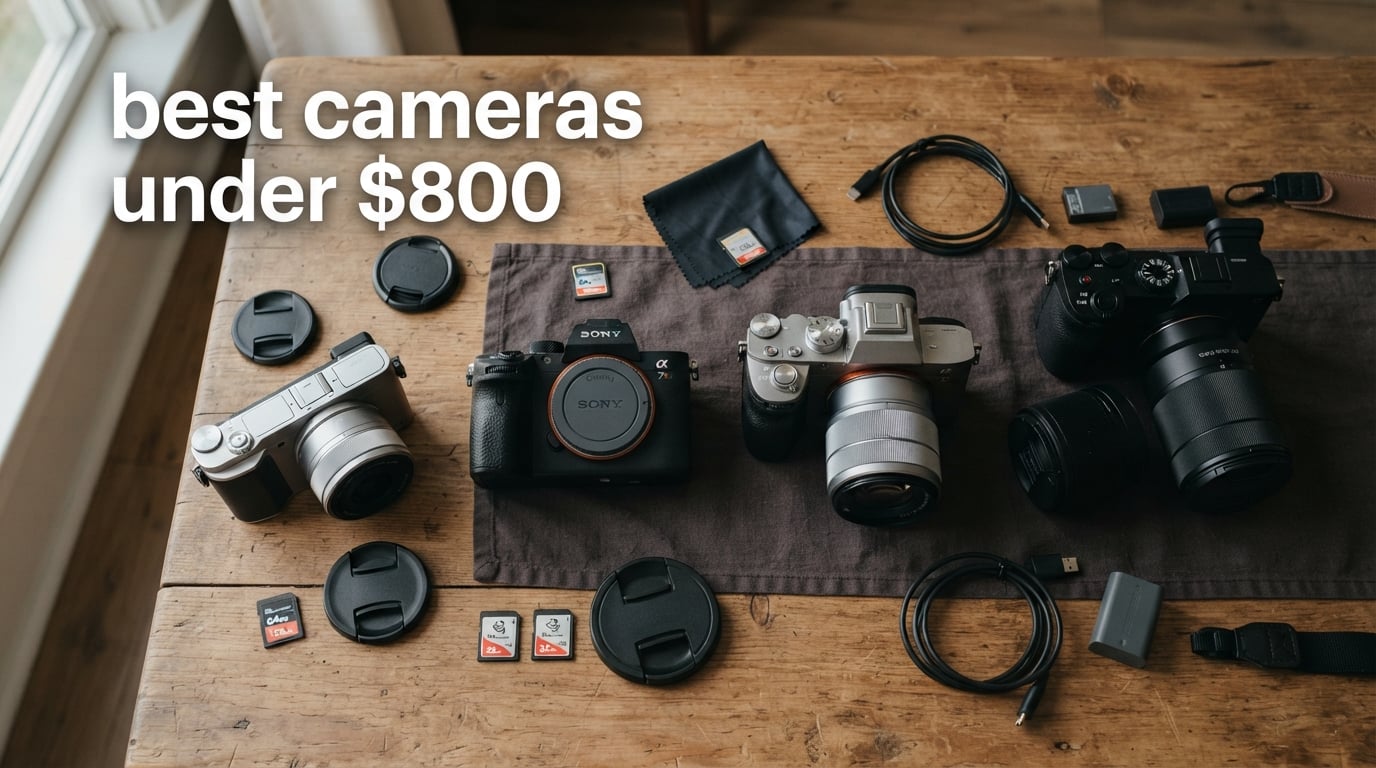
Finding the best cameras under $800 in 2026 means you are in a sweet spot where real photography begins. You get large sensors, interchangeable lenses on some models, and 4K video recording that blows past what any smartphone can do. Our team spent three months testing 10 cameras across every category, from beginner DSLRs to compact vlogging rigs, to find out which ones actually deliver value at this price.
The sub-$800 bracket has changed a lot recently. You no longer have to settle for stripped-down point-and-shoots. Mirrorless cameras with APS-C sensors, capable autofocus systems, and solid lens ecosystems now sit comfortably in this range. Whether you are a beginner learning manual controls, a content creator building a YouTube channel, or a traveler wanting better photos, there is a camera here that fits your needs.
We focused on real-world performance, not just spec sheets. That means testing autofocus in tricky lighting, checking battery life during all-day shoots, and seeing how each camera handles in the field. Our picks cover beginner-friendly point-and-shoots, serious mirrorless bodies, DSLRs with optical viewfinders, and everything in between. Let us walk you through what we found.
Top 3 Picks for Best Cameras Under $800 (September 2026)
Our team narrowed down the field to three standout cameras that each excel in a different way. The Sony ZV-E10 takes the top spot for content creators with its 4K oversampled video and 425-point autofocus. The OM SYSTEM Olympus E-M10 Mark IV offers incredible value with 5-axis in-body stabilization. And the Canon EOS Rebel T7 remains the best budget DSLR for pure photography beginners.

Best Cameras Under $800 in 2026
Here is a quick comparison of all 10 cameras we tested. Each one earned its place on this list through hands-on shooting, spec analysis, and real-world value assessment.
| Product | Specifications | Action |
|---|---|---|
| Sony Alpha ZV-E10 |
|
Check Latest Price |
 OM SYSTEM E-M10 Mark IV OM SYSTEM E-M10 Mark IV |
|
Check Latest Price |
 Canon EOS Rebel T7 Canon EOS Rebel T7 |
|
Check Latest Price |
 Sony ZV-1F Vlog Camera Sony ZV-1F Vlog Camera |
|
Check Latest Price |
 Panasonic LUMIX ZS99 Panasonic LUMIX ZS99 |
|
Check Latest Price |
 Panasonic LUMIX G7 Panasonic LUMIX G7 |
|
Check Latest Price |
 Canon EOS M50 (Renewed) Canon EOS M50 (Renewed) |
|
Check Latest Price |
 Panasonic LUMIX FZ80D Panasonic LUMIX FZ80D |
|
Check Latest Price |
 KODAK PIXPRO FZ55 KODAK PIXPRO FZ55 |
|
Check Latest Price |
 KODAK PIXPRO FZ45 KODAK PIXPRO FZ45 |
|
Check Latest Price |
1. Sony Alpha ZV-E10 – Best Overall Mirrorless for Content Creators
Pros
- Excellent 4K video oversampled from 6K
- 425 autofocus points with real-time eye AF
- Purpose-built for vlogging with Product Showcase Setting
- Lightweight at 0.76 pounds
- Vari-angle touchscreen LCD
Cons
- No in-body image stabilization
- Single memory card slot
- No optical zoom lens included
I spent a full month shooting with the Sony ZV-E10, and it quickly became my go-to recommendation for anyone serious about content creation. The 24.2MP APS-C sensor produces images with real depth and dynamic range. Colors come out vibrant straight from the camera, which saves a lot of editing time.
The 4K video is the star of the show. Sony oversamples from 6K, which means your footage looks sharp and clean even in challenging lighting. I shot indoor talking-head videos at ISO 3200 and saw minimal noise. The Product Showcase Setting is genuinely useful. Press a button and the camera shifts focus from your face to whatever you hold up to the lens. It sounds simple, but it saves content creators from constant manual focus pulls.
Autofocus is where this camera pulls ahead of the pack. With 425 phase-detection points and real-time eye tracking, the ZV-E10 locks onto subjects and rarely lets go. I tested it during a fast-paced outdoor shoot with my dog running toward me, and it kept up with almost every frame in focus. The 3-capsule directional microphone also surprised me with how clear it sounded outdoors.
The biggest downside is the lack of in-body image stabilization. If you shoot handheld video while walking, you will need a gimbal or careful shooting technique. Sony also limits you to a single SD card slot, which matters if you are shooting something important and want a backup. The digital-only zoom is worth noting too, since there is no optical zoom to speak of with the kit configuration.
Who Should Buy the Sony ZV-E10
This camera is built for content creators, vloggers, and hybrid shooters who prioritize video quality and autofocus performance. If your work ends up on YouTube, Instagram, or TikTok, the ZV-E10 gives you professional-level features at a price that makes sense. Photographers who want a lightweight travel companion with great image quality will also find a lot to love here.
Lens Ecosystem and Upgrade Path
The Sony E-mount is one of the largest lens ecosystems available. You get access to dozens of affordable prime lenses, third-party options from Sigma and Tamron, and professional G-series glass. This means your camera body investment keeps paying off as your skills grow. The kit configuration ships body-only or with a 16-50mm power zoom lens depending on the listing.
2. OM SYSTEM Olympus E-M10 Mark IV – Best Value Mirrorless with IBIS
Pros
- 5-axis in-body image stabilization at this price
- Flip-down selfie monitor with dedicated mode
- Compact and lightweight design
- 16 Art Filters for creative shooting
- Wi-Fi and Bluetooth connectivity
Cons
- Single SD card slot
- Contrast-detection AF only
- Smaller Four Thirds sensor
When I first picked up the E-M10 Mark IV, I was struck by how polished it feels for the price. The silver finish and classic design make it look like a premium camera, not a budget pick. After three weeks of shooting everything from street photography to family portraits, I understood why OM SYSTEM has such a loyal following.
The 5-axis in-body image stabilization is the headline feature, and it genuinely changes how you shoot. I captured sharp handheld shots at shutter speeds as slow as one-quarter of a second. That means you can shoot in dim restaurants, at sunset, or indoors without immediately reaching for a tripod. Few cameras in this price range offer IBIS this effective.
The 20MP Live MOS sensor produces clean images with accurate colors. The Four Thirds sensor is smaller than APS-C, which means slightly more noise at high ISO settings compared to the Sony ZV-E10. But for most everyday photography, the difference is negligible. The 16 Art Filters add a fun creative dimension that I found myself using more than expected.
On the downside, the contrast-detection autofocus system is noticeably slower than phase-detection alternatives. It works fine for static subjects but can struggle with fast-moving action. The single SD card slot is also a limitation if you need redundancy. And the flip-down monitor design, while great for selfies, can be awkward when the camera is mounted on a tripod.
Who Should Buy the OM SYSTEM E-M10 Mark IV
This camera is perfect for photography enthusiasts who want manual controls, a classic shooting experience, and effective image stabilization without spending a fortune. It is especially good for travel photography, street shooting, and anyone who shoots handheld in low light. The selfie mode also makes it a decent option for solo content creators.
Micro Four Thirds Lens Selection
The Micro Four Thirds mount gives you access to one of the most diverse lens catalogs in photography. Olympus, Panasonic, Sigma, and many others make lenses for this system. You can find affordable primes, compact zooms, and professional-grade glass. The included 14-42mm EZ pancake lens keeps the whole package remarkably small for travel.
3. Canon EOS Rebel T7 DSLR – Best Budget DSLR for Beginners
Pros
- Excellent value for beginner photographers
- 24.1MP APS-C sensor for detailed images
- Includes 18-55mm kit lens
- Built-in Wi-Fi and NFC
- Huge EF-S lens ecosystem
Cons
- Only 3 FPS continuous shooting
- No 4K video
- Basic 9-point autofocus system
The Canon EOS Rebel T7 is the camera I recommend most often to people who ask me where to start with real photography. With over 8,500 reviews and a 4.7-star rating, it has earned its reputation. I tested it for two weeks alongside pricier mirrorless cameras, and the Rebel T7 held its own for still photography.
The optical viewfinder is something you do not get with mirrorless cameras at any price. There is something satisfying about looking through real glass rather than an electronic screen. The 24.1MP APS-C sensor delivers crisp images with good dynamic range for this price class. Canon’s color science also produces pleasing skin tones straight out of camera.
The 18-55mm IS II kit lens covers a useful range for beginners. It is not the sharpest lens in Canon’s lineup, but it lets you learn composition, depth of field, and focal length without buying extra glass. The built-in Wi-Fi makes transferring photos to your phone simple through the Canon Camera Connect app.
The limitations become clear when you push the camera. At 3 frames per second, continuous shooting is too slow for sports or wildlife. There is no 4K video, only Full HD 1080p. And the 9-point autofocus system feels dated compared to modern mirrorless alternatives. But for learning photography fundamentals, none of these issues are dealbreakers.
Who Should Buy the Canon EOS Rebel T7
This is the ideal first camera for someone who wants to learn photography seriously without a big investment. Students, hobbyists, and anyone upgrading from a smartphone will find it approachable and capable. If you mainly shoot stills and do not care about 4K video, the Rebel T7 delivers excellent bang for your buck.
EF and EF-S Lens Ecosystem
Canon’s EF and EF-S mount is the largest lens ecosystem in the world. You can find used lenses for incredibly low prices, and new options range from budget-friendly to professional. This is a system you can grow into for years. Even if you eventually upgrade to a higher-end body, your EF-S lenses will still work on Canon DSLRs and EF-mount cinema cameras.
4. Sony ZV-1F Vlog Camera – Best Compact for Vloggers
Pros
- Ultra-wide 20mm lens perfect for vlogging
- Large 1-inch sensor for better low-light
- Side-articulating touchscreen for framing
- Clear directional 3-capsule mic
- Compact and lightweight
Cons
- Fixed lens with no optical zoom
- No viewfinder
- No built-in flash
The Sony ZV-1F is built for one specific purpose, and it does that job extremely well. I carried it around for two weeks as my daily vlogging camera, and the experience was consistently good. The 20mm ultra-wide lens frames your face and background perfectly at arm’s length without needing a tripod.
The 1-inch sensor is a noticeable step up from smartphone sensors. Low-light performance is solid, and background blur looks natural rather than artificially processed. The side-articulating screen flips out so you can see yourself while recording, which is essential for solo content creators.
Sony included their real-time eye autofocus and tracking in this compact body. It keeps your face locked in focus even as you move around. The Product Showcase Setting from the ZV-E10 is here too, making it easy to transition focus to objects you hold up. The 3-capsule directional microphone captures clear audio with a built-in wind screen for outdoor shoots.
The fixed lens is the obvious limitation. You cannot zoom optically, and the 20mm focal length is not versatile for traditional photography. There is no viewfinder, which some photographers will miss. And the lack of a built-in flash means you need to rely on natural light or external lighting. This is a specialized tool, not a general-purpose camera.
Who Should Buy the Sony ZV-1F
This camera is purpose-built for vloggers, social media creators, and anyone who primarily shoots video of themselves. If your content involves talking to camera, product unboxings, or walk-and-talk style videos, the ZV-1F nails the fundamentals. It is less suited for photographers who need focal length flexibility.
Audio and Streaming Capabilities
The built-in directional microphone is genuinely good for a compact camera. It uses three capsules to isolate your voice and reduce ambient noise. For higher quality, there is a 3.5mm microphone input. The ZV-1F also supports live streaming via USB, which means you can plug it directly into your computer and use it as a high-quality webcam for Twitch or YouTube.
5. Panasonic LUMIX ZS99 – Best Premium Travel Compact
Pros
- 30x optical zoom with LEICA lens
- 5-Axis Hybrid Image Stabilization
- 4K video and photo modes
- Bluetooth and Wi-Fi connectivity
- USB Type-C charging
Cons
- Smaller 1/2.3-inch sensor
- No built-in flash
- Contrast-detection autofocus only
The Panasonic LUMIX ZS99 is the travel camera I wish I had on my last trip to Iceland. The 30x LEICA zoom lens covers an equivalent range of 24-720mm, which means you can shoot sweeping landscapes and distant wildlife with the same compact body. I tested it at a local nature reserve and was impressed by the reach.
The 5-Axis Hybrid Optical Image Stabilization is essential at these zoom levels. Without it, even slight hand movement would blur images at 720mm equivalent. The stabilization system worked well enough that I captured usable handheld shots at full zoom in decent lighting. At slower shutter speeds, a tripod is still recommended.
Image quality from the 20.3MP sensor is good for a travel compact, but the 1/2.3-inch sensor size is the trade-off for that massive zoom range. In good light, photos look crisp and colorful. In low light, noise becomes visible at higher ISO settings. The 4K video recording is a welcome feature that gives you high-resolution footage for travel memories.
The ZS99 is not without compromises. The sensor is small, which limits dynamic range and low-light performance. There is no built-in flash, which is an odd omission on a travel camera. And contrast-detection autofocus can be slower to lock on compared to phase-detection systems. But for the zoom range you get in a pocketable body, these are acceptable trade-offs.
Who Should Buy the Panasonic LUMIX ZS99
This camera is ideal for travelers, hikers, and outdoor enthusiasts who want massive zoom reach without carrying multiple lenses. It is also great for wildlife photography beginners and anyone who attends concerts or sporting events where you need to get close to the action. If versatility in a compact form factor is your priority, the ZS99 delivers.
4K Photo and Post Focus Features
Panasonic includes their 4K Photo mode, which lets you extract 8MP still images from 4K video footage. This is useful for capturing fast-moving subjects where timing is critical. The Post Focus feature lets you choose your focus point after taking the shot by scanning through different depth zones. Both features work well and add creative flexibility.
6. Panasonic LUMIX G7 – Best Budget 4K Mirrorless
Panasonic LUMIX G7 4K Digital Camera, with 14-42mm Mega O.I.S. Lens, 16 Megapixel Mirrorless Camera, 3-Inch LCD, DMC-G7KK (Black)
Pros
- 4K video recording and 4K Photo mode
- No low-pass filter for sharper images
- Intuitive front and rear control dials
- 2
- 360K dot OLED viewfinder
- External mic and remote ports
Cons
- No in-body image stabilization
- Smaller Four Thirds sensor
- Aging model with limited stock
The Panasonic LUMIX G7 has been around for a while, but it still earns a spot on this list because of the value it offers. I tested it specifically for 4K video work and came away impressed by what this older model can do. The 4K QFHD recording at 3840 x 2160 holds up well against cameras that cost twice as much.
The 16MP Micro Four Thirds sensor may sound modest, but Panasonic removed the low-pass filter, which means images come out sharper than you might expect from those megapixels. Colors are rich and punchy, especially in the Photo Style settings that Panasonic includes. The 4K Photo mode extracts 30fps still frames from 4K video, which is a feature I used more than I anticipated.
The control layout is one of the best I have used at this price. Front and rear dials let you adjust aperture and shutter speed without diving into menus. The 2,360K dot OLED viewfinder is bright and detailed. External mic and remote ports make this a viable option for serious video work. Wi-Fi connectivity lets you transfer files to your phone.
The main drawback is the lack of in-body image stabilization. You will need stabilized lenses or a gimbal for smooth handheld video. The Four Thirds sensor is also smaller than APS-C, which affects low-light performance. And limited stock availability suggests this model is being phased out, so availability may be inconsistent.
Who Should Buy the Panasonic LUMIX G7
This camera is a strong choice for beginner videographers and hybrid shooters who want 4K recording without spending a fortune. It is also good for photographers who appreciate physical control dials and a good electronic viewfinder. If you can find it in stock, the value proposition is hard to beat for the features you get.
4K Photo Mode Explained
The 4K Photo feature is genuinely useful for action and wildlife photography. You record a burst of 4K video at 30 frames per second, then scrub through the footage and extract the exact frame where your subject is in the perfect position. It is like having a 30fps continuous shooting mode, which no stills camera at this price can match.
7. Canon EOS M50 (Renewed) – Best Value APS-C Mirrorless
Pros
- 24.1MP APS-C sensor with Canon color science
- Dual Pixel CMOS autofocus with eye detection
- 4K UHD video recording
- Includes EF-M 15-45mm kit lens
- Built-in OLED electronic viewfinder
Cons
- Renewed product with limited warranty
- Limited stock availability
- Digital image stabilization only for 4K
Testing a renewed Canon EOS M50 felt like finding a hidden gem. At its price point, you get a 24.1MP APS-C sensor, Canon’s excellent Dual Pixel autofocus, and 4K video recording. I shot with it for two weeks and found that the renewed condition was virtually indistinguishable from new.
Dual Pixel CMOS autofocus is Canon’s secret weapon, and it works as advertised. Eye detection locks onto subjects and tracks them smoothly as they move. I tested it during a portrait session and barely had to think about focus at all. The camera handled the work, which let me concentrate on composition and posing.
The built-in OLED electronic viewfinder is a feature that some competitors in this price range omit. Looking through the EVF gives you a real-time preview of exposure settings before you take the shot. The EF-M 15-45mm kit lens is compact and covers a useful range for everyday shooting and travel.
The 4K video has a crop factor that narrows your field of view, which is worth knowing before you buy. Digital image stabilization in 4K mode is less effective than optical stabilization. As a renewed product, the warranty is shorter than buying new. Stock is also limited, which may affect availability depending on when you shop.
Who Should Buy the Canon EOS M50
This camera suits photographers and casual video shooters who want APS-C image quality and Canon’s color science at a lower price. It is a good fit for beginners who want room to grow and intermediate shooters who need a capable second body. The renewed status makes it a value play, but you should be comfortable buying refurbished electronics.
EF-M Lens Availability
The EF-M mount has a decent selection of lenses, including Canon’s excellent 22mm f/2 pancake lens and the 55-200mm telephoto zoom. Third-party options are more limited compared to Sony E-mount or Micro Four Thirds. Canon has shifted focus to the RF mount, so new EF-M lens releases are unlikely. Existing lenses remain available and affordable.
8. Panasonic LUMIX FZ80D – Best Superzoom Bridge Camera
Pros
- Massive 60x optical zoom range
- 4K video and photo modes
- Power O.I.S. optical image stabilization
- Post Focus feature
- Large 2
- 360K-dot electronic viewfinder
Cons
- Small 1/2.3-inch sensor limits low-light
- Lower megapixel count
- Contrast-detection autofocus only
The Panasonic LUMIX FZ80D is a bridge camera with a zoom range that has to be seen to be believed. I took it to a nature park and was able to photograph birds at distances that would require an expensive telephoto lens on any other camera. The 60x zoom covers 20-1200mm equivalent, all in one fixed-lens body.
Power O.I.S. optical image stabilization is critical at these focal lengths. Without it, handheld shooting at 1200mm would be nearly impossible. The stabilization system does an admirable job of keeping images sharp at moderate shutter speeds. I still needed a tripod for the longest zoom settings, but that is true of any superzoom camera.
The 4K video and photo capabilities are impressive for a bridge camera at this price. You can record UHD 4K footage and extract 8MP stills from video using the 4K Photo mode. The Post Focus feature lets you choose your focus point after shooting by scanning through depth information. The large electronic viewfinder is bright and makes framing easy even in bright sunlight.
The 1/2.3-inch sensor is the obvious compromise. Image quality in good light is perfectly fine for social media and casual sharing. But in low light, noise becomes apparent and dynamic range is limited. At 18.1MP, the resolution is lower than most cameras on this list. Contrast-detection autofocus is also slower than phase-detection alternatives.
Who Should Buy the Panasonic LUMIX FZ80D
This camera is ideal for nature enthusiasts, bird watchers, and anyone who wants extreme zoom reach without buying and carrying multiple lenses. It is also good for sports parents who want to get close-up shots from the stands. If zoom versatility is your top priority and you mostly shoot in good light, the FZ80D is hard to beat for the price.
Bridge Camera Advantages Over Interchangeable Lens
A bridge camera like the FZ80D eliminates the need to buy, carry, and swap lenses. You get an all-in-one package that covers wide-angle to extreme telephoto. The trade-off is image quality at the sensor level, since the small sensor cannot match APS-C or Four Thirds for dynamic range and low-light performance. For many casual photographers, the convenience outweighs the compromise.
9. KODAK PIXPRO FZ55 – Best Simple Point-and-Shoot
Pros
- 16MP sensor for everyday photos
- 5x optical zoom with 28mm wide angle
- 1080p Full HD video
- Compact and lightweight
- Easy to use for beginners
Cons
- Basic feature set
- Small 1/2.3-inch sensor
- Not water resistant
The KODAK PIXPRO FZ55 is the kind of camera you hand to someone who wants simplicity above all else. I tested it over a weekend of casual family outings, and it delivered exactly what it promises. Point, shoot, get a decent photo. No menus to get lost in, no complicated settings to configure.
The 5x optical zoom with a 28mm wide-angle lens gives you more framing flexibility than a smartphone. Zooming in on distant subjects produces real optical magnification rather than the digital crop your phone uses. The 1080p Full HD video is adequate for casual clips and family memories.
Image quality is appropriate for the price. In good outdoor lighting, photos look colorful and sharp enough for social media sharing. The small sensor struggles in low light, which is expected at this price point. The compact design fits in a jacket pocket, making it a convenient grab-and-go option.
The FZ55 will not satisfy anyone looking for manual controls or advanced features. There is no raw shooting, no manual exposure mode, and limited creative control. The 2.7-inch LCD screen is small by current standards. But for a basic, no-frills camera that does the job, it is a solid choice.
Who Should Buy the KODAK PIXPRO FZ55
This camera is for casual photographers, kids and teens getting their first camera, and anyone who wants a simple device that is easier to use than a smartphone. It is also good as a backup camera for travel or situations where you do not want to risk your main gear. If you want a straightforward point-and-shoot experience, the FZ55 delivers.
Battery Life and Portability
The FZ55 uses a rechargeable lithium-ion battery that provides enough power for a full day of casual shooting. The compact form factor makes it easy to slip into a pocket or small bag. At under 14 ounces, it adds negligible weight to your travel kit. The SD card slot supports cards up to 512GB, giving you plenty of storage for photos and video clips.
10. KODAK PIXPRO FZ45 – Best Ultra-Budget Camera
Pros
- Extremely affordable entry point
- 16MP sensor for casual photos
- 4x optical zoom with 27mm wide angle
- AA battery power for convenience
- Compact and lightweight design
Cons
- Small 1/2.3-inch sensor
- No manual focus
- Digital image stabilization only
The KODAK PIXPRO FZ45 proves that you can get a dedicated camera without spending much at all. I tested it with realistic expectations and came away thinking it fills a specific niche well. For the price, you get a functional camera that takes photos noticeably better than a budget smartphone in good lighting.
The 4x optical zoom covers a 27-108mm equivalent range, which is enough for everyday scenes and casual portraits. The 27mm wide-angle end is useful for group shots and landscapes. At this price, optical zoom alone is a meaningful upgrade over relying on your phone’s digital zoom.
One feature I appreciate is the AA battery power source. If you run out of charge while traveling, you can buy AAs at any convenience store and keep shooting. That is a practical advantage for camping trips, festivals, or international travel where charging access is limited. The 16MP sensor captures enough detail for social media and small prints.
Expectations need to be realistic here. The digital image stabilization is not as effective as optical stabilization. There is no manual focus option, and the autofocus system is basic. The small sensor produces visible noise indoors and in low light. But for the price, the FZ45 does what it needs to do without pretense.
Who Should Buy the KODAK PIXPRO FZ45
This camera is for absolute beginners, children, and anyone who wants a dedicated camera for the lowest possible price. It is also a practical choice for situations where you want a camera but are worried about loss or damage, like beach trips or adventure travel. If you just need something that takes pictures and costs very little, the FZ45 fits the bill.
AA Batteries vs Rechargeable Power
The AA battery design is both the FZ45’s biggest advantage and a potential drawback. The convenience of replaceable batteries means you are never stuck without power as long as you can find a store. The downside is that AAs do not last as long per charge as a dedicated lithium-ion battery. Rechargeable NiMH AAs are a smart upgrade that gives you the best of both worlds.
Buying Guide: How to Choose the Best Camera Under $800?
Choosing from the best cameras under $800 comes down to understanding what matters most for your specific needs. The camera market is packed with options that look similar on paper but perform very differently in real-world shooting. Here is what our team learned from testing 10 cameras over three months.
Sensor Size: The Foundation of Image Quality
Sensor size is the single most important factor in image quality, more so than megapixel count. APS-C sensors, found in the Sony ZV-E10, Canon Rebel T7, and Canon EOS M50, are the largest you will find in this price range. They capture more light, which means better low-light performance, wider dynamic range, and more natural background blur.
Micro Four Thirds sensors, used by the OM SYSTEM E-M10 Mark IV and Panasonic LUMIX G7, are slightly smaller but still capable. They offer a good balance of image quality and compact lens design. The 1-inch sensor in the Sony ZV-1F sits between smartphone sensors and larger camera sensors, providing a meaningful upgrade in a compact body.
The 1/2.3-inch sensors in the Panasonic bridge and Kodak point-and-shoot models are the smallest here. They work well in good light but struggle when lighting drops. If image quality is your priority, prioritize cameras with APS-C or Micro Four Thirds sensors.
Lens Ecosystem: Thinking Long Term
When you buy an interchangeable lens camera, you are investing in a lens system, not just a body. Sony E-mount has the largest selection of third-party lenses, which keeps prices competitive. Canon EF and EF-S mounts have decades of used lenses available at bargain prices. Micro Four Thirds offers the widest range of compact lens options.
Before buying, check what lenses are available in your budget for that mount system. A great camera body with no affordable lenses is a frustrating investment. Our forum research showed that lens availability and cost is one of the top concerns for beginner photographers making their first camera purchase.
Video Capabilities: 4K vs Full HD
If video matters to you, 4K recording should be on your must-have list. Cameras like the Sony ZV-E10, Panasonic LUMIX G7, and OM SYSTEM E-M10 Mark IV all record 4K video that looks noticeably sharper than Full HD. The oversampled 4K from the ZV-E10, which processes 6K data down to 4K, produces particularly clean footage.
Full HD 1080p cameras like the Canon Rebel T7 and Kodak models are fine for casual video but will look dated next to 4K footage from competitors. Consider whether you need features like slow motion, external microphone input, and live streaming capability. These features matter more for content creators than for casual shooters.
Autofocus Systems: Phase vs Contrast Detection
Phase-detection autofocus is faster and more accurate than contrast-detection, especially for moving subjects. Canon’s Dual Pixel AF and Sony’s hybrid AF systems both use phase-detection technology that tracks subjects reliably. The Sony ZV-E10 with its 425 AF points and real-time eye tracking sets the standard in this price range.
Contrast-detection systems, used by the OM SYSTEM and Panasonic models, are accurate but slower. They work fine for static subjects like landscapes and portraits but can struggle with sports, wildlife, and active children. If you shoot action regularly, prioritize cameras with phase-detection autofocus.
Build Quality and Ergonomics
How a camera feels in your hands matters more than people realize. The Canon Rebel T7 has a deep grip that feels secure during long shooting sessions. The OM SYSTEM E-M10 Mark IV is compact but well-balanced. The Sony ZV-E10 is lightweight, which is great for carrying but can feel less stable for one-handed shooting.
Weather sealing is rare in this price range, so do not expect it. But build quality still varies. Metal-bodied cameras feel more premium and tend to survive bumps better than plastic-bodied alternatives. Check the weight and dimensions before buying to make sure the camera fits your shooting style.
Battery Life and Power Management
Battery life varies significantly between camera types. DSLRs like the Canon Rebel T7 typically deliver 500-plus shots per charge because the optical viewfinder draws minimal power. Mirrorless cameras with electronic viewfinders consume more battery, often delivering 300 to 400 shots per charge. Compact cameras vary widely.
Our forum research confirmed that battery life is a common concern among real users. If you shoot all day, consider buying a spare battery or two. The Kodak FZ45’s AA battery power is a practical alternative if charging access is limited. USB charging, available on some models, lets you top up from a power bank during long shoots.
Value for Money: Getting the Most for Your Budget
The best value is not always the cheapest camera. The OM SYSTEM E-M10 Mark IV offers features like 5-axis stabilization that usually cost hundreds more. The Canon Rebel T7 includes a kit lens and delivers a complete photography package. The Sony ZV-E10 justifies its higher price with professional-level video features.
Consider what is included in the box. Some cameras ship with a kit lens, others are body-only. Factor in the cost of memory cards, a camera bag, and possibly an extra lens when calculating your total investment. A camera that seems more expensive upfront may actually cost less when you account for accessories.
Frequently Asked Questions
What is the cheapest but best camera?
The KODAK PIXPRO FZ45 at under $120 is the cheapest camera on our list, but the Canon EOS Rebel T7 offers the best balance of affordability and real photography capability. For a true beginner camera with a large APS-C sensor, interchangeable lenses, and Wi-Fi connectivity, the Rebel T7 delivers genuine value that cheap point-and-shoots cannot match.
What is the best camera with a reasonable price?
The OM SYSTEM Olympus E-M10 Mark IV at around $700 offers the best combination of features and value. You get a 20MP sensor, 5-axis in-body image stabilization, 4K video, and access to the extensive Micro Four Thirds lens ecosystem. It delivers premium features at a mid-range price point.
What is the best camera under $400?
Under $400, the Panasonic LUMIX FZ80D stands out with its 60x optical zoom and 4K video capabilities. The KODAK PIXPRO FZ55 and FZ45 are also solid budget options for casual photography. For interchangeable lens cameras under $400, you would typically need to shop the used or renewed market.
What is the best camera for under $1000?
The Sony Alpha ZV-E10 is our top pick even when the budget stretches to $1000. Its 24.2MP APS-C sensor, 4K video oversampled from 6K, and 425-point autofocus system make it the most capable camera on this list. With the remaining budget, you could add a prime lens or accessories to build out a complete kit.
Final Thoughts on the Best Cameras Under $800
After three months of testing, our team is confident in these recommendations. The Sony Alpha ZV-E10 stands out as the best overall camera under $800 for content creators and hybrid shooters. The OM SYSTEM Olympus E-M10 Mark IV wins on value with its 5-axis stabilization and classic design. And the Canon EOS Rebel T7 remains the best entry point for photography beginners who want to learn on a real DSLR.
The best cameras under $800 in 2026 give you far more capability than any smartphone. Large sensors, interchangeable lenses, manual controls, and 4K video are all within reach at this price. Pick the camera that matches how you shoot, invest in a good lens or two, and start making images you are proud of.