
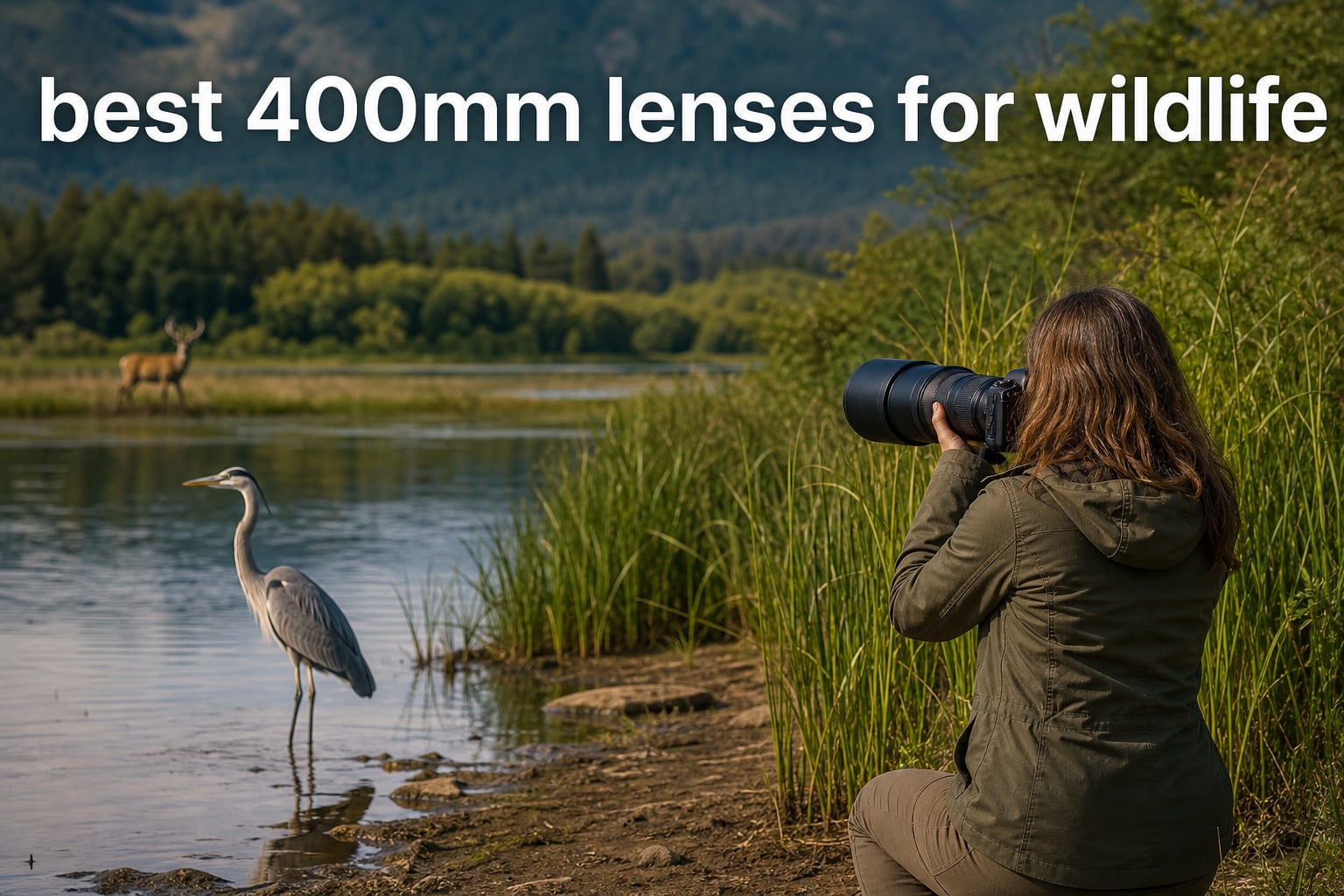
Choosing the best 400mm lenses for wildlife comes down to one practical question: can you get close enough without changing the animal’s behavior? A 400mm telephoto lens is enough for many wildlife encounters, including larger mammals, birds at feeders, wetlands, and subjects approached from a vehicle or hide. It gives a close-looking frame while leaving working distance between you and the subject.
I would not treat 400mm as a magic answer for every scene. Small birds across a field, shy animals beyond roughly 100 yards, and severe crops still favor more reach, but a 400mm lens can make stronger photos when its wider view helps you find and track the subject first. The 100-400mm zooms here also make it far easier to reframe when an animal moves toward you.
For 2026, I compared ten real lenses covering Nikon Z, Canon EF and RF, Sony E, and Micro Four Thirds systems. I looked at focal-range flexibility, maximum aperture, stabilization, stated weight, weather resistance, focus design, and teleconverter support rather than making a blanket recommendation across mounts. That distinction matters because a 400mm lens on Micro Four Thirds provides a 200-800mm full-frame equivalent angle of view, while full-frame and APS-C users will experience the same physical 400mm focal length differently.
Forum discussions around wildlife photography keep returning to the same problems: 400mm can feel short for far-off birds, heavy glass is tiring on a long walk, and variable-aperture zooms ask more of the camera in dim light. This guide addresses those trade-offs directly. I also separate fixed 400mm primes from zooms, because the best choice is usually the one that matches the distance, light, and pace of your shooting rather than the lens with the longest specification list.
These three picks are the clearest starting points for 400mm wildlife work
The Nikon NIKKOR Z 100-400mm VR S is the broadest premium Nikon Z choice, the Canon RF 100-400mm is the lighter Canon RF entry point, and the OM SYSTEM M.Zuiko 100-400mm IS II gives Micro Four Thirds users exceptional equivalent reach with strong stated stabilization. Start with your camera mount, then decide whether a flexible zoom or a fixed focal length fits your subjects.

These are the 10 best 400mm lenses for wildlife in 2026
This overview compares the complete list at a glance. A 100-400mm telephoto zoom favors changing distances and easier subject acquisition; a 400mm prime favors photographers who regularly work at one distance and want a fixed angle of view. Do not compare focal length alone: mount, stabilization, aperture, and carry weight will change how the lens feels in the field.
| Product | Specifications | Action |
|---|---|---|
 Nikon Z 100-400mm VR S Nikon Z 100-400mm VR S |
|
Check Latest Price |
 Canon EF 100-400mm L IS II Canon EF 100-400mm L IS II |
|
Check Latest Price |
 Sony FE 100-400mm GM OSS Sony FE 100-400mm GM OSS |
|
Check Latest Price |
 Nikon Z 28-400mm VR Nikon Z 28-400mm VR |
|
Check Latest Price |
 Canon RF 100-400mm IS USM Canon RF 100-400mm IS USM |
|
Check Latest Price |
 Nikon Z 400mm f/4.5 VR S Nikon Z 400mm f/4.5 VR S |
|
Check Latest Price |
 Panasonic Leica 100-400mm II Panasonic Leica 100-400mm II |
|
Check Latest Price |
| OM SYSTEM 100-400mm IS II |
|
Check Latest Price |
 Tamron 50-400mm VC VXD Tamron 50-400mm VC VXD |
|
Check Latest Price |
 Olympus 100-400mm IS Olympus 100-400mm IS |
|
Check Latest Price |
1. Nikon NIKKOR Z 100-400mm VR S is the premium all-round Nikon Z zoom
Pros
- S-Line optics
- 5.5-stop VR
- dual STM focus
- teleconverter compatible
Cons
- 3.2 lb
- not water resistant
The NIKKOR Z 100-400mm f/4.5-5.6 VR S is the Nikon Z lens I would put first for a photographer who wants one serious wildlife zoom. Its 100-400mm range provides the short end needed when a deer steps closer, then reaches to 400mm without a lens change. The supplied data lists a 4x zoom ratio, a 77mm filter thread, and a 3.2-pound weight.
Nikon rates its optical Vibration Reduction at up to 5.5 stops, with five-axis VR on full-frame Z cameras and two-axis VR on DX-format bodies. That is meaningful for steady framing and still subjects, though stabilization does not freeze an active bird or running animal. You still need shutter speed that matches subject motion.
Its autofocus and teleconverter support suit patient wildlife tracking
Two high-speed STM stepping motors are specified for near-silent autofocus. For a lens used around easily disturbed wildlife, quiet focus behavior is a welcome detail, and the dual-motor design is a better fit for tracking than an older, noisier drive system.
The lens accepts Nikon Z TC-1.4x and TC-2.0x teleconverters. I see that as useful flexibility for a distant subject, but it is not a substitute for deciding whether 400mm gives you enough reach on most outings. Add a teleconverter when its narrower angle of view is genuinely needed, not as a permanent attachment.
Its weight and weather rating set the field-use boundary
At 3.2 pounds, this is a substantial wildlife lens rather than a casual walkaround zoom. Carrying it for a morning is reasonable for many photographers, but a full day of handheld panning may favor a strap, monopod, or planned rests.
The listing identifies it as not water resistant, despite the fluorine coating. I would take that stated rating seriously and protect it in prolonged rain, spray, or dusty conditions instead of assuming a premium designation means unrestricted weather exposure.
2. Canon EF 100-400mm f/4.5-5.6L IS II USM is the established EF wildlife zoom
Pros
- L-series build
- weather sealing
- Air Sphere Coating
- zoom torque ring
Cons
- 1570g
- f/5.6 at 400mm
Canon’s EF 100-400mm f/4.5-5.6L IS II USM remains a focused option for photographers using Canon EF cameras. This is an L-series 100-400mm zoom with four stops of image stabilization, a 77mm filter thread, and a listed weight of 1570 grams. Its rotation-type zoom ring is designed for deliberate changes in framing rather than the push-pull approach associated with earlier designs.
The maximum aperture narrows to f/5.6 at 400mm, so I would plan for that limit when the light starts fading. A variable aperture does not mean poor images; it means exposure settings must work harder at the long end. For perched birds or large animals in good light, the 100-400mm range is much more flexible than a fixed lens.
Its sealed L-series construction suits changing outdoor conditions
The product data calls out resistance to dust and water, along with Air Sphere and fluorine coatings. That combination makes practical sense for photographers who work from wet grass, along shorelines, or in a vehicle with open windows, where front-element cleaning and changing conditions are ordinary.
Weather resistance is not permission to ignore care. I would still wipe down the zoom ring, mount the hood, and keep a dry cover available. The point is that this lens carries stated protection where several entries in this list do not.
Its zoom torque control favors composed wildlife framing
The zoom torque adjustment ring is a small but useful field feature. It lets the photographer manage how freely the barrel moves, which can help during a slow, deliberate framing change or when carrying the lens at an angle.
At 1570 grams, the Canon is not weightless, but it is a sensible middle ground for EF photographers who want 100mm flexibility and 400mm reach in one lens. I would choose it for an established EF kit rather than changing systems solely for a wildlife zoom.
3. Sony FE 100-400mm F4.5-5.6 GM OSS is the professional Sony E zoom
Pros
- G Master optics
- fast quiet focus
- OSS
- 9-blade aperture
Cons
- 49.3 oz
- Sony E only
The Sony FE 100-400mm F4.5-5.6 GM OSS is the dedicated Sony E-mount zoom for photographers who want a 400mm endpoint without abandoning 100mm framing. Sony lists Optical SteadyShot stabilization, a 9-blade circular aperture, and a 0.35x maximum magnification. The 49.3-ounce weight places it in the serious telephoto category.
G Master optical design is the central appeal here, paired with a 100-400mm range that is highly practical for wildlife. I particularly like this range when a bird lands closer than expected or a large animal moves through a narrow opening. A prime lens can be sharper in a narrow use case, but a zoom often gets the frame because it is already at the right focal length.
Its focus motors target fast and quiet subject acquisition
Sony specifies Double Linear and Direct Drive SSM focus systems for fast, quiet operation. That is the right kind of specification to prioritize for action photography, where the lens needs to respond as a subject changes distance without drawing attention through loud mechanical noise.
Focus performance also depends on the camera body, subject contrast, light, and settings. I would pair this lens with a Sony body whose subject-recognition and continuous autofocus modes you already understand, then practice acquiring a flying bird at 100mm before zooming tighter.
Its 400mm view and bokeh suit isolated wildlife portraits
The 9-blade circular aperture is intended to produce smooth out-of-focus areas. At 400mm, distance between subject and background can matter as much as aperture, so placing a bird or animal well away from distracting branches will do a lot for subject separation.
This is Sony E-mount only, which sounds obvious but is worth stating in a cross-brand guide. A wildlife lens is a system purchase: choose the mount you use, then judge how the lens’s reach, mass, stabilization, and focus behavior fit your style.
4. Nikon NIKKOR Z 28-400mm f/4-8 VR is the light all-in-one Nikon Z choice
Pros
- 28-400mm range
- 1.6 lb
- 5-stop VR
- wide-angle coverage
Cons
- f/4-8 aperture
- not water resistant
The NIKKOR Z 28-400mm f/4-8 VR takes a different route from a dedicated wildlife zoom. It runs from a genuinely wide 28mm to 400mm in a 14.2x range, yet the stated weight is just 1.6 pounds. I would choose it when the outing includes habitats, travel scenes, and wildlife rather than only distant animals.
The benefit is simple: you can frame an environmental image at 28mm, then work at 400mm without changing lenses. That can keep dust off the sensor and save a missed moment. The trade-off is an f/4-8 variable aperture, with the slowest maximum aperture at the long end.
Its 28mm starting point suits wildlife storytelling beyond tight crops
Wildlife photography is not only about filling the frame. A 28mm setting can show an animal in its surroundings, a sunrise location, or the track that led to the encounter. I find that creative range meaningful for hikers and travelers who prefer one lens over a bag full of equipment.
At 400mm, it remains a real telephoto reach lens, but it is not meant to replace a brighter fixed-aperture lens in very low light. Use its broad range as the main reason to buy it, not an assumption that it will behave like a specialist super telephoto in every condition.
Its stabilization and low carry weight favor long walks
Nikon states 5.0 stops of VR performance and up to 5.5 stops with Synchro VR on compatible cameras. That is especially helpful when the light is moderate and you need a stable viewfinder image while standing on a trail.
The 1.6-pound specification changes the packing calculation dramatically next to heavier 100-400mm options. If lens weight has kept you from carrying telephoto reach at all, I would take the lens you will actually bring over a bigger alternative that stays at home.
5. Canon RF 100-400mm F5.6-8 IS USM is the compact Canon RF wildlife entry
Canon RF100-400mm F5.6-8 is USM Telephoto Lens, Black, Compatible with EOS R Series Mirrorless Cameras
Pros
- 816g weight
- up to 6 stops IS
- Nano USM
- 0.41x magnification
Cons
- f/5.6-8
- not water resistant
The Canon RF 100-400mm F5.6-8 IS USM is the clearest starting point for Canon EOS R photographers who want 400mm reach in a compact lens. Canon lists it at 816 grams and specifies 5.5 stops of optical stabilization, rising to up to six stops with compatible in-body stabilization cameras. Those numbers explain why it appears so often in beginner wildlife discussions.
Its f/5.6-8 maximum aperture is the important compromise. In bright daylight, that is manageable for wildlife and bird photography. In forest shade or late in the day, you may need a higher ISO or slower action, so I would set expectations around the conditions you actually shoot rather than the lens’s small size alone.
Its light weight makes 400mm reach easier to carry every day
A 816-gram telephoto zoom is far less intimidating than a lens that weighs several pounds. That matters when you are learning to hold a long lens steady, scanning a reserve for hours, or carrying a camera while hiking with other gear.
The focal range begins at 100mm rather than a wider setting, which is sensible for a wildlife-oriented telephoto. I would use 100mm to find a subject, keep both eyes open when possible, then zoom toward 400mm only after the animal is located and the composition is stable.
Its Nano USM and close focus add practical versatility
Canon specifies Nano USM for smooth, quiet autofocus. The lens also has a stated minimum focusing distance of 2.89 feet at 200mm and 0.41x maximum magnification at 400mm, so it can handle close details such as butterflies, flowers, or texture when larger wildlife stays hidden.
The product listing calls it not water resistant. I would treat it as a fair-weather wildlife lens or use a rain cover when conditions change. That is a manageable limitation if compact carry weight is the chief goal, but it should influence decisions for wetland and coastal work.
6. Nikon NIKKOR Z 400mm f/4.5 VR S is the portable fixed-length Nikon Z prime
Pros
- 400mm prime
- up to 6 stops VR
- silent STM focus
- teleconverter ready
Cons
- fixed focal length
- 95mm filters
The NIKKOR Z 400mm f/4.5 VR S is for the Nikon Z photographer who knows 400mm is the working focal length and does not need a zoom range. It weighs 2.56 pounds, carries a 95mm filter thread, and has a stated f/4.5 maximum aperture. That aperture is brighter than the long end of most zooms in this guide.
A fixed 400mm lens asks more of your field position. You cannot zoom out when a fox approaches or when a bird suddenly flies close, so you need room to back up or patience to wait for the right distance. In return, a consistent angle of view can make your composition and exposure routine simpler.
Its brighter fixed aperture suits lower-light wildlife sessions
An f/4.5 maximum aperture at 400mm admits more light than f/5.6, f/6.3, or f/8 settings. I would consider that useful at dawn, in open woodland, or when a faster shutter speed is needed for a moving subject, while remembering that subject motion still determines the shutter speed target.
Nikon lists an STM stepping motor for near-silent, precise autofocus and a nine-blade diaphragm for bokeh. Those details line up with the lens’s role: a specialized 400mm tool for natural-looking background separation and quiet work around wildlife.
Its VR and converter support extend a fixed-lens workflow
The product information states up to 6.0 stops of Vibration Reduction with Synchro VR on the Z 9. That level of stabilization helps manage camera movement and makes framing easier, particularly when waiting with the lens raised for a short moment.
Nikon also specifies compatibility with TC-1.4x and TC-2.0x teleconverters. I would view those as occasional reach options, since teleconverters change both focal length and light transmission. The main decision is whether you enjoy working at a fixed 400mm field of view before adding any accessory.
7. Panasonic Leica DG Vario-Elmar 100-400mm II is the weather-aware Micro Four Thirds zoom
Pros
- 200-800mm equivalent
- weather-resistant
- Power O.I.S.
- 1.3m close focus
Cons
- Micro Four Thirds only
- manual focus listed
The Panasonic LUMIX Leica DG Vario-Elmar 100-400mm F4.0-6.3 II is a compelling Micro Four Thirds wildlife lens because its 100-400mm range gives a 200-800mm full-frame equivalent angle of view. That makes it especially attractive for bird photography when physical closeness is not possible. The stated weight is 2.2 pounds, keeping the package more compact than many full-frame super-telephoto setups.
The listing specifies Power O.I.S. and a dust-, splash-, and freeze-resistant construction down to minus 10 degrees Celsius. Leica DG optics are part of the appeal, but I would make the equivalent reach the first reason to consider it. A 400mm setting on this system gives a tight field of view without attaching a teleconverter.
Its 200-800mm equivalent reach favors small and distant birds
Micro Four Thirds does not turn the lens into a different physical focal length, but its smaller sensor records a narrower angle of view. In practical terms, the 400mm setting frames like an 800mm lens on full frame, which can make a huge difference for a small bird across water.
That reach does not remove the need for technique. Heat haze, poor light, subject movement, and an unstable stance can still spoil a distant frame. I would use the extra angle-of-view advantage alongside careful shutter speed, a stable hold, and realistic expectations about atmospheric conditions.
Its close-focus and field protection broaden its nature role
A stated 1.3-meter closest focusing distance with 0.5x magnification makes this more than a distant-subject lens. It can shift from a perched bird to a dragonfly or flower detail without changing gear, which is useful on nature walks with unpredictable subjects.
The supplied product data lists manual focus, so confirm how that focus operation fits your Panasonic or Micro Four Thirds body before committing. I would also pair any weather-resistant lens with a body that can meet the same outdoor demands.
8. OM SYSTEM M.Zuiko 100-400mm F5.0-6.3 IS II is the stabilized Micro Four Thirds reach leader
Pros
- 200-800mm equivalent
- 5-Axis Sync IS
- weather-sealed
- teleconverter compatible
Cons
- Micro Four Thirds only
- limited review base
The OM SYSTEM M.Zuiko Digital ED 100-400mm F5.0-6.3 IS II brings 200-800mm equivalent coverage to the Micro Four Thirds mount. The second-generation designation matters because the provided specifications list 5-Axis Sync IS with up to 7.0 steps at 100mm and 5.5 steps at 400mm. For a photographer who spends most time on birds, that long-end stabilization figure is a major draw.
The lens has weather-sealed dust- and splashproof construction, a 72mm filter thread, and a 9-blade circular aperture. I would call it a reach-first wildlife zoom rather than a general-purpose travel lens. It starts at 100mm, but the strongest reason to own it is the tight 400mm framing on a Micro Four Thirds body.
Its Sync IS helps stabilize the demanding 800mm-equivalent view
A 400mm setting with a 200-800mm equivalent angle of view amplifies every small movement in the viewfinder. The stated 5.5 steps of stabilization at the long end can make composition calmer and handheld work more feasible with still or slowly moving subjects.
I would not confuse stabilization with action stopping power. A small bird launching from a branch still needs a fast shutter speed, and no stabilization system can correct a blurred wing. Use Sync IS to reduce camera shake while setting shutter speed for the animal’s behavior.
Its teleconverter support and sealing suit dedicated field days
OM SYSTEM specifies compatibility with MC-14 and MC-20 teleconverters. That support gives specialists a path beyond the already narrow 800mm-equivalent angle of view, though a teleconverter also asks for more light and steadier handling.
The weather-sealed construction fits the kind of long, uncertain outdoor session wildlife photographers know well. I would still check that the camera body is similarly protected, use the hood, and keep the mount clean after a wet or sandy outing.
9. Tamron 50-400mm f/4.5-6.3 Di III VC VXD is the versatile Sony E range champion
Tamron 50-400mm f/4.5-6.3 Di III VC VXD Lens for Sony Full Frame Mirrorless Cameras Black
Pros
- 50-400mm range
- VXD autofocus
- VC stabilization
- fluorine coating
Cons
- Sony E only
- variable aperture
The Tamron 50-400mm f/4.5-6.3 Di III VC VXD gives Sony E photographers an unusual 50mm-to-400mm range. That 8x zoom span reaches much wider than a typical 100-400mm lens while retaining a true 400mm endpoint. I would choose it for mixed outings where wildlife, people, and wider habitat views may all happen without warning.
Tamron lists a VXD linear motor for high-speed, precise, quiet autofocus and VC image stabilization. The optical construction includes 24 elements in 18 groups, with XLD and LD elements plus a BBAR G2 coating. Those are meaningful technical details, but the broader focal range is what makes this lens different in real shooting.
Its 50mm starting point reduces lens changes on varied outings
Beginning at 50mm lets you frame a larger animal at close range or include more surroundings before moving quickly toward 400mm. That is particularly convenient on a trail, from a safari vehicle, or during travel when carrying a second lens is not appealing.
The range also gives you more time to locate a fast subject. I would begin at a wider setting, acquire the animal, then zoom tighter while keeping the focus point placed on the head or eye area. That approach is easier than beginning at 400mm with a very narrow view.
Its VXD focus and coatings support practical outdoor use
The VXD linear motor specification points toward fast, quiet autofocus, while VC addresses camera movement. The front element receives a fluorine coating, which can make routine cleaning easier after dust or light moisture reaches the lens surface.
The product data identifies the lens as water resistant, but this is still a variable-aperture f/4.5-6.3 zoom. I would reserve expectations of the fastest action performance in dim light for brighter lenses and enjoy this one for the range it covers in a single Sony E-mount package.
10. Olympus M.Zuiko 100-400mm F5.0-6.3 IS is the established Micro Four Thirds alternative
Pros
- 200-800mm equivalent
- weather-sealed
- 1.3m close focus
- teleconverter compatible
Cons
- 3 EV stabilization
- older version
The Olympus M.Zuiko Digital 100-400mm F5.0-6.3 IS is the earlier Micro Four Thirds option in this roundup. It gives the same 200-800mm equivalent angle of view at its 100-400mm settings and has a listed 1325-gram weight. With 410 reviews and a 4.4 rating in the supplied data, it is also the most reviewed Micro Four Thirds lens in this group.
The design includes weather sealing, ZERO Coating, a 72mm filter thread, and stated in-lens stabilization of three EV steps at the 800mm-equivalent end. I would consider it for a Micro Four Thirds photographer who wants established long-reach coverage and understands that the newer OM SYSTEM IS II lists stronger stabilization figures.
Its equivalent reach makes it a serious bird-photography lens
The 200-800mm equivalent field of view is the headline specification. It provides tight framing potential for distant water birds, perched raptors, or wildlife that cannot be approached safely, all without the bulk of a full-frame 800mm setup.
Reach helps only when the air between you and the subject is clear enough. I would be cautious on hot days across open ground or water, where shimmer can soften the image before focus or stabilization becomes relevant. Getting closer is still the best image-quality upgrade whenever ethics and safety allow it.
Its close focus and converter compatibility add useful options
The specified minimum shooting distance is 1.3 meters, opening up close nature details as well as distant subjects. That flexibility is welcome when a planned bird session becomes an encounter with insects, leaves, or small animals near the trail.
Compatibility with MC-14 and MC-20 teleconverters offers additional reach for specialized work. I would first get comfortable with the native 400mm setting and its three-EV stabilization, then assess whether a teleconverter fits the available light and support setup.
A good 400mm wildlife lens matches your distance, light, and camera mount
The correct wildlife photography lens is not simply the longest one. The following checks turn the choice into a practical decision. I would rank camera mount first, because every lens in this list is designed for a specific system and no amount of optical appeal changes that.
400mm is enough when your working distance fits the subject
A 400mm lens is enough for many wildlife scenes when you can approach responsibly or work from a hide, vehicle, trail edge, or shoreline. It is strong for larger mammals, birds near feeders or wetlands, and animals that occupy a meaningful portion of the frame at moderate distance.
It becomes less adequate for tiny subjects far away. Community reports repeatedly point out that at around 100 yards and beyond, especially for small birds, many photographers want 600mm or more reach. That is why Micro Four Thirds 400mm lenses are interesting: their 200-800mm equivalent angle of view gives a naturally tighter frame.
A zoom is better when your subject distance changes quickly
A 100-400mm zoom is usually the better first wildlife lens because it can start wide enough to find the subject. It also handles the common moment when an animal walks toward you, a bird flies close, or the scene needs habitat around the subject rather than a tight portrait.
The Nikon Z 28-400mm and Tamron 50-400mm extend that flexibility even further. A fixed 400mm prime makes more sense when you often shoot from a known distance and prefer its brighter fixed maximum aperture. Neither design is universally better; the field position decides.
A brighter aperture is better when motion and low light meet
At 400mm, the difference between f/4.5 and f/8 is not academic. A wider maximum aperture gives more room for a faster shutter speed or lower ISO, which is useful when photographing movement at dawn, dusk, or under trees.
Variable-aperture zooms are still capable wildlife tools, particularly in good daylight. I would plan the Canon RF 100-400mm, Nikon Z 28-400mm, and comparable f/5.6-to-f/8 lenses around their long-end aperture rather than their wide-end number. Set the exposure for 400mm, where many wildlife images are actually made.
Stabilization helps camera shake but cannot stop animal movement
Optical stabilization, VR, IS, OSS, VC, and Sync IS all help steady the view and reduce blur caused by your hands moving the camera. The models here list anywhere from three EV steps through up to six or more steps in certain body-and-lens combinations.
That support is most helpful with static wildlife, deliberate panning, and framing from an unbraced position. It does not freeze a wingbeat, shake off a running animal’s motion, or correct an incorrectly chosen shutter speed. I would set shutter speed for the action first and let stabilization handle the remaining camera movement.
Crop-sensor reach changes the angle of view, not the lens focal length
A 400mm lens always has a physical focal length of 400mm. On a Micro Four Thirds camera, the field of view is equivalent to 800mm on full frame, which is why the Panasonic, OM SYSTEM, and Olympus 100-400mm lenses are so appealing for bird photography.
On APS-C cameras, the view is also narrower than full frame, though the exact equivalent depends on the camera system. I would focus less on the equivalent number and more on the frame you see in the viewfinder, the resolution left for cropping, and whether you can hold the setup steadily at that angle of view.
Weather protection and carry weight decide whether the lens comes along
Wildlife rarely appears on a schedule or in ideal weather. Lenses with stated water resistance or weather sealing, such as the Canon EF L, Sony GM, Panasonic Leica, OM SYSTEM, Tamron, and Olympus entries, can make more sense for outdoor regulars than an unprotected lens with a similar focal range.
Weight is just as personal. The Nikon Z 28-400mm is listed at 1.6 pounds, Canon’s RF 100-400mm at 816 grams, and the Nikon Z 100-400mm VR S at 3.2 pounds. I would simulate your planned carry by holding your current camera with a comparable load, then choose a lens you are comfortable raising repeatedly.
Autofocus practice matters as much as the lens focus motor
Many of these lenses specify quiet or fast focus systems: dual STM on the Nikon Z 100-400mm, Nano USM on the Canon RF, Direct Drive SSM on the Sony GM, VXD on the Tamron, and STM on the Nikon 400mm prime. Those systems are useful foundations, but they are only part of the result.
Learn continuous autofocus, subject detection, focus-area selection, and back-button focus on your own body. I would practice on predictable subjects before a once-in-a-season wildlife trip. Tracking a dog, cyclist, or local bird teaches framing and focus placement without pressure.
These answers cover the most common 400mm wildlife questions
Is a 400mm lens enough for wildlife photography?
Yes, a 400mm lens is enough for many wildlife situations, including larger mammals, birds at feeders, wetlands, hides, and subjects at moderate distance. It can feel short for very small or distant birds, especially beyond roughly 100 yards, where getting closer, using a crop-sensor field of view, or choosing more reach may help.
What is the best size lens for wildlife photography?
A 100-400mm zoom is a strong all-purpose size because it helps you find a subject at 100mm and frame tightly at 400mm. A fixed 400mm lens suits consistent working distances and brighter-aperture needs, while 600mm or longer reach suits very distant or small subjects. The best size depends on subject distance, light, and carrying comfort.
What are 400mm lenses good for?
400mm lenses are good for wildlife, bird, sports, aircraft, and distant-detail photography. Their long focal length creates a tight angle of view, helps isolate a subject from its background, and lets photographers keep a respectful distance. A 100-400mm zoom also provides flexibility when the distance changes quickly.
How far away can a 400mm lens shoot?
A 400mm lens can focus on subjects at great distances, but usable image detail depends on subject size, resolution, light, air quality, and camera stability rather than distance alone. Larger wildlife can photograph well at moderate distance, while small birds far away often need more reach or a tighter crop-sensor field of view. Heat haze can soften distant images even with accurate focus.
The best choice is the lens that fits your mount and wildlife distance
The best 400mm lenses for wildlife are not interchangeable across camera systems, but the decision can stay simple. Nikon Z photographers wanting a premium 100-400mm zoom should look closely at the NIKKOR Z 100-400mm VR S, while the Nikon 400mm f/4.5 VR S serves a more specialized fixed-length approach. Canon RF users who want a lighter telephoto should start with the RF 100-400mm, and EF users have the weather-aware L-series option.
For Sony E, the GM 100-400mm is the dedicated professional zoom while Tamron’s 50-400mm supplies wider coverage. Micro Four Thirds photographers get the tightest equivalent view from the Panasonic, OM SYSTEM, and Olympus 100-400mm options. Pick the reach you can carry, match shutter speed to the animal’s motion, and spend time learning your autofocus system; that combination will matter far more than chasing specifications alone in 2026.