
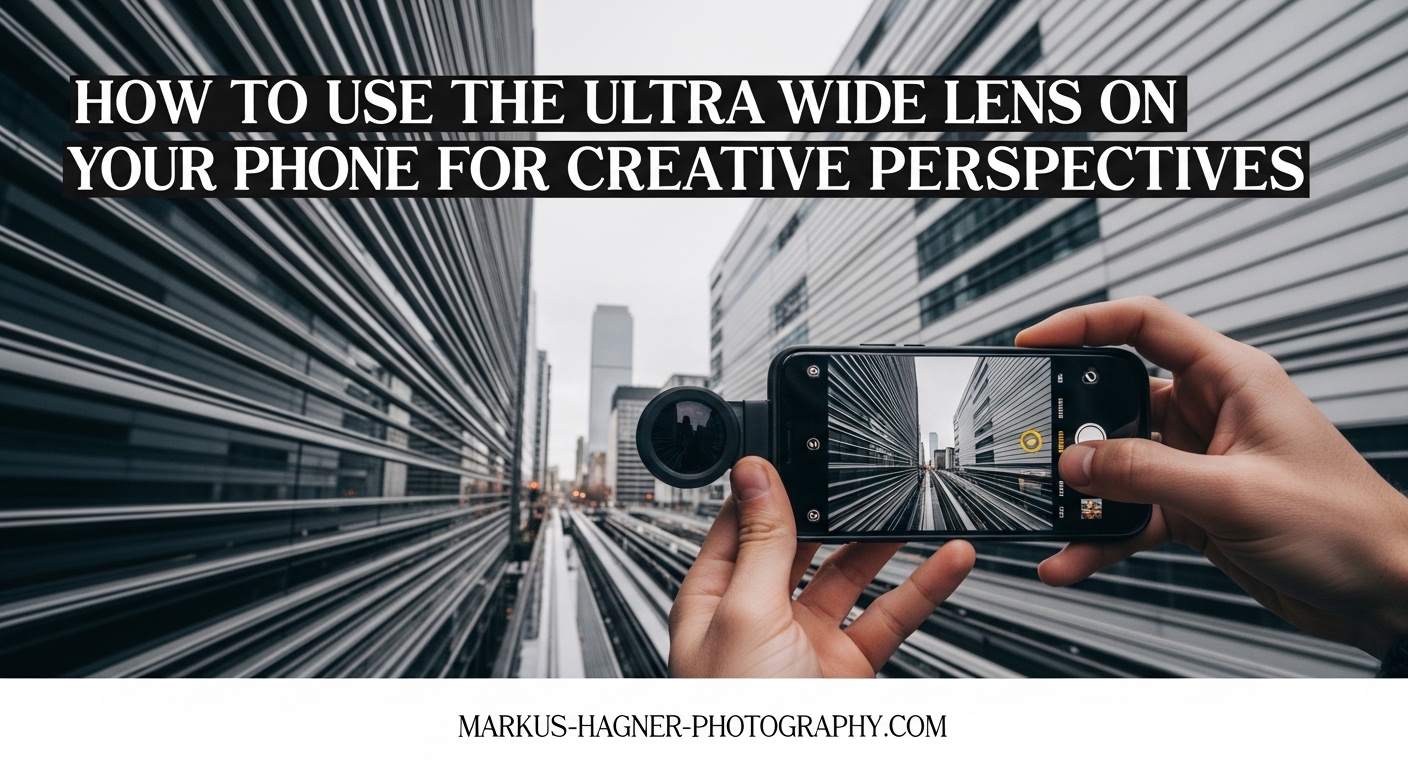
That little 0.5x button on your phone camera? Most people tap it accidentally and immediately switch back. I get it. Ultra wide photos often look strange, stretched, and nothing like what your eyes actually see. But here’s the thing: the ultra wide lens phone cameras now include is actually one of the most powerful creative tools in your pocket. After shooting with ultra wide lenses on phones for over five years, I’ve learned that this lens can transform ordinary scenes into dramatic, eye-catching images when you know how to use it properly.
In this guide, I’ll show you exactly how to use the ultra wide lens on your phone for creative perspectives. You’ll learn why distortion happens, how to control it, and specific techniques that will make your photos stand out from the typical flat snapshots most people capture.
What Is an Ultra Wide Lens on Your Phone?
An ultra wide lens on a smartphone typically has a focal length between 13mm and 16mm (35mm equivalent), which is significantly wider than the standard 24-28mm main camera on most phones. This translates to a field of view of 120 degrees or more, allowing you to capture roughly three times as much scene horizontally as your main camera.
The key difference between wide and ultra wide lenses comes down to that focal length number. A wide lens might capture 80-100 degrees, while ultra wide pushes beyond 120 degrees. This expanded view fundamentally changes how you compose shots and interact with your subjects.
Phone manufacturers implement ultra wide lenses differently. iPhones since the 11 series feature a 13mm ultra wide with a fixed aperture. Samsung’s Galaxy S series uses a 12mm equivalent that captures even more scene. Google Pixels offer a 17mm ultra wide that’s slightly less extreme but produces cleaner results in challenging light. Understanding your specific phone’s implementation helps you work within its strengths and limitations.
One thing to note: ultra wide lenses on phones typically use smaller sensors and have narrower apertures (often f/2.4 or smaller) compared to the main camera. This means less light gathering capability and sometimes lower resolution. The megapixel count is often reduced too. A 50MP main sensor might only deliver 12MP from the ultra wide. These aren’t deal-breakers, just factors to consider when choosing which lens to use.
Understanding Distortion: The Ultra Wide Challenge
Here’s what frustrates most people about ultra wide photography: distortion. There are actually two types you’ll encounter, and understanding both is crucial for creative control.
Barrel distortion makes straight lines appear to curve outward, like the sides of a barrel. This is inherent to the optical design of ultra wide lenses and is most visible at the edges of your frame. Buildings that should stand straight might lean outward, and horizons can appear curved.
Perspective distortion is different. This happens when objects close to the lens appear dramatically larger than those farther away. It’s not a lens flaw but a result of the extreme field of view. Get too close to a person’s face with an ultra wide, and their nose will look enormous while their ears seem tiny.
Here’s the creative secret: what many call distortion is actually perspective exaggeration, and you can use it intentionally. That same effect that makes faces look weird can make a small flower look towering against a vast landscape. The key is knowing when distortion helps your image and when it hurts it.
Creative Techniques for Ultra Wide Phone Photography
Now let’s get into the practical techniques that will transform your ultra wide shots from awkward to artistic.
Technique 1: Foreground Emphasis for Dramatic Depth
The most powerful ultra wide technique is getting close to something interesting in the foreground. I’m talking inches away. When you position a subject near the lens and include a sweeping background, the ultra wide exaggerates the size relationship between foreground and background.
Try this: find a textured rock, a patch of wildflowers, or even your shoes. Get the camera within 6 inches of that foreground element. Now compose so the foreground fills the bottom third of your frame while the background stretches above. The result? That small rock now looks monumental, and the distant mountains feel vast and epic.
The mistake I see most often is shooting ultra wide from standing height without any foreground interest. This produces flat, boring images with too much empty space. Always look for something to anchor the bottom of your frame.
Technique 2: Leading Lines and Converging Lines
Ultra wide lenses excel at emphasizing lines that draw the viewer into a scene. Roads, fences, shorelines, and architectural elements all become powerful compositional tools when shot wide.
When you position leading lines starting from the bottom corners of your frame and pointing inward, the ultra wide’s distortion actually helps by making those lines appear to converge more dramatically toward a vanishing point. This creates a strong sense of depth and pulls the viewer’s eye exactly where you want it.
Converging lines work particularly well in urban environments. Stand at the end of a corridor, alley, or hallway and watch how the walls seem to race toward each other in the distance. The ultra wide exaggerates this effect, creating almost tunnel-like perspectives that feel dynamic and engaging.
Technique 3: Low Angle Shots for Scale Exaggeration
Drop your phone to the ground. Seriously, get it dirty. Low angles with ultra wide lenses create some of the most dramatic perspectives possible in mobile photography.
When you shoot from ground level, everything above the camera appears to tower upward. A small child becomes a giant. A modest building feels like a skyscraper. A simple puddle transforms into a mirror reflecting an entire world above.
The combination of low angle plus ultra wide field of view is particularly powerful for full-body portraits. Have your subject stand with feet slightly closer to the camera than their head. This elongates their legs in a flattering way while keeping their face at a reasonable distance from the lens. Just keep their face centered to avoid the stretched-face effect that ruins so many ultra wide portraits.
Technique 4: Environmental Portraits (With Care)
I mentioned portrait problems earlier, but ultra wide can work beautifully for environmental portraits when you follow the rules. The goal is to show your subject within their surroundings, telling a story about place and context.
Keep your subject centered horizontally in the frame. The center of an ultra wide image has the least distortion. Position them at least 4-5 feet from the camera. This distance minimizes the perspective distortion that stretches facial features. Frame them relatively small within a larger scene, perhaps taking up only the middle third of your composition.
This approach works brilliantly for travel photography, showing someone experiencing a place rather than just standing in front of it. The Taj Mahal becomes more than a backdrop; it becomes part of a narrative about your subject’s journey.
Technique 5: Architecture and Interior Photography
Real estate agents and interior designers love ultra wide lenses for good reason. When you need to show an entire room in a single frame, nothing else works as well.
For architecture, try to keep your phone level rather than tilting up or down. Tilting causes vertical lines to converge dramatically, making buildings look like they’re falling backward. Sometimes this creates a cool effect, but if you want straight lines, keep that phone parallel to the ground.
For interiors, position yourself in a corner to maximize the sense of space. Include foreground elements like furniture edges to add depth layers. And watch for mirrors or windows that might reflect you or your phone back into the shot.
Technique 6: Landscape Photography
Landscapes are where ultra wide lenses truly shine. The ability to capture sweeping vistas while emphasizing foreground elements creates images with incredible depth and dimension.
The secret to compelling ultra wide landscapes is the foreground-midground-background structure. Find an interesting rock, plant, or texture within arm’s reach. Position it prominently in your foreground. Include a middle element like a lake, field, or road. Let the sky, mountains, or horizon fill the background.
Golden hour and blue hour are particularly magical with ultra wide lenses. The expansive sky captures more of those gorgeous color gradients, and the wide field of view includes more of the landscape bathed in beautiful light.
Composition Rules for Ultra Wide Phone Shots
Standard composition rules apply to ultra wide photography, but they need adaptation. Here’s how to think about composition when shooting wider than you’re used to.
Center your subjects: The edges of an ultra wide frame are where distortion runs wild. Keep important subjects, especially people, toward the center third of your image. This prevents stretched faces and warped bodies.
Use the rule of thirds differently: Instead of placing subjects at the intersection points, use those lines to place your horizon or major dividing elements. The bottom third line works well for horizons when you want dramatic sky. The top third line emphasizes interesting foreground terrain.
Layer your composition: Every ultra wide image benefits from clear layers. Foreground element, middle ground subject, background context. Without these layers, ultra wide images feel flat despite capturing so much scene.
Avoid cluttered backgrounds: The ultra wide captures everything, including distracting elements you might not notice while shooting. Scan the edges of your frame before pressing the shutter. Move your feet to eliminate clutter rather than just zooming with your fingers.
When to Use (and When NOT to Use) Your Ultra Wide Lens
Not every situation calls for ultra wide. Here’s a practical framework for choosing the right lens.
Use ultra wide for:
- Landscapes with interesting foreground elements
- Interior spaces and real estate
- Architecture (when showing entire buildings or spaces)
- Environmental portraits showing context
- Group shots in tight spaces
- Travel scenes where you want to capture the scale of a place
- Creative effects that exaggerate perspective
Avoid ultra wide for:
- Close-up portraits (unless you want that distorted look intentionally)
- Product photography (distortion makes products look inaccurate)
- Low-light situations (the smaller aperture lets in less light)
- When you need maximum detail (main cameras have better resolution)
- Wildlife or distant subjects (they’ll appear tiny in the frame)
My rule of thumb: if I’m not getting close to something or trying to fit a lot into the frame, I probably don’t need the ultra wide. The main camera handles most situations better.
Common Ultra Wide Photography Mistakes to Avoid
After years of shooting and reviewing countless photos from forum discussions, these are the mistakes I see repeatedly.
Mistake 1: Using ultra wide for close-up portraits. This is the number one complaint I hear. People put their phone close to someone’s face, switch to ultra wide, and wonder why their friend looks like an alien. The solution is simple: never use ultra wide for headshots. Switch to your main camera or telephoto instead.
Mistake 2: Ignoring edge distortion on subjects. Even at portrait distance, people positioned at the edges of ultra wide frames look stretched. If you must include people in ultra wide shots, keep them centered.
Mistake 3: Not getting close enough to foreground. Ultra wide images need foreground interest, and that interest needs to be close. Six inches away is not too close. Two feet away is probably too far for dramatic effect.
Mistake 4: Shooting in low light without awareness. That f/2.4 aperture means your ultra wide needs more light or longer exposure times. In dim conditions, brace your phone against something solid or expect noise in your images.
Editing Tips for Ultra Wide Phone Photos
Post-processing can salvage problem shots and enhance already-good ones. Here’s what works for ultra wide images.
Many phones now include built-in distortion correction. On iPhones, check Settings > Camera > Composition for “Ultra Wide Shape Correction.” This automatically reduces barrel distortion, though it crops your image slightly. Android phones often have similar options in camera settings.
For manual correction, apps like Adobe Lightroom Mobile and Google Snapseed include lens correction tools. The key is finding the balance between fixing distortion and maintaining the dramatic perspective that makes ultra wide images special.
When all else fails, crop. Removing the outer 10-15% of an ultra wide image eliminates the most distorted areas while still leaving you with a wider-than-normal perspective.
Frequently Asked Questions
What is the 20-60-20 rule in photography?
The 20-60-20 rule suggests that in any portfolio, 20% of images will be excellent, 60% will be average, and 20% will be below average. This helps photographers set realistic expectations and focus on improving that middle 60% through practice and technique refinement.
What lens will give you the widest perspective?
Fisheye lenses provide the widest perspective, with focal lengths as short as 8mm capturing up to 180 degrees. For phones, the ultra wide lens (typically 13-16mm) gives the widest native perspective, capturing roughly 120 degrees of view.
Is an ultra wide lens worth it?
Yes, an ultra wide lens is worth it if you shoot landscapes, architecture, interiors, or want creative perspective effects. It expands your creative options dramatically and handles situations no other lens can. However, if you primarily shoot portraits or wildlife, you might use it rarely.
Why do my ultra wide photos look distorted?
Ultra wide photos appear distorted because the lens captures a much wider field of view than human vision, exaggerating the size difference between near and far objects. Objects close to the lens appear larger, while edge areas show barrel distortion. Keep subjects centered and at moderate distance to minimize this effect.
How do I avoid distortion with ultra wide lens?
To avoid distortion with an ultra wide lens, keep important subjects centered in the frame, maintain at least 4-5 feet distance from people, hold your phone level rather than tilted, and use built-in shape correction features. For architecture, shoot from further back and crop later rather than tilting up at buildings.
Conclusion
Learning how to use the ultra wide lens on your phone for creative perspectives that simply don’t exist with standard focal lengths. The key is understanding that distortion isn’t something to avoid entirely but something to control and use intentionally. Get close to foreground subjects, center your people, look for leading lines, and don’t be afraid to get your phone dirty shooting from ground level.
Your assignment for this week: take ten ultra wide shots using the foreground emphasis technique. Find interesting textures within arm’s reach and compose them against larger backgrounds. Review your results, and you’ll start seeing the world differently through that 0.5x button.