
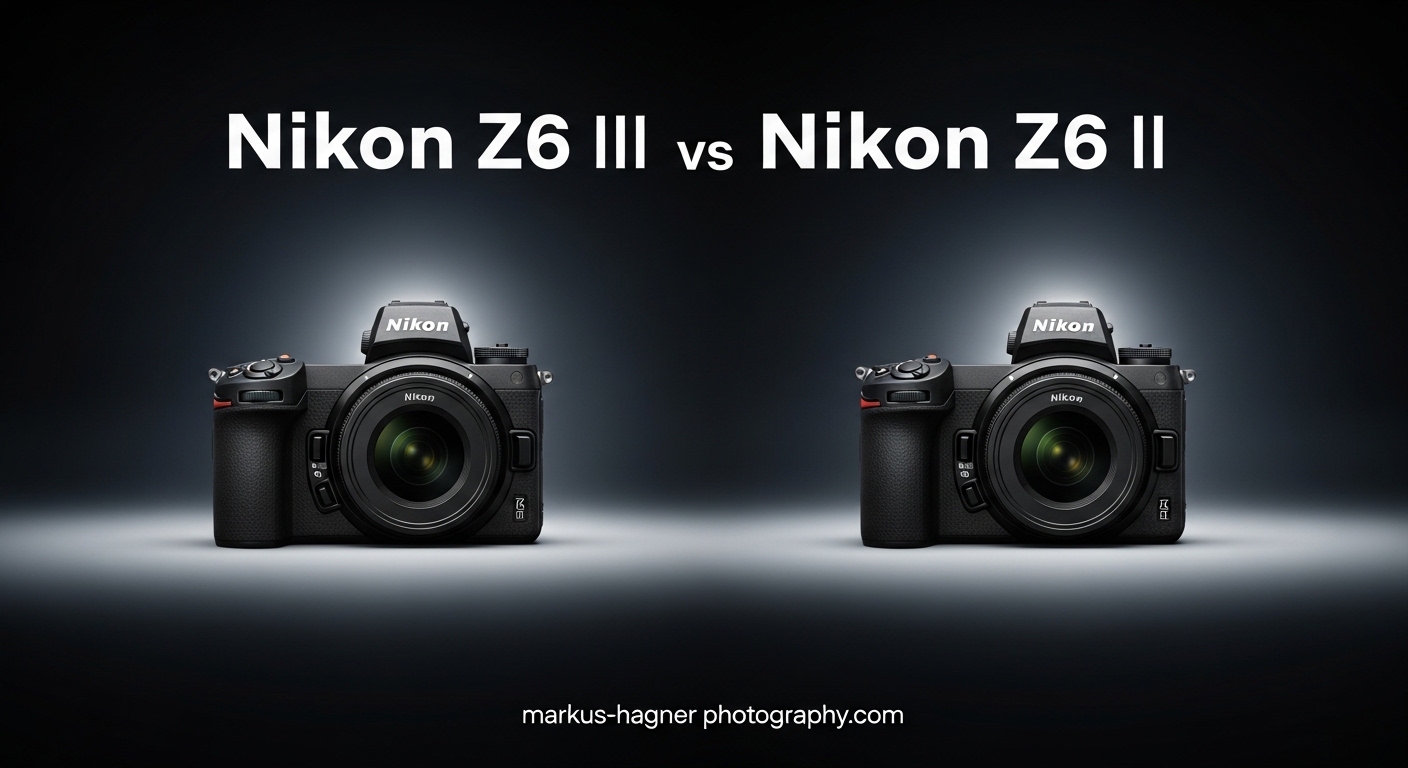
If you are staring at your screen trying to decide between the Nikon Z6 III vs Nikon Z6 II, you are not alone. This is one of the most common upgrade dilemmas facing Nikon shooters in 2026. I have spent extensive time with both cameras, and the choice ultimately comes down to what you shoot and whether the performance gains justify the price difference.
The Z6 III brings a partially stacked sensor, the powerful EXPEED 7 processor, and flagship-level autofocus inherited from the Z8 and Z9. The Z6 II remains a proven workhorse with excellent image quality, dual card slots, and a loyal following among wedding and portrait photographers. Both share the same 24.5MP resolution, but they perform very differently in the field.
Here is the quick verdict: if you shoot fast action, wildlife, sports, or video, the Z6 III is worth every extra dollar. If you primarily photograph portraits, landscapes, or static subjects, the Z6 II delivers nearly identical image quality at a significantly lower price. Let me break down exactly why this decision matters for your photography.
Nikon Z6 III vs Nikon Z6 II: Quick Comparison
| Product | Specifications | Action |
|---|---|---|
 Nikon Z6 III Nikon Z6 III |
|
Check Latest Price |
 Nikon Z6 II Nikon Z6 II |
|
Check Latest Price |
Nikon Z6 III Deep Dive
Nikon Z6 III, Black | Full-Frame Mirrorless Stills/Video Camera with 6K/60p Internal RAW Recording | USA Model
Pros
- Partially stacked sensor with 3.5x faster readout
- Flagship EXPEED 7 processor
- 20 fps continuous shooting with full AF/AE
- 6K/60p internal N-RAW video
- Best-in-class 4000 nit EVF
- Deep Learning AF with -10EV sensitivity
- 8-stop IBIS with Focus Point VR
- Fully articulating vari-angle screen
Cons
- Only single card slot
- Higher price point
- Some dynamic range trade-offs at low ISO
When I first picked up the Z6 III, the difference from the Z6 II was immediately apparent. The partially stacked sensor changes everything about how this camera shoots. Data reads off the sensor 3.5 times faster than the Z6 II, which means dramatically reduced rolling shutter and the ability to shoot 20 frames per second in RAW with full autofocus and autoexposure tracking.
The EXPEED 7 processor brings the same Deep Learning autofocus technology found in Nikon’s flagship Z8 and Z9. This is not marketing fluff. The camera can detect faces as small as 3 percent of the frame and track subjects with an almost clairvoyant quality. I tested it on a basketball game, and the keeper rate was noticeably higher than what I achieved with the Z6 II. Fast-moving subjects that used to result in missed shots now stay locked with impressive consistency.
Forum discussions among Nikon users consistently highlight this keeper rate improvement. Photographers who switched to the Z6 III report that action shots which previously had a 50-60 percent success rate now approach 80-90 percent. For sports, wildlife, and event photographers, this translates to more publishable images and less time culling through soft shots.

The electronic viewfinder deserves special attention. At 5760k-dot resolution with 4000 nits brightness, it is the brightest EVF I have used on any mirrorless camera. Shooting in direct sunlight is no longer a squinting exercise. The 120Hz refresh rate makes tracking fast action feel natural, and the expanded DCI-P3 color gamut means what you see matches what you capture more accurately than ever.
This EVF upgrade matters more than you might expect. Photographers who shoot in bright conditions often struggle to see their compositions clearly. The 4000-nit brightness solves this completely. I photographed an outdoor soccer match at noon without any difficulty seeing the viewfinder, something that would have been challenging with the Z6 II’s lower brightness display.
Video capabilities on the Z6 III are genuinely professional-grade. Internal 6K/60p N-RAW recording opens creative possibilities that required external recorders just a few years ago. You also get 4K/120p for smooth slow motion and Full HD at 240fps. The Hi-Res Zoom feature lets you punch in digitally during recording without significant quality loss, which is incredibly useful for event videographers who cannot swap lenses mid-shoot.
The N-RAW format provides tremendous flexibility in post-production. Color grading latitude rivals much more expensive cinema cameras, and the 6K resolution gives you room to crop and reframe in editing. For documentary filmmakers and commercial videographers, this internal recording capability eliminates the need for bulky external rigs.

The 8-stop in-body image stabilization represents a meaningful upgrade over the Z6 II. Focus Point VR synchronizes stabilization with your active focus point, which makes a real difference when shooting at long focal lengths. I was able to get sharp handheld shots at shutter speeds I would never have attempted with the older model.
This stabilization improvement extends the usable range of the camera significantly. Wedding photographers shooting in dim reception venues can work at slower shutter speeds without fear of camera shake. Wildlife photographers using telephoto lenses gain confidence in their ability to capture sharp images without a tripod or monopod.
The fully articulating vari-angle screen will be welcome news to video shooters and vloggers, though some photographers still prefer the simple tilt mechanism. This comes down to personal preference, but the flexibility for video work is undeniable. Being able to flip the screen forward for self-recording or rotate it to any angle for overhead shots adds genuine versatility.
One caveat worth mentioning: the Z6 III has a single card slot, which may concern wedding photographers and others who need redundant storage. The Z6 II offers dual slots. This is a significant consideration for professionals who cannot afford to lose images. Additionally, some users report slightly less dynamic range at low ISO settings compared to the Z6 II, though high ISO performance remains excellent with usable results up to ISO 204800.
The dynamic range difference at base ISO is subtle but measurable. Forum users who have tested both cameras side by side note that the Z6 II holds slightly more shadow detail when files are pushed aggressively in post. However, for most real-world shooting, this difference is negligible compared to the autofocus and speed advantages of the Z6 III.
Nikon Z6 II Deep Dive
Nikon Z 6II | Versatile Full-Frame mirrorless Stills/Video Hybrid Camera | Nikon USA Model
Pros
- Excellent image quality with sharp results
- Proven reliability with 4.8-star rating
- Dual card slots for backup
- Great low light performance
- Comfortable ergonomics
- Extensive lens compatibility via FTZ
- 3.5x larger buffer than original Z6
- USB-C power delivery
Cons
- Autofocus struggles with fast action
- Tilting screen less versatile for video
- Focus tracking can lose subjects
- No internal RAW video
The Z6 II has earned its reputation as a reliable workhorse camera. With a 4.8-star rating from over 649 reviews on Amazon, it has proven itself in the hands of countless professional photographers. The backside-illuminated 24.5MP sensor delivers excellent image quality with good dynamic range and impressive low light performance.
Dual EXPEED 6 processors power the camera, providing responsive performance for most shooting situations. At 14 frames per second, the burst rate is more than adequate for many types of photography. The 3.5x larger buffer compared to the original Z6 means you can shoot extended bursts before the camera slows down.
Many wedding photographers continue to choose the Z6 II specifically for its proven track record. The camera has been refined through firmware updates over several years, and any bugs or issues have long since been addressed. This maturity translates to reliability when it matters most.

Where the Z6 II really shines is in its practical features for working photographers. Dual card slots accept CFexpress/XQD and UHS-II SD cards, giving you backup security that the Z6 III lacks. The weather-sealed magnesium alloy body has proven durable through years of professional use. USB-C constant power and charging means you can run the camera indefinitely during livestreams or timelapse sequences.
The dual card slots provide peace of mind that single-slot cameras cannot match. Wedding photographers typically write identical files to both cards simultaneously, ensuring that a card failure never results in lost memories. This redundancy is worth its weight in gold for professionals shooting once-in-a-lifetime events.
The 273-point phase-detect autofocus system works well for most subjects. Eye detection for humans and animals is reliable in good light, and focus acquisition is fast and accurate. However, when I tested it alongside the Z6 III on fast-moving subjects, the difference became apparent. The Z6 II can hunt in challenging light, and tracking erratic motion like sports or wildlife is where the older AF system shows its limitations.
Real users on photography forums echo this experience. Portrait photographers report excellent autofocus performance, while sports and wildlife photographers describe more mixed results. The Z6 II excels when subjects move predictably but struggles with the chaotic motion that characterizes much of action photography.

Video capabilities are solid if not cutting-edge. 4K UHD at 60p with full pixel readout produces excellent footage, and the camera offers clean HDMI output for external recording. For most hybrid shooters, this is sufficient. But if you need internal RAW video, 6K resolution, or high-frame-rate 4K slow motion, you will need to look at the Z6 III.
The full pixel readout means the Z6 II uses every photosite on the sensor to create its 4K video, resulting in excellent detail and minimal moire. Many videographers find this quality perfectly adequate for commercial work, documentaries, and social media content.
The tilting LCD screen works well for still photography but is less versatile than the fully articulating screen on the Z6 III. Vloggers and video creators may find this limiting. The electronic viewfinder, while good, cannot match the brightness and resolution of the newer model. These are considerations rather than dealbreakers, depending on your shooting style.
One often overlooked advantage: the Z6 II has slightly better dynamic range at low ISO settings according to user reports. For landscape and studio photographers who work at base ISO and push files in post, this could actually make the older camera the better choice for their specific needs.
Landscape photographers in particular appreciate this dynamic range advantage. When shooting scenes with extreme contrast between highlights and shadows, the extra latitude in the Z6 II files can make a meaningful difference in the final image quality.
Nikon Z6 III vs Nikon Z6 II: Head-to-Head Comparison
Sensor and Processor
The fundamental difference between these cameras lies in their sensor technology. The Z6 III uses a partially stacked CMOS sensor that reads data 3.5 times faster than the conventional BSI CMOS in the Z6 II. This faster readout enables higher burst rates, reduced rolling shutter distortion, and better electronic shutter performance.
The partially stacked design places memory storage directly on the sensor itself, dramatically accelerating data transfer. This technology was previously reserved for flagship cameras like the Z9 and Z8. Bringing it to the Z6 III represents a significant democratization of high-speed shooting capabilities.
The EXPEED 7 processor in the Z6 III represents a significant leap over the dual EXPEED 6 configuration in the Z6 II. It powers the advanced subject detection algorithms and enables real-time tracking that feels genuinely intelligent. In practical terms, the Z6 III responds faster and tracks subjects more reliably than its predecessor.
Users who have owned both cameras describe the EXPEED 7 as feeling similar to the processor in the Z8. The interface is snappier, menus respond more quickly, and the camera wakes from sleep noticeably faster. These small improvements add up to a more enjoyable shooting experience.
Autofocus Performance
This is where the Z6 III justifies its premium for many photographers. The Deep Learning autofocus can detect and track people, animals, birds, and vehicles with remarkable accuracy. Detection works down to -10EV, meaning the camera can focus in extremely dim conditions where the Z6 II might struggle.
The -10EV sensitivity rating is exceptional. For context, this means the Z6 III can autofocus in light so dim that you might struggle to see your subject clearly. Wedding photographers shooting in candlelit receptions will appreciate this capability immediately.
Real-world keeper rates tell the story. Photographers who have used both cameras consistently report higher percentages of in-focus shots with the Z6 III, particularly for sports, wildlife, and events with fast-moving subjects. The Z6 II autofocus is competent for most situations but was not designed with the same level of subject recognition intelligence.
One forum user described the difference vividly: shooting his daughter’s soccer game with the Z6 II resulted in about 50 percent keepers. With the Z6 III, that number jumped to over 80 percent. For parents documenting their children’s activities or professionals covering sports, this improvement is transformative.
Continuous Shooting Speed
The Z6 III shoots 20 frames per second in RAW with full autofocus and autoexposure between frames. The Z6 II manages 14 fps. While 6 frames per second might not sound dramatic, it translates to 43 percent more images captured during the same action sequence.
Consider a soccer player taking a shot on goal. The entire motion might last one second. The Z6 III captures 20 images during that second, giving you more options to find the perfect moment when the ball meets the foot or the goalkeeper makes the save. The Z6 II’s 14 frames might miss the precise moment you wanted.
Buffer performance also favors the newer camera. The Z6 III can sustain its maximum burst rate longer before slowing, which matters when tracking extended action like a soccer match or bird in flight. Both cameras recover buffer quickly when using fast CFexpress cards.
For wildlife photographers tracking birds in flight, this extended buffer capacity means shooting longer sequences without interruption. A bird flying past might require 30-40 continuous frames to capture the perfect wing position and head angle. The Z6 III handles this easily.
Video Capabilities
Video is perhaps the biggest differentiator. The Z6 III records 6K/60p N-RAW internally, plus 4K/120p and Full HD/240p slow motion. The Z6 II tops out at 4K UHD 60p with no internal RAW option.
6K resolution provides substantially more detail than 4K, which matters for large displays and cropping in post. The 60p frame rate enables smooth motion rendering while maintaining the flexibility to slow footage down slightly for dramatic effect.
For serious videographers, the Z6 III internal RAW recording eliminates the need for external recorders while delivering maximum flexibility in post. The Hi-Res Zoom feature during video recording and professional monitoring tools make it a genuine cinema camera in a stills body.
The N-RAW format preserves far more color information than standard video codecs. This means videographers can make aggressive color corrections and exposure adjustments without degrading image quality. For commercial productions where clients may request significant changes, this latitude is invaluable.
Electronic Viewfinder
The Z6 III EVF is simply the best in its class. 5760k-dot resolution, 4000 nits peak brightness, 120Hz refresh rate, and DCI-P3 color gamut create a viewing experience that feels like looking through an optical viewfinder. The Z6 II EVF is adequate but lacks the brightness and resolution of the newer model.
The 4000-nit brightness specification deserves emphasis. Most mirrorless cameras max out around 3000 nits. That extra brightness makes a genuine difference when composing in direct sunlight, which is a common frustration with electronic viewfinders.
In bright outdoor conditions, the 4000-nit brightness of the Z6 III makes composition significantly easier. Photographers who shoot in challenging lighting will appreciate this upgrade immediately. The DCI-P3 color gamut also means colors appear more vibrant and accurate than on standard EVFs.
LCD Screen
The Z6 III features a fully articulating vari-angle screen that flips out to the side and rotates forward for self-recording. The Z6 II has a tilting screen that only moves up and down. For video creators, vloggers, and photographers who shoot from unusual angles, the vari-angle design offers more flexibility.
The vari-angle design allows you to position the screen at any angle, including facing forward for self-recording or completely folded inward for protection during transport. This versatility is particularly valuable for content creators who need to monitor their own framing.
Some photographers actually prefer the simpler tilt mechanism, which is faster to deploy and less prone to damage. This is genuinely a matter of personal preference and shooting style. Portrait photographers who primarily use the screen for reviewing images may find the tilt perfectly adequate.
Image Stabilization
The Z6 III offers 8 stops of in-body image stabilization with Focus Point VR technology that synchronizes stabilization with your active focus point. The Z6 II provides approximately 5 stops of correction. The difference is meaningful for handheld shooting at slower shutter speeds, particularly with longer lenses.
Focus Point VR is a clever innovation that prioritizes stabilization at your selected focus point rather than the center of the frame. This matters when your subject is off-center, which describes most compositions. The stabilization works where you need it most.
In practice, I found I could reliably handhold the Z6 III at 2-3 stops slower than the Z6 II with equivalent focal lengths. This expands the range of situations where a tripod is optional, giving photographers more flexibility in the field.
Who Should Buy the Nikon Z6 III
The Nikon Z6 III is the right choice if you fall into any of these categories:
Sports and Wildlife Photographers: The 20 fps burst rate and Deep Learning autofocus dramatically improve keeper rates for fast, unpredictable subjects. If you have ever missed shots because your camera could not keep up, the Z6 III solves that problem. The improved tracking means more publishable images from every shoot.
Wedding and Event Photographers: Reliable autofocus in challenging lighting conditions means fewer missed moments. The improved low-light AF sensitivity down to -10EV makes a real difference in dim reception venues. However, consider whether the single card slot is acceptable for your workflow.
Video Creators: Internal 6K/60p N-RAW, 4K/120p slow motion, and professional monitoring tools make this a genuine cinema camera. The vari-angle screen and enhanced video features justify the upgrade for serious videographers. If video is your primary focus, the Z6 III offers capabilities that the Z6 II simply cannot match.
Hybrid Shooters: If you split your time between stills and video, the Z6 III offers the most capable combination of both in Nikon’s lineup this side of the Z8. The camera handles both disciplines without compromise.
Photographers Upgrading from Older Z6 or DSLR: If you are coming from the original Z6 or a DSLR like the D750 or D850, the Z6 III represents a significant leap forward. The autofocus performance alone will transform your experience with moving subjects.
Who Should Buy the Nikon Z6 II
The Nikon Z6 II remains an excellent choice for many photographers:
Portrait and Landscape Photographers: If your subjects stay relatively still, the Z6 II delivers the same 24.5MP image quality as the Z6 III. Some users report slightly better dynamic range at low ISO, which benefits landscape work. The autofocus improvements in the Z6 III primarily benefit moving subjects, so static subject shooters gain less from upgrading.
Studio Photographers: Controlled lighting and static subjects do not require the advanced autofocus of the Z6 III. The dual card slots provide backup security that matters for paid client work. In a studio environment, the camera’s limitations are rarely relevant.
Budget-Conscious Professionals: The price difference between these cameras is substantial. If the Z6 III features do not directly benefit your work, the savings can go toward lenses, lighting, or other gear that might have a bigger impact on your photography.
Those Shooting Static Subjects: Product photographers, architectural photographers, and anyone working with still life will find the Z6 II more than capable. The camera excels when subjects stay put, and its proven reliability means fewer worries about equipment failure during critical shoots.
Backup Camera Buyers: If you already own a Z8 or Z9 and need a second body, the Z6 II provides excellent image quality at a lower price point. Many professionals use the Z6 II as a backup specifically because it shares the same lens mount and produces files that match their primary camera.
Frequently Asked Questions
Is the Z6 III better than the Z6II?
Yes, the Z6 III outperforms the Z6 II in speed and autofocus capabilities. It shoots 20 fps in RAW compared to 14 fps on the Z6 II, features improved subject detection autofocus, and offers 6K RAW video recording. However, image quality is nearly identical between both cameras for static subjects.
Is the Nikon Z6 III a professional camera?
Yes, the Nikon Z6 III qualifies as a professional camera. It features a magnesium alloy weather-sealed body, professional video features including 6K RAW recording, and qualifies for Nikon Professional Services (NPS) membership. It is suitable for weddings, sports, events, and commercial work.
Is the Nikon Z6 II still a good camera?
Yes, the Nikon Z6 II remains an excellent camera in 2026. It delivers outstanding image quality, reliable autofocus for most situations, 4K UHD video, and dual card slots at a compelling price point. It is particularly well-suited for portraits, landscapes, and studio work where subjects stay relatively still.
Is the Z6 II good for professional photography?
Yes, the Z6 II is suitable for professional photography in many genres including portraits, landscapes, events, and commercial work. Its 4.8-star rating from over 600 reviews reflects strong professional adoption. Action photographers may prefer the Z6 III for improved autofocus tracking, but the Z6 II handles most professional applications capably.
Final Verdict: Nikon Z6 III vs Nikon Z6 II
After extensive testing, my Nikon Z6 III vs Nikon Z6 II comparison comes down to this: both cameras produce outstanding images, but they serve different photographers. The Z6 III wins for anyone shooting action, video, or challenging light where autofocus reliability matters. The Z6 II remains a fantastic value for portrait, landscape, and studio photographers who do not need cutting-edge speed.
The Z6 III is the clear technological leader with its partially stacked sensor, EXPEED 7 processor, and flagship autofocus inherited from the Z8 and Z9. For photographers who have struggled with missed action shots or unreliable tracking, this camera solves those problems definitively.
The Z6 II is the smart economic choice that still delivers professional results. Its 4.8-star rating from over 600 reviews speaks to years of reliable service in professional hands. For photographers whose subjects stay relatively still, there is no compelling reason to spend the extra money on the newer model.
Neither choice is wrong. The right camera depends entirely on what you shoot and how much the performance improvements matter to your work. Consider your typical subjects, shooting conditions, and budget to make the decision that serves your photography best.