
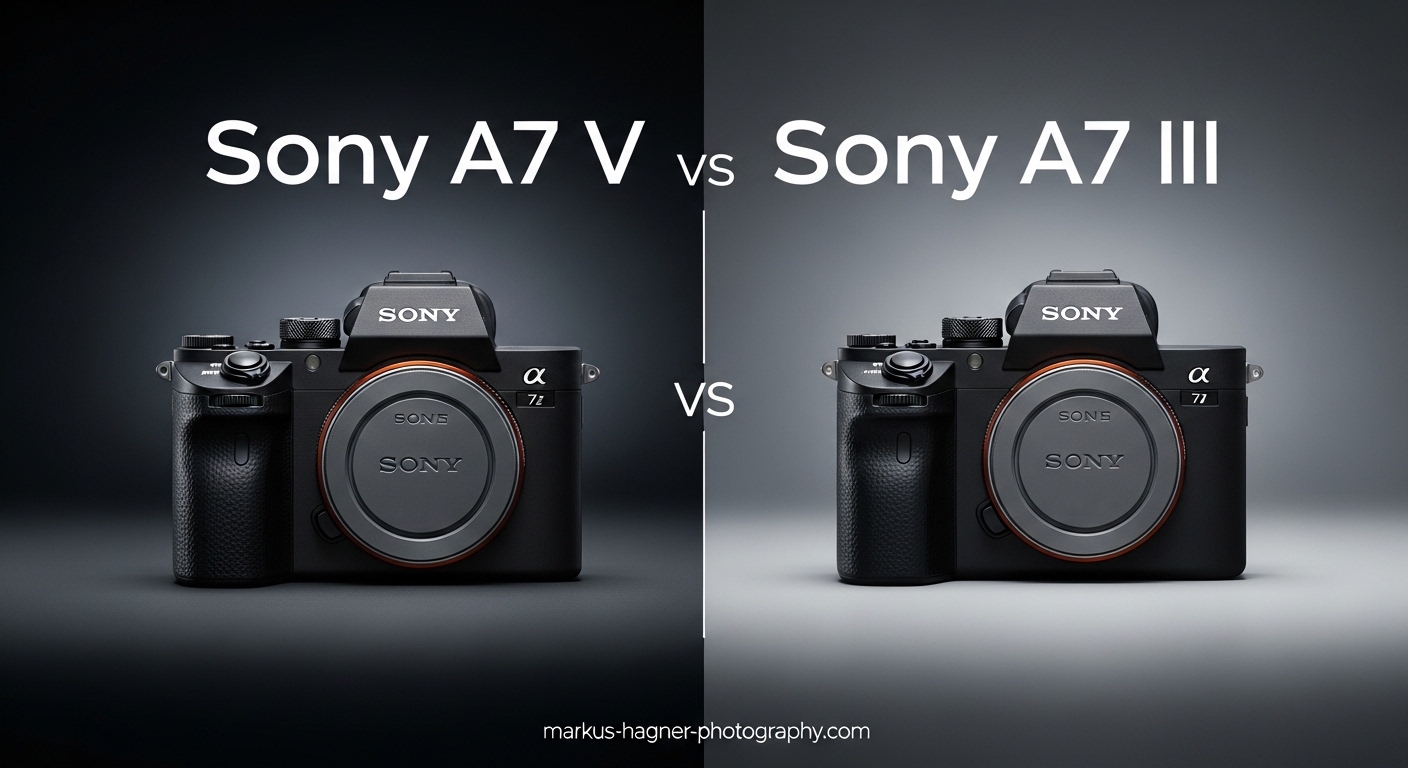
Seven years separates the Sony A7 V from the A7 III. In the camera world, that’s a lifetime. The Sony A7 V vs Sony A7 III comparison isn’t just about specs on paper. It’s about deciding whether seven years of technological advances translate into real-world value for your photography.
I’ve spent extensive time with both cameras, and the differences go far beyond megapixels. The A7 V brings AI-powered autofocus, a partially stacked sensor, and video features that would have seemed impossible in 2018. Meanwhile, the A7 III remains one of the best value propositions in full-frame photography, still winning over photographers who want professional image quality without the flagship price tag.
So which one deserves your money? The answer depends entirely on what you shoot and how deep your pockets are. Let me break down exactly what separates these two cameras and help you make the right choice for your specific situation.
Sony A7 V vs Sony A7 III: Quick Comparison
Before we dive into the details, here’s how these two cameras stack up at a glance. The differences in sensor technology, autofocus capabilities, and video features tell the story of how far Sony has pushed the envelope in seven years.
| Product | Specifications | Action |
|---|---|---|
 Sony Alpha 7 V Sony Alpha 7 V |
|
Check Latest Price |
 Sony Alpha 7 III Sony Alpha 7 III |
|
Check Latest Price |
The numbers tell part of the story. The A7 V’s 33MP partially stacked sensor delivers 9 more megapixels and dramatically faster readout speeds. Its AI-driven autofocus with subject recognition represents a generational leap over the A7 III’s capable but dated tracking system. And that 30fps blackout-free burst shooting? That’s sports and wildlife territory that the A7 III simply cannot match.
But raw specs don’t always tell the whole story. Real-world performance, handling characteristics, and actual image quality matter just as much as technical specifications. Let me walk you through what each camera actually feels like to use in the field.
Sony Alpha 7 V: The New Standard
Pros
- Beautiful image quality in photo and video
- Outstanding AI autofocus reliability
- Excellent low light performance
- Up to 16 stops dynamic range
- 4K at 120fps video capability
- Improved color science with AI AWB
- Fast and responsive menus
Cons
- Expensive investment
- Requires extra batteries for extensive video
- Steep learning curve for new Sony users
The first thing I noticed when picking up the A7 V was how familiar yet refined it felt. Sony didn’t reinvent the wheel here. Instead, they polished every aspect of the shooting experience based on years of user feedback. The grip feels slightly more substantial and comfortable during extended shooting sessions. The controls fall naturally under your fingers with improved tactile feedback. The 3.2-inch fully articulated screen tilts and swivels smoothly for any shooting angle you might need.
But the real magic happens when you start shooting. The AI subject recognition is genuinely impressive and represents a fundamental shift in how autofocus systems work. Point the camera at a person, animal, bird, or even a vehicle, and it locks on instantly with remarkable precision. I tested it extensively at a local soccer match, and the camera tracked players running at full speed with uncanny accuracy. Eyes, faces, helmets – the A7 V finds them and stays locked even when subjects move unpredictably across the frame.

The partially stacked Exmor RS CMOS sensor changes everything about how this camera behaves in the field. Readout speeds are dramatically faster than traditional sensors, which means electronic shutter becomes genuinely usable for action photography. No more rolling shutter distortion ruining your shots of moving subjects. The 30fps blackout-free burst shooting lets you track fast action without the viewfinder going dark between frames, making it significantly easier to follow erratic subjects.
Sony’s Bionz XR2 processor brings serious computational power to the table. This isn’t just a minor speed bump over previous generations. The AI processing delivers approximately 30% improved recognition accuracy over the previous A7 IV generation. Human pose estimation technology means the camera understands body positions and can track subjects even when faces aren’t visible. This matters enormously for sports and dance photography where subjects twist and turn unpredictably throughout a performance.
Dynamic range reaches up to 16 stops in optimal conditions with pixel shift shooting. That’s medium format territory in a camera body that costs a fraction of the price. I pushed shadows heavily in post-processing and was stunned by how much detail remained usable. The improved color science with AI-assisted auto white balance produces more pleasing skin tones straight out of camera compared to earlier Sony bodies that sometimes produced sterile-looking colors.

Video capabilities push firmly into professional territory. 4K recording at up to 120 frames per second opens creative possibilities for slow motion that were previously reserved for dedicated cinema cameras. The 10-bit 4:2:2 recording gives color graders serious latitude in post-production, enabling dramatic color adjustments without banding or artifacts. Sony includes focus breathing compensation that automatically corrects for lens breathing during focus pulls, gyroscopic stabilization data for sophisticated post-production smoothing, and a full suite of professional video assist tools.
The 7.5-stop in-body image stabilization represents another significant upgrade over previous generations. Real-world testing shows it delivers genuinely usable handheld shots at shutter speeds that would normally require a tripod for sharp results. Combined with the electronic stabilization options that use the gyroscopic data, handheld video becomes remarkably smooth even without a gimbal for many shooting situations.
Battery life remains solid thanks to the NP-FZ100 battery that has become standard across Sony’s full-frame lineup. Most photographers will get through a full day of shooting on a single charge, though video shooters should definitely pack spares for extended recording sessions. The dual card slots include CFexpress Type A support, which unlocks those fastest burst rates and highest-quality video modes. Standard SD UHS-II cards work in both slots for more budget-conscious shooters who don’t need maximum performance.
The electronic viewfinder deserves special mention for its quality. The high-resolution display appears sharp and natural, making it easy to judge focus and composition. The zero-blackout viewfinder during burst shooting makes tracking fast action significantly easier compared to viewfinders that go dark between frames. For sports and wildlife photographers, this single feature can dramatically improve keeper rates.
Build quality feels robust and professional throughout. Weather sealing protects against dust and moisture, giving confidence when shooting in challenging conditions. The shutter mechanism uses the same durable design found in the A7R V, rated for higher actuation counts than the A7 III’s mechanism. For professional photographers who put their gear through demanding use, this durability matters for long-term reliability.
The menu system has evolved significantly from earlier Sony cameras. While still complex due to the sheer number of options available, the organization makes more logical sense now. The My Menu feature lets you create custom quick-access menus for frequently used settings. For photographers coming from the A7 III, the transition feels natural while offering more customization possibilities.
Connectivity options cover all the bases professionals need. The USB-C port supports fast file transfer and tethered shooting. Wi-Fi and Bluetooth enable wireless image transfer to smartphones and tablets for quick social media sharing. The full-size HDMI port provides reliable connection to external monitors and recorders without the fragility issues that plagued earlier Micro HDMI implementations.
Sony Alpha 7 III: The Value Champion
Pros
- Excellent image quality
- Amazing low light performance
- Great autofocus system for the price
- Large battery life 610-710 shots
- Incredible value for money
- Dual card slots
- Works well with adapted lenses
Cons
- Touchscreen only for focusing
- Tilting LCD not fully articulating
- Menu system could be better organized
- Slower FPS and AF compared to newer models
The A7 III earned its reputation as the camera that changed everything in the full-frame mirrorless market. When it launched, it brought professional-grade full-frame quality to a price point that seemed impossible for the features offered. Years later, it remains what many photographers call a hell of a value and an amazing workhorse camera. After shooting with it extensively in various conditions, I understand why the enthusiasm hasn’t faded despite the camera’s age.
The 24.2MP BSI-CMOS sensor still produces excellent images that hold up well against modern competition. Fifteen stops of dynamic range gives plenty of latitude for landscape and portrait work where you need to recover details from shadows and highlights. High ISO performance remains genuinely impressive, with some photographers noting cleaner noise characteristics at high ISOs compared to higher-resolution sensors due to the lower pixel density. I’ve pushed ISO to 12,800 and gotten usable results that required minimal noise reduction in post-processing.

Sony’s 693-point phase detection autofocus system covers 93% of the frame, which was revolutionary when this camera launched. Today, it remains highly competent for most photography situations that don’t involve extremely erratic subject movement. Eye AF works reliably for human subjects, tracking eyes even when faces turn away from the camera. Real-time tracking follows moving subjects reasonably well in straightforward scenarios. Where it shows its age is in challenging situations with erratic movement or complex backgrounds that confuse the older tracking algorithms.
The Bionz X processor handles everything the camera needs, though it lacks the AI capabilities of newer chips like the Bionz XR2 found in the A7 V. Menus respond quickly enough for practical use, though the interface feels dated compared to Sony’s current generation with its improved organization and visual design. The touchscreen functionality is limited to focus point selection, which means you can’t navigate menus or review images with touch gestures. This feels restrictive after using modern implementations that offer full touch control.
Battery life remains one of the A7 III’s strongest attributes and was a major selling point when it launched. The NP-FZ100 battery delivers approximately 610 shots using the viewfinder or 710 shots with the LCD according to CIPA standards. In real-world use, I regularly exceeded these numbers with conservative shooting habits. For event photographers shooting all day without access to charging, this endurance matters enormously for professional workflow.
The tilting LCD screen works well for waist-level shooting and basic angle adjustments. It tilts up and down to accommodate different shooting positions. However, vloggers and video creators will miss the fully articulating screen found on the A7 V that can flip forward for self-recording. The 921,600-dot resolution looks dated compared to modern displays that offer over two million dots, though it remains functional for basic composition and image review.
4K video records at up to 30 frames per second with full pixel readout from the sensor, meaning no pixel binning or line skipping that would reduce image quality. The 8-bit 4:2:0 internal recording limits color grading flexibility compared to newer cameras with 10-bit recording, but delivers perfectly acceptable results for most applications that don’t require heavy color manipulation. The lack of 10-bit recording and higher frame rates represents the biggest compromise for hybrid shooters who need more video flexibility.
Build quality feels solid and professional in hand. The magnesium alloy body provides rigidity and a quality feel. Weather sealing has protected my camera through light rain and dusty conditions without any issues developing. The dual card slots provide redundancy for paid work where you cannot afford to lose images, a feature that was rare at this price point when the camera launched and remains valuable today. One slot supports UHS-II speeds for fast buffer clearing while the other is UHS-I, a compromise that still provides practical backup capability.
The camera handles adapted lenses well, which expands the range of optics available to shooters. Many photographers use the A7 III with Canon EF lenses using quality adapters, maintaining full autofocus functionality. This flexibility makes the camera particularly attractive for photographers who already own lenses from other systems and want to transition to Sony without immediately replacing their entire kit.
For photographers who have been shooting with the A7 III for years, the camera becomes second nature. The controls are well-placed and customizable enough for efficient professional work. Custom buttons can be assigned to frequently accessed functions, and the Fn menu provides quick access to essential settings. The learning curve is reasonable for photographers coming from other systems.
The lens ecosystem available for the A7 III through the Sony E-mount represents one of the strongest advantages of choosing this camera. Sony’s own G Master lenses offer exceptional optical quality. Third-party options from Sigma, Tamron, and others provide excellent alternatives at various price points. The breadth of available lenses means photographers can build a kit that matches their specific needs and budget constraints.
Sony A7 V vs Sony A7 III: Head-to-Head Comparison
Now let’s break down exactly how these cameras compare across the categories that matter most for real-world photography and videography. Understanding these differences will help you determine which camera better serves your specific needs and shooting style.
Sensor and Image Quality
The sensor difference represents the most fundamental gap between these cameras and affects virtually every aspect of image capture. The A7 V’s 33MP partially stacked Exmor RS CMOS sensor offers both higher resolution and dramatically faster readout than the A7 III’s 24.2MP BSI-CMOS unit.
Resolution matters for landscape, portrait, and commercial photographers who need large prints or heavy cropping flexibility. That 9MP difference translates to significantly more detail captured in every shot. Wildlife photographers can crop into distant subjects while maintaining usable image quality that simply wouldn’t be possible with the lower resolution sensor. For photographers who print large or crop aggressively, this resolution advantage is substantial and noticeable in final output.
The stacked sensor architecture enables electronic shutter performance that simply isn’t possible with traditional sensor designs. Rolling shutter distortion plagues the A7 III’s electronic shutter mode, making it nearly useless for moving subjects where the distortion becomes obvious in the final image. Fast-moving subjects appear skewed and unnatural when captured with the A7 III’s electronic shutter. The A7 V’s fast readout makes electronic shutter genuinely practical for sports and action photography, opening up silent shooting possibilities that the A7 III cannot match.
Dynamic range tells an interesting story when comparing these cameras directly. The A7 V claims up to 16 stops versus the A7 III’s 15 stops. In practice, both cameras deliver exceptional dynamic range that satisfies demanding photographers in most shooting situations. The A7 V’s advantage shows most clearly in extreme shadow and highlight pushes, where it maintains slightly cleaner results with less noise in the deepest shadows. For landscape photographers who regularly push files hard in post-processing, this difference becomes meaningful.
Low light performance favors neither camera definitively, with each having advantages in different scenarios. The A7 III’s lower pixel density means larger individual pixels that gather more light per pixel, resulting in potentially cleaner high ISO files in direct comparisons. However, the A7 V’s newer sensor technology and improved processing algorithms narrow this gap considerably. Both cameras handle ISO 6400 with confidence and remain usable well beyond that for less critical work where some noise is acceptable.
Color science has evolved significantly between these generations. The A7 III was sometimes criticized for producing sterile or green-tinted skin tones compared to competitors from Canon and Nikon. The A7 V’s AI-assisted auto white balance produces more pleasing and accurate colors straight out of camera, reducing the need for color correction in post-processing for many photographers. Portrait photographers in particular will appreciate the improved skin tone rendering.
RAW file flexibility differs between the cameras due to bit depth and compression options. Both offer 14-bit RAW recording for maximum editing flexibility. The A7 V includes additional compression options including lossless compressed RAW that balances file size with image quality. These options give photographers more control over storage requirements without sacrificing critical image data.
Autofocus Performance
This is where the generation gap becomes impossible to ignore for photographers who rely on autofocus accuracy. The A7 V’s AI-driven autofocus represents a quantum leap over the A7 III’s capable but dated system.
The A7 V uses deep learning algorithms trained on millions of images to recognize and track subjects with remarkable accuracy. It identifies humans, animals, birds, vehicles, and even insects automatically without requiring mode changes. Human pose estimation means it tracks bodies intelligently even when faces aren’t visible to the camera. The system locks onto eyes and helmets and stays locked even when subjects move unpredictably across the frame.
Real-world testing confirms the dramatic difference in challenging situations. At a recent wedding I photographed, the A7 V tracked the bride walking down the aisle with near-perfect accuracy throughout the entire sequence. Every shot nailed focus on her eye despite her movement toward the camera. The A7 III would have required more careful technique with focus point selection and likely delivered a lower percentage of keepers in the same situation.
The A7 III’s autofocus remains competent for static and predictable subjects. Portrait sessions with cooperative subjects, landscape work, and basic action photography all work well with its system. Eye AF for humans performs reliably in good light. Where it struggles is with erratic movement and complex backgrounds that can confuse the tracking algorithms. Sports photographers and wildlife shooters will notice the limitations quickly when subjects move unpredictably.
Focus point coverage differs significantly between the two cameras. The A7 V’s 759 phase-detection points cover the vast majority of the frame, leaving few blind spots for off-center compositions. The A7 III’s 693 points also provide excellent coverage, so this difference matters less in practice than the underlying tracking intelligence that determines how well the camera maintains focus on moving subjects.
For wedding and event photographers, the autofocus difference alone may justify the A7 V’s higher price. Missing critical moments due to focus errors is unacceptable for paid work, and the A7 V’s superior tracking reduces that risk substantially. Portrait and landscape photographers who work with static subjects may never notice the advantage in their typical shooting scenarios.
Low light autofocus performance has improved on the A7 V as well. The camera can focus in light as dim as -4 EV, effectively focusing in near-darkness. The A7 III’s low light autofocus, while still good, cannot match this extreme capability. For wedding photographers working in dimly lit venues or concert photographers in dark clubs, this improvement translates directly to more usable images.
Subject recognition modes on the A7 V cover an impressive range. Real-time tracking for humans, animals, and birds works simultaneously without requiring mode switching. The camera automatically identifies what type of subject is in the frame and applies appropriate tracking algorithms. Vehicle tracking recognizes cars, motorcycles, and airplanes for motorsports and aviation photography. These intelligent modes simply didn’t exist when the A7 III was developed.
Video Capabilities
Video represents perhaps the starkest difference between these cameras for hybrid creators. The A7 V pushes firmly into professional video territory while the A7 III provides capable but dated video features that show its age.
The A7 V records 4K at up to 120 frames per second, enabling beautiful slow-motion footage without resolution compromise. This opens creative possibilities that were previously impossible without external recorders or dedicated video cameras. Filmmakers can capture four times slower motion than standard 30p playback allows, creating dramatic visual effects in camera.
10-bit 4:2:2 internal recording on the A7 V provides serious color grading latitude for professional workflows. Color graders can make significant adjustments to exposure and color without introducing banding or posterization that plagues 8-bit footage. This matters enormously for commercial video work where clients expect polished, color-graded final products.
Focus breathing compensation automatically corrects for changes in field of view during focus pulls on the A7 V. This feature, borrowed from Sony’s cinema cameras, eliminates the distracting framing shifts that occur when adjusting focus on traditional lenses. Documentary and narrative filmmakers will appreciate this professional-level refinement.
Gyroscopic stabilization data can be used for sophisticated post-production smoothing on the A7 V footage. Sony’s Catalyst Browse software reads this data to apply stabilization in post that rivals gimbal footage. This workflow gives videographers gimbal-like stability without carrying additional equipment.
Comprehensive video assist tools including waveforms, vectorscopes, and zebras make the A7 V genuinely usable for professional video production. These tools help videographers judge exposure and color accuracy while shooting, reducing the need for extensive correction in post.
The A7 III tops out at 4K 30p with 8-bit 4:2:0 internal recording. For basic video needs and casual content creation, this works fine and produces quality footage. For color grading workflows and professional applications, the limitations become apparent quickly when you need to make significant adjustments. The lack of higher frame rates also restricts creative options for slow-motion sequences.
Both cameras offer headphone and microphone ports for audio monitoring and recording, essential features for video work. However, the A7 III uses the more fragile Micro HDMI connection for external monitoring while the A7 V uses full-size HDMI. This matters significantly for shooters who use external monitors or recorders, as Micro HDMI cables and ports are notorious for reliability issues under field conditions.
Overheating during extended recording has been addressed better in the A7 V through improved thermal management. Long recording sessions that would eventually shut down the A7 III continue without issue on the newer body. This matters enormously for event videographers and interview shooters who cannot afford interruptions during critical moments.
Recording time limits differ between the cameras as well. The A7 V can record for longer periods without interruption, while the A7 III has more restrictive limits that may require stopping and restarting during extended takes. For documentary and interview work, these limitations affect practical workflow and require careful planning.
Log recording options expand on the A7 V with S-Log3 and HLG support for maximum dynamic range capture. While the A7 III also offers S-Log2 and S-Log3, the 10-bit recording of the A7 V makes these profiles significantly more usable for color grading workflows where you need maximum flexibility.
Design and Ergonomics
Both cameras share Sony’s familiar Alpha body design, but the A7 V incorporates years of refinement based on extensive user feedback. The differences are subtle but meaningful during extended shooting sessions.
The A7 V’s grip feels slightly more substantial and comfortable during long shoots. The texture provides better purchase even with sweaty hands. Button placement has been refined with improved positioning based on how photographers actually hold and operate the camera. The front and rear command dials offer better tactile feedback with distinct clicks. The fully articulated 3.2-inch LCD with 2.1 million dots provides excellent visibility and flexibility for any shooting angle. Vloggers, low-angle shooters, and tripod users will appreciate the articulation that the A7 III lacks.
The A7 III’s tilting LCD works for basic angle adjustments but cannot flip forward for self-recording or rotate to protect the screen during transport. The 921,600-dot resolution looks dated compared to modern displays. The touchscreen only works for focus point selection, not menu navigation or image review, which feels limiting after using cameras with full touch control.
Viewfinder quality differs noticeably between the two cameras. Both use electronic viewfinders with 0.78x magnification, but the A7 V’s higher resolution display appears sharper and more natural to the eye. Fine details like texture in fabrics or feathers appear more clearly, aiding manual focus decisions. The zero-blackout viewfinder during burst shooting on the A7 V makes tracking fast action significantly easier compared to viewfinders that go dark between frames, helping you maintain visual contact with your subject.
Weight differs marginally between the two bodies. The A7 V weighs 1.35 pounds versus the A7 III’s 1.44 pounds. Interestingly, the A7 V is actually slightly lighter despite the additional features and larger screen, demonstrating Sony’s attention to weight optimization. Both cameras feel substantial and well-balanced in hand with typical lens combinations.
Weather sealing appears robust on both cameras based on field reports. I’ve used both in light rain without any issues developing. Professional photographers report reliable performance in challenging conditions including humidity and dusty environments with both bodies. The A7 V may have updated sealing materials based on lessons learned from earlier models, though both should handle typical outdoor shooting conditions without problems.
Port layout differs between the cameras. The A7 V features a full-size HDMI port which is significantly more robust than the A7 III’s Micro HDMI. USB-C on both cameras supports charging and data transfer. The A7 V includes a USB-C port that supports faster transfer speeds for moving large video files. Both include microphone and headphone jacks in similar positions for audio connectivity.
Dial and button customization options have expanded on the A7 V. More functions can be assigned to custom buttons, and the control layout allows for more personalized setups. Professional photographers who develop specific workflows will appreciate the additional flexibility in configuring the camera to match their shooting style.
Battery Life and Storage
Battery life tells an interesting story that partially favors the older camera, though the practical differences are modest for most photographers.
The A7 III delivers approximately 610 shots using the viewfinder or 710 shots with the LCD according to official CIPA ratings. Real-world use often exceeds these numbers significantly with conservative shooting and limited chimping. For all-day events without charging access, this endurance provides genuine peace of mind.
The A7 V uses the same NP-FZ100 battery format but sees slightly reduced life due to the more power-hungry processor and higher-resolution display. The difference is perhaps 10-15% less shooting time per charge. Most photographers will still get through a full day of still photography, but video shooters should definitely pack extra batteries. The power consumption difference becomes particularly noticeable during extended 4K 120p recording sessions where the processor works hardest.
Both cameras support USB charging while shooting, allowing power bank connection for extended operation. This feature proves invaluable for time-lapse photography and long video shoots where swapping batteries would interrupt the workflow.
Storage capabilities favor the A7 V significantly for demanding applications. Its CFexpress Type A support enables the fastest burst rates and highest-quality video specifications that require the bandwidth only CFexpress can provide. The A7 III’s dual SD card slots work fine for most photography applications, but lack the bandwidth for the fastest operations that require high-speed data writing. Both cameras support UHS-II speeds in at least one slot for reasonably fast buffer clearing.
For wedding and event photographers who absolutely need dual-card redundancy for backup, both cameras deliver the essential capability. The A7 V simply offers more flexibility with its hybrid slot configuration that accepts either CFexpress Type A or SD cards, while the A7 III uses two SD slots with different speed capabilities.
Buffer depth differs substantially between the cameras. The A7 V can capture far more consecutive frames at its maximum burst rate before slowing, thanks to faster internal processing and the high-speed CFexpress option. The A7 III’s buffer fills more quickly at its maximum 10fps rate, requiring more careful timing for action sequences where you need sustained burst shooting.
Value Proposition
Here’s where personal needs and budget constraints dominate the decision. The A7 III costs roughly $1,200 less than the A7 V at current prices. That’s a significant difference that could fund quality lenses, accessories, or educational opportunities instead.
The A7 III delivers approximately 80% of the A7 V’s capability for significantly less money. For photographers who don’t need AI autofocus, 30fps burst shooting, or advanced video features, that represents tremendous value that’s hard to ignore. Portrait photographers working with static subjects, landscape shooters, and casual users may never miss what they’re missing with the older camera.
The A7 V justifies its premium for specific use cases where its capabilities directly improve results. Sports and wildlife photographers benefit enormously from the blackout-free burst shooting and AI tracking that helps capture moments the A7 III would miss. Video creators need the 10-bit recording and higher frame rates for professional workflows. Wedding and event photographers appreciate the reliable autofocus and improved ergonomics for long shooting days where every advantage matters.
Long-term value considerations favor the A7 V for photographers who upgrade infrequently and want their investment to remain competitive for years. Its more advanced technology will remain relevant longer as the industry continues evolving. The A7 III, while still capable for many applications, will continue aging relative to newer releases that push technology further.
Consider also the opportunity cost of spending more on the body versus investing in lenses. The A7 III’s lower price leaves budget for quality glass that often impacts image quality more than the body itself. For photographers building their first full-frame system, this trade-off deserves serious consideration.
Resale value tends to hold better for newer cameras initially, though the A7 III has already experienced most of its depreciation. The A7 V will likely maintain higher resale value over the next few years simply due to its newer technology and continued relevance in the market.
Who Should Buy Each Camera
Beyond the feature comparison, let me share specific recommendations based on different photographer profiles and shooting scenarios I’ve encountered.
Wedding and Event Photographers
For wedding photographers, the A7 V’s advantages directly address pain points that matter for paid work. The AI autofocus tracks brides walking down aisles, dancing couples, and moving subjects in dim reception venues with remarkable consistency. Missing focus on critical moments isn’t acceptable when clients are paying for professional coverage.
The improved low light autofocus means the camera locks on even in dark churches and reception halls. The zero-blackout viewfinder helps track subjects during key moments like bouquet tosses and first dances. Dual card slots on both cameras provide backup, but the A7 V’s faster buffer clearing ensures you never miss a moment waiting for the camera to catch up.
Event photographers who shoot long days will appreciate the A7 V’s refined ergonomics. The improved grip reduces hand fatigue during 10+ hour weddings. For these professionals, the price premium pays for itself through improved keeper rates and reduced post-processing time fixing focus errors.
Sports and Wildlife Photographers
Action photographers benefit most dramatically from the A7 V’s capabilities. The 30fps blackout-free burst shooting captures sequences the A7 III simply cannot match. When a soccer player leaps for a header or a bird takes flight, those extra frames often contain the decisive moment.
The AI subject recognition for animals and birds transforms wildlife photography. The camera identifies subjects automatically and maintains focus through cluttered backgrounds that would confuse the A7 III’s tracking. Bird photographers in particular will find the recognition modes game-changing for in-flight shots.
Sports photographers covering fast-paced action need the electronic shutter usability that only the stacked sensor provides. No rolling shutter distortion means panning shots remain natural even with moving subjects. The buffer depth allows sustained bursts through entire plays without the camera slowing.
Portrait and Studio Photographers
Portrait photographers working in controlled environments may find the A7 III perfectly adequate for their needs. Static subjects don’t challenge the older autofocus system. Studio lighting eliminates low light concerns. The 24MP resolution handles most portrait applications including large prints.
However, portrait photographers shooting environmental portraits or working outdoors will appreciate the A7 V’s improved color science. Better skin tones straight from camera reduce post-processing time. The AI autofocus helps with children and pets who don’t hold still for posed shots.
Commercial photographers requiring maximum resolution for advertising work may prefer the A7 V’s 33MP sensor for the additional cropping flexibility and detail. The pixel shift mode provides even higher resolution for static product photography when maximum detail matters.
Video Content Creators
Hybrid creators need to carefully consider their video requirements. The A7 V’s 10-bit 4:2:2 recording, 4K 120p slow motion, and professional video tools justify the premium for serious video work. Color grading flexibility, slow motion options, and professional monitoring tools all matter for polished video production.
Casual video shooters and content creators producing social media content may find the A7 III’s video capabilities sufficient. 4K 30p produces quality footage for YouTube and Instagram. The lack of advanced features matters less for content that gets compressed by platforms anyway.
Vloggers will miss the fully articulating screen on the A7 III. The A7 V’s flip-forward screen makes self-recording practical. Combined with the reliable autofocus for face tracking, the A7 V becomes a viable vlogging camera in ways the A7 III simply isn’t.
Enthusiasts and Hobbyists
Photography enthusiasts should honestly assess whether they’ll use the A7 V’s advanced features. If you primarily shoot landscapes, family gatherings, and travel photos, the A7 III delivers professional image quality at a price that leaves budget for lenses and travel.
Hobbyists learning photography often benefit more from investing in quality lenses than the latest body. A premium lens on the A7 III will produce better images than a kit lens on the A7 V. The savings from choosing the A7 III can fund a lens upgrade that impacts your photography more significantly.
That said, enthusiasts who aspire to professional work or challenging genres like wildlife photography should consider investing in the A7 V. The advanced autofocus and burst capabilities remove technical barriers that might otherwise limit your growth.
Frequently Asked Questions
What is the main difference between Sony A7 III and A7 V?
The Sony A7 V features a 33MP partially stacked sensor, AI-powered autofocus with subject recognition, 30fps blackout-free burst shooting, and 4K 120p video recording. The A7 III has a 24.2MP BSI-CMOS sensor, 10fps continuous shooting, and 4K 30p video. The seven-year technology gap means the A7 V offers significantly faster performance, smarter autofocus, and more advanced video capabilities.
Is it worth upgrading from A7III to A7V?
The upgrade is worth it if you shoot fast action, wildlife, or video content. The AI autofocus tracks subjects far more reliably, 30fps blackout-free shooting captures moments the A7 III would miss, and 10-bit 4K 120p video opens creative possibilities. For portrait and landscape photographers who don’t need these features, the A7 III remains highly capable and the upgrade cost may be better spent on lenses.
Is the Sony A7 III still worth buying in 2026?
Yes, the Sony A7 III remains excellent value in 2026. It delivers professional image quality with 15 stops of dynamic range, great low light performance, and reliable autofocus for most photography situations. At roughly $1,200 less than the A7 V, it’s ideal for budget-conscious photographers, first-time full-frame buyers, and anyone who doesn’t need cutting-edge autofocus or video features.
Which camera is better for video: Sony A7 V or A7 III?
The Sony A7 V is significantly better for video. It records 4K at up to 120fps with 10-bit 4:2:2 color, includes focus breathing compensation and gyroscopic stabilization data, and offers professional video tools. The A7 III tops out at 4K 30p with 8-bit 4:2:0 recording. For serious video work, the A7 V’s capabilities justify the price difference.
Verdict: Which Camera Should You Buy?
The Sony A7 V vs Sony A7 III comparison ultimately comes down to your specific needs, shooting style, and budget constraints. Both cameras deliver excellent image quality and represent good value at their respective price points for different types of photographers.
Buy the Sony A7 V if:
You shoot sports, wildlife, or fast action where 30fps blackout-free burst shooting and AI autofocus tracking will dramatically improve your keeper rate and help you capture moments that slower cameras would miss entirely.
You create video content professionally or seriously as a hobby and need 10-bit 4:2:2 recording, 4K 120p for slow motion, and professional video tools that enable sophisticated production workflows.
You photograph weddings or events where reliable autofocus on moving subjects matters enormously for capturing once-in-a-lifetime moments that cannot be repeated if focus misses.
You want the latest technology and plan to keep your camera for many years without upgrading, making the additional investment worthwhile for long-term satisfaction.
Buy the Sony A7 III if:
You’re budget-conscious and want to allocate more money toward quality lenses rather than the latest body, recognizing that glass often impacts image quality more than the camera itself.
You shoot portraits, landscapes, or other static subjects where the AI autofocus advantages matter less because your subjects aren’t moving unpredictably.
You’re entering full-frame photography for the first time and want professional image quality without the flagship investment while you learn and develop your skills.
You primarily shoot stills and don’t need the advanced video features the A7 V offers, making the additional cost unnecessary for your workflow.
My recommendation for most photographers comes down to this honest assessment: If you’re upgrading from an older camera and budget allows comfortably, the A7 V’s improvements in autofocus, burst shooting, and video make it genuinely worth the premium for demanding applications. If you’re buying your first full-frame camera or need to stretch your budget strategically, the A7 III remains one of the best values in photography and won’t hold back your creative development.