
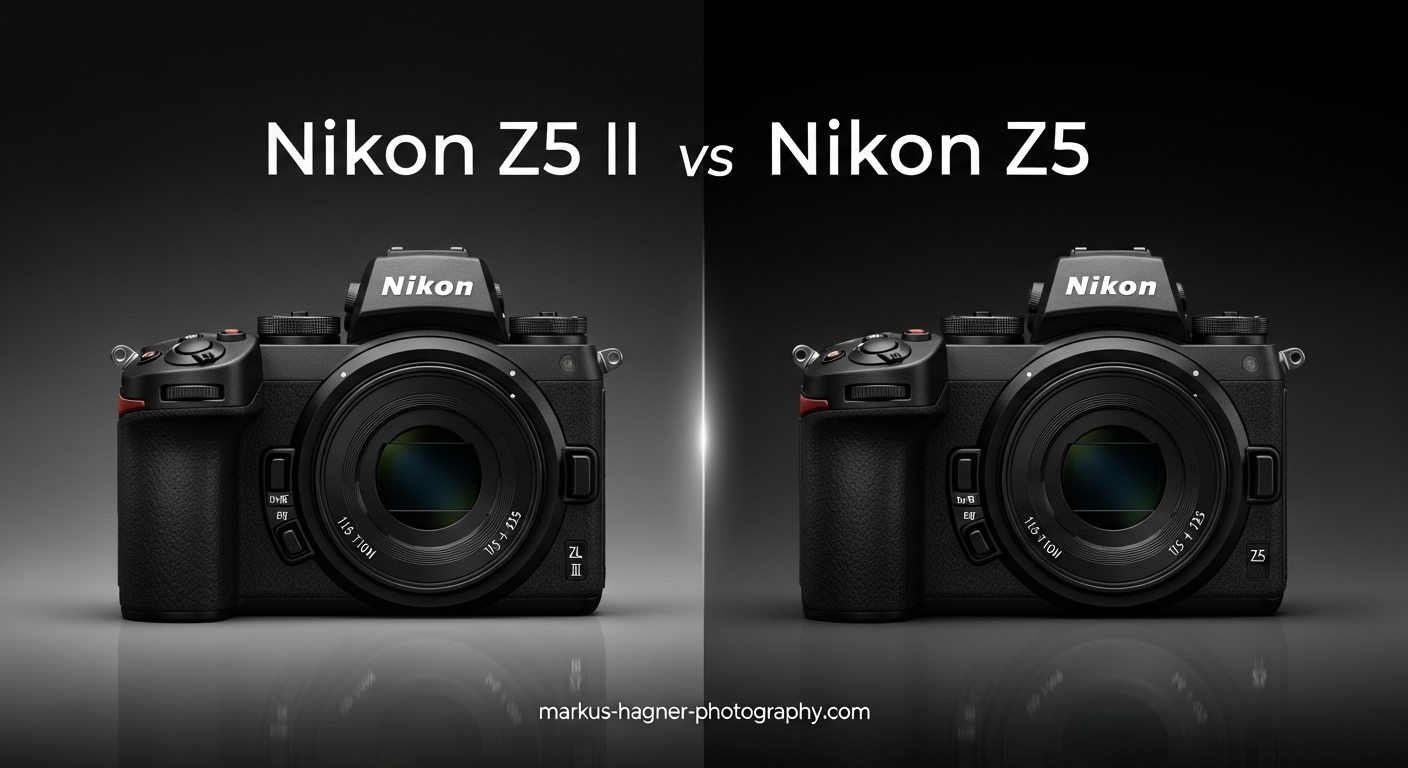
The Nikon Z5 II vs Nikon Z5 debate comes down to one question: how much does a five-year gap in camera technology actually matter in real-world shooting?
The original Z5 launched in 2020 as Nikon’s entry into affordable full-frame mirrorless. It was a solid camera — good image quality, 5-axis IBIS, and a familiar Nikon control layout. Then in 2025, Nikon released the Z5 II, and the upgrades are significant across the board.
I’ve spent time closely looking at both cameras — the specs, the real-world forum feedback, and what photographers in the field are actually saying about both. This comparison covers every major category so you can make an informed decision without wading through a dozen different sources.
The short verdict: the Z5 II wins across almost every technical category. But the original Z5 still makes sense for certain shooters. Read on to find out where you fall.
Nikon Z5 II vs Nikon Z5: Quick Comparison
Here’s a direct side-by-side look at the core specifications for both cameras before we dig into the details.
| Specification | Nikon Z5 II | Nikon Z5 |
|---|---|---|
| Sensor | 24.5MP BSI CMOS | 24.3MP CMOS |
| Processor | EXPEED 7 | EXPEED 6 |
| Autofocus Points | 273 hybrid PDAF points | 273 phase-detect points |
| Subject Detection | 9 AI-driven modes (people, animals, birds, vehicles, aircraft) | People and dogs only |
| AF Sensitivity | -10EV | -4.5EV |
| Continuous Shooting | 14fps (electronic), 7fps (mechanical) | 4.5fps |
| Pre-Release Capture | Yes (up to 1 second) | No |
| 4K Video | 4K/60p (uncropped up to 30p) | 4K/30p (1.7x crop) |
| Slow Motion | 1080p/120fps | 1080p/120fps |
| N-RAW / N-Log | Yes / Yes | No / Yes |
| IBIS | 5-axis, 7.5 stops | 5-axis, 5.0 stops |
| Viewfinder | 3.69M-dot EVF, 0.8x magnification | 3.69M-dot EVF, 0.8x magnification |
| LCD Screen | 3.2-inch vari-angle touchscreen, 2.1M-dot | 3.2-inch tilting touchscreen, 1.04M-dot |
| Battery Life | ~490 shots (CIPA) | ~470 shots (CIPA) |
| Memory Cards | 2x SD (UHS-II compatible) | 2x SD (UHS-I only) |
| Weather Sealing | Yes | Yes |
| Body Weight | 700g (with battery and card) | 590g (with battery and card) |
| Release Year | 2025 | 2020 |
At a glance, the Z5 II improves on almost every spec. The areas that stayed the same — EVF resolution, weather sealing, and slow-motion video — were already solid in the original Z5.
Sensor and Image Quality
The Z5 II wins this category, and the reason comes down to sensor architecture. The Z5 II uses a 24.5MP back-side illuminated (BSI) CMOS sensor, while the original Z5 uses a more conventional front-illuminated 24.3MP CMOS sensor.
BSI sensors place the wiring layer behind the photodiodes rather than in front of them. This allows more light to reach each pixel, which translates to better low-light performance and improved dynamic range, especially at higher ISOs.
The resolution difference is marginal — 24.5MP vs 24.3MP is not something you’ll ever notice in a print or on screen. What you will notice is the improvement in ISO performance. The Z5 II has a native ISO range of 100-51200 (expandable to 204800), compared to the Z5’s 100-51200 range. The numbers look similar, but the BSI architecture means the Z5 II delivers cleaner images at equivalent ISOs, particularly above ISO 3200.
The EXPEED 7 processor in the Z5 II also contributes to image quality beyond just raw sensor output. It handles noise reduction more effectively, enables faster processing for burst shooting, and powers the advanced subject detection system. The EXPEED 6 in the Z5 was competent for its time, but the gap between the two processors is substantial.
In practical terms: if you’re shooting landscapes, architecture, or portraits in controlled lighting, both cameras will produce excellent images that are hard to distinguish at base ISO. Put them in a dimly lit reception hall or under a forest canopy at dusk, and the Z5 II’s BSI advantage becomes visible.
One area where the Z5 punches above its weight: Nikon’s color science and Picture Controls are consistent across both bodies. You get the same excellent JPEGs and RAW files that Nikon is known for — the Z5 II simply has more room to work with at the extremes.
Autofocus System
The Z5 II has a dramatically better autofocus system than the original Z5, and this is where the upgrade matters most for a wide range of photographers.
Both cameras use 273 phase-detect autofocus points covering the frame. But that’s where the similarity ends. The Z5 pairs those AF points with the older EXPEED 6 processor and offers subject detection for people and dogs only. The Z5 II is powered by EXPEED 7 with deep learning AI, expanding subject detection to 9 different categories: people, dogs, cats, birds, cars, motorcycles, bicycles, trains, and aircraft.
The AF sensitivity difference is significant: the Z5 II can focus down to -10EV, compared to the Z5’s -4.5EV. That’s a massive gap in low-light autofocus capability — the Z5 II can lock focus in near-darkness where the Z5 would struggle or hunt.
Real-world feedback from photographers on the Nikon forums consistently highlights this difference. Users moving from the Z5 to Z5 II report that “the autofocus on the Z5 II alone is worth the extra cost” — particularly for anyone shooting wildlife, children, pets, or sports.
The Z5 also lacks pre-release capture, which is a meaningful omission. The Z5 II can buffer up to one second of frames before you press the shutter, meaning you’re less likely to miss the decisive moment. For action and wildlife photography, this feature alone changes how you shoot.
Eye detection and tracking on the Z5 works reasonably well for stationary subjects in good light. The moment your subject starts moving or the light drops, the Z5 struggles to maintain lock. The Z5 II’s subject tracking is far more tenacious, maintaining focus through movement and in lower light conditions with noticeably fewer hunting episodes.
Winner: Z5 II, by a wide margin. If you shoot anything that moves, the autofocus difference alone justifies the upgrade.
Video Capabilities
The Z5 II is the clear winner for video, and the gap between these two cameras for video work is one of the largest in any category.
The original Z5 was always a weak video camera relative to its peers. It shoots 4K at up to 30fps, but with a heavy 1.7x crop applied. That crop turns your 24-70mm lens into an effective 41-119mm lens, which is a severe limitation for wide-angle work. The Z5 doesn’t support N-RAW, and while N-Log is available, the overall video specification was already behind competitors at launch.
The Z5 II fixes all of this. It shoots 4K up to 30p with no crop — full-width from the entire sensor. Push it to 4K/60p and a 1.5x crop applies, which is far more manageable than the Z5’s 1.7x crop at 30p. The Z5 II also adds N-RAW recording internally, which is Nikon’s compressed RAW video format — a major addition for anyone who needs flexibility in post-production color grading.
Both cameras support 1080p at up to 120fps for slow-motion footage, and both support N-Log for flat color profiles. The Z5 II adds HLG (Hybrid Log-Gamma) support, which makes it better suited for HDR workflows.
The Z5 II also benefits from the improved IBIS for video stabilization (more on that below), and the vari-angle screen — compared to the Z5’s simple tilt screen — is a practical improvement for video shooters who need to monitor framing from unusual angles.
If video is any part of your workflow, the Z5 is a frustrating camera. The Z5 II is a genuinely capable video body for its class.
Winner: Z5 II, decisively. The removal of the harsh 4K crop, addition of N-RAW, and vari-angle screen make it a completely different class of video camera.
Continuous Shooting and Burst Performance
The Z5 II is dramatically faster than the original Z5 for burst shooting.
The Z5 is limited to 4.5fps with the mechanical shutter. That rate is slow by modern standards — you’re catching roughly 4-5 frames per second of action, which makes it challenging for sports, birds in flight, or fast-moving wildlife.
The Z5 II shoots at 7fps with the mechanical shutter, matching what many cameras offer. But push to electronic shutter and it reaches 14fps, making it genuinely capable for action work. Add pre-release capture — which starts buffering frames up to one second before you press the shutter button — and the Z5 II becomes an effective action camera within the full-frame mirrorless segment at this price level.
Buffer depth is adequate on both cameras for typical shooting, though the Z5 II’s faster UHS-II card support (vs. the Z5’s UHS-I) means it clears the buffer faster, allowing you to keep shooting in rapid-fire situations.
For landscape, portrait, and architecture photographers who rarely shoot bursts, this difference won’t matter much. For anyone who needs to capture fast action reliably, the Z5’s 4.5fps is a genuine limitation.
Winner: Z5 II. The jump from 4.5fps to 14fps, combined with pre-release capture and faster card support, puts them in completely different categories for action photography.
In-Body Image Stabilization (IBIS)
Both cameras include Nikon’s 5-axis in-body image stabilization, but the Z5 II offers meaningfully more stabilization performance.
The Z5 provides up to 5.0 stops of stabilization with compatible Z-mount lenses. The Z5 II pushes this to 7.5 stops, which is one of the highest ratings in the full-frame mirrorless category. In practical use, this means you can handhold the Z5 II at significantly slower shutter speeds and still capture sharp images.
The Z5 II also introduces Focus Point VR, which applies stabilization based on where your focus point is set rather than the center of the frame. This is particularly useful when your subject is off-center, as it reduces blur where it matters most rather than optimizing for the middle of the image.
The Z5 II’s Starlight View is another IBIS-related feature — it stabilizes the live view display in very low light to make it easier to compose shots before you take them. This is a quality-of-life improvement that the Z5 lacks.
For handheld landscape work, the difference between 5.0 and 7.5 stops of IBIS is meaningful. The Z5 II can handhold at shutter speeds that previously would have required a tripod.
Winner: Z5 II. The 2.5-stop improvement in stabilization plus Focus Point VR and Starlight View are real advantages for handheld photographers.
Body Design and Ergonomics
Both cameras share Nikon’s familiar Z-series body design, and anyone comfortable with one will feel at home with the other. The grip, button layout, and overall ergonomics are similar — recognizably Nikon.
The Z5 II is slightly larger and heavier than the Z5: approximately 700g with battery and card versus the Z5’s 590g. That 110g difference is noticeable when you’re carrying a camera all day, particularly when paired with heavier lenses.
Both cameras have full weather sealing, protecting against dust and moisture. This is a genuine differentiator from cheaper mirrorless cameras and makes both bodies suitable for outdoor shooting in less than ideal conditions.
The Z5 II gains a USB-C port that supports charging and data transfer, and it retains the HDMI port for external monitor connection. The Z5 also has HDMI and USB-C, so connectivity is broadly similar.
One meaningful ergonomic difference: the Z5 II has a slightly more refined control layout with better customization options for the function buttons, benefiting from Nikon’s experience developing the Z8 and Z9 before the Z5 II. Power users who build muscle memory around custom buttons will appreciate the additional flexibility.
The Z5 also has an advantage here: some photographers genuinely prefer the smaller, lighter body, especially for travel with compact Z-mount lenses. A forum user summarized this well: “Z5 is lighter and smaller — really good for travel with compact lenses.” If you’re packing a camera for a hiking trip, that 110g difference in body weight matters before you even add lenses.
Winner: Draw. The Z5 II has better controls and a newer design; the original Z5 is lighter and slightly more compact.
Viewfinder and LCD Screen
The viewfinder on both cameras is identical: a 3.69-million-dot EVF with 0.8x magnification. This is a good EVF — clear, with a wide magnification ratio that makes it easy to see fine details through the eyepiece. Nikon didn’t change the viewfinder between generations, which is understandable given it was already a strong performer.
The LCD screen is where the cameras differ significantly. The original Z5 has a 3.2-inch tilting touchscreen with a resolution of 1.04 million dots. It tilts up and down, which covers most shooting scenarios. The Z5 II replaces this with a 3.2-inch fully articulating (vari-angle) touchscreen at 2.1 million dots.
The vari-angle screen on the Z5 II can flip out to the side, allowing you to shoot from any angle — including directly toward you for self-recording or vlogging. The resolution jump from 1.04M dots to 2.1M dots also makes a visible difference in how sharp and detailed the live view image appears.
For video shooters and content creators, the vari-angle screen is a practical necessity. For photographers who mainly use the EVF, the tilting screen on the Z5 is workable but the lower resolution makes it slightly harder to judge critical focus and exposure.
Winner: Z5 II. The vari-angle screen and doubled resolution of the LCD are meaningful improvements.
Battery Life and Memory Cards
Battery life on both cameras is similar: the Z5 II is rated for approximately 490 shots per charge (CIPA), while the Z5 manages around 470 shots. In real-world use, both cameras will last through a typical full day of shooting, and both use the same EN-EL15c battery, meaning existing Z5 users don’t need to buy new batteries when upgrading.
The memory card situation is a more meaningful difference. The original Z5 has two SD card slots, but both are limited to UHS-I speeds. UHS-I is acceptable for single-shot work but becomes a bottleneck during burst shooting — the camera’s buffer fills faster, and clearing it takes longer. The Z5 II also has dual SD card slots but supports UHS-II speeds, which deliver significantly faster write speeds and reduce buffer clearing time.
For burst photographers, the UHS-II support on the Z5 II pairs naturally with its 14fps shooting capability. Running a fast UHS-II card in the Z5 II keeps the buffer clearing quickly so you can keep shooting. Running the Z5 with UHS-I cards means burst sessions are shorter and recovery time is longer.
Both cameras support USB charging, so you can top up the battery in the field with a power bank — useful for travel and outdoor photography.
Winner: Z5 II on memory cards; a virtual draw on battery life (both use the same battery and get similar shot counts).
Z-Mount Lens Ecosystem
One aspect that most comparison articles skip entirely: both cameras use the same Nikon Z-mount, so your lens options are identical. Every Z-mount lens — from the compact Nikkor Z 40mm f/2 to the professional Nikkor Z 400mm f/2.8 TC VR S — works with both bodies.
This is important context for Z5 owners considering an upgrade. You don’t need to re-invest in glass. The investment is purely in the body, and whatever lenses you’ve built up work equally well on the Z5 II.
It’s also worth noting that good glass matters more than body generation for certain types of photography. As photographers on Reddit have noted: “Good glass on a Z5 can outperform basic glass on a Z5 II” — a reminder that the best upgrade isn’t always the body. If you’re on a limited budget and already have a Z5, investing in a sharper lens might deliver more visible image quality improvements than upgrading the body.
Both cameras also support adapted F-mount lenses via the FTZ II adapter, so Nikon DSLR users transitioning to mirrorless can bring their existing glass along on either body.
The Z5 II’s autofocus system does extract better performance from the same lens lineup, particularly for tracking. So a telephoto like the Nikkor Z 100-400mm f/4.5-5.6 VR S will track birds and wildlife more reliably on the Z5 II than on the Z5 — same glass, meaningfully different tracking performance.
Nikon Z5 II vs Nikon Z5: Head-to-Head by Use Case
Here’s how the two cameras compare across the most common photography use cases.
Landscape Photography
For landscape photography, both cameras are excellent. You’re typically shooting at base ISO, from a tripod, with no need for fast autofocus or burst shooting. The original Z5 remains a capable landscape camera in 2026 — full-frame sensor, solid dynamic range, reliable weather sealing, and 24MP resolution is more than enough for large prints.
The Z5 II’s BSI sensor gives it a slight edge in dynamic range and shadow recovery, and the extra 2.5 stops of IBIS is useful for handheld landscape work at twilight. But if you shoot landscapes exclusively, the Z5 is more than adequate and the upgrade is harder to justify.
Winner by use case: Z5 is still good; Z5 II has a slight edge in low-light and handheld scenarios.
Wildlife and Bird Photography
This is where the gap between the cameras is largest. The Z5 is a frustrating camera for wildlife — 4.5fps is slow for action, subject detection covers only people and dogs (no birds or animals in tracking mode), and the AF sensitivity of -4.5EV means it can struggle at dawn and dusk.
The Z5 II is a genuinely capable wildlife camera. Bird detection, animal tracking, 14fps with pre-release capture, and -10EV AF sensitivity combine to make it a dramatically better tool for this type of work. For wildlife photographers, there is no contest.
Winner by use case: Z5 II, convincingly.
Portrait Photography
Both cameras are solid for portrait work. Eye detection on the Z5 works well for stationary subjects in good light. The Z5 II’s eye detection is faster, more reliable on moving subjects, and works in lower light — useful for candid portraits and event photography.
The image quality from both cameras at base ISO is excellent for portraits, with Nikon’s skin tones coming through beautifully in both RAW and JPEG. The Z5 II’s BSI sensor gives it a slight quality advantage in challenging indoor light.
Winner by use case: Z5 II for studio and candid work; Z5 is workable for studio portraits with stationary subjects.
Video and Content Creation
The Z5 is a poor choice for video in 2026. The 1.7x crop at 4K/30p is genuinely limiting, N-RAW is absent, and the tilting screen — while functional — can’t flip toward you for self-shooting. The Z5 is workable for simple, static video in controlled conditions, but for anything more demanding it will frustrate you.
The Z5 II is a capable video camera. Uncropped 4K up to 30p, 4K/60p with a moderate crop, N-RAW internally, vari-angle screen, and superior IBIS for handheld footage. If you shoot video at all, the Z5 II is the clear choice.
Winner by use case: Z5 II, by a large margin.
Travel Photography
Here the Z5 makes a stronger case. It’s 110g lighter, slightly more compact, and the practical shooting performance is excellent for travel’s typical demands — landscapes, street scenes, and travel portraits. The original Z5 paired with compact Z-mount primes like the Nikkor Z 28mm f/2.8 or Nikkor Z 40mm f/2 is a nimble, capable system.
For travel shooters who don’t need fast action AF or video, the Z5 remains a compelling option — especially at a lower cost, which leaves budget for additional lenses or travel itself.
Winner by use case: Draw — Z5 has the weight and compactness advantage; Z5 II has better performance if you need it on the road.
Frequently Asked Questions
What are the key differences between Nikon Z5 and Z5 II?
The Z5 II has a BSI sensor for better low-light performance, EXPEED 7 processor with AI subject detection for 9 subject types (vs people and dogs only on the Z5), 14fps burst shooting (vs 4.5fps), uncropped 4K/30p video with N-RAW support, 7.5-stop IBIS (vs 5.0 stops), a vari-angle touchscreen with 2.1M dots (vs 1.04M-dot tilt screen), and UHS-II memory card support. The AF sensitivity also jumps from -4.5EV to -10EV.
Is the Nikon Z5 II worth the extra cost?
For action, wildlife, video, and low-light photographers: yes, absolutely. The autofocus and video improvements alone justify the premium. For landscape and portrait photographers working primarily in good light with stationary subjects, the original Z5 may offer better value — especially if found at a significant discount. The Z5 II is worth it if autofocus tracking, burst speed, or video capabilities matter to your shooting.
Which camera has better autofocus — Z5 or Z5 II?
The Z5 II has significantly better autofocus. It uses the EXPEED 7 processor with deep learning AI to detect 9 subject types including birds and animals, reaches -10EV sensitivity, and tracks moving subjects far more reliably than the original Z5. The Z5 is limited to people and dog detection, -4.5EV sensitivity, and struggles with fast-moving subjects in lower light.
Is Nikon Z5 still worth buying in 2026?
Yes, but with caveats. The Nikon Z5 is still worth buying if your budget is limited, you shoot landscapes or static subjects in good light, and you can find it at a meaningfully reduced price (used or clearance). It produces excellent image quality and has solid weather sealing and IBIS. It is not recommended for wildlife, action, video work, or any photography requiring fast, reliable subject tracking.
Which Nikon camera is better for video — Z5 or Z5 II?
The Z5 II is dramatically better for video. The Z5 applies a 1.7x crop in 4K/30p and lacks N-RAW, making it limiting for serious video work. The Z5 II shoots uncropped 4K up to 30p, adds 4K/60p, supports N-RAW internally, includes HLG for HDR workflows, and has a vari-angle screen for self-recording. For video, the Z5 II is the only reasonable choice between the two.
Do the Nikon Z5 and Z5 II use the same lenses?
Yes. Both cameras use the Nikon Z-mount, so all Z-mount lenses work on both bodies. Both also support F-mount lenses via the FTZ II adapter. If you’re upgrading from Z5 to Z5 II, you keep all your existing glass. The Z5 II’s superior autofocus system does extract better tracking performance from the same lenses, particularly telephoto zooms used for wildlife.
Should I upgrade from Nikon Z5 to Z5 II?
It depends on your shooting needs. If autofocus tracking, burst speed, or video capabilities are frustrating you on the Z5, the Z5 II is a worthwhile upgrade. If you shoot landscapes or static subjects and are satisfied with image quality, upgrading to a better lens may deliver more noticeable improvements than a body upgrade. The Z5 II is a substantial generational upgrade — if the Z5’s limitations are genuinely limiting your photography, it’s time to upgrade.
Nikon Z5 II vs Nikon Z5: Final Verdict
After comparing Nikon Z5 II vs Nikon Z5 across every major category, the Z5 II is the better camera in almost every measurable way. The five-year gap between these two cameras shows clearly in the autofocus system, video capabilities, burst speed, IBIS performance, and screen quality.
That said, the right choice depends entirely on your photography.
Choose the Nikon Z5 II if you shoot wildlife, birds, or sports; if video is part of your work; if you need reliable subject tracking for events or candids; or if you want the most capable full-frame mirrorless at this price level. The autofocus system alone makes the Z5 II worth the premium for anyone who photographs anything that moves.
Choose the original Nikon Z5 if you shoot landscapes, architecture, or portraits primarily in controlled settings; if you’re budget-limited and want full-frame quality for static subjects; or if you’re building a lightweight travel kit where the weight difference matters. The Z5 still produces beautiful images and represents excellent value if you can find it discounted as a used or clearance purchase.
One thing forum users have said that rings true: don’t upgrade from Z5 to Z5 II if you’re going to put budget glass in front of it. Put that money toward a sharper lens for your Z5 first, and then upgrade bodies when you’re ready. Good glass on the Z5 will outperform basic glass on the Z5 II for most still photography purposes.
If you’re coming from outside the Nikon Z system entirely, the Z5 II is the obvious choice — it’s a genuinely modern full-frame mirrorless camera that will serve you well for years, and both cameras use the same Z-mount lens lineup, so your investment in glass is secure.