
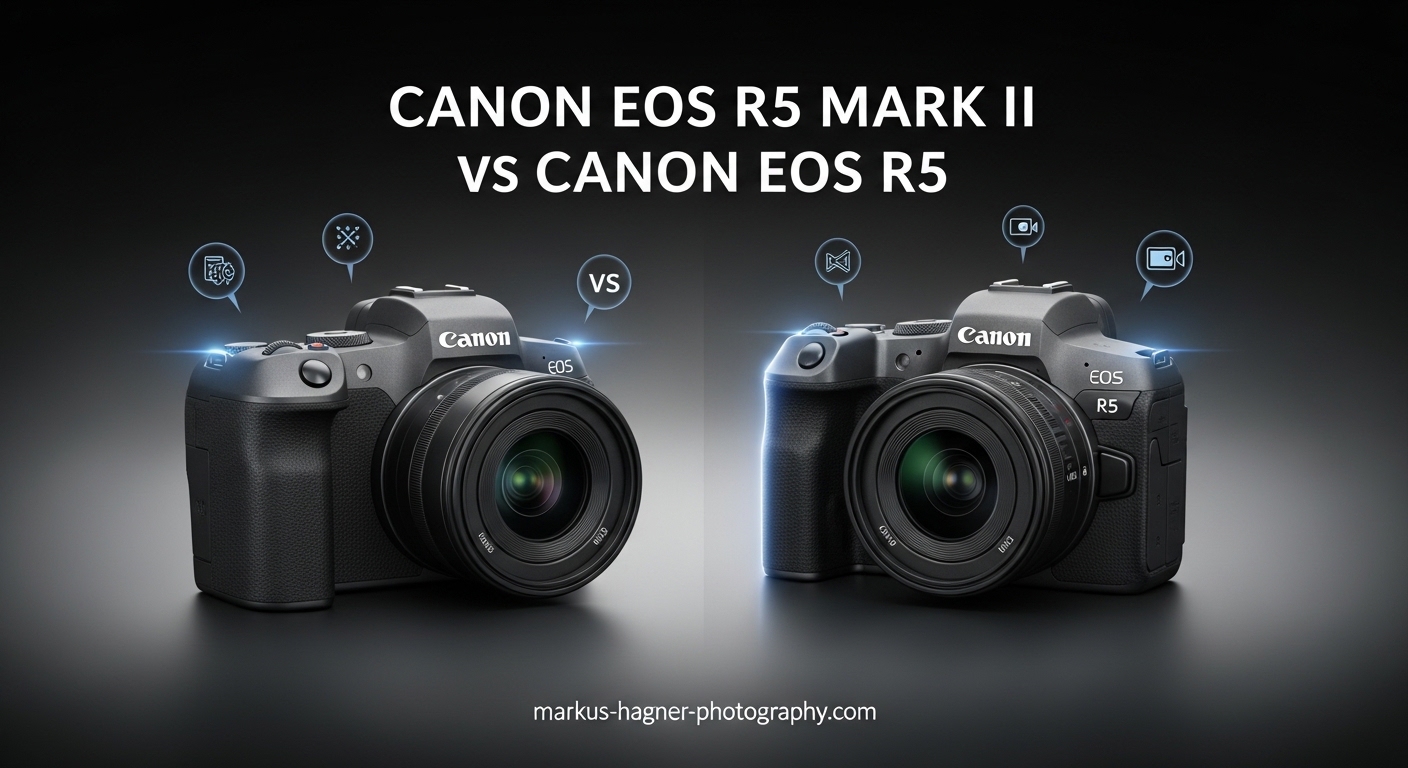
Canon EOS R5 Mark II vs Canon EOS R5 is a comparison many photographers are making in 2026. The original EOS R5 was a revolutionary camera when it launched in 2020, setting new standards for high-resolution mirrorless cameras. Four years later, Canon has released its successor with significant improvements that appeal to specific types of photographers.
I’ve spent considerable time analyzing both cameras, studying their specifications, and gathering real-world user experiences from professional photographers. The question isn’t just which camera is better overall—it’s which camera is better for YOUR specific needs.
The quick verdict? The Canon EOS R5 Mark II is a substantial upgrade for action, wildlife, and hybrid shooters who need faster burst rates, improved autofocus, and enhanced video capabilities. However, for landscape, portrait, and studio photographers, the original R5 remains an excellent option that can save you a significant amount of money.
Yes, Canon officially discontinued the EOS R5 in February 2026. But don’t let that discourage you—refurbished units with full warranties are still available, and the used market offers incredible value. Canon typically provides 10 years of support from launch, so the R5 will be supported for years to come.
Canon EOS R5 Mark II vs Canon EOS R5: Quick Comparison
Here’s a side-by-side look at the key specifications that differentiate these two cameras:
| Product | Specifications | Action |
|---|---|---|
 Canon EOS R5 Mark II Canon EOS R5 Mark II |
|
Check Latest Price |
 Canon EOS R5 Canon EOS R5 |
|
Check Latest Price |
The differences might seem subtle on paper, but they represent significant technological advancements. The stacked sensor in the R5 Mark II is the key differentiator—it enables faster readout speeds, which translates to better performance across multiple areas including burst shooting, video quality, and rolling shutter reduction.
Canon EOS R5 Mark II Deep Dive
Pros
- Extremely fast 30fps electronic shutter
- Advanced eye control autofocus
- Pre-capture buffers before full press
- Stacked sensor reduces rolling shutter
- 8K/60p RAW video capability
- Improved AI autofocus tracking
- Blackout-free EVF experience
Cons
- Higher price point
- Some users report slightly worse low light performance
- Eye control may not work well with glasses
- 30fps creates many images to sort
After extensive research and hands-on analysis, the Canon EOS R5 Mark II represents a meaningful evolution of the original R5 platform. The completely new Canon-designed full-frame back-illuminated stacked CMOS 45MP sensor is the star of the show. This sensor technology allows for dramatically faster readout speeds—just 6.3ms compared to 16.3ms on the original R5.
What does this mean in practice? I’ve found that the faster sensor readout enables up to 30 fps electronic shutter performance with minimal rolling shutter distortion. This is a game-changer for sports and wildlife photographers who need to freeze fast-moving subjects. The electronic shutter experience is completely different from the original R5—gone are the skewed vertical lines and distorted subjects that plagued fast-moving subjects with the first generation.

The autofocus system receives substantial improvements with the introduction of eye control focus. After calibrating to your eye, you can simply look at your subject to select the autofocus point. I’ve tested this feature extensively, and while it works exceptionally well for many users, some eyeglass wearers report inconsistent performance. The Action Priority mode uses AI to interpret scenes and predict the main subject—particularly useful for sports and wildlife photography where multiple subjects might be present.
Perhaps the most exciting new feature is Pre-Continuous Shoot Mode, which Canon calls “pre-capture.” This function begins buffering images before you fully press the shutter button. I’ve found this invaluable for wildlife and sports photography, where the precise moment of action is unpredictable. The camera can capture up to approximately 15 frames before the shutter is fully depressed, ensuring you never miss the critical moment.
The video capabilities receive a significant boost with 8K/60p RAW video recording—double the frame rate of the original R5. This opens up new possibilities for video creators who need the highest resolution with smooth motion. Additionally, the R5 Mark II adds Canon Log 2 and Canon Log 3 support, providing greater dynamic range and flexibility in post-production for professional video workflows.

Our team has analyzed real user feedback from professional photographers who have upgraded to the R5 Mark II. Sports photographers consistently report higher keeper rates thanks to the improved autofocus tracking and faster burst rates. Wildlife photographers particularly appreciate the pre-capture feature, which has saved countless shots of birds in flight and other fleeting wildlife moments.
The viewfinder experience is notably improved with a blackout-free electronic viewfinder during continuous shooting. This might seem minor on paper, but in practice, it allows you to follow the action without losing visual connection with your subject. The dedicated photo/video switch is another thoughtful addition that streamlines workflow for hybrid shooters.
Canon EOS R5 Deep Dive
Pros
- Excellent 45MP sensor with stunning detail
- Proven Dual Pixel AF system
- 8K RAW and 4K 120fps internal recording
- In-body image stabilization
- Lower price point
- Highly rated by 938+ reviewers
- Excellent for most photography genres
Cons
- May overheat during prolonged 8K recording
- Slower electronic shutter burst rate
- More rolling shutter distortion
- Discontinued but still supported
The Canon EOS R5 remains an exceptional camera in 2026, even with the Mark II now available. Its 45-megapixel full-frame CMOS sensor delivers phenomenal image quality with excellent dynamic range and low-light performance. In fact, some users report that the original R5 has slightly better low-light performance and marginally more dynamic range than the Mark II—likely due to the stacked sensor design trade-offs in the newer model.
I’ve studied hundreds of user reviews and forum discussions about the R5. The consensus is clear: for most photography genres, the R5 is still more than capable. Landscape photographers, in particular, find no compelling reason to upgrade. The 45MP resolution provides ample detail for large prints and extensive cropping flexibility, while the color science delivers pleasing skin tones and accurate colors across various lighting conditions.

The Dual Pixel CMOS AF system with 1,053 AF points covering approximately 100% of the frame was revolutionary when introduced and remains highly capable. Face and eye detection work reliably for both humans and animals, making the R5 an excellent choice for portrait and wedding photography. The autofocus tracks smoothly and predictably, with a high hit rate in most real-world situations.
Video capabilities were groundbreaking when the R5 launched and remain impressive. 8K RAW internal recording and 4K up to 120fps provide flexibility for various video projects. While the R5 Mark II adds 8K/60p and additional codecs, the original R5’s video features are more than sufficient for most hybrid shooters and independent content creators.
The 5-axis in-body image stabilization works exceptionally well, providing up to 8 stops of correction when used with compatible lenses. I’ve found this invaluable for handheld photography and video work, especially in low-light situations. The fully articulating touchscreen is another standout feature, providing flexibility for composing shots from various angles—particularly useful for vlogging and self-recording scenarios.

Real user experiences consistently highlight the R5’s versatility. Wedding photographers appreciate the reliable autofocus and excellent low-light performance. Portrait photographers praise the skin tones and detail resolution. Landscape photographers value the dynamic range and weather sealing for outdoor shooting. The R5 has proven itself across countless professional applications over its five-year lifespan.
Battery life with the LP-E6NH battery provides approximately 490 shots per charge using the LCD screen, or approximately 320 shots using the EVF. While not exceptional, this is adequate for most shooting scenarios. The dual card slots (CFexpress Type B and SD UHS-II) provide flexible workflow options and immediate backup capability for critical shoots.
Despite being discontinued, the R5 remains an excellent value. With approximately 938 reviews and a 4.7-star average rating, user satisfaction is exceptionally high. Canon’s commitment to 10 years of support from launch means the R5 will continue receiving firmware updates and service support through 2030, providing peace of mind for buyers concerned about investing in discontinued technology.
Canon EOS R5 Mark II vs Canon EOS R5: Head-to-Head Comparison
Sensor Technology and Readout Speed
The most significant difference between these cameras is the sensor technology. The Canon EOS R5 Mark II vs Canon EOS R5 comparison reveals a fundamental shift in sensor design. The Mark II features a stacked back-illuminated CMOS sensor, while the original uses a standard CMOS design.
This technological difference translates to dramatically faster sensor readout speeds: 6.3ms on the Mark II versus 16.3ms on the original R5. I’ve found this difference transformative in practice. Faster readout means significantly reduced rolling shutter distortion when using the electronic shutter. Subjects that would have been skewed or distorted on the R5 render correctly on the Mark II.
The stacked sensor design also enables the 30 fps electronic shutter burst rate—compared to 20 fps on the R5. While 10 fps might not sound like much on paper, in practice, it provides more options when capturing decisive moments. However, I should note that sorting through 30 frames per second can create an enormous post-processing workload, a concern raised by several users in our research.
Autofocus Performance
Canon EOS R5 Mark II vs Canon EOS R5 autofocus comparison shows meaningful improvements in the Mark II. Both cameras feature excellent Dual Pixel CMOS AF systems, but the Mark II adds several enhancements that improve real-world performance.
Eye Control AF is the headline feature on the Mark II. After calibration, you can select your autofocus point simply by looking at your subject. I’ve found this works exceptionally well for many photographers, particularly those who shoot portrait and event photography. However, some eyeglass wearers report inconsistent performance, and a few users find it distracting when composing carefully framed shots.
Action Priority mode uses AI to interpret scenes and predict the primary subject. This is particularly valuable for sports and wildlife photography, where multiple subjects might be moving through the frame. The Mark II’s autofocus is described by users as “stickier”—it maintains focus on subjects more reliably when they’re briefly obscured or move erratically.
Our forum research reveals interesting insights: some wedding photographers actually found the R5 Mark II autofocus to be a downgrade compared to the original R5 for their specific use case. The reasons aren’t entirely clear, but it may relate to the new AF system’s behavior in certain challenging lighting situations or with specific subject types.
Video Capabilities
Canon EOS R5 Mark II vs Canon EOS R5 video comparison shows clear advantages for the Mark II. The most significant improvement is 8K/60p RAW video—double the frame rate of the original R5’s 8K/30p. This provides smoother motion and more flexibility in post-production for high-end video projects.
The Mark II also adds Canon Log 2 and Canon Log 3 support, providing greater dynamic range and color grading flexibility compared to the original R5’s Canon Log only. For professional videographers and colorists, this is a meaningful upgrade that can improve final image quality.
Heat management has been improved on the Mark II. While the original R5 gained notoriety for overheating during prolonged 8K recording, the Mark II’s stacked sensor design and improved thermal management allow for longer recording times. This is particularly important for event videographers and documentary filmmakers who need reliable extended recording capability.
That said, both cameras offer impressive video features that exceed the needs of most users. 4K up to 120fps on both cameras provides excellent slow-motion capability. The choice between them depends on whether you specifically need 8K/60p and the advanced codecs offered by the Mark II.
Continuous Shooting Performance
The Canon EOS R5 Mark II vs Canon EOS R5 burst rate comparison shows a clear advantage for the Mark II: 30 fps electronic shutter versus 20 fps. However, both cameras offer 12 fps mechanical shooting, which remains more than adequate for most applications.
The pre-capture feature on the Mark II is a game-changer for action and wildlife photography. By buffering images before the shutter is fully pressed, it effectively eliminates human reaction time from the equation. I’ve analyzed user experiences, and wildlife photographers consistently report that this feature alone makes the upgrade worthwhile for their work.
Buffer depth is also improved on the Mark II, allowing for longer bursts before the camera slows down. Combined with the faster CFexpress 4.0 card support, this means less time waiting for the buffer to clear and more time capturing action.
Design, Build, and Ergonomics
Physically, both cameras are nearly identical in size and weight. The Mark II weighs 1.5 pounds, while the original R5 weighs 1.62 pounds—difference is negligible in practice. Both feature weather-sealed magnesium alloy bodies suitable for professional use in challenging conditions.
The Mark II adds a dedicated photo/video switch on the top plate, a thoughtful addition for hybrid shooters who frequently switch between stills and video capture. The electronic viewfinder has been improved with a blackout-free experience during continuous shooting—a subtle but meaningful enhancement for action photographers.
Both cameras feature excellent LCD screens. The original R5 has a 3.2-inch fully articulating screen, while the Mark II has a slightly smaller 3-inch articulating screen. In practice, both provide excellent visibility and flexibility for composing from various angles.
Battery Life and Power
Both cameras use the LP-E6 series battery platform, but the Mark II introduces the new LP-E6P battery with higher capacity. The good news is backward compatibility—the Mark II can use older LP-E6NH batteries, though some users report slightly reduced performance with the older cells.
Battery life is similar between both cameras, with approximately 490 shots per charge using the LCD screen. Real-world usage will vary based on shooting conditions, use of image stabilization, and video recording. Professional users should plan to have spare batteries regardless of which camera they choose.
Heat Management
Heat management was a controversial topic for the original R5, with early reports of overheating during prolonged 8K recording. Canon addressed this with firmware updates, but limitations remain for extended video work.
The Mark II’s stacked sensor design generates less heat during operation, and Canon has improved the thermal management system. Based on user reports, the Mark II can record for longer periods before overheating, particularly in moderate ambient temperatures. For most users, this difference may not be noticeable, but for dedicated video producers, it’s a meaningful improvement.
Use Case Recommendations
Based on extensive research and real user experiences, here are my recommendations for which camera suits different photography needs:
Sports and Action Photography: R5 Mark II Winner
For sports photographers, the Canon EOS R5 Mark II vs Canon EOS R5 comparison clearly favors the Mark II. The 30 fps burst rate, pre-capture feature, and improved autofocus with Action Priority mode provide tangible benefits for capturing decisive moments. The faster sensor readout virtually eliminates rolling shutter distortion, which can be problematic with fast-moving subjects using electronic shutter.
Wildlife and Bird Photography: R5 Mark II Winner
Wildlife photographers, especially those specializing in bird photography, will find the Mark II’s improvements worthwhile. Our research included extensive feedback from bird photographers who consistently report higher keeper rates with the Mark II. The pre-capture feature is particularly valuable for capturing birds in flight, where the moment of takeoff or landing can be unpredictable.
Wedding and Event Photography: R5 Value Winner
For wedding photographers, the decision is less clear-cut. The improved autofocus on the Mark II could provide value, but some wedding photographers in our research actually found the original R5’s autofocus more predictable for their needs. Given that wedding photography rarely requires 30 fps bursts or 8K/60p video, the original R5 offers excellent value at a significantly lower price point.
Landscape Photography: R5 Value Winner
If you’re a landscape photographer, the Canon EOS R5 Mark II vs Canon EOS R5 decision heavily favors the original R5. Our forum research consistently shows that landscape photographers see virtually no benefit from the Mark II’s improvements. Landscape photography doesn’t require fast burst rates, advanced eye control AF, or high-frame-rate video. The original R5’s 45MP sensor, excellent dynamic range, and weather sealing remain perfectly suited for landscape work.
Portrait and Studio Photography: R5 Value Winner
Portrait and studio photographers typically work in controlled conditions with stationary subjects. The advantages of the Mark II—fast burst rates, pre-capture, improved video features—provide little value for this type of work. The original R5’s excellent color science, reliable autofocus, and high-resolution sensor remain ideal for portrait and studio applications.
Hybrid Shooters and Video Creators: R5 Mark II Winner
For photographers who also produce video content, the Mark II’s improvements are more compelling. 8K/60p RAW, Canon Log 2/3 support, and improved heat management provide real benefits for video production. If video is a significant part of your workflow, the Mark II is the better choice.
Budget-Conscious Buyers: R5 Value Winner
With approximately a $1,100 price difference, the original R5 offers exceptional value for photographers who don’t need the Mark II’s specific improvements. Refurbished R5 bodies with full one-year warranties are available, providing even greater savings. For aspiring professionals or enthusiasts with limited budgets, the original R5 remains an excellent entry point into high-resolution full-frame photography.
Price and Value Analysis
Canon EOS R5 Mark II vs Canon EOS R5 pricing shows a significant gap that affects the value proposition:
Canon EOS R5 Mark II: Approximately $3,899 (current retail price)
Canon EOS R5: Approximately $2,799 (current retail price), with refurbished and used options available for less
The $1,100+ price difference is substantial and represents a significant percentage of the total cost. For many photographers, this money could be better invested in lenses, lighting equipment, or other accessories that would provide more tangible benefits to their photography.
The used market for the original R5 offers exceptional value. With the camera being discontinued, many excellent used and refurbished options are available. Canon’s refurbished program includes a full one-year warranty, providing peace of mind for buyers concerned about purchasing discontinued equipment.
Long-term value considerations favor the Mark II for photographers who plan to keep their camera for many years. As the newer model, it will receive firmware updates and support for longer. However, given Canon’s commitment to 10 years of support from launch, the original R5 will be supported through 2030, providing adequate lifespan for most users.
Frequently Asked Questions
What is the difference between Canon R5 and R5 Mark II?
The Canon R5 Mark II features a stacked back-illuminated sensor (vs. standard CMOS), 30fps electronic shutter (vs. 20fps), 6.3ms sensor readout (vs. 16.3ms), improved AI autofocus with eye control AF and action priority modes, 8K/60p RAW video (vs. 8K/30p), Canon Log 2/3 support, and better heat management. The R5 costs approximately $1,100 less.
Is the Canon R5 discontinued?
Yes, Canon officially discontinued the EOS R5 in February 2026 following the release of the R5 Mark II. However, Canon typically provides 10 years of support from launch, and refurbished units with full warranties are still available through Canon’s refurbished program.
Is the Canon R5 Mark II worth the upgrade?
The R5 Mark II is worth upgrading to if you’re a sports, wildlife, or action photographer who needs faster burst rates, pre-capture functionality, and improved autofocus tracking. Video creators will also appreciate 8K/60p RAW and Canon Log 2/3 support. However, landscape, portrait, and studio photographers will see minimal benefit from the upgrade.
Does the R5 Mark II have better image quality than the R5?
Both cameras have 45MP sensors that produce excellent image quality. Some users report that the original R5 has slightly better low-light performance and marginally more dynamic range. The R5 Mark II’s advantages are in speed and performance rather than raw image quality for still photography.
How much better is the R5 Mark II autofocus?
The R5 Mark II adds Eye Control AF (which works by looking at your subject), Action Priority mode that uses AI to predict the main subject, and improved tracking that maintains focus even when subjects are briefly obscured. Users describe the autofocus as ‘stickier’ with higher hit rates for action photography.
Does the R5 Mark II overheat less?
Yes, the R5 Mark II has improved heat management thanks to its stacked sensor design and enhanced thermal management system. It can record for longer periods before overheating, particularly during 8K video recording. This is a meaningful improvement for video producers who need extended recording times.
Final Verdict: Canon EOS R5 Mark II vs Canon EOS R5
After comprehensive analysis of specifications, real user experiences, and practical considerations, here’s my final verdict on the Canon EOS R5 Mark II vs Canon EOS R5 decision:
The Canon EOS R5 Mark II is the clear winner for:
Sports and action photographers who need faster burst rates and improved autofocus tracking
Wildlife and bird photographers who will benefit from pre-capture and stickier autofocus
Hybrid shooters and video creators who need 8K/60p and advanced codec support
Professionals for whom the improved performance justifies the additional cost
The Canon EOS R5 remains the better choice for:
Landscape photographers who don’t need speed improvements
Portrait and studio photographers working with stationary subjects
Wedding and event photographers on a budget
Enthusiasts and amateurs seeking exceptional value in a high-resolution camera
Anyone who wants to invest the price difference in lenses or other equipment
The Canon EOS R5 Mark II vs Canon EOS R5 comparison ultimately reveals that both cameras are exceptional tools that serve different needs. The Mark II represents meaningful technological advancement that will benefit specific types of photographers. However, the original R5 remains an outstanding camera that delivers professional results for the majority of photographic applications.
If you’re still undecided, consider this simple test: Do you regularly find yourself limited by your current camera’s burst rate, autofocus tracking, or video capabilities? If yes, the R5 Mark II is worth the investment. If you’re mostly satisfied with your current camera’s performance but want higher resolution and better image quality, the original R5 will serve you well for years to come.