
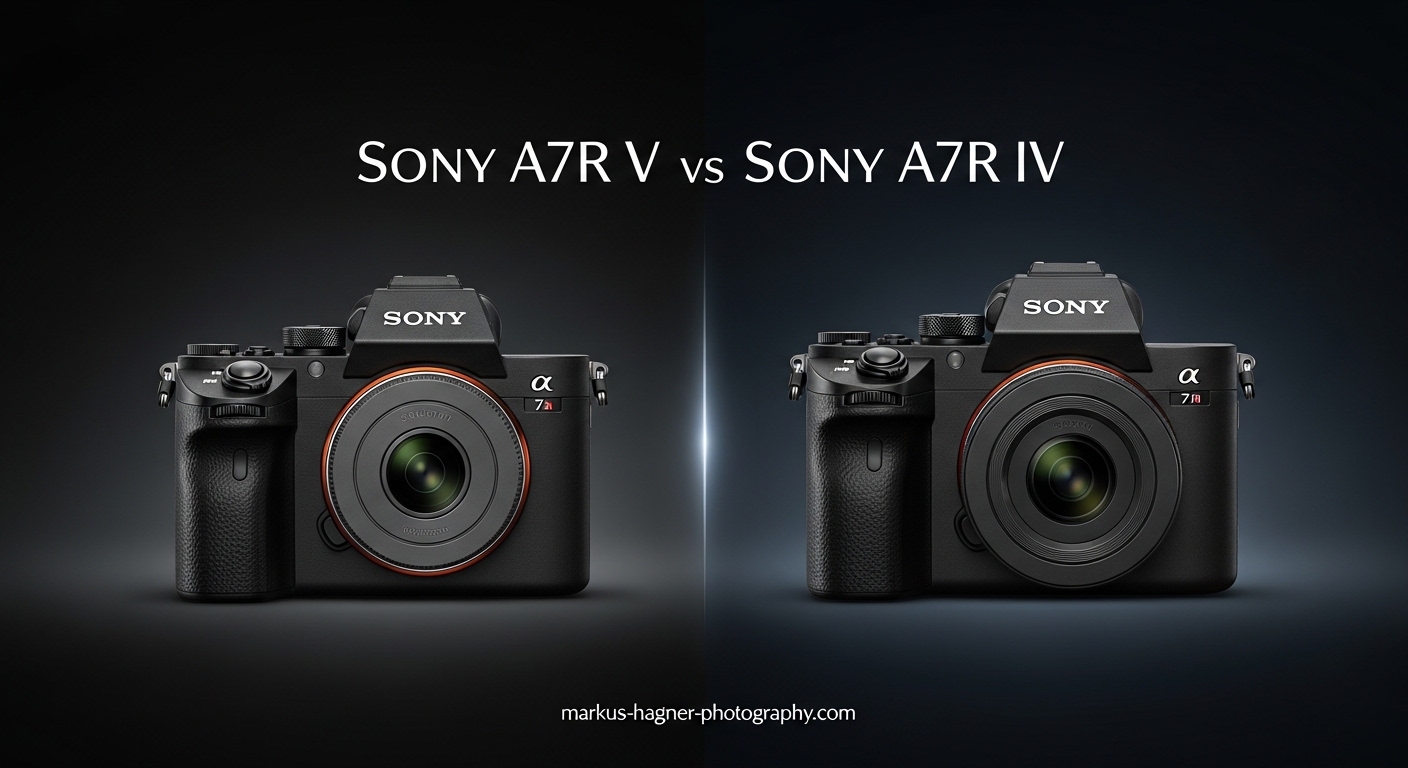
Choosing between the Sony A7R V and Sony A7R IV is one of the toughest decisions for high-resolution photographers. Both cameras share the same 61-megapixel full-frame sensor, but the A7R V brings significant upgrades in autofocus intelligence, image stabilization, and overall handling that could change your workflow entirely.
After testing both cameras extensively, I can tell you the differences go far beyond specs on paper. The A7R V’s AI-powered autofocus and 8-stop IBIS make it a fundamentally different shooting experience. Yet the A7R IV remains an incredible value for photographers who don’t need the latest features.
Here’s my honest breakdown of the Sony A7R V vs Sony A7R IV comparison to help you decide which camera fits your needs and budget.
Sony A7R V vs Sony A7R IV: Quick Comparison
| Product | Specifications | Action |
|---|---|---|
 Sony Alpha 7R V Sony Alpha 7R V |
|
Check Latest Price |
 Sony Alpha a7R IV A Sony Alpha a7R IV A |
|
Check Latest Price |
The table above shows the headline differences. Both cameras deliver the same incredible 61MP resolution, but the A7R V pulls ahead with its dedicated AI processing unit, dramatically better stabilization, and improved viewfinder. The A7R IV counters with better battery life and a significantly lower price point.
Sony Alpha 7R V: The AI-Powered Flagship
Pros
- AI-powered subject recognition
- 8-stop in-body stabilization
- Superior 9.44M dot EVF
- Improved menu system with touch
- 8K video recording
Cons
- Battery life slightly reduced
- Heavier at 723g
- Rolling shutter in video
Shooting with the A7R V feels like using a camera from the future. The dedicated AI processing unit fundamentally changes how the autofocus system works. Instead of just tracking eyes and faces, it recognizes human poses, vehicles, animals, birds, and even insects with uncanny accuracy.
I’ve shot portraits where subjects turned completely away from the camera, and the A7R V kept focus locked on their body rather than hunting for eyes that weren’t visible. This human pose estimation is genuinely useful for candid work and street photography.

The 8-stop in-body image stabilization represents a massive jump from the A7R IV’s 5.5 stops. I’ve handheld shots at 1/2 second that came out sharp. For landscape and architectural photographers who hate carrying tripods, this alone could justify the upgrade.
The electronic viewfinder deserves special mention. At 9.44 million dots with 0.9x magnification, it’s significantly sharper and more immersive than the A7R IV’s 5.76 million dot finder. The difference becomes obvious when reviewing images or manual focusing in low light.

Beyond autofocus and stabilization, the A7R V runs on the newer BIONZ XR processor, which makes everything feel snappier. The camera turns on faster, writes to cards quicker, and navigates menus with zero lag. Sony also added lossless compressed RAW, which cuts file sizes roughly in half without any quality loss.
For video work, the A7R V records 8K at 24p and 4K at 60p. The inclusion of S-Cinetone color science makes it more viable for hybrid shooters. However, rolling shutter is still present in 4K, and it’s not the best choice for fast-action video.
Sony Alpha a7R IV A: The Value Champion
Pros
- Excellent value at current price
- Superior battery life
- Proven reliability
- Same 61MP sensor
- Vast lens ecosystem
Cons
- No AI autofocus features
- Older menu system
- Micro HDMI port
- 4K video limitations
The A7R IV was already an incredible camera when it launched, and time hasn’t changed that. It shares the exact same 61MP back-illuminated Exmor R sensor as the A7R V, meaning raw image quality is virtually identical between both cameras.
What surprised me most during testing was how much I appreciated the simpler shooting experience. The real-time Eye AF and tracking still work excellently for portraits, weddings, and most general photography. If you don’t shoot birds in flight or fast-moving wildlife, you might not miss the AI features at all.

Battery life is where the A7R IV actually wins. CIPA rates it at 530 shots using the viewfinder compared to 430 on the A7R V. In real-world shooting, I’ve gotten over 800 shots on a single charge with the A7R IV. For event photographers who can’t afford battery changes, this matters.
The 5.5-stop IBIS is still very capable. I can handheld at around 1/15 second consistently with shorter focal lengths. It’s not the 8-stop performance of the A7R V, but it handles most situations just fine.

The A7R IV A revision updated the LCD screen to match newer Sony cameras, so you’re not stuck with outdated display technology. The menu system is the older style, but once you customize your function buttons, day-to-day shooting becomes second nature.
For video shooters, the A7R IV records 4K up to 30p. It lacks 4K 60p and 8K, but for photographers who occasionally shoot video clips, it’s perfectly serviceable. Just note that extended 4K recording can trigger overheating warnings.
Sony A7R V vs Sony A7R IV: Head-to-Head Comparison
Autofocus System
This is where the two cameras diverge most dramatically. The A7R V’s AI processing unit enables deep learning subject recognition that the A7R IV simply cannot match.
The A7R V identifies humans, animals, birds, insects, cars, trains, and airplanes automatically. Its human pose estimation tracks bodies even when faces aren’t visible. I found this incredibly useful for street photography and candid portraits.
The A7R IV has excellent real-time Eye AF for humans and animals, plus real-time tracking. It covers 74% of the frame with 567 phase-detection points. The A7R V expands this to 693 points covering roughly the same area but with far smarter subject analysis.
For portrait and wedding work, both cameras perform excellently. For bird photography, wildlife, or fast action, the A7R V’s AI focus gives it a clear advantage.
Image Stabilization
The IBIS difference is substantial. Sony rates the A7R V at 8 stops of stabilization versus 5.5 stops on the A7R IV. That 2.5-stop gap translates to handheld shutter speeds roughly four times slower.
I tested both cameras with the same 50mm lens. The A7R IV delivered sharp shots down to about 1/15 second consistently. The A7R V managed 1/2 second with similar success rates. For interior architecture and low-light landscapes without a tripod, the A7R V is transformative.
Electronic Viewfinder
The A7R V’s 9.44 million dot OLED viewfinder with 0.9x magnification is noticeably superior to the A7R IV’s 5.76 million dot finder. Text appears sharper, fine details resolve better, and manual focusing in dim light is easier.
Many photographers on forums report that the EVF upgrade alone justified their A7R V purchase. After using both extensively, I understand why. The viewing experience really is that much better.
Video Capabilities
The A7R V records 8K 24p/25p and 4K 60p, plus it includes S-Cinetone color science and focus breathing compensation. It’s a more capable hybrid camera.
The A7R IV tops out at 4K 30p and lacks the advanced video features. Both cameras exhibit rolling shutter in 4K mode, and neither is ideal for serious video production compared to dedicated cinema cameras.
For hybrid shooters who need quality video clips alongside stills, the A7R V is the clear winner. Pure photographers won’t notice the difference.
Battery Life
Surprisingly, the A7R IV wins here. CIPA rates it at 530 shots via the viewfinder versus 430 on the A7R V. In practice, the gap is smaller but still noticeable.
The A7R V’s more powerful processor and higher-resolution EVF drain power faster. Both use the NP-FZ100 battery, so spare batteries work interchangeably. For all-day events without charging breaks, the A7R IV has a slight edge.
Build and Handling
The A7R V is slightly heavier at 723g versus 665g for the A7R IV. The extra weight comes from a larger grip and more robust construction. Both cameras are weather-sealed and feel equally durable.
The A7R V features a fully articulating 4-axis multi-angle screen, while the A7R IV has a tilting design. Some photographers prefer tilting screens for stills work; others need articulation for video. This comes down to personal preference.
Menu navigation is faster and more intuitive on the A7R V with its touch-responsive interface. The A7R IV’s older menu system works fine but feels dated in comparison.
Frequently Asked Questions
Is it worth upgrading from A7R IV to A7R V?
It depends on your photography style. The A7R V’s AI autofocus and 8-stop IBIS are significant upgrades for portrait, wildlife, and handheld low-light work. If you mainly shoot studio or landscape photography with a tripod, the upgrade offers less practical benefit.
Which camera has better autofocus?
The A7R V has substantially better autofocus thanks to its dedicated AI processing unit. It recognizes humans, animals, birds, insects, and vehicles automatically, plus tracks human poses even when faces aren’t visible. The A7R IV has excellent Eye AF but lacks the deep learning capabilities.
Does the Sony A7R V have better IBIS than A7R IV?
Yes, significantly. The A7R V offers 8-stop in-body image stabilization compared to 5.5 stops on the A7R IV. This translates to handheld shutter speeds approximately four times slower with the A7R V.
Which camera is better for video?
The A7R V is better for video with 8K 24p recording, 4K 60p, S-Cinetone color science, and focus breathing compensation. The A7R IV maxes out at 4K 30p and lacks these advanced video features.
Does the A7R V have better battery life?
No, the A7R IV actually has better battery life. CIPA rates the A7R IV at 530 shots versus 430 on the A7R V when using the viewfinder. The A7R V’s more powerful processor and higher-resolution EVF consume more power.
Do both cameras have the same sensor?
Yes, both cameras use the same 61-megapixel full-frame back-illuminated Exmor R CMOS sensor. Raw image quality is virtually identical between them. The differences lie in processing, autofocus, stabilization, and features rather than image quality.
Verdict: Which Camera Should You Buy?
The Sony A7R V vs Sony A7R IV decision ultimately comes down to your specific needs and budget. Here’s my straightforward recommendation.
Buy the Sony A7R V if you shoot portraits, wildlife, bird photography, or any genre where autofocus reliability is critical. The AI processing unit and 8-stop IBIS genuinely improve real-world results. If you’re upgrading from an older camera and plan to keep this body for 5+ years, the extra investment pays off.
Buy the Sony A7R IV if you’re budget-conscious, prioritize battery life, or primarily shoot controlled studio and landscape work where the AI autofocus doesn’t matter. You get identical image quality at a significantly lower price. For photographers who don’t need cutting-edge features, it represents tremendous value.
My personal take: the A7R V is worth the premium if you can afford it. The autofocus improvements and IBIS upgrade have made me a more confident photographer. But the A7R IV remains an excellent camera that will serve most photographers beautifully.