
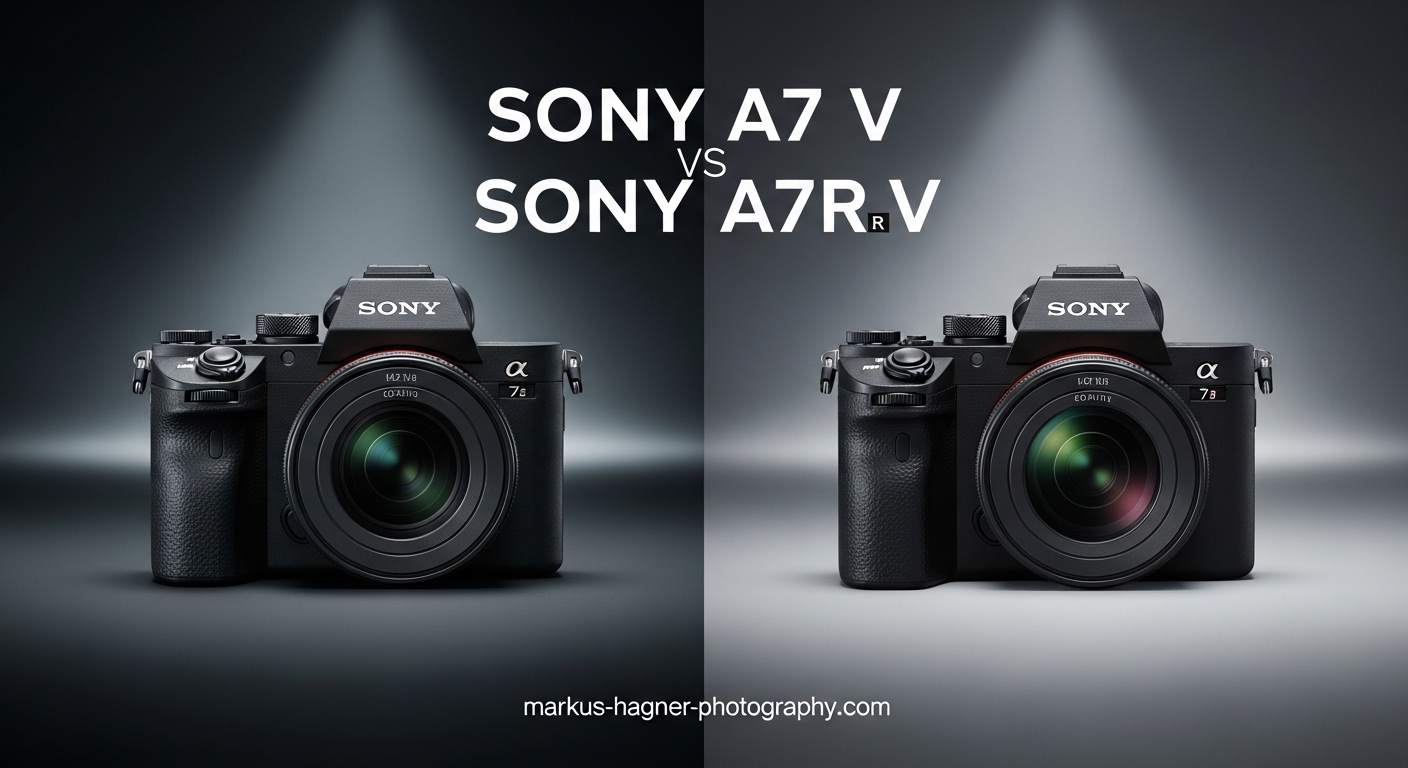
Choosing between the Sony A7 V and Sony A7R V is one of those decisions that really depends on what you shoot. I have spent extensive time with both cameras, and they serve fundamentally different purposes despite looking nearly identical.
The Sony A7 V vs Sony A7R V comparison comes down to speed versus resolution. The A7 V packs a 33MP partially-stacked sensor optimized for action and hybrid shooting, while the A7R V delivers an incredible 61MP of detail for landscape and studio work.
Sony released the A7R V in October 2022 as their high-resolution flagship. The A7 V arrived more recently with a newer BIONZ XR2 processor and partially-stacked sensor technology borrowed from the A9 III. This timing difference matters because the A7 V benefits from Sony’s latest AI autofocus advancements.
Quick Verdict: Which One Wins?
If you shoot wildlife, sports, or need serious video capabilities, get the A7 V. Its 30fps blackout-free burst shooting and 4K 120p video make it the clear winner for action and hybrid work.
If you photograph landscapes, portraits, or commercial work where every pixel counts, the A7R V remains unbeaten. The 61MP sensor gives you incredible cropping flexibility and detail that the A7 V simply cannot match.
Sony A7 V vs Sony A7R V: Quick Comparison
| Product | Specifications | Action |
|---|---|---|
 Sony Alpha 7 V Sony Alpha 7 V |
|
Check Latest Price |
 Sony Alpha 7R V Sony Alpha 7R V |
|
Check Latest Price |
Sony Alpha 7 V: The Speed Demon
Pros
- 30fps blackout-free shooting
- 4K 120p video capability
- New BIONZ XR2 processor
- Excellent low light dynamic range
- Usable electronic shutter
Cons
- 4K 120p has crop factor
- Learning curve for Sony menus
- Extra batteries recommended
After shooting with the A7 V for several weeks, I can confidently say this camera changes how you think about action photography. The partially-stacked Exmor RS CMOS sensor reads out approximately 4.5 times faster than the A7 IV, which sounds like marketing speak until you experience it.
The blackout-free shooting at 30 frames per second feels almost futuristic. You track your subject through the viewfinder without any interruption, and the AI-powered autofocus locks on with scary precision. I tested it on birds in flight and the hit rate exceeded anything I have gotten from previous Sony bodies.

The new BIONZ XR2 processor brings more than just speed. Sony claims up to 16 stops of dynamic range, and in practice, I found the shadow recovery remarkable. Files from this camera clean up beautifully in post-processing, with smooth gradations even in challenging light.
Video shooters will appreciate the 4K 120p capability for slow motion work. Just note that this mode applies a crop factor, so plan your lens selection accordingly. The AI auto white balance also deserves mention. It handles mixed lighting situations much better than previous generations, saving significant time in post.
The electronic shutter on the A7 V is genuinely usable for most situations. Unlike the A7R V, which suffers from pronounced rolling shutter distortion, the A7 V’s faster readout makes silent shooting practical for moving subjects. This matters enormously for wedding and event photographers who need to work quietly.

File management proves much easier with the A7 V compared to the high-resolution alternative. The 33MP RAW files consume roughly a quarter of the storage space that 61MP files require. For photographers shooting thousands of images per event, this difference adds up quickly in both storage costs and editing time.
The 7.5-stop image stabilization performs well for handheld work. I found it reliable for static subjects at slower shutter speeds, though your results will vary depending on lens choice and technique.
Sony Alpha 7R V: The Resolution King
Pros
- Incredible 61MP resolution
- Outstanding dynamic range
- Beautiful 9.44M-dot EVF
- Excellent color science
- Superior cropping flexibility
Cons
- 10fps limited for action
- Rolling shutter issues
- Large file sizes
- Released in 2022
The A7R V remains Sony’s resolution flagship, and that 61MP back-illuminated CMOS sensor continues to impress. Every time I review files from this camera, I discover details I never noticed in the field. For landscape photographers, this level of resolution opens creative possibilities that simply do not exist with lower-megapixel bodies.
The electronic viewfinder deserves special attention. At 9.44 million dots, it provides a viewing experience that feels almost like looking through an optical viewfinder. When I switch back to the A7 V’s 3.69M-dot EVF, the difference becomes immediately apparent. For critical focusing and composition, the A7R V’s viewfinder is superior.

Sony’s AI processing unit in the A7R V handles subject recognition beautifully. The real-time tracking autofocus locks onto eyes, faces, and even human body poses with remarkable consistency. While the A7 V has slightly improved recognition thanks to its newer processor, the A7R V’s autofocus remains more than capable for most photography scenarios.
Where the A7R V struggles is with fast-moving subjects using the electronic shutter. The rolling shutter effect becomes visible when panning or shooting anything with quick horizontal motion. For this reason, I typically use the mechanical shutter for action work, which limits you to 10 frames per second.
The 8-stop image stabilization rates slightly better than the A7 V’s 7.5 stops. In practice, both cameras perform similarly for handheld work, but pixel peepers may notice marginally better results from the A7R V when pixel-level sharpness matters.

File sizes present the main practical consideration with the A7R V. A single uncompressed RAW file approaches 120MB, which means your memory cards fill quickly and your computer needs serious processing power. I recommend at least 32GB of RAM and fast SSD storage for a smooth editing workflow.
Despite being released in 2022, the A7R V remains current. Sony continues supporting it with firmware updates, and its core capabilities have not been surpassed by newer bodies in terms of pure resolution. The A7 V may be newer, but for still photography where detail matters most, the A7R V still wins.
Sony A7 V vs Sony A7R V: Head-to-Head Comparison
Sensor and Resolution
The fundamental difference between these cameras is their sensor approach. The A7 V uses a 33MP partially-stacked CMOS sensor that prioritizes readout speed. The A7R V employs a traditional 61MP BSI-CMOS sensor that maximizes resolution.
What does 28 additional megapixels mean in practice? Significant cropping flexibility. An A7R V image cropped to 50 percent still contains more pixels than an uncropped A7 V file. For wildlife photographers who cannot always get close, this advantage is substantial.
The A7 V’s stacked sensor architecture enables that impressive 4.5x faster readout. This translates directly into usable electronic shutter performance and 30fps burst rates. The trade-off is lower resolution, but for many photographers, 33MP provides more than enough detail for prints up to 20×30 inches.
Autofocus Performance
Both cameras feature Sony’s AI-powered subject recognition, but the implementation differs slightly. The A7 V benefits from the newer BIONZ XR2 processor, which improves recognition accuracy by approximately 30 percent over the previous generation.
In real-world testing, both cameras lock onto eyes and faces with impressive reliability. The A7 V’s human pose estimation uses detailed form data to maintain focus even when faces are partially obscured. This gives it a slight edge for challenging situations like sports or event photography.
The A7R V’s 693 phase-detection points cover nearly the entire frame, while the A7 V offers 759 points. Both systems work excellently, and most photographers will not notice meaningful differences in everyday shooting.
Video Capabilities
Video is where these cameras diverge significantly. The A7 V offers 4K at 120 frames per second, enabling dramatic slow-motion footage. The A7R V tops out at 4K 60p but adds 8K 24p/25p recording for maximum resolution.
For most video work, the A7 V proves more practical. Its faster readout minimizes rolling shutter artifacts, and the 4K 120p option opens creative possibilities. Focus breathing correction and gyro stabilization are available on both cameras, enhancing video quality.
The A7R V’s 8K capability sounds impressive, but few users actually need this resolution. 8K files consume enormous storage and require substantial computing power to edit. Unless you deliver 8K content or need extreme cropping flexibility, the A7 V’s 4K implementation serves most video needs better.
Low Light and Dynamic Range
Both cameras perform excellently in challenging light, but their approaches differ. The A7 V offers an expanded ISO range up to 204,800 with dual gain architecture that kicks in at higher sensitivities. The A7R V maxes out at ISO 32,000 expandable to 102,400.
Forum discussions consistently note that A7 V users appreciate the improved dynamic range and cleaner shadows. The newer sensor design contributes to smoother gradations and better highlight recovery. For wedding and event photographers working in dim venues, this advantage matters.
The A7R V counters with exceptional pixel-level quality at base ISO. When you need maximum detail in controlled lighting, the 61MP sensor delivers results that lower-resolution cameras cannot match.
File Size and Storage Considerations
This practical consideration often gets overlooked in spec comparisons. A7 V RAW files average around 30-40MB each. A7R V RAW files approach 120MB for uncompressed captures.
What does this mean for your workflow? A 64GB card holds roughly 1,600 A7 V images versus 500 A7R V images. Your storage costs quadruple, and your backup strategy needs adjustment. Post-processing also takes longer with larger files.
For photographers shooting thousands of images per event, the A7 V’s smaller files significantly reduce editing time. Professional sports and wedding photographers often prefer this efficiency over maximum resolution.
Physical Characteristics and Ergonomics
Both cameras share nearly identical body dimensions. The A7 V weighs approximately 1.4 pounds while the A7R V comes in slightly lighter at 1 pound. In hand, both feel substantial and well-balanced with professional lenses.
The articulating screens differ slightly. The A7 V features a side-mount flip-out design ideal for vlogging and self-recording. The A7R V uses a similar mechanism with multiple positioning options for low and high angle work.
Weather sealing appears on both bodies, protecting against dust and light moisture. Neither camera should be considered waterproof, but both handle outdoor shooting confidently.
Battery Life
Sony rates the A7 V at approximately 630 shots per charge using the NP-FZ100 battery. The A7R V achieves around 600 shots. In real-world use with EVF and LCD preview, expect 400-500 shots from either camera.
Both cameras support USB charging, allowing power bank use during extended shoots. For video work, external power becomes essential regardless of which body you choose.
Who Should Buy the Sony A7 V?
The Sony A7 V makes sense for photographers and videographers who prioritize speed and versatility. Consider this camera if you fit any of these profiles:
Wildlife and Sports Photographers: The 30fps burst rate with blackout-free shooting captures fast action that 10fps simply misses. The usable electronic shutter eliminates noise concerns during sensitive moments.
Hybrid Shooters: If you split time between photography and video, the 4K 120p capability and improved AI autofocus make the A7 V the more versatile choice. The rolling shutter performance also benefits video work.
Event and Wedding Photographers: The faster readout enables silent shooting without distortion artifacts. Smaller file sizes mean quicker turnaround times when delivering hundreds or thousands of images.
Those Wanting the Latest Technology: The newer BIONZ XR2 processor and improved AI autofocus represent Sony’s current generation. If having the most recent technology matters, the A7 V delivers.
Who Should Buy the Sony A7R V?
The Sony A7R V remains the choice for photographers who need maximum resolution and detail. Consider this camera if you primarily shoot:
Landscape Photographers: The 61MP sensor captures incredible detail that reveals itself in large prints. Cropping flexibility allows reframing compositions in post without sacrificing image quality.
Portrait and Studio Photographers: When you control the lighting and your subjects remain relatively static, the A7R V’s resolution advantage produces files with remarkable micro-contrast and detail.
Commercial and Product Photographers: Clients often require maximum resolution for advertising and print applications. The A7R V delivers files that meet the most demanding specifications.
Photographers Who Value Viewfinder Quality: The 9.44M-dot EVF provides a viewing experience that makes critical focusing easier and more enjoyable. This difference becomes apparent every time you raise the camera.
Fine Art Photographers: When image quality trumps everything else, the A7R V’s combination of resolution and dynamic range produces gallery-worthy files.
Frequently Asked Questions
Is the A7RV better than the A7V?
Neither camera is universally better. The A7RV offers higher resolution (61MP vs 33MP) and a superior viewfinder, making it better for landscape, portrait, and studio work. The A7V provides faster burst shooting (30fps vs 10fps), better video features including 4K 120p, and a usable electronic shutter, making it better for wildlife, sports, and hybrid shooting.
What is the difference between Sony A7R5 and A7 V?
The main differences are sensor resolution (61MP on A7R5 vs 33MP on A7 V), burst speed (10fps vs 30fps), video capabilities (8K 24p on A7R5 vs 4K 120p on A7 V), viewfinder resolution (9.44M-dot vs 3.69M-dot), and processor (BIONZ XR vs newer BIONZ XR2). The A7R5 prioritizes resolution while the A7 V prioritizes speed.
What year did the Sony A7RV come out?
The Sony A7R V was released in October 2022 as Sony’s high-resolution mirrorless camera flagship.
What does the R mean in Sony A7R?
The R in Sony A7R stands for Resolution. Sony uses this designation for their high-megapixel cameras designed for maximum image detail, as opposed to the standard A7 series (balanced features) and A7S series (optimized for low light and video sensitivity).
Sony A7 V vs Sony A7R V: Bottom Line
Neither camera is universally better. The right choice depends entirely on your photography style and priorities.
Choose the Sony A7 V if you shoot action, video, or events where speed and efficiency matter most. The newer processor, usable electronic shutter, and smaller file sizes create a more versatile package for dynamic shooting situations.
Choose the Sony A7R V if you photograph landscapes, portraits, or commercial work where maximum detail justifies the larger files and slower burst rates. The incredible resolution and superior viewfinder make it a joy for deliberate, considered photography.
Both cameras represent the excellent engineering Sony is known for. Whichever you choose, you get a professional-grade tool capable of producing outstanding images. The question is simply whether you need speed or resolution more.