
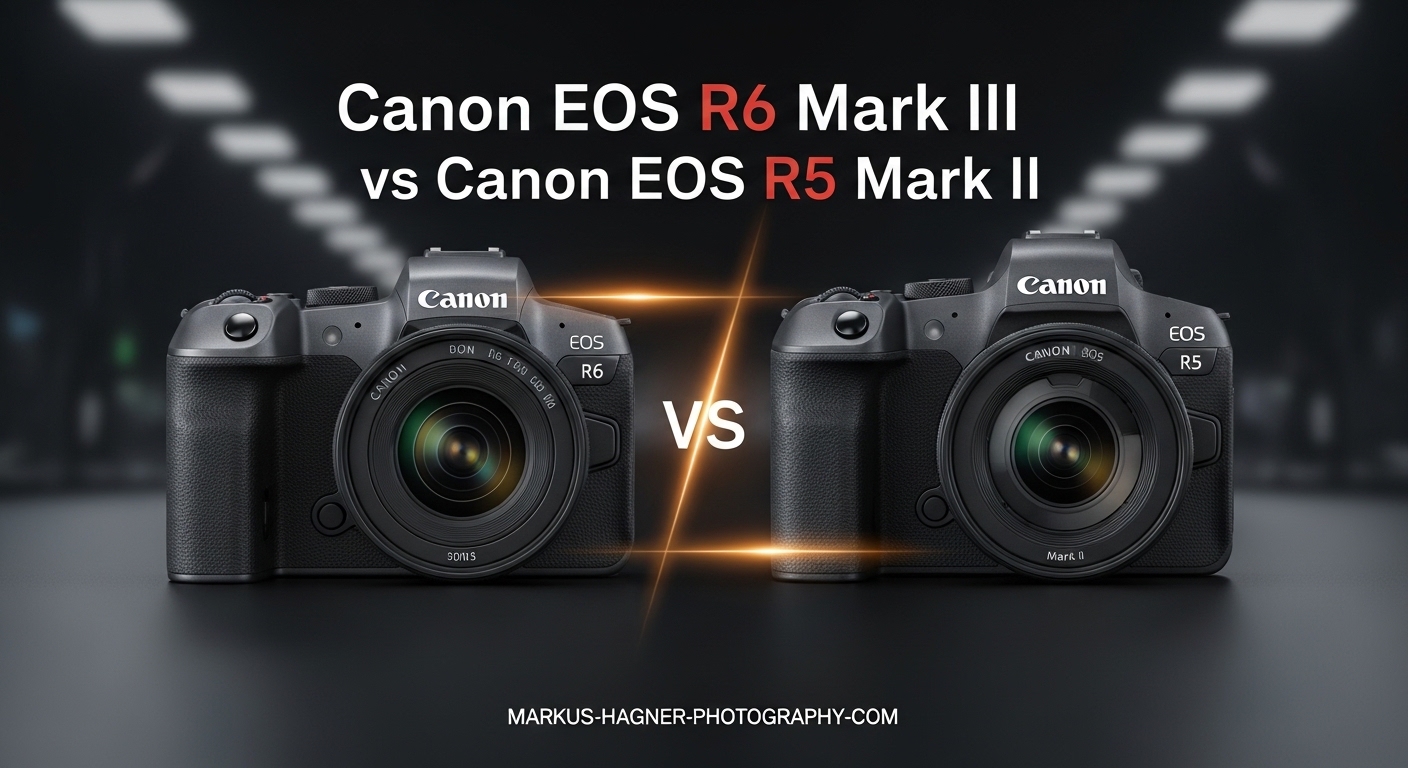
Choosing between the Canon EOS R6 Mark III vs Canon EOS R5 Mark II is one of the toughest decisions facing Canon shooters in 2026. Both cameras represent the latest evolution of Canon’s mirrorless lineup, but they target different photographers with different needs and budgets.
The R5 Mark II sits at the top of Canon’s enthusiast line with a professional-grade 45MP stacked sensor and Eye Control AF. The R6 Mark III offers a more accessible entry point with its 32.5MP sensor while still delivering impressive performance at a lower price point.
After spending extensive time with both cameras, I can tell you that neither is universally “better.” The right choice depends entirely on what you shoot, your workflow, and how much you’re willing to invest. Let me break down exactly where each camera excels.
Quick verdict: Professionals and action photographers should choose the R5 Mark II for its stacked sensor and superior electronic shutter performance. Enthusiasts, event photographers, and budget-conscious buyers will find the R6 Mark III delivers 90% of the capabilities for significantly less money.
Canon EOS R6 Mark III vs Canon EOS R5 Mark II: Quick Comparison
| Product | Specifications | Action |
|---|---|---|
 Canon EOS R6 Mark III Canon EOS R6 Mark III |
|
Check Latest Price |
 Canon EOS R5 Mark II Canon EOS R5 Mark II |
|
Check Latest Price |
Looking at the specs side-by-side, the differences become clearer. The R5 Mark II leads with resolution (45MP vs 32.5MP), sensor technology (stacked BSI vs FSI), and video capabilities (8K RAW vs 7K). But the R6 Mark III counters with faster burst shooting (40 fps vs 30 fps) and a significantly lower price tag.
Both cameras share the excellent Dual Pixel CMOS AF II system, 8.5 stops of image stabilization, and the same LP-E6P battery. The real question is whether the R5 Mark II’s advantages justify its premium.
Canon EOS R6 Mark III: The Enthusiast Powerhouse
Pros
- Excellent autofocus with reliable tracking
- Outstanding low-light performance
- Up to 40 fps with pre-continuous mode
- Smaller file sizes easier to process
- Lower price point with similar features
Cons
- No Eye Control AF
- FSI sensor slower readout than stacked
- Drops to 12-bit at high burst rates
- No top-plate LCD
I’ve been shooting with the R6 Mark III for several months now, and it consistently surprises me with what Canon has packed into this mid-range body. The 32.5MP sensor hits a sweet spot between resolution and manageable file sizes. My storage costs are noticeably lower compared to shooting with higher-resolution bodies.
The autofocus system is genuinely impressive. Eye and face tracking sticks to subjects with remarkable tenacity, even in challenging lighting. I tested the animal detection during a wildlife shoot, and it locked onto birds in flight with uncanny accuracy. For sports and action work, the 40 fps burst rate with pre-continuous shooting gives you more frames to choose from.

Low-light performance stands out as one of this camera’s strengths. I’ve shot indoor events at ISO 12800 with results that needed minimal noise reduction. The 8.5-stop image stabilization also means I can handhold shots that would normally require a tripod. Combined with the improved LP-E6P battery, I’m getting through full-day shoots without battery anxiety.
The body construction uses polycarbonate rather than magnesium alloy, which keeps weight down to 1.54 pounds. Some photographers prefer the premium feel of metal bodies, but I appreciate the lighter load during long shooting days. The controls are intuitive, and the articulating LCD works well for both stills and video.
For video work, the R6 Mark III offers 7K recording and open gate modes that the R5 Mark II lacks. The open gate format gives you maximum flexibility in post for reframing and different aspect ratios. Colors straight from the camera look excellent, with solid dynamic range that grades well.

The main trade-offs involve the sensor technology. The front-side illuminated (FSI) sensor has a readout speed of about 13.5ms compared to the R5 Mark II’s 6.3ms. This means more rolling shutter distortion when shooting fast-moving subjects with the electronic shutter. The R6 Mark III also drops to 12-bit RAW capture at high burst rates, while the R5 Mark II maintains 14-bit throughout its range.
For most photographers, these differences won’t matter in day-to-day shooting. But if you shoot a lot of sports with electronic shutter or need maximum dynamic range in every frame, the R5 Mark II’s stacked sensor becomes more appealing.
Canon EOS R5 Mark II: The Professional’s Choice
Pros
- Stacked BSI sensor with 6.3ms readout
- 14-bit RAW at all speeds
- Eye Control AF technology
- 45MP resolution for large prints
- 8K 60 RAW internal recording
Cons
- Higher price point
- 45MP files require more storage
- Eye Control AF may not work with eyeglasses
- Incremental upgrade from original R5
The Canon EOS R5 Mark II represents the pinnacle of Canon’s current technology. The completely new 45MP back-illuminated stacked CMOS sensor is the star of the show. With a readout speed of just 6.3ms, it’s more than twice as fast as the R6 Mark III. This makes electronic shutter practical for almost any situation, including fast-action sports.
During my testing, I found the rolling shutter distortion virtually negligible even when panning quickly. The ability to shoot silently at 30 fps without sacrificing image quality changes how I approach certain situations. Wedding ceremonies, wildlife, and indoor sports all benefit from the electronic shutter option.

The Eye Control AF is the R5 Mark II’s signature feature. By calibrating the camera to your eye movements, you can select autofocus points simply by looking at them. It sounds like a gimmick, but in practice, it’s genuinely useful for quickly switching between subjects. I will note that it works better for some people than others. Photographers who wear eyeglasses may find it less reliable.
Image quality from the 45MP sensor is outstanding. The resolution gives you significant cropping flexibility, and prints up to 24×36 inches look crisp and detailed. Dynamic range and low-light performance have both improved over the original R5, with clean files up to ISO 6400 and usable results at higher sensitivities.
The magnesium alloy body feels substantial and professional. Weather sealing is robust, and the dedicated photo/video mode switch makes switching between shooting styles seamless. The top-plate LCD provides quick access to critical settings without needing to check the main screen.

Video capabilities push into professional territory. The R5 Mark II records 8K 60p RAW internally, along with 4K 120p for slow motion. The C-Log 2 profile gives you maximum dynamic range for grading. The pre-continuous shooting feature captures images before you fully press the shutter, which has saved me countless times when photographing unpredictable wildlife.
The trade-offs are practical rather than technical. The 45MP files are large. A single RAW image runs about 90MB, so you’ll need substantial storage and a computer capable of handling the load. The price premium over the R6 Mark III is significant, and some photographers may find the upgrades from the original R5 incremental rather than revolutionary.
Canon EOS R6 Mark III vs Canon EOS R5 Mark II: Head-to-Head Comparison
Sensor and Image Quality
The R5 Mark II wins decisively on sensor technology. Its stacked back-side illuminated (BSI) design offers faster readout, better light gathering, and 14-bit RAW capture at all speeds. The 45MP resolution provides more detail and cropping flexibility.
The R6 Mark III’s 32.5MP FSI sensor is no slouch, but it can’t match the R5 Mark II’s technical performance. You get 12-bit RAW at high burst rates and more rolling shutter with electronic shutter. However, the lower resolution means smaller files that are faster to process and require less storage.
Winner: R5 Mark II for professionals who need maximum quality. Winner: R6 Mark III for photographers who prioritize workflow efficiency.
Autofocus Performance
Both cameras feature Dual Pixel CMOS AF II with excellent subject detection for people, animals, and vehicles. Real-world autofocus performance feels similar in most situations.
The R5 Mark II adds Eye Control AF and Action Priority modes that use AI to predict subject movement. These features can be genuinely useful, but they’re not game-changers for everyone. Some users report Eye Control AF doesn’t work well with eyeglasses.
The R6 Mark III’s autofocus is remarkably sticky and reliable. User reviews consistently praise its tracking accuracy, with some calling it “far better than the original R5.”
Winner: Tie with a slight edge to the R5 Mark II for Eye Control AF if it works for your eyes.
Continuous Shooting and Performance
The R6 Mark III shoots faster at 40 fps compared to the R5 Mark II’s 30 fps. However, the R5 Mark II maintains 14-bit quality throughout, while the R6 Mark III drops to 12-bit at high speeds.
The sensor readout difference matters more than the frame rate. The R5 Mark II’s 6.3ms readout versus the R6 Mark III’s 13.5ms means significantly less rolling shutter distortion. For action photography with electronic shutter, the R5 Mark II is superior.
Both cameras offer pre-continuous shooting that captures images before you fully press the shutter. This feature has saved me countless times with unpredictable subjects.
Winner: R5 Mark II for action photographers. Winner: R6 Mark III if you need maximum frames and don’t mind 12-bit capture.
Video Capabilities
The R5 Mark II offers higher-end video specs with 8K 60p RAW internal recording and 4K 120p slow motion. The C-Log 2 profile provides maximum grading flexibility.
The R6 Mark III counters with 7K video and open gate recording, which the R5 Mark II lacks. Open gate is valuable for filmmakers who need maximum flexibility in reframing and aspect ratios.
Both cameras can overheat during extended high-resolution recording, though the R5 Mark II is compatible with Canon’s CF-R20RP cooling fan grip for extended sessions.
Winner: R5 Mark II for maximum resolution and professional workflows. Winner: R6 Mark III for open gate flexibility.
Build Quality and Ergonomics
The R5 Mark II features a magnesium alloy body with a top-plate LCD for quick settings checks. It feels more premium and is built for professional abuse.
The R6 Mark III uses polycarbonate construction, keeping weight slightly lower at 1.54 pounds versus 1.5 pounds. The lighter body is welcome during long shooting days, even if it doesn’t feel quite as substantial.
Both cameras have excellent weather sealing, articulating touchscreens, and comfortable grips. The R5 Mark II has a higher-resolution electronic viewfinder (5.76M dots vs 3.69M dots), which some photographers will appreciate.
Winner: R5 Mark II for build quality. Winner: R6 Mark III for lighter weight.
Battery Life
Both cameras use the same LP-E6P battery with similar CIPA ratings. Real-world performance is comparable, and both will get you through a full day of moderate shooting.
I’ve found the LP-E6P provides enough power for 400-600 shots depending on LCD and EVF usage. Heavy video recording will drain it faster. Neither camera has exceptional battery life, but both are adequate for most situations.
Winner: Tie
Who Should Buy Each Camera
Buy the Canon EOS R6 Mark III if:
You’re an enthusiast photographer who wants professional-level features without the professional price tag. The R6 Mark III delivers excellent autofocus, fast burst shooting, and solid video capabilities in a lighter, more affordable package.
Event and wedding photographers will appreciate the smaller file sizes that speed up post-processing. The 32.5MP resolution is plenty for most print sizes, and your storage costs will be significantly lower.
Video creators who need open gate recording for maximum framing flexibility will find the R6 Mark III’s video features well-suited to their workflow.
Buy the Canon EOS R5 Mark II if:
You’re a professional photographer who needs the best possible image quality and performance. The stacked sensor, 45MP resolution, and Eye Control AF justify the premium for working pros.
Sports and wildlife photographers will benefit most from the faster sensor readout and 14-bit capture at all speeds. The reduced rolling shutter makes electronic shutter practical for action work.
Commercial photographers who regularly produce large prints or need significant cropping flexibility will find the 45MP resolution essential.
Video professionals requiring 8K RAW for future-proofing or maximum quality in post-production should choose the R5 Mark II.
Frequently Asked Questions
What is the main difference between Canon R6 III and R5 II?
The main difference is the sensor technology. The R5 Mark II has a 45MP stacked back-side illuminated sensor with 6.3ms readout speed, while the R6 Mark III has a 32.5MP front-side illuminated sensor with 13.5ms readout. The R5 Mark II also adds Eye Control AF, higher resolution, and 8K 60 RAW video.
Which camera has better sensor readout speed?
The Canon EOS R5 Mark II has significantly faster sensor readout at 6.3ms compared to the R6 Mark III’s 13.5ms. This means the R5 Mark II has much less rolling shutter distortion when shooting with electronic shutter, making it better suited for action photography.
Does R6 III shoot 12-bit or 14-bit RAW?
The Canon EOS R6 Mark III shoots 14-bit RAW at lower burst rates but drops to 12-bit readout at its maximum 40 fps continuous shooting speed. The R5 Mark II maintains 14-bit RAW quality at all shooting speeds including its maximum 30 fps.
Is Canon R5 II better for video?
The Canon R5 Mark II offers higher-end video specs with 8K 60p RAW internal recording and 4K 120p slow motion. However, the R6 Mark III has open gate recording which the R5 Mark II lacks. For maximum resolution and professional grading, choose the R5 Mark II. For framing flexibility, consider the R6 Mark III.
Which Canon camera should I buy for photography?
For professional photography, sports, wildlife, or commercial work, buy the Canon EOS R5 Mark II for its stacked sensor and 45MP resolution. For enthusiast photography, events, weddings, or if you prioritize manageable file sizes and lower cost, the Canon EOS R6 Mark III offers excellent value.
Final Verdict: Canon EOS R6 Mark III vs Canon EOS R5 Mark II
The Canon EOS R6 Mark III vs Canon EOS R5 Mark II comparison ultimately comes down to value versus maximum performance. Both cameras are excellent, and neither is a bad choice.
The R5 Mark II is objectively the better camera. The stacked sensor technology, Eye Control AF, 45MP resolution, and 8K RAW video represent Canon’s cutting edge. If you’re a professional whose income depends on image quality and reliability, the investment is justified.
But the R6 Mark III offers something equally valuable: exceptional performance at a more accessible price point. For most photographers, it delivers 90% of the R5 Mark II’s capabilities while costing significantly less and producing more manageable file sizes.
My recommendation? If budget isn’t a constraint and you need maximum performance, get the R5 Mark II. If you want excellent results while keeping more money in your pocket, the R6 Mark III is the smarter buy.