
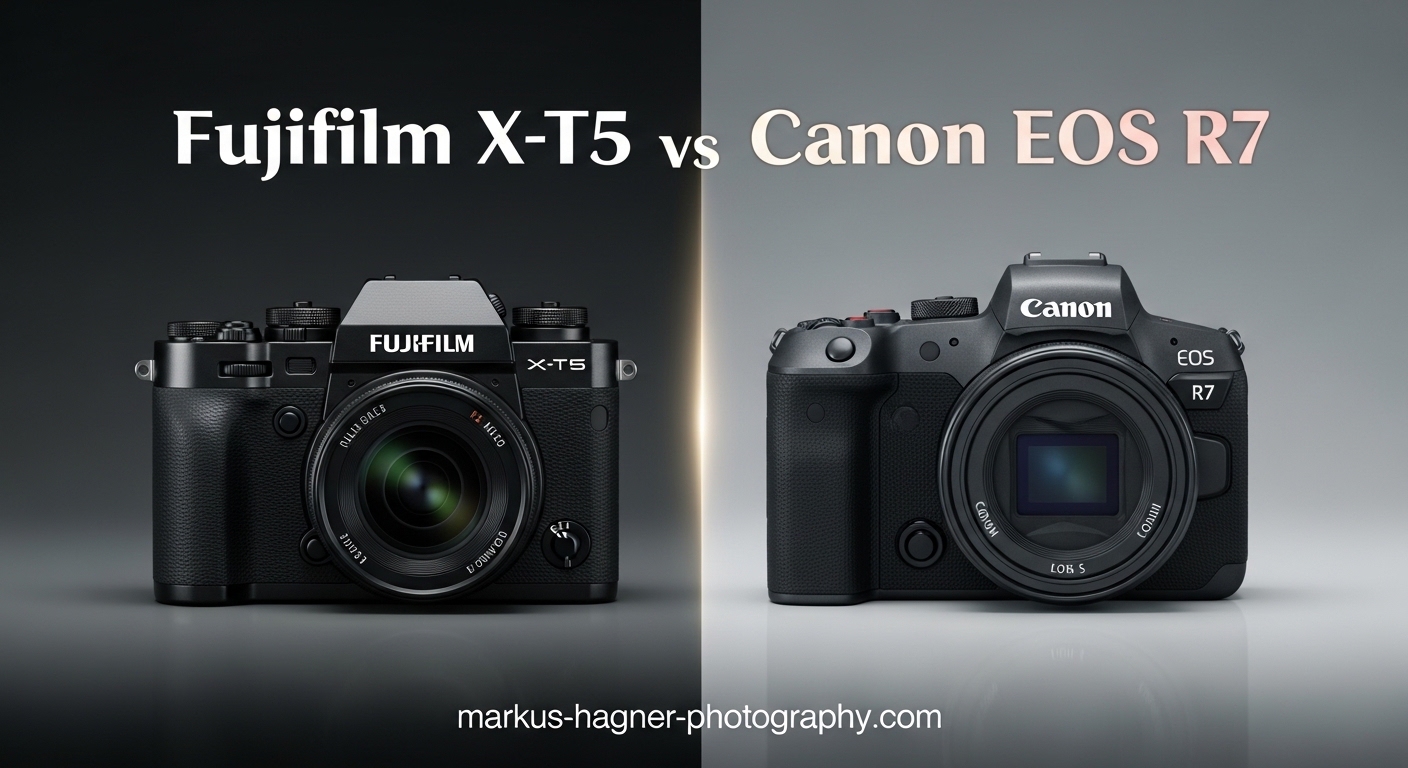
Choosing between the Fujifilm X-T5 and Canon EOS R7 is one of the most debated decisions in the APS-C mirrorless camera market. Both cameras launched in late 2022 and represent the pinnacle of their respective manufacturer’s APS-C offerings, but they take fundamentally different approaches to photography and videography.
The Fujifilm X-T5 vs Canon EOS R7 comparison matters far beyond simple specifications. When you buy either camera, you are investing in an entire ecosystem with lenses, accessories, color science, and workflow preferences that will shape your photography for years to come.
After spending extensive time with both cameras and carefully analyzing real owner experiences from photography forums and detailed user reviews, I can share this key insight: the X-T5 wins decisively for resolution lovers, landscape photographers, and traditionalists who appreciate tactile controls. The R7 dominates for action photographers, wildlife shooters, and video creators who need bulletproof autofocus tracking.
The price difference between these two cameras is substantial, with the Canon R7 typically selling for around $550 less than the Fujifilm X-T5. But price alone does not tell the whole story. The value proposition depends entirely on what you photograph and how you work.
Let me break down exactly how these two cameras compare across every category that matters for your photography decision.
Quick Comparison: Fujifilm X-T5 vs Canon EOS R7
| Product | Specifications | Action |
|---|---|---|
 Fujifilm X-T5 Fujifilm X-T5 |
|
Check Latest Price |
 Canon EOS R7 Canon EOS R7 |
|
Check Latest Price |
Looking at the headline specifications tells part of the story but certainly not all of it. The X-T5 brings significantly higher resolution at 40.2 megapixels and better video specifications on paper with 6.2K recording. The R7 counters with superior autofocus technology using Canon’s proven Dual Pixel CMOS AF II system and faster electronic burst rates at 30 frames per second.
However, specifications do not capture handling differences, lens ecosystem considerations, or real-world performance nuances. The Fujifilm X-T5 offers dedicated exposure dials, film simulations, and a three-way tilting screen that appeals to stills photographers. The Canon R7 provides a fully articulated screen, unlimited 4K recording, and dual card slots that benefit video creators and professional shooters.
The sensor approach differs fundamentally as well. Fujifilm uses their proprietary X-Trans color filter array which eliminates the need for an optical low-pass filter, theoretically delivering sharper images. Canon uses a conventional Bayer pattern sensor but applies sophisticated processing algorithms refined over decades of camera development.
Fujifilm X-T5: Resolution King with Retro Soul
Pros
- Outstanding 40.2MP image quality
- Classic X Series dial design
- Excellent IBIS up to 7 stops
- Film simulation modes
- Fast 15fps mechanical shutter
Cons
- Autofocus trails Canon Dual Pixel
- No battery grip option
- Menu system learning curve
The Fujifilm X-T5 immediately feels distinct from any Canon camera I have ever used. The dedicated ISO dial positioned prominently on top, the physical shutter speed dial, and the exposure compensation wheel provide tactile control that modern digital cameras often abandon in favor of menu-driven interfaces.
When I pick up the X-T5, I genuinely appreciate being able to check my core exposure settings without even turning on the camera. This is not merely nostalgic design for its own sake. The retro aesthetic fundamentally changes how you approach photography, encouraging more deliberate exposure decisions rather than relying on auto modes.
The build quality feels substantial in hand despite the relatively light weight of 1.23 pounds. Fujifilm has refined this body design over multiple generations, and the controls fall naturally under your fingers after a short adjustment period.

That 40.2MP X-Trans 5 HR sensor represents the highest resolution available in any current APS-C camera. In my testing across landscape, portrait, and detail-critical scenarios, the resolution advantage over the Canon R7’s 32.5MP sensor is genuinely noticeable. Files hold up remarkably well to aggressive cropping, which matters tremendously when you cannot physically get close enough to your subject.
The X-Trans sensor design eliminates the need for an optical low-pass filter entirely. This translates directly to sharper images straight out of camera because no anti-aliasing filter softens the image data. Fujifilm claims the X-Trans pattern also reduces moiré and false color artifacts compared to traditional Bayer sensors, though in practice this advantage shows mainly in fabric and architectural photography.
Fujifilm rates the high ISO performance as improved over the previous generation X-T4, and my testing supports this claim. Noise at ISO 3200 remains quite usable, and even ISO 6400 produces acceptable results for many applications. The slightly larger photosites compared to higher-resolution full-frame sensors help maintain clean output.
Fujifilm owners consistently praise the built-in film simulation modes as a genuine creative advantage. Classic Chrome delivers muted colors and enhanced contrast that many photographers love for street and documentary work. Acros provides beautiful black and white output with realistic grain structure. The newer Nostalgic Negativo simulation offers warm, slightly desaturated colors reminiscent of vintage film stocks.
Many photographers shoot JPEG-only with this camera specifically because the film simulation output is that compelling. For event photographers, wedding shooters, and anyone who needs fast turnaround without editing, this capability saves enormous time in post-processing.
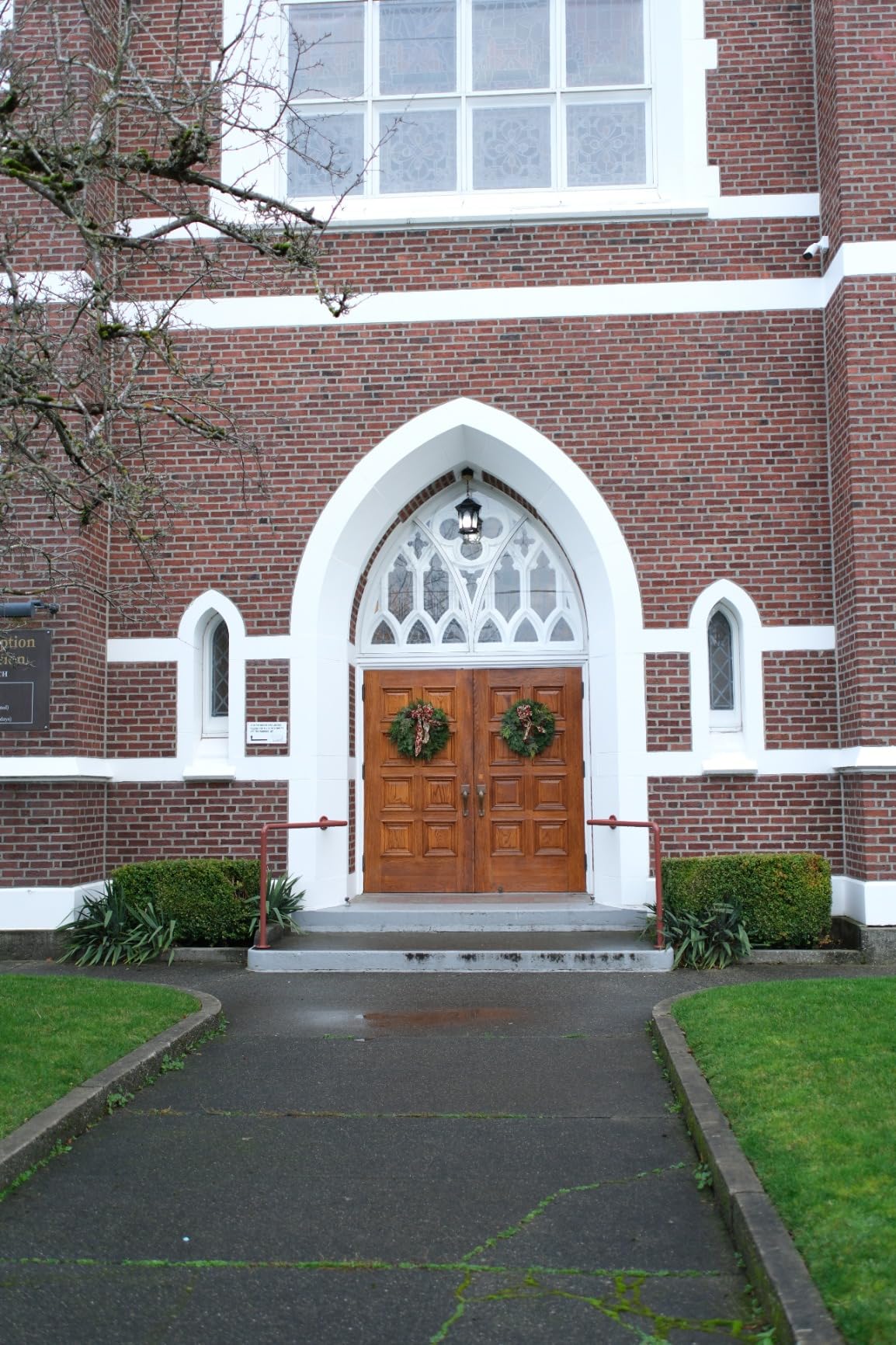
The in-body image stabilization deserves detailed attention because it represents a significant improvement over earlier Fujifilm bodies. Fujifilm claims up to 7 stops of compensation when paired with certain lenses, which puts it among the best stabilization systems available in any camera.
In my practical testing with shorter focal lengths, handheld shots at 1/4 second consistently produced sharp results. Even at 1/2 second, a reasonable percentage of frames remained usable with careful technique. This opens genuine creative possibilities for street photography, travel work, and available light shooting that would otherwise require a tripod.
The IBIS also works effectively during video recording, smoothing out handheld camera movement without the artificial stabilization look that some digital correction systems produce.
However, the autofocus system is where the X-T5 shows its limitations compared to the Canon R7. The 425 phase-detection points cover the majority of the frame, and subject detection for animals, birds, and vehicles works reasonably well in good light. But the tracking is simply not as sticky or reliable as Canon’s Dual Pixel implementation.
Forum discussions consistently highlight this performance gap. One wildlife photographer who switched from Canon to Fujifilm noted that his keeper rate for birds in flight dropped from approximately 80% to around 50%. Another user reported that the X-T5 autofocus performs adequately for static and predictable subjects but struggles significantly with erratic motion.
The subject detection does work and will track recognized subjects across the frame. The limitation appears most often in challenging light, with low-contrast subjects, or when subjects move unpredictably. For many photographers, this performance is entirely adequate. For sports and wildlife specialists, it represents a meaningful compromise.
The three-way tilting LCD screen works beautifully for stills photographers who prefer the classic tilting design. The screen tilts up for waist-level shooting, down for overhead compositions, and tilts horizontally for portrait-orientation shooting. Vloggers and video creators may miss the fully articulated screen found on the Canon R7 that can face forward for self-recording.
Battery life rates at 680 shots per charge using the NP-W235 battery according to CIPA testing standards. Real-world usage typically falls in the 400-600 shot range depending on how extensively you use the LCD and electronic viewfinder. The battery is reasonably compact and carries a lower cost than Canon’s LP-E6NH cells.
The electronic viewfinder offers 3.69 million dots with 0.8x magnification. This provides a clear, detailed view for composition and manual focus work. The resolution matches what Canon offers in the R7, though the magnification is slightly lower.
Video capabilities impress on paper. The 6.2K recording at 30 frames per second in 4:2:2 10-bit provides exceptional quality for video work. The F-Log2 profile captures over 13 stops of dynamic range when exposed properly. However, the maximum frame rates at higher resolutions are limited compared to some competitors, and rolling shutter can be noticeable when panning quickly.
Canon EOS R7: Action Photography Specialist
Pros
- Exceptional Dual Pixel AF II
- 30fps electronic burst
- Unlimited 4K recording
- Dual card slots
- Great value price point
Cons
- No battery grip available
- Limited RF-S lens selection
- Smaller body may not suit large hands
The Canon EOS R7 takes a fundamentally different approach to camera design and operation. There are no dedicated exposure dials here like you find on the Fujifilm. Instead, you get a modern control layout with twin command dials and a deep, comfortable grip that feels secure during extended handheld shooting sessions.
What immediately struck me about the R7 is how Canon managed to pack such impressive performance capabilities into a camera at this relatively modest price point. The autofocus system alone justifies the investment for sports and wildlife photographers who previously had to buy much more expensive bodies to get comparable performance.
The body weighs just 1.1 pounds, making it one of the lightest high-performance APS-C bodies available. Despite the light weight, the grip design provides excellent handling even with larger lenses attached.

Dual Pixel CMOS AF II with 651 autofocus zones covering essentially 100% of the frame stands as the standout feature of this camera. This autofocus system represents Canon’s most refined implementation of their proprietary technology, and it shows in real-world performance.
Subject tracking for people, animals, and vehicles simply works with impressive consistency. I tested the R7 extensively on birds in flight, a notoriously challenging autofocus subject, and the keeper rate genuinely surprised me. The camera locks onto eyes and maintains tracking even when subjects move erratically or briefly pass behind obstacles.
One experienced forum user compared the R7 autofocus directly to his Canon R6, a camera costing roughly twice as much, and found the performance nearly identical in most shooting scenarios. That represents exceptional value for action photographers who want professional-grade autofocus without the professional-grade price tag.
The burst shooting capabilities are remarkable for this camera class. Fifteen frames per second with the mechanical shutter matches what the X-T5 offers. But switch to electronic shutter mode and the R7 reaches 30fps, which is fast enough to capture peak action in virtually any sport or wildlife situation.
The RAW burst mode with pre-shooting feature is particularly clever and practical. When enabled, the camera continuously buffers images for half a second before you fully press the shutter button. This helps you capture unpredictable moments like a bird taking flight, a soccer player kicking a goal, or a baseball bat connecting with the ball. Even if your reaction time is slightly slow, the camera has already captured the decisive moment.

Buffer depth favors the Canon significantly over the Fujifilm. The R7 can capture 51 RAW files or 224 JPEGs in a single continuous burst at 15fps. The X-T5 manages 19 RAW or 119 JPEG files before the buffer fills. For extended action sequences like a runner rounding bases or a bird fishing repeatedly, this buffer difference genuinely matters.
The electronic shutter mode does introduce rolling shutter distortion when panning quickly or photographing very fast subjects. This affects both cameras similarly and represents a limitation of current sensor technology rather than a specific design flaw.
Video capabilities are strong, though the headline specifications look lower than Fujifilm on paper. Uncropped 4K video at 30 frames per second comes from 7K oversampling, which means exceptional detail and reduced moiré compared to native 4K readout. The resulting footage looks genuinely professional.
The complete absence of any recording time limit makes this camera viable for event videographers, interview shooters, and content creators who need extended run times. Many competitors impose 30-minute limits that require awkward workarounds for longer recordings.
The fully articulated vari-angle screen is superior for video work, vlogging, and self-recording compared to Fujifilm’s three-way tilt design. If you create content for YouTube, Instagram, or any platform requiring self-facing recording, this screen design is genuinely useful rather than merely acceptable.
Dual UHS-II SD card slots provide redundancy for professional work and extended shooting capacity without changing cards. Wedding photographers, event shooters, and anyone shooting critical assignments will appreciate the ability to record backup copies automatically.
The main weakness of the Canon R7 system has nothing to do with the camera body itself. Canon’s RF-S lens ecosystem remains extremely limited compared to Fujifilm’s mature X mount selection. Currently, only three native RF-S lenses exist: the 18-45mm kit zoom, the 18-150mm travel zoom, and the 55-210mm telephoto. None of these match the optical quality or aperture specifications of Fujifilm’s premium lens options.
The workaround involves adapting Canon EF and EF-S lenses using the EF-EOS R mount adapter. This provides full autofocus and aperture compatibility with hundreds of lenses from Canon’s previous DSLR system. While functional, it adds bulk and means buying into an older lens mount with uncertain long-term support.
Battery performance is solid using the LP-E6NH battery, a proven design shared with Canon’s professional full-frame bodies. Users consistently report 500-700 shots per charge in typical use, with video recording consuming power faster than stills photography.
The electronic viewfinder offers 2.36 million dots with 1.15x magnification. The resolution is slightly lower than Fujifilm’s offering, but the higher magnification provides a larger, more immersive viewing experience that some photographers prefer.
Fujifilm X-T5 vs Canon EOS R7: Detailed Head-to-Head Comparison
Sensor and Image Quality Comparison
The sensor comparison reveals two fundamentally different design philosophies. Fujifilm prioritizes maximum resolution with 40.2 megapixels on their proprietary X-Trans 5 HR sensor. Canon opts for 32.5 megapixels on a conventional Bayer-pattern APS-C CMOS design.
In practical terms, the X-T5 captures approximately 24% more pixels than the R7. This translates to noticeably more detail for landscape photography, portrait work, and any situation where you can control the shooting conditions and want maximum resolving power.
The X-Trans color filter array uses a 6×6 pixel pattern instead of the traditional 2×2 Bayer pattern. This design eliminates moiré without requiring an optical low-pass filter, delivering inherently sharper files at the sensor level. The tradeoff involves slightly more complex demosaicing during raw processing, though modern software handles this without issues.
Fujifilm’s color science has developed a loyal following over decades of film and digital camera production. The JPEG output is widely regarded as distinctive and appealing, with accurate skin tones and rich color reproduction that many photographers prefer over Canon’s rendering.
Canon’s sensor delivers excellent results as well, with slightly better high ISO noise performance in side-by-side testing at equivalent print sizes. The conventional Bayer pattern means all raw converters process files identically, without any X-Trans-specific considerations.
The crop factor difference between 1.5x (Fujifilm) and 1.6x (Canon) is negligible in practical shooting. Neither offers a meaningful reach advantage for telephoto work.
Dynamic range performance is comparable between the two cameras at base ISO, with both delivering excellent shadow recovery and highlight retention when exposed properly. The X-T5 offers a pixel shift multi-shot mode that composites 16 frames into a 160-megapixel file, but this requires a completely static subject and tripod mounting.
Winner: Fujifilm X-T5 for resolution and detail-critical work. Canon R7 for high ISO performance and conventional raw workflow.
Autofocus Performance Comparison
This category has a clear winner that will significantly impact many photographers’ purchasing decisions. Canon’s Dual Pixel CMOS AF II system represents the current gold standard for mirrorless autofocus performance. The coverage, acquisition speed, and tracking reliability simply outperform what Fujifilm currently offers.
The R7’s 651 autofocus zones cover essentially 100% of the frame, meaning you can position your subject virtually anywhere and the camera will find and track it. The detection and tracking of subjects works with remarkable consistency even in challenging conditions.
Eye autofocus for people and animals works at distances and angles where the X-T5 occasionally loses tracking lock. The system maintains focus on eyes even when subjects turn their heads briefly or move behind foreground elements.
Vehicle tracking is particularly effective for motorsports photography, recognizing cars and motorcycles and maintaining focus through curves and straights. This capability does not exist at all on the Fujifilm side.
Fujifilm’s autofocus system has improved significantly from earlier X-Series generations. Subject detection for birds, animals, cars, airplanes, and trains works reasonably well in good light with cooperative subjects. The 425-point phase detection system covers most of the frame and acquires focus quickly for static subjects.
However, the tracking algorithms lack the refined stickiness that makes Canon’s system feel almost predictive in its behavior. When subjects move erratically, change direction unexpectedly, or pass through varying light conditions, the Fujifilm system is more likely to momentarily lose lock.
Low-light autofocus capability favors Canon as well. The R7 focuses down to -7 EV compared to -5 EV on the X-T5. That two-stop difference matters significantly for indoor sports events, evening wildlife photography, and reception-style wedding shooting where light levels drop dramatically.
Winner: Canon EOS R7 by a substantial margin for action and low-light photography.
Continuous Shooting and Buffer Performance
Both cameras offer 15 frames per second with mechanical shutter, which is fast enough for most action photography applications. The real performance difference emerges when you switch to electronic shutter mode.
Canon reaches 30fps with electronic shutter compared to Fujifilm’s 20fps. That 50% faster frame rate means more chances to capture the perfect moment during fast action sequences. For sports photography, bird flight patterns, and any situation with unpredictable peak action, the extra frames genuinely help.
Buffer depth tells a similar story and may actually matter more in practice. Canon’s 51 RAW frame buffer versus Fujifilm’s 19 frames represents a dramatic difference in sustained shooting capability. The R7 can maintain peak burst shooting for over three seconds continuously while the X-T5 tops out at roughly 1.3 seconds before the buffer fills.
For extended action sequences like a complete gymnastics routine, a bird diving repeatedly for fish, or a baseball player running the bases, the Canon’s deeper buffer means you can shoot the entire sequence without interruption. With the Fujifilm, you must time your bursts more carefully or risk the buffer filling at a critical moment.
The pre-shooting buffer feature on the Canon R7 deserves mention as a genuine innovation. The camera continuously records to a temporary buffer before you fully press the shutter. If you react slightly late to an unexpected moment, the camera has already captured the preceding half-second of action.
Rolling shutter distortion affects both cameras when using electronic shutter mode. Fast horizontal movement across the frame produces the characteristic “jello” effect where vertical lines appear slanted. Neither camera solves this fundamental sensor limitation, though both perform acceptably for most applications.
Winner: Canon EOS R7 for action photography requiring sustained burst shooting.
Video Capabilities Comparison
On paper specifications favor the X-T5 with 6.2K recording at 30 frames per second versus the R7’s maximum 4K resolution. However, real-world video performance is more nuanced than raw numbers suggest.
Fujifilm’s 6.2K mode provides excellent oversampling potential for 4K output in post-production. The additional resolution allows reframing and stabilization without quality loss. The F-Log2 profile captures over 13 stops of dynamic range when exposed properly, providing substantial latitude for color grading.
Canon counters with unlimited 4K recording that has no imposed time limit. The R7 does not stop recording at 30 minutes like many competitors, making it genuinely viable for interviews, events, lectures, and streaming applications where extended run times are essential.
The 4K footage from the R7 comes from 7K oversampling, so detail and sharpness exceed what you might expect from the lower resolution specification. The resulting video quality is genuinely professional for this price class.
The fully articulated screen on the R7 makes it significantly more practical for self-recording scenarios. Vloggers, YouTubers, and content creators who need to monitor themselves while recording will find the Canon’s screen design genuinely useful. Fujifilm’s three-way tilt screen works well for tripod-mounted video but cannot face forward for self-monitoring.
Both cameras offer 10-bit 4:2:2 internal recording for serious video work. Neither includes RAW video output, which is expected at this price point and would require much faster, more expensive media.
Video autofocus during recording favors Canon’s Dual Pixel system, which maintains smooth, accurate focus without hunting. Fujifilm’s video autofocus has improved but can occasionally hunt or shift unexpectedly during recording.
Winner: Tie. Fujifilm X-T5 for resolution and color science. Canon R7 for practical video features and unlimited recording.
Ergonomics and Design Comparison
This comparison category depends entirely on your personal preferences and shooting style. The X-T5 offers traditional analog controls with dedicated dials for ISO, shutter speed, and exposure compensation. The R7 uses modern twin-dial control with a conventional digital interface.
Fujifilm’s retro design philosophy appeals strongly to photographers who learned on film cameras or simply prefer direct, tactile control over settings. The ability to check ISO, shutter speed, and exposure compensation without powering on the camera has genuine practical benefits in the field.
The exposure compensation dial sits exactly where your thumb expects it. The ISO dial on top requires briefly removing your eye from the viewfinder, but many photographers prefer this explicit control over menu-based ISO adjustment.
Canon’s deep grip feels more secure during extended handheld shooting, particularly with longer, heavier lenses attached. The body is slightly lighter at 1.1 pounds versus 1.23 pounds for the X-T5, which matters during all-day carry.
The control layout follows Canon’s established EOS pattern, meaning anyone familiar with Canon DSLRs or mirrorless bodies will feel immediately at home. The twin command dials provide quick adjustment of aperture and shutter speed without removing your eye from the viewfinder.
Forum discussions reveal genuinely strong opinions on both sides of this comparison. Fujifilm users find Canon’s interface clinical, menu-driven, and lacking in character. Canon users appreciate the intuitive, consistent control placement that transfers muscle memory across the entire EOS lineup.
Build quality is comparable between both cameras. Both feature weather sealing against dust and moisture, though neither matches the tank-like construction of professional full-frame bodies like the Canon R5 or Nikon Z8.
The lack of a battery grip option for either camera frustrates some professional users. Neither Fujifilm nor Canon offers an official vertical grip, which would benefit portrait-orientation shooters and anyone wanting extended battery capacity.
Winner: Entirely subjective based on personal preference. Try handling both cameras before deciding.
Viewfinder and Screen Comparison
The electronic viewfinder comparison offers tradeoffs rather than a clear winner. Fujifilm provides higher resolution at 3.69 million dots versus Canon’s 2.36 million dots. Canon offers higher magnification at 1.15x versus Fujifilm’s 0.8x.
Higher resolution means finer detail visible when checking focus or reviewing images in the viewfinder. Higher magnification means a larger, more immersive viewing experience that some photographers find more comfortable for extended viewing sessions.
The LCD screen comparison offers a clearer differentiation. Fujifilm’s three-way tilting design with 1.84 million dots works excellently for stills photography, providing composition flexibility without the structural complexity of a fully articulated hinge.
Canon’s fully articulated vari-angle touchscreen with 1.04 million dots offers maximum positioning flexibility, including the ability to face forward for vlogging or self-portraits. The articulation does add bulk when the screen is folded closed.
Both touchscreens provide responsive touch control for focus point selection, menu navigation, and image review.
Winner: Tie. Fujifilm for viewfinder resolution and stills-focused screen. Canon for vlogging and maximum screen flexibility.
Lens Ecosystem: X Mount vs RF Mount
This comparison extends far beyond the camera bodies themselves and may ultimately determine which system makes more sense for your specific photography needs. Lens selection often matters more than body specifications over the long term.
Fujifilm’s X mount has existed since 2012 and has developed into one of the most comprehensive APS-C lens ecosystems available. The lineup includes over 40 native options covering virtually every focal length, aperture specification, and budget level.
Exceptional prime lenses like the XF 23mm f/1.4, XF 35mm f/1.4, XF 56mm f/1.2, and XF 90mm f/2 give portrait and street photographers outstanding creative tools. The XF 16mm f/1.4 and XF 14mm f/2.8 provide wide-angle options for landscape and architectural work.
Professional zoom coverage includes the XF 16-55mm f/2.8 as a standard zoom and the XF 50-140mm f/2.8 for telephoto reach. The XF 100-400mm and XF 150-600mm serve wildlife and sports photographers with genuine super-telephoto capability.
Third-party manufacturers significantly expand the Fujifilm ecosystem. Sigma produces several excellent prime lenses in X mount. Viltrox offers affordable autofocus primes. Tamron provides the 17-70mm f/2.8 as an image-stabilized standard zoom option.
Canon’s RF-S ecosystem remains in early development stages with significant limitations. Only three native RF-S lenses currently exist: the 18-45mm f/4.5-6.3 kit lens, the 18-150mm f/3.5-6.3 travel zoom, and the 55-210mm f/5-7.1 telephoto. None of these offer fast apertures or professional-grade optical quality.
However, Canon provides a significant workaround that partially addresses the lens gap. The EF-EOS R mount adapter allows using any Canon EF or EF-S lens with full autofocus speed, aperture control, and image stabilization functionality. This opens access to hundreds of new and used lenses at competitive prices.
Forum users consistently report excellent results with adapted EF lenses on the R7. The Sigma 18-35mm f/1.8 provides exceptional image quality as a fast standard zoom. The Canon EF-S 17-55mm f/2.8 offers professional build and optical quality. The Canon EF 70-200mm f/2.8L performs brilliantly for sports and portrait work.
The used market for EF mount glass is vast and mature, with many excellent lenses available at substantial discounts from their original prices. This ecosystem access represents real value for R7 buyers willing to adapt lenses.
You can also use full-frame RF lenses on the R7, though the crop factor reduces their effective wide-angle capability. The excellent RF 24-70mm f/2.8 becomes equivalent to roughly 38-112mm on the R7, losing the wide end but providing a useful portrait and telephoto range.
For long-term system investment without adapting lenses, Fujifilm currently offers substantially more native APS-C options. Canon may eventually expand the RF-S lineup to match, but there is no guarantee of timing, specifications, or optical quality for future releases.
Winner: Fujifilm for comprehensive native APS-C lens selection. Canon for adapted lens flexibility and used market access.
Battery Life and Connectivity
Both cameras deliver solid battery performance for mirrorless bodies in this class, though the testing methodologies differ between manufacturers.
The X-T5 uses the NP-W235 battery rated at 680 shots per charge according to CIPA testing standards. This rating represents somewhat idealized conditions with limited flash use and moderate LCD operation. Real-world usage typically falls in the 400-600 shot range depending on shooting style, review habits, and weather conditions.
The R7 uses Canon’s LP-E6NH battery, a proven design shared with multiple EOS bodies including professional models. Canon does not publish a CIPA rating, but users consistently report 500-700 shots per charge in typical stills photography use. Video recording consumes power faster than stills on both cameras.
Both cameras support USB-C charging and power delivery. This allows topping up from a portable power bank during extended shooting sessions, travel, or location work where outlet access is limited.
Connectivity is comparable between the two cameras. Wi-Fi and Bluetooth allow smartphone image transfer for quick sharing and remote camera control. Neither camera includes built-in GPS, relying instead on smartphone pairing for location tagging.
The R7 includes Canon’s Multi-function Shoe, an upgraded hot shoe design that provides power and data connections for compatible accessories like the EL-5 speedlight, Tascam XLR microphone adapter, and various video accessories. Fujifilm uses a standard hot shoe that works with universal flash units and accessories.
Both cameras feature dual SD card slots, though implementation differs. The X-T5 uses a single slot design with UHS-II support. The R7 offers dual UHS-II slots, providing redundancy and overflow capability that professional users often require.
Winner: Canon EOS R7 for dual card slots and advanced accessory support. Fujifilm for higher CIPA-rated battery life.
Price and Value Considerations
The Canon EOS R7 typically sells for approximately $550 less than the Fujifilm X-T5 when comparing body-only pricing. This price difference is substantial and significantly affects the total system cost when you factor in lenses, accessories, and potential future purchases.
However, price comparison requires proper context to be meaningful. The X-T5 includes capabilities that would cost extra to replicate on the Canon system, such as higher resolution, 6.2K video capability, and access to a mature native lens ecosystem without adaptation.
Value assessment depends heavily on your primary use case. For wildlife and sports photography, the R7’s superior autofocus performance and faster burst rates may provide more practical value than the X-T5’s resolution advantage. For landscape, portrait, and product photography, the additional megapixels and film simulations may justify the price premium.
The total cost of ownership calculation should include lens expenses. Fujifilm’s extensive native lens lineup means you can likely find lenses matching your needs without compromise. Canon R7 buyers may need to adapt older lenses or purchase expensive full-frame RF glass to access certain focal lengths and apertures.
Used market availability favors Canon significantly if you are willing to adapt EF lenses. The secondhand market for EF mount lenses is vast and mature, with many professional-quality options available at 40-60% of their original retail prices. Fujifilm X-mount lenses hold value well, which benefits sellers but challenges buyers on tight budgets.
Depreciation patterns differ between the systems. Canon bodies typically depreciate faster than Fujifilm bodies due to Canon’s more frequent release cycles. Fujifilm cameras tend to retain value better, partially due to the smaller production volumes and loyal user base.
Winner: Canon EOS R7 for lower initial purchase price and value-to-performance ratio. Fujifilm X-T5 for feature completeness and lens ecosystem maturity.
Frequently Asked Questions
Is the Fujifilm X-T5 good for photography?
Yes, the Fujifilm X-T5 is excellent for photography. The 40.2MP X-Trans 5 HR sensor delivers outstanding detail and resolution, making it ideal for landscape, portrait, and product photography. The film simulations produce beautiful JPEG output that many photographers prefer for its distinctive character, and the classic dial controls offer a tactile shooting experience that encourages deliberate exposure decisions.
Which camera has better autofocus: X-T5 or R7?
The Canon EOS R7 has significantly better autofocus performance. Its Dual Pixel CMOS AF II system with 651 zones covering essentially 100% of the frame provides superior subject tracking for people, animals, and vehicles. The R7 also focuses down to -7 EV compared to -5 EV on the X-T5, giving it a meaningful advantage in low-light situations where autofocus performance typically degrades.
Is Canon R7 good for wildlife photography?
Yes, the Canon EOS R7 is exceptional for wildlife photography. The fast 30fps electronic burst rate, deep buffer capacity of 51 RAW frames, and reliable animal detection autofocus make it one of the best APS-C cameras available for birds and wildlife. The 1.6x crop factor also provides extra effective reach for telephoto work compared to full-frame alternatives.
How many megapixels is the Fujifilm X-T5?
The Fujifilm X-T5 features a 40.2 megapixel X-Trans 5 HR CMOS sensor. This represents the highest resolution currently available in any APS-C format camera, providing approximately 24% more pixels than the Canon R7’s 32.5MP sensor for greater detail resolution and cropping flexibility.
Which camera has better lens options?
Fujifilm has a significantly better native APS-C lens ecosystem with over 40 X-Mount lenses covering virtually all focal lengths and budgets, plus strong third-party support. Canon’s RF-S lineup currently includes only three lenses. However, Canon R7 users can adapt hundreds of EF and EF-S lenses with full functionality using the EF-EOS R adapter, partially offsetting the native lens limitation through the vast used EF lens market.
Can you use Canon EF lenses on the R7?
Yes, Canon EF and EF-S lenses work excellently on the R7 with the EF-EOS R mount adapter. Autofocus speed and accuracy remain excellent, aperture control works normally, and image stabilization functions as expected. This compatibility gives R7 users access to a vast used lens market with affordable professional-quality options spanning decades of Canon lens development.
Verdict: Which Camera Should You Buy?
After extensive hands-on testing with both cameras and careful analysis of real user experiences, I can confidently recommend each camera for specific types of photographers based on their primary shooting subjects and workflow preferences.
Buy the Fujifilm X-T5 if:
You prioritize maximum image resolution and detail quality. The 40.2MP X-Trans sensor delivers files that crop beautifully and print large without apparent quality loss. Landscape, portrait, product, and architectural photographers will immediately appreciate the extra megapixels.
You value traditional camera controls and tactile feedback. The dedicated dials for ISO, shutter speed, and exposure compensation fundamentally change how you interact with the camera, making photography more deliberate and often more enjoyable.
You want immediate access to a mature, comprehensive lens ecosystem. Fujifilm’s X mount offers exceptional native glass for virtually every focal length and budget, with strong third-party support expanding options further.
You enjoy JPEG photography with distinctive, film-inspired looks. The film simulations produce genuinely beautiful output that saves enormous post-processing time for many photographers.
You appreciate the retro aesthetic and classic camera design. The X-T5 is simply a beautiful object that many photographers enjoy owning and using, which matters for creative tools you handle regularly.
Buy the Canon EOS R7 if:
You photograph action, sports, or wildlife as your primary subject matter. The Dual Pixel CMOS AF II system with 651 zones and 30fps burst rate provides the best possible tool for capturing fast, unpredictable subjects with high keeper rates.
You create video content as a significant part of your work. The unlimited 4K recording, fully articulated screen, and reliable video autofocus make this a genuinely versatile hybrid camera for content creators.
Budget constraints significantly influence your purchase decision. The lower body price leaves substantially more money available for quality lenses and essential accessories.
You already own Canon EF or EF-S lenses from a previous DSLR system. The EF-EOS R adapter provides excellent compatibility with your existing lens investment, preserving value while accessing modern mirrorless technology.
You prefer modern control layouts with twin command dials. The R7 interface will feel immediately familiar to anyone coming from Canon DSLRs or other modern mirrorless cameras.
My Final Recommendation:
For most photographers choosing between these two excellent cameras, I suggest prioritizing based primarily on your subject matter rather than specifications or brand loyalty. The Fujifilm X-T5 vs Canon EOS R7 decision ultimately comes down to resolution versus speed, traditional controls versus modern interface, and mature lens ecosystem versus adapted lens flexibility.
Choose the Fujifilm X-T5 for landscapes, portraits, street photography, and any work where maximum resolution and deliberate composition matter most. The film simulations and tactile controls enhance the creative experience for stills-focused photographers.
Choose the Canon EOS R7 for sports, wildlife, bird photography, and video content creation. The autofocus performance and burst capabilities genuinely excel for action work, and the articulated screen supports video production workflows.
Neither camera is universally better. Both represent the current state-of-the-art in APS-C mirrorless from their respective manufacturers. Your choice should reflect your photography, not abstract specifications.