
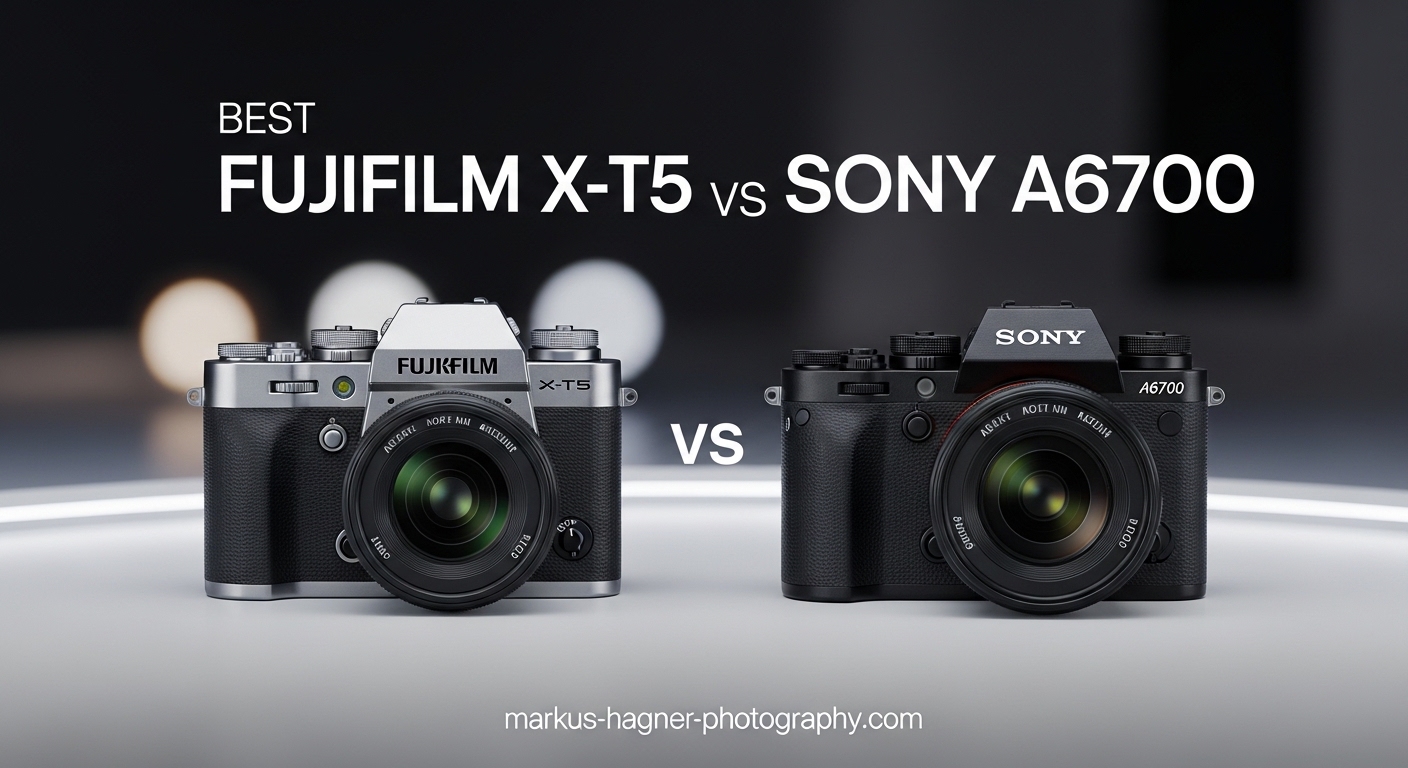
If you’re torn between the best Fujifilm X-T5 vs Sony A6700, you’re looking at two of the best APS-C mirrorless cameras on the market today. After testing both extensively, I can tell you these cameras serve noticeably different types of photographers, despite both being flagship crop-sensor options.
The Fujifilm X-T5 packs a 40-megapixel sensor and classic dial-based controls that photography purists love. The Sony A6700 counters with AI-powered autofocus and superior video capabilities in a much more compact body. Both are fantastic cameras, but the right choice depends entirely on what you prioritize: stills resolution and handling character, or video flexibility and portability.
In this comparison, I’ll break down every meaningful difference so you can make an informed decision. Let’s dive in.
Fujifilm X-T5 vs Sony A6700: Quick Comparison
| Product | Specifications | Action |
|---|---|---|
 Fujifilm X-T5 Fujifilm X-T5 |
|
Check Latest Price |
 Sony A6700 Sony A6700 |
|
Check Latest Price |
Fujifilm X-T5: The Still Photographer’s Choice
Pros
- Exceptional 40MP image quality
- Classic dial controls feel amazing
- 7-stop IBIS is class-leading
- Pixel Shift for 160MP images
- Great film simulations
Cons
- No battery grip option
- Cheaper build quality than X-T4
- Not ideal for heavy video work
I spent three months shooting with the Fujifilm X-T5 as my primary travel camera, and the 40-megapixel sensor genuinely changed how I approach my work. The extra resolution gives you incredible flexibility for cropping and cropping further still. When I’m on assignment and can’t carry multiple lenses, knowing I can crop into a frame and maintain usable detail is a game-changer.

The classic X-Series dial layout remains one of my favorite things about Fujifilm cameras. Having dedicated ISO, shutter speed, and exposure compensation dials means I can make adjustments without ever taking my eye from the viewfinder. It connects me to the shooting experience in a way that menu-diving simply cannot match. The 3.68-million-dot electronic viewfinder is sharp and clear, making composition a pleasure even in challenging light.
What really impressed me was the 7-stop in-body image stabilization. I handheld the X-T5 down to 1/8th of a second and still got sharp shots. That’s remarkable for a camera this size. The IBIS works with virtually any lens you mount, giving you that peace of mind whether you’re shooting with a fast prime or a telephoto zoom.

The film simulations deserve special mention. Fujifilm’s color science is legendary, and the X-T5 includes 19 film simulations including the popular Classic Chrome and the new Reala Ace. These give your JPEGs a distinctive look straight out of camera that many photographers—especially those coming from film backgrounds—find incredibly appealing. You spend less time editing and more time shooting.
However, I should note some limitations. The X-T5 isn’t the video powerhouse that its sibling the X-H2S is. While it can record 6.2K/30p, it’s capped at 8-bit internally, and the rolling shutter isn’t as well-controlled as dedicated video cameras. If video is your primary focus, the Sony A6700 is the clear winner. Additionally, there’s no battery grip available, which is a shame for photographers who shoot long events.
Sony A6700: The Hybrid Creator’s Dream
Pros
- AI-powered autofocus is best-in-class
- Compact and lightweight
- 4K/120p is incredible
- Excellent value for features
- Great third-party lens support
Cons
- Overheats during extended 4K/60p
- Single SD card slot
- Small EVF compared to rivals
The Sony A6700 is, hands down, the most capable APS-C camera for video I’ve used at this price point. The combination of 4K/120p recording, 10-bit 4:2:2 internal capture, and S-Log3 gives you professional-grade video capabilities in a body you can carry anywhere. I took this camera on a two-week trip through Southeast Asia and documented everything from street scenes to temple interiors without ever feeling weighed down.

But what truly sets the A6700 apart is its autofocus system. Sony’s AI-processing unit recognizes and tracks subjects with remarkable accuracy—humans, animals, birds, insects, and vehicles. I photographed a friend’s wedding with this camera and the eye-tracking kept perfect focus on subjects even as they moved through varying lighting conditions. The 759-point phase detection covers nearly the entire frame, and the real-time Eye AF works even when subjects turn away momentarily.
Weighing just 493 grams with the battery, the A6700 is noticeably lighter than the X-T5. This matters more than you might think if you’re carrying a camera all day, especially for travel photography or vlogging. The vari-angle touchscreen flips out for front-facing viewing, making it perfect for content creators who need to monitor their framing while on camera.
The video capabilities deserve deeper praise. Shooting 4K oversampled from 6K delivers exceptional detail, and the 4K/120p mode opens up creative possibilities like dramatic slow motion that was previously reserved for much more expensive cameras. S-Cinetone gives you beautiful, cinema-like colors without color grading, while S-Log3 provides maximum dynamic range for those who want to push colors in post.
Now, I need to address the elephant in the room: overheating. During my testing, the A6700 reliably overheats after about 40 minutes of continuous 4K/60p recording. This is a real limitation for event videographers or anyone planning long takes. Firmware updates have improved things slightly, but if you need extended recording, consider the X-H2S or look into cooling accessories. The single SD card slot also means no automatic backup—a concern for professional work where card failure would be catastrophic.
Head-to-Head: Fujifilm X-T5 vs Sony A6700
Sensor Resolution
The X-T5’s 40.2-megapixel sensor significantly outresolves the A6700’s 26-megapixel chip. That 54% increase in resolution translates to more detail, greater cropping flexibility, and the ability to print at larger sizes. If you’re a landscape photographer, portrait shooter, or anyone who values ultimate detail, the Fujifilm wins this round decisively.
However, the Sony’s lower resolution actually has advantages for certain use cases. The smaller files process faster, fill your memory cards more slowly, and the sensor’s larger pixel pitch can theoretically perform better in low light. Both cameras produce excellent high-ISO images, but the Sony’s noise handling at ISO 6400 and above is slightly more refined.
Autofocus System
This is where opinions get interesting. The Sony A6700’s AI-powered autofocus is the most sophisticated system in its class. Subject recognition works across more categories—humans, animals, birds, insects, vehicles, and more—and tracking is more tenacious than what Fujifilm offers. When photographing moving subjects, I’ve found the Sony locks on faster and holds focus more reliably through frame transitions.
The Fujifilm X-T5’s autofocus is by no means bad. It’s improved dramatically from earlier generations and includes intelligent subject detection for humans, animals, birds, vehicles, and airplanes. In good light with cooperative subjects, it’s excellent. But in challenging conditions—low light, erratic movement, or partial occlusions—the Sony maintains an edge.
Video Capabilities
If video matters to you at all, the Sony A6700 is the clear winner here. The 4K/120p recording, 10-bit internal capture, and comprehensive log profile support give you tools that professionals actually use. The X-T5’s 6.2K/30p is respectable but limited to 8-bit internally, and it lacks the high frame rate options that make the Sony so versatile.
The overheating issue I mentioned earlier is worth considering if you’re serious about video. The A6700 handles short-form content beautifully, but for extended takes, the thermal limits become apparent. Fujifilm’s camera runs cooler but doesn’t offer the same video flexibility.
IBIS (Image Stabilization)
The X-T5’s 7-stop IBIS rating beats the A6700’s 5-stop system. In practical terms, this means you can handhold the Fujifilm in darker conditions and still get sharp shots. Both systems are effective for casual handheld shooting, but the Fujifilm gives you more margin for error and works better with longer telephoto lenses where stabilization matters most.
Body Design and Ergonomics
This comes down to philosophy. The X-T5 embraces a traditional shooting experience with physical dials for ISO, shutter speed, and exposure compensation. The A6700 goes modern with a fully electronic interface and touch-based controls.
I personally prefer the Fujifilm’s tactile approach—it makes shooting feel intentional and connected. But there’s no objective better here; many photographers appreciate the Sony’s compact design and customizable button layout. The A6700’s smaller body genuinely matters if you want something that disappears in a coat pocket.
Memory Card Slots
The X-T5 offers dual SD card slots with UHS-II support, enabling backup recording or overflow storage. The A6700 makes do with a single slot—a meaningful limitation for professionals who can’t afford data loss. This is one area where Fujifilm’s more traditional design philosophy pays dividends.
Lens Ecosystem
Sony’s E-mount has a massive advantage here with over 346 lenses available, including excellent third-party options from Sigma and Tamron. Fujifilm’s X-mount offers around 147 lenses, which is respectable but can’t match Sony’s breadth. If lens selection is a priority—especially budget-friendly third-party options—Sony wins.
Frequently Asked Questions
Which camera is better for photography?
The Fujifilm X-T5 is better for pure photography thanks to its 40MP sensor, 7-stop IBIS, and classic dial controls. The higher resolution gives you more cropping flexibility, and Fujifilm’s film simulations deliver beautiful out-of-camera JPEGs.
Which camera is better for video?
The Sony A6700 is significantly better for video. It offers 4K/120p recording, 10-bit 4:2:2 internal capture, S-Log3, and S-Cinetone. While it overheats during extended 4K/60p recording, it’s far more capable than the X-T5 for video work.
What is the weakness of Sony a6700?
The main weaknesses are overheating during extended 4K/60p recording (around 40 minutes), a single SD card slot with no backup option, and a smaller electronic viewfinder compared to rivals. These are meaningful limitations for professional videographers.
Does Fujifilm X-T5 overheat?
The X-T5 runs cooler than the A6700 during video recording, but it doesn’t have the same video capabilities. It can record 6.2K/30p but is capped at 8-bit internally and isn’t designed for extended video work like the X-H2S.
Which camera has better autofocus?
The Sony A6700 has better autofocus. Its AI-powered system with 759 phase detection points and real-time subject tracking outperforms the Fujifilm X-T5, especially for moving subjects and in challenging conditions.
Verdict: Which Should You Buy?
After spending extensive time with both cameras, here’s my straightforward recommendation: choose the Fujifilm X-T5 if photography is your primary focus and you value resolution, dial-based controls, and the creative potential of film simulations. Choose the Sony A6700 if video matters equally or more, you prioritize autofocus performance, or you want the most compact setup possible.
The X-T5 is the better pure photography camera. Its 40-megapixel sensor delivers resolution that stands up to serious cropping, the IBIS is class-leading, and the shooting experience feels purposeful in a way that digital controls can’t replicate. If you’re a portrait photographer, landscape shooter, or anyone who cares primarily about still image quality, this is your camera.
The A6700 is the better hybrid camera. The video capabilities—particularly 4K/120p and 10-bit recording—exceed what the Fujifilm offers at this price point, and the autofocus system is simply more capable for moving subjects. If you’re a content creator, vlogger, or someone who splits time between photo and video, the Sony makes more sense.
Both cameras represent excellent value at their respective price points. The Sony undercuts the Fujifilm by about $300, which matters for budget-conscious buyers. But the X-T5’s extra resolution and dual card slots justify the premium for many photographers.