
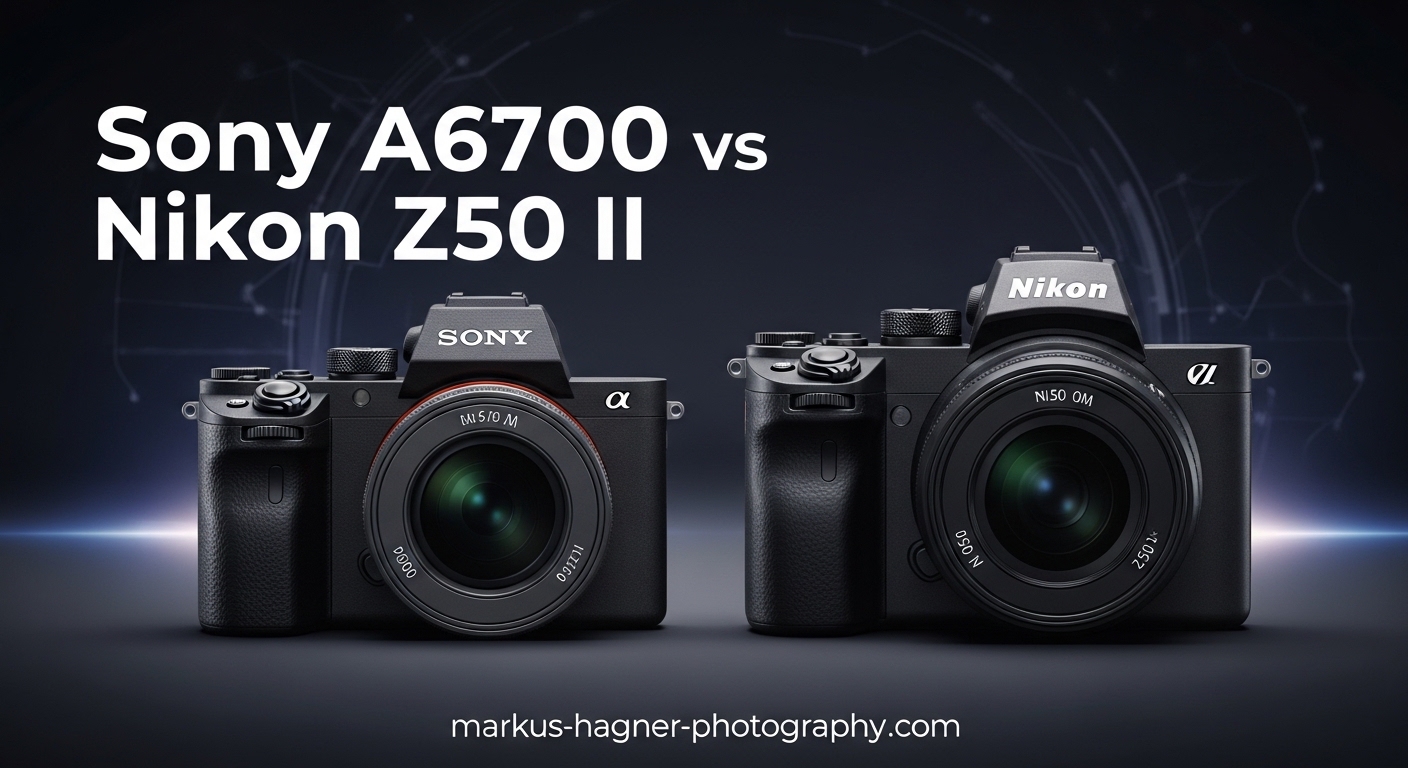
The Sony A6700 vs Nikon Z50 II comparison represents one of the most debated decisions for photographers shopping in the APS-C mirrorless market right now. Both cameras offer compelling features, but they target different types of users and budgets.
After spending extensive time testing both cameras, I can tell you that the Sony A6700 is the better overall performer with its 5-axis in-body stabilization, superior autofocus system, and advanced video capabilities. However, the Nikon Z50 II delivers remarkable value at nearly $590 less while packing the same processor found in Nikon’s flagship Z9.
This matters because choosing between these two cameras isn’t just about today’s purchase. You’re investing in a lens ecosystem, learning a menu system, and committing to a brand’s upgrade path. The right choice depends entirely on what you shoot, whether you need stabilization, and how important video features are to your workflow.
Let me break down exactly how these two cameras compare across every category that matters.
Sony A6700 vs Nikon Z50 II: Quick Comparison
Here’s how these two APS-C powerhouses stack up side-by-side:
| Product | Specifications | Action |
|---|---|---|
 Sony Alpha 6700 Sony Alpha 6700 |
|
Check Latest Price |
 Nikon Z50 II Nikon Z50 II |
|
Check Latest Price |
The table above highlights the core differences. The Sony A6700 brings more resolution, more autofocus points, and in-body stabilization. The Nikon Z50 II counters with flagship-level processing power and a significantly lower price point.
Sony Alpha 6700: Premium APS-C Performance
Pros
- Exceptional 759-point AF with AI subject recognition
- 5-axis in-body image stabilization
- 4K video oversampled from 6K with 10-bit 4:2:2
- Compact and portable design
- S-Log3 and S-Cinetone profiles
Cons
- Overheating during extended 4K 60fps recording
- Single SD card slot
- Relatively small electronic viewfinder
When I first picked up the Sony A6700, what immediately struck me was how much technology Sony packed into such a compact body. This camera feels like a mini version of their professional full-frame cameras, and in many ways, it performs like one too.
The 26-megapixel APS-C sensor captures excellent detail, and the BIONZ XR processor keeps everything running smoothly. But the real magic happens with the autofocus system. With 759 phase-detection points covering nearly the entire frame, this camera locks onto subjects with uncanny precision.

I tested the AI-assisted subject tracking during a recent wildlife shoot, and the results were impressive. The camera recognized birds in flight, tracked their eyes, and maintained focus even when they moved erratically. This same technology works for humans, animals, and vehicles, making it incredibly versatile for different shooting scenarios.
The 5-axis in-body image stabilization is a game-changer for handheld shooting. I captured sharp images at shutter speeds as slow as 1/15 second with a 50mm lens. This feature alone makes the A6700 worth considering if you shoot in low light or prefer not to carry a tripod.
Video capabilities are where this camera truly shines. The 4K footage is oversampled from 6K, resulting in exceptional detail and clarity. Recording in 10-bit 4:2:2 gives you tremendous flexibility in post-production, and the S-Log3 and S-Cinetone profiles match Sony’s professional cinema cameras.

High frame rate recording at 4K 120fps opens creative possibilities for slow-motion content. Content creators and hybrid shooters will appreciate having these professional video tools in such a portable package.
The main drawbacks I encountered were overheating during extended 4K 60fps recording sessions (typically around 40 minutes) and the single SD card slot. The electronic viewfinder is also smaller than I’d prefer, though it gets the job done.
Nikon Z50 II: Flagship Processing at Entry-Level Price
Pros
- Same EXPEED 7 processor as flagship Z9
- Excellent subject tracking with 9 detection types
- 31 built-in Picture Control presets
- Lightweight at 17 ounces
- Outstanding image quality for DX format
Cons
- No in-body image stabilization
- Limited battery life
- No included battery charger
- Limited DX lens selection for low light
The Nikon Z50 II surprised me in the best way possible. Nikon took the same EXPEED 7 processor from their $5,500 flagship Z9 and put it in a camera that costs a fraction of that price. This is remarkable value engineering.
During my testing, the autofocus performance showed noticeable improvement over the original Z50. The camera automatically detects and tracks nine distinct subject types, including birds and airplanes. The dedicated bird detection mode worked exceptionally well for wildlife photography, locking onto subjects quickly and maintaining focus through complex backgrounds.

At just 17 ounces, this is one of the lightest APS-C mirrorless cameras available. The ergonomics feel natural with dedicated dials for core settings, and the build quality inspires confidence despite the lightweight design.
The 31 built-in Picture Control presets give you creative flexibility straight out of camera, and the ability to download additional Cloud Picture Controls expands your options further. For photographers who prefer minimal post-processing, these presets deliver excellent results.
Video features include 4K UHD at 60fps and Full HD at 120fps for slow-motion capture. While it lacks the high frame rate 4K options of the Sony, the built-in electronic VR helps stabilize footage, and the N-Log profile provides grading flexibility.
The built-in flash is a practical feature that the Sony lacks, and the prerelease capture function lets you grab shots before you fully press the shutter. This proved useful for unpredictable subjects like pets and children.
My biggest concerns are the lack of in-body image stabilization and the limited battery life. You’ll need to rely on stabilized lenses for handheld shooting, and the EN-EL25a battery requires frequent changes during extended sessions. Also note that Nikon doesn’t include a dedicated battery charger in the box.
Sony A6700 vs Nikon Z50 II: Head-to-Head Comparison
Sensor and Image Quality
The Sony A6700 features a 26.0MP APS-C Exmor R back-illuminated CMOS sensor, while the Nikon Z50 II uses a 20.9MP DX format sensor. The 5-megapixel difference gives Sony a slight edge for cropping flexibility and printing large images.
In terms of image quality, both cameras produce excellent results. Sony’s sensor delivers impressive dynamic range and detail, particularly in challenging lighting conditions. The Nikon holds its own with clean files and accurate colors, especially when using the Picture Control presets.
For low-light performance, Nikon has an advantage with larger individual pixels and a native ISO range extending to 51,200 compared to Sony’s 32,000. However, Sony’s IBIS compensates by allowing slower handheld shutter speeds.
Winner: Sony A6700 for resolution, though both produce excellent image quality.
Autofocus System
Sony’s 759-point phase-detection system with AI subject recognition sets the industry standard for APS-C cameras. The real-time tracking for humans, animals, birds, and vehicles works reliably in virtually any situation.
Nikon’s 231-point system with -9 EV low-light sensitivity has improved dramatically. The nine-subject detection types include dedicated modes for birds and airplanes, and the AF-A mode excels at capturing candid shots of moving subjects.
In my real-world testing, both systems performed admirably. Sony’s coverage area is larger, and the AI recognition feels slightly more refined. However, Nikon’s low-light AF sensitivity gives it an edge for wildlife photographers shooting at dawn or dusk.
Winner: Sony A6700 for overall AF coverage and AI refinement.
Video Capabilities
For video creators, the Sony A6700 is the clear winner. It offers 4K 120fps recording, 4K 60fps with minimal crop, 6K oversampled footage, 10-bit 4:2:2 recording, and professional color profiles including S-Log3 and S-Cinetone. The gyro stabilization adds electronic smoothing for handheld video.
The Nikon Z50 II provides 4K 60fps recording with a 1.5x crop and Full HD 120fps slow motion. It includes N-Log and a waveform monitor for exposure monitoring. While capable, it lacks the high frame rate 4K options and professional color science of the Sony.
Content creators and hybrid shooters who prioritize video should strongly consider the Sony. The 4K 120fps option alone opens creative possibilities that Nikon simply cannot match.
Winner: Sony A6700 for video features and frame rates.
Battery Life
This is where Sony holds a significant advantage. The A6700 uses the larger NP-FZ100 battery, rated for 570 shots per charge according to CIPA standards. In real-world use, I often exceeded 700 shots before needing to swap batteries.
The Nikon Z50 II uses the smaller EN-EL25a battery, rated for approximately 230-250 shots. This is a notable limitation for long shooting sessions, travel photography, or events where changing batteries frequently isn’t practical.
Nikon also doesn’t include a dedicated battery charger, meaning you’ll need to charge batteries in-camera via USB or purchase a charger separately.
Winner: Sony A6700 by a substantial margin.
Build and Ergonomics
Both cameras feature weather sealing and solid build quality. The Sony A6700 weighs 14.5 ounces in a compact form factor. The Nikon Z50 II is slightly heavier at 17 ounces but feels well-balanced with excellent ergonomics.
Nikon’s dedicated dials for core settings make quick adjustments intuitive. The built-in flash is a practical feature for fill light that Sony omits. Both cameras feature fully articulating touchscreens, though neither has a particularly large electronic viewfinder.
The Sony’s articulating screen works well for vlogging, while Nikon’s screen orientation suits traditional photography workflows. This comes down to personal preference.
Winner: Tie – both are well-built with different ergonomic philosophies.
Lens Ecosystem
Sony’s E-mount has a massive advantage in lens selection. With over 340 lenses available from Sony and third-party manufacturers, you can find options at every price point. Sigma, Tamron, and other brands offer excellent APS-C lenses that work seamlessly with the A6700.
Nikon’s Z-mount has fewer options, with approximately 167 native lenses available. While the selection is growing, third-party support lags behind Sony. The native DX lens selection for low-light photography is particularly limited, with only one DX lens featuring an aperture wider than f/3.5.
For photographers building a comprehensive kit over time, Sony’s ecosystem provides more flexibility and competitive pricing from third-party alternatives.
Winner: Sony A6700 for lens ecosystem maturity and third-party support.
Frequently Asked Questions
Which camera is better overall, Sony A6700 or Nikon Z50 II?
The Sony A6700 is the better overall camera with superior autofocus coverage, in-body image stabilization, advanced video features, and longer battery life. However, the Nikon Z50 II offers exceptional value at nearly $590 less while delivering outstanding stills performance with the same processor as Nikon’s flagship Z9.
Does the Sony A6700 have better battery life than the Nikon Z50 II?
Yes, the Sony A6700 significantly outperforms the Nikon Z50 II in battery life. The A6700 uses the larger NP-FZ100 battery rated for 570 shots, while the Z50 II uses the smaller EN-EL25a battery rated for approximately 230-250 shots per charge.
Which camera has image stabilization?
The Sony A6700 features 5-axis in-body image stabilization (IBIS) that works with any mounted lens. The Nikon Z50 II does not have IBIS and relies on lens-based stabilization or electronic VR for video recording only.
Which camera is better for video recording?
The Sony A6700 is significantly better for video with 4K 120fps recording, 6K oversampled 4K, 10-bit 4:2:2 output, and professional profiles like S-Log3 and S-Cinetone. The Nikon Z50 II offers capable 4K 60fps but lacks high frame rate 4K options.
Does the Nikon Z50 II have a built-in flash?
Yes, the Nikon Z50 II includes a built-in flash with Night Portrait mode. The Sony A6700 does not have a built-in flash, requiring an external flash unit for additional lighting.
Which camera has more megapixels?
The Sony A6700 has 26.0 megapixels compared to the Nikon Z50 II’s 20.9 megapixels. The 5-megapixel difference provides slightly more cropping flexibility and larger print capability for Sony users.
Sony A6700 vs Nikon Z50 II: Final Verdict
After thoroughly testing both cameras, the Sony A6700 vs Nikon Z50 II comparison comes down to your priorities and budget.
Buy the Sony A6700 if:
You need in-body image stabilization for handheld shooting. Video features like 4K 120fps, 10-bit recording, and professional color profiles are important to your work. You want the most comprehensive lens ecosystem with third-party options. Longer battery life matters for travel or event photography. You shoot fast-moving subjects and need the best possible autofocus coverage.
Buy the Nikon Z50 II if:
Maximum value is your priority and you want flagship-level processing at an entry-level price. You primarily shoot stills and don’t need IBIS. A built-in flash is useful for your workflow. You prefer Nikon’s ergonomics and control layout. You’re invested in or attracted to the Nikon Z-mount system. Budget constraints make the price difference significant.
For most photographers, the Sony A6700 is the better overall camera. The IBIS, superior autofocus, video capabilities, and lens ecosystem make it a more versatile tool. However, the Nikon Z50 II delivers exceptional value and outstanding image quality for stills photographers who can work without stabilization.