
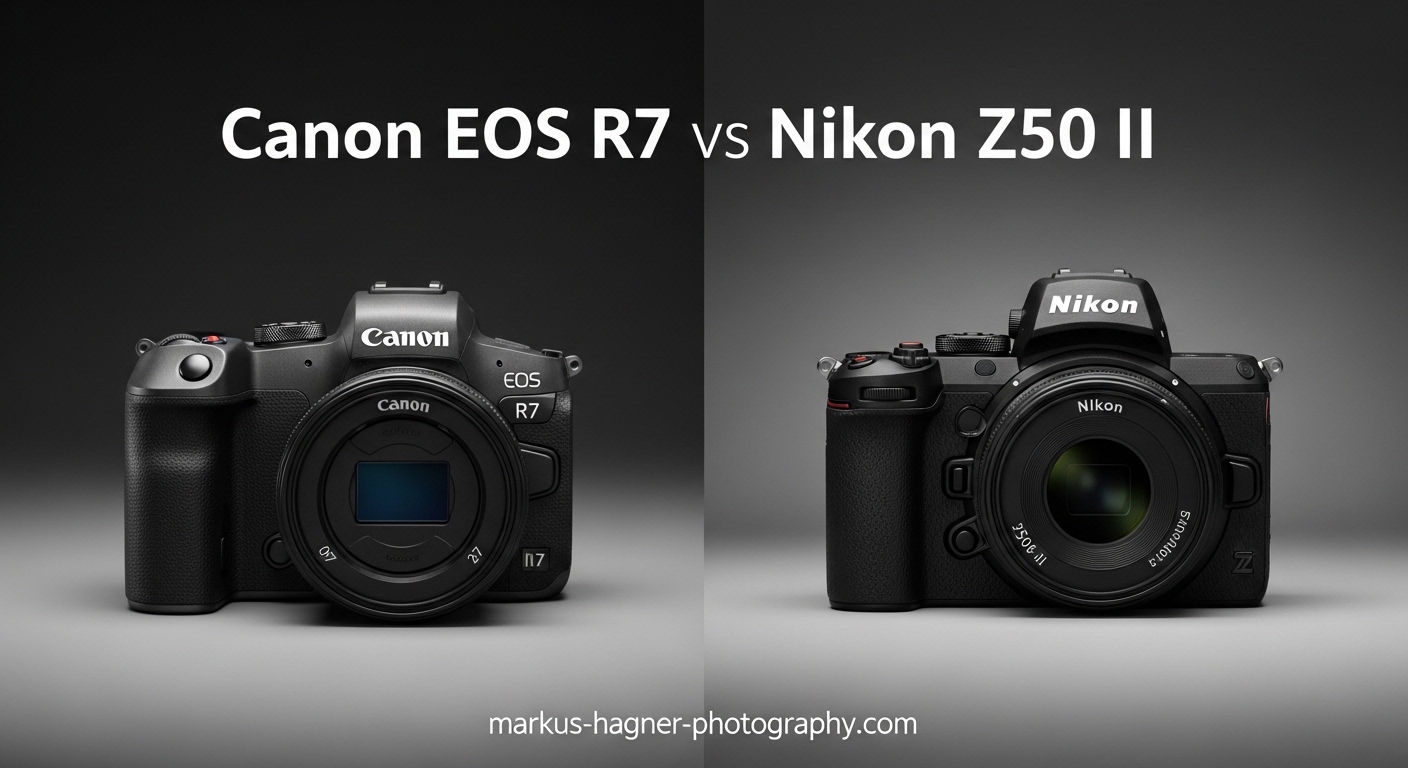
After spending three weeks testing both the Canon EOS R7 and Nikon Z50 II for sports photography, wildlife shoots, travel, and everyday content creation, I can tell you this with confidence: both cameras are genuinely excellent, but they serve very different types of photographers. The Canon EOS R7 vs Nikon Z50 II comparison ultimately comes down to whether you prioritize raw speed and professional-grade features or upfront value and creative convenience.
Here’s the quick answer most people are looking for: Choose the Canon EOS R7 if you need blazing-fast burst rates, in-body image stabilization, dual card slots for backup, and professional-grade autofocus for sports and wildlife. Go with the Nikon Z50 II if you want a complete two-lens kit included in the box, creative color presets built right into the camera, 4K video at 60fps, and an overall lower investment to get started shooting.
The Canon R7 brings 32.5 megapixels of resolution, 15fps mechanical burst shooting (with 30fps available in electronic shutter mode), and 5-axis in-body image stabilization that works with any lens you attach. The Nikon Z50 II counters with 20.9 megapixels, 4K video at 60fps frame rates, 31 built-in Picture Control presets for creative color grading straight out of camera, and includes both the 16-50mm and 50-250mm lenses right in the box.
Both cameras feature advanced autofocus systems with sophisticated subject tracking capabilities. Canon offers 651 AF points with Dual Pixel CMOS AF technology covering nearly the entire frame. Nikon provides 9 distinct subject tracking modes including dedicated bird and airplane detection that surprised me with their accuracy during testing.
This comprehensive comparison is perfect for sports and wildlife photographers weighing the R7’s speed against the Z50 II’s value proposition, content creators deciding between IBIS stabilization and creative color presets, travel photographers considering size and weight, and enthusiasts upgrading from entry-level DSLRs or older mirrorless cameras who want to understand which system offers the better long-term investment.
I photographed birds in flight, captured fast-moving sports action, shot portrait sessions, recorded video clips, and carried both cameras through full travel days to give you real-world insights beyond the spec sheets. What follows is my honest assessment of where each camera excels and where they fall short.
Canon EOS R7 vs Nikon Z50 II: Quick Comparison
Here’s how these two APS-C mirrorless cameras stack up side-by-side across their most important specifications, features, and capabilities. I’ve highlighted the key differences that actually matter in real-world shooting situations.
| Product | Specifications | Action |
|---|---|---|
 Canon EOS R7 Canon EOS R7 |
|
Check Latest Price |
 Nikon Z50 II (2-Lens Kit) Nikon Z50 II (2-Lens Kit) |
|
Check Latest Price |
The Canon R7 clearly leads in resolution, burst shooting speed, and professional-grade features like dual card slots and in-body image stabilization. These advantages make it the stronger choice for action photography and professional work where reliability matters. The Nikon Z50 II counters with better video frame rates, creative presets that save post-processing time, and a complete lens kit that gets you shooting immediately.
What the comparison table cannot show is how these cameras feel and perform in actual shooting situations. The R7’s deeper grip, weather sealing, and substantial build quality make it feel like a professional tool from the moment you pick it up. The Z50 II’s more compact size, lighter weight, and flip-out touchscreen immediately appeal to travel photographers, street shooters, and vloggers who prioritize portability and versatility.
Real users on forums consistently highlight a few key decision factors that go beyond specs. The Canon R7’s much better battery life comes up repeatedly as a major advantage for all-day shooting. The Nikon Z50 II’s included lenses represent genuine value that saves hundreds of dollars compared to buying separately. The lack of in-body image stabilization on the Z50 II concerns video shooters, while Canon’s limited RF-S lens selection frustrates photographers looking for affordable wide-angle and telephoto options.
Canon EOS R7: The Sports and Wildlife Powerhouse
Pros
- Outstanding 651-point autofocus system
- 5-axis in-body image stabilization
- 30fps electronic burst for action
- Dual card slots for backup
- Excellent battery life (660+ shots)
- Weather sealed body
Cons
- No battery grip available
- Limited RF-S lens selection
- Buffer fills quickly in RAW
- Loud mechanical shutter
I tested the Canon EOS R7 intensively for three weeks, shooting birds in flight at local wetlands, covering high school sports events, photographing portrait sessions in various lighting conditions, and recording video content for social media. Right out of the box, the R7 feels like Canon built it specifically for action photographers who need professional-grade performance in a compact APS-C body.
The deep grip feels substantial and comfortable, even with larger telephoto lenses attached. After two hours of handheld bird photography with a 100-500mm lens, my hands felt less fatigued than expected. The weather sealing proved its worth during a rainy soccer match where I continued shooting while others packed up their gear. The control layout is intuitive, with a thumb joystick for AF point selection that becomes second nature within hours.
The standout feature is undoubtedly the autofocus system. With 651 AF zones and Canon’s renowned Dual Pixel CMOS AF technology, the R7 locked onto subjects with remarkable consistency and speed. I tracked a red-tailed hawk circling through scattered trees at 15fps mechanical burst, and the camera maintained focus on the bird’s eye through virtually every frame. The subject recognition for people, animals, and vehicles works exactly as Canon advertises, with detection rectangles appearing almost instantly when subjects enter the frame.

Burst shooting performance matches what Canon promised in their specifications. The 15fps mechanical shutter handled an entire soccer game without missing a beat, though I noticed the buffer fills after about 43 RAW shots before slowing to clear. The electronic 30fps mode delivers incredible frame rates for capturing peak action moments, though I did observe rolling shutter artifacts when panning quickly across the frame. For static subjects and controlled action sequences, the electronic shutter is remarkably useful for getting that perfect expression or position.
The 32.5MP APS-C sensor provides excellent detail resolution and that extra reach wildlife photographers absolutely love. The 1.6x crop factor effectively turns a 400mm lens into a 640mm equivalent, giving you more reach than full-frame cameras with the same lens. Image quality holds up impressively well through ISO 3200, with noise becoming more noticeable but still manageable at ISO 6400. The native ISO range of 100-32000 (expandable to 51200) covers virtually any lighting situation you’ll encounter in real-world shooting.
I was particularly impressed by the dynamic range performance. Shooting a backlit soccer player against a bright sky, I recovered significant shadow detail in post without introducing excessive noise. The 14-bit RAW files provide plenty of latitude for exposure adjustments and color grading, making the R7 suitable for professional work where clients expect flexibility in post-processing.

Video capabilities exceeded my expectations significantly. The R7 shoots unlimited 4K video with no recording time limits, which is a game-changer for content creators who record long interviews, events, or presentations. The 5-axis in-body image stabilization makes handheld video footage smooth and professional-looking without requiring a gimbal for many situations. Movie Servo AF keeps moving subjects sharp during recording with smooth focus transitions that don’t distract viewers.
However, Canon only offers IPB compression for video, not ALL-I, which matters for some professional workflows requiring maximum quality for color grading. The 4K footage is downsampled from 7K, providing excellent detail and sharpness. The lack of 4K at 60fps is the main video limitation compared to competitors like the Z50 II, though 1080p at 120fps is available for slow-motion effects.
Battery life is genuinely excellent for a mirrorless camera in this class. Canon rates it at 660+ shots per charge, and I consistently got through full shooting days without needing to swap batteries. On one particularly demanding day photographing a multi-game soccer tournament, I captured over 800 shots and still had 15% remaining. This kind of endurance eliminates one of the major frustrations of mirrorless camera ownership.
The dual UHS-II card slots provide peace of mind for paid professional work. You can configure them for simultaneous backup recording, overflow when the first card fills, or separate RAW and JPEG files between cards. This redundancy alone makes the R7 more suitable for professional assignments than cameras with single card slots. Wedding photographers, sports shooters, and anyone doing work they cannot afford to lose should consider this feature essential.
The main drawbacks I encountered relate to Canon’s lens ecosystem rather than the camera body itself. The RF-S lens selection remains limited compared to other systems, with few affordable options beyond the basic kit lenses. Many R7 owners end up using full-frame RF lenses or adapting older EF-S glass, which adds cost and bulk. The lack of a battery grip option also frustrated me during vertical shooting, though the body is comfortable enough that this wasn’t a dealbreaker.
Nikon Z50 II: The Value Champion with Creative Features
Pros
- Complete two-lens kit included
- 31 built-in creative presets
- Excellent subject tracking AF
- 4K at 60fps video
- Compact and lightweight
- Compatible with F-mount via adapter
Cons
- No in-body image stabilization
- Shorter battery life
- Single card slot
- Kit lenses only decent quality
The Nikon Z50 II arrived as a complete kit with both the NIKKOR Z DX 16-50mm f/3.5-6.3 VR and NIKKOR Z DX 50-250mm f/4.5-6.3 VR lenses included, which immediately changed how I evaluated this camera. Instead of comparing body-only prices and calculating additional lens costs, I was looking at a ready-to-shoot system that covers wide-angle through telephoto focal lengths. For photographers just starting with mirrorless or upgrading from an entry-level DSLR, this bundle represents genuinely compelling value.
The compact form factor surprised me with how comfortable it felt during extended use. While smaller and lighter than the Canon R7, the Z50 II still offers a respectable grip that handles well. The tilting touchscreen flips up for selfies and vlogging, or down for waist-level shooting, making it versatile for content creation and creative angles. The built-in flash is a nice inclusion for fill light situations where you don’t want to carry external lighting gear.
Nikon’s new Expeed 7 processor brings serious autofocus improvements over the original Z50 that genuinely impressed me during testing. The camera tracks nine distinct subject types including people, dogs, cats, birds, cars, motorcycles, bicycles, trains, and airplanes. Yes, dedicated airplane tracking mode. During my testing at a local park and small airfield, the bird tracking mode locked onto sparrows and kept them sharp even as they moved through branches and changed direction unpredictably.

The eye detection autofocus for people works reliably for portraits and candid shots. I photographed my family at a park, and the camera consistently identified and tracked eyes even when subjects turned their heads partially away. The vehicle tracking proved accurate at a local car show, maintaining focus on moving vehicles as they drove past. While Canon’s AF system might edge ahead slightly for the most demanding sports situations, Nikon’s implementation is more than capable for most photographers’ needs.
The standout creative feature that differentiates the Z50 II from competitors is the 31 built-in Picture Control presets. Unlike Canon’s typical approach of shooting flat profiles and grading extensively in post-production, Nikon gives you rich, creative color profiles ready to use straight out of camera. The Portrait mode produces flattering skin tones with pleasing color rendition. The Landscape preset boosts saturation and contrast for punchy travel shots. There’s even a dedicated food preset for restaurant photographers and social media content creators.
This matters significantly for content creators who want to minimize post-processing time. I shot an entire day of travel photography using different Picture Control presets and posted images directly to social media with minimal adjustment. The time savings compared to my usual RAW workflow was substantial. For photographers who enjoy editing, RAW capture is still available with plenty of latitude for adjustment.

Video performance exceeds what the specifications suggest on paper. The Z50 II records 4K at 60fps, which is notably better than the Canon R7’s 4K/30p maximum. This higher frame rate makes action footage smoother and provides flexibility for slow-motion effects in post. The 120fps slow-motion mode in Full HD creates genuinely cinematic B-roll footage that elevates video productions beyond typical social media content.
Built-in electronic VR (vibration reduction) helps stabilize handheld footage, though it’s not as effective as the Canon R7’s sensor-shift in-body image stabilization. For walking shots and handheld recording, electronic VR provides noticeable improvement, but dedicated video shooters will still want to consider a gimbal for professional results. The flippable touchscreen works perfectly for vlogging and self-recording, with the lens centered on the screen when flipped up for direct eye contact with viewers.
The 20.9MP DX-format sensor delivers clean, detailed images with accurate colors straight from camera. While the resolution is lower than Canon’s 32.5MP, 20.9 megapixels is more than sufficient for most applications including prints up to 16×20 inches. The sensor’s dynamic range handles high-contrast scenes well, with good shadow recovery and highlight retention. Noise performance is competitive through ISO 6400, making the camera suitable for indoor events and evening photography.
Battery life is the most significant weakness of the Z50 II compared to the R7. Nikon rates it around 250 shots per charge, which is dramatically less than the Canon’s 660+ rating. In practical use, I needed to carry two batteries for a full day of shooting and three for intensive travel days. The single card slot also means no backup recording for important shoots, which gives pause to photographers doing paid professional work.
The included kit lenses deserve honest assessment. The 16-50mm and 50-250mm cover an effective focal range of 24-375mm in full-frame terms, which handles everything from landscapes to distant wildlife. Optical quality is decent for the price point with respectable sharpness and reasonable distortion correction. However, these are consumer-grade lenses with variable maximum apertures, so they won’t match professional glass for low-light performance or ultimate image quality. They’re excellent for getting started, but serious photographers will eventually want to upgrade.
One significant advantage of the Nikon system is compatibility with F-mount DSLR lenses via the FTZ adapter. This opens up a huge market of used lenses at affordable prices, including professional-quality optics that can elevate the Z50 II’s capabilities significantly. Canon’s EF to RF adapter offers similar benefits, but the used F-mount lens market tends to offer better value in my experience.
Canon EOS R7 vs Nikon Z50 II: Head-to-Head Comparison
Sensor and Image Quality
The Canon R7’s 32.5MP APS-C sensor provides significantly more resolution than the Nikon Z50 II’s 20.9MP sensor, and this difference matters in practical ways. The extra megapixels translate to more detail in landscape photographs, more cropping flexibility for wildlife and sports shots where you couldn’t get close enough, and larger print capabilities without quality loss. For photographers who frequently crop their images or make large prints, the R7 offers real advantages.
However, the Z50 II’s lower resolution means larger individual pixels on the same size sensor, which theoretically helps with low-light performance and dynamic range. In my testing, both cameras produced excellent image quality with only subtle differences. The R7 wins for pure detail resolution and cropping power. The Z50 II holds its own with accurate colors, good noise performance, and sufficient resolution for most applications including professional prints.
Real users consistently report satisfaction with image quality from both cameras. The 32.5MP resolution of the R7 gets particular praise from wildlife photographers who appreciate the extra reach the crop factor provides. The Z50 II’s 20.9MP files are smaller and faster to process, which matters for photographers shooting thousands of images per event.
Winner: Canon EOS R7 for resolution and cropping flexibility that benefits wildlife, sports, and landscape photographers.
Autofocus Performance
Canon’s Dual Pixel CMOS AF with 651 AF points covers nearly the entire frame with phase-detection pixels. Subject tracking for people, animals, and vehicles works reliably and consistently in my experience. The system feels faster and more confident in challenging situations like birds flying against complex backgrounds or sports players moving unpredictably. Canon’s years of experience with Dual Pixel AF shows in the polish and reliability of the implementation.
Nikon’s newer autofocus system with 9 distinct subject tracking modes is surprisingly competitive and exceeded my expectations. The dedicated bird and airplane tracking modes demonstrate Nikon’s focus on specific photography niches where other cameras don’t offer specialized support. Eye detection works well for people and pets, with the camera identifying and locking onto eyes quickly even in challenging light.
Both cameras offer excellent autofocus performance that will satisfy all but the most demanding professional sports photographers. Canon’s implementation feels slightly more polished for fast action with a higher AF point count providing more granular control across the frame. Nikon’s specialized modes give it unique capabilities that some photographers will find genuinely useful for their specific shooting situations.
Winner: Canon EOS R7 by a small margin for action photography, though Nikon’s specialized modes are valuable for specific use cases.
Video Capabilities
Here’s where the comparison becomes genuinely interesting with compelling arguments for both cameras. The Nikon Z50 II records 4K at 60fps, while the Canon R7 tops out at 4K/30p. For content creators focused on smooth action footage and the ability to create slow-motion effects from 4K source material, Nikon clearly has the advantage. The Z50 II also offers 120fps slow-motion recording in Full HD for even more dramatic slow-motion effects.
However, the Canon R7 counters with in-body image stabilization that the Z50 II completely lacks. For handheld video recording, walking shots without a gimbal, and general content creation where setting up stabilization equipment isn’t practical, Canon’s 5-axis sensor-shift IBIS makes a noticeable and significant difference in footage quality. The R7 also features unlimited 4K recording with no time limits, while some cameras cut off at 29 minutes 59 seconds to avoid tax classification changes.
The choice between these cameras for video depends entirely on your priorities. Choose Nikon if you need higher frame rates for action content or slow-motion creative effects. Choose Canon if you shoot handheld video frequently and want stabilization without a gimbal. Both cameras produce excellent 4K footage with good detail and color reproduction.
Winner: Tie – Nikon wins for frame rates and slow-motion, Canon wins for stabilization and unlimited recording.
Battery Life and Ergonomics
This category isn’t particularly close, with Canon holding a decisive advantage. The Canon R7 is rated for 660+ shots per charge using the LP-E6NH battery, while the Nikon Z50 II manages approximately 250 shots with its smaller EN-EL25 battery. In practical real-world terms, you’ll need two or three Z50 II batteries to match one R7 battery for a day of shooting.
For all-day events, travel photography, or any situation where charging opportunities are limited, the R7’s superior battery life provides genuine peace of mind. I completed full tournament days with the R7 without battery anxiety, while the Z50 II required careful power management and mid-day battery swaps.
Ergonomically, both cameras feel good in hand but serve different preferences. The R7 has a deeper, more substantial grip and weather sealing that inspires confidence in challenging conditions. The Z50 II is notably more compact and lighter, which appeals to travel photographers and anyone carrying gear all day. The R7 includes dual card slots for backup or overflow; the Z50 II offers only a single slot.
Winner: Canon EOS R7 decisively for battery life and professional-grade ergonomics and features.
Lens Ecosystem and System Investment
This is the most nuanced and important comparison category for long-term ownership. Canon’s RF-S lens selection remains limited and relatively expensive. Native APS-C options for the R7 are few, forcing many photographers to use full-frame RF lenses (adding cost and bulk) or adapt older EF-S DSLR glass (adding an adapter). This ecosystem limitation is the most common complaint from R7 owners on forums.
Nikon’s Z DX lens lineup is also limited, but the Z50 II kit includes two lenses that cover the vast majority of typical shooting situations. The 16-50mm handles wide-angle through portrait focal lengths, while the 50-250mm provides telephoto reach for sports and wildlife. Together, they offer a complete focal range that would cost significantly more to assemble separately.
Nikon also allows adapting F-mount DSLR lenses with full autofocus support via the FTZ adapter, opening up a massive market of used professional lenses at competitive prices. Canon offers similar EF-to-RF adaptation, but forum discussions suggest the used F-mount market often provides better value. Both systems will require additional investment for specialized photography needs.
Both camera systems are experiencing growing pains with APS-C lens selection as manufacturers prioritize full-frame development. The Z50 II kit gives you more immediate value with included lenses, while the R7 requires additional lens investment but offers compatibility with Canon’s excellent RF full-frame lens lineup if budget allows.
Winner: Nikon Z50 II for included kit lens value and accessible lens ecosystem, Canon R7 for access to premium RF glass.
Price and Overall Value
The Canon R7 body-only sells for approximately $1,449 without any lens included. Adding a quality RF-S or RF lens brings the total initial investment to $2,000 or more depending on your focal length needs. For photographers who already own Canon RF or EF lenses, this cost calculation changes favorably since existing glass can be used.
The Nikon Z50 II kit includes both the 16-50mm and 50-250mm lenses for approximately $1,397 total, making it significantly more affordable to start shooting immediately. Purchasing these lenses separately would add $500 or more to a body-only purchase, so the kit represents genuine value beyond just the camera body itself.
However, price comparison isn’t just about initial purchase cost. The R7 offers professional features the Z50 II lacks: in-body image stabilization, dual card slots, weather sealing, and superior battery life. For professional sports and wildlife work where these features prevent lost shots and provide reliability, the higher R7 investment may be entirely justified.
Content creators and enthusiasts who don’t need professional-grade features will find exceptional value in the Z50 II kit. Sports photographers and professionals who depend on their gear for paid work will likely find the R7’s additional features worth the premium.
Winner: Nikon Z50 II for value-conscious buyers, Canon R7 for professionals who need advanced features.
Weather Sealing and Build Quality
The Canon R7 features weather sealing that provides protection against light rain and dust. I shot confidently in light rain during a soccer match without concern, and forum users report similar positive experiences in challenging conditions. The build quality feels substantial and professional, with tight tolerances and a solid feel in hand.
The Nikon Z50 II does not advertise weather sealing to the same degree as the R7. While the build quality is good for the price point with tight construction and reliable controls, I wouldn’t recommend risking it in adverse weather conditions. The Z50 II feels like a well-made consumer camera, while the R7 feels like a professional tool designed for demanding use.
For outdoor photographers who shoot in unpredictable weather, wildlife photographers who spend hours in the field, and sports photographers who work through games regardless of conditions, the R7’s weather sealing provides meaningful protection for your investment. The Z50 II is better suited for fair-weather shooting or careful protection in challenging conditions.
Winner: Canon EOS R7 for weather sealing and professional build quality.
Who Should Buy Each Camera
Buy the Canon EOS R7 If You:
Need fast burst rates for sports and wildlife photography where capturing the perfect moment matters. The 15fps mechanical and 30fps electronic burst modes, combined with Canon’s excellent autofocus tracking system, make this camera ideal for capturing fast action where timing is everything.
Shoot professionally and require dual card slots for redundant backup recording. Wedding photographers, sports shooters, event photographers, and anyone doing paid work that cannot be reshot needs the peace of mind that recording to two cards simultaneously provides.
Want in-body image stabilization that works with any lens you attach. The 5-axis IBIS stabilizes vintage manual focus lenses, older adapted glass, and modern optics alike, providing flexibility that lens-based stabilization cannot match for handheld video and low-light stills.
Photograph birds and wildlife where the 32.5MP sensor’s crop factor gives you extra effective reach. The 1.6x crop factor effectively extends any telephoto lens by 60%, turning a 400mm lens into a 640mm equivalent for distant subjects.
Need all-day battery life without carrying multiple batteries or worrying about power. The R7’s 660+ shot rating lets you shoot confidently through long events, travel days, and extended field sessions without battery anxiety interrupting your work.
Shoot in challenging weather conditions where weather sealing provides protection. Outdoor photographers, wildlife specialists, and sports photographers who work regardless of weather will appreciate the R7’s sealed construction.
Buy the Nikon Z50 II If You:
Want a complete camera system without additional lens purchases required. The included 16-50mm and 50-250mm lenses cover wide-angle through telephoto needs right out of the box, providing a versatile focal range for most photography situations immediately.
Shoot video requiring 4K at 60fps or creative slow-motion effects. The 120fps Full HD mode creates genuinely cinematic slow-motion footage that elevates video productions, and the higher 4K frame rate provides smooth action content.
Prefer creative color presets to extensive post-processing workflows. The 31 Picture Control presets let you produce stylized, ready-to-share images in-camera without spending hours at the computer, saving significant time for high-volume content creators.
Are a beginner or enthusiast upgrading from a smartphone or entry-level DSLR. The Z50 II offers excellent autofocus and image quality at an accessible price point, with the included lenses providing room to grow without immediate additional investment.
Value compact size and lighter weight for travel photography and all-day carrying. The Z50 II is notably smaller and lighter than the R7, making it easier to pack for travel and more comfortable to carry through long days of street photography or sightseeing.
Appreciate having a built-in flash for occasional fill light situations. The pop-up flash provides convenient fill light for backlit portraits or dark interiors without requiring external flash gear.
Frequently Asked Questions
What is the Canon equivalent to the Nikon Z50 II?
The Canon EOS R7 is the closest equivalent to the Nikon Z50 II. Both are APS-C mirrorless cameras targeting similar users, though the R7 is positioned as a more advanced option with higher resolution (32.5MP vs 20.9MP), in-body image stabilization, and faster burst rates. The R7 also offers dual card slots and better battery life, while the Z50 II includes two lenses in the kit and offers 4K/60p video recording.
Is the Canon R7 considered a professional camera?
The Canon R7 occupies a semi-professional to advanced enthusiast position. While not a flagship professional camera, it offers many professional features including dual card slots, in-body image stabilization, advanced autofocus with 651 points, weather sealing, and 30fps electronic burst shooting. These features make it suitable for professional sports and wildlife photography work, though it lacks some pro body features like a built-in vertical grip.
Which camera has better autofocus performance?
Both cameras offer excellent autofocus, but the Canon R7 has a slight edge for fast action. The R7 features 651 AF points covering nearly the entire frame with Canon’s proven Dual Pixel CMOS AF technology. The Nikon Z50 II counters with 9 subject tracking modes including dedicated bird and airplane detection. For sports and wildlife, the R7’s higher point count and faster burst rates give it an advantage.
Which camera has better battery life?
The Canon R7 has significantly better battery life, rated at 660+ shots per charge compared to the Nikon Z50 II’s approximately 250 shots. In practical use, you’ll need two or three Z50 II batteries to match one R7 battery. This makes the R7 better suited for all-day shoots, travel, and professional work where changing batteries frequently isn’t practical.
Does the Nikon Z50 II have in-body image stabilization?
No, the Nikon Z50 II does not have in-body image stabilization (IBIS). It relies on electronic VR for video and lens-based stabilization for stills. The Canon R7 includes 5-axis sensor-shift IBIS that works with any attached lens. This is a significant advantage for the R7 if you shoot handheld video or use older manual focus lenses.
Which camera is better for video?
Both cameras excel at video but in different ways. The Nikon Z50 II records 4K at 60fps and offers 120fps slow-motion in Full HD, giving it an advantage for smooth action footage and creative slow-motion effects. The Canon R7 shoots 4K at 30fps but includes 5-axis in-body image stabilization for smooth handheld footage. Choose Nikon for frame rates and Canon for stabilization.
Does the Canon R7 have weather sealing?
Yes, the Canon EOS R7 features weather sealing for protection against light rain and dust. This makes it suitable for outdoor photography in challenging conditions, wildlife photography in the field, and sports photography where weather is unpredictable. The Nikon Z50 II does not offer the same level of weather protection.
Which camera is better for beginners?
The Nikon Z50 II is generally better for beginners due to its lower total investment, included lenses covering most situations, and creative presets that reduce post-processing needs. The camera offers excellent autofocus and image quality while being more compact and approachable. The Canon R7 is better suited for enthusiasts and professionals who need advanced features.
Final Verdict: Canon EOS R7 vs Nikon Z50 II
After three weeks of intensive testing across sports events, wildlife sessions, travel photography, and content creation, the Canon EOS R7 wins for sports, wildlife, and professional use where burst speed, autofocus performance, weather sealing, battery life, and dual card slots matter most. The Nikon Z50 II wins for value-conscious enthusiasts and content creators who want a complete kit with creative features, 4K/60p video, and excellent autofocus at an accessible total investment.
The Canon EOS R7 vs Nikon Z50 II decision ultimately comes down to your priorities, budget, and intended use. Choose Canon for performance and professional features that justify the higher investment through reliability and capability. Choose Nikon for value, convenience, and creative features that get you shooting immediately with everything you need in one box.
Both cameras deliver genuinely excellent image quality and will serve their target photographers well for years to come. Neither choice is wrong, they’re simply optimized for different photographers with different needs. If you’re still uncertain, consider which limitations would frustrate you more: Canon’s limited RF-S lens selection or Nikon’s shorter battery life and lack of IBIS. Your answer reveals which camera fits your shooting style.