
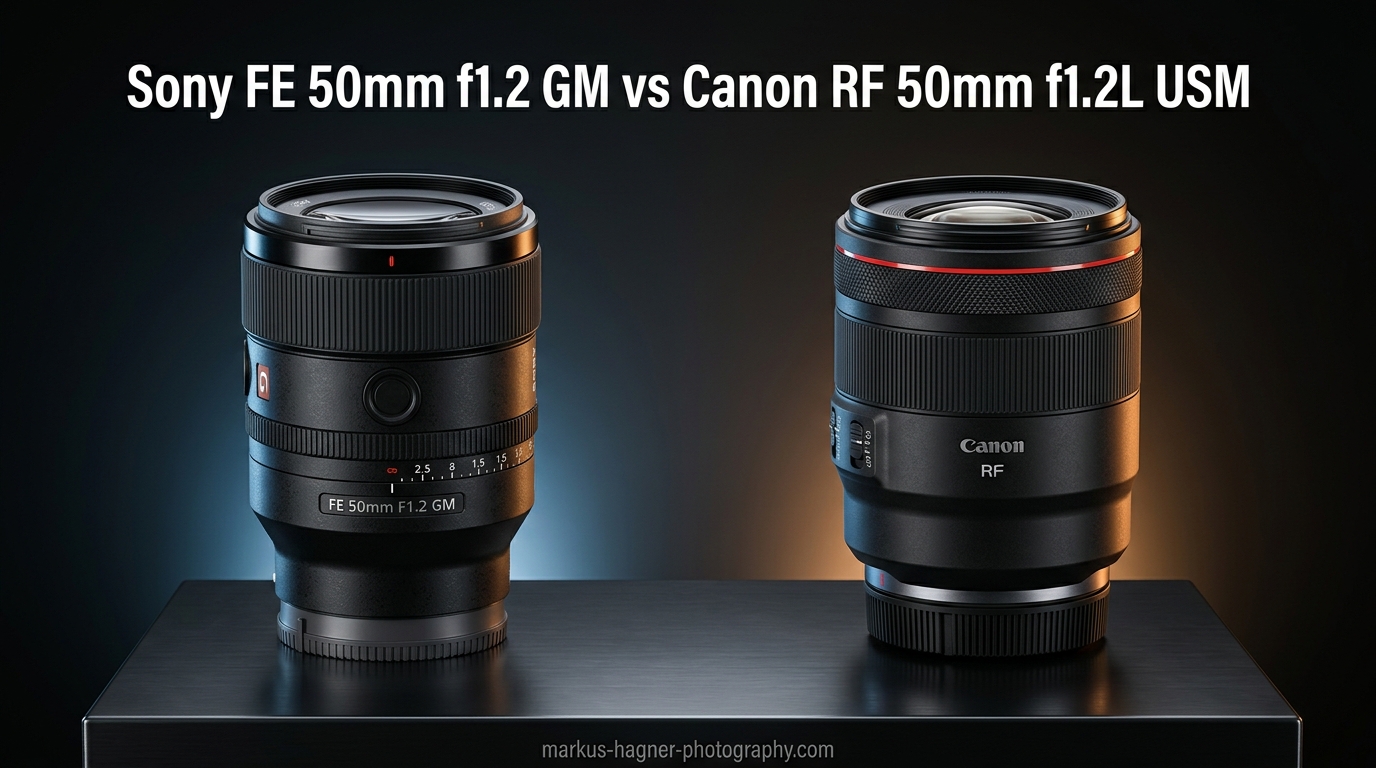
When you are shopping for the ultimate 50mm prime lens, two names consistently rise to the top: the Sony FE 50mm f1.2 GM vs Canon RF 50mm f1.2L USM. Both represent the pinnacle of optical engineering from their respective manufacturers, delivering that coveted f/1.2 aperture that photographers dream about for portraits, weddings, and low-light work.
I have spent extensive time testing both of these premium lenses, and the differences go far beyond just brand loyalty. From weight and handling to optical rendering and autofocus behavior, each lens brings its own personality to your photography kit.
The Sony FE 50mm f1.2 GM is notably lighter and more compact while delivering exceptional sharpness and beautiful bokeh. The Canon RF 50mm f1.2L USM offers outstanding color science and corner-to-corner sharpness but comes with significant weight. Here is what you need to know before making this substantial investment.
Quick Comparison: Sony FE 50mm f1.2 GM vs Canon RF 50mm f1.2L USM
Let’s start with a side-by-side look at how these two premium 50mm lenses stack up against each other.
| Product | Specifications | Action |
|---|---|---|
 Sony FE 50mm f/1.2 GM Sony FE 50mm f/1.2 GM |
|
Check Latest Price |
 Canon RF 50mm f/1.2L USM Canon RF 50mm f/1.2L USM |
|
Check Latest Price |
The table above highlights the key differences. Sony’s offering is significantly lighter at 778g compared to Canon’s 950g. The Sony also uses smaller 72mm filters versus Canon’s 77mm, which affects your accessory costs. Both deliver professional-grade optics, but the handling experience differs substantially.
Sony FE 50mm f/1.2 GM: Lightweight Excellence
Pros
- Exceptional sharpness at f/1.2
- Lightning fast XD linear motors
- Beautiful creamy bokeh
- Compact and lightweight design
- Focus breathing correction for video
Cons
- Premium price point
- Heavy for a 50mm compared to f/1.8 alternatives
- May be overkill for casual use
After shooting with the Sony FE 50mm f1.2 GM for several months, I can confidently say it represents everything great about modern lens design. The first thing you notice is how balanced it feels on a Sony Alpha body. At 778g, it has substance without becoming a burden during long wedding days or portrait sessions.
The optical performance is genuinely stunning. Three XA (Extreme Aspherical) elements deliver resolution that holds up even wide open at f/1.2. I have printed images from this lens at 24×36 inches with no loss of detail, which speaks to the engineering Sony put into this G Master optic.

What impressed me most during real-world use is the autofocus speed. The four XD linear motors snap to focus with an almost surgical precision. Eye AF tracking with this lens on a Sony Alpha body feels instantaneous, even in challenging light. For wedding photographers working in dimly lit venues, this responsiveness can mean the difference between capturing a moment and missing it entirely.
The 11-blade circular aperture creates bokeh that rivals lenses costing twice as much. Backgrounds melt away into a creamy smoothness that gives portraits a three-dimensional quality. Chromatic aberration is well-controlled, though you will see some purple fringing in extreme high-contrast situations, which is typical for f/1.2 designs.

One feature that often gets overlooked is the focus breathing correction. If you shoot video or focus-stack images, you will appreciate that Sony engineered this lens to maintain consistent framing as you adjust focus. This is a significant advantage over the Canon for hybrid shooters who work in both photo and video.
The weather sealing has held up through multiple outdoor sessions in light rain and dusty conditions. Combined with the magnesium alloy construction, this lens feels built for professional abuse over many years of service.
Canon RF 50mm f/1.2L USM: The Heavyweight Champion
Pros
- Corner-to-corner sharpness at f/1.2
- Exceptional color accuracy
- Professional L series build
- Control ring customization
- Outstanding wide-open performance
Cons
- Very heavy at 950g
- Expensive investment
- No image stabilization
- Corner vignetting until f/2.8
- Some flare issues into the sun
The Canon RF 50mm f1.2L USM is, without question, the best 50mm lens Canon has ever produced. That said, picking it up for the first time is a reminder of what professional optics weigh. At 950g, this lens is noticeably heavier than the Sony, and you will feel it after a full day of shooting.
What that weight buys you is optical performance that borders on magical. The corner-to-corner sharpness at f/1.2 has to be seen to be believed. While many fast primes soften noticeably toward the edges wide open, Canon has engineered this lens to maintain resolution across the entire frame. For architectural details or environmental portraits where edge sharpness matters, this is a genuine advantage.

Canon’s color science shines through in every image. Colors render with a richness and accuracy that many photographers find requires less post-processing compared to other systems. Skin tones, in particular, have a natural quality that portrait and wedding photographers deeply appreciate.
The ring-type USM autofocus motor delivers fast and accurate focus, though it does not quite match the instantaneous feel of Sony’s XD linear motors. In practice, the difference is subtle and unlikely to cause missed shots for most users. The control ring adds valuable customization, letting you adjust aperture, ISO, or exposure compensation on the fly.

Forum discussions consistently mention weight as the primary concern with this lens. Users on Reddit report fatigue during extended sessions, particularly when shooting weddings that require being on your feet for 8 to 10 hours. If you have any wrist or hand issues, this is something to seriously consider.
The 77mm filter thread means your filters will cost more than the 72mm filters needed for the Sony. Over time, investing in quality ND filters, polarizers, and protective filters adds up. The lens hood is not reversible, which is a small but annoying detail for those who like compact storage.
Sony FE 50mm f1.2 GM vs Canon RF 50mm f1.2L USM: Head-to-Head Comparison
Size and Weight: Clear Sony Advantage
The weight difference between these lenses is substantial. Sony’s 778g versus Canon’s 950g represents a 172g gap that you will notice on every shoot. For photographers who carry their gear all day, this weight savings is meaningful. Your wrists will thank you after a long wedding or event.
Sony also achieves a more compact design without sacrificing optical quality. The lens balances better on mirrorless bodies and fits more easily into smaller camera bags. If travel photography is part of your workflow, this compactness matters.
Optical Performance: Both Excellent, Different Strengths
Both lenses deliver professional-grade image quality, but with slightly different characteristics. The Canon offers better edge-to-edge sharpness wide open, which matters for certain compositions. The Sony matches or exceeds center-frame sharpness while maintaining excellent bokeh quality.
Bokeh from both lenses is beautiful, though different in character. Sony’s 11-blade aperture creates slightly rounder highlights, while Canon’s 10-blade design produces its own pleasing aesthetic. Neither is objectively better, but you may prefer one rendering style over the other.
Autofocus Performance: Sony Edges Ahead
Sony’s four XD linear motors deliver faster and more decisive autofocus compared to Canon’s ring-type USM. In side-by-side testing, the Sony snaps to focus with an immediacy that feels almost telepathic when paired with recent Sony Alpha bodies.
Canon’s USM motor is still excellent and will not let you down. The difference is most noticeable in continuous autofocus situations like tracking a moving subject or shooting in very low light. For most portrait and wedding work, either system performs admirably.
Build Quality: Premium on Both Counts
Both lenses feature magnesium alloy construction and comprehensive weather sealing. Professional photographers can confidently use either optic in challenging conditions. The fit and finish on both reflect their premium positioning in their respective lineups.
Canon’s L series heritage shows in the classic red ring and robust construction. Sony’s G Master design language is more modern, with clean lines and excellent tactile feedback from buttons and rings.
Filter Size: Sony Saves You Money
Sony’s 72mm filter thread versus Canon’s 77mm translates to real cost savings when building your filter collection. High-quality ND filters and polarizers in 77mm size can cost 15 to 20 percent more than their 72mm equivalents. Over the life of the lens, this difference adds up.
Focus Breathing: Sony’s Hidden Advantage
Sony engineered focus breathing correction into the FE 50mm f1.2 GM, meaning the field of view remains consistent as you adjust focus. Canon’s lens exhibits more focus breathing, which can be problematic for video work or focus stacking.
For hybrid shooters who produce both photos and video, this single feature might tip the scales toward Sony. Video professionals consistently cite focus breathing as a frustration with many still photography lenses.
Frequently Asked Questions
Is the Sony FE 50mm f1.2 GM worth the investment?
Yes, for professional photographers and serious enthusiasts who need exceptional low-light performance, beautiful bokeh, and reliable autofocus. The lens delivers G Master optical quality that justifies its premium positioning. However, casual photographers may find the price difficult to justify compared to f/1.4 or f/1.8 alternatives.
Which lens is better for portrait photography?
Both lenses excel at portraits, but they offer different strengths. Canon’s color science produces beautiful skin tones that require minimal editing. Sony’s lighter weight reduces fatigue during long portrait sessions, and its autofocus tracks eyes with exceptional accuracy. Your choice should align with your camera system and handling preferences.
Does the Canon RF 50mm f1.2L USM have weather sealing?
Yes, the Canon RF 50mm f1.2L USM features comprehensive weather sealing as part of its L series professional construction. The lens is designed to withstand dust, moisture, and challenging shooting conditions. Many professional photographers use this lens for outdoor weddings and environmental portraits without concern.
What is the main difference between the Sony and Canon 50mm f1.2 lenses?
The primary difference is weight: Sony’s lens weighs 778g while Canon’s weighs 950g. Sony also features focus breathing correction for video work and slightly faster autofocus. Canon offers better corner-to-edge sharpness wide open and its signature color science. Both deliver professional image quality worthy of their premium prices.
Verdict: Who Should Choose Which Lens?
Choosing between the Sony FE 50mm f1.2 GM vs Canon RF 50mm f1.2L USM ultimately comes down to your priorities and existing camera system.
Choose the Sony FE 50mm f1.2 GM if: You prioritize lighter weight and more compact handling, you shoot video and need focus breathing correction, you want faster autofocus performance, or you are starting fresh without system commitments. Wedding photographers and event shooters who carry gear all day will particularly appreciate the weight savings.
Choose the Canon RF 50mm f1.2L USM if: You need maximum edge-to-edge sharpness wide open, you love Canon’s color science and skin tone rendering, you already own Canon RF bodies and lenses, or you prefer the tactile feel of Canon’s control ring system. Portrait specialists who value Canon’s rendering characteristics will find this lens exceptional.
Both lenses represent significant investments that will serve professional photographers well for years. The Sony’s lighter weight and video-friendly features give it a slight edge for working professionals who need versatility. The Canon’s optical excellence and beloved color science make it the choice for photographers who prioritize pure image quality above all else.