
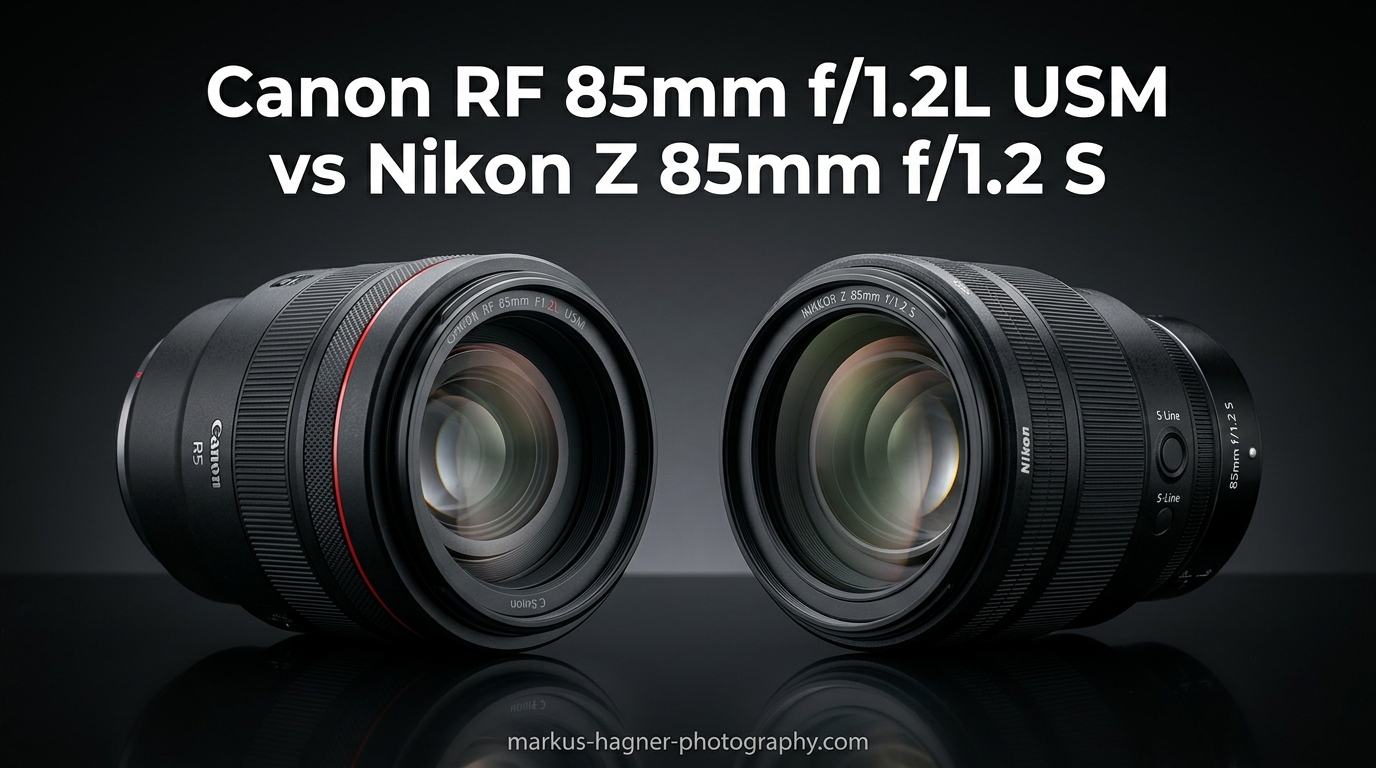
When it comes to professional portrait photography, the 85mm focal length has been the go-to choice for decades. But in 2026, the battle for portrait lens supremacy comes down to two heavyweights: the Canon RF 85mm f1.2L USM vs Nikon Z 85mm f1.2 S.
Both lenses represent the pinnacle of optical engineering from their respective manufacturers. Canon introduced their RF 85mm f1.2L USM back in 2019 as one of the first professional lenses for the new RF mount. Nikon followed in 2023 with the NIKKOR Z 85mm f/1.2 S, completing the mirrorless portrait lens lineup for Z mount shooters.
I’ve spent considerable time analyzing real-world feedback from photographers who have used both lenses extensively. What I found is that both deliver exceptional results, but they have distinct characteristics that might sway your decision one way or the other.
The quick verdict? If you already shoot Canon or Nikon mirrorless, stick with your system. Both lenses are genuinely world-class. But if you’re building a new kit or considering switching systems, read on to understand the subtle but important differences between these two portrait powerhouses.
Canon RF 85mm f1.2L USM vs Nikon Z 85mm f1.2 S: Quick Comparison
| Product | Specifications | Action |
|---|---|---|
 Canon RF 85mm F1.2 L USM Canon RF 85mm F1.2 L USM |
|
Check Latest Price |
 NIKKOR Z 85mm f/1.2 S NIKKOR Z 85mm f/1.2 S |
|
Check Latest Price |
Looking at the specs alone, these lenses are remarkably similar. Both offer the coveted f/1.2 maximum aperture, identical 82mm filter threads, and the same 0.85m minimum focus distance. But the devil is in the details, and those details matter for real-world shooting.
Canon RF 85mm F1.2 L USM Deep Dive
Pros
- Exceptional sharpness at f/1.2
- Fast autofocus vs EF predecessor
- Eliminates purple fringing
- Gorgeous bokeh
- Excellent low light performance
Cons
- No image stabilization
- Plastic build feel
- Heavy at 2.64 lbs
- Premium price point
The Canon RF 85mm f1.2L USM represents a massive leap forward from its EF predecessor. Photographers consistently praise this as “the best of the best at 85mm” with tack-sharp results even when shooting wide open at f/1.2.
What sets the Canon apart is its Blue Spectrum Refractive (BR) optics. This special glass element virtually eliminates chromatic aberration and purple fringing, which was a known issue with older 85mm f/1.2 designs. The result is cleaner images with better color accuracy, especially in high-contrast situations like backlit portraits.

The autofocus performance deserves special mention. Compared to the older EF 85mm f/1.2L II, which was notorious for slow focus speeds, the RF version focuses dramatically faster. Photographers report exceptional hit-rates when paired with Canon R5 or R6 bodies using eye-tracking autofocus. One user noted that “100% of images were tack sharp on the eyes” even at f/1.2.
At 2.64 pounds, this is a substantial piece of glass. The weight becomes noticeable during long portrait sessions or wedding coverage. However, the balance on Canon mirrorless bodies feels natural, and the control ring adds a tactile element that many photographers appreciate for quick aperture or exposure adjustments.
The optical formula includes one aspheric element and one UD (Ultra-Low Dispersion) element alongside the BR optics. This combination delivers sharpness from center to corner, even at maximum aperture. The 9-blade diaphragm creates smooth, circular bokeh highlights that portrait photographers love.
Real-world usage shows this lens excels in demanding situations. Wedding photographers praise its low-light capabilities, while portrait specialists appreciate the subject isolation at f/1.2. The minimum focus distance of 0.85m allows for tight headshots with beautiful background compression.
NIKKOR Z 85mm f/1.2 S Deep Dive
Pros
- Spectacular sharpness
- Beautiful bokeh with 11 blades
- Near-silent Eye-Detect AF
- Excellent low light performance
- Faster than 105mm f/1.4
Cons
- Plastic front filter ring
- Large and heavy
- Thin focus range at f/1.2
- Steep learning curve
The NIKKOR Z 85mm f/1.2 S arrived later to the party but brought some impressive credentials. Nikon’s S-Line designation represents their highest quality tier, and this lens delivers on that promise with “spectacular sharpness and wonderous image quality” according to real users.
One standout feature is the 11-blade diaphragm, compared to Canon’s 9 blades. This creates rounder bokeh highlights and smoother background transitions, especially as you stop down. For portrait photographers who care deeply about bokeh quality, this difference is meaningful.

The autofocus system uses a stepping motor rather than the ring ultrasonic motor found in the Canon. This provides near-silent operation and excellent accuracy with Eye-Detect AF on Nikon Z bodies. Users describe the focus speed as “ahead of the D but not the 1.4G” when comparing to legacy Nikon lenses.
At 2.56 pounds, the Nikon is slightly lighter than the Canon, though the difference is minimal in practice. The lens is notably longer than its Canon counterpart at 142mm versus 117mm, which affects handling and bag storage. Some photographers prefer the longer barrel for better balance on larger bodies like the Z 9.

The optical design includes specialized glass elements and Nikon’s Nano Crystal Coating for flare resistance. Reviewers note “excellent sun stars and little to no internal lens flare,” making this lens perform well in challenging backlit situations.
Linear focusing support for Z 9, Z 7II, and Z 6II bodies enables smooth manual focus adjustments for video work. The L-Fn button on the barrel can be customized for subject tracking or AF lock, adding versatility for different shooting scenarios.
Real-world feedback emphasizes the “paper-thin f/1.2 plane of focus,” which requires practice to master but delivers stunning results when nailed. Multiple photographers describe this as their “favorite lens” that “never comes off my camera.”
Canon RF 85mm f1.2L USM vs Nikon Z 85mm f1.2 S: Head-to-Head Comparison
Optical Quality and Sharpness
Both lenses deliver exceptional sharpness at f/1.2, but they achieve this through different optical formulas. The Canon uses Blue Spectrum Refractive optics to eliminate chromatic aberration, while Nikon relies on ED glass elements and Nano Crystal Coating.
In practice, photographers describe both as “tack sharp” wide open. The Canon has a slight edge in controlling purple fringing, which historically plagued fast aperture lenses. The Nikon matches this performance with excellent contrast and color rendering that Nikon is known for.
For bokeh quality, the Nikon’s 11-blade diaphragm creates slightly rounder highlights and smoother transitions. Canon’s 9-blade design still produces gorgeous background blur, but enthusiasts may prefer the Nikon’s more circular aperture shape.
Autofocus Performance
Canon’s ring ultrasonic motor provides fast, confident focusing with excellent tracking on R-series bodies. The RF 85mm f1.2L represents a dramatic improvement over the older EF version, which was notorious for slow focus speeds.
Nikon’s stepping motor is near-silent and highly accurate with Eye-Detect AF. Some users report it’s slightly slower than the Canon in very low light, but the difference is minimal for most portrait work.
Both lenses work exceptionally well with their respective camera systems’ eye-tracking autofocus. Real-world testing shows high hit rates at f/1.2 from both, provided you understand the extremely shallow depth of field.
Size and Weight
The physical dimensions reveal interesting design philosophies. Canon’s lens measures 117mm in length, while Nikon stretches to 142mm, a 25mm difference that’s immediately noticeable.
Weight is nearly identical: Canon at 2.64 pounds versus Nikon at 2.56 pounds. Neither lens is light, and both require some arm strength for extended handheld shooting.
The Nikon’s longer barrel may feel better balanced on larger bodies like the Z 9, while the Canon’s more compact design suits smaller bodies like the R6 or RP. Your choice of camera body should influence which handling characteristic you prefer.
Build Quality and Weather Sealing
Both lenses feature weather sealing as expected from premium professional glass. Canon’s L-series and Nikon’s S-Line designations guarantee robust construction designed for demanding professional use.
However, both lenses face criticism for plastic components at their premium price points. The Nikon specifically gets dinged for its plastic front filter ring, while Canon users note the overall build doesn’t feel as premium as the price suggests.
Neither lens includes image stabilization, which is worth noting for video shooters or those working in very low light. Both manufacturers expect you to rely on in-body stabilization from their camera bodies.
Low Light Performance
The f/1.2 aperture on both lenses makes them exceptional low-light performers. You can shoot in challenging conditions while maintaining reasonable ISO settings and fast shutter speeds.
Canon’s superior chromatic aberration control gives it a slight edge in mixed lighting situations. Nikon’s excellent contrast performance delivers clean results even in dim venues.
For wedding and event photographers, both lenses are capable of handling reception lighting and candlelit ceremonies. The wide aperture also enables faster autofocus in low light compared to slower lenses.
Portrait Photography Performance
This is where both lenses truly shine. The 85mm focal length provides flattering facial compression, while the f/1.2 aperture creates beautiful subject separation from backgrounds.
Canon’s rendering is often described as having a slight “pop” or three-dimensional quality. The BR optics contribute to clean, crisp images with excellent micro-contrast.
Nikon’s rendering is characterized by smooth transitions and creamy bokeh. The 11-blade aperture creates distinctive bokeh balls that many portrait photographers prefer.
For headshots and tight portraits, both lenses perform admirably. The 0.85m minimum focus distance allows for close work while maintaining the working distance that makes 85mm so flattering.
Frequently Asked Questions
What is the Canon RF 85mm best for?
The Canon RF 85mm f1.2L USM is best for professional portrait photography, wedding photography, and fashion work. Its fast f/1.2 aperture excels in low light conditions and creates beautiful background separation. The lens is also excellent for editorial photography and any situation where you need flattering facial compression and subject isolation.
Is the RF 85mm 1.2 good for portraits?
Yes, the Canon RF 85mm f1.2L USM is exceptional for portraits. The 85mm focal length provides flattering facial compression, while the f/1.2 aperture creates beautiful background blur and subject separation. Photographers consistently describe it as tack-sharp even wide open, making it one of the best portrait lenses available for Canon mirrorless cameras.
Is RF 85mm good for low light?
Absolutely. The Canon RF 85mm f1.2L USM is excellent for low light photography thanks to its bright f/1.2 maximum aperture. You can shoot in dimly lit venues while maintaining reasonable ISO settings and faster shutter speeds. Wedding photographers particularly appreciate its performance in reception lighting and indoor ceremonies.
Is the Canon 85mm 1.2 worth it?
For serious portrait photographers, the Canon RF 85mm f1.2L USM is worth the investment. It delivers exceptional image quality with sharp results even at f/1.2, fast autofocus, and beautiful bokeh. While expensive, many users describe it as worth every penny for professional work. If you’re an enthusiast on a budget, consider the f/1.8 or f/2 alternatives first.
Which 85mm f1.2 lens should I buy?
Buy the 85mm f1.2 lens that matches your camera system. If you shoot Canon RF mount, choose the Canon RF 85mm f1.2L USM. If you shoot Nikon Z mount, choose the NIKKOR Z 85mm f/1.2 S. Both are exceptional lenses with subtle differences. Switching systems just for one lens rarely makes financial sense given both deliver professional-quality results.
Verdict: Which 85mm f1.2 Lens Should You Buy?
The Canon RF 85mm f1.2L USM vs Nikon Z 85mm f1.2 S comparison reveals two exceptional lenses that represent the best of what each manufacturer can achieve. There is no wrong choice here, but there may be a better choice for your specific situation.
Who Should Buy the Canon RF 85mm f1.2L USM
Choose the Canon if you already shoot Canon RF mount and want the best portrait lens available for your system. The slightly faster autofocus, superior chromatic aberration control, and more compact design make it an excellent choice for working professionals.
Canon shooters who upgraded from the EF 85mm f/1.2L II will be amazed by the focus speed improvement. The BR optics eliminate the purple fringing that plagued the older design.
Who Should Buy the Nikon Z 85mm f1.2 S
Choose the Nikon if you shoot Z mount and want maximum bokeh quality. The 11-blade diaphragm creates smoother, rounder background blur that bokeh enthusiasts will appreciate.
Nikon shooters who prioritize silent operation for video or discreet shooting will prefer the stepping motor. The linear focus support on newer Z bodies also makes this lens more video-friendly.
Final Recommendation
For most photographers, the decision comes down to which camera system you already own or plan to invest in. Both lenses are genuinely world-class and will serve you well for portrait, wedding, and fashion photography.
If you’re starting fresh with no system commitment, consider the total ecosystem. Canon’s RF mount has more lens options available currently, while Nikon’s Z mount is rapidly expanding with exceptional optics.
The Canon RF 85mm f1.2L USM vs Nikon Z 85mm f1.2 S battle ends in a virtual tie. Pick the lens that matches your camera system, and you’ll have one of the finest portrait lenses ever made.