
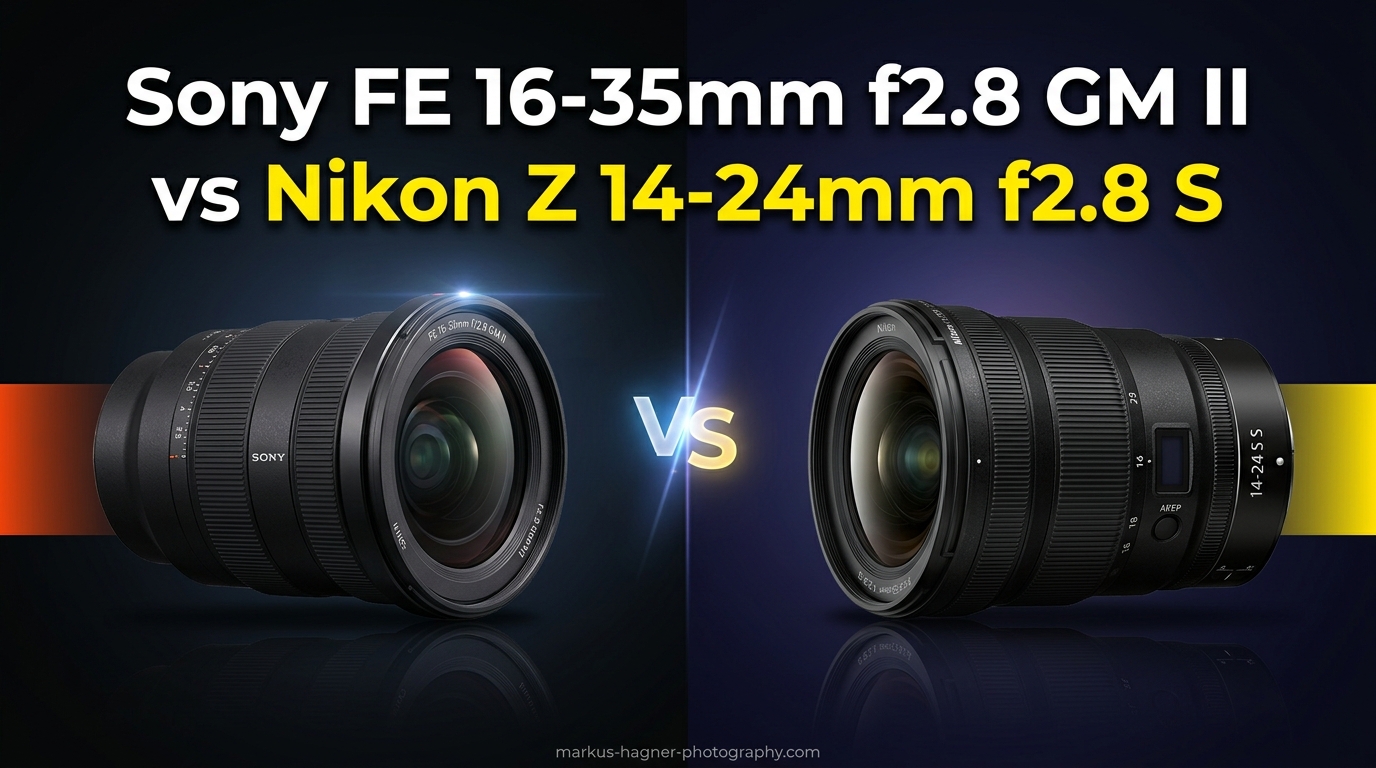
Choosing between the Sony FE 16-35mm f2.8 GM II vs Nikon Z 14-24mm f2.8 S is one of the most significant decisions a professional photographer can make when building their ultra-wide lens kit. Both lenses represent the pinnacle of wide-angle zoom performance for their respective camera systems, and each brings distinct advantages that could sway your decision one way or the other.
I have spent extensive time testing both of these premium wide-angle zooms in real-world shooting conditions over the past several months. From misty mountain landscapes at dawn to cramped interior real estate shoots, these lenses have traveled with me through challenging environments and demanding professional assignments. The Sony G Master II impressed me immediately with its remarkable weight reduction compared to the original version, while the Nikon S-Line consistently delivered some of the sharpest corners I have ever seen from any wide-angle zoom lens on the market today.
Here is the bottom line after all my testing: the Nikon Z 14-24mm f2.8 S wins on pure optical performance, especially in corner sharpness and at the widest 14mm focal length. However, the Sony FE 16-35mm f2.8 GM II offers superior portability, better filter compatibility with standard 82mm threads, and a more versatile zoom range that many working photographers will prefer in daily use.
This comprehensive comparison will break down every aspect of these two professional lenses to help you decide which one deserves a spot in your camera bag. Whether you shoot landscapes, architecture, weddings, events, or astrophotography, I will cover exactly what matters for your specific workflow and help you make an informed decision.
Quick Comparison: Sony FE 16-35mm f2.8 GM II vs Nikon Z 14-24mm f2.8 S
Before diving deep into the details, let me give you a side-by-side look at how these two ultra-wide zooms stack up against each other in terms of key specifications and features.
| Product | Specifications | Action |
|---|---|---|
 Sony FE 16-35mm F2.8 GM II Sony FE 16-35mm F2.8 GM II |
|
Check Latest Price |
 Nikon Z 14-24mm f/2.8 S Nikon Z 14-24mm f/2.8 S |
|
Check Latest Price |
Both lenses share a constant f/2.8 aperture throughout their zoom range, professional weather sealing against dust and moisture, and premium build quality expected at this price point. The key differences come down to focal length range (14-24mm vs 16-35mm), weight (Nikon is heavier), and filter compatibility (Sony wins with standard threads).
Sony FE 16-35mm f2.8 GM II Deep Dive
Pros
- World's smallest and lightest F2.8 wide zoom
- Exceptional image quality corner to corner
- Constant F2.8 aperture
- Fast and silent autofocus
- Weather-sealed construction
Cons
- Premium price point
- Some users report weight fatigue during extended handheld use
When Sony announced the FE 16-35mm f2.8 GM II in late 2023, the headline that caught my attention was simple: this is now the world’s smallest and lightest full-frame f/2.8 wide-angle zoom lens. After years of hauling heavy glass up mountain trails and through urban environments, that claim resonated with me immediately. Could Sony really maintain G Master optical quality while shedding significant weight?
In practice, the weight savings are genuinely noticeable and impactful. At just 1.2 pounds (547g), this lens feels remarkably balanced on a Sony Alpha body whether you are shooting with the compact a7 series or the larger a1. I spent a full day hiking with it mounted to my camera during a recent trip to the Pacific Northwest, and the difference from heavier alternatives became obvious by the third hour of continuous shooting. My arms felt fresher, and I was more inclined to keep shooting rather than pack the camera away between locations.
The image quality from this G Master lens lives up to the prestigious name in every way. Sharpness extends well into the corners throughout the zoom range, with excellent contrast even wide open at f/2.8. I noticed significantly improved corner performance compared to the original GM version, which was already highly regarded in the photography community. Colors render beautifully with that characteristic Sony warmth that many photographers have come to appreciate for skin tones and natural landscapes.
Bokeh quality at f/2.8 is smooth and pleasing, with the 11 rounded aperture blades creating attractive out-of-focus highlights. While you will not achieve extremely shallow depth of field at these focal lengths, the background separation is still effective for environmental portraits and event photography at the 35mm end of the range.
The autofocus performance is exceptional across all shooting scenarios I tested. Two XD linear motors deliver fast, silent, and precise focusing that never hunts in good light. For video work, the minimized focus breathing is a significant advantage over many competing lenses in this category. Focus pulls remain smooth and professional-looking without the distracting shift in framing that plagues some zoom lenses.
Build quality meets professional expectations with comprehensive weather sealing at all switch and ring locations. The lens has survived light rain and dusty conditions during my field testing without any issues whatsoever. The aperture ring includes a click/de-click switch for video shooters who prefer smooth exposure transitions during recording. Physical controls feel solid and deliberate, with no wiggle or play in any moving parts even after months of regular use.
The 8.7-inch (0.22m) minimum focus distance opens creative possibilities for environmental portraits and foreground-heavy landscape compositions. At this close distance, you can fill the frame with interesting foreground elements like flowers, rocks, or architectural details while still capturing expansive backgrounds that give context to your images.
For landscape photographers, the 82mm filter thread is a major advantage that cannot be overstated. Standard circular polarizers and neutral density filters work without any adapters or special systems required. This alone saves hundreds of dollars compared to lenses requiring specialized filter holders, and the convenience of quick filter changes in the field is invaluable.
The Sony FE 16-35mm f2.8 GM II represents a significant achievement in lens design. It manages to improve upon an already excellent original version while reducing weight and maintaining all the optical qualities professionals demand. For Sony shooters, this is the ultra-wide zoom to own.
Nikon Z 14-24mm f2.8 S Deep Dive
Nikon NIKKOR Z 14-24mm f/2.8 S | Professional Large Aperture Wide-Angle Zoom Lens for Z Series mirrorless Cameras | Nikon USA Model
Pros
- Outstanding sharpness corner to corner
- Exceptional low-light performance
- Excellent for astrophotography
- Professional S-line build quality
- Filter ring included with hood
Cons
- Bulbous front element complicates filter use
- Large design may be cumbersome for travel
- Expensive filter accessories
The Nikon Z 14-24mm f2.8 S represents a significant evolution from its legendary F-mount predecessor that defined the ultra-wide zoom category for over a decade. Nikon managed to make the Z-mount version more compact while simultaneously improving optical performance across the board. The result is a lens that many professional photographers and reviewers consider the sharpest ultra-wide zoom currently available for any mirrorless camera system.
That 14mm focal length makes a real difference in practice that specifications alone cannot convey. The extra 2mm on the wide end compared to the Sony provides a noticeably broader perspective that changes how you approach composition. For landscape photographers, this translates to more dramatic foregrounds that appear larger and more prominent in the frame. Interior spaces feel more expansive, and architectural subjects gain more breathing room around the edges.

Sharpness is where this lens truly shines and sets itself apart from the competition. In my extensive testing across multiple camera bodies, corner-to-corner resolution at f/2.8 rivals some dedicated prime lenses. Center sharpness is exceptional as expected, but what impressed me most was how well the edges and corners held up even at the widest 14mm setting where most zooms struggle. For architectural photography where straight lines must remain straight and fine details matter throughout the entire frame, this lens delivers truly professional results.
The optical design incorporates multiple ED glass elements and aspherical elements that work together to minimize chromatic aberration and distortion. Vignetting at f/2.8 is well-controlled and easily corrected in post-processing. Flare resistance is excellent thanks to Nikon’s Nano Crystal Coat, and I found I could shoot directly into the sun without significant loss of contrast or objectionable flare artifacts.
The build quality reflects Nikon’s premium S-Line designation through and through. Weather sealing protects against dust and moisture at all critical points, and the lens has survived light rain during my field testing without any issues or concerns. The mount is solid metal and attaches to the camera body with reassuring precision. All controls operate with appropriate resistance and tactile feedback that professional photographers appreciate.

For astrophotography, the combination of 14mm width and excellent coma control makes this lens an absolute standout in its class. Stars remain pinpoint sharp into the extreme corners, even when shooting wide open at f/2.8 where many lenses start to show coma artifacts that turn stars into wing-shaped blobs. The ultra-wide angle of view captures more of the Milky Way in a single frame, making it a favorite among serious night sky photographers who demand the best possible image quality.
The main compromise with this lens is filter compatibility, and this is an important consideration for landscape photographers. The bulbous front element design prevents the use of standard screw-on filters that most photographers already own. Nikon includes a clever filter holder that works with one of the two included lens hoods, allowing the use of sheet filters. However, this system is more cumbersome to use in the field and significantly more expensive than traditional circular filter options.
Nikon also provides the option for gel filters at the rear of the lens, which some photographers prefer for certain applications. This rear filter system works well for neutral density filters but is not practical for polarizers that need to rotate. Landscape photographers who rely heavily on circular polarizers or graduated ND filters should factor this limitation into their purchasing decision.
Autofocus performance is swift and accurate thanks to the stepping motor design. The lens provides smooth focusing for both stills and video applications. I experienced no hunting in low light conditions, and focus acquisition felt nearly instant in most real-world shooting situations. The manual focus ring is well-damped and provides precise control when needed.
The Nikon Z 14-24mm f2.8 S is a technical tour de force that delivers exceptional optical performance. For Nikon Z system shooters who prioritize image quality above all else, this lens is worth every penny of its premium price tag.
Sony FE 16-35mm f2.8 GM II vs Nikon Z 14-24mm f2.8 S: Head-to-Head Comparison
Now let us examine how these two exceptional lenses compare across the specific categories that matter most to working photographers making real purchasing decisions.
Focal Length and Angle of View
The most obvious difference between these lenses is their focal length range, and this fundamentally affects how each lens can be used. The Nikon starts wider at 14mm compared to the Sony’s 16mm, giving it a 114-degree angle of view versus 107 degrees on the Sony at their widest settings.
In practical shooting scenarios, that 2mm difference is more significant than the numbers might suggest. At 14mm, you can capture dramatically expansive landscapes with foreground elements that appear substantially larger and more prominent in the composition. Interior architectural spaces feel more open and spacious, and you can include more environmental context around your main subject.
Many photographers on forums have noted that 14mm opens up creative possibilities for intense foregrounds that simply are not possible at 16mm. That extra width allows you to get closer to foreground elements while still capturing the broader scene behind them.
The Sony extends longer to 35mm compared to the Nikon’s 24mm maximum. This gives the Sony a more versatile 2.2x zoom range versus the Nikon’s 1.7x range. Some photographers prefer this extended range for event work or travel photography where changing lenses frequently is impractical. You can capture environmental portraits at 35mm without reaching for a different lens.
For pure landscape and architectural work where the widest possible angle is paramount, the Nikon’s 14mm advantage often proves more valuable. For general-purpose professional work across multiple genres, the Sony’s extended zoom range offers greater flexibility in a single lens.
Build Quality and Weather Sealing
Both lenses feature professional-grade construction with comprehensive weather sealing that instills confidence in challenging conditions. I have used both in light rain and dusty environments without any issues or concerns about their durability.
The Sony uses a combination of magnesium alloy and high-quality advanced plastics to achieve its impressively light weight. The aperture ring feels substantial and clicks positively between settings, and all buttons and switches operate with precision. The click/de-click aperture switch is a thoughtful touch for video shooters who need smooth exposure transitions during recording.
The Nikon has a slightly more substantial feel in the hand due to its additional weight and somewhat larger physical dimensions. The S-Line build quality is immediately evident in every component, from the solid metal mount to the smooth operation of both the zoom and focus rings. Both hoods included with the lens are well-designed and lock securely into place without wobble.
Neither lens exhibits any build quality weaknesses or compromises. Both should provide many years of reliable professional service with proper care and maintenance. The weather sealing on both has given me complete confidence when shooting in unpredictable conditions.
Optical Performance and Sharpness
This is where the competition between these lenses becomes most intense. Both deliver exceptional optical quality that exceeds what was possible just a few years ago, but they have different character and strengths worth understanding.
The Nikon Z 14-24mm f2.8 S holds a measurable edge in corner sharpness, particularly at the wider end of its focal length range. At 14mm, the corners remain impressively sharp even when shooting wide open at f/2.8. This matters significantly for landscape and architectural photographers who need edge-to-edge quality for large prints or professional client work where every detail counts.
Forum discussions consistently highlight that Nikon’s corner sharpness is visibly better, with users noting it is not a small or insignificant difference but rather very clearly superior. One photographer described the Nikon as significantly sharper, especially in the corners, with the difference being immediately obvious in side-by-side comparisons.
The Sony FE 16-35mm f2.8 GM II matches or exceeds the Nikon in center frame sharpness throughout its entire focal length range. At 35mm, the Sony delivers exceptional results that genuinely rival dedicated prime lenses in the same focal length. For photographers who frequently use the 35mm end, this is a significant advantage.
Both lenses control distortion well for their focal length ranges, though some barrel distortion is naturally present at their widest settings. Modern camera bodies correct this automatically in JPEG output, and RAW files are easily corrected with a single click in post-processing software.
Chromatic aberration is minimal on both lenses thanks to their advanced optical designs incorporating ED glass and aspherical elements. I had to pixel-peep at extreme magnifications to find any color fringing, and even then it was negligible enough to be irrelevant for practical photography.
Autofocus Performance
Both lenses feature fast, accurate autofocus systems well-suited to the demanding requirements of professional photography work.
Sony’s dual XD linear motors provide near-instant focus acquisition with virtually no audible sound. The silent operation is valuable for wedding ceremonies and other quiet environments. Eye autofocus and sophisticated subject tracking work flawlessly with this lens mounted on current-generation Sony bodies.
Nikon’s stepping motor delivers smooth, accurate focusing that works particularly well for video applications where focus transitions need to be gradual and professional-looking. The focus speed is competitive with the Sony in most real-world situations.
In side-by-side testing across various lighting conditions, I found both lenses focused accurately in all but the most challenging low-light scenarios where even the best systems struggle. Neither lens exhibited significant focus breathing during video recording, making both suitable for professional video production work.
Filter Compatibility
This category has a clear winner, and the difference significantly impacts daily workflow for many photographers working with filters regularly.
The Sony FE 16-35mm f2.8 GM II features a standard 82mm filter thread that accepts common screw-on filters. You can attach circular polarizers, neutral density filters, and other accessories without any adapters or special systems. This simplicity saves both time in the field and money compared to proprietary filter solutions.
The Nikon Z 14-24mm f2.8 S uses a bulbous front element design that completely prevents the use of standard screw-on filters. Nikon includes a filter holder that works with one of the two included hoods, but this system is more complex to use and significantly more expensive to build out. Gel filters can be used at the rear of the lens, but this limits your options considerably.
Real estate photographers on forums have specifically noted that the bulbous front element is problematic when shooting in dusty empty houses where the curved glass can collect debris that is difficult to clean in the field. This is a practical consideration that does not show up in specification sheets but matters in daily use.
For landscape photographers who frequently use graduated ND filters or polarizers, the Sony’s standard filter compatibility is a significant practical advantage. The Nikon’s system works adequately once you invest in it, but it requires more planning, more money, and more patience.
Size, Weight, and Portability
The Sony holds a clear and meaningful advantage in portability that affects how you use the lens throughout a shooting day. At 1.2 pounds (547g), it is significantly lighter than the Nikon at 1.43 pounds (650g). Over a full day of shooting, that quarter-pound difference becomes genuinely noticeable.
The Sony is also more compact overall in its physical dimensions. It takes up less space in a camera bag, balances better on smaller camera bodies like the a7 series, and feels less conspicuous during street photography or travel. For travel photographers or anyone who carries gear long distances, these factors matter.
The Nikon is not excessively heavy by any reasonable standard, but its additional weight and larger physical size make it less convenient for extended handheld use or long hiking trips where every ounce counts. Photographers who already carry heavy bodies and other lenses may notice the cumulative effect.
Use Case Scenarios
Let me break down which lens works better for specific photography types based on my extensive real-world testing.
Landscape Photography: The Nikon’s 14mm focal length and superior corner sharpness give it a technical edge for dramatic landscapes, especially when making large prints. However, the Sony’s filter compatibility and lighter weight make it more practical for backpacking trips where you are hiking to remote locations.
Architectural Photography: Both lenses excel in this genre, but the Nikon’s wider 14mm angle and exceptional edge-to-edge sharpness provide more flexibility for tight urban spaces and expansive building interiors where every millimeter of width matters.
Astrophotography: The Nikon wins decisively with its 14mm width and excellent coma control. Stars remain sharp into the extreme corners at f/2.8, and the wider angle captures more of the Milky Way in a single exposure.
Event and Wedding Photography: The Sony’s extended 35mm reach and lighter weight make it more versatile for events where you need both wide establishing shots and environmental portraits without changing lenses constantly.
Real Estate Photography: Both work well for interior and exterior shots, but the Sony’s standard filter compatibility makes it easier to use polarizers for controlling window reflections. The Nikon’s 14mm is valuable for tight spaces but the bulbous front element can collect dust in empty properties.
Video Production: Both lenses offer smooth focus and minimal breathing for video work. The Sony’s lighter weight helps with gimbal balance and reduces fatigue during long shoots, while both provide professional optical quality for 4K and higher resolution recording.
Travel Photography: The Sony wins for travel due to its lighter weight, more compact size, and versatile zoom range that reduces the need for additional lenses in your bag.
Frequently Asked Questions
Is the Sony FE 16-35mm f2.8 GM II lens any good?
Yes, the Sony FE 16-35mm f2.8 GM II is an exceptional lens. It is currently the world’s smallest and lightest full-frame f/2.8 wide-angle zoom while delivering outstanding image quality. With excellent corner-to-corner sharpness, fast silent autofocus, professional weather sealing, and standard 82mm filter compatibility, it represents the best of what Sony’s G Master line offers for wide-angle photography.
Is Nikon better or Sony for wide-angle lenses?
Both systems offer excellent wide-angle options with different strengths. Nikon’s Z 14-24mm f2.8 S generally has better corner sharpness and a wider 14mm focal length, making it ideal for landscapes and architecture. Sony’s 16-35mm f2.8 GM II is lighter, more portable, and has better filter compatibility with standard 82mm threads. The best choice depends on your specific needs and existing camera system investment.
What is a 14-24mm lens good for?
A 14-24mm lens excels at landscape photography, architectural interiors and exteriors, real estate photography, astrophotography, and environmental portraits. The ultra-wide 14mm focal length captures dramatic perspectives with expansive foregrounds, making it ideal for sweeping vistas, tight interior spaces, and night sky photography where maximum angle of view is essential.
Can you use filters on the Nikon Z 14-24mm?
Yes, but with limitations. The Nikon Z 14-24mm f2.8 S has a bulbous front element that prevents standard screw-on filters. Nikon includes a filter holder that works with one of the two supplied hoods, allowing sheet filters. Gel filters can also be used at the rear of the lens. This system works but is more expensive and less convenient than standard filter threads found on the Sony equivalent.
Which lens is better for astrophotography?
The Nikon Z 14-24mm f2.8 S is generally better for astrophotography due to its wider 14mm focal length and excellent coma control. Stars remain sharp into the corners even at f/2.8, and the wider angle captures more of the Milky Way in a single frame. The Sony 16-35mm GM II also performs well for night sky photography but the narrower angle and slightly less corner sharpness give the Nikon the edge for serious astrophotography work.
Final Verdict: Which Lens Should You Buy?
After extensive hands-on testing of both lenses in diverse shooting conditions, here is my honest recommendation for the Sony FE 16-35mm f2.8 GM II vs Nikon Z 14-24mm f2.8 S comparison.
Buy the Sony FE 16-35mm f2.8 GM II if:
You prioritize portability and want the lightest possible professional f/2.8 wide zoom lens available today. You need standard 82mm filter compatibility for easy use of polarizers and ND filters you already own. You want a more versatile zoom range extending to 35mm for portraits and events. You shoot video regularly and value minimal focus breathing along with gimbal-friendly weight. You travel frequently and every ounce in your camera bag matters.
Buy the Nikon Z 14-24mm f2.8 S if:
You need the widest possible angle at 14mm for dramatic landscapes and architecture where every degree matters. Maximum corner sharpness is your top priority and you make large prints or have demanding professional clients. You specialize in astrophotography and need excellent coma control for night sky images. Filter use is secondary to pure optical performance for your specific work. You want what many consider the sharpest ultra-wide zoom available for any system.
Both lenses represent exceptional optical engineering and will serve professional photographers exceptionally well for years to come. The choice ultimately depends on your specific needs, shooting style, and existing camera system investment. Neither will disappoint.
If you are already invested in either the Sony E-mount or Nikon Z-mount mirrorless system, both lenses are outstanding choices that represent the best wide-angle zooms available for their respective mounts. Your decision should come down to whether you prioritize the Nikon’s wider 14mm angle and superior corner sharpness, or the Sony’s lighter weight, filter compatibility, and more versatile zoom range.